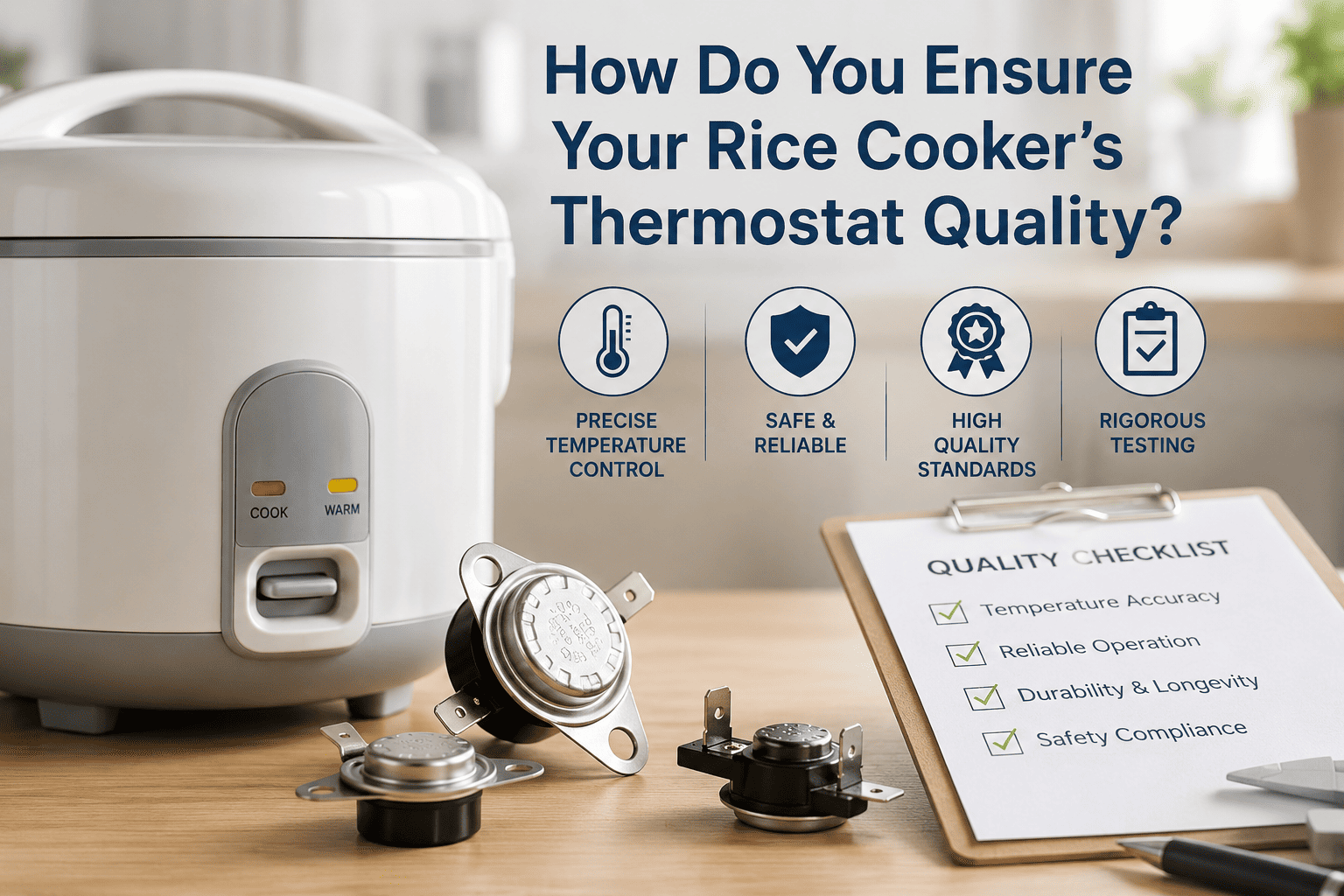
Worried about inconsistent cooking results or safety issues from your supplier? A tiny, overlooked part—the thermostat—could be the cause, leading to costly returns and brand damage.
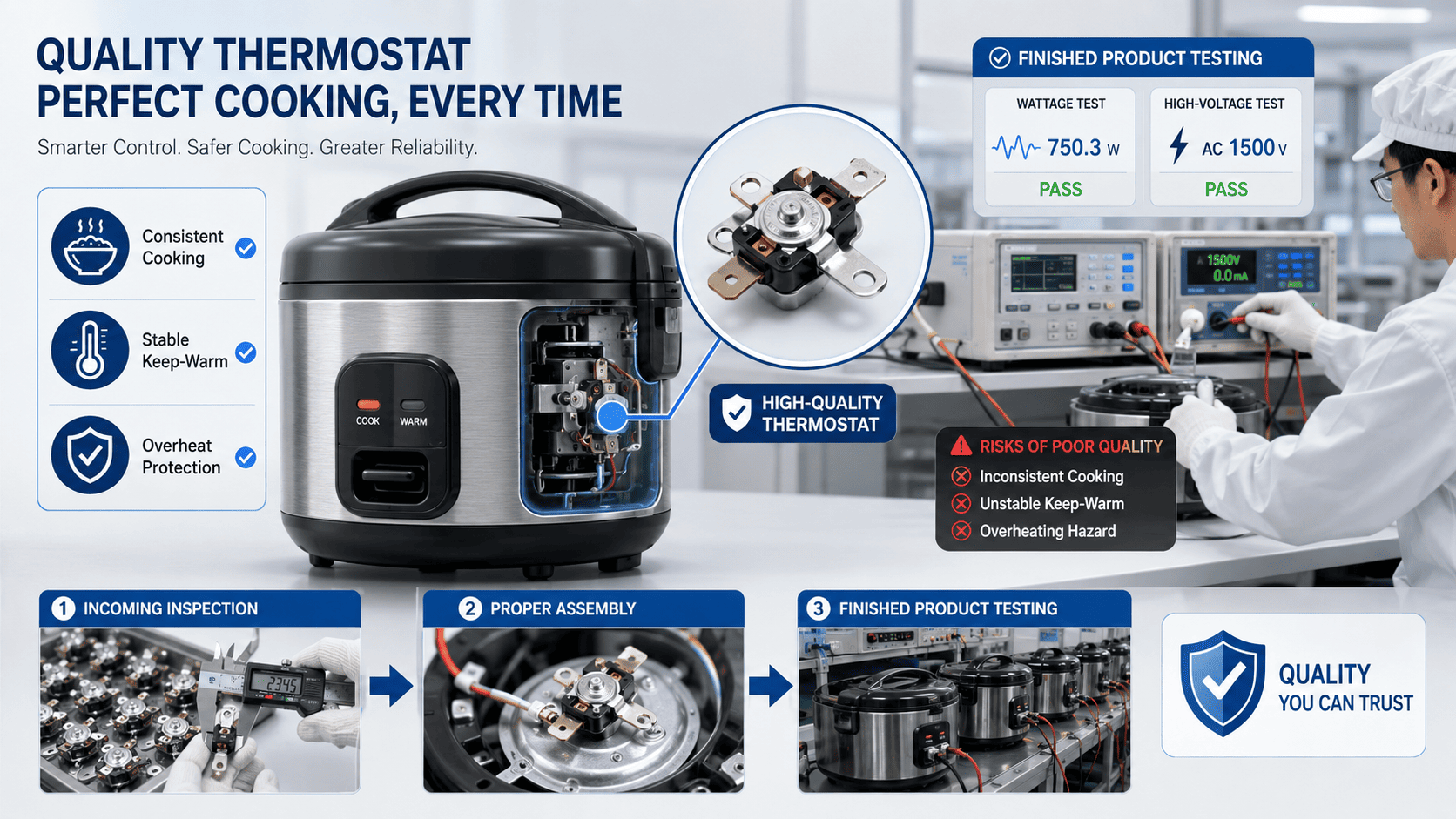
A quality thermostat ensures consistent cooking, stable keep-warm temperatures, and crucial overheat protection. Quality control isn't just about the component itself but its integration, verified through incoming inspections, proper assembly, and finished product testing like wattage and high-voltage checks.
When you source rice cookers, it's easy to focus on big-ticket items like the inner pot or the outer design. The thermostat often seems like a minor, low-cost component. But in my years of experience manufacturing rice cookers, I've seen how this small part can create major problems if it's not managed correctly. Its performance is directly tied to the rice cooker’s power, heating plate, and overall design. Let's break down what you, as a buyer, really need to look for to avoid future headaches.
What Does a Rice Cooker Thermostat Actually Do?
Have you ever received complaints about undercooked rice or a keep-warm function that burns the bottom layer? These inconsistencies can damage your brand's reputation and increase customer returns.
A rice cooker thermostat has three key functions. It controls the heating cycle to cook rice perfectly, maintains a stable temperature for the keep-warm feature, and acts as a safety switch to prevent overheating.1 It's the brain behind the cooking and safety process.
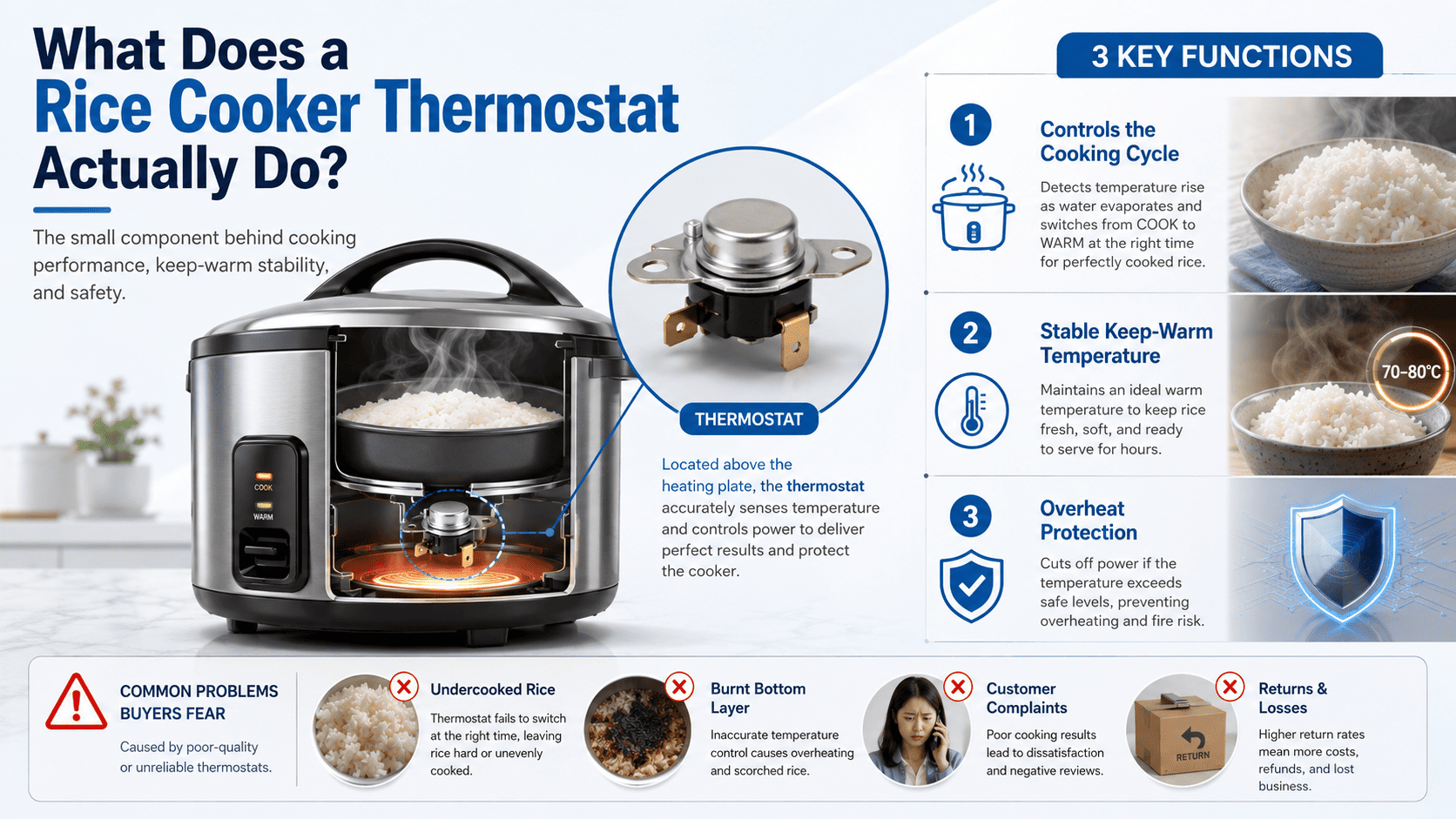
From the factory floor, I can tell you that a well-functioning thermostat is essential for a reliable product. It’s not just one part; it’s a system controller with three distinct jobs. Understanding these jobs helps you ask suppliers the right questions.
Cooking Control
This is the thermostat's primary role. It senses the temperature at the bottom of the inner pot. When all the water is absorbed by the rice, the temperature rapidly rises above 100°C (212°F).2 The thermostat detects this spike and reduces or cuts power to the main heating element, automatically switching the appliance from "cook" to "keep warm." If this is not calibrated correctly, you get mushy or undercooked rice.
Keep-Warm Stability
After the cooking cycle ends, the thermostat's job isn't over. It needs to maintain a food-safe temperature, usually between 60-80°C (140-176°F).3 It does this by cycling the heater on and off. A poor-quality thermostat or one that's poorly matched to the cooker might keep the temperature too high, burning the rice, or too low, creating a food safety risk4 and drying the rice out.
Overheat Protection
This is a critical safety function. If the rice cooker malfunctions and continues to heat uncontrollably—for example, if it's turned on without the inner pot—the thermostat acts as a fail-safe. It's designed to permanently cut the circuit if temperatures reach a dangerous level, preventing potential fire hazards5.
Here is a simple breakdown:
| Function | What it Does | Impact on User Experience |
|---|---|---|
| Cooking Control | Switches power from 'cook' to 'warm' when water is absorbed. | Ensures perfectly cooked rice, not mushy or hard. |
| Keep-Warm Stability | Cycles power to maintain a safe, warm temperature. | Keeps rice ready to eat without burning or drying out. |
| Overheat Protection | Cuts power completely if temperatures exceed safe limits. | Prevents fire hazards and damage to the appliance. |
Why Is Matching the Thermostat to the Rice Cooker Design So Critical?
Do you focus only on a thermostat's brand or certification when sourcing? A "good" thermostat in the wrong rice cooker can still perform poorly, causing inconsistent performance across production batches.
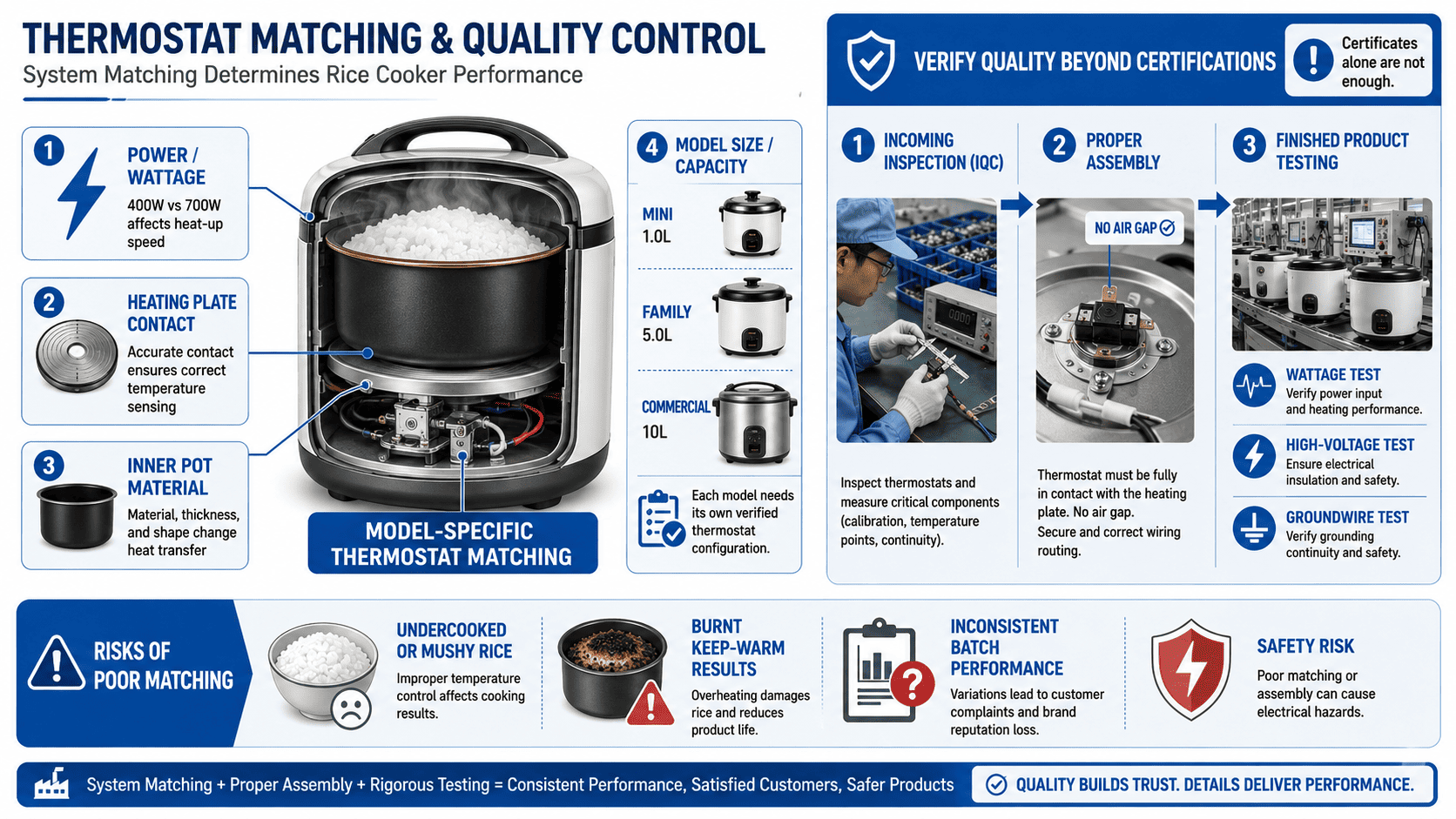
A thermostat's effectiveness depends on its harmony with other parts. The rice cooker's power (wattage), heating plate size, and inner pot material all influence temperature dynamics.6 A mismatch can lead to poor cooking or safety risks, even if the thermostat itself is high quality.7

I often see buyers ask, "What brand of thermostat do you use?" It's a valid question, but a better one is, "How do you ensure the thermostat is perfectly matched to this specific model?" A high-end thermostat is useless if it's not calibrated for the system it's in. In our factory, we spend a lot of time testing these combinations because we know that true performance comes from synergy, not just individual component quality. The relationships between components are what make or break the final product.
Matching with Power and Heating Plate
The power rating (wattage) of a rice cooker dictates how quickly it generates heat. A 700W cooker heats up much faster than a 400W model. The thermostat must be calibrated to react to the temperature rise specific to that wattage. Furthermore, the physical contact between the thermostat and the heating plate is essential. If there's an air gap due to poor assembly, the thermostat won't sense the temperature accurately8, leading to a delayed switch-off and burnt rice.
Considering the Inner Pot
Different inner pots have different thermal properties.9 A thin, single-layer aluminum pot transfers heat very differently than a thicker, multi-ply pot with a non-stick coating. The thermostat's trigger temperature must account for the pot's material, thickness, and even its shape. A supplier can't just swap a standard pot for a "premium" one without re-evaluating and possibly changing the thermostat settings.
Impact on Model Design
The overall size and volume of the rice cooker also matter. A 1.0L mini rice cooker has a much smaller thermal mass than a 5.0L family-sized model or a 10L commercial cooker.10 Heat builds up and dissipates differently. Using the same thermostat across different models without adjustment is a common cost-cutting measure by low-quality suppliers, and it always leads to inconsistent performance. Each model design requires its own specific, tested and verified thermostat configuration.
How Can You Verify Thermostat Quality Control Beyond Certifications?
A supplier shows you a thermostat's CE or CB certificate. Is that enough to guarantee quality? Certificates prove a component can meet standards, not that every single one in your order does.
Verify quality by examining the factory's processes. Ask for records of incoming material inspection (IQC) for thermostats. Check that assembly procedures ensure proper installation. Most importantly, review the finished product testing reports, which include high-voltage, wattage, and groundwire tests for every unit.
Certifications are a good starting point, but they are not the end of the story. I've seen cases where a supplier uses certified components in the samples but then swaps them for cheaper, uncertified alternatives in mass production to save costs. This is a huge risk for your brand. The only way to protect yourself is to look at the supplier's day-to-day quality control system. At our facility, we have a multi-stage process specifically to prevent these issues.
Incoming Material Inspection (IQC)
This is the first line of defense. When a batch of thermostats arrives from our sub-supplier, our IQC team gets to work. They don't just assume the parts are correct. They check that the supplier, model number, and technical markings on the thermostat match our "golden sample" and engineering specifications. We also perform a visual inspection for any physical damage or defects. This simple step prevents unapproved components from ever entering our production line.
In-Process Quality Control (IPQC)
A perfect thermostat is useless if installed incorrectly. During assembly, our line workers are trained to ensure the thermostat sits flush against the heating plate for accurate temperature sensing. Our IPQC staff then patrols the production line, randomly pulling units to double-check the installation. This continuous monitoring ensures that the correct procedure is followed for every single unit, not just the first one of the day.
Finished Product Testing (FQC)
Before any rice cooker is packed, it undergoes a 100% functional and safety test.11 This final check is where we can confirm the entire system, including the thermostat, is working correctly. These tests include:
- Wattage Test: We confirm the unit draws the specified power. An incorrect wattage could indicate a problem with the heating element or thermostat system.
- High-Voltage Test: This checks the electrical insulation to prevent shocks.
- Groundwire Test: This ensures the product is properly grounded for safety.
These final tests give us confidence that every rice cooker we ship is safe and will perform as designed.
Conclusion
The thermostat is a vital part of any rice cooker. To ensure quality, look beyond component specs and focus on the supplier's integration, assembly, and rigorous end-to-end testing processes.
"How exactly does a standard rice cooker automatically switch off of ...", https://www.reddit.com/r/NoStupidQuestions/comments/1n2vr26/how_exactly_does_a_standard_rice_cooker/. A technical reference on electric rice cookers and thermal switches supports that temperature-sensing controls can terminate the cooking cycle, maintain warming operation, and provide over-temperature interruption; however, the exact implementation varies by rice cooker design. Evidence role: mechanism; source type: encyclopedia. Supports: A neutral technical source should explain that rice cookers use temperature sensing or thermal switching to end cooking, maintain warmth, and provide overheating protection.. Scope note: Contextual support; it may not prove that every rice cooker thermostat combines all three functions in one component. ↩
"High Altitude Cooking | Food Safety and Inspection Service - USDA", http://www.fsis.usda.gov/food-safety/safe-food-handling-and-preparation/food-safety-basics/high-altitude-cooking. Educational explanations of rice cooker operation describe that liquid water holds the cooking vessel near water's boiling point and that, after water is absorbed or evaporated, the vessel temperature can rise above 100°C, triggering a thermal switch. Evidence role: mechanism; source type: education. Supports: An educational or technical source should support that water limits the pot temperature near its boiling point until it is absorbed or evaporated, after which temperature increases.. ↩
"How Temperatures Affect Food | Food Safety and Inspection Service", http://www.fsis.usda.gov/food-safety/safe-food-handling-and-preparation/food-safety-basics/how-temperatures-affect-food. Government food-safety guidance generally requires hot foods to be held at or above about 57-60°C to reduce pathogen growth, which is consistent with the lower end of the stated 60-80°C keep-warm range; the source does not establish that all rice cookers are designed to operate throughout that full range. Evidence role: expert_consensus; source type: government. Supports: A government food safety source should support minimum hot-holding temperatures for cooked foods, while appliance documentation or technical sources may support the 60-80°C rice cooker keep-warm range.. Scope note: Directly supports the food-safety threshold, but only contextual support for the full appliance-specific 60-80°C range. ↩
"Risk of Bacillus cereus in Relation to Rice and Derivatives - PMC - NIH", https://pmc.ncbi.nlm.nih.gov/articles/PMC7913059/. Public-health guidance on cooked rice notes that Bacillus cereus spores can survive cooking and that improper holding or storage temperatures increase food-poisoning risk, supporting the concern that inadequate keep-warm temperature can be unsafe. Evidence role: mechanism; source type: government. Supports: A public health source should explain that cooked rice can support Bacillus cereus growth or toxin production if held at unsafe temperatures.. ↩
"Thermal cutoff - Wikipedia", https://en.wikipedia.org/wiki/Thermal_cutoff. Electrical appliance safety references describe thermal cutoffs and over-temperature protective devices as circuit-interrupting safeguards intended to limit overheating and associated fire risk; this supports the safety rationale but not the performance of a specific rice cooker model. Evidence role: mechanism; source type: institution. Supports: A standards body or technical source should support that thermal cutoffs or over-temperature protective devices are used to interrupt circuits and mitigate overheating hazards.. Scope note: Contextual support; it does not verify that any particular product's protection device meets a given safety standard. ↩
"Influence of heating temperature and time on mechanical ... - PMC", https://pmc.ncbi.nlm.nih.gov/articles/PMC11324993/. Heat-transfer principles show that power input, contact geometry, material thermal conductivity, and thermal mass affect the rate and distribution of temperature rise, providing engineering support for considering wattage, heating plate size, and pot material together. Evidence role: mechanism; source type: education. Supports: An engineering or university source should support that power input, contact area, thermal conductivity, and thermal mass influence heat-transfer rate and temperature response.. ↩
"Lessons from Systems Engineering Failures: Determining Why ...", https://hammer.purdue.edu/articles/thesis/Lessons_from_Systems_Engineering_Failures_Determining_Why_Systems_Fail_the_State_of_Systems_Engineering_Education_and_Building_an_Evidence-Based_Network_to_Help_Systems_Engineers_Identify_and_Fix_Problems_on_Complex_Projects/7488569. Systems-engineering and thermal-control literature emphasizes that component performance and safety depend on integration, calibration, and operating environment, supporting the article's point that an otherwise suitable thermostat can fail to perform if mismatched to the appliance design. Evidence role: general_support; source type: research. Supports: A systems engineering or thermal control source should support that component performance depends on system integration, sensor placement, calibration, and operating context.. Scope note: General engineering support; it does not provide rice-cooker-specific failure rates. ↩
"Determination of Contact Resistance of Thermal Interface ...", https://pmc.ncbi.nlm.nih.gov/articles/PMC11242076/. Heat-transfer references explain that air gaps and poor surface contact increase thermal contact resistance, which can delay or distort heat flow to a temperature sensor and reduce measurement accuracy. Evidence role: mechanism; source type: education. Supports: A heat-transfer or instrumentation source should support that air gaps increase thermal resistance and can cause temperature measurement errors.. ↩
"Aluminum vs Stainless Steel Cookware: Heat, Durability & Safety ...", https://www.solamexhome.com/aluminum-vs-stainless-steel-cookware-heat-durability-safety-compared.html. Materials and heat-transfer references document that metals and layered cookware constructions differ in thermal conductivity and heat capacity, supporting the claim that inner-pot material and construction affect rice cooker thermal behavior. Evidence role: mechanism; source type: education. Supports: A university or materials reference should support that cookware materials and layer structures differ in thermal conductivity, heat capacity, and heat distribution.. ↩
"Heat capacity - Wikipedia", https://en.wikipedia.org/wiki/Heat_capacity. Physics references define thermal mass or heat capacity as the capacity of matter to store heat, depending on mass and specific heat, which supports the inference that larger rice cooker assemblies usually have greater thermal mass than smaller ones. Evidence role: definition; source type: education. Supports: A physics education source should define thermal mass or heat capacity as depending on mass and specific heat, supporting the comparison between smaller and larger cookers.. Scope note: Contextual support; exact thermal mass also depends on materials and construction, not capacity alone. ↩
"Ground Continuity Testing in Appliances: IEC 60335-1 ...", https://www.china-gauges.com/news/Ground-Continuity-Testing-in-Appliances-IEC-60335-1-Requirements-Simplified.html. Household-appliance safety standards and test guidance include electric-strength insulation testing and protective earthing continuity checks, supporting the relevance of high-voltage and groundwire tests in finished-product safety verification. Evidence role: expert_consensus; source type: institution. Supports: An appliance safety standard or testing institution should support that electric strength/high-voltage and earthing continuity tests are used to assess household appliance electrical safety.. Scope note: Supports the relevance of the test types, but not the article's unverified claim that a specific factory tests 100% of units. ↩