Struggling to choose between gas and electric rice cookers for your product line? Making the wrong decision can lead to compliance issues and lost profits. This guide simplifies the choice.
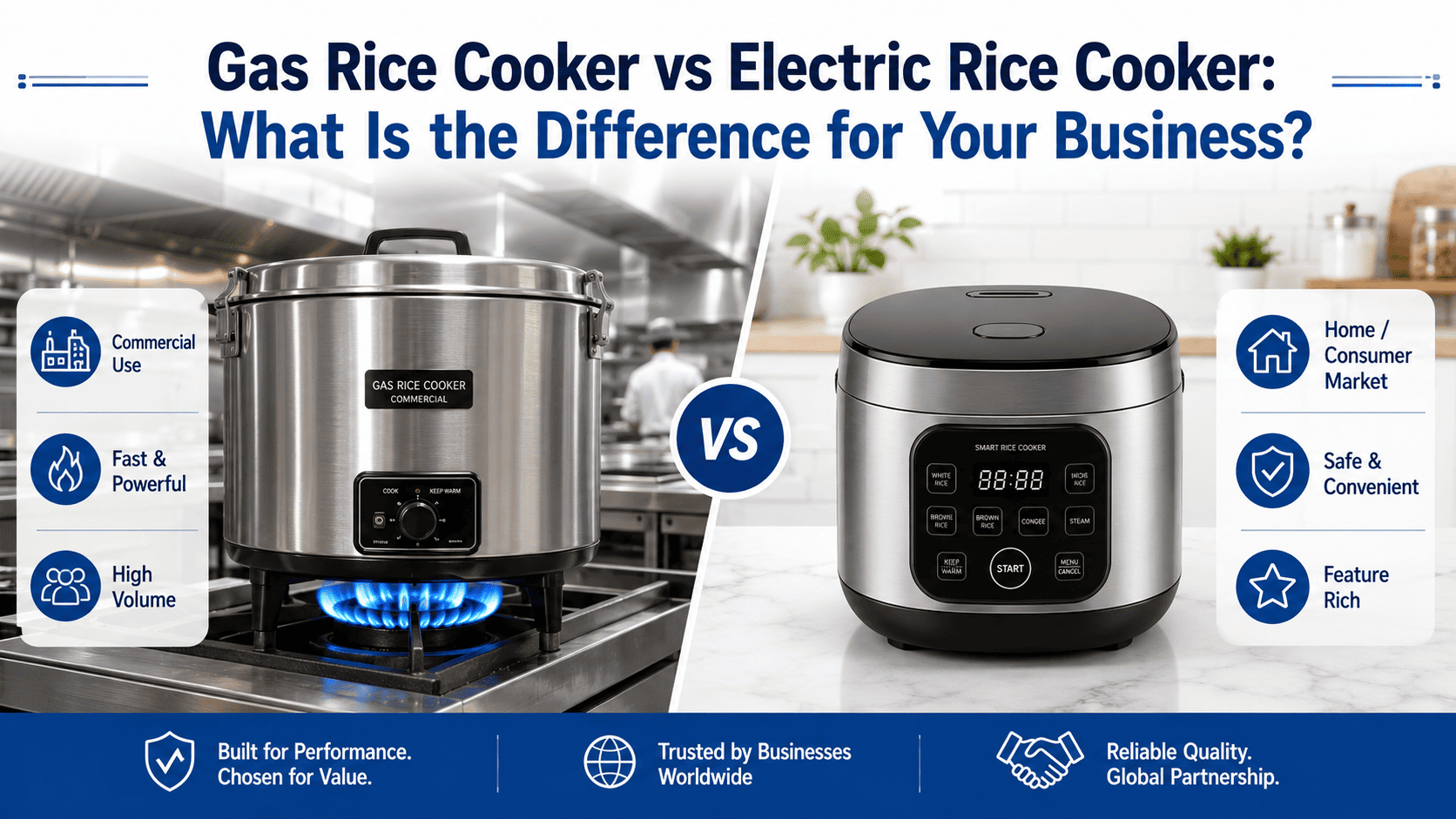
The core difference is the target market. Gas rice cookers are designed for high-volume commercial use due to their speed and power. Electric rice cookers dominate the consumer market with their safety, convenience, and wide range of features, offering more opportunities for brand differentiation.
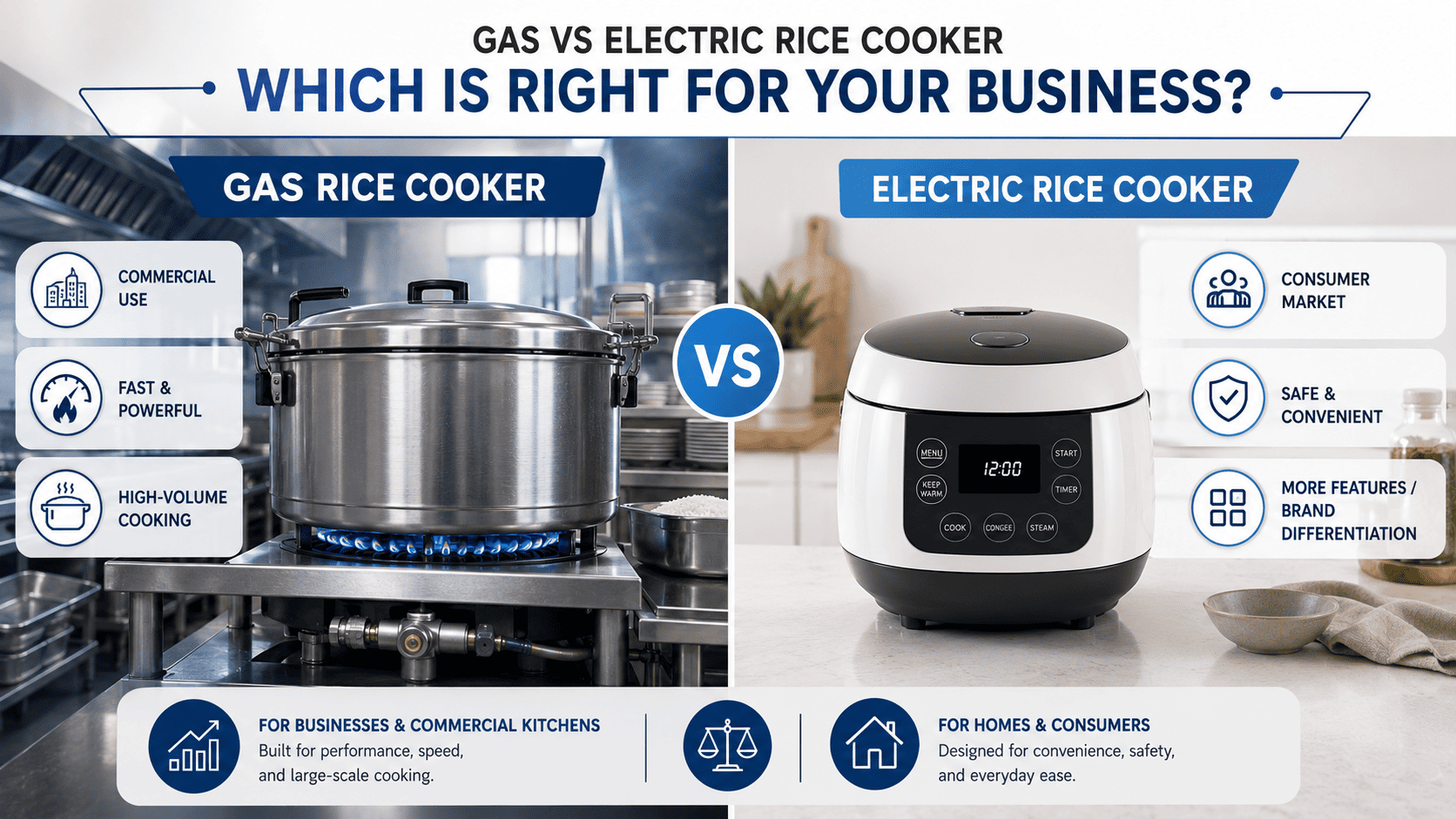
The choice between a gas and an electric rice cooker is one of the first questions we address with new clients. Many procurement managers initially believe it's a simple technical comparison. However, as a manufacturer with over 15 years of experience, I can tell you it's a strategic business decision that impacts everything from your compliance risk to your brand's market position. The right answer isn't about which technology is superior; it's about which technology is the right fit for your target customer and your business model. Let's break down how to make the right choice for your company.
Will a Gas Rice Cooker Suit Your Commercial Market?
Your restaurant clients need to serve hundreds of customers quickly. Can your product line meet this high-volume demand efficiently? A slow cooker means lost revenue and unhappy customers for them.
Yes, if your target market is commercial kitchens, restaurants, or catering services. Gas rice cookers provide the raw power and speed necessary for high-volume cooking, making them the industry standard for professional food service where output and operating costs are critical.
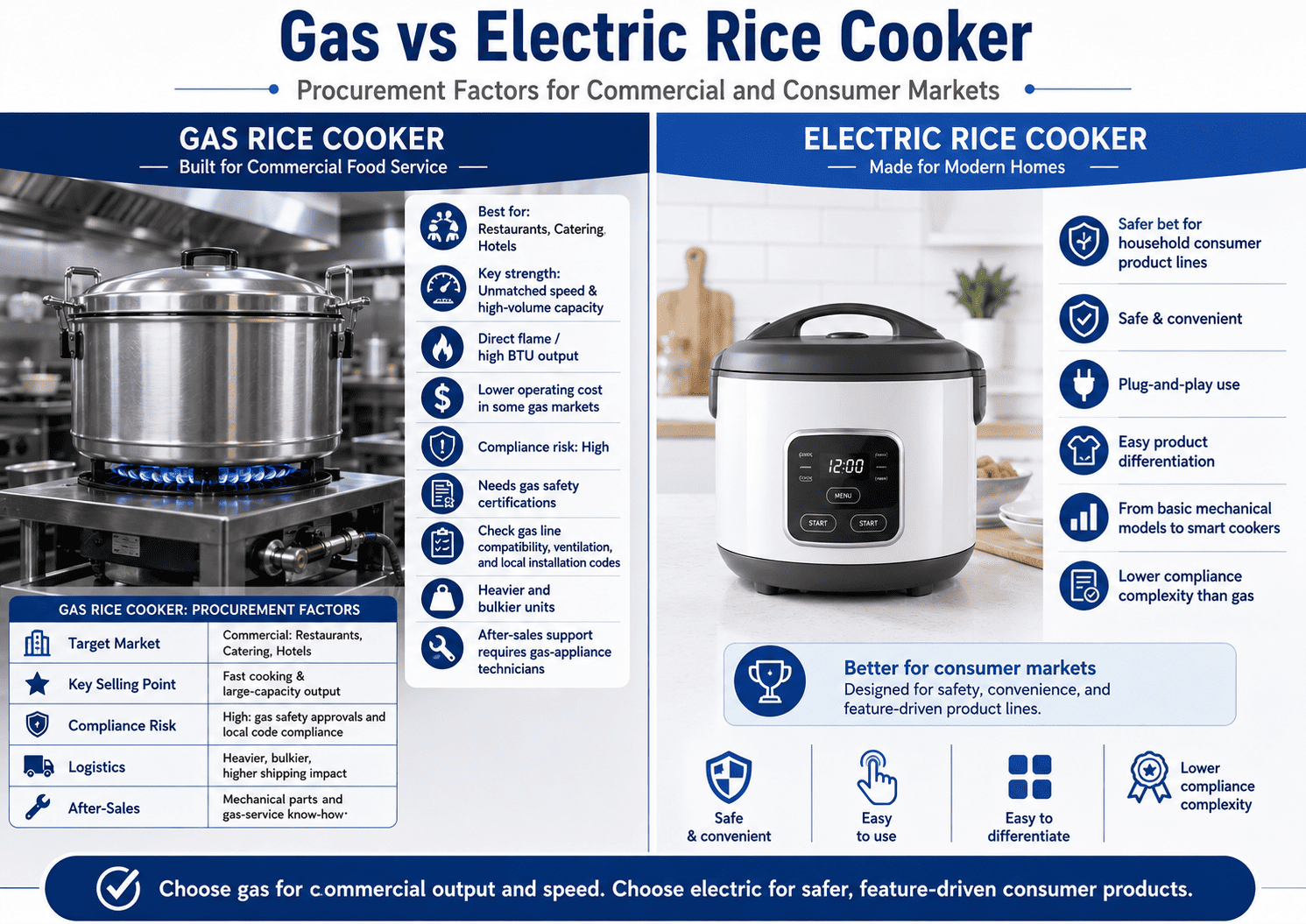
When I speak with procurement managers targeting the food service industry, the conversation always turns to speed and capacity. This is where gas rice cookers excel. They operate on a simple, powerful principle: a direct flame that generates immense heat, measured in BTUs1. For your business clients, this translates directly to how many servings of rice they can produce per hour. An electric model simply cannot compete on the sheer speed needed to cook 50 or 100 cups of rice at once. In markets with low natural gas prices, the lower operating cost is another significant selling point for a restaurant owner's bottom line2.
However, from a procurement standpoint, this power comes with significant complexities. Most procurement managers focus on unit cost, but the real challenges are in compliance and logistics. Gas appliances are subject to much stricter safety regulations and certification processes that vary drastically from country to country3. You must account for gas line compatibility, ventilation requirements, and local installation codes. Failing to do so can result in your entire shipment being rejected at the port or your brand facing serious liability issues.
| Procurement Factor | Gas Rice Cooker Implication |
|---|---|
| Target Market | Commercial (Restaurants, Catering, Hotels) |
| Key Selling Point | Unmatched Speed & High-Volume Capacity |
| Compliance Risk | High: Requires specific gas safety certifications and adherence to local installation codes. |
| Logistics | Units are typically heavier and bulkier, impacting shipping costs. |
| After-Sales Support | Focuses on mechanical components and requires technicians familiar with gas appliances. |
Is an Electric Rice Cooker a Safer Bet for Your Consumer Product Line?
The consumer market is saturated with basic appliances. You need a product that stands out, but adding complex features can feel risky and expensive. How do you innovate profitably?
Absolutely. For the household consumer market, electric rice cookers are the superior choice. They offer unparalleled safety, plug-and-play convenience, and a clear path for product differentiation through features, from simple mechanical models to advanced smart cookers.
For any brand targeting household consumers, the conversation must start with safety and convenience. Electric rice cookers are inherently safer for home use as they eliminate the risks associated with open flames and gas connections4. This "plug-and-play" nature makes them instantly accessible to end-users, lowering the barrier to adoption and reducing potential after-sales issues related to installation. More importantly for you as a procurement manager, the electric platform offers a vast landscape for creating a tiered product line that captures different market segments. This is where you can build your brand and command higher margins.
Instead of offering one single product, you can strategically develop a portfolio. Start with a basic mechanical model for entry-level markets that compete on price. Then, introduce a mid-range digital model with fuzzy logic5 and presets for porridge and soup, targeting families. Finally, establish your brand as an innovator with a premium smart or Induction Heating (IH) model6 featuring app control, targeting tech-savvy consumers willing to pay for performance and convenience. This tiered approach allows you to capture a wider audience and build a sustainable, profitable product category. The compliance process, while still critical (CE, CB, RoHS), is generally more standardized and less complex than for gas appliances7.
| Feature Tier | Target Consumer | Key Benefit for Your Brand |
|---|---|---|
| Basic (Mechanical) | Price-sensitive individuals, students | Allows for high-volume sales and successful market entry. |
| Mid-Range (Digital) | Families, everyday home cooks | Adds value through features, justifying a higher price point and margin. |
| Premium (Smart/IH) | Tech-savvy users, affluent households | Creates a "halo effect8" for your brand, establishing it as a premium player. |
How Does This Choice Impact Your Total Cost and Business Risk?
Focusing only on the factory unit price is a common mistake. Hidden costs in shipping, certification, and returns can destroy your profit margins long after the purchase order is signed.
The choice directly shapes your total cost of ownership (TCO) and risk profile. Gas cookers have higher compliance and logistics risks. Electric cookers' costs are tied to feature complexity and the marketing support needed to sell those features effectively.
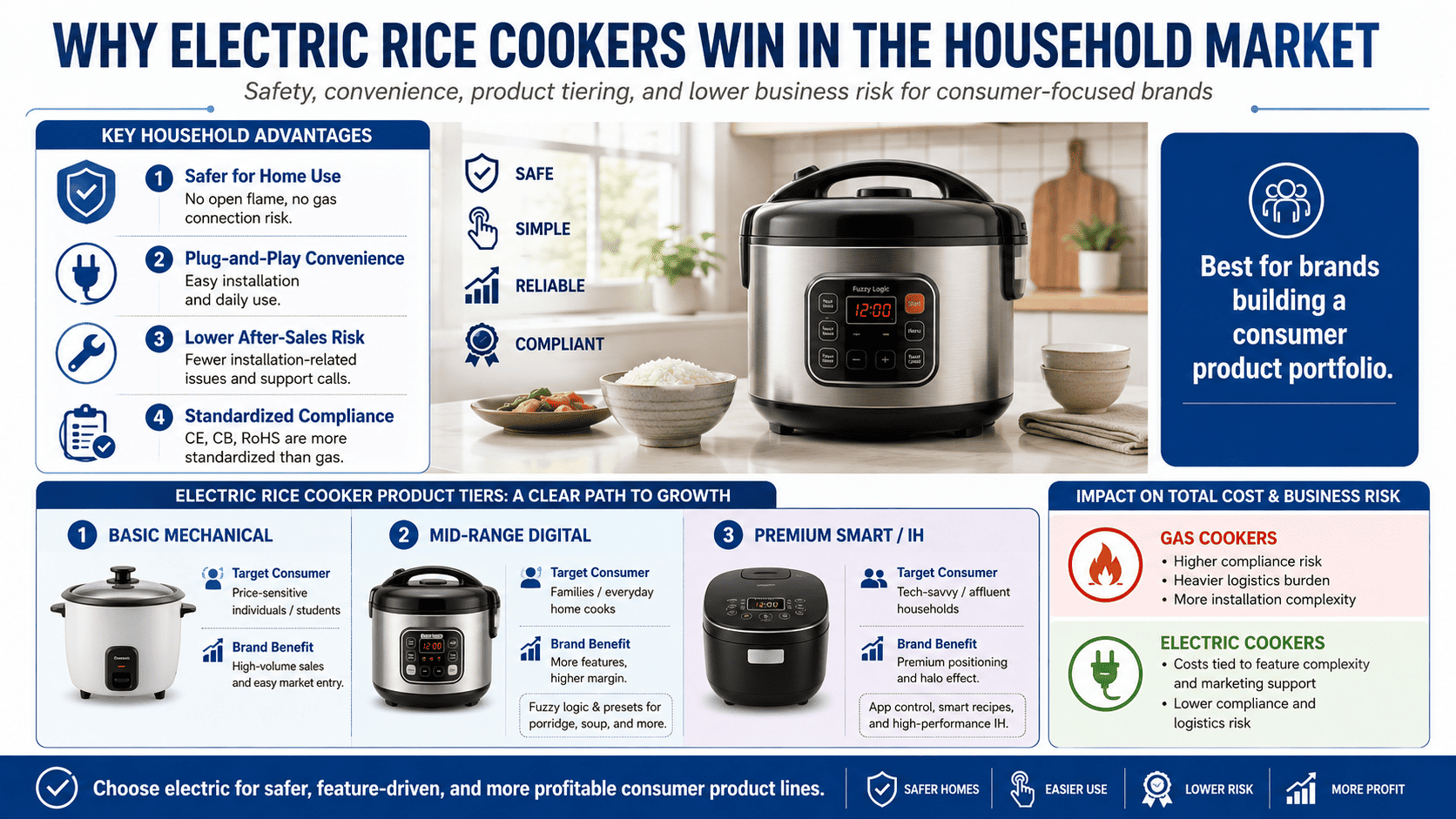
One of the most frequent questions we get from buyers is, "Which one is cheaper?" I always tell them that's the wrong question. The right question is, "Which model provides the best return on investment for my specific business strategy?" The factory price is just one component of your TCO. For a gas cooker, you must factor in the higher costs of specialized safety certifications, potentially higher shipping weight, and the business risk of a product recall if it fails to meet a specific region's gas regulations.
For an electric cooker, the TCO is more about the feature set. A simple mechanical cooker will have a low unit cost, but a smart IH cooker will be significantly more expensive to produce. The cost here is also tied to your own internal capabilities: Does your marketing team know how to sell "fuzzy logic"? Is your after-sales team prepared to troubleshoot an app connection issue? Your choice isn't just about a product; it's about aligning a product with your company's strengths. A reliable manufacturing partner won't just give you a price list; they will ask questions to help you build this strategic framework.
Strategic Sourcing Checklist
Before you decide, ask your team and your potential supplier these questions:
- End-User Profile: Are we selling to a chef who values speed or a home cook who values safety and convenience?
- Market Infrastructure: What are the local energy costs? Is electricity stable and affordable? Is natural gas common and inexpensive?
- Regulatory Landscape: What specific safety standards (e.g., GS, UKCA, KC) and import laws apply to gas vs. electric appliances in our target country9?
- Brand Positioning: Is our brand known for being the most affordable option, or are we trying to build a reputation for innovation and quality?
- Supply Chain & Support: Can our logistics handle heavy, bulky gas units? Is our customer support team trained for digital and smart products?
Answering these questions transforms the decision from a simple spec comparison into a strategic business plan.
Conclusion
Ultimately, the best rice cooker choice is not about gas or electric technology. It's a strategic decision based on your target market, brand positioning, and a clear understanding of business risk.
"British thermal unit - Wikipedia", https://en.wikipedia.org/wiki/British_thermal_unit. The British Thermal Unit (BTU) is a traditional unit of heat defined as the amount of energy needed to raise the temperature of one pound of water by one degree Fahrenheit, and is commonly used to rate the output of gas-fired cooking appliances (Wikipedia, 'British thermal unit'). Evidence role: definition; source type: encyclopedia. Supports: That BTU (British Thermal Unit) is the standard measure of heat energy output used to rate gas cooking appliances. ↩
"U.S. Natural Gas Prices - EIA", https://www.eia.gov/dnav/ng/ng_pri_sum_dcu_nus_m.htm. The International Energy Agency (IEA) publishes data showing significant variation in natural gas end-user prices across countries, a factor that directly influences the operating cost calculus for commercial kitchens choosing between gas and electric cooking equipment. Evidence role: statistic; source type: institution. Supports: That natural gas prices vary substantially across international markets, affecting the relative operating cost advantage of gas versus electric commercial cooking equipment. Scope note: IEA data covers energy prices broadly; direct studies comparing total operating costs of gas versus electric rice cookers in commercial settings are limited in the public literature. ↩
"[PDF] Consumer Conventional Cooking Products - Department of Energy", https://www.energy.gov/sites/default/files/2024-01/cooking-products-ecs-dfr.pdf. Standards bodies such as ISO and regional regulators (e.g., the European Gas Appliance Regulation EU 2016/426, UL in North America, and PSB in Singapore) impose jurisdiction-specific certification requirements for gas appliances that address combustion safety, gas type compatibility, and installation, creating a more fragmented compliance landscape than that faced by most electric appliances. Evidence role: general_support; source type: institution. Supports: That gas appliances are subject to distinct, country-specific safety certification requirements that differ substantially from those governing electric appliances. Scope note: The relative complexity of gas versus electric compliance varies by target market; the claim of universal greater strictness for gas may not hold in all jurisdictions. ↩
"[PDF] Cooking Fires - Consumer Product Safety Commission", https://www.cpsc.gov/s3fs-public/cookingfires.pdf. The U.S. Consumer Product Safety Commission (CPSC) and the National Fire Protection Association (NFPA) have reported that cooking equipment is a leading cause of home fires, with gas ranges associated with specific risks including gas leaks and open-flame ignition that are absent in electric appliances. Evidence role: statistic; source type: government. Supports: That gas cooking appliances are associated with higher residential fire and injury risk compared to electric appliances due to open flame and gas leak hazards. Scope note: Statistics typically address ranges and stovetops rather than rice cookers specifically; the safety comparison is directionally supported but not directly proven for this appliance category. ↩
"Fuzzy control system - Wikipedia", https://en.wikipedia.org/wiki/Fuzzy_control_system. Fuzzy logic, a form of multi-valued logic that handles approximate rather than fixed and exact reasoning, has been applied in consumer appliances such as rice cookers to enable microprocessor-controlled adaptive adjustments to temperature and cooking time based on real-time sensor data (Wikipedia, 'Fuzzy logic'). Evidence role: definition; source type: encyclopedia. Supports: That fuzzy logic is a computational control method applied in consumer appliances, including rice cookers, to make adaptive cooking decisions based on sensor inputs. ↩
"Induction heating - Wikipedia", https://en.wikipedia.org/wiki/Induction_heating. Induction cooking uses electromagnetic induction to heat a ferromagnetic cooking vessel directly rather than heating an element that transfers heat to the pot, enabling faster heating and more precise temperature control; this mechanism underlies the performance claims associated with premium IH rice cookers (Wikipedia, 'Induction cooking'). Evidence role: mechanism; source type: encyclopedia. Supports: That induction heating uses electromagnetic induction to heat the cooking vessel directly, enabling more precise temperature control than conventional electric resistance heating. ↩
"EU Legislation and CE Marking - International Trade Administration", https://www.trade.gov/country-commercial-guides/eu-eu-legislation-and-ce-marking. CE marking is a mandatory conformity mark for products sold in the European Economic Area, indicating compliance with EU safety, health, and environmental directives; the CB Scheme is an IEC-administered international system for mutual recognition of electrical equipment test results; and RoHS (Restriction of Hazardous Substances Directive) restricts the use of specific hazardous materials in electrical and electronic equipment sold in the EU. Evidence role: definition; source type: government. Supports: That CE marking, the CB Scheme, and RoHS are established international or regional compliance frameworks applicable to electric household appliances including rice cookers. Scope note: The relative complexity of these frameworks compared to gas appliance certification is a qualitative judgment not directly established by the defining regulatory texts themselves. ↩
"Halo effect - Wikipedia", https://en.wikipedia.org/wiki/Halo_effect. In marketing, the halo effect refers to the cognitive bias whereby a consumer's positive evaluation of one product or attribute influences their overall perception of a brand or its other products; this principle is applied in tiered product strategies where a premium offering is intended to elevate the perceived quality of lower-tier products in the same line (Wikipedia, 'Halo effect'). Evidence role: definition; source type: encyclopedia. Supports: That the halo effect, as applied in marketing, describes how a positive impression of one product influences consumer perception of other products under the same brand. ↩
"GS Mark | US | TÜV Rheinland", https://www.tuv.com/usa/en/gs-mark.html. The GS mark (Geprüfte Sicherheit) is a voluntary but widely required safety certification for products sold in Germany and the EU; the UKCA (UK Conformity Assessed) mark replaced CE marking for products placed on the Great Britain market following Brexit; and the KC mark is South Korea's mandatory safety certification for electrical and electronic products, administered by the Korea Agency for Technology and Standards (KATS). Evidence role: definition; source type: government. Supports: That GS (Germany), UKCA (United Kingdom), and KC (South Korea) are mandatory or recognized safety certification marks required for appliance market access in their respective jurisdictions. ↩