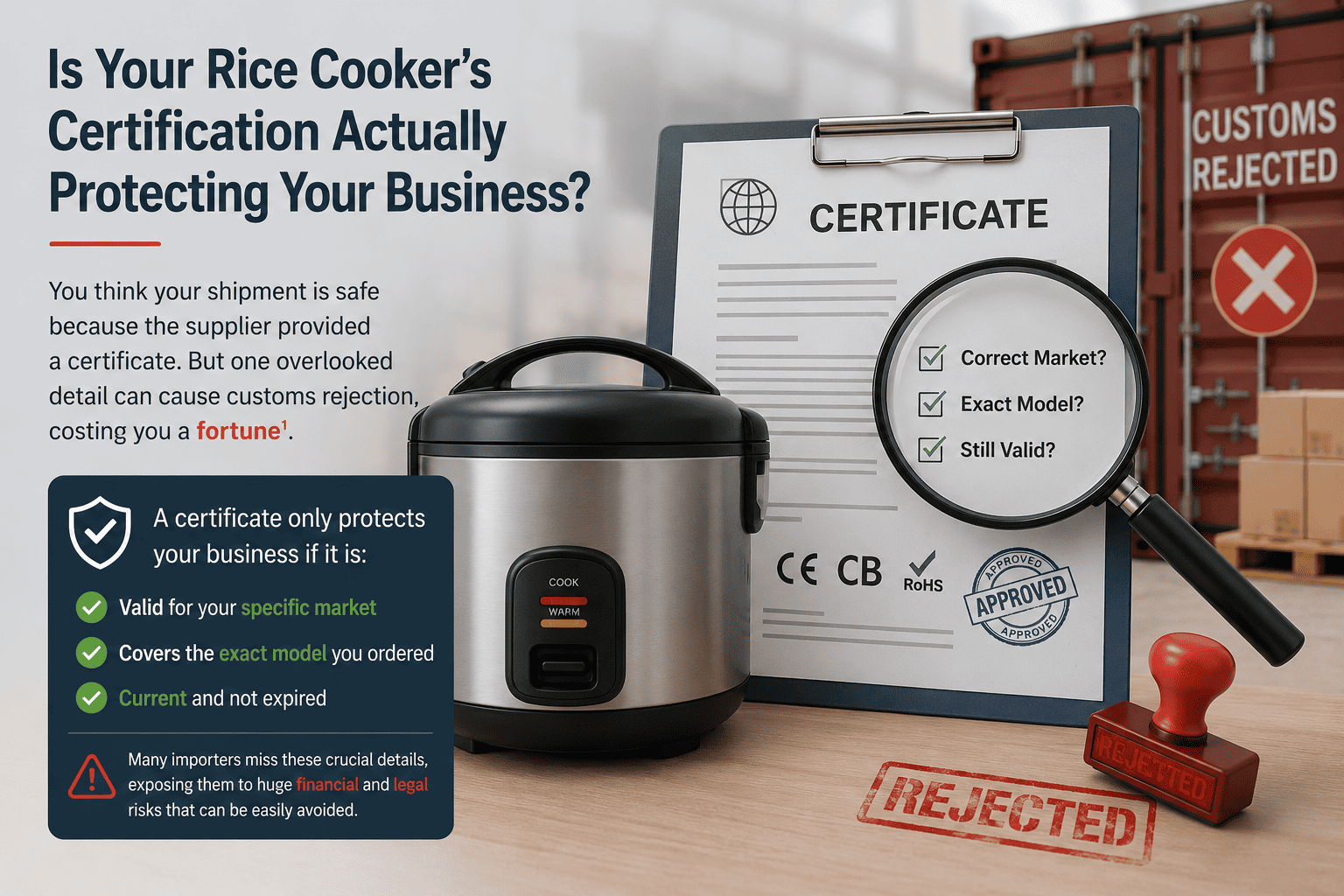
You think your shipment is safe because the supplier provided a certificate. But one overlooked detail can cause customs rejection, costing you a fortune1. Understanding certification is your best protection.
A certificate only protects your business if it is valid for your specific market, covers the exact model you ordered, and is current. Many importers miss these crucial details, exposing them to huge financial and legal risks that can be easily avoided.
I've been in the rice cooker business for over 15 years, working directly with importers from all over the world. I’ve seen the relief on a client's face when a large shipment clears customs without a hitch. I've also seen the panic when an entire container is held up because of a simple paperwork mistake. The difference often comes down to how they approach product certification. It’s not just a piece of paper; it’s a critical part of your business strategy. Let's walk through the questions you should be asking to make sure your investment is truly protected.
Do All 'International' Certifications Work in My Country?
You ask a supplier for an "international certificate" to save time. But you might get a product that is illegal to sell in your market. You must be specific about your country.
No, there is no single "international" certification for home appliances2. You must have the specific certificate required by the country of sale, such as CE for the EU3, UKCA for the UK, or KC for Korea. Using the wrong one means your product is non-compliant.
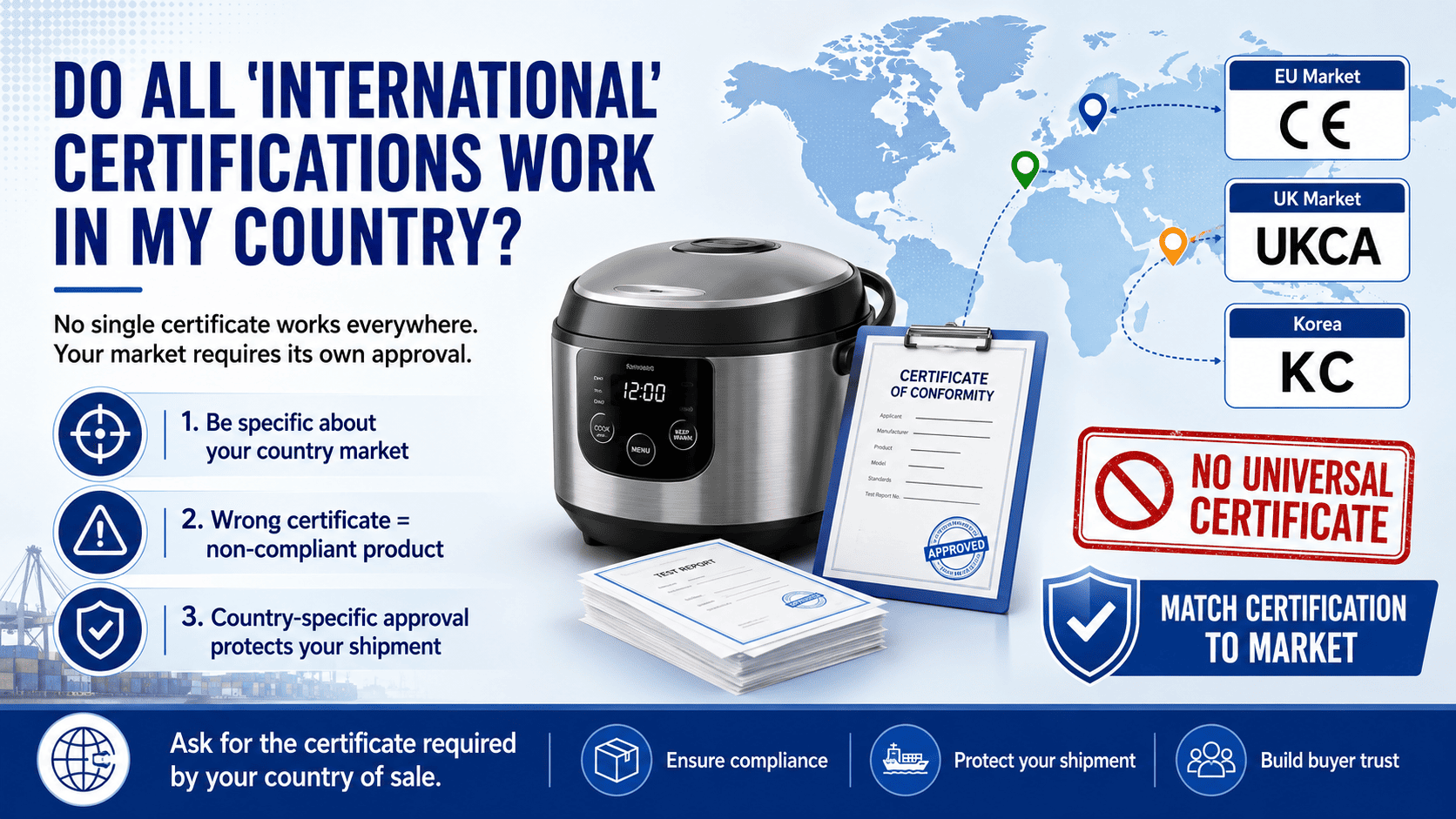
Many importers, especially those new to sourcing, ask us for products with "international certification." This is the first red flag. In my experience, this question shows a misunderstanding that can lead to costly mistakes. The reality is that safety and compliance standards are set by individual countries or economic blocs. A rice cooker that is perfectly legal to sell in Germany with a CE mark is illegal to sell in the UK without a UKCA mark4. They are not interchangeable. A good supplier should immediately ask you, "Which country are you selling in?" Your first step should always be to identify the specific certifications required for your target market.
Here is a simple breakdown of some common examples:
| Market | Required Certification (Example) |
|---|---|
| European Union | CE |
| United Kingdom | UKCA |
| South Korea | KC |
| Gulf States | G-Mark5 |
Getting this right is fundamental. It's the key that unlocks market access. Getting it wrong means the door is locked, and your goods might not even be allowed past the port.
Is the Supplier's Certificate Good Enough for My Order?
Your supplier sends a PDF of a certificate, and you feel secure. But that document could be outdated or for a completely different product. You must have a clear process to verify it.
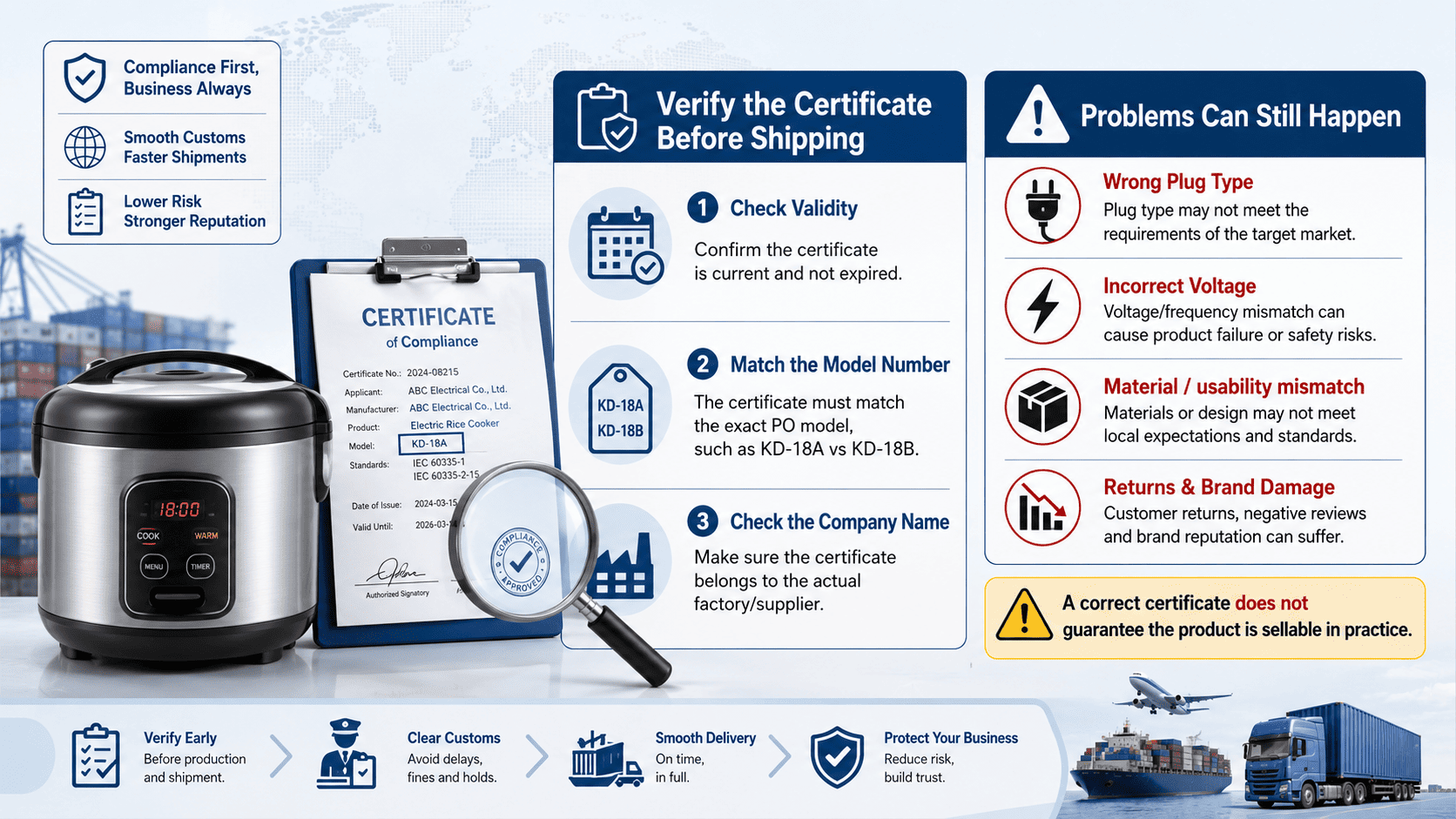
Not always. You must verify that the certificate is current, belongs to the factory, and explicitly covers the exact model and specifications you are buying. A certificate for a standard model often does not cover your customized version, leaving you unprotected.
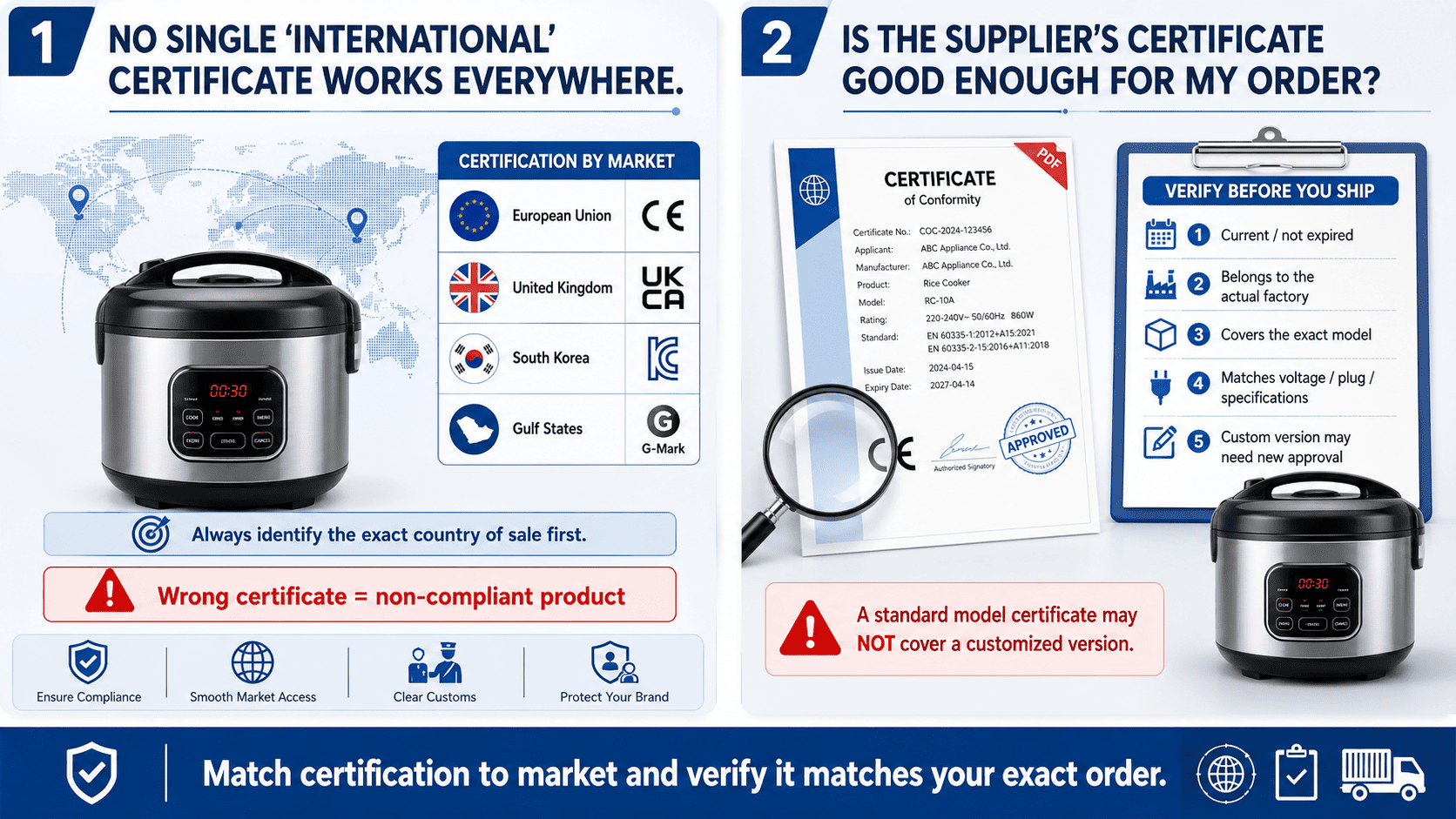
Relying on a supplier's certificate without doing your own checks is a huge gamble. I've seen importers get burned by this. A factory might have a certificate, but you need to ask more questions. Here is what you must check to ensure the certificate actually applies to your order.
Verify Certificate Validity
First, check the date. Is the certificate still valid or has it expired? Regulatory standards change, and certificates need to be renewed. An expired certificate is as good as no certificate at all in the eyes of customs officials.
Match the Model Number
This is where many problems happen. A factory might have a valid GS certificate for their standard model, let's call it KD-18A. But you, the importer, requested a small change to the heating element or control panel, so your model is KD-18B. That small change makes it a new product. The certificate for KD-18A does not cover your KD-18B. You are not compliant. You must ensure the model number on your purchase order matches the one on the certificate exactly.
Check the Company Name
Does the certificate belong to the factory you are buying from, or does it belong to a trading company or another third party? This is critical for accountability6. If something goes wrong, you want a direct link between your product, your factory, and the compliance documentation.
Can I Still Have Problems Even with the Right Certificate?
You have the correct, valid certificate for your specific product. You feel safe. But a tiny detail like a plug pin can make your entire shipment useless and unsellable. You have to look beyond the paper.
Yes, absolutely. A certificate covers core safety and electrical standards but doesn't guarantee practical usability7. Issues with plugs, voltage ratings, or material choices can lead to mass product returns and brand damage, even if you are technically "certified."
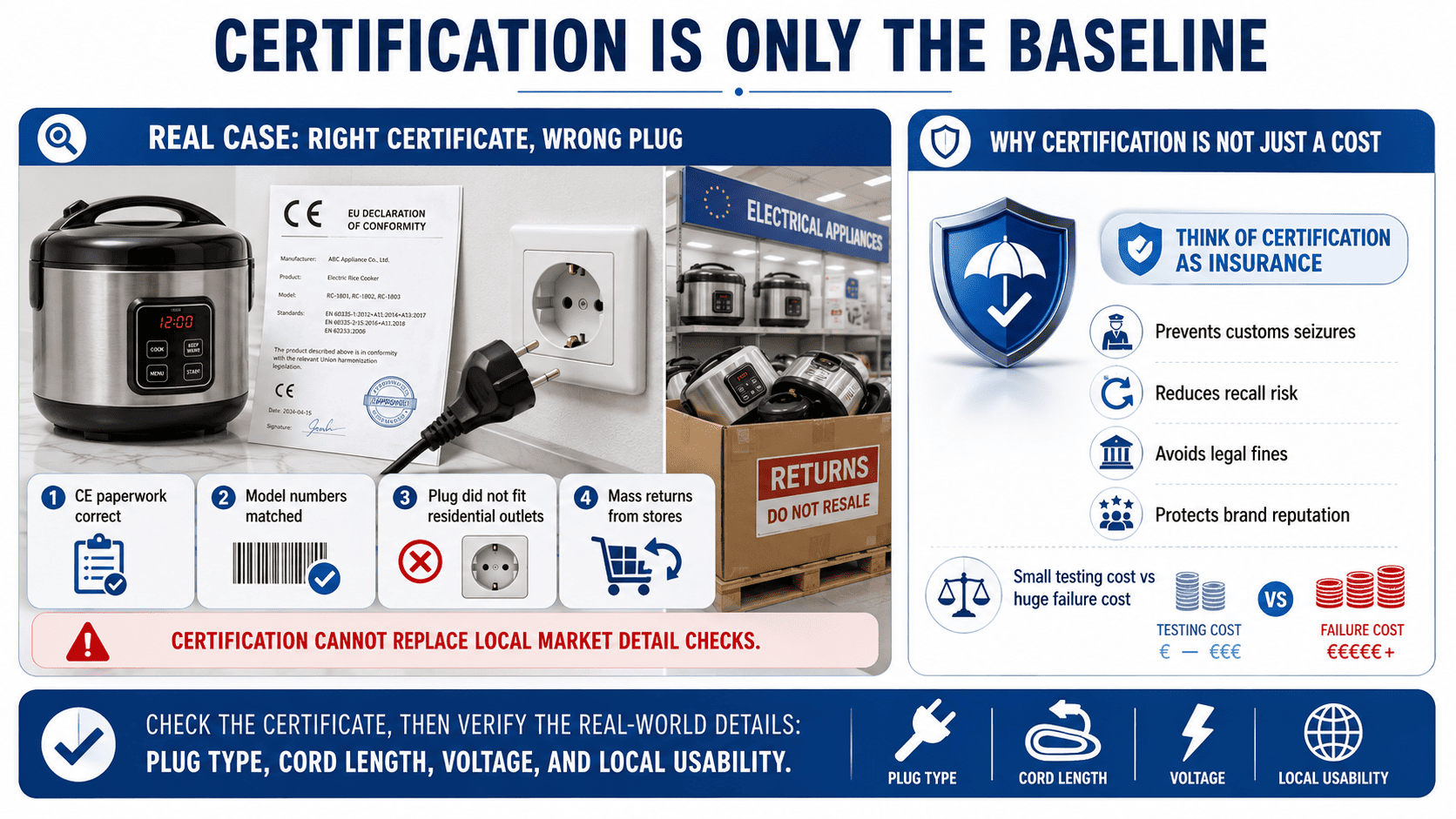
Let me tell you a true story. A few years ago, we had a major client in Europe. They placed a large order and were very specific: they needed a "Swiss plug." We are an experienced factory, so we sourced and installed what is technically known as a Swiss plug. The shipment had all the right CE paperwork, the model numbers matched, and everything looked perfect.
But when the rice cookers reached the stores, the complaints started pouring in. The plugs wouldn't fit into the wall sockets. It turned out that while it was a "Swiss plug" by technical definition, the pin size was for a different industrial application8, not for standard residential outlets. The importer had to deal with a massive product return. This was a disaster that no certificate could have prevented. It required specific, local knowledge that went beyond the lab test report. This taught me that certification is just the baseline. You must also confirm every practical detail, from the plug type and cord length to the correct voltage for your market.
Isn't Getting All These Certifications Just an Extra Cost?
You see the line item for certification and testing on the invoice. It's tempting to think of it as just another expense. But skimping now could cost you your entire container value later.
Viewing certification as a cost is a dangerous mistake. The small investment in proper testing is insurance against catastrophic expenses like customs seizures, forced product recalls, legal fines9, and irreparable damage to your brand's reputation. The cost of getting it wrong is far higher10.
I often talk to procurement managers who are under pressure to reduce costs. It's easy to look at the fees for certification and see it as an area to save money. This is a short-term view that creates massive long-term risk. The real cost is not in getting the certification; it's in not getting it. Think of it as an investment in your business's security and reputation. A few hundred or thousand dollars spent on proper testing can save you from a hundred-thousand-dollar loss.
Let's compare the two scenarios:
| Getting it Wrong (The "Cost") | Getting it Right (The "Investment") |
|---|---|
| Blocked shipments at customs | Smooth market entry |
| Fines from regulatory bodies | Brand reputation for safety & quality |
| Mandatory product recalls | Lower after-sales and warranty costs |
| Loss of entire order value | Long-term supplier partnership |
| Lawsuits from injured consumers | Peace of mind and business security |
A good manufacturing partner understands this. We don't see certification as a hassle; we see it as a shared responsibility to protect your business and ensure the products we make are successful in your market. It's about reducing your total cost of ownership, not just the initial price.
Conclusion
Proper certification isn't a bureaucratic hurdle. It's your best tool for managing risk, ensuring market access, and protecting your brand. Always verify the details for your specific market.
"Certificates of Compliance - Federal Register", https://www.federalregister.gov/documents/2025/01/08/2024-30826/certificates-of-compliance. A source from a national customs and border protection agency can confirm its legal authority to detain, seize, or refuse entry to goods that fail to comply with mandatory product safety and certification regulations, often at the importer's expense. Evidence role: general_support; source type: government. Supports: The source should confirm that customs authorities have the legal power to reject, seize, or order the destruction of imported goods that do not meet local certification and safety standards, and can impose financial penalties on the importer.. ↩
"International Electrotechnical Commission - Wikipedia", https://en.wikipedia.org/wiki/International_Electrotechnical_Commission. An overview from an international standards organization like the International Electrotechnical Commission (IEC) can explain that while its standards are used as a basis for certification in many countries, there is no single global mark, and manufacturers must obtain the specific certifications required by each country or region. Evidence role: general_support; source type: institution. Supports: The source should explain the global product compliance landscape, noting that while international standards (like those from IEC) exist, legal market access is typically granted through mandatory national or regional conformity marks (e.g., CE, UKCA, KC).. ↩
"CE marking - Wikipedia", https://en.wikipedia.org/wiki/CE_marking. The official website of the European Commission defines the CE mark as a mandatory conformity marking for certain products sold within the European Economic Area, indicating that the manufacturer has assessed the product and it meets EU safety, health, and environmental protection requirements. Evidence role: definition; source type: government. Supports: The source should define CE marking, state that it signifies conformity with EU health, safety, and environmental protection standards, and confirm that it is mandatory for products falling under its scope to be sold within the European Economic Area.. ↩
"UKCA marking - Wikipedia", https://en.wikipedia.org/wiki/UKCA_marking. Official guidance from the UK government explains the introduction of the UKCA mark as the conformity assessment marking for Great Britain after its departure from the European Union, outlining the transition periods and requirements for replacing the CE mark. Evidence role: historical_context; source type: government. Supports: The source should explain the post-Brexit transition from the CE mark to the UKCA (UK Conformity Assessed) mark for goods placed on the market in Great Britain (England, Wales, and Scotland).. ↩
"GCC Standardization Organization - Wikipedia", https://en.wikipedia.org/wiki/GCC_Standardization_Organization. The GCC Standardization Organization (GSO) website describes the Gulf Conformity Mark (G-Mark) as a requirement for specific categories of products to demonstrate compliance with technical regulations and ensure their safety for consumers in the Gulf member states. Evidence role: definition; source type: institution. Supports: The source should identify the GCC Standardization Organization (GSO) as the body behind the G-Mark and define it as a mandatory conformity mark for certain products, such as low-voltage electrical equipment and toys, sold in member countries.. ↩
"products liability | Wex | US Law | LII / Legal Information Institute", https://www.law.cornell.edu/wex/products_liability. EU regulations, for example, place legal responsibility for product conformity, technical documentation, and liability on the manufacturer or their authorized representative named on the compliance documents. This direct link is crucial for market surveillance authorities and for accountability in case of safety issues. Evidence role: definition; source type: government. Supports: The source should define the legal roles and responsibilities of the 'manufacturer' or 'economic operator' who places a product on the market and is named on the Declaration of Conformity.. ↩
"CE Marking - International Trade Administration", https://www.trade.gov/ce-marking. The official scope of a safety standard like IEC 60335-1 for household appliances shows that its primary focus is on preventing injury or damage from the appliance, covering electrical and fire hazards. It does not typically specify market-specific usability features like plug type, which are considered separate national requirements. Evidence role: definition; source type: institution. Supports: The source should describe the scope of a major safety standard, showing that it focuses on protecting against hazards like electrical shock, fire, and mechanical injury.. ↩
"AC power plugs and sockets - Wikipedia", https://en.wikipedia.org/wiki/AC_power_plugs_and_sockets. Documentation of the Swiss SEV 1011 standard for plugs and sockets illustrates that different ratings exist (e.g., for 10 amps and 16 amps) which have different pin shapes or sizes to prevent them from being used interchangeably, confirming that multiple incompatible 'Swiss plugs' exist. Evidence role: case_reference; source type: encyclopedia. Supports: The source should show that within the Swiss SEV 1011 standard (Type J), there are different plug and socket designs for different amperage ratings (e.g., 10A vs 16A) that are intentionally not mechanically compatible.. ↩
"Recalls & Product Safety Warnings | CPSC.gov", https://www.cpsc.gov/Recalls. Government-managed databases, such as the EU's 'Safety Gate' rapid alert system or the U.S. Consumer Product Safety Commission's (CPSC) recall list, provide numerous examples of products being recalled due to non-compliance with safety standards, including certification issues. Evidence role: statistic; source type: government. Supports: The source should provide a database or report of real-world examples where products were recalled from the market or other enforcement actions were taken due to safety and compliance failures.. ↩
"[PDF] The financial impact of product recall announcements in China", https://scholarworks.indianapolis.iu.edu/bitstreams/b954b36b-0f91-4650-9172-3ba32aa13c5e/download. Studies and reports from insurance companies or business consulting firms analyze the financial impact of product recalls, often finding that the total cost—including logistics, replacement, legal fees, and brand reputation damage—can run into millions of dollars, far exceeding the initial cost of compliance testing. Evidence role: statistic; source type: research. Supports: The source should provide data or analysis on the various costs associated with a product recall, including logistics, legal fees, regulatory fines, and brand damage.. Scope note: The source provides a general economic analysis of recall costs rather than a direct comparison for a specific product, but it supports the principle that the cost of failure is disproportionately high. ↩