Every week, restaurant procurement managers contact me with the same concern: they're torn between buying an 8L commercial rice cooker to save budget and space, or investing in a larger unit "just to be safe." The fear of running out of rice during dinner rush keeps them awake at night. I understand that anxiety—service delays during peak hours damage your reputation faster than any other operational failure.
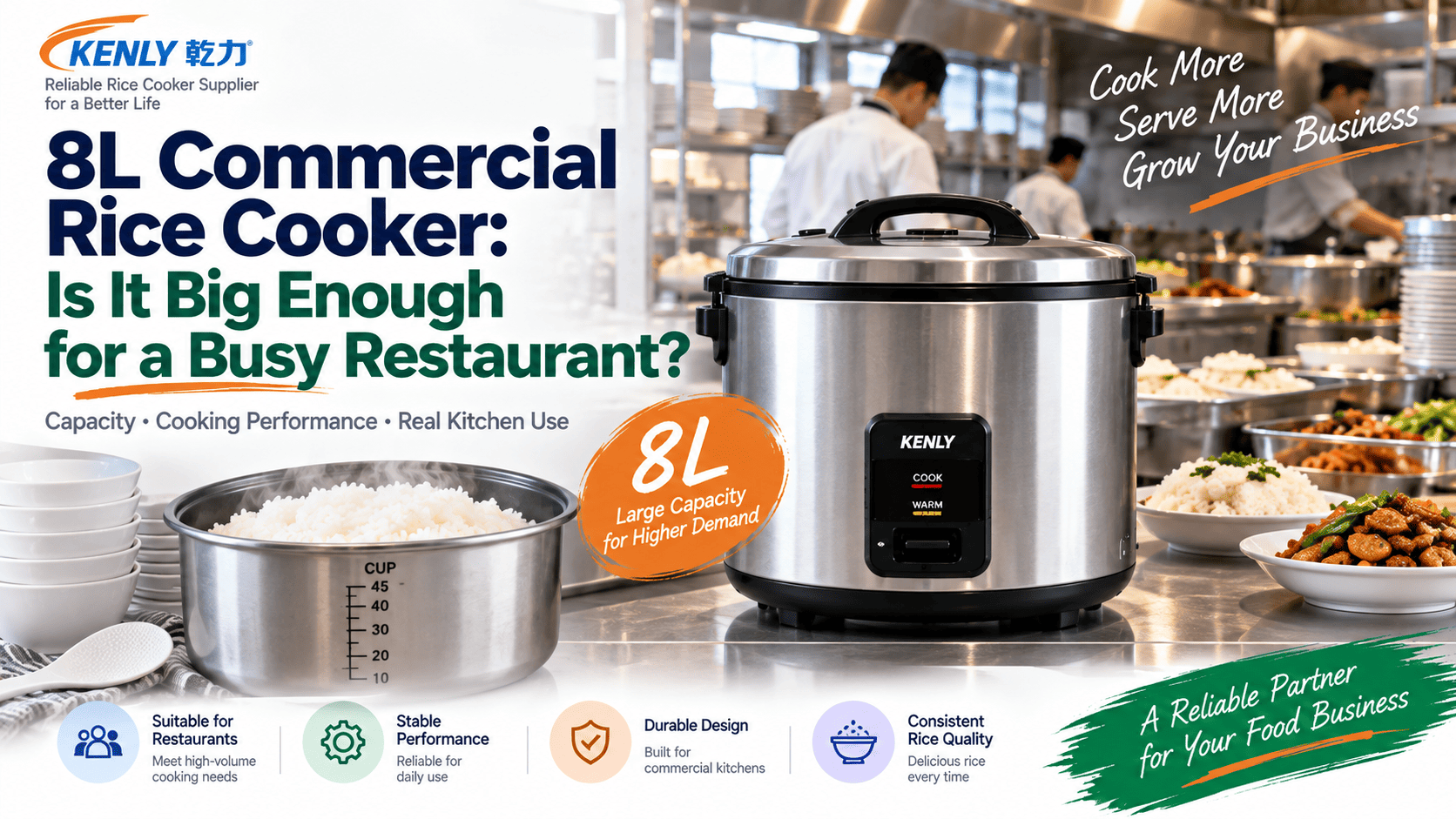
An 8L commercial rice cooker produces approximately 3–4 kg of cooked rice per cycle, serving roughly 20–30 restaurant portions. Whether this capacity matches your busy restaurant depends not on your daily guest count, but on aligning the unit's cycle time with your service rhythm during peak hours. If your peak demand exceeds one cycle's output before the cooker completes its next batch, you'll face service bottlenecks regardless of total daily volume.
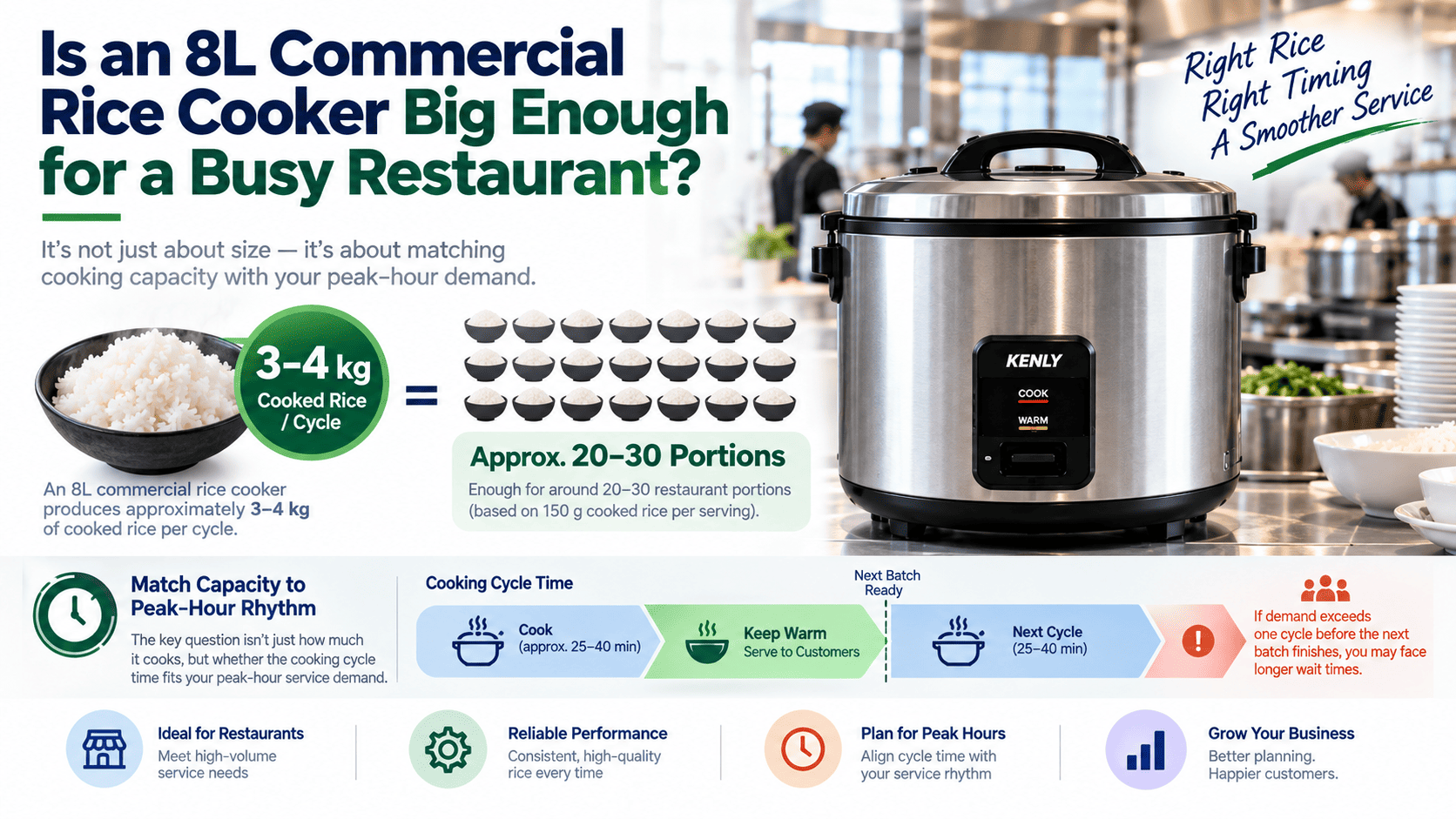
The real question isn't "is 8L big enough"—it's "does my restaurant's service pattern fit an 8L unit's throughput capability?" I'll walk you through the calculation framework I use when restaurant buyers ask me this question, so you can make this decision based on your specific operation, not guesswork.
How Much Rice Does an 8L Commercial Rice Cooker Actually Produce?
Restaurant owners often misunderstand what "8L capacity" means when they first research commercial rice cookers. I hear this confusion in nearly every initial consultation call.
An 8L commercial rice cooker holds 8 liters of total pot volume, but produces approximately 3–4 kg of cooked rice per cycle.1 This translates to about 20–30 standard restaurant portions (120–150g cooked rice per serving)2, depending on your portion control standards and the rice variety you use.
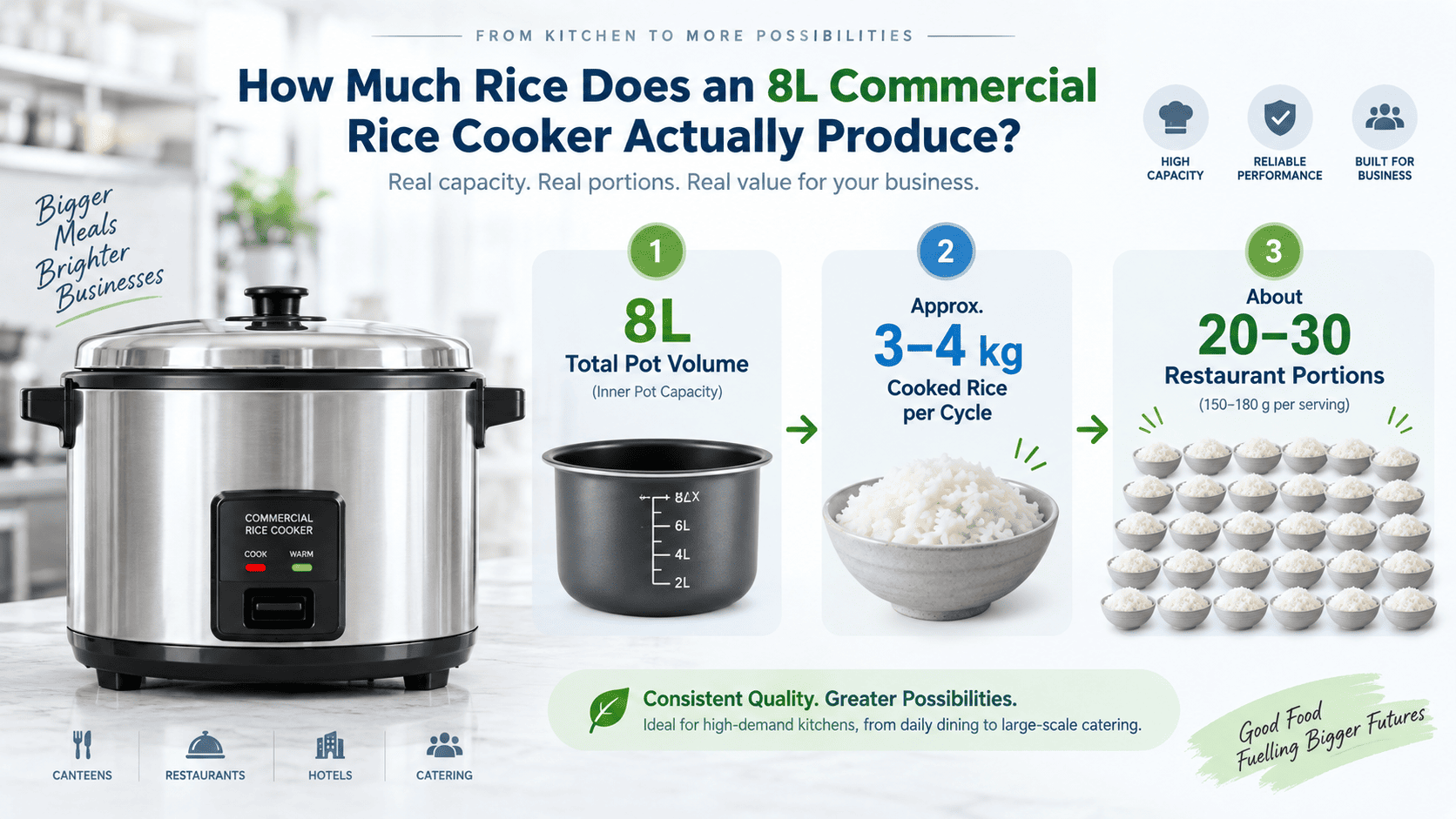
The gap between pot volume and usable output creates the most common procurement mistake. Here's why this distinction matters:
Raw vs. Cooked Rice Volume
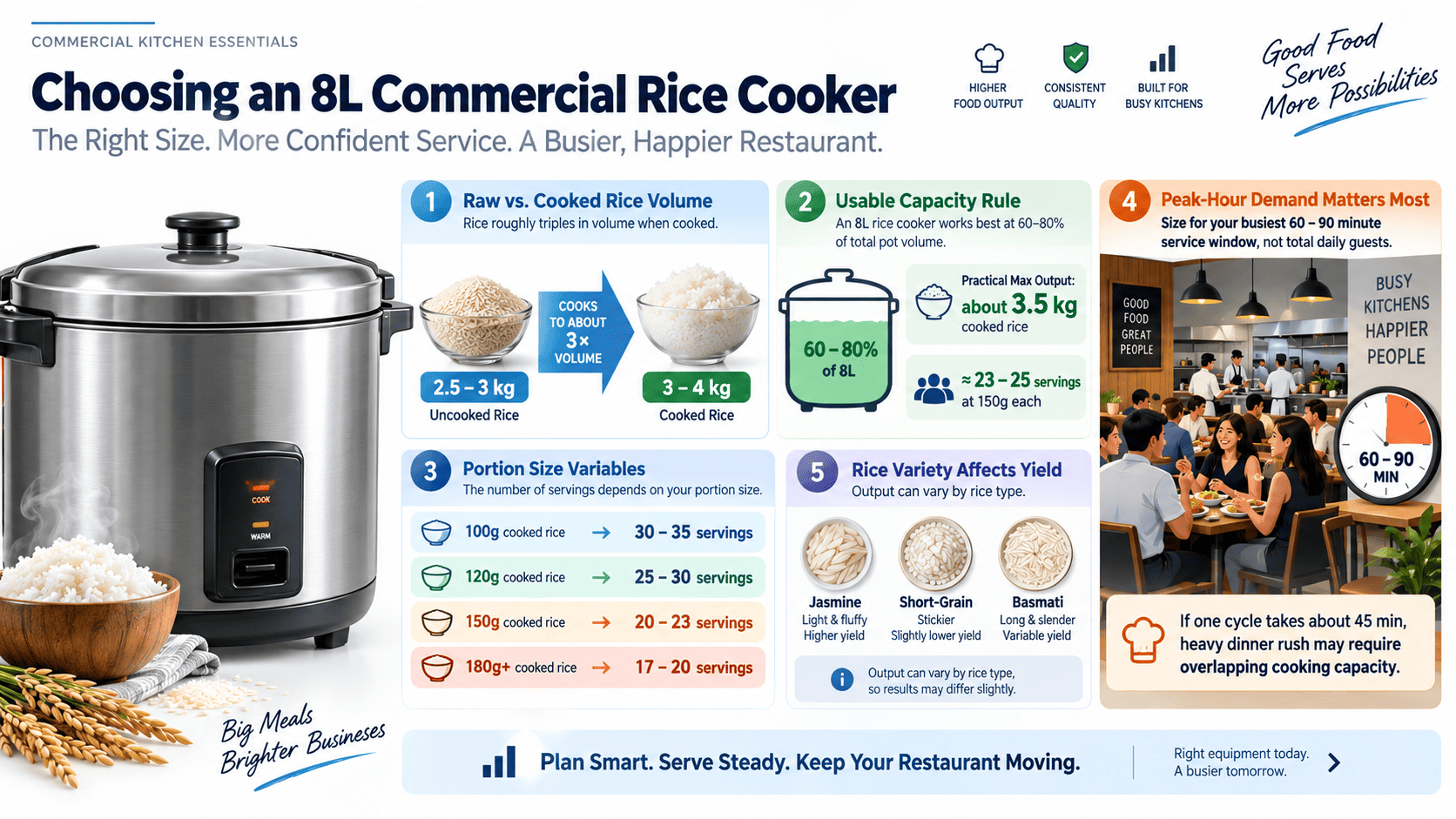
Rice expands during cooking—typically doubling to tripling in volume depending on the variety.3 An 8L pot accommodates approximately 2.5–3 kg of uncooked rice with adequate water and expansion space. After cooking, you get 3–4 kg of finished product.
I've noticed buyers often calculate backwards from their daily guest count, assuming an 8L cooker should handle 8 liters of cooked rice output. This math error leads to undersizing equipment by 40–50%.
The Usable Capacity Rule
Commercial rice cookers perform best when filled to 60–80% of total pot volume.4 Overfilling compromises cooking evenness and increases the risk of overflow during the cooking cycle.5 For an 8L unit, your practical maximum per cycle sits around 3.5 kg cooked rice—about 23–25 portions at 150g per serving.
Restaurant operators working with smaller portion sizes (100–120g) stretch this to 30 portions per cycle. Conversely, establishments serving larger rice portions or using long-grain varieties that require more cooking water see output closer to 20 portions.
Portion Size Variables
Your actual portion control standards significantly impact how many servings you extract from each cycle:
| Portion Size | Servings per 8L Cycle | Typical Restaurant Type |
|---|---|---|
| 100g cooked rice | 30–35 servings | Fast-casual, side dish emphasis |
| 120g cooked rice | 25–30 servings | Mid-range casual dining |
| 150g cooked rice | 20–23 servings | Full-service restaurants, rice-focused menus |
| 180g+ cooked rice | 17–20 servings | Large portions, rice bowl concepts |
When procurement managers tell me their menu design, I can immediately estimate whether an 8L unit aligns with their operation. A Thai restaurant serving rice as a side dish operates in a completely different throughput zone than a Japanese donburi concept where rice constitutes the meal foundation.
Rice Variety Considerations
Different rice varieties absorb varying amounts of water and expand at different rates:6
- Jasmine rice (common in Thai restaurants): Higher water absorption, moderate expansion—expect output toward the lower end of the 3–4 kg range
- Japanese short-grain rice (sushi rice): Dense grain structure, less expansion—typically yields 3.2–3.6 kg per 8L cycle
- Basmati rice (Indian restaurants): Lower water absorption, more elongation than expansion—may produce closer to 4 kg but with fluffier, less dense results
I advise buyers to request sample cooking tests with their specific rice variety before finalizing equipment orders. A 20% variance in output based on rice type7 can determine whether your sizing calculation works or fails during service.
What's Your Peak-Hour Rice Demand Pattern?
Most restaurant sizing mistakes happen because buyers calculate equipment needs based on average daily volume rather than peak-hour demand spikes. I've seen this error repeatedly.
Your 8L rice cooker sizing decision must account for your busiest 60–90 minute service window, not your total daily guest count.8 If your dinner rush serves 80 guests requiring rice within 90 minutes, and each cycle takes 45 minutes, you need overlapping cooking capacity that an 8L unit alone cannot provide.
The cycle time constraint creates the real bottleneck. Here's how to analyze your specific situation:
Typical Commercial Rice Cooker Cycle Times
An 8L commercial rice cooker completes a full cooking cycle in approximately:
- White rice: 30–40 minutes (cooking + brief holding)
- Brown rice: 50–65 minutes (longer cooking requirement)
- Mixed grain rice: 45–60 minutes (depends on grain combination)
After cooking completes, you need 5–10 minutes to transfer rice to holding containers and prepare the cooker for the next batch. Your realistic cycle-to-cycle time: 40–50 minutes for standard white rice service.
The Peak Demand Calculation Framework
When restaurant buyers ask me if 8L works for their operation, I walk them through this calculation:
Step 1: Identify your busiest service window
Most restaurants see peak demand during:
- Lunch: 12:00 PM – 1:30 PM (90 minutes)
- Dinner: 6:30 PM – 8:30 PM (120 minutes)
Step 2: Calculate peak-hour rice portions needed
Example: 60 guests during peak 90 minutes, 80% order rice dishes, average 150g portion
60 guests × 0.80 × 150g = 7.2 kg cooked rice needed
Step 3: Determine how many complete cycles fit within your peak window
90-minute peak window ÷ 45-minute cycle time = 2 complete cycles (with tight timing)
Step 4: Calculate total output capacity
2 cycles × 3.5 kg per cycle = 7 kg maximum output during peak period
In this example, an 8L cooker theoretically covers peak demand—but with zero margin for error. Any delay (batch held slightly longer, uneven guest arrival timing, staff occupied with other tasks) creates service gaps.
The Service Rhythm Reality Check
The math above assumes perfect timing: you start cooking the second batch exactly when the first cycle completes. Restaurant kitchens don't operate with such precision.
I recommend building in a 30% buffer above calculated peak needs.9 Using the example above:
- Required peak output: 7.2 kg
- With 30% buffer: 7.2 kg × 1.30 = 9.36 kg needed
- 8L unit capacity during peak: 7 kg
- Conclusion: Undersized for this operation
When Continuous Cooking Becomes Impractical
If your peak window requires three or more overlapping cycles to meet demand, you face operational complexity:
- Someone must monitor cooking cycles continuously
- Rice holding times extend (quality degradation risk)
- Any service delay compounds through the shift
- Staff stress increases during highest-pressure periods
Restaurant operators consistently tell me that managing multiple overlapping cooking cycles during rush hours creates more problems than buying appropriately sized equipment from the start. The cost savings from buying a smaller unit evaporate quickly when service quality suffers or when you eventually purchase a second cooker.
How Does an 8L Unit Fit Different Restaurant Types?
The same 8L commercial rice cooker that works perfectly for one restaurant concept fails miserably in another. I've watched this pattern across hundreds of buyer inquiries.
An 8L commercial rice cooker suits small to mid-sized restaurants serving 80–120 daily covers where rice functions as a side dish, or operations with distinct service windows allowing time for multiple cooking cycles between rushes. The unit struggles in high-volume rice-focused concepts, continuous service operations, or establishments experiencing sharp demand spikes.
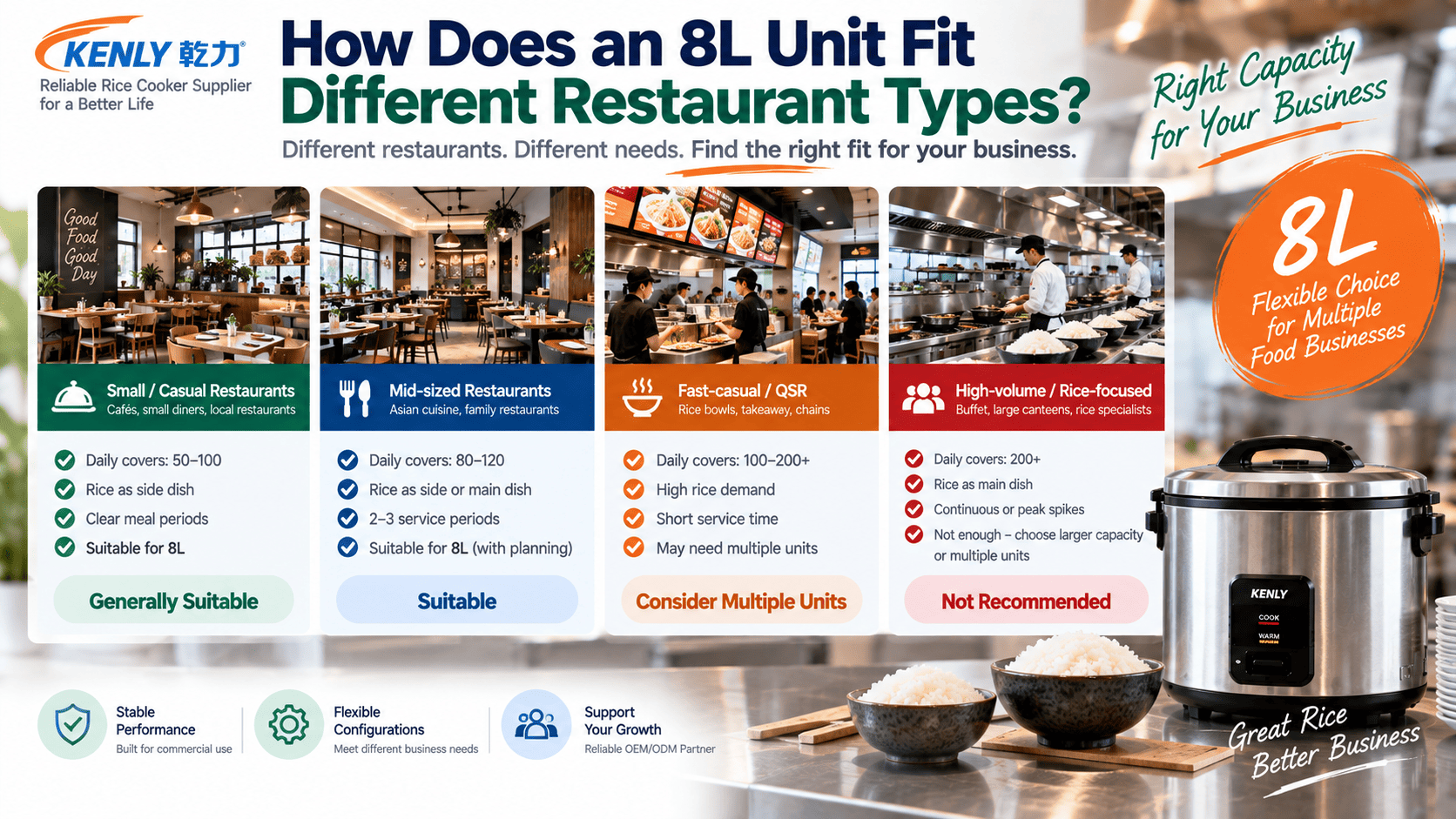
Here's how different restaurant formats match up with 8L capacity constraints:
Small Casual Dining Restaurants
Profile: 40–60 seats, table service, rice as accompaniment to main dishes, distinct lunch and dinner services
Rice demand pattern: 30–50 portions per service window, 60–70% of guests order rice
8L suitability: Good fit
These operations typically see manageable, predictable demand waves. You can cook one batch before service, hold it during the peak window, and prepare a second batch for late arrivals or takeout orders. The gap between lunch and dinner provides ample time to reset.
I've noticed family-run restaurants in this category particularly value the space efficiency and lower initial investment of an 8L unit. The equipment pays for itself quickly when matched to appropriate volume.
Fast-Casual Rice Bowl Concepts
Profile: 25–35 seats, counter service, rice as meal foundation, continuous service from 11 AM – 9 PM
Rice demand pattern: 120–180 portions daily, concentrated peaks at lunch and dinner
8L suitability: Marginal to inadequate
This restaurant type creates the toughest challenge for 8L capacity. Rice sits at the center of every menu item, and continuous service hours mean you can't batch-cook between clear service windows.
Buyers from rice bowl concepts frequently ask me if they can "make it work" with an 8L unit to reduce startup costs. My honest observation: you'll likely need to upgrade within 6–12 months as the operational friction becomes unsustainable. Starting with a 13L or dual 8L setup saves money and stress in the medium term.
Hotel Breakfast Buffets
Profile: 80–120 room hotel, breakfast buffet 6:30 AM – 10:00 AM, predictable guest flow
Rice demand pattern: 40–60 portions (not all guests choose rice), concentrated 7:30 AM – 9:00 AM
8L suitability: Good fit with proper timing
Hotel breakfast buffets often work well with 8L units because you can prepare the first batch before service opens, hold it in the buffet setup, and cook a mid-service refresh batch around 8:00 AM. The three-hour service window provides sufficient time for two cycles.
The key requirement: someone must start the second batch at precisely the right moment to have fresh rice ready when the first batch depletes. Hotels with attentive kitchen staff manage this well; operations running minimal breakfast staffing struggle with the timing coordination.
Takeout-Heavy Asian Restaurants
Profile: 20 seats dine-in, 70% takeout business, peak periods 11:30 AM – 1:30 PM and 5:30 PM – 8:00 PM
Rice demand pattern: 100–140 portions daily, extreme concentration during 90-minute windows
8L suitability: Inadequate for peak demand
Takeout-dominant operations compress their entire service volume into narrow time windows. Guests expect quick order turnaround—you can't ask takeout customers to wait 45 minutes for the next rice batch.
Restaurant owners in this category often underestimate their peak demand because they focus on the small dine-in space, not the actual order volume. The 20-seat dining room misleads them into thinking they need "small restaurant" equipment, when their order throughput actually requires "high-volume restaurant" capacity.
Catering and Meal Prep Operations
Profile: Off-premise catering, event-based demand, advance preparation possible
Rice demand pattern: Variable, but often 50–200 portions per event with 24-hour preparation lead time
8L suitability: Good fit with batch cooking strategy
Catering operations have the luxury of cooking multiple batches over several hours before the event. An 8L unit can prepare 200+ portions across five or six cycles when you have advance preparation time.
The limitation: if you book multiple events on the same day or need to prepare other components simultaneously, your single 8L cooker becomes a production bottleneck. Catering businesses that grow beyond occasional events typically need either larger capacity or multiple units.
Table-Service Restaurants with Low Rice Penetration
Profile: Western-fusion or international concept, rice offered with select dishes only, 100–150 daily covers
Rice demand pattern: 30–50 rice portions daily, distributed across service hours
8L suitability: Excellent fit
When rice appears on your menu but doesn't dominate dish composition, an 8L cooker easily handles demand. You might cook one large batch at midday that serves through both lunch and early dinner, then prepare a smaller second batch for the evening tail.
These operations represent the ideal 8L use case: sufficient capacity for actual needs, space efficiency in the kitchen, and cost-effectiveness for equipment that isn't mission-critical to every menu item.
What Happens When You Undersize Your Rice Cooker?
I've had uncomfortable conversations with restaurant operators who contact me three months after opening, desperate to upgrade their rice cooker because service is suffering. The pattern repeats with troubling consistency.
Undersizing your commercial rice cooker creates cascading operational problems: service delays during peak hours, inconsistent rice quality from rushed cooking, staff stress, customer complaints, and ultimately the expense of replacing equipment you just purchased. The cost of buying correctly sized equipment upfront is always lower than the combined costs of operational disruption plus replacement.
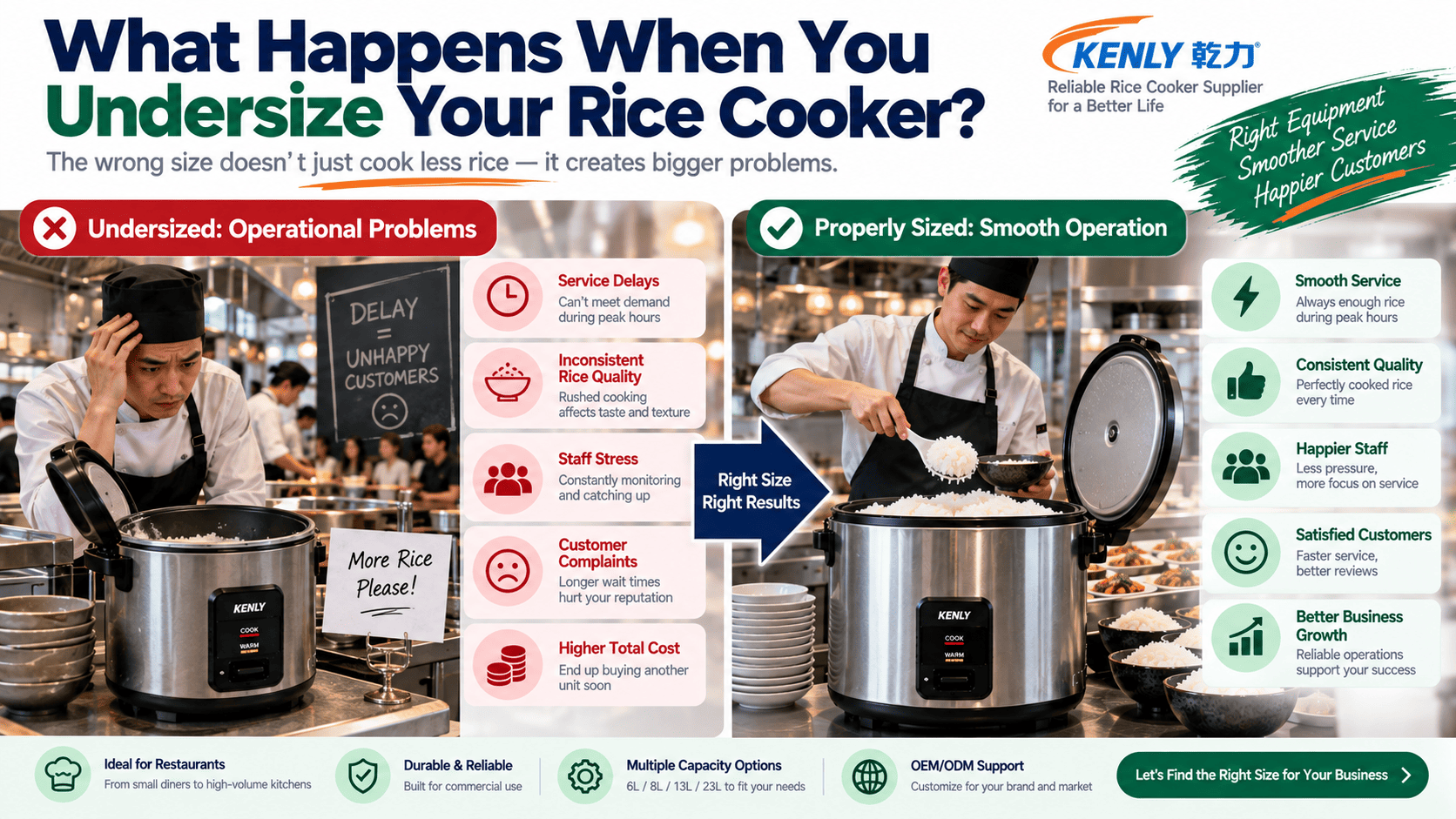
Here's what actually happens when your rice cooker can't keep pace with demand:
The Service Delay Spiral
When you run out of rice during peak service, everything stops. Guests wait 30–40 minutes for their meals while a fresh batch cooks—an unacceptable delay in any restaurant context.
Your servers face angry customers. Your kitchen staff stresses under the pressure. Your reputation takes hits on review platforms. I've watched restaurants lose their lunch business momentum because word spreads that "they run out of rice during busy times."
The most damaging aspect: this problem isn't intermittent. Once your volume exceeds your equipment capacity, you experience service delays every single day during peak hours. The operational pain becomes your new normal.
Quality Compromise Temptations
Faced with inadequate capacity, some restaurant operators resort to workarounds that damage food quality:
Stretching rice with excess water: Adding extra water to cook larger batches in the same cooker produces mushy, overcooked rice. Customers notice immediately—especially in Asian restaurants where rice quality is central to the dining experience.
Cooking too-large batches: Overfilling the cooker beyond recommended capacity creates uneven cooking. The bottom layer burns while the top layer stays undercooked. You end up throwing away rice that didn't cook properly, wasting both product and time.
Holding rice too long: When you can't cook enough rice per cycle to match demand pace, you hold finished rice longer to stretch each batch. Rice quality degrades significantly after 2–3 hours in a holding warmer.10 The dry, hard texture and lost flavor hurt your food reputation.
I can't emphasize enough: none of these workarounds actually solve the capacity problem. They just shift the negative impact from service delays to food quality—and customers notice that too.
Staff Morale Impact
Your kitchen staff becomes demoralized when they lack the equipment to do their jobs properly. Line cooks shouldn't spend their shifts anxiously watching the rice cooker timer, calculating whether the next batch will finish before orders back up.
Restaurant operators underestimate how much stress inadequate equipment puts on their teams. Staff turnover accelerates when people feel set up to fail by insufficient tools. The cost of recruiting and training replacement kitchen staff far exceeds the price difference between an 8L and 13L commercial rice cooker.
The Replacement Equipment Expense
Here's the financial reality I share with buyers who want to cut initial costs: if you undersize your rice cooker, you'll likely replace it within your first year of operation.
Equipment replacement costs include:
- Purchase price of the new, correctly sized unit
- Disposal or resale loss on the undersized cooker you're replacing
- Additional shipping costs for the replacement equipment
- Installation and setup labor for the new unit
- Opportunity cost of not having that capital available for
"How much rice can I cook in an 8 liter pressure cooker?", https://www.quora.com/How-much-rice-can-I-cook-in-an-8-liter-pressure-cooker. Foodservice equipment capacity guidance or institutional cooking-yield tables support converting rice-cooker pot volume into an approximate cooked-rice mass, providing contextual support for a 3–4 kg estimate for an 8L unit; the source may not test the exact cooker model discussed. Evidence role: general_support; source type: institution. Supports: An 8-liter rice-cooker pot has a practical cooked-rice output in the range of several kilograms per batch, rather than 8 liters of finished rice.. Scope note: The source would likely support an approximate range, not a universal output for all 8L rice cookers. ↩
"USDA FoodData Central", https://fdc.nal.usda.gov/. Government dietary databases or food-composition references report gram weights for cooked-rice servings, supporting the plausibility of using 120–150g as a portion benchmark; the evidence contextualizes serving size rather than defining a restaurant-wide standard. Evidence role: general_support; source type: government. Supports: Cooked rice servings are commonly described in gram-weight ranges that can contextualize the article's 120–150g restaurant portion assumption.. Scope note: Dietary serving references may not directly represent commercial restaurant portioning practices. ↩
"Improvement of cooking quality of germinated brown rice ...", https://pmc.ncbi.nlm.nih.gov/articles/PMC6525723/. University extension cooking guidance documents that raw rice absorbs water and commonly yields about two to three times its original volume after cooking, supporting the article's stated expansion range. Evidence role: mechanism; source type: education. Supports: Rice grains absorb water and expand substantially during cooking, commonly producing two to three times the uncooked volume.. ↩
"55-Cup, RiceMaster Electric Rice Cooker", https://townfood.com/product/55-cup-ricemaster-electric-rice-cooker/. Foodservice equipment manuals and safety guidance commonly specify maximum fill lines below total pot volume, supporting the article's practical advice to leave expansion space; the evidence may not establish the exact 60–80% range for every model. Evidence role: general_support; source type: other. Supports: Rice cookers are designed with maximum fill levels below the full pot volume to allow water, foam, and grain expansion during cooking.. Scope note: The source would support the principle of underfilling, while the exact percentage may remain model-specific. ↩
"Using rice cooker first time - what do I do once it starts ...", https://www.reddit.com/r/Cooking/comments/1f8hdhx/using_rice_cooker_first_time_what_do_i_do_once_it/. Food-science or appliance-safety research on rice hydration, starch foaming, and heat transfer supports the mechanism by which overfilling can cause overflow and uneven cooking; the evidence is mechanistic rather than a test of the specific 8L unit. Evidence role: mechanism; source type: research. Supports: Excess rice and water reduce headspace, while starch foam and uneven heat transfer can contribute to overflow and inconsistent cooking.. Scope note: The source would explain why overfilling is risky, not quantify the risk for each commercial cooker. ↩
"Kinetics of water absorption expansion of rice during ...", https://pubmed.ncbi.nlm.nih.gov/33387834/. Peer-reviewed studies of rice cooking quality report cultivar-dependent differences in water uptake, swelling, and cooked texture, supporting the article's statement that rice varieties expand at different rates. Evidence role: mechanism; source type: paper. Supports: Rice cultivar and grain type affect water uptake, swelling, and cooked-rice yield.. ↩
"Effect of Parboiling Conditions on Physical and Cooking ...", https://pmc.ncbi.nlm.nih.gov/articles/PMC7499280/. Peer-reviewed comparisons of rice cultivars document substantial variation in water absorption and swelling during cooking, providing contextual support for the article's warning that output can vary by rice type; the source may not verify the exact 20% figure. Evidence role: general_support; source type: paper. Supports: Empirical rice-cooking studies show measurable differences in cooked yield, swelling, or water uptake among rice varieties.. Scope note: The evidence would support the existence of meaningful variation, but the precise 20% value may depend on variety and cooking method. ↩
"Capacity Planning for Service Delivery: Demand ...", https://auroratrainingadvantage.com/operations/service-operations-management/capacity-planning-service-delivery/. Operations-management texts describe capacity planning around peak-load periods and bottleneck resources, supporting the article's focus on the busiest service window; the evidence is a general service-operations principle rather than restaurant-rice-specific data. Evidence role: expert_consensus; source type: education. Supports: Capacity planning for service operations commonly uses peak demand and bottleneck throughput rather than daily averages alone.. Scope note: The source would support the planning logic, not the article's exact 60–90 minute window for every restaurant. ↩
"What Is Capacity Planning In Operations Management?", https://www.auroratrainingadvantage.com/operations/faqs/capacity-planning-operations-management/. Operations-management literature defines capacity cushions as reserve capacity used to absorb demand variability and process delays, supporting the article's use of a buffer above calculated peak needs; the literature does not necessarily prescribe a universal 30% margin. Evidence role: expert_consensus; source type: education. Supports: Operations management recognizes capacity cushions as a way to handle demand variability, delays, and service uncertainty.. Scope note: The source would justify having a buffer, while the 30% figure remains a practical assumption rather than a universal standard. ↩
"Mutual Relations between Texture and Aroma of Cooked Rice ...", https://pmc.ncbi.nlm.nih.gov/articles/PMC9689002/. Peer-reviewed food-science studies on cooked-rice storage and holding document texture changes associated with moisture migration and starch retrogradation, supporting the article's warning that extended warm holding can degrade quality; the exact 2–3 hour threshold may vary by rice type and holding conditions. Evidence role: mechanism; source type: paper. Supports: Cooked rice texture and sensory quality change during holding because of moisture loss and starch retrogradation.. Scope note: The source would support quality degradation during holding, but not necessarily the same time threshold for every warmer and rice variety. ↩