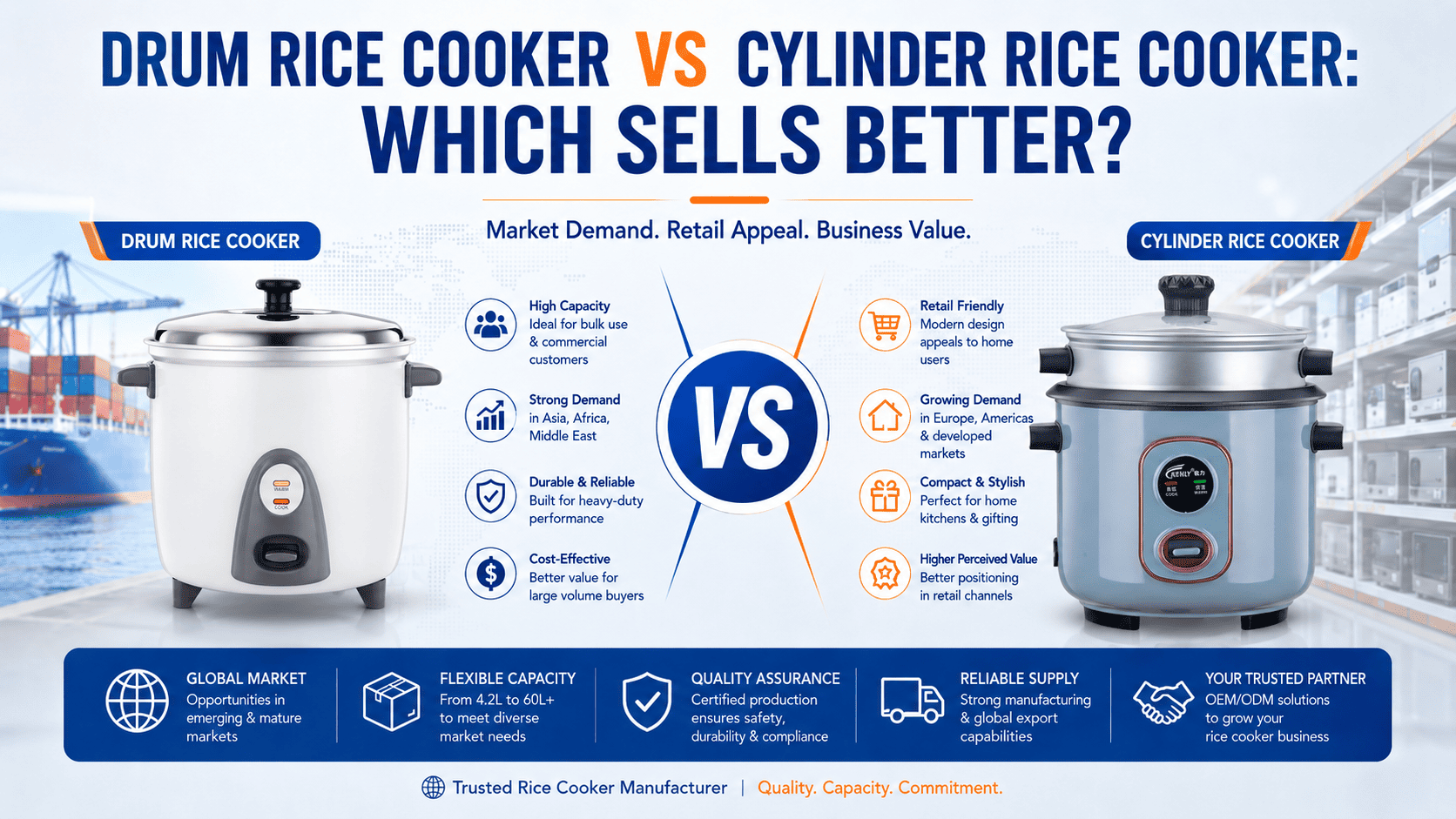
Every month I receive the same question from overseas buyers: "Which one sells better, drum or cylinder?" They expect a simple answer. But after fifteen years helping procurement managers choose rice cooker models, I know the real question is not which shape wins everywhere. The real question is which model fits your market, your channel, and your price.
There is no universal winner. Drum rice cookers and cylinder rice cookers both sell well in different markets and channels. The better choice depends on your target country, retail price band, sales channel, expected functions, and procurement risk tolerance. A procurement manager who defines these factors first will make a more profitable sourcing decision than one who only compares shape.
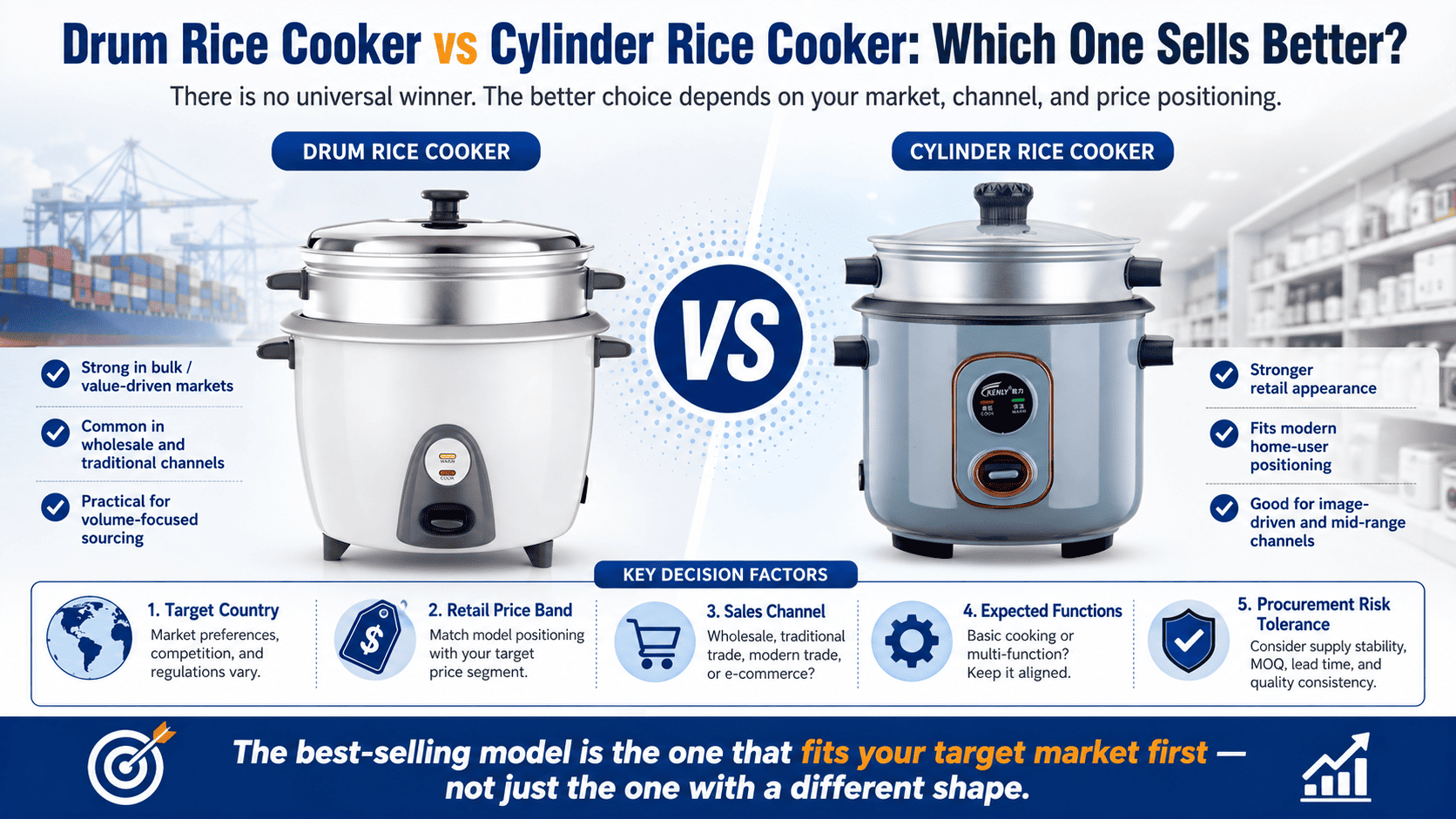
I work with brand owners and wholesalers from more than twenty countries. Many of them start the conversation with shape preference. But shape alone does not predict sales performance. The buyers who later place repeat orders are the ones who shift the conversation quickly. They tell me their market. They tell me their channel. They tell me their target retail price. Then we discuss which configuration matches those factors. That approach reduces after-sales problems and increases order confidence.
Why Does Shape Matter at All?
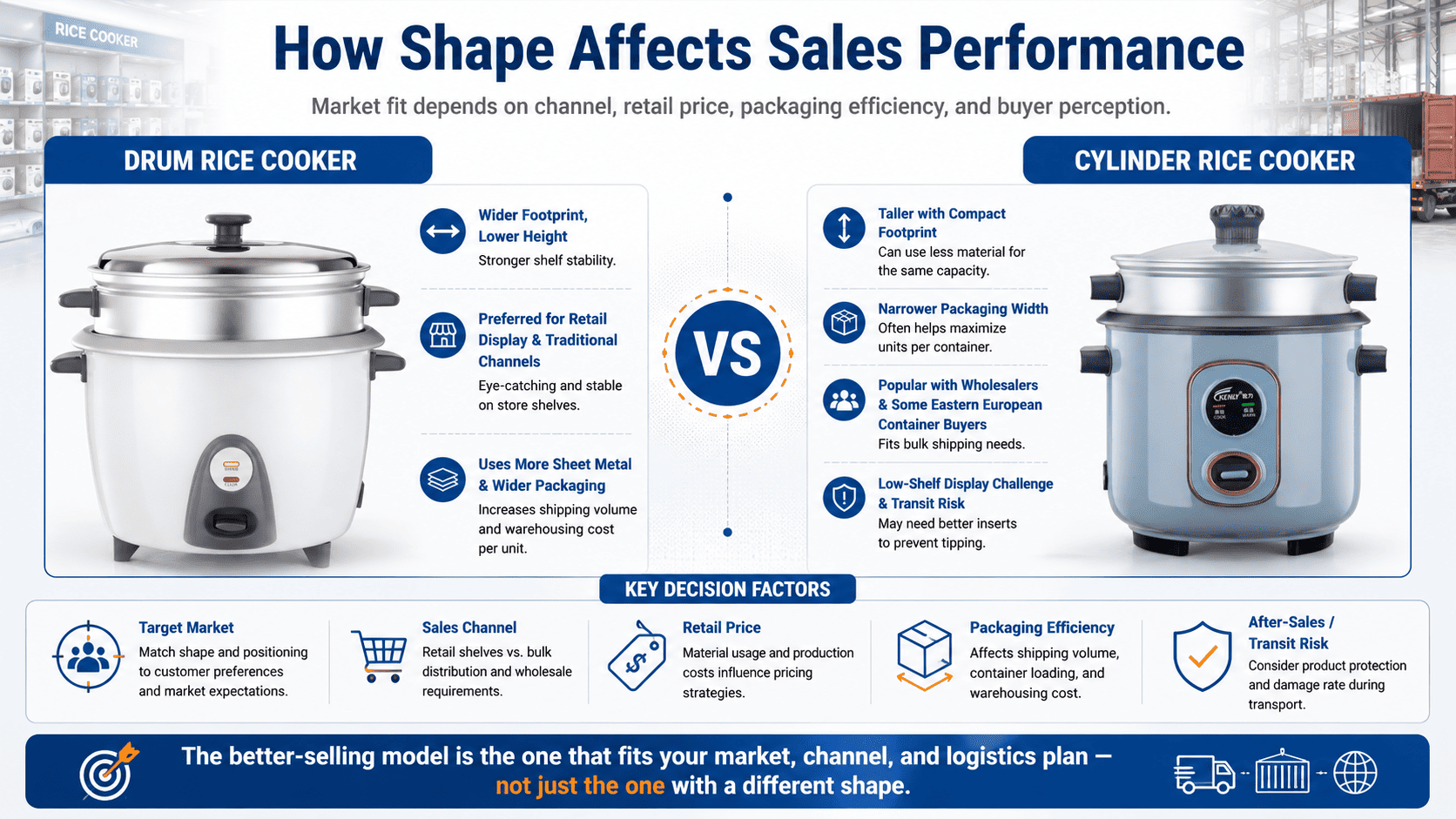
Shape is not decoration. The outer body design affects manufacturing cost, packaging size, shelf display area, and buyer perception. Drum rice cookers usually have a wider footprint and lower height. Cylinder rice cookers are taller and occupy less counter space. These differences influence both your procurement cost and your customer's buying decision.
Drum rice cookers often use more sheet metal and require wider packaging boxes.1 That increases shipping volume and warehousing cost per unit. But the lower profile fits better on retail shelves with limited vertical clearance. Some buyers tell me their retail partners prefer drum models because the stacked boxes are more stable during transport and display setup.
Cylinder rice cookers use less material for the same capacity because the vertical design is more compact. The taller shape reduces packaging width.2 Several wholesalers who ship containers to Eastern Europe choose cylinder models to maximize the number of units per container3. But the taller body sometimes creates display challenges in stores with low shelf height or requires different packaging inserts to prevent tipping during transit.
Cost and Material Differences by Shape
| Factor | Drum Rice Cooker | Cylinder Rice Cooker |
|---|---|---|
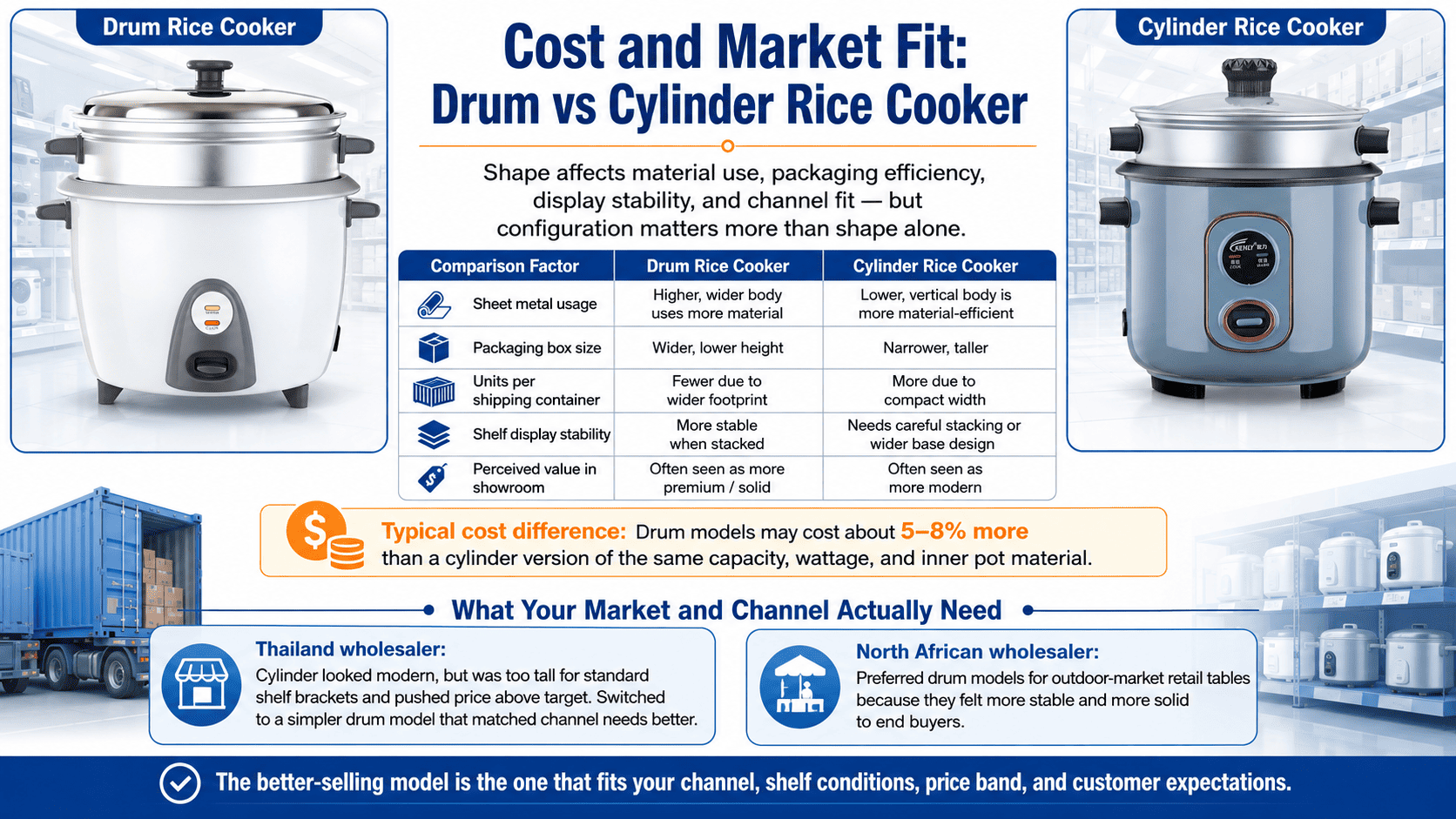
| Sheet metal usage | Higher, wider body requires more material | Lower, vertical design is more material-efficient |
| Packaging box size | Wider, lower height | Narrower, taller |
| Units per shipping container | Fewer due to wider footprint | More due to compact width |
| Shelf display stability | More stable when stacked | Requires careful stacking or wider base design |
| Perceived value in showroom | Some buyers say it looks more premium | Some buyers say it looks more modern |
The cost difference is not dramatic for most models. A drum rice cooker with the same capacity, wattage, and inner pot material may cost five to eight percent more than a cylinder version4 because of the additional sheet metal and larger packaging. But that difference disappears if you compare a basic drum model with a cylinder model that includes extra functions like preset timer or keep-warm indicator light. Configuration matters more than shape in the final purchase price.
What Your Market and Channel Actually Need?
Your target market and sales channel determine which model will perform better. A drum rice cooker that sells well in Middle Eastern hypermarkets may not move in Southeast Asian convenience chains. A cylinder model that works for European online retail may create returns in markets where customers expect different capacity or function sets.
I worked with a wholesaler in Thailand who wanted cylinder rice cookers because he believed they looked more modern. He ordered a sample. Then he tested it with three retail partners. Two partners said the model was too tall for their standard shelf brackets. The third partner said the capacity was fine but the price was above their target range because the cylinder model included functions their customers did not use. He switched to a drum model with simpler functions and lower cost. That model matched his channel needs and his price band. It sold better not because drum shape is superior but because the whole package matched the market.
Another buyer from a North African country preferred drum models for his wholesale business. He sold to small retailers who displayed products on tables during outdoor markets. The drum shape was more stable and did not tip over when customers picked up the box. He also told me his retail customers liked the wider body because it "felt more solid" when they held the packaging. That perception mattered in his channel. A cylinder model might have saved him container space but would not have matched his retailers' display habits or his end customers' tactile expectations.
Questions to Ask Before Choosing Shape
Before you decide between drum and cylinder rice cookers, answer these questions with your team or your retail partners:
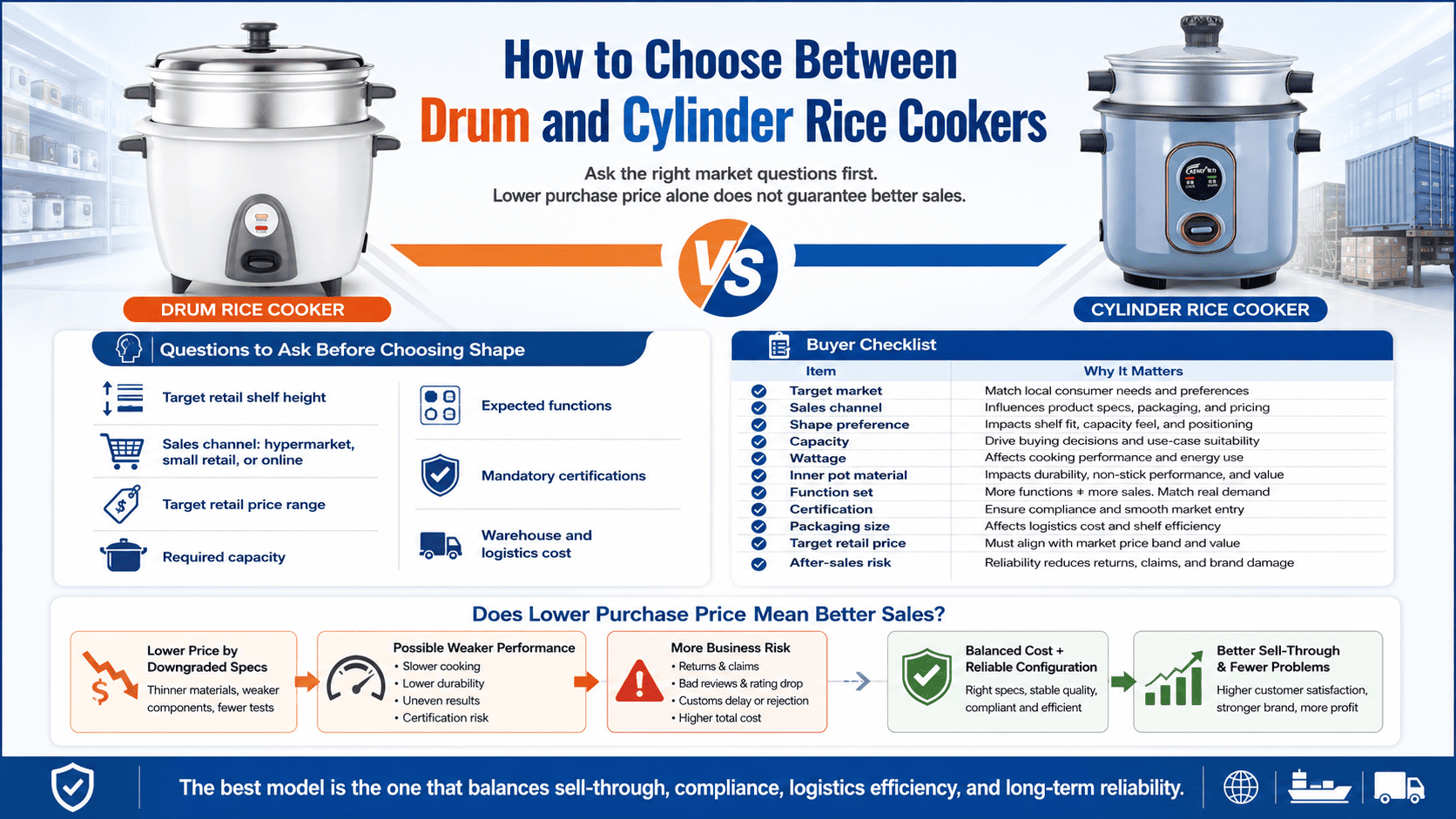
- What is the most common shelf height in your target retail stores?
- Do your customers buy rice cookers in hypermarkets, small retailers, or online?
- What is your target retail price range, not your purchase price, but the price your customer pays?
- What capacity do most households in your market need: one to three liters, three to five liters, or larger?
- Do your customers expect preset cooking modes, or do they prefer a simple on-off model?
- What certifications are mandatory in your country, such as CE, CB, GS, UKCA, KC, or others?
- How much warehouse space do you have, and how does packaging size affect your logistics cost?
If you cannot answer most of these questions clearly, then debating drum versus cylinder is premature. You are choosing a model without defining the problem. A responsible supplier will not promise one shape sells better until you provide this context.
Buyer Checklist: How to Choose Between Drum and Cylinder Rice Cookers
Before confirming a drum or cylinder rice cooker model, buyers should avoid comparing only appearance or unit price. A better approach is to evaluate the model from market fit, channel fit, logistics cost, certification risk, and after-sales risk.
Use this checklist before you finalize the model:
| Checklist Item | What to Confirm | Why It Matters |
|---|---|---|
| Target market | Country, region, household size, cooking habits, and common kitchen space | A model that sells well in one region may not fit another market. |
| Sales channel | Hypermarket, small retail shop, wholesaler, online platform, or project buyer | Shelf display, packaging size, and perceived value change by channel. |
| Shape preference | Drum or cylinder based on shelf height, display style, and customer perception | Shape affects both visual appeal and logistics efficiency. |
| Capacity | 1.8L, 2.2L, 2.8L, 3.0L, 5.0L, or larger capacity | Capacity must match family size and local cooking habits. |
| Wattage | Power level matched with capacity and voltage | Too-low wattage causes long cooking time; too-high wattage increases cost. |
| Inner pot material | Aluminum non-stick, stainless steel, or other material | This affects price, durability, cooking result, and customer complaints. |
| Function set | Basic cook/keep-warm, indicator light, timer, steam function, or digital control | Extra functions only make sense if the market is willing to pay for them. |
| Certification | CE, CB, GS, UKCA, KC, RoHS, or local market requirements | Missing certification can delay customs clearance or block retail sales. |
| Packaging size | Color box size, master carton size, and container loading quantity | Shape and packaging dimensions affect freight cost per unit. |
| Target retail price | The price your customer will pay in store or online | Procurement price should be calculated backward from retail price and margin. |
| After-sales risk | Warranty period, spare parts, common complaints, and replacement cost | A low purchase price may become expensive if quality is unstable. |
A practical sourcing decision should answer one question clearly: which model gives your buyer the best balance between sell-through, compliance, logistics efficiency, and long-term reliability?
Does Lower Purchase Price Mean Better Sales?
Many buyers focus on getting the lowest purchase price per unit. That makes sense for cost control. But if cost reduction comes from downgraded materials, inconsistent quality, or missing certifications, the model may create after-sales problems that cost more than the initial savings. Better sales performance requires both competitive price and reliable product consistency.
I have seen this pattern many times. A buyer asks for a quotation on a drum rice cooker with stainless steel inner pot, 700-watt heating element, and CE certification. I provide the price. The buyer then asks if we can reduce the price by switching to an aluminum inner pot, lowering the wattage, or skipping certain quality tests. Sometimes the buyer does not realize that these changes affect cooking performance, durability, or compliance. Sometimes the buyer knows but believes the end customer will not notice.
The problem appears later. If the aluminum inner pot dents easily or the lower wattage increases cooking time too much5, customers return the product or leave bad reviews. If the model does not pass local safety inspections, the entire shipment may be held at customs. The buyer loses the selling season, pays storage fees, and sometimes has to re-order with corrected specifications. The total cost is higher than if they had chosen the slightly more expensive configuration from the start.
Cost Reduction That Makes Sense vs Cost Reduction That Creates Risk
Not all cost reduction is dangerous. Some changes lower price without increasing risk.
Safe cost adjustments:
- Simplifying the control panel from digital display to mechanical switch if your market does not expect digital controls
- Reducing packaging decoration or switching to a plainer box design if your channel is wholesale rather than premium retail
- Choosing a drum or cylinder shape that uses less material for the same capacity if the shape fits your market's display and perception needs
- Ordering a higher volume to achieve a lower unit price if you have verified demand and warehouse capacity
Risky cost adjustments:
- Changing the inner pot material from stainless steel to aluminum without testing customer acceptance or durability in your market
- Reducing wattage below the level needed to cook rice properly for the stated capacity
- Skipping mandatory safety certifications to save on testing fees
- Switching to a less experienced supplier just because the quoted price is ten percent lower, without checking their quality control process or order history
A procurement manager who understands these differences protects their company from after-sales costs and delays. A supplier who explains these tradeoffs honestly builds long-term relationships with buyers who value reliability over the lowest possible quote.
How Do Capacity and Configuration Interact With Shape?
Shape does not exist in isolation. A three-liter drum rice cooker behaves differently in the market than a five-liter drum model. A cylinder rice cooker with a keep-warm function competes in a different price band than a cylinder model with only basic on-off control. Buyers need to evaluate shape together with capacity, wattage, inner pot material, functions, and certifications.
Capacity is the first variable that matters as much as shape. In my experience, buyers from Southeast Asia often request 1.8-liter or 2.2-liter models because households are smaller and kitchens have limited counter space6. Buyers from Middle Eastern and North African markets usually ask for 2.8-liter to 5-liter models because families are larger and rice is served at most meals7. If you choose a drum or cylinder shape that does not match the expected capacity in your market, the model will not sell regardless of how attractive the shape is.
Wattage must match capacity. A 2.8-liter rice cooker with only 500 watts will take too long to cook a full pot. Customers will complain. A 1.8-liter rice cooker with 900 watts is over-engineered and adds unnecessary cost. The right wattage range depends on capacity and your market's voltage standard. We usually recommend 600 to 700 watts for 1.8 to 2.5-liter models and 700 to 900 watts for 2.8 to 5-liter models. Some buyers ask for higher wattage because they think it sounds impressive in marketing. But if the higher wattage does not improve cooking time or performance noticeably, it only increases the purchase price and the energy consumption disclosure on the packaging.
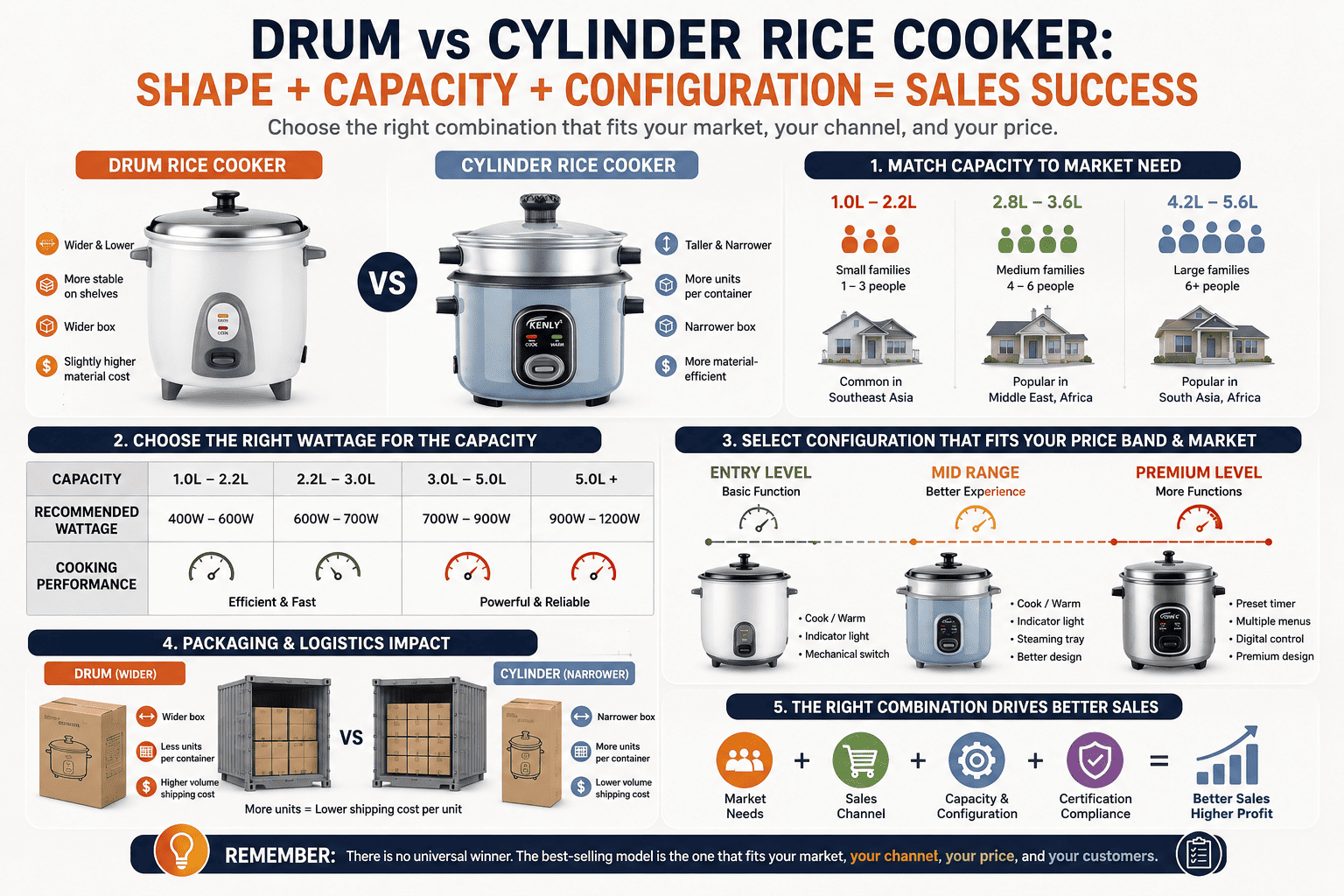
Configuration Matrix Example
Here is a simplified example of how shape, capacity, and functions combine into different configurations. This table does not represent every possible model, but it shows the type of thinking a buyer should use:
| Model Type | Shape | Capacity | Wattage | Inner Pot | Functions | Typical Market Fit |
|---|---|---|---|---|---|---|
| Basic drum | Drum | 1.8L | 600W | Aluminum non-stick | Cook, keep-warm | Budget-conscious Southeast Asia, small households |
| Standard drum | Drum | 2.8L | 700W | Stainless steel | Cook, keep-warm, indicator light | Middle Eastern wholesale, mid-range retail |
| Premium drum | Drum | 5L | 900W | Stainless steel | Cook, keep-warm, preset timer, steam function | Large families, higher price band, showroom retail |
| Basic cylinder | Cylinder | 1.8L | 600W | Aluminum non-stick | Cook, keep-warm | Online retail, compact kitchen markets |
| Standard cylinder | Cylinder | 2.8L | 700W | Stainless steel | Cook, keep-warm, indicator light | European small appliance chains, space-saving preference |
| Premium cylinder | Cylinder | 5L | 900W | Stainless steel | Cook, keep-warm, preset timer, multi-grain mode | High-end retail, customers who value modern design and functions |
A buyer who requests "the cylinder rice cooker that sells best" is really asking for one row in this matrix. But which row? The answer depends on target capacity, price band, functions, and market. A supplier who helps the buyer identify the right row is more useful than a supplier who simply says "cylinder models are popular."
What About Certifications and Compliance?
Certifications are not optional extras. They are mandatory market entry requirements in most countries. A rice cooker that does not carry the required safety and energy marks cannot be sold legally, regardless of whether it is drum or cylinder shape. Procurement managers must confirm which certifications apply to their target market before selecting any model.
The certifications we handle most often are CE, CB, GS, UKCA, KC, RoHS, and Energy Star. Each certification has different testing requirements and costs. CE is required for the European Economic Area. UKCA is now required for Great Britain after Brexit. KC is required for South Korea.8 GS is a voluntary German safety mark that some European retailers demand. Energy Star is voluntary but helps with marketing in North America9 and some other markets. RoHS restricts hazardous substances and applies in Europe and several other regions.10
Buyers sometimes tell me they want to skip certain certifications to reduce cost. I explain that skipping mandatory certifications is not a cost reduction strategy. It is a risk that can result in customs rejection, fines, product recalls, or legal liability if a product causes injury. Skipping voluntary certifications like GS or Energy Star is a business decision. If your retail partners do not require those marks and your customers do not expect them, you can save the testing cost. But if your competitors carry those marks and your product does not, you may lose shelf space or online visibility.
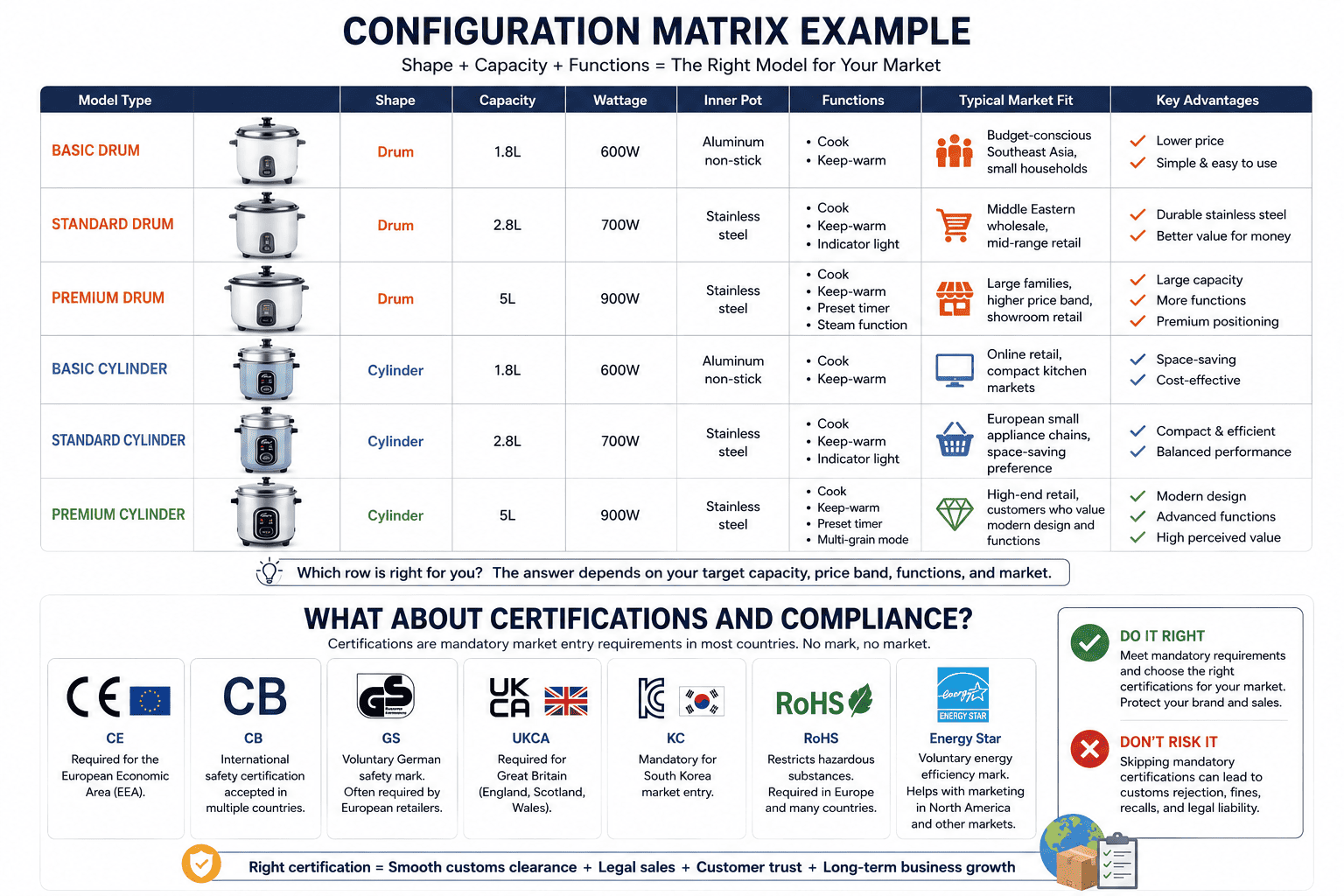
Typical Certification Requirements by Region
| Region | Mandatory Certifications | Common Voluntary Certifications | Notes |
|---|---|---|---|
| European Union | CE, RoHS | GS, Energy label | CE marking is self-declared but must be backed by test reports |
| United Kingdom | UKCA, RoHS | Energy label | UKCA replaced CE for GB market after Brexit |
| South Korea | KC | Energy label | KC safety certification is strictly enforced |
| North America | Varies by product category and voluntary standards | Energy Star, ETL, UL | Requirements differ between USA and Canada |
| Middle East, North Africa | Varies by country | Local energy labels | Check specific country requirements before shipping |
If you are sourcing rice cookers for multiple countries, you may need several certifications. We maintain CE, CB, GS, UKCA, KC, and RoHS compliance on most of our standard models. When a buyer orders a customized configuration, we discuss which certifications apply and whether any additional testing is required. This planning step happens during sampling, before mass production. Buyers who skip this step sometimes discover compliance gaps after the goods arrive at the destination port. That delay is expensive and avoidable.
Certification Requirements Buyers Should Confirm Before Choosing a Model
Certification should not be checked after you have already selected the rice cooker shape and configuration. Shape, capacity, wattage, plug type, inner pot material, label information, and manual language can all affect the certification and compliance process.
Before confirming a drum or cylinder rice cooker, buyers should check these requirements:
| Requirement Area | What to Check | Buyer Risk If Ignored |
|---|---|---|
| Electrical safety | CE, CB, GS, UKCA, KC, or local safety approval | Customs delay, retailer rejection, or legal compliance problems |
| Restricted substances | RoHS or other hazardous substance requirements | Product may fail market access requirements in regulated markets |
| Plug and voltage | 220–240V, 110–120V, BS plug, EU plug, KC plug, or other local plug type | Product may not be suitable for household use in the destination market |
| Rating label | Model number, voltage, frequency, power, capacity, warning marks | Incorrect labels can create customs or after-sales disputes |
| User manual | Required language, safety warnings, usage instructions, importer details | Retailers or authorities may require relabeling or reprinting |
| Packaging marks | Certification logos, barcode, recycling mark, energy label, importer information | Wrong or missing packaging information can block retail listing |
| Test report scope | Whether the selected model, wattage, plug, and configuration are covered | A certificate for one model may not cover a customized version |
| Factory documentation | BOM, circuit diagram, product photos, label artwork, and test samples | Missing documents can delay certification application or renewal |
For example, a buyer selling in Europe should confirm CE, RoHS, voltage, plug type, EU importer information, rating label, and manual language before mass production. A buyer selling in South Korea should confirm KC certification and Korean labeling requirements. A buyer selling in the Middle East should check whether CE/CB is accepted or whether a local conformity process is required.
The safest approach is to confirm certification requirements during the quotation and sampling stage. If the buyer changes wattage, plug type, heating element, thermostat, PCB, or inner pot after certification planning, the existing test report may no longer be enough.
How Do Sampling and Testing Reduce Procurement Risk?
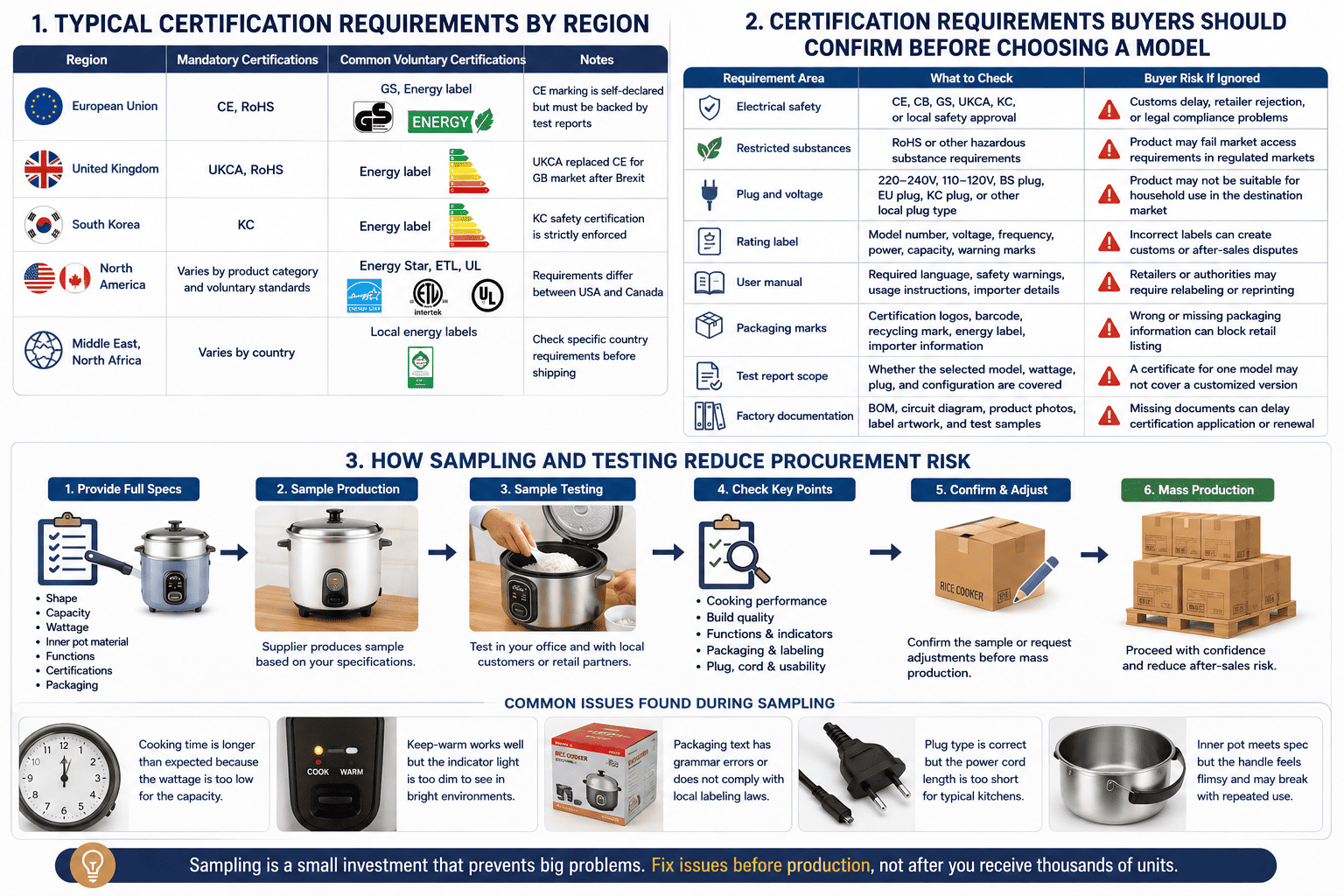
Sampling is not just about checking appearance. It is the stage where you verify that the supplier's standard configuration matches your market needs, test the product under realistic conditions, and identify any adjustments needed before mass production. Buyers who skip sampling or treat it as a formality increase the risk of after-sales problems and repeat negotiations.
When a buyer requests a sample, I ask for the full specification they have in mind: shape, capacity, wattage, inner pot material, functions, certifications, and packaging requirements. Then I provide a sample that matches those specs or explain which specs need adjustment based on our manufacturing constraints or certification scope. The buyer tests the sample in their office and ideally with a few local customers or retail partners. They check cooking performance, build quality, packaging condition after simulated transport, and whether the product matches local expectations.
Common issues found during sampling:
- The cooking time is longer than expected because the wattage is too low for the capacity.
- The keep-warm function maintains temperature well but the indicator light is too dim to see in bright retail environments.
- The packaging box is sturdy but the printed text has grammar errors or does not comply with local labeling laws.
- The plug type is correct but the power cord length is too short for typical kitchen layouts in the target market.
- The inner pot is stainless steel as specified but the handle feels flimsy and may break with repeated use.
These issues are easy to fix before mass production. They are expensive and disruptive to fix after you receive five thousand units. Buyers who invest time in thorough sampling save much more time and money later.
What to Test During Sampling
A useful sampling process includes these checks:
Functional testing:
- Cook rice with the typical rice variety used in your market, such as jasmine, basmati, short-grain, or long-grain rice.
- Measure actual cooking time and compare it with the claimed cooking time.
- Test the keep-warm function for at least four hours and check rice texture and moisture.
- Try all buttons, switches, and indicator lights to confirm they work reliably.
- Check whether the inner pot handle, lid handle, and outer body stay comfortable during normal use.
Build quality inspection:
- Inspect the inner pot for scratches, dents, uneven coating, or weak finishing.
- Check the lid seal and steam vent for proper fit and alignment.
- Verify that the power cord and plug are firmly attached and match your country's plug standard.
- Test the feet or base for stability on a flat surface.
- Look for sharp edges, loose parts, poor plastic molding, or weak handles.
Packaging and labeling review:
- Confirm that the packaging box, inner foam, and instruction manual match the selected model.
- Check whether the model number, capacity, voltage, power, plug type, and barcode are consistent.
- Review the rating label, manual, color box, and carton mark together.
- Confirm whether the packaging size affects container loading quantity.
- Check whether the packaging can protect the rice cooker during normal sea freight and warehouse handling.
Compliance review:
- Confirm whether the sample matches the certification scope.
- Check whether the plug, voltage, rating label, and manual language meet the target market requirements.
- Ask whether any customized change requires additional testing.
- Keep sample photos and test records for future production comparison.
Sampling should not be treated as a formality. It is the buyer's opportunity to find problems when they are still easy to fix.
Factory Capability: What a Reliable Supplier Should Support
Choosing between drum and cylinder rice cookers is not only a product decision. It is also a supplier capability decision. A good factory should help buyers compare model shape, capacity, cost, certification, packaging, and production stability together.
A reliable rice cooker factory should support the following capabilities:
| Factory Capability | What It Means for Buyers |
|---|---|
| OEM/ODM model selection | The factory can recommend drum or cylinder models based on target market, capacity, price band, and channel. |
| Multiple capacity options | The factory can support common capacities such as 1.8L, 2.2L, 2.8L, 3.0L, and larger family-size models. |
| Component matching | The factory understands how to match wattage, thermostat, heating plate, inner pot, lid, and body structure. |
| Certification support | The factory can help buyers prepare documents for CE, CB, GS, UKCA, KC, RoHS, or other market requirements. |
| Packaging calculation | The factory can calculate color box size, master carton size, and container loading quantity before order confirmation. |
| Sample testing support | The factory can provide samples for cooking tests, packaging review, and market feedback. |
| Incoming material inspection | Key parts such as inner pots, heating plates, thermostats, plugs, wires, and plastic parts are checked before assembly. |
| In-line quality control | The factory checks assembly quality during production instead of only at final inspection. |
| 100% electrical testing | Each unit is tested for high voltage, power, basic function, and safety before packing. |
| After-sales feedback tracking | The factory records repeated complaints and improves future batches. |
A supplier who only says "drum sells better" or "cylinder sells better" is not giving enough guidance. A stronger supplier should be able to explain why one model fits your country, sales channel, retail price, certification needs, and logistics plan better than the other.
Common Mistakes When Choosing Drum or Cylinder Rice Cookers
Many sourcing mistakes happen because buyers compare models too narrowly. They look at shape, price, or sample appearance, but ignore the market and execution details behind the order.
Mistake 1: Asking which shape sells better without defining the market
Drum and cylinder rice cookers can both sell well. The real issue is whether the shape fits the target country, sales channel, display method, kitchen space, and retail price band. A model that works in a Middle Eastern hypermarket may not work for an online seller in Europe.
Mistake 2: Choosing the lower price without checking configuration
A cheaper quotation may come from lower wattage, thinner material, simpler inner pot, weaker packaging, or missing certification. Buyers should compare the full configuration, not only the shape and unit price.
Mistake 3: Ignoring packaging and loading quantity
Drum rice cookers and cylinder rice cookers use different box dimensions. A model with a slightly lower purchase price may become more expensive after freight if it reduces container loading quantity. Always compare carton size and loading quantity before confirming the order.
Mistake 4: Treating certification as a later issue
Certification should be checked before model confirmation. If the buyer changes plug type, voltage, wattage, thermostat, or PCB later, the existing certificate may not cover the final product. This can delay shipment or create customs problems.
Mistake 5: Not testing local cooking habits
Different markets use different rice varieties and cooking habits. A sample should be tested with the rice type commonly used in the buyer's market. Cooking time, water ratio, keep-warm performance, and rice texture should all be checked.
Mistake 6: Choosing functions that the market will not pay for
Digital display, preset timer, steam function, or multi-grain mode may look attractive, but they also increase cost. If the target market mainly wants a simple, durable, low-cost model, unnecessary functions can reduce competitiveness.
Mistake 7: Copying a competitor's model without understanding why it sells
A competitor's drum or cylinder model may sell well because of brand awareness, retail channel, price promotion, or packaging, not only because of shape. Buyers should analyze the full product offer before copying it.
FAQ About Drum Rice Cookers and Cylinder Rice Cookers
1. Which sells better, drum rice cooker or cylinder rice cooker?
There is no universal answer. Drum rice cookers and cylinder rice cookers both sell well in different markets. The better choice depends on your target country, sales channel, retail price, capacity, function requirements, and logistics cost.
2. Is a drum rice cooker more expensive than a cylinder rice cooker?
In many cases, a drum rice cooker may cost slightly more because the wider body can require more material and larger packaging. But the final price depends more on capacity, wattage, inner pot material, certification, packaging, and function set than shape alone.
3. Is a cylinder rice cooker better for container loading?
Often, yes. Cylinder rice cookers usually have a narrower packaging footprint, which may help improve container loading quantity. However, the actual loading result depends on the final carton size, master carton design, and stacking method.
4. Which shape is better for supermarket sales?
Drum rice cookers can work well in supermarkets because the wider and lower shape may look stable on shelves. Cylinder rice cookers can also work if the store shelf height and packaging design fit the display requirements. Buyers should confirm shelf size and retailer preference before choosing.
5. Which shape is better for online sales?
Cylinder rice cookers may be attractive for online sales because of compact packaging and modern appearance. However, online sellers should also consider product photos, customer reviews, packaging protection, return rate, and shipping cost.
6. What capacity should I choose for my market?
For smaller households or compact kitchens, 1.8L to 2.2L models are often more practical. For larger families, wholesale markets, or Middle Eastern and African markets, 2.8L to 5.0L models may be more suitable. The final choice should match local household size and cooking habits.
7. Should I choose stainless steel inner pot or aluminum non-stick inner pot?
Stainless steel inner pots can improve durability and perceived value, but they usually cost more. Aluminum non-stick inner pots are cost-effective and widely used, but coating quality must be checked carefully. The right choice depends on retail price and customer expectations.
8. Can one model be sold in multiple countries?
Yes, but buyers must confirm certification, plug type, voltage, label, manual language, packaging information, and local market preferences. A model that works technically may still need different packaging or compliance documents for different countries.
9. Should I start with a drum model or a cylinder model for a new market?
For a new market, start with the model that best matches your sales channel and target price. If you are unsure, test one simple configuration first, collect customer feedback, and then expand to more shapes or capacities in the second order.
10. What should I ask the factory before placing an order?
Ask about capacity, wattage, inner pot material, plug type, certification coverage, carton size, loading quantity, sample testing, quality control process, and after-sales support. Do not ask only which shape sells better.
Conclusion
Drum rice cookers and cylinder rice cookers are both workable options for overseas buyers. The right choice is not decided by shape alone. It is decided by market demand, sales channel, capacity, wattage, function set, certification, packaging, and logistics cost.
If your retail partners prefer a stable shelf display and your customers associate a wider body with stronger value, a drum rice cooker may be a better fit. If your market values compact design, modern appearance, and better loading efficiency, a cylinder rice cooker may be more suitable.
For procurement managers, the best decision comes from a complete comparison: model shape, configuration, compliance, packaging, cost, and after-sales risk. Once these factors are clear, the choice between drum and cylinder becomes much easier.
"Sheet metal - Wikipedia", https://en.wikipedia.org/wiki/Sheet_metal. Geometric principles demonstrate that for equivalent internal volumes, cylindrical containers require less surface material than rectangular containers due to the mathematical relationship between surface area and volume in different geometric forms. Evidence role: mechanism; source type: education. Supports: the geometric principle that cylindrical shapes require less surface area than rectangular shapes for equivalent volumes. Scope note: This supports the general principle but does not specifically address rice cooker manufacturing contexts or account for structural reinforcement requirements. ↩
"Horizontal vs Vertical Packaging", https://www.spackmachine.com/difference-between-horizontal-packaging-machine-vs-vertical-packaging-machine/. Packaging engineering principles indicate that product orientation directly affects outer packaging dimensions, with vertically oriented products typically requiring narrower but taller boxes, which can influence shipping density and storage configurations. Evidence role: mechanism; source type: education. Supports: how product orientation affects packaging dimensions and shipping efficiency. ↩
"Load deflection characteristics of square and rectangular archwires", https://pubmed.ncbi.nlm.nih.gov/26826971/. Logistics research demonstrates that packaging footprint dimensions significantly impact container utilization rates, with narrower packages potentially allowing more efficient stacking patterns depending on container dimensions and loading configurations. Evidence role: general_support; source type: research. Supports: how packaging dimensions affect container loading efficiency. Scope note: Actual container efficiency depends on multiple factors including total package dimensions, stacking strength, and specific container types, not solely on footprint width. ↩
"Investigation of home appliances industry and devices ... - PMC", https://pmc.ncbi.nlm.nih.gov/articles/PMC11300863/. Manufacturing cost studies indicate that material usage represents a significant component of small appliance production costs, with body design affecting both raw material quantities and fabrication complexity. Evidence role: general_support; source type: research. Supports: the relationship between material usage and manufacturing costs in small appliance production. Scope note: This provides context for cost differentials but does not verify the specific 5-8% figure cited for rice cooker shape variations. ↩
"Heat - Wikipedia", https://en.wikipedia.org/wiki/Heat. Thermodynamic principles establish that the time required to heat a substance to a target temperature is inversely related to the power input, with lower wattage heating elements requiring proportionally longer times to deliver the same thermal energy to a given mass. Evidence role: mechanism; source type: education. Supports: the relationship between electrical heating power and the time required to heat a given mass of material. ↩
"List of Asian countries by population - Wikipedia", https://en.wikipedia.org/wiki/List_of_Asian_countries_by_population. Demographic data from Southeast Asian countries show trends toward smaller household sizes in urban areas, with housing surveys indicating that kitchen spaces in urban apartments are often compact compared to Western standards. Evidence role: statistic; source type: institution. Supports: household size trends and urban housing characteristics in Southeast Asian countries. Scope note: This provides regional context but household size and kitchen dimensions vary significantly across Southeast Asian countries and between urban and rural areas. ↩
"Population, total - Middle East, North Africa, Afghanistan & Pakistan", https://data.worldbank.org/indicator/SP.POP.TOTL?locations=ZQ. Demographic surveys from Middle Eastern and North African countries indicate larger average household sizes compared to many other regions, while dietary studies show rice as a staple food in many MENA cuisines, though consumption patterns vary by country and subregion. Evidence role: statistic; source type: institution. Supports: household size patterns and dietary habits in Middle Eastern and North African regions. Scope note: This provides general regional trends but household sizes and dietary patterns vary considerably across the diverse countries within the MENA region. ↩
"Achieving EC Certification: The Ultimate Guide to EU ...", https://imba.missouri.edu/ec-certification-3365674872.html. Regulatory frameworks in the European Economic Area require CE marking for electrical appliances, the United Kingdom requires UKCA marking following Brexit, and South Korea mandates KC certification, each representing conformity with regional safety and electromagnetic compatibility standards. Evidence role: general_support; source type: government. Supports: the mandatory certification requirements for electrical appliances in the European Economic Area, United Kingdom, and South Korea. ↩
"ENERGY STAR Awareness", https://www.energystar.gov/partner-resources/awareness. The Energy Star program, a joint initiative of the U.S. Environmental Protection Agency and Department of Energy, has achieved significant consumer recognition in North America, with program documentation indicating that the label influences purchasing decisions for energy-efficient products. Evidence role: general_support; source type: government. Supports: the Energy Star program's recognition and influence on consumer purchasing in North America. Scope note: While the program has high recognition, the specific marketing benefit varies by product category and target consumer segment. ↩
"European Union Reduction of Hazardous Substances RoHS and ...", https://www.waru.edu/artifact/european-union-reduction-hazardous-substances-rohs-and-waste-electrical-and-electronic. The RoHS Directive restricts the use of specific hazardous materials found in electrical and electronic products, including lead, mercury, cadmium, and certain flame retardants, and applies to products sold in the European Union with similar regulations adopted by other jurisdictions. Evidence role: definition; source type: government. Supports: the purpose and scope of RoHS (Restriction of Hazardous Substances) regulations. ↩