I work in pre-sales technical support for commercial rice cookers, and the most expensive conversation I have with restaurant buyers isn't about price—it's the one where they realize, three months after purchase, that they ordered too small. A café owner in Bangkok once told me his 20-cup cooker worked perfectly until his first weekend promotion, when he spent two hours cooking rice in batches while customers waited. He called asking if we could upgrade his machine. I had to explain that commercial rice cookers don't have upgrade paths—he needed to buy a second unit or replace the existing one entirely.
The real challenge in choosing between 20, 30, and 40 cup commercial rice cookers isn't understanding the specifications—it's correctly identifying your peak demand rather than your average daily needs. Restaurants that size equipment based on typical weekday lunch crowds consistently run into capacity problems during weekend rushes, holidays, and promotional events, forcing them to either delay service or purchase additional units within 3–6 months of operation.
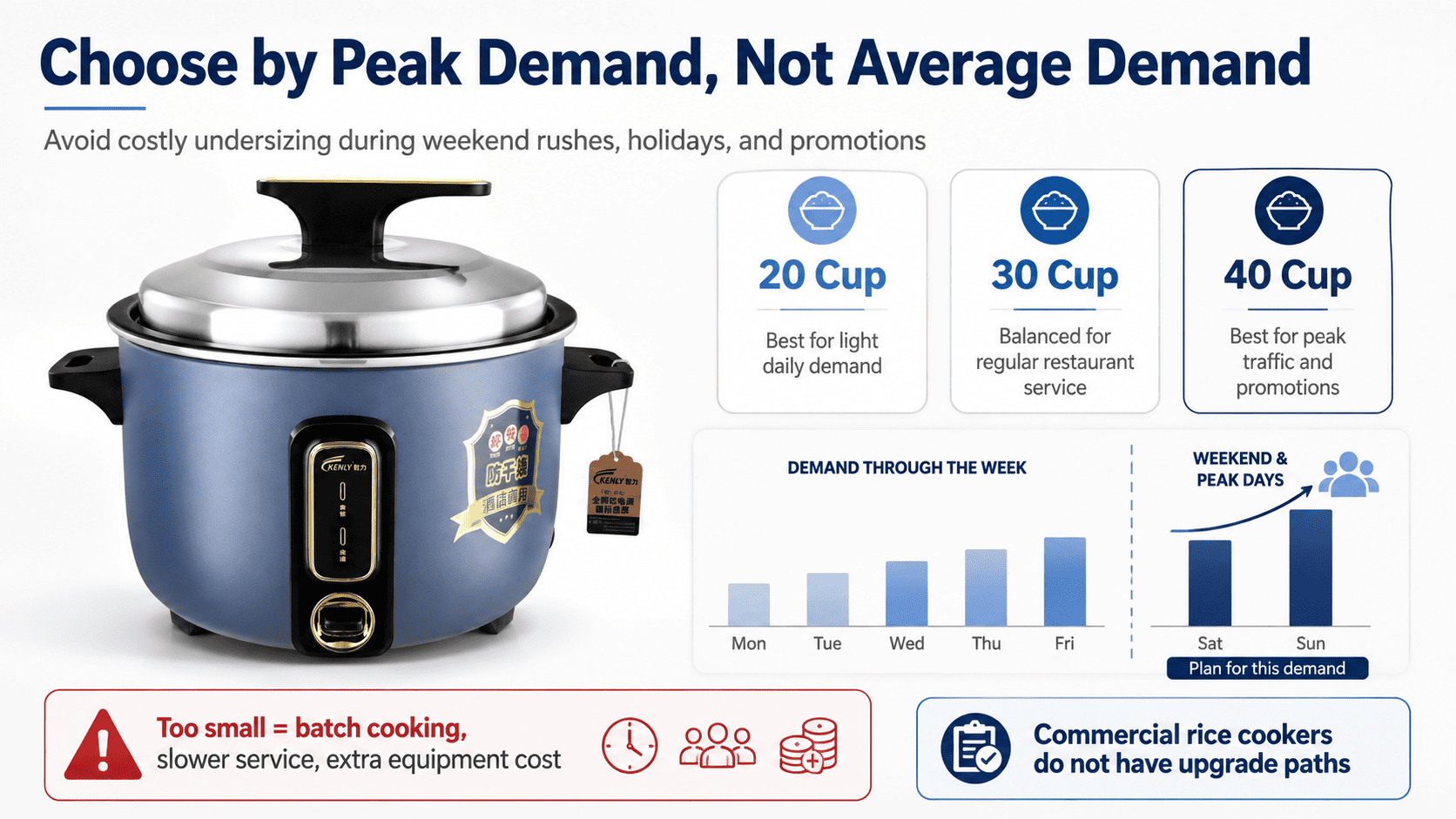
Most buyers approach this decision by looking at their average daily customer count and matching it to a capacity chart. That approach sounds logical, but I've watched it fail repeatedly in real purchasing scenarios.
The actual question you need to answer isn't:
"How many people do I serve on a typical Tuesday?"
It's:
"What's the maximum amount of cooked rice I need ready at the same time during my busiest service period?"
Those are completely different numbers, and confusing them is what leads to undersized equipment.
What Do 20, 30, and 40 Cups Actually Mean in Commercial Rice Cookers?
When I ask a potential customer how many people they need to serve, they usually give me a number immediately. When I ask them what they think "20 cups" means, I get much longer pauses.
The cup measurement on commercial rice cookers refers to uncooked rice capacity, not the volume of cooked rice you'll get out.
One cup of raw rice typically produces about 2–2.5 cups of cooked rice, depending on the rice variety and water ratio. This already creates confusion because customers often calculate:
"I serve 50 people lunch, each person gets one cup of rice, so I need a 50-cup cooker."
That calculation treats cups as servings, which drastically oversizes the equipment.
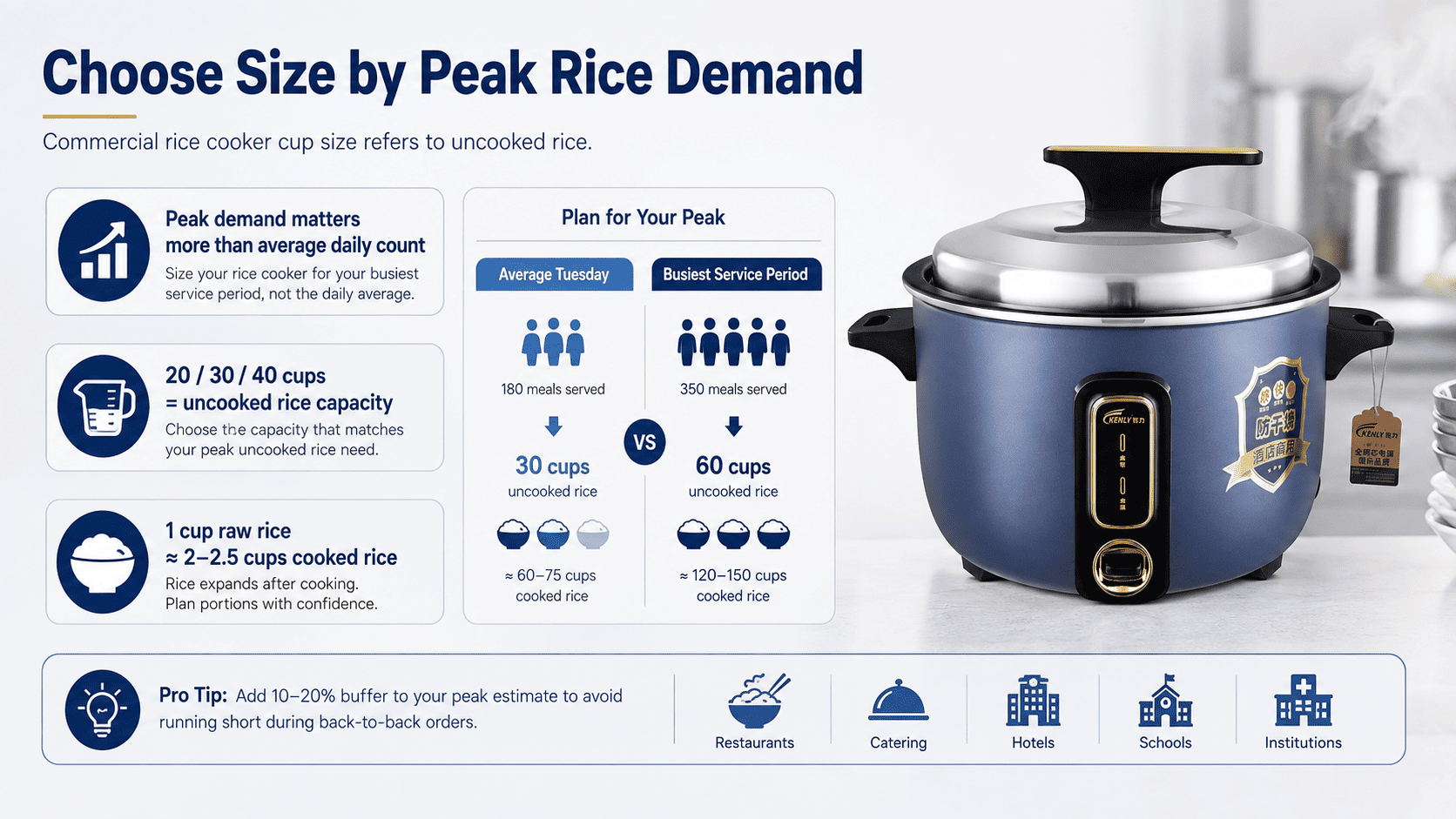
The second complication: not all manufacturers use the same cup volume.
Some brands use 180ml cups, others use 200ml cups. A "30 cup" cooker from one manufacturer might have roughly the same actual capacity as a "27 cup" model from another brand.
When I'm working with buyers who are comparing quotes from multiple suppliers, I always ask them to request:
- Measuring cup volume
- Inner pot liter capacity
- Maximum raw rice weight
- Recommended working capacity
Do not compare suppliers using the cup number alone.
The third layer buyers often miss is rated capacity versus usable capacity.
A 40-cup commercial rice cooker has a safety margin built in—you shouldn't automatically fill it completely to the maximum line for every batch.
Most commercial units perform better when the actual loading allows enough space for water expansion, steam circulation, and rice expansion during cooking.
So if your operation consistently needs almost the full rated capacity, you should discuss the recommended working load with the manufacturer rather than assuming the maximum marking is the ideal daily operating level.
Why "Cup Count" Creates Purchasing Mistakes
In my pre-sales conversations, I've noticed that the cup measurement system actually encourages buyers to think in terms of unit counts rather than operational workflow.
A restaurant owner will say:
"I serve 60 customers at lunch."
Then they try to translate that directly into a cooker size without considering:
- Do all 60 customers eat rice?
- Do they arrive simultaneously or over a two-hour window?
- How much rice constitutes one serving in their menu?
- Are portions 120g, 180g, or 250g?
- Is rice free-refill?
- Do customers order takeaway portions?
- Do they need backup rice ready if the first batch runs out?
- Can the kitchen cook another batch during service?
These questions reveal whether someone is choosing equipment based on real kitchen operations or just matching numbers to numbers.
The purchasing error I see most frequently is simple:
Buyers confuse their daily total customer count with their peak simultaneous rice demand.
A small restaurant might serve 100 customers throughout the day, but if 60 of those customers arrive during a 90-minute dinner rush, the equipment-sizing requirement changes completely.
How Do You Calculate Your Restaurant's Actual Peak Rice Demand?
When someone contacts me asking whether they should choose a 20, 30, or 40 cup model, the first thing I do is stop them from giving me their average customer numbers.
Average numbers hide the problem.
Instead, I ask questions that force them to think about operational reality rather than daily totals.
The most important question is:
"What's the maximum number of customers you serve in a single service period, and how much rice does each customer get?"
Notice I'm not asking about daily volume.
I'm asking about the busiest single lunch or dinner service.
A restaurant might serve 150 customers per day, but if 45 of those show up between 12:00 PM and 1:00 PM, that's the number that determines equipment size.
The second critical question is:
"Do you cook rice in batches throughout service, or do you need the full amount ready before service starts?"
Some restaurants cook fresh rice repeatedly during service.
Others need one large batch ready before opening because the kitchen cannot handle additional rice cooking during the rush.
If you're comfortable cooking several batches, a smaller cooker may work.
If you need everything ready simultaneously, you need more capacity.
The third question is:
"What's your weekend and holiday volume compared to weekdays?"
I've worked with restaurant buyers who calculated their needs based on Tuesday lunch numbers, then discovered their Saturday dinner service was double or triple that volume.
You don't size commercial equipment for your quietest day.
You size it for your busiest predictable service period.
The Calculation Method I Walk Customers Through
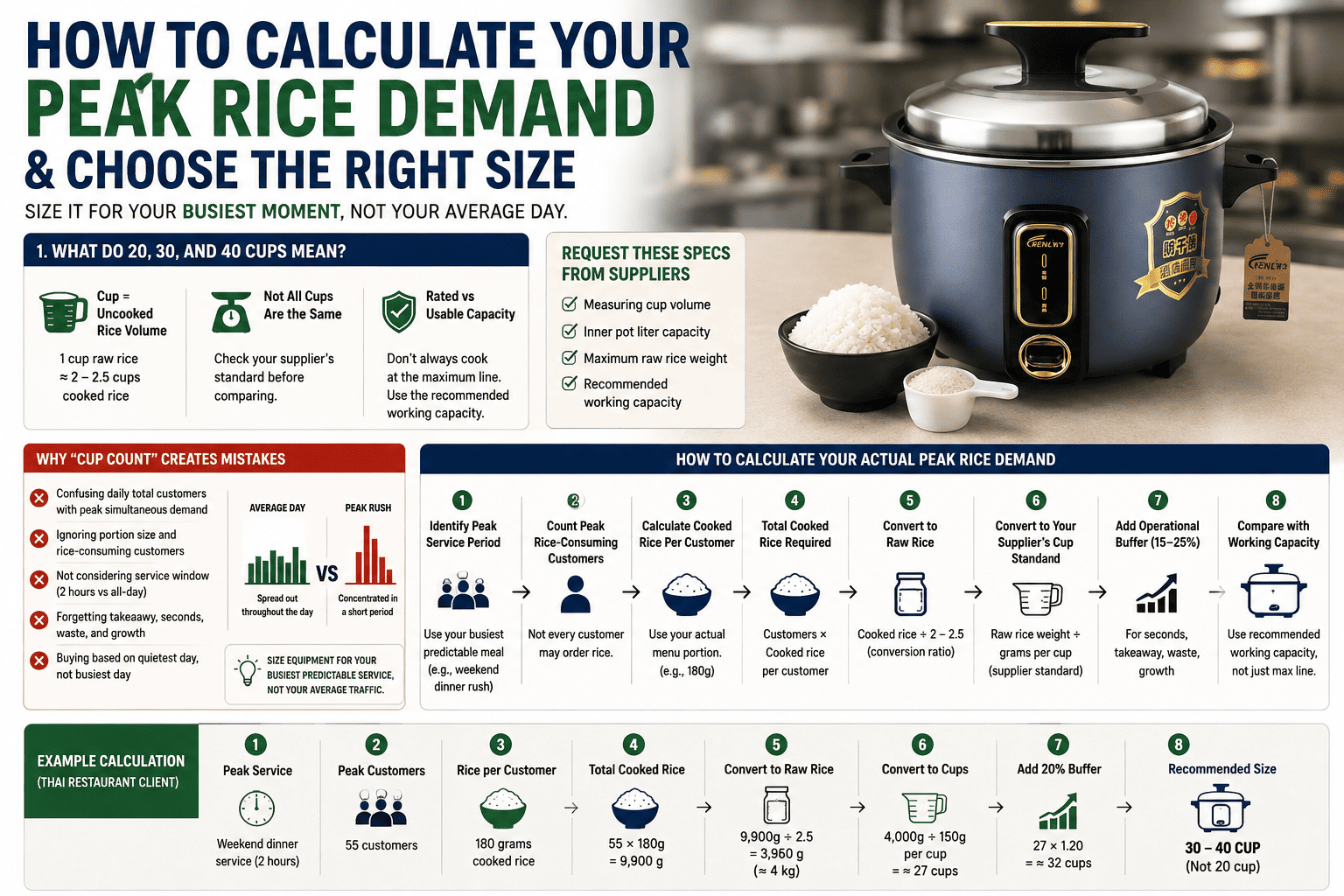
Here's the framework I use with buyers to convert their operational reality into actual capacity requirements:
-
Identify peak service period
Use your busiest predictable meal period, not average daily traffic. -
Count peak rice-consuming customers
Not every customer may order rice. -
Calculate cooked rice per customer
Use your actual menu portion. -
Calculate total cooked rice required
-
Convert cooked rice demand to raw rice
-
Convert raw rice weight into your supplier's measuring cup standard
-
Add operational buffer
Include seconds, unexpected traffic, takeaway orders, waste, and growth. -
Compare the result with recommended working capacity—not only maximum rated capacity
Let me show you how this works with a real example from a client conversation.
A Thai restaurant owner told me he served "about 80 customers daily" and was looking at a 20-cup cooker.
When I walked him through the actual calculation:
- Weekend dinner service: 55 customers over 2 hours
- Rice per customer: 180 grams cooked rice
- Total cooked rice needed: 55 × 180g = 9,900 grams
- Approximate cooked-to-raw conversion: 9,900g ÷ 2.5
- Raw rice required: approximately 4 kg
- Approximate cup conversion: about 27 cups based on his measuring standard
- Add 20% operating buffer: approximately 32 cups
He was about to buy a 20-cup cooker.
The actual calculation showed his peak requirement was much closer to the 30–40 cup range.
The Questions Most Buyers Don't Ask Themselves
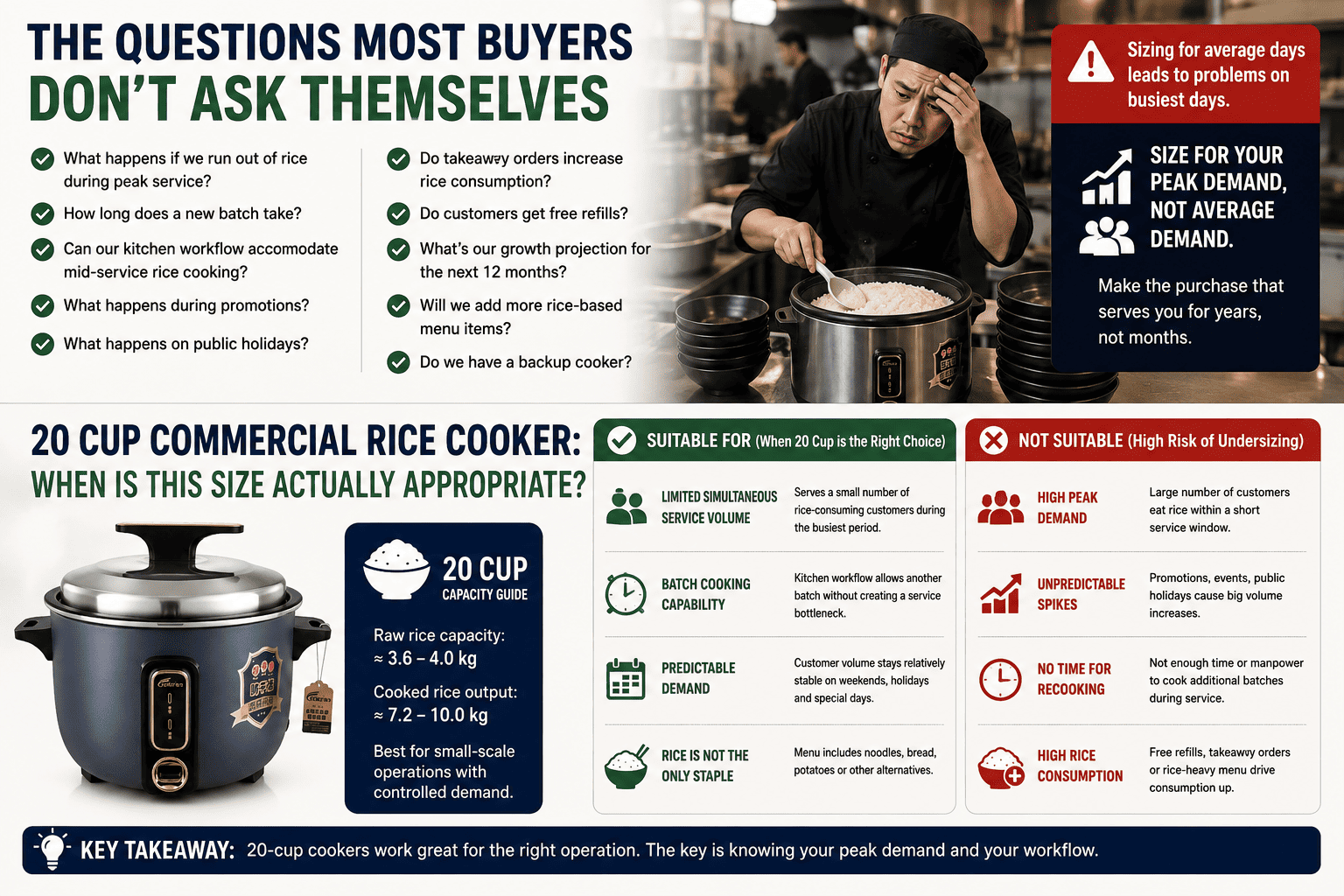
In my experience doing pre-sales consultations, buyers who size equipment correctly are the ones who ask uncomfortable operational questions:
- What happens if we run out of rice during peak service?
- How long does a new batch take?
- Can our kitchen workflow accommodate mid-service rice cooking?
- What happens during promotions?
- What happens on public holidays?
- Do takeaway orders increase rice consumption?
- Do customers get free refills?
- What's our growth projection for the next 12 months?
- Will we add more rice-based menu items?
- Do we have a backup cooker?
The buyers who get this wrong are usually those who focus exclusively on current average demand without considering variability or growth.
I had a restaurant owner who insisted a 20-cup model was adequate because:
"We only serve about 40 lunches per day."
When I asked about weekend volume, he admitted Saturdays were closer to 70 customers.
When I asked about his six-month growth target, he mentioned a marketing campaign intended to increase traffic by 30%.
He was sizing equipment for his current Tuesday lunch—not his projected Saturday dinner six months from now.
That's the distinction between buyers who reorder equipment within months and buyers who make a purchase that serves them for years.
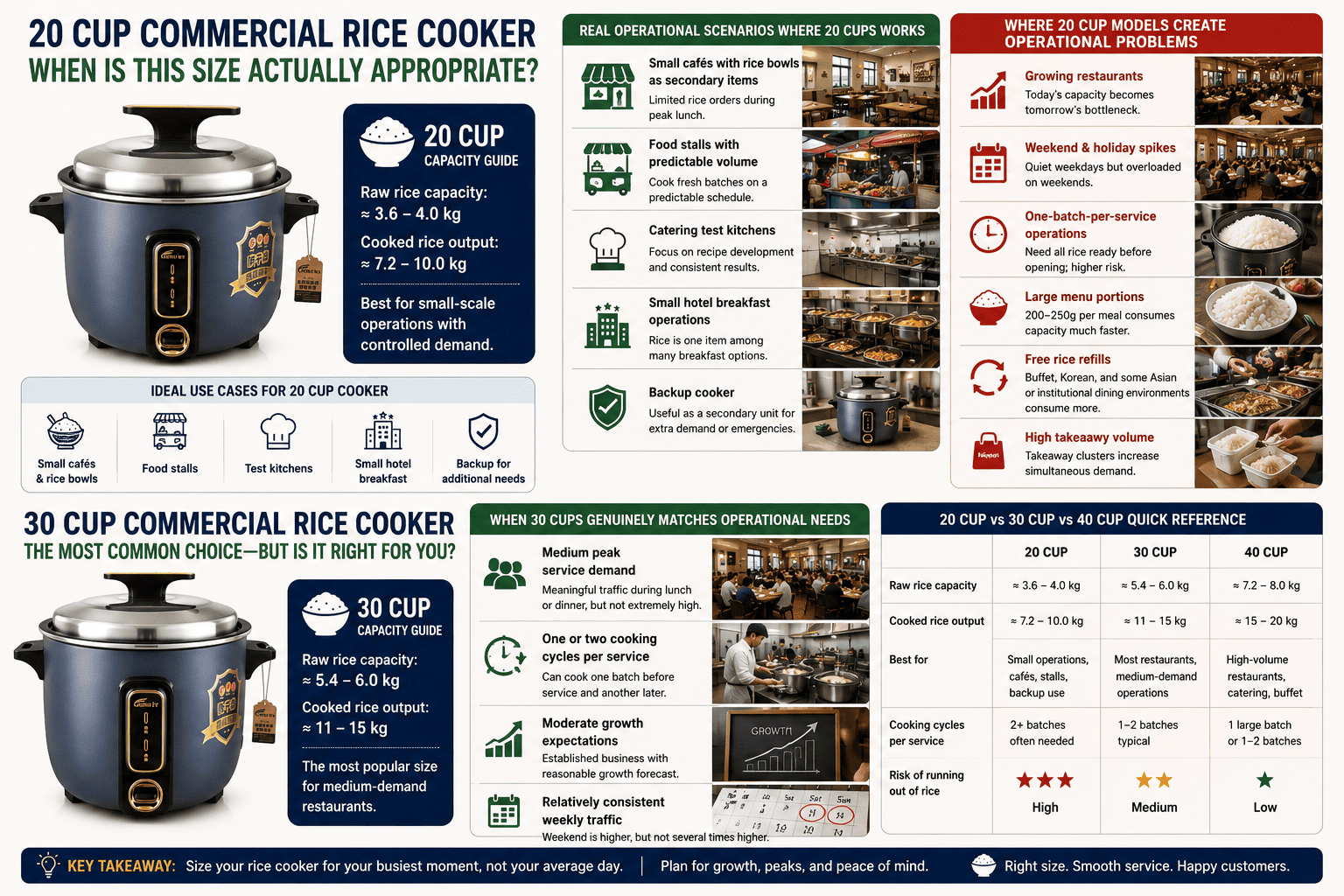
20 Cup Commercial Rice Cooker: When Is This Size Actually Appropriate?
Based on the customer inquiries I handle, 20-cup commercial rice cookers get bought by two types of businesses:
- Small operations that correctly identified their limited peak demand
- Larger operations that are about to realize they undersized their equipment
The buyers who successfully use 20-cup models typically share specific operational characteristics.
Limited simultaneous service volume: They serve a relatively small number of rice-consuming customers during the busiest service period.
Batch cooking capability: Their kitchen workflow allows them to cook another batch without creating a service bottleneck.
Predictable demand: Customer volume does not increase dramatically on weekends or holidays.
Rice is not the only staple: They offer noodles, bread, potatoes, or other alternatives, so not every customer needs rice.
Real Operational Scenarios Where 20 Cups Works
I've seen 20-cup commercial rice cookers work well in these environments:
Small cafés with rice bowls as secondary items
A café primarily sells coffee, pastries, and sandwiches but also offers several rice bowls. Peak lunch traffic is limited, and only part of the customer base orders rice.
Food stalls with predictable volume
A food stall serving a focused menu may cook fresh batches on a predictable schedule throughout the service period.
Catering test kitchens
Recipe-development kitchens need consistent cooking results rather than maximum production volume.
Small hotel breakfast operations
Rice may be only one item among a larger breakfast selection.
Backup cooker
A 20-cup unit can also be useful as a secondary machine for:
- Extra weekend demand
- Special rice varieties
- Staff meals
- Emergency backup
- Small catering orders
Where 20 Cup Models Create Operational Problems
Situations where buyers often regret choosing 20-cup capacity include:
Growing restaurants
If you're actively increasing customer traffic, today's safe capacity can become tomorrow's bottleneck.
Weekend and holiday spikes
A restaurant may be quiet Monday through Thursday but overloaded on Saturday night.
One-batch-per-service operations
If your kitchen needs all rice prepared before opening, smaller capacity becomes more risky.
Large menu portions
A restaurant serving 200–250g of cooked rice per meal consumes capacity much faster than one serving 120–150g.
Free rice refills
Buffets, Korean restaurants, some Asian restaurants, and institutional dining environments may consume considerably more rice than the original serving count suggests.
High takeaway volume
Takeaway orders often arrive in clusters and can increase simultaneous demand unexpectedly.
I had a restaurant buyer who purchased a 20-cup cooker based on weekday volume, then contacted me two months later because Saturday dinner was running out of rice by 7:30 PM.
They were cooking a second batch, but customers ordering during the gap faced extended waiting times.
The equipment wasn't defective.
The capacity calculation was.
That buyer eventually purchased a larger cooker and kept the 20-cup unit as backup.
That solution worked—but sizing correctly from the beginning would have been cheaper.
30 Cup Commercial Rice Cooker: The Most Common Restaurant Choice—But Is It Right for You?
The 30-cup commercial rice cooker is the model I sell most frequently, and it's also the model where I see the biggest gap between popular choice and correct choice.
Buyers gravitate toward 30-cup models because they seem like the safe middle ground:
- Not too small
- Not too large
- Moderate price
- Moderate footprint
- Suitable for many restaurants
But "middle ground" is only the right purchasing strategy if your real demand is actually in the middle.
When 30 cups genuinely matches operational needs, the buyer often has these characteristics:
Medium peak service demand
The restaurant has meaningful lunch or dinner traffic but does not require very high-volume production in one single batch.
One or two cooking cycles per service
They can prepare one batch before service and another batch later without disrupting kitchen operations.
Moderate growth expectations
They are established enough to predict demand reasonably well.
Relatively consistent weekly traffic
Weekend demand is higher, but not several times higher than weekday demand.
Where 30 Cup Capacity Becomes the Bottleneck
Common problems include:
Buying based on average instead of peak
A restaurant averages 60 customers per day and assumes 30 cups is enough. But the problem may be that 45 rice orders arrive in 90 minutes.
Ignoring promotional growth
The restaurant is sized for today's business but not for a new marketing campaign.
Underestimating holiday volume
Regular weekly demand may not represent Ramadan, Eid, Chinese New Year, Christmas, weekend events, or tourist-season peaks.
Adding more rice-based menu items
Customer count can stay the same while rice demand increases.
Takeaway expansion
Adding delivery platforms can dramatically change peak-order patterns without increasing dining-room seat count.
The Real Question: Are You Filling the Cooker or Working Around It?
The test I suggest to buyers considering 30-cup models is:
Are you sizing the equipment to serve your operation, or are you planning your operation around the equipment's limitations?
If you're thinking:
"We can probably make 30 cups work if we cook earlier, reduce portions, or schedule a second batch during the rush."
you may already be undersizing.
Your equipment should support the business model—not force the business model to adapt around capacity limitations.
I worked with a restaurant owner in Kuala Lumpur who was convinced a 30-cup model was adequate.
When I asked him to describe his busiest service, he said:
"Weekend lunch, about 65 customers over two hours. We'll cook one batch before service and another during lunch."
The problem wasn't simply the total quantity.
It was the timing.
During the second cooking cycle, customers could arrive faster than fresh rice became available.
After mapping the workflow, he chose the larger model so he could prepare more rice before service and reduce dependence on mid-rush cooking.
40 Cup Commercial Rice Cooker: When Larger Capacity Becomes Essential
In my experience with restaurant buyers, 40-cup commercial rice cookers are simultaneously undersold to businesses that need them and oversold to businesses that don't.
The buyers who genuinely need 40-cup capacity have operational realities that make smaller equipment unworkable, but many buyers assume 40 cups is "too big" without calculating actual demand.
The operational profile where 40 cups becomes important includes:
High peak service volume
Restaurants serving large numbers of rice-consuming customers during one concentrated service period need enough rice available before demand peaks.
No practical mid-service cooking capacity
Some kitchens simply cannot start another large rice batch during the rush.
High-volume single cuisine
Restaurants where rice accompanies almost every meal consume capacity much faster than mixed-menu cafés.
Examples may include:
- Asian restaurants
- Curry restaurants
- Rice bowl concepts
- Buffet restaurants
- Catering kitchens
- Canteens
- Hotel kitchens
- Institutional food service
- Staff cafeterias
Large portions or refill service
If customers regularly consume larger portions or receive free refills, the number of servings supported by one batch drops quickly.
Heavy takeaway and delivery business
Online orders often arrive in waves rather than evenly across the service period.
Growth or promotional demand
A restaurant expecting significant growth may prefer spare capacity rather than replacing equipment six months later.
Catering and event support
Restaurants that occasionally handle corporate events, parties, or large takeaway orders may need more capacity than normal dining-room traffic suggests.
When 40 Cups Is Too Large
Bigger is not always better.
A 40-cup model may be unnecessary if:
- Your peak demand is consistently low
- You cook multiple small fresh batches
- Kitchen counter space is limited
- Rice is a secondary menu item
- You need several rice varieties rather than one large batch
- Your restaurant prioritizes frequent fresh cooking
- Your electrical supply is limited
- The larger unit creates unnecessary energy and equipment cost
Large equipment can also reduce flexibility.
For example, a restaurant serving:
- White rice
- Brown rice
- Basmati rice
- Sticky rice
may benefit more from two smaller cookers than one large cooker.
The correct question is not:
"What's the biggest cooker I can afford?"
It's:
"What configuration gives my kitchen enough capacity, backup, flexibility, and service continuity?"
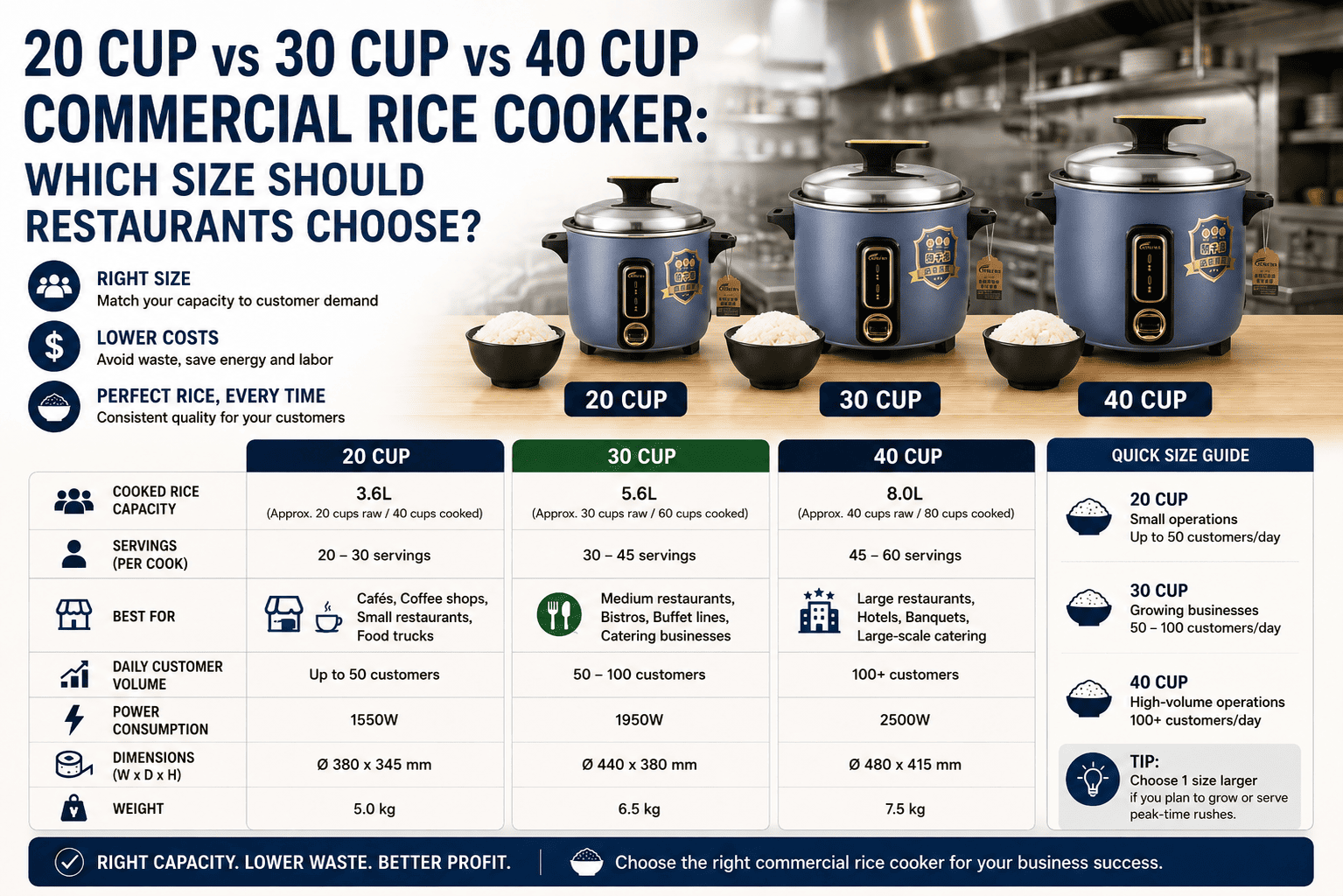
20 Cup vs 30 Cup vs 40 Cup: Quick Restaurant Comparison
| Factor | 20 Cup | 30 Cup | 40 Cup |
|---|---|---|---|
| Best fit | Small operations, cafés, food stalls, backup use | Medium restaurants, stable demand | Busy restaurants, catering, high-volume service |
| Peak-demand tolerance | Low to moderate | Moderate | High |
| Mid-service batch dependence | Higher | Moderate | Lower when correctly sized |
| Kitchen footprint | Smaller | Medium | Larger |
| Growth buffer | Limited | Moderate | Higher |
| Multiple rice types | Easier if using several small units | Moderate flexibility | Better for one high-volume rice type |
| Backup strategy | Often needs second unit as business grows | May benefit from smaller backup | Often paired with secondary cooker in critical operations |
| Risk of undersizing | High for growing restaurants | Medium | Lower if demand calculation is accurate |
| Risk of oversizing | Lower | Medium | Higher for small operations |
This table should only be used as a starting point.
Your final decision should be based on actual rice weight, cooking workflow, operating voltage, cooking time, usable capacity, and peak demand.
Buyer Checklist: What Should Restaurants Confirm Before Choosing a Commercial Rice Cooker Size?
Before choosing between 20, 30, and 40 cups, use this checklist with your kitchen team and supplier.
1. Peak Demand
- [ ] What is your busiest lunch service?
- [ ] What is your busiest dinner service?
- [ ] What is your busiest weekend?
- [ ] What happens during holidays?
- [ ] What happens during promotions?
- [ ] How many customers actually order rice?
- [ ] How many takeaway orders arrive during peak periods?
- [ ] Do customers receive free rice refills?
2. Portion Size
- [ ] What is your actual cooked rice portion per customer?
- [ ] Is the portion measured or estimated?
- [ ] Do different menu items use different rice portions?
- [ ] Does takeaway packaging use more rice than dine-in portions?
- [ ] Does your buffet or refill policy increase consumption?
Use your real kitchen data whenever possible instead of generic serving estimates.
3. Rice Type
- [ ] Jasmine rice
- [ ] Basmati rice
- [ ] Short-grain rice
- [ ] Brown rice
- [ ] Sticky rice
- [ ] Mixed grains
- [ ] Other local rice varieties
Different rice types can use different:
- Water ratios
- Cooking times
- Expansion ratios
- Keep-warm conditions
Test the actual rice used by your restaurant.
4. Batch Strategy
- [ ] Do you cook once before service?
- [ ] Do you cook multiple batches?
- [ ] How long does one cooking cycle take?
- [ ] Can staff start another batch during peak service?
- [ ] Do you have enough preparation space?
- [ ] Do you have enough electrical outlets?
- [ ] Can a second cooker operate at the same time?
5. Growth Buffer
- [ ] What is your expected customer growth over 6 months?
- [ ] What is your expected growth over 12 months?
- [ ] Will you add delivery platforms?
- [ ] Will you expand the menu?
- [ ] Will you add catering?
- [ ] Are you planning promotions?
- [ ] Is a second branch planned?
6. Commercial Rice Cooker Specification
Ask the supplier to confirm:
- [ ] Cup definition
- [ ] Measuring cup volume
- [ ] Maximum raw rice weight
- [ ] Inner pot liter capacity
- [ ] Recommended working capacity
- [ ] Rated wattage
- [ ] Voltage
- [ ] Frequency
- [ ] Plug type
- [ ] Power cord specification
- [ ] Cooking time at full load
- [ ] Keep-warm temperature
- [ ] Maximum keep-warm period recommended
- [ ] Inner pot material
- [ ] Inner pot thickness
- [ ] Heating plate specification
- [ ] Thermostat
- [ ] Thermal protection
- [ ] Net weight
- [ ] Gross weight
- [ ] Carton size
7. Kitchen Infrastructure
- [ ] Does the kitchen have the correct voltage?
- [ ] Can the electrical circuit support the cooker wattage?
- [ ] Is a dedicated circuit needed?
- [ ] Is the plug compatible?
- [ ] Is the power cord long enough?
- [ ] Is there enough ventilation?
- [ ] Is there enough counter space?
- [ ] Is there safe clearance around the lid and steam outlet?
8. Backup Plan
Commercial kitchens should also ask:
- [ ] What happens if the main cooker fails during dinner service?
- [ ] Do we need a backup cooker?
- [ ] Can we use the backup for another rice type?
- [ ] Are spare parts available locally?
- [ ] Can the heating plate, thermostat, switch, cord, or fuse be replaced?
- [ ] What is the supplier warranty?
For a restaurant where rice is mission-critical, two appropriately sized cookers may be safer operationally than depending on one machine with no backup.
Certification Requirements for Commercial Rice Cookers
Capacity alone does not determine whether a commercial rice cooker is suitable for your market.
The final model also needs to match the electrical, safety, food-contact, labeling, and market-access requirements that apply in the destination country and sales channel.
The exact requirements vary by country, product design, voltage, and whether the product is sold for household, professional, or commercial use.
Buyers should verify current requirements with the supplier, importer, retailer, testing laboratory, or local compliance specialist before mass production.
Key Compliance Areas to Confirm
| Compliance Area | What Buyers Should Confirm | Why It Matters |
|---|---|---|
| Electrical safety | Applicable safety standard and market approval | Commercial cookers operate at relatively high power and temperature |
| Voltage and frequency | Exact destination-market electrical configuration | Wrong configuration can make the product unusable or unsafe |
| Plug and power cord | Local plug, cable rating, grounding, cord length | High-current appliances require correctly rated components |
| Heating system | Heating plate wattage and safety protection | Must match product design and certification |
| Thermal protection | Thermostat, limiter, thermal fuse, or other protection system | Controls overheating risk |
| Food-contact materials | Inner pot, coating, lid, steam parts, measuring cup | These parts may contact food or steam |
| Restricted substances | Applicable chemical/material requirements | Important in regulated markets |
| Rating label | Voltage, wattage, frequency, model, warnings | Must match the actual production unit |
| Manual | Operating instructions, cleaning, warnings, local language | Commercial users need clear operating limits |
| Packaging | Model, capacity, barcode, certification marks where applicable | Incorrect information can cause retail or customs problems |
| Test-report scope | Exact model, voltage, wattage, components, factory | Customization may require additional review |
Certifications and Market Approvals
Depending on the destination, commercial rice cooker projects may involve documentation or approvals such as:
- CB
- CE-related conformity documentation
- UKCA or applicable UK requirements
- KC
- PSE
- SAA/RCM
- UL or ETL
- INMETRO
- G-Mark or national conformity programs
- Local electrical safety registration
- Food-contact testing
Not every certification applies to every market or every commercial rice cooker.
The correct approach is:
- Identify destination country
- Confirm product-use classification
- Confirm voltage and frequency
- Confirm applicable safety standard
- Review existing supplier reports
- Confirm whether your exact model is covered
- Review customization impact
- Complete additional testing before production if necessary
What Changes Should Trigger a Compliance Review?
Ask before changing:
- Capacity
- Wattage
- Heating plate
- Thermostat
- Thermal fuse
- Internal wiring
- Plug
- Power cord
- Voltage
- Frequency
- Inner pot
- Coating
- Body structure
- Bottom cover
- Switch
- Insulation
- Production factory
A 20-cup model and a 40-cup model may look similar but use different electrical and thermal configurations.
Do not assume one report automatically covers every size.
Factory Capability: What Should a Reliable Commercial Rice Cooker Supplier Provide?
Commercial rice cookers operate differently from small household units.
Restaurants may use the machine:
- Every day
- Several times per day
- At maximum load
- For extended keep-warm periods
- In hot commercial kitchens
- Under heavy staff handling
That makes factory capability important.
A supplier should not only know how to assemble the cooker. It should understand how the product behaves under repeated commercial use.
Factory Capability Checklist
| Factory Capability | What Buyers Should Verify | Why It Matters |
|---|---|---|
| Commercial model experience | Existing 20/30/40 cup or comparable high-capacity models | Reduces development risk |
| Capacity verification | Actual raw rice weight, pot volume, working capacity | Prevents misleading cup comparisons |
| Heating plate control | Correct wattage, flatness, contact, material | Influences cooking speed and consistency |
| Inner pot quality | Material, thickness, coating, fit | Commercial users handle pots frequently |
| Thermostat matching | Correct cooking and keep-warm control | Prevents undercooking, burning, or drying |
| Thermal protection | Controlled safety components | Important under repeated high-load use |
| Incoming QC | Heating plates, thermostats, cords, plugs, pots, plastic parts | Reduces batch inconsistency |
| 100% electrical testing | High-voltage, grounding, wattage, function where applicable | Controls safety-critical defects |
| Cooking testing | Full-load or defined cooking tests | Verifies real performance |
| Keep-warm testing | Temperature and rice condition over time | Important for restaurant operations |
| Production traceability | Batch and component records | Supports after-sales investigation |
| Certification support | Market-specific reports and technical documentation | Reduces import risk |
| Spare parts | Heating plates, thermostats, switches, cords, lids, pots | Important for commercial after-sales service |
| Packaging engineering | Strong protection for heavy cooker and inner pot | Reduces transit damage |
Questions to Ask the Factory
Before placing a commercial rice cooker order, ask:
- What does "20/30/40 cups" mean on your model?
- What measuring cup size do you use?
- What is the maximum raw rice weight?
- What is the inner pot volume?
- What working capacity do you recommend?
- How long does a full batch take?
- What rice variety do you use for factory testing?
- What wattage is used?
- How do you control heating plate flatness?
- How do you test thermostat switching?
- How long can rice remain in keep-warm mode?
- Do you conduct full-load cooking tests?
- What electrical tests are performed on every unit?
- Are plugs and cords certified for the destination market?
- What safety components are used?
- Can you supply replacement inner pots?
- Can you supply heating plates and thermostats as spare parts?
- How do you handle commercial warranty claims?
- Can you provide production photos and test records before shipment?
A supplier that answers only:
"40 cup, 2500W, good quality"
is not giving enough information for a commercial procurement decision.
Common Mistakes When Buying Commercial Rice Cookers
Mistake 1: Choosing Size Based on Daily Customer Count
Daily customer count tells you very little about peak production requirements.
Use your busiest service period.
Mistake 2: Treating One Cup as One Customer Serving
Cup capacity usually refers to raw rice measuring cups—not servings.
Always convert using actual portion weight.
Mistake 3: Comparing Different Suppliers by Cup Number Alone
A 30-cup model using a 180ml cup is not necessarily comparable with a supplier using another measuring standard.
Compare:
- Cup volume
- Raw rice weight
- Inner pot volume
- Working capacity
Mistake 4: Filling the Cooker to Maximum Capacity Every Batch
Maximum rated capacity may not be the same as ideal daily working capacity.
Ask the supplier for recommended operating load.
Mistake 5: Using Average Weekday Demand
Commercial equipment should be sized around predictable peak demand.
Include:
- Weekends
- Holidays
- Promotions
- Tourist season
- Delivery orders
- Catering
Mistake 6: Ignoring Cooking Time
A smaller cooker only works if you actually have enough time to cook a second batch.
Ask for full-load cooking time.
Mistake 7: Ignoring Keep-Warm Performance
Restaurants may hold rice much longer than household users.
Test whether the rice:
- Dries out
- Yellows
- Burns at the bottom
- Develops odor
- Becomes too hard
- Becomes too wet
Mistake 8: Buying the Largest Size "Just in Case"
Oversizing can create:
- Higher purchase cost
- Larger footprint
- Higher power demand
- Less flexibility
- Unnecessary capacity
- Poor economics for very small batches
Size for realistic peak demand plus buffer—not fear.
Mistake 9: Ignoring Electrical Infrastructure
A commercial rice cooker may draw substantially more power than a household unit.
Confirm:
- Voltage
- Wattage
- Circuit capacity
- Plug
- Grounding
- Outlet location
before ordering.
Mistake 10: Not Checking Replacement Parts
A restaurant cannot wait several weeks for a replacement inner pot or thermostat.
Ask about:
- Inner pots
- Lids
- Switches
- Thermostats
- Heating plates
- Power cords
- Thermal fuses
before the first order.
Mistake 11: Buying Only One Cooker for a Rice-Dependent Restaurant
If rice is central to your menu, one equipment failure can stop service.
Consider a backup strategy.
Mistake 12: Not Testing the Restaurant's Actual Rice
Supplier factory tests may use a different rice type.
Test your own:
- Jasmine
- Basmati
- Short grain
- Brown rice
- Sticky rice
before placing a large order.
Mistake 13: Ignoring Future Growth
A cooker that's perfect today can become too small after:
- Marketing campaigns
- Delivery-platform growth
- Menu expansion
- Catering
- New seating
- Higher repeat traffic
Include reasonable growth buffer.
Mistake 14: Choosing Only by FOB Price
The cheapest cooker may create higher costs through:
- Slow cooking
- Uneven cooking
- Higher failure rate
- Weak inner pot
- Poor spare-parts support
- Wrong certification
- Warranty claims
- Service interruptions
Commercial buyers should calculate operating risk, not only purchase price.
FAQ About 20, 30, and 40 Cup Commercial Rice Cookers
1. What does 20 cup mean in a commercial rice cooker?
It normally refers to a specified number of measuring cups of uncooked rice, but the measuring cup size varies by manufacturer.
Always confirm the cup volume and raw rice weight.
2. Is a 20-cup rice cooker enough for a small restaurant?
It can be if your peak rice demand is low and your kitchen can cook additional batches during service.
Do not decide based on total daily customers.
3. How many people can a 20-cup rice cooker serve?
There is no fixed number because serving size varies.
Calculate using:
- Raw rice capacity
- Cooked yield
- Your actual portion size
- Whether customers receive refills
4. How many people can a 30-cup commercial rice cooker serve?
Again, this depends on portion size and rice type.
A restaurant serving smaller portions may serve considerably more people than a restaurant providing large rice portions or free refills.
5. Is a 40-cup rice cooker better for busy restaurants?
It can be more suitable when peak simultaneous rice demand is high or the kitchen cannot cook another batch during service.
But a smaller restaurant may be better served by a 20- or 30-cup cooker.
6. Should I buy a 30-cup or 40-cup rice cooker?
Choose 40 cups when your calculated peak demand approaches or exceeds the comfortable working range of the 30-cup model.
Choose 30 cups when your real peak demand leaves enough operating buffer.
7. Is it better to buy one 40-cup cooker or two 20-cup cookers?
It depends on kitchen workflow.
One 40-cup cooker may provide:
- Simpler operation
- One large batch
- Less duplication
Two 20-cup cookers may provide:
- Backup redundancy
- Two rice varieties
- More flexible batch sizes
- Continued operation if one unit fails
Restaurants where rice is mission-critical should consider redundancy carefully.
8. Do commercial rice cookers use more electricity?
Larger-capacity models generally require higher wattage, but actual consumption depends on:
- Heating design
- Cooking time
- Load
- Keep-warm duration
- Insulation
- Control system
Compare complete operating requirements—not wattage alone.
9. Can I cook a small amount of rice in a 40-cup cooker?
Often yes, but very small batches may not perform the same as appropriately sized batches.
Ask the manufacturer for minimum recommended cooking quantity and test your actual portion.
10. How long does a commercial rice cooker take to cook?
Cooking time depends on:
- Capacity
- Rice quantity
- Rice type
- Water temperature
- Wattage
- Voltage
- Heating plate
- Ambient temperature
Ask the supplier for a full-load cooking test rather than relying only on a general estimate.
11. How long can commercial rice cookers keep rice warm?
It depends on the model and rice type.
Even if the appliance can remain in keep-warm mode for a long time, rice quality may gradually change.
Test:
- Texture
- Moisture
- Color
- Smell
- Bottom condition
over the actual holding period your restaurant uses.
12. What size cooker is best for a buffet restaurant?
Buffets usually need strong peak capacity and may require backup because rice demand can be continuous.
Calculate actual consumption per service and consider two units if uninterrupted rice availability is critical.
13. What size is best for a café?
A 20-cup model may be enough when rice is a secondary menu item.
A café specializing in rice bowls may need considerably more capacity.
14. What size is best for a hotel?
Hotels vary widely.
A small breakfast service may use a 20-cup cooker, while large buffet, staff cafeteria, banquet, or catering operations may need 30-, 40-cup, or multiple larger units.
15. What size is best for a catering business?
Catering businesses should calculate the largest event they handle and whether multiple rice varieties are needed.
Multiple units may provide better operational flexibility than one very large cooker.
16. Do I need special certification for a commercial rice cooker?
Requirements depend on destination market and product classification.
Confirm electrical safety, food-contact, labeling, plug, voltage, and any local market approval requirements before ordering.
17. What should I ask a supplier before buying?
At minimum ask for:
- Measuring cup volume
- Raw rice capacity
- Inner pot volume
- Recommended working capacity
- Wattage
- Voltage
- Plug
- Full-load cooking time
- Keep-warm performance
- Inner pot specification
- Heating plate
- Safety protection
- Certification documents
- Spare parts
- Warranty
18. Should I request a sample before ordering?
Yes, especially for a commercial model.
Test the sample using:
- Your rice
- Your portion size
- Your water ratio
- Maximum expected load
- Your local voltage
- Your expected keep-warm duration
19. What spare parts should restaurants keep?
Depending on the model and service structure, common parts may include:
- Inner pot
- Power cord
- Switch
- Thermostat
- Thermal fuse
- Heating plate
- Lid components
Ask the supplier which parts are replaceable before purchasing.
20. What is the biggest sizing mistake restaurants make?
They size the cooker for average demand instead of peak demand.
The best size is not the smallest cooker that can survive a normal weekday.
It's the cooker configuration that can handle your busiest predictable service without disrupting customer service.
Conclusion
Choosing between a 20-cup, 30-cup, and 40-cup commercial rice cooker is not really a question about cup numbers.
It is a question about restaurant workflow.
A 20-cup cooker can be the right choice for a small café, food stall, test kitchen, or backup unit.
A 30-cup cooker can work well for medium-volume restaurants with predictable service and the ability to cook more than one batch.
A 40-cup cooker becomes more attractive when peak demand is high, rice is central to the menu, takeaway orders arrive in waves, or the kitchen cannot afford to wait for another cooking cycle during service.
But the final choice should never be based on restaurant size alone.
Calculate:
- Peak rice-consuming customers
- Actual cooked rice portion
- Raw rice requirement
- Supplier's cup definition
- Recommended working capacity
- Cooking-cycle timing
- Weekend and holiday demand
- Expected growth
- Backup requirements
- Electrical and certification requirements
Then ask your supplier to validate the result using the exact commercial rice cooker model you intend to purchase.
The most expensive cooker is not always the 40-cup model.
Sometimes the most expensive cooker is the 20-cup model you have to replace three months after opening because you sized it for an average Tuesday instead of your busiest Saturday night.