I've watched dozens of brand clients walk into our factory wanting to "stand out in the rice cooker market." Most arrive with mood boards, feature lists, and competitor screenshots. Nearly all start the conversation the same way: "We want something unique—maybe a touch screen, or a special coating, or..." Three months later, the ones who succeeded in the market weren't the ones who added the most features. They were the ones who first asked themselves: What promise are we making to buyers, and which OEM tools can actually back that promise?
Brand differentiation through OEM rice cookers isn't about piling on features or chasing premium materials—it's about choosing a specific brand promise your target buyers care about, then strategically combining the 6-8 OEM customization levers (exterior finish, capacity options, control layouts, preset menus, packaging language, certifications, accessory bundles, warranty positioning) to deliver proof that promise is real. Success comes when your brand claim and your supplier's manufacturing boundaries align, not when you chase "innovation" that your budget, MOQ, or timeline can't support.
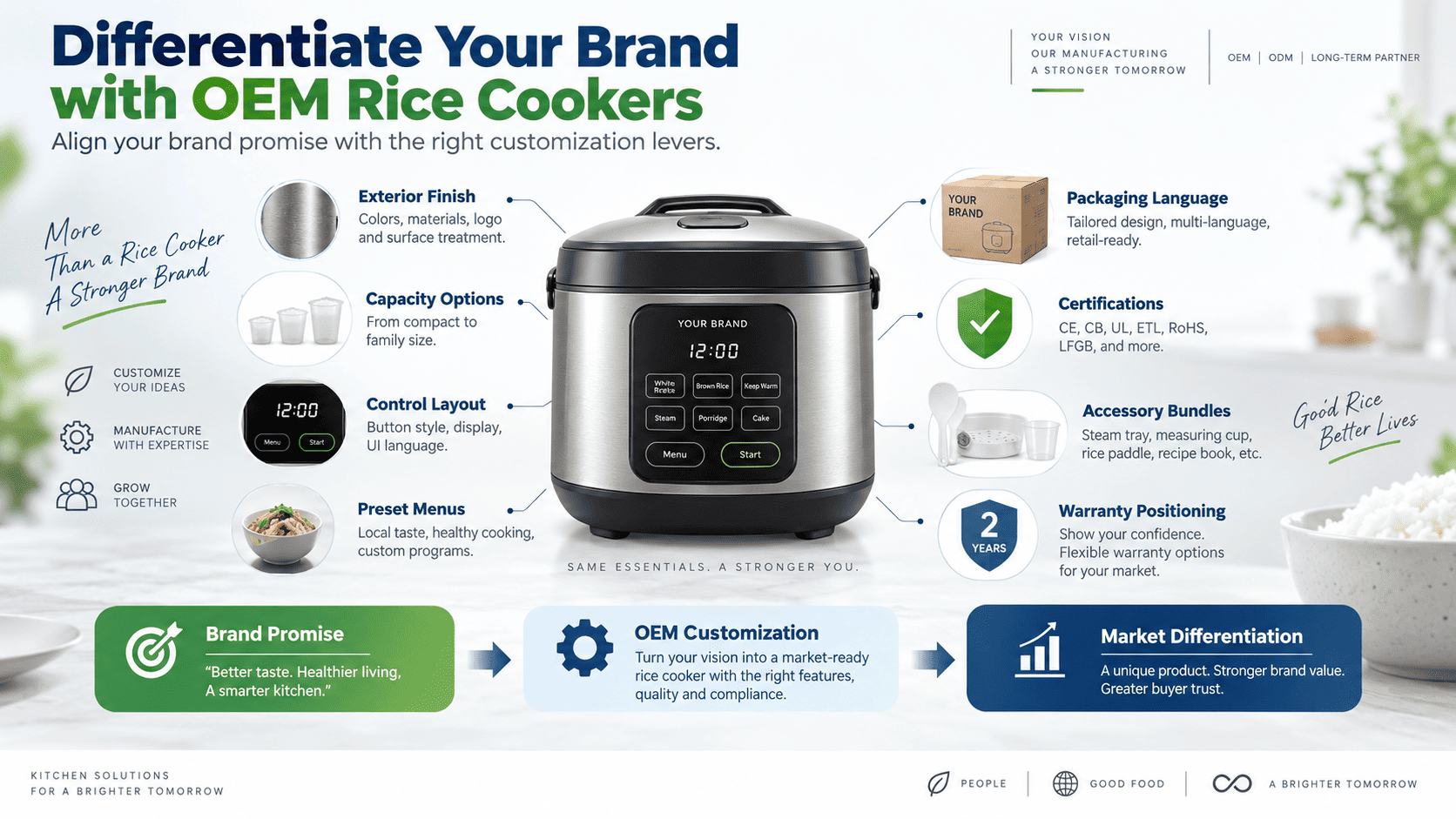
Most brand owners I work with already know their target market. The gap isn't market research—it's translating buyer needs into manufacturable configurations without blowing the budget or tripling the MOQ. That translation process, where brand strategy meets factory reality, is where differentiation actually happens. Let me show you how we approach this with clients who end up succeeding.
What Does Brand Differentiation Actually Mean for OEM Rice Cookers?
When a new client tells me they want a "differentiated rice cooker," I usually ask: "Differentiated from what, and to whom?" The question catches people off guard because they're often thinking in competitive features ("Our competitor has 8 presets, we need 10") rather than buyer decisions ("Why would someone choose us over the product they're already considering?").
Brand differentiation means making a specific promise—"This rice cooker is designed for X type of person facing Y situation"—that competitors aren't claiming or can't credibly deliver. For OEM products, differentiation happens when you match that promise with a combination of customization options the factory can actually manufacture within your constraints.
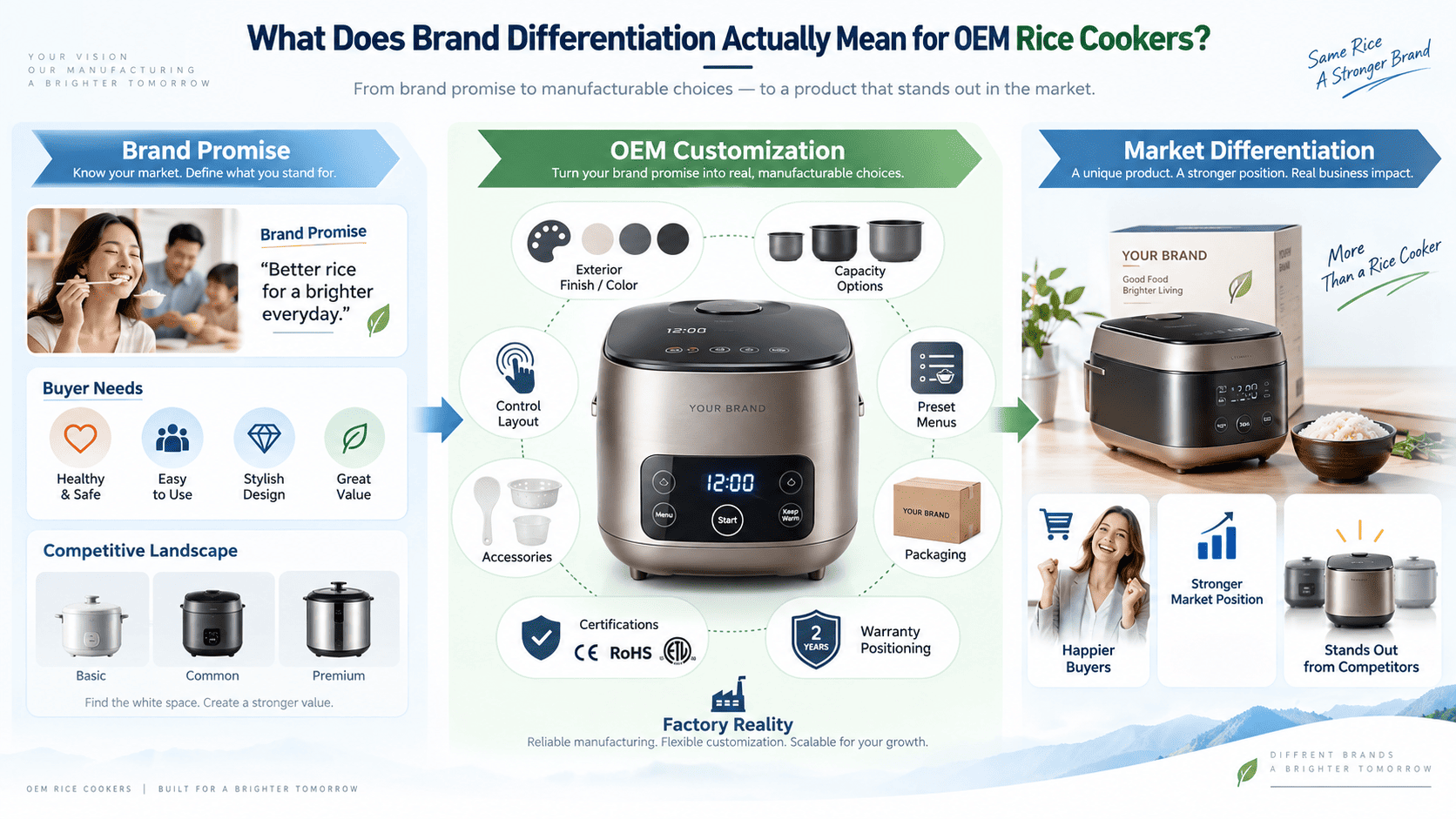
Here's what actually works: One client wanted to enter a market dominated by established Japanese brands. Their instinct was to compete on "premium features." We asked what buyer problem they were solving. After discussion, they realized their real opportunity was "hassle-free cooking for first-time rice cooker buyers intimidated by complex controls." That insight changed everything. Instead of adding features, we simplified the control panel to three buttons, wrote packaging instructions in friendly language with photos, and bundled a measuring cup with local unit markings. The differentiation wasn't technical—it was about removing barriers for a specific buyer.
Why Feature Lists Don't Create Differentiation
I see this pattern constantly: clients arrive with competitor comparison spreadsheets. "Brand A has fuzzy logic. Brand B has a delay timer. Brand C has quick cook mode. We need all three plus something extra." The assumption is that differentiation equals more features. It doesn't.
Features create differentiation only when they credibly support a brand claim that matters to your target buyer.1 A delay timer matters if your brand promise is "designed for working parents who prep dinner before leaving for work." It doesn't matter if your promise is "authentic Asian rice texture preferred by chefs." The same feature has different strategic value depending on the promise you're making.
The Real Differentiation Levers OEM Factories Control
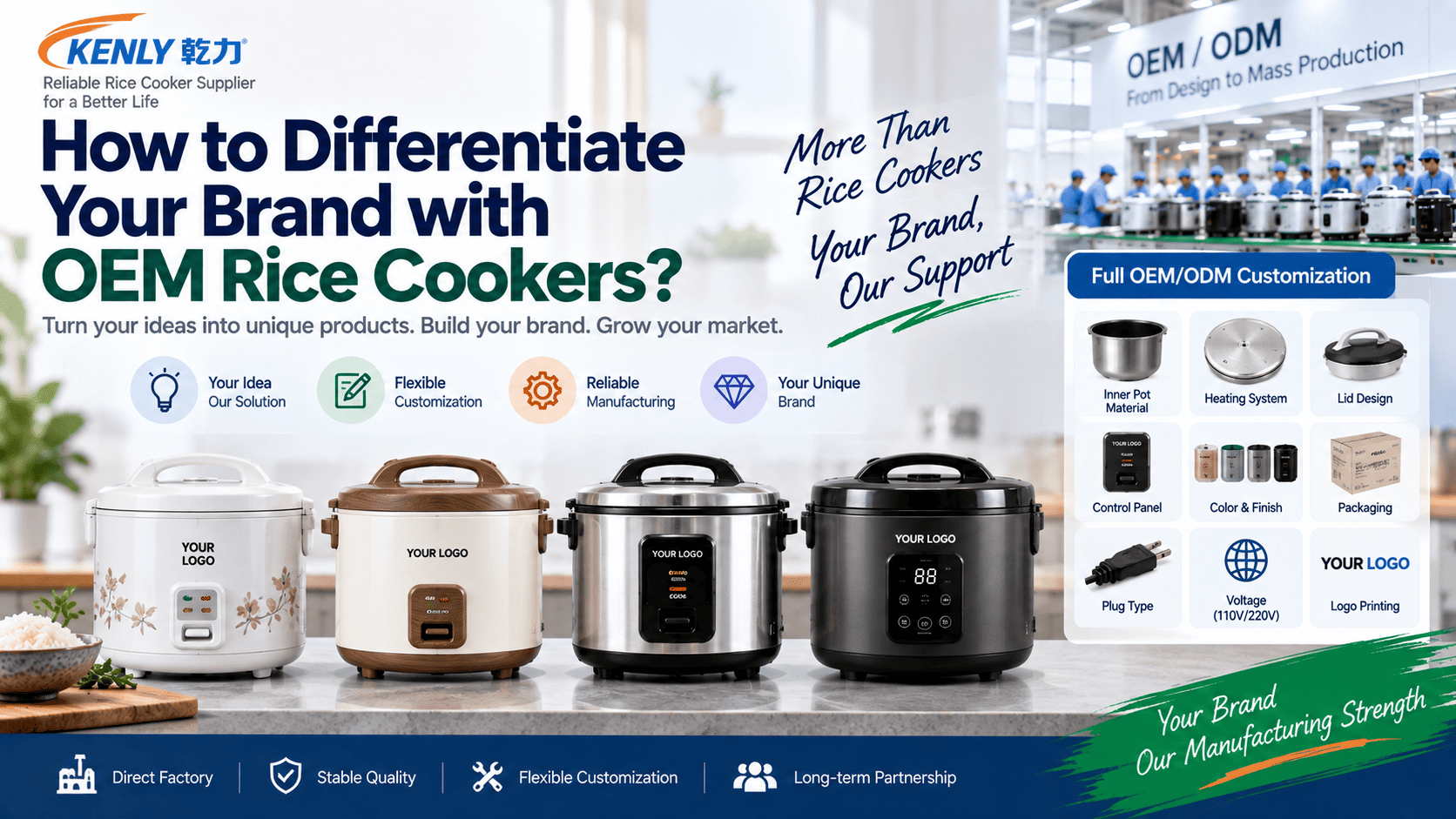
After 15 years of OEM projects, I can count the meaningful customization levers we work with. There are about six to eight. These aren't "limitations"—they're the actual tools that create market differentiation when combined strategically:
- Exterior design and finish options — housing color, material texture (matte vs. glossy), handle style, LED display vs. analog dial
- Capacity range and form factor — compact 1.0L models for singles, family-size 1.8L, bulkier 3.0L for commercial use
- Control interface complexity — one-button simplicity, multi-preset panels, digital vs. mechanical controls
- Cooking preset configurations — which grain types, porridge settings, keep-warm duration, quick-cook options
- Packaging and documentation language — instruction clarity, local language support, recipe suggestions, brand story
- Certification mix — CE, GS, UKCA, KC, energy ratings that signal quality or market access2
- Included accessories — measuring cups with local units, rice paddles, steaming baskets, serving spoons
- Warranty and service positioning — 1-year standard vs. 2-year extended, replacement vs. repair policies
Most clients don't realize these levers exist as distinct options. They think customization means "design a new product from scratch" (which requires enormous NRE and MOQ) or "pick from catalog items" (which offers no differentiation). The middle path—strategically combining these eight levers—is where practical brand differentiation lives.
Why Clients Often Request the Wrong Customizations
When a client says "We want smart WiFi controls to differentiate," I don't dismiss it. I ask: "What brand promise does WiFi support? Who's the buyer, and what decision does connectivity help them make?" Usually there's a long pause.
The gap isn't that clients don't understand their market—they do. The gap is they're translating market needs into product specs without understanding the cost structure, MOQ implications, or manufacturing constraints of each customization type.
Here's the reality most clients don't see: Changing inner pot material (say, from aluminum to ceramic-coated) might increase unit cost by 15-20% and require higher MOQ because material sourcing changes.3 Changing control panel layout—moving buttons, rewording labels, adjusting the preset sequence—costs almost nothing because it's programming and printing, not tooling.4 Yet clients often perceive the control interface change as "small" and the material change as "premium innovation."
The cost structure is inverse to perceived innovation. This misunderstanding kills differentiation projects.
How Do You Identify the Right Differentiation Strategy for Your Brand?
The clients who succeed don't start with product features. They start with a clear statement: "Our brand is for [specific buyer type] who needs [specific outcome] and currently struggles with [specific barrier]." Then we reverse-engineer which OEM levers remove that barrier.
Your differentiation strategy should emerge from matching your target buyer's decision criteria with the OEM customization tools you can actually afford and execute within your timeline and MOQ constraints. This isn't a product configuration exercise—it's a brand promise selection exercise.
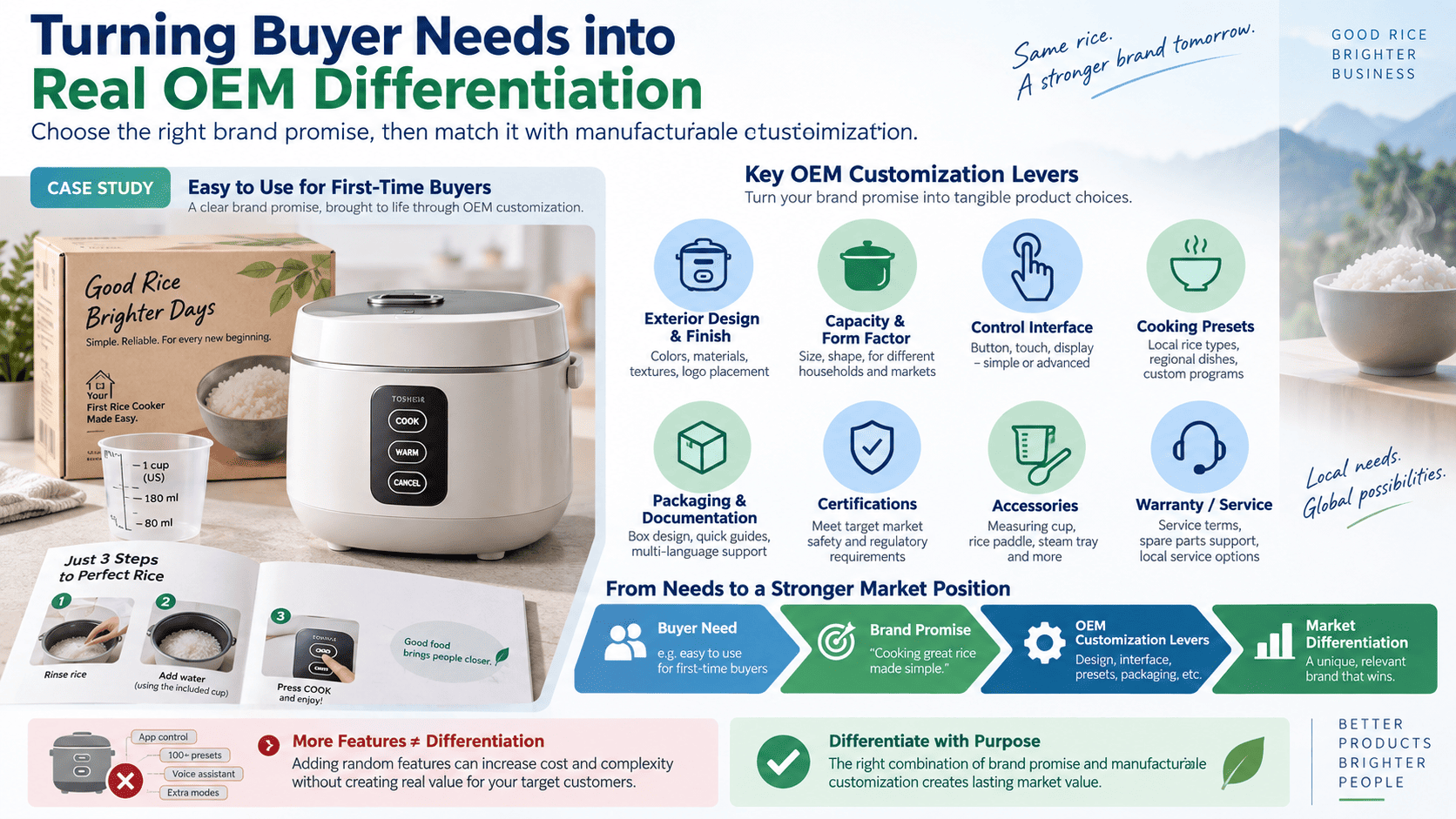
I worked with a client entering a Southeast Asian market where rice cookers were saturated, but nobody was addressing elderly users living alone. The differentiation wasn't a new technology—it was "large, tactile buttons; audible cooking completion alerts; lightweight body for easy handling; simple one-touch operation." We achieved this by selecting our drum rice cooker base model (lighter than deluxe models), enlarging control buttons, adding a buzzer preset, and including pictographic instructions in packaging. The MOQ stayed standard because we didn't retool anything—we reconfigured existing options. That's differentiation through focus, not features.
Start with Buyer Situations, Not Product Categories
Most differentiation conversations start wrong. The client says: "We want to launch a rice cooker line." I respond: "Who's buying it, and what situation are they in when they decide to buy?"
The product category—"rice cooker"—is too broad. Differentiation requires narrowing to a buyer situation:5
- First-time buyers who don't know how much rice to add or which button to press
- Busy professionals who want dinner ready when they get home
- Health-conscious consumers worried about non-stick coating safety6
- Students in dorm rooms with limited counter space and no cooking skills
- Elderly users who need large text and fail-safe operation
- Wholesale buyers supplying rental properties who prioritize durability over features
Each situation suggests different OEM lever combinations. The first-time buyer needs simplified controls and foolproof instructions—no advanced features. The health-conscious buyer cares about inner pot material certifications and BPA-free components—customization focuses on materials and documentation, not presets. The dorm student needs compact size and easy cleaning—form factor and removable parts matter more than cooking modes.
Map Your Brand Promise to Manufacturable Proof Points
Once you've identified the buyer situation, write out your brand promise explicitly. Then list the proof points buyers would need to believe that promise. Finally, match those proof points to OEM customization levers.
Here's an example from a recent project:
Brand Promise: "Designed for working parents who want home-cooked meals without evening stress."
Proof Points Buyers Need:
- Cooking can start automatically hours after I leave for work
- Food stays warm without drying out until family dinnertime
- Controls are obvious enough that my teenager can operate it
- Cleanup doesn't take more than 2 minutes
OEM Levers to Deliver Proof:
- Delay timer preset (standard customization, no extra cost)
- Extended keep-warm function with moisture retention setting (available in our deluxe line, requires selecting that base model)
- Simplified 4-button control panel with icons instead of text (programming change, minimal NRE)
- Non-stick removable inner pot plus included cleaning tool (accessory bundle adjustment)
Total customization cost: under 8% unit price increase. MOQ: standard 500 units per SKU because no retooling. Lead time: standard 45-60 days. That's a viable differentiation strategy because it aligns brand promise, buyer proof points, and OEM constraints.
Understand the Cost-MOQ-Timeline Triangle
The hardest conversation I have with clients is about constraints. Everyone wants maximum customization with minimum cost, low MOQ, and fast delivery. Manufacturing doesn't work that way. Understanding the trade-offs is what separates viable differentiation strategies from wishful thinking.
| Customization Type | Cost Impact | MOQ Impact | Lead Time Impact | Differentiation Strength |
|---|---|---|---|---|
| Control panel layout/wording | Very Low (+2-3%) | None | Low (+5-10 days) | Medium |
| Exterior color/finish | Low (+5-8%) | Low (300-500 units) | Medium (+15-20 days) | Medium |
| Preset cooking programs | Low (+3-5%) | None | Low (+5-10 days) | High |
| Capacity/form factor change | Medium (+8-12%) | Medium (500-1000 units) | Medium (+20-30 days) | High |
| Inner pot material change | High (+15-25%) | High (1000+ units) | High (+30-45 days) | Low-Medium |
| Housing mold/tooling | Very High (+NRE $5k-15k) | Very High (3000+ units) | Very High (+60-90 days) | Very High |
| Smart connectivity features | Very High (+30-50%) | Very High (2000+ units) | Very High (+90+ days) | Variable |
This table reflects my experience, not universal rules—your OEM partner's specifics may vary. The pattern holds: cosmetic and software changes are cheap and flexible; structural and technology changes are expensive and rigid.7
The strategic insight: high differentiation strength doesn't require high cost or complexity.8 Preset customization and control interface changes—both low-cost, low-MOQ levers—deliver strong differentiation when aligned with the right brand promise. Meanwhile, inner pot material changes—expensive, high-MOQ—often deliver weak differentiation because consumers can't verify the difference and competitors can quickly copy.
Test Your Strategy Against Budget Reality
I've seen too many differentiation plans collapse when the client finally runs the numbers. Before you commit to a strategy, pressure-test it:
Questions to ask your OEM partner before finalizing:
- What's the per-unit cost delta for this specific combination of customizations?
- What's the MOQ for initial production, and can we split it across variants or is that total per SKU?
- What's the NRE (non-recurring engineering cost) if any tooling or mold changes are needed?
- What's the realistic lead time from PO to delivery, including customization work?
- If we want to adjust after the first production run, which elements can change easily and which lock us in?
These aren't fun questions, but they prevent disasters. One client wanted "luxury finish with metallic coating" to differentiate as premium. The cost increase was acceptable. The problem: coating process added 3 weeks to lead time and required 1000-unit MOQ per color. They'd planned to test three colors in a new market with initial order of 800 total units. The math didn't work. We pivoted to a matte finish with premium packaging graphics—achieved the "premium" positioning without the MOQ trap.
What Are the Most Effective OEM Customization Combinations for Differentiation?
After guiding 50+ differentiation projects, I've seen patterns in which combinations actually move the needle in the market. Effective differentiation isn't about picking the "best" features—it's about matching the right combination of levers to your specific brand promise and buyer segment.
The most effective OEM customization combinations match 3-4 levers across different categories (exterior, controls, presets, accessories/packaging) to reinforce a single brand claim. Avoid spreading customizations across unrelated promises—"premium design + budget materials" creates cognitive dissonance instead of differentiation9.
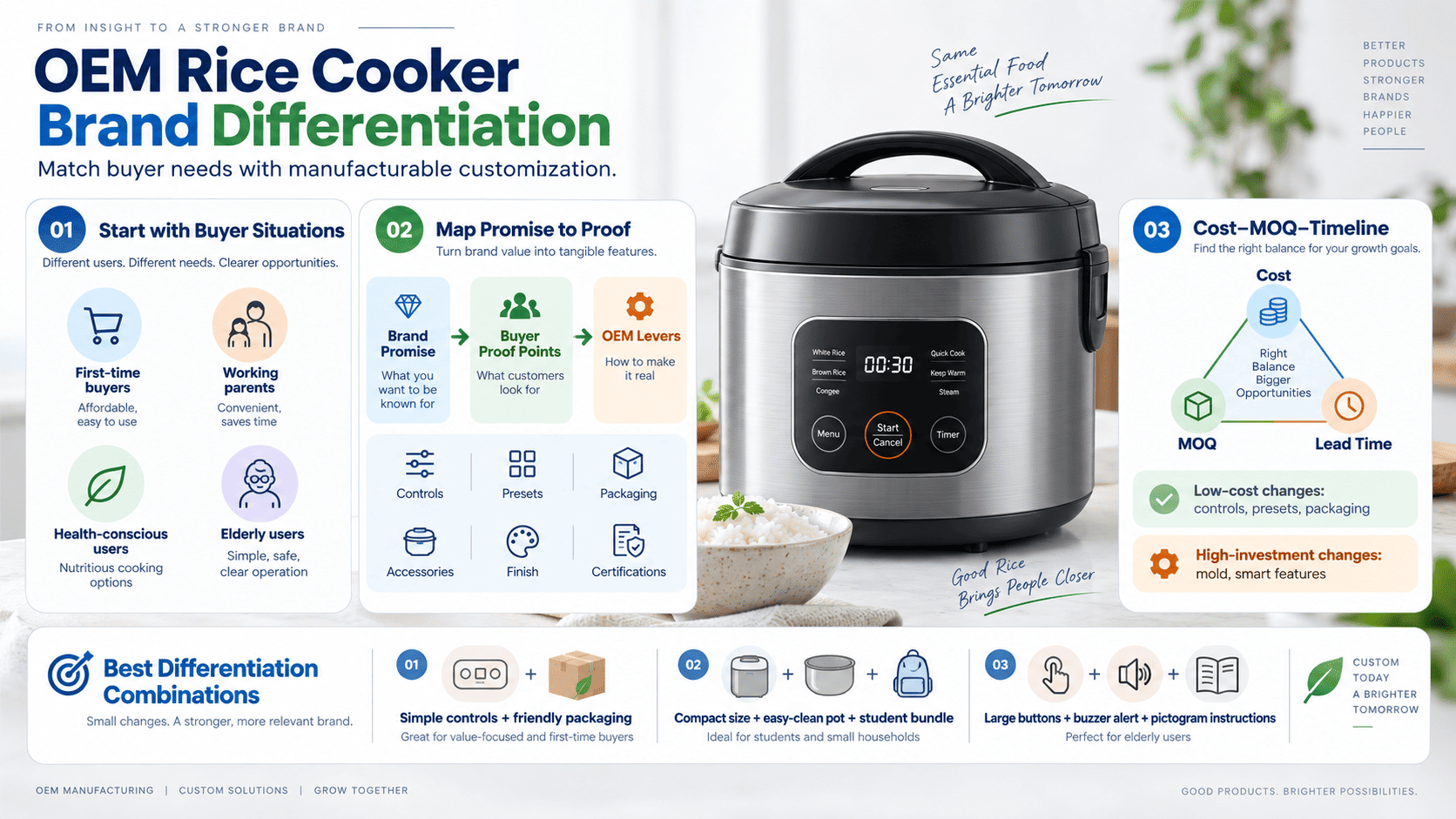
Let me walk through the combinations that consistently succeed, organized by buyer segment and brand positioning.
For First-Time or Inexperienced Users
Brand Promise: "Foolproof cooking for people who don't know how to use rice cookers."
Effective Combination:
- Control interface: 2-3 large buttons with pictographic labels (rice bowl icon, porridge icon, keep-warm icon)
- Preset programs: Simplified to basic white rice, porridge, and keep-warm—no advanced modes that intimidate
- Packaging/documentation: Step-by-step photo instructions in local language, measurement guide printed on inner lid
- Accessory bundle: Measuring cup with both local and standard markings, rice washing guide
Why this works: Every element removes a barrier to confident use. The differentiation isn't technical—it's psychological. Buyers in this segment fear making mistakes. You're competing against their decision to just buy instant rice or takeout instead.
Cost impact: 3-5% increase (mostly printing and accessory costs)
MOQ impact: Standard 500 units
Manufacturing reality: No tooling changes needed—this is configuration of existing components plus packaging customization
For Health-Conscious Consumers
Brand Promise: "Safe, verified materials for families who care what touches their food."
Effective Combination:
- Inner pot material: Certified non-toxic coating (we provide LFGB or FDA documentation)
- Housing materials: BPA-free plastic components with material declarations10
- Certification visibility: Prominently display CE, RoHS, food-contact compliance marks on product and packaging
- Documentation: Include material safety data sheet (MSDS) summary in packaging, QR code linking to full certifications
Why this works: You're not claiming the rice tastes better or cooks faster—you're providing proof of safety claims competitors don't bother documenting. The differentiation is in verification, not features.
Cost impact: 8-12% increase (upgraded materials and certification documentation)
MOQ impact: Medium (800-1000 units) due to material sourcing
Manufacturing reality: Material certifications we already hold can be leveraged; new material testing adds cost and time
I worked with a European client who discovered their market was skeptical of "non-stick coatings" after a competitor recall. We shifted their differentiation to "ceramic-coated inner pot with LFGB certification" and added a product page on their website with the actual test reports. Their conversion rate jumped because we gave buyers the proof they were already searching for.
For Budget-Conscious Buyers Who Want Reliability
Brand Promise: "Basic functions that work year after year, no features you'll never use."
Effective Combination:
- Capacity/form factor: Select mid-size drum rice cooker (our most durable base model, simpler mechanics than deluxe multi-function)
- Control interface: Mechanical dial or minimal digital display—fewer electronics to fail
- Preset programs: White rice, keep-warm only—no complexity
- Warranty positioning: Emphasize 2-year warranty, easy local parts replacement in marketing
Why this works: You're competing against consumer distrust of "cheap appliances that break." The differentiation is reliability signaling through simplicity and warranty confidence, not through adding features.
Cost impact: Often negative 5-8% (selecting simpler base model)
MOQ impact: Low (standard 500 units)
Manufacturing reality: Simplification is easier than complexity—fewer components, fewer failure points
Caution on warranty claims: Extended warranty positioning requires coordination with your after-sales network. Don't promise what
"The impact of perceived value on brand image and loyalty", https://pmc.ncbi.nlm.nih.gov/articles/PMC11484097/. Marketing research on positioning and customer value indicates that product attributes contribute to differentiation when they are salient to the target segment and support a valued benefit, rather than merely increasing feature count. Evidence role: expert_consensus; source type: paper. Supports: Differentiation is effective when product attributes are meaningful to target customers and tied to perceived value.. Scope note: This would provide general marketing support, not rice-cooker-specific proof. ↩
"EU - EU Legislation and CE Marking", https://www.trade.gov/country-commercial-guides/eu-eu-legislation-and-ce-marking. Government guidance on CE, UKCA, and similar conformity marks explains that such labels indicate a product's assessed compliance with applicable safety or regulatory requirements for sale in designated markets. Evidence role: definition; source type: government. Supports: Certification marks are used to demonstrate conformity with applicable product safety, regulatory, or market-entry requirements.. Scope note: Certification marks show regulatory conformity; they do not independently prove superior product quality. ↩
"Manufacturing Strategies for Optimizing Supply Chains and ...", https://scholarworks.waldenu.edu/cgi/viewcontent.cgi?article=17289&context=dissertations. Research on manufacturing cost drivers shows that material substitutions can affect procurement, process qualification, and unit cost, which supports the general claim that changing an inner-pot material may increase cost and order constraints. Evidence role: general_support; source type: research. Supports: Material substitutions in manufactured products can alter sourcing, processing, testing, and production economics.. Scope note: The source would contextualize the mechanism; it may not verify the article's specific 15-20% estimate for rice cookers. ↩
"Cost Modeling Software for Manufacturing", https://www.dfma.com/software/cost-modeling-software-for-manufacturing.html. Manufacturing research on engineering change management reports that changes requiring tooling or mold modification typically impose greater cost and schedule impact than changes limited to software, labeling, or documentation. Evidence role: mechanism; source type: research. Supports: Engineering changes that avoid new tooling generally have lower cost and shorter implementation burden than changes requiring molds or physical redesign.. Scope note: This would support the cost mechanism generally, not the exact economics of a specific rice-cooker factory. ↩
"Segmentation, Targeting, and Product Positioning", https://hbsp.harvard.edu/course-explorer/modules/segmentation-targeting-and-product-positioning. Standard segmentation-targeting-positioning frameworks describe market segmentation as the process of identifying customer groups with distinct needs so that positioning and product choices can be tailored to them. Evidence role: definition; source type: education. Supports: Segmentation and targeting frameworks recommend dividing broad markets into customer groups with distinct needs before positioning a product.. Scope note: This supports the strategic framework generally and does not identify the best segment for any particular rice-cooker brand. ↩
"Authorized Uses of PFAS in Food Contact Applications", https://www.fda.gov/food/process-contaminants-food/authorized-uses-pfas-food-contact-applications. Public-agency materials on PFAS and food-contact substances discuss concerns associated with some non-stick materials, providing context for why safety-conscious buyers may scrutinize non-stick coatings. Evidence role: general_support; source type: government. Supports: Non-stick coatings and related PFAS or food-contact chemical issues have been discussed by public agencies, making consumer safety concern plausible.. Scope note: This supports the existence of safety concerns generally; it does not show that all rice-cooker coatings pose the same risk. ↩
"What is Engineering Change Management?", https://www.ptc.com/en/technologies/plm/engineering-change-management?srsltid=AfmBOorCE7BgKGuN8fxtgTM1Gsn-NghEM1DtLSAjdKfJbawcdIxztvya. Studies of engineering change management find that modifications affecting product architecture, tooling, or production processes usually carry higher cost and schedule risk than changes confined to software, appearance, or documentation. Evidence role: mechanism; source type: paper. Supports: The cost and rigidity of product changes increase when changes affect physical architecture, tooling, or technology integration.. Scope note: The evidence would support the general manufacturing pattern, not every customization option listed in the table. ↩
"Price Competition and Product Differentiation Based on ... - PMC", https://pmc.ncbi.nlm.nih.gov/articles/PMC7038382/. Research on competitive positioning and perceived customer value supports the view that differentiation may come from salient, segment-relevant attributes and messaging, not solely from technically complex or costly product changes. Evidence role: general_support; source type: paper. Supports: Differentiation can be created through customer-relevant positioning and selected attributes rather than through high-cost technical innovation alone.. Scope note: This is contextual support and does not prove which specific rice-cooker customizations will differentiate in a given market. ↩
"Impact of brand hate on consumer well-being for technology ...", https://pmc.ncbi.nlm.nih.gov/articles/PMC9366433/. Consumer-behavior research on brand congruity and information consistency indicates that mismatched product cues can reduce perceived credibility and weaken consumer evaluation of a brand claim. Evidence role: mechanism; source type: paper. Supports: Consumers may evaluate products less favorably when brand cues or product attributes are incongruent with the promised positioning.. Scope note: This supports the psychological mechanism generally; it does not test the exact example of premium rice-cooker design with budget materials. ↩
"Bisphenol A (BPA)", https://www.fda.gov/food/food-packaging-other-substances-come-contact-food-information-consumers/bisphenol-bpa. Food-safety authorities have evaluated bisphenol A in food-contact materials, supporting the relevance of BPA-related material declarations for products marketed on food-contact safety. Evidence role: general_support; source type: government. Supports: BPA is a recognized chemical of interest in food-contact materials, making BPA-free declarations relevant to safety-oriented product communication.. Scope note: A BPA-free declaration addresses one material concern and does not establish that the entire appliance is risk-free. ↩