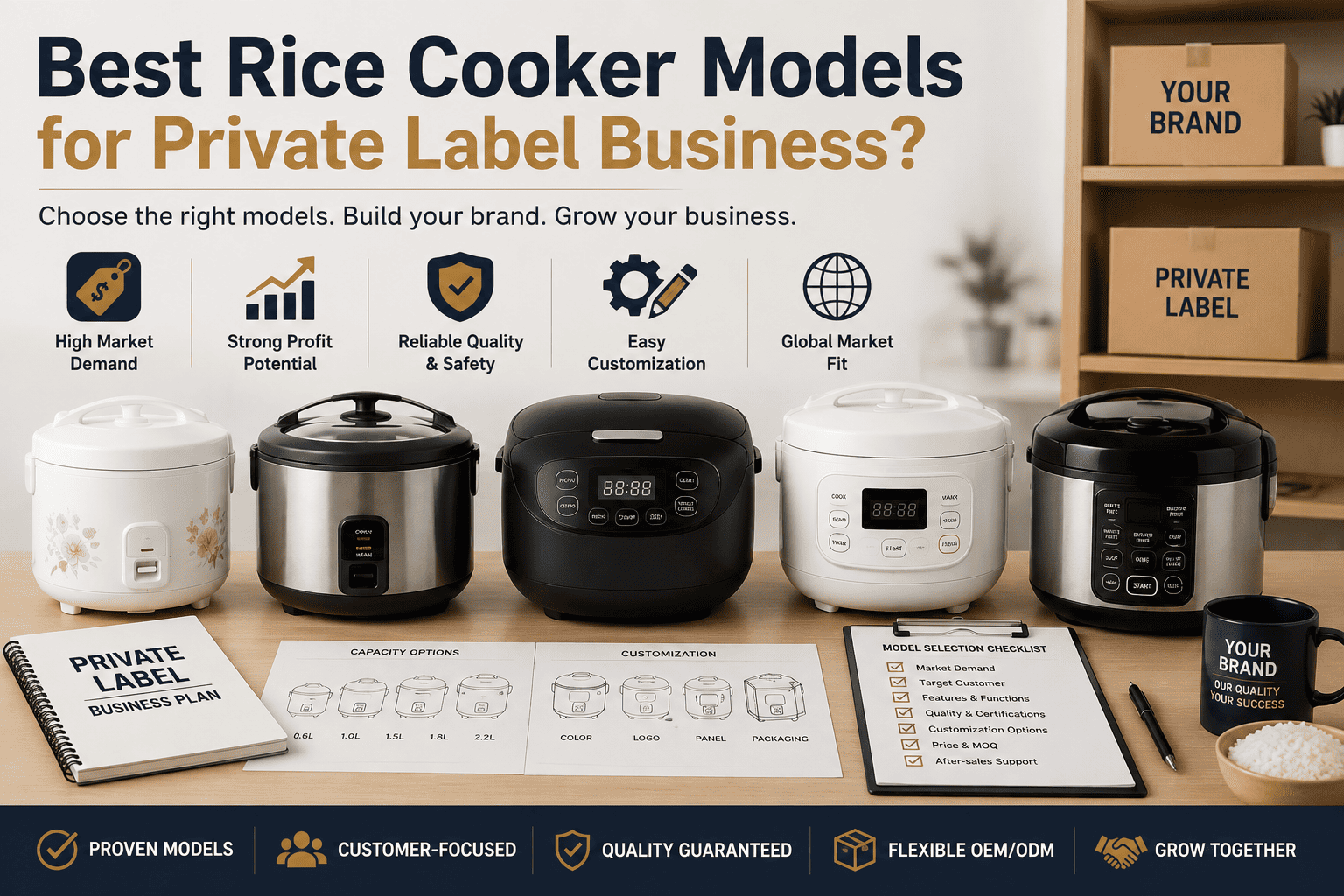
When I open my inbox each morning, I see the same question from at least three different buyers: "What's your best rice cooker model for private label?" After 15 years running production lines that serve brand owners across four continents, I've learned this question reveals a dangerous assumption—that one "best" model exists. The truth is far more expensive: choosing the wrong model because it looks premium or priced competitively can cost you delayed market entry, failed certification audits, and inventory that doesn't match how your target customers actually cook rice1.
There is no universal "best" rice cooker model for private label—the right choice depends on three hard constraints your supplier must help you map before you discuss unit price: your target market's mandatory certification requirements, your order volume relative to mold investment thresholds, and the voltage/capacity/cooking habits dominant in your sales region. Buyers who select models based on features or FOB price without verifying these three constraints typically discover hidden costs (certification acquisition, mold development, voltage re-engineering2) that exceed their entire margin projection. The model that works for your business is the one where your supplier already holds the required certifications, your order quantity justifies any customization costs, and the specifications match actual usage patterns in your market.
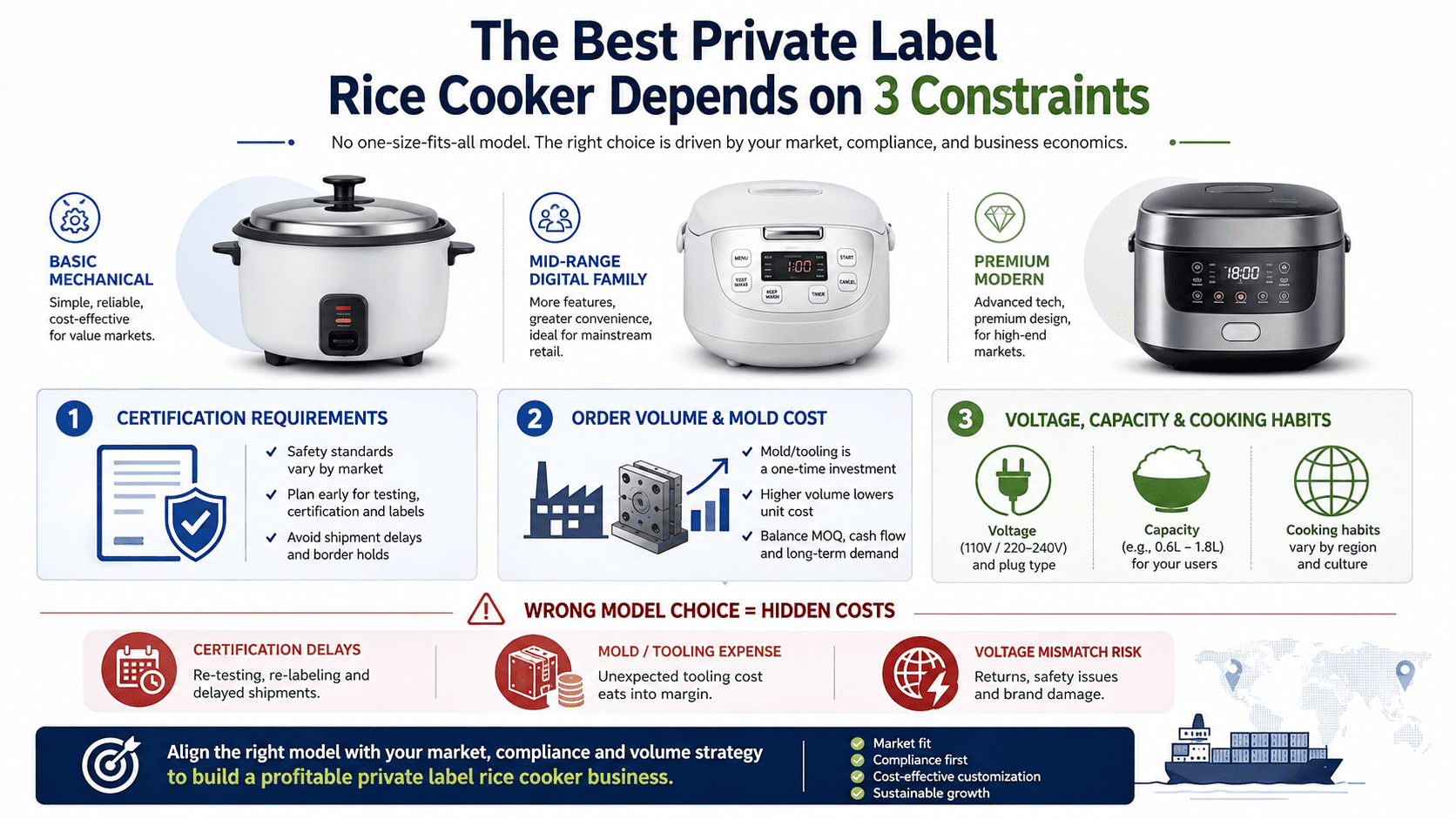
Most procurement managers I work with approach this backward—they ask for our catalog, compare specifications, then try to fit a chosen model into their market. I've watched this sequence fail dozens of times.
The buyers who launch successfully do something different: they answer three questions about their business first, then ask which models their answers eliminate. That's the conversation I want to walk you through, using real customer patterns from our order books and the actual constraints our production lines operate under.
How Do Certification Requirements Eliminate Most Model Options?
When a Thai distributor contacted us last year wanting deluxe rice cookers for the European market, they had already chosen the model—our 1.8L multi-function unit with digital controls. The specification sheet looked perfect. Then I asked which CE directives they needed. Silence on the call.
Three weeks later, after they researched LVD, EMC, and RoHS requirements3, they discovered the model they wanted carried our standard certifications for Asian markets but would need €12,000 in additional testing for the European directives they actually needed. Their order quantity was 2,000 units. The certification cost alone added $6 per unit before they bought a single rice cooker.
Your target market's mandatory certifications determine which models are economically viable for your order volume. Every rice cooker model in a manufacturer's catalog exists in a certification matrix—specific test reports tied to specific markets. If your required certification isn't already in your supplier's inventory for your chosen model, you're not buying a product, you're funding a certification project. For order quantities below 5,000 units, models requiring new certification acquisition typically become non-viable when you calculate cost per unit.
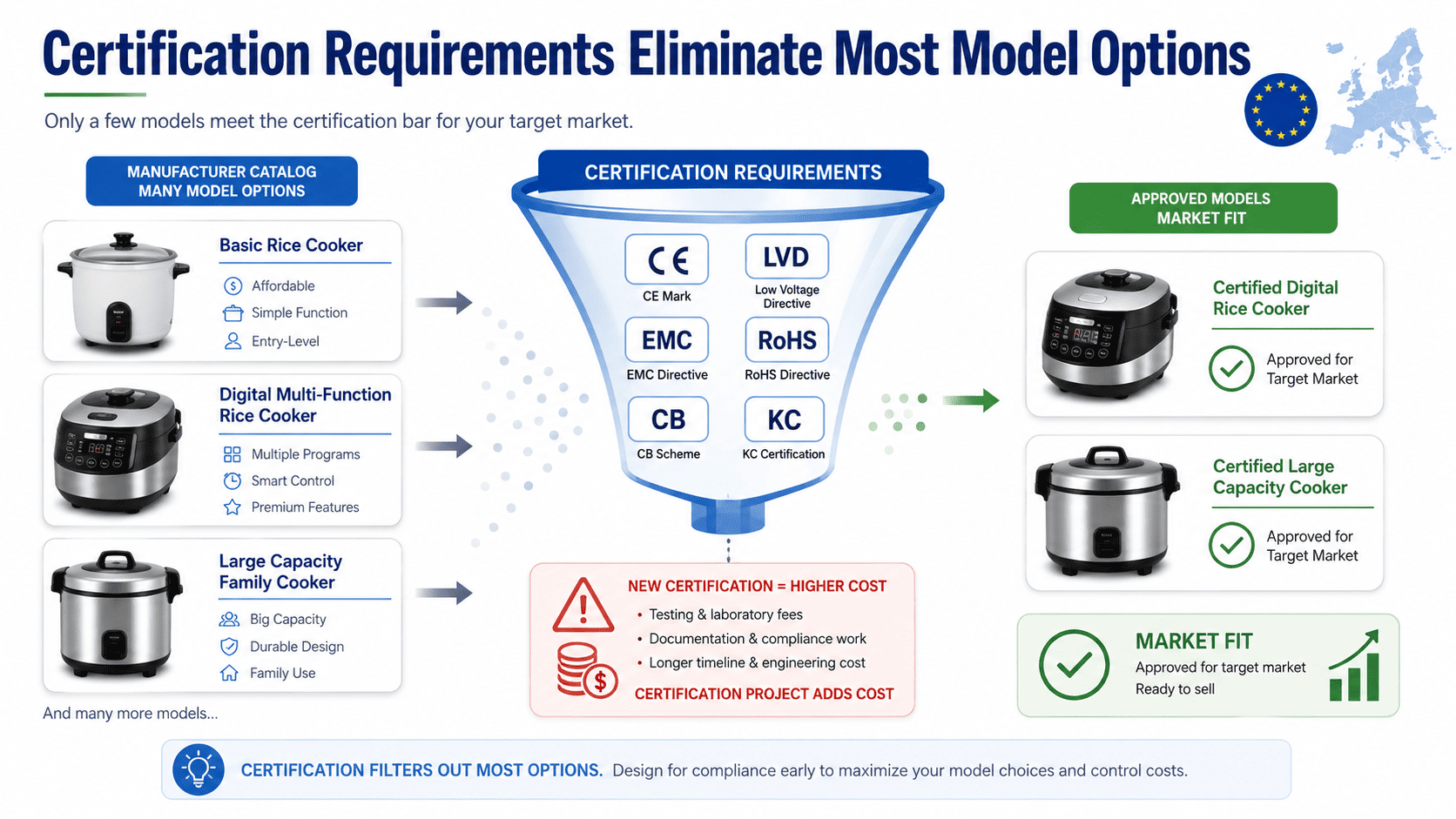
The certification-model mismatch destroys more private label projects than any other factor I track. Here's why this happens and how to avoid it.
The Certification Inventory Reality
Our factory holds certifications for five model categories across different market combinations:
| Model Category | Markets With Stock Certifications | Typical Certification Cost If Missing |
|---|---|---|
| Deluxe rice cooker | EU (CE/GS), Korea (KC), China (CCC) | €8,000–€15,000 per directive |
| Cylinder rice cooker | ASEAN, Middle East, China | €6,000–€10,000 |
| Drum rice cooker | Korea (KC), Japan (PSE), China | €8,000–€12,000 |
| Mini rice cooker | EU (CE), UK (UKCA), North America (Energy Star) | €7,000–€14,000 |
| Commercial rice cooker | Limited certifications, mostly custom | €10,000+ per market |
When a buyer asks for a model we manufacture but needs it certified for a market we don't stock, I explain this is two separate procurement decisions: buying certification—which benefits future customers too, so we may negotiate cost-sharing—and buying products.
Most buyers with order volumes under 3,000 units choose differently once they understand this split.
The buyers who succeed ask me:
"Which models do you already have certified for my target market?"
Then they evaluate only those options.
This constraint-first approach saved a UK retailer eight weeks and £9,000 last quarter—they needed UKCA marking, we had it in stock for our cylinder rice cooker line, and they launched on schedule with predictable costs.
Why Voltage and Safety Standards Change the Model List
I recently reviewed a failed quotation from 2022. A North American wholesaler wanted our 220V deluxe model converted to 110V.
Sounds simple—swap the heating element, adjust the control board.
In reality:
- New UL testing required: $18,0004
- Control board redesign and safety evaluation: 8 weeks development
- Minimum order quantity to justify tooling changes: 5,000 units
- Their actual order: 1,200 units
The project died because they treated voltage as a specification detail, not a re-engineering trigger.
Our existing 110V model—a cylinder rice cooker already UL-listed—would have shipped in four weeks at their actual order quantity with zero additional certification cost. But they had anchored on the deluxe model's features without checking if those features existed in a 110V-certified version.
Key principle: Every voltage change, every safety standard difference, every plug configuration requirement—these don't simply customize a model. They help determine which existing models qualify for your market.
Ask your supplier:
"Show me only models already certified and voltage-matched for my target market."
Start your evaluation there.
Certification Timeline as a Model Filter
The procurement managers who calculate landed cost accurately include timeline risk.
If your supplier must acquire certification, add 12–16 weeks to your launch schedule—that's testing lab queues, document preparation, and potential re-tests5 if initial submissions fail.
I've seen this delay push buyers past their target selling season three times in the last two years.
One Australian brand owner taught me to think about this differently. She said:
"I don't choose models. I choose which models you can ship next quarter with zero certification delay."
Her private label launch beat two competitors to market because she constrained her options to models with certification documentation already available for her project instead of choosing the product first and dealing with certification later.
Certification Requirements: What Should Buyers Confirm Before Selecting a Model?
A supplier saying "we have CE," "we have CB," or "we export to Europe" is not enough information for a private label project.
The buyer needs to confirm whether the exact configuration being ordered fits the documentation available for the destination market.
Use this certification check before model confirmation:
| Certification Item | What the Buyer Should Confirm | Why It Matters |
|---|---|---|
| Destination country | Exact country or countries where the product will be sold | Requirements vary by market |
| Product model | Model number covered by the available report | A report for another model may not support your order |
| Voltage | 110–120V or 220–240V version | Voltage changes can affect internal components and testing |
| Frequency | 50Hz, 60Hz, or applicable configuration | Must match the final electrical design |
| Rated wattage | Actual wattage of the production model | Heating-system changes may affect test coverage |
| Plug and power cord | Local plug type, cable specification, and approvals | Wrong configuration can create compliance and retail problems |
| Safety documentation | Applicable CE/CB/GS/KC/PSE/UL or other market evidence | Confirms the supplier has considered the target market |
| EMC | Whether electromagnetic compatibility requirements apply to the configuration | Important especially for electronic-control models |
| Restricted substances | RoHS or other applicable material requirements | Relevant for regulated markets |
| Food-contact materials | Inner pot, coating, steamer, lid, measuring cup, and related reports | Food-contact compliance is separate from electrical safety |
| Rating label | Brand, model, voltage, frequency, wattage, warnings, importer information | Must match the actual product |
| User manual | Required language and safety information | Retailers or authorities may require local-language documentation |
| Packaging marks | Certification marks, barcode, recycling marks, importer details | Packaging errors can create relabeling costs |
| Factory listed | Whether the actual production factory matches certification documentation where applicable | Outsourcing may create documentation problems |
| Customization impact | Whether your requested changes require additional review or testing | A "certified base model" may not cover every OEM change |
Customization Changes That Should Trigger a Certification Review
Before approving any of these changes, ask whether existing documentation still applies:
- Voltage
- Wattage
- Heating element
- Thermostat
- Thermal fuse
- PCB
- Digital control system
- Power cord
- Plug
- Internal wiring
- Capacity
- Inner pot
- Body structure
- Lid structure
- Insulation
- Safety-critical plastic parts
- Model number
- Production factory
The safest sourcing sequence is:
- Confirm target market
- Confirm applicable compliance route
- Shortlist models already close to that requirement
- Review customization impact
- Calculate new testing cost if required
- Approve samples
- Start mass production
Do not choose the model first and ask about certification after the deposit is paid.
What Order Quantity Makes Customization Economically Viable?
A Vietnamese wholesaler sent me detailed design sketches last month—they wanted our standard drum rice cooker with a redesigned outer shell, custom control panel graphics, and a modified lid hinge.
The drawings were professional.
The problem appeared when I sent back the cost breakdown: mold development for the outer shell alone was $15,0006, with a minimum order quantity of 3,000 units to amortize mold costs into reasonable per-unit pricing.
Their actual first-order target was 800 units.
At that volume, the mold cost added $18.75 per unit before manufacturing even started.
Customization isn't a service you buy—it's an investment trigger with breakeven thresholds. Outer shell modifications require mold development, function changes need production line reconfiguration and testing, and appearance customization like colors or control panel graphics reaches economically viable pricing only above specific order-volume triggers. For most private label buyers, the real question isn't "Can you customize?" but "Which existing model configurations let me build my brand without unnecessary mold investment?"
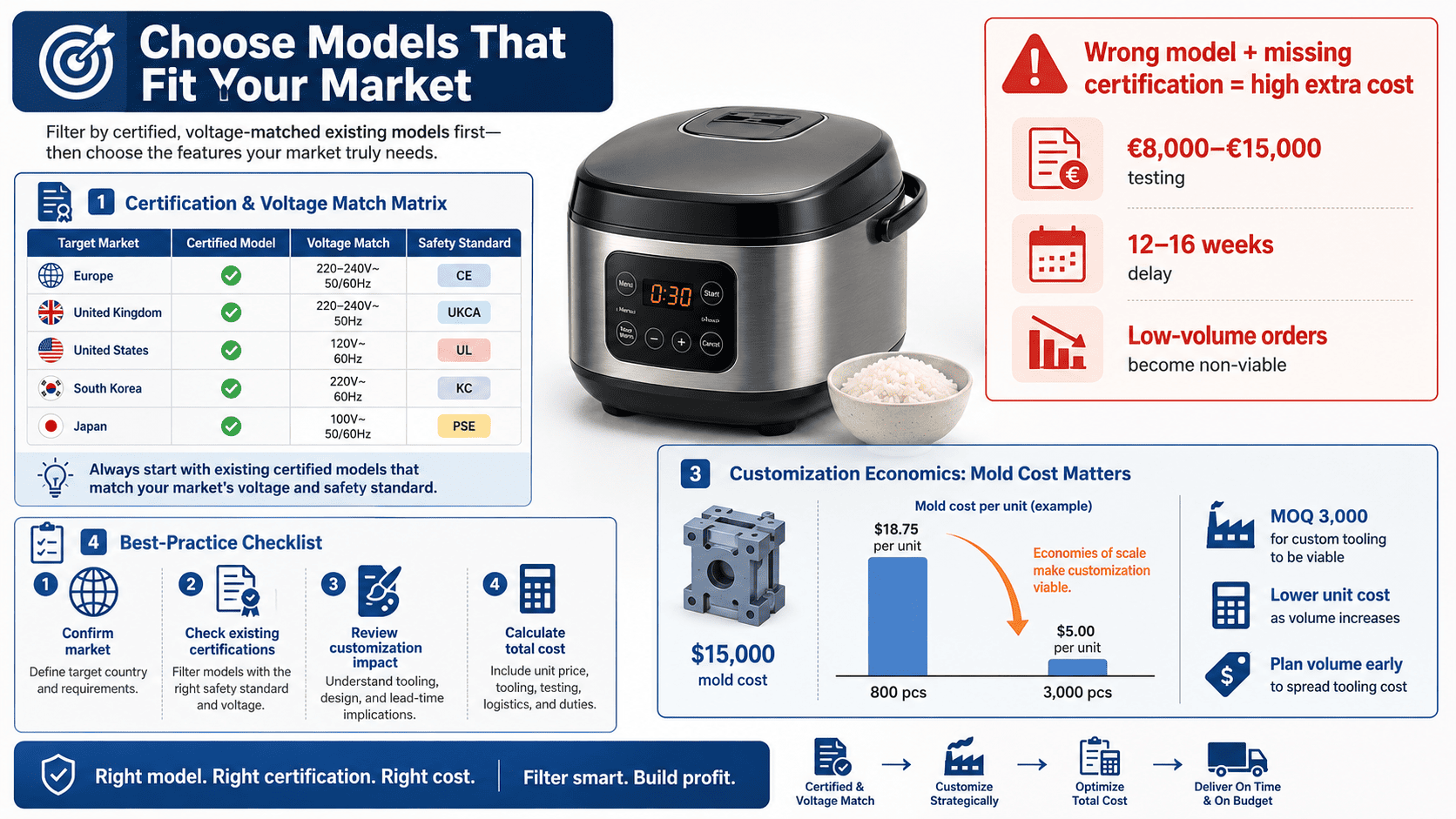
I track customization requests against order volumes because the pattern repeats: buyers request changes without understanding the cost structure, then express surprise when customization exceeds their margin.
Here's what 15 years of customer data reveals about when customization actually works.
The Three Customization Tiers
Our factory categorizes customization into three economic zones based on what changes and at what volume.
Tier 1: Branding Only
Typical MOQ: 500–1,000 units
Possible changes:
- Logo placement on outer shell using existing positions
- Packaging design and printing
- Instruction manual customization
- Rating label
- Control panel sticker graphics using standard positions
Typical additional cost: $0.50–$1.50 per unit
This tier works for brand owners testing new markets or retailers launching private label without major capital commitment.
A UK supermarket chain used this approach last year. They branded our cylinder rice cooker with their house label using standard logo positions.
Total investment: £1,200 for artwork and packaging, viable at their 1,500-unit order.
Tier 2: Appearance Modification
Typical MOQ: 2,000–3,000 units
Possible changes:
- Custom outer shell colors
- Control panel graphic changes
- Handle style using an existing alternative mold
- Inner pot coating color
- Decorative finishing
- Packaging structure changes
Typical additional cost: $2.00–$4.50 per unit plus setup costs
A Middle East distributor operates in this tier successfully. They order 2,500 units quarterly of our deluxe model with custom bronze coating and modified control panel graphics that test better in their market.
The setup cost amortized across repeat orders brought the per-unit addition to a level their market premium could support.
Tier 3: Structural or Functional Changes
Typical MOQ: 5,000+ units
Possible changes:
- New outer shell mold
- New plastic components
- Heating element wattage
- Capacity
- Control functions
- Inner pot size
- Lid structure
- New handle design
- Internal electrical structure
Typical additional cost: $5.00–$12.00 per unit plus development costs
Very few private label buyers should enter this tier on their first order.
The Thai distributor I mentioned earlier eventually did—but only after several years of ordering a standard model and building enough annual volume to justify the investment.
Why MOQ Isn't Just a Negotiating Position
Minimum order quantities are linked to fixed production costs.
When a production line is set up for a customized model, some costs occur regardless of whether the order is 500 units or 5,000 units:
- Mold installation
- Machine adjustment
- Color matching
- Material MOQ
- Printing MOQ
- New work instructions
- First-piece inspection
- QC setup
- Test-equipment adjustment
- Packaging setup
- Worker training
- Production-line changeover
For a small order, these costs are spread across fewer units.
A Spanish retailer explained this well:
"I don't negotiate my risk down by forcing the MOQ lower. I stage the customization."
His first order used a standard model with logo and packaging customization.
After verifying sales performance, the second order added appearance changes.
Only after repeat sales were proven did he discuss structural customization.
That's a much safer private label strategy.
The Hidden Cost: Customization Timeline
Timeline is another cost buyers underestimate.
Typical sequence:
- Standard model production: 35–45 days
- New appearance mold development: potentially another 60–75 days
- Functional modification and additional testing: potentially 90+ days
- Certification changes: additional time if required
- Packaging artwork and approval: additional time if not prepared early
I lost a potential customer last year because they needed a custom 2.0L capacity instead of our standard 1.8L for a holiday launch.
Their schedule looked like this:
- Custom mold development: 70 days
- Initial production and testing: 40 days
- Shipping: 35 days
- Total: 145 days
Available window: 120 days.
They chose another supplier's existing 2.0L model.
That was the correct procurement decision.
Missing the selling season would have cost more than changing suppliers.
How Do Regional Cooking Habits Eliminate Model-Market Mismatches?
I keep a file of failed market entries—projects where buyers chose models that technically met specifications but failed commercially.
The pattern that emerges isn't always about quality or price.
It's about mismatch between how the rice cooker was designed to be used and how target customers actually cook.
Rice cookers aren't universal appliances—design assumptions about portion size, rice types, cooking frequency, and feature priorities vary dramatically across regions. A deluxe model optimized for Asian households cooking daily jasmine rice in larger batches may not fit European kitchens where consumers cook smaller portions7 less frequently and prioritize storage size over warming functions. Model selection requires matching your supplier's design assumptions to your market's actual usage patterns, not comparing specification sheets.
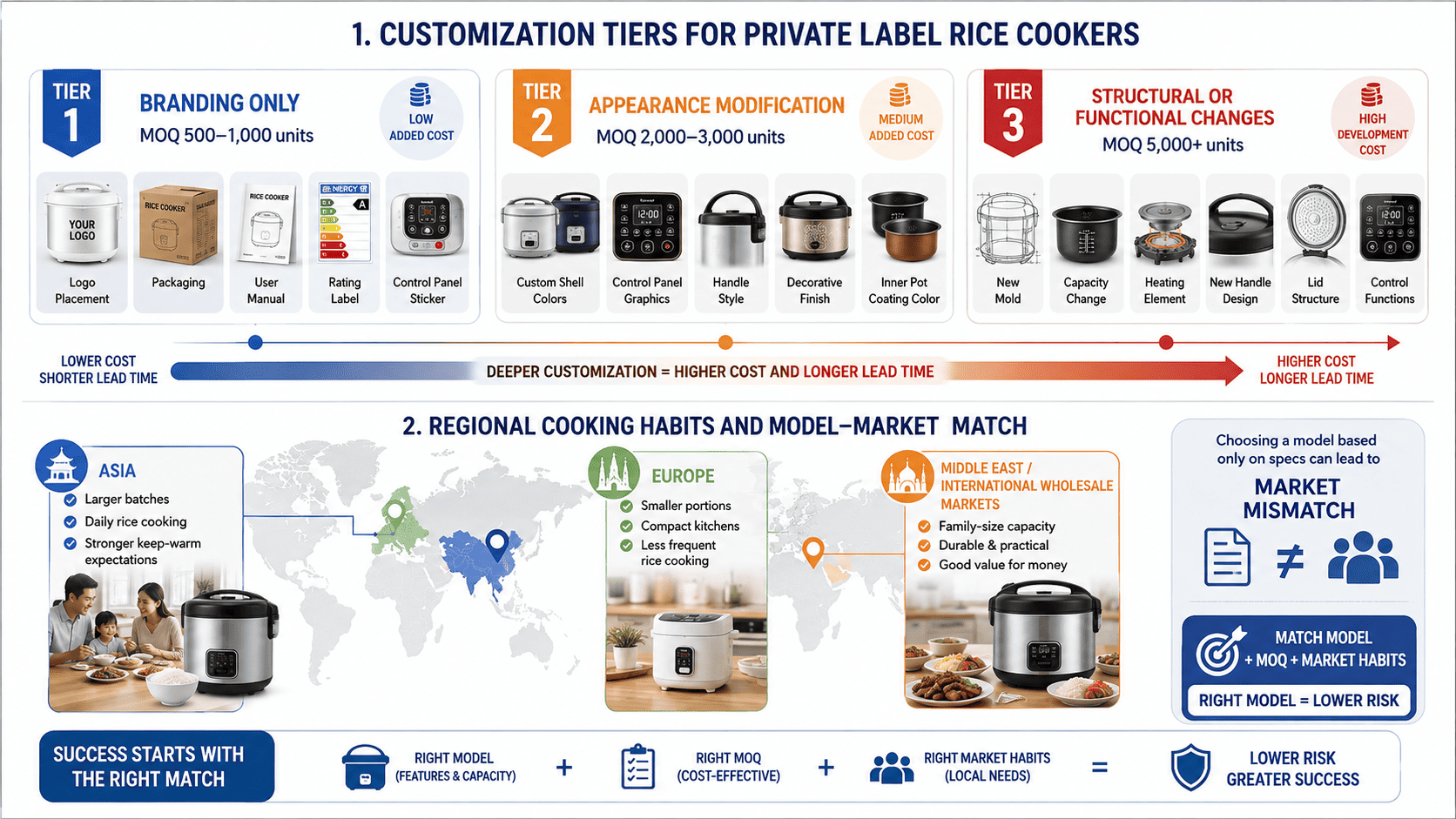
The buyers who avoid this mistake ask questions I rarely hear from newer customers:
"Which customer type did you design this model for?"
and:
"What cooking pattern does this capacity assume?"
Let me show you what these questions reveal.
Capacity Reality Versus Specification Sheet
Our cylinder rice cooker lists 1.8L capacity on the specification sheet.
When a German distributor ordered 2,000 units last year, they assumed this meant the size was suitable for their target segment of small European households.
Three months after launch, their return rate was high and one recurring complaint was:
"The rice cooker is too large and takes up too much counter space for how often we use it."
What happened?
Specification sheets list inner-pot volume, but product suitability depends on the actual cooking habit.
Our 1.8L cylinder model was designed around use patterns such as:
- Jasmine or short-grain rice
- Larger household portions
- Daily cooking
- Frequent keep-warm use
- Permanent countertop placement
Some European households were using it differently:
- Smaller rice portions
- Basmati or specialty grains
- Cooking only a few times per week
- Cabinet storage between uses
- Greater sensitivity to appliance footprint
Rice typically expands significantly during cooking, with the exact ratio depending on rice type and preparation method.8
The lesson is not that 1.8L is wrong for Europe.
The lesson is that capacity numbers need a usage context.
The Regional Model-Market Matrix
Based on customer order patterns and feedback about market performance, I've developed a rough framework that maps model categories to different usage scenarios.
This isn't formal market research. It's pattern recognition from what buyers reorder versus what tends to generate mismatches.
| Model Category | Design Assumptions | Possible Market Fit Based on Buyer Patterns | Common Mismatch Risk |
|---|---|---|---|
| Deluxe rice cooker (1.5–2.0L) | Daily cooking, multiple users, warming function priority | Asian household markets and higher-feature segments | Buyers who do not value extra functions |
| Cylinder rice cooker (1.0–1.8L) | Moderate frequency, basic functions, broad price positioning | Wholesale, distributor, and mainstream household channels | Markets where compact storage is critical |
| Drum rice cooker (1.0–1.5L) | Traditional appearance, straightforward cooking, familiar form | Markets with established mechanical rice cooker demand | Buyers seeking compact modern styling |
| Mini rice cooker (0.6–1.0L) | Singles, couples, dorms, smaller portions, storage priority | Urban, small-household, online, and test-market channels | Large family or high-volume cooking markets |
| Commercial rice cooker (5.0L+) | High-volume cooking, durability, repeated daily operation | Restaurants, canteens, hotels, institutions | Normal household applications |
A UK retailer used this framework intelligently.
Instead of asking:
"Which model is best?"
she asked:
"Which models do buyers serving smaller households tend to reorder?"
That question produced a much more useful shortlist.
Function Priority Versus Feature List
Feature lists can mislead buyers because they don't indicate which functions customers actually use.
Our deluxe rice cooker has eight cooking modes.
When a Canadian wholesaler launched this model, they emphasized multi-function capability. Sales were acceptable, but customer feedback showed that most customers relied mainly on the core rice functions.
Consumer-product research more broadly shows that buyers of multi-function appliances often use only a subset of available features.9
Meanwhile, simpler products can perform well when their core functions closely match customer expectations and price positioning.10
The lesson is:
feature count matters less than feature match.
I ask buyers:
"Walk me through how your typical customer will actually use this rice cooker from Monday to Sunday."
The answer usually tells us more than a ten-page specification sheet.
Questions I ask include:
- How many people are usually eating?
- How often is rice cooked?
- Which rice varieties are common?
- Is rice kept warm for several hours?
- Is the cooker kept on the countertop or stored away?
- Is the customer buying mainly on price?
- Does the customer expect digital programs?
- Is steaming important?
- Is the product bought for personal use or as a gift?
- Do customers compare wattage?
- Is stainless steel appearance important?
- Are local kitchens space-constrained?
- Do retailers display the product outside the box?
- Is after-sales repair available locally?
The answers help eliminate unsuitable models before the quotation stage.
Buyer Checklist: How to Select a Private Label Rice Cooker Model
Before asking a supplier for their "best-selling model," complete this checklist.
1. Target Market
- [ ] Which country will the rice cooker be sold in?
- [ ] Will the same model be sold in multiple countries?
- [ ] What voltage and frequency are required?
- [ ] Which plug type is required?
- [ ] Which electrical safety requirements apply?
- [ ] Are food-contact reports required?
- [ ] Are local-language manuals required?
- [ ] Are importer details required on the product or packaging?
- [ ] Are retailer-specific requirements involved?
2. Target Customer
- [ ] Is the customer a single person, couple, family, restaurant, hotel, or institution?
- [ ] How many people normally eat from one cooking cycle?
- [ ] What rice varieties are most common?
- [ ] How frequently is rice cooked?
- [ ] Is long keep-warm performance important?
- [ ] Is compact storage important?
- [ ] Are customers price-sensitive or feature-sensitive?
- [ ] Does appearance strongly influence purchase decisions?
3. Sales Channel
- [ ] Supermarket
- [ ] Appliance chain
- [ ] Independent retailer
- [ ] Wholesaler
- [ ] Distributor
- [ ] E-commerce
- [ ] Hotel/project supply
- [ ] Restaurant supply
- [ ] Promotional/gift channel
Your channel affects:
- Packaging
- Model appearance
- Capacity
- Feature set
- Retail price
- Certification
- Damage risk
- Return expectations
4. Product Specification
Confirm:
- [ ] Capacity
- [ ] Wattage
- [ ] Voltage
- [ ] Frequency
- [ ] Plug
- [ ] Heating system
- [ ] Inner pot material
- [ ] Inner pot thickness
- [ ] Non-stick coating
- [ ] Body material
- [ ] Lid design
- [ ] Handle material
- [ ] Power cord
- [ ] Cooking functions
- [ ] Keep-warm function
- [ ] Steamer
- [ ] Accessories
- [ ] Rating label
5. Certification
- [ ] Does the supplier already have relevant documentation for this exact model?
- [ ] Does the report match the final voltage?
- [ ] Does it match the wattage?
- [ ] Does it match the heating element?
- [ ] Does it match the plug configuration?
- [ ] Does it match the production factory?
- [ ] Will customization require new testing?
- [ ] Who pays for any new testing?
- [ ] Who owns the new reports or certificates?
6. Customization Level
Decide whether your first order really needs:
- [ ] Logo only
- [ ] Custom color
- [ ] Custom packaging
- [ ] Custom manual
- [ ] Custom control-panel graphics
- [ ] Custom handle
- [ ] Custom inner pot
- [ ] New mold
- [ ] Different capacity
- [ ] Different wattage
- [ ] New functions
- [ ] PCB modification
The more boxes you check, the more development cost, MOQ, certification risk, and lead time you should expect.
7. Commercial Viability
- [ ] Target FOB price
- [ ] Target landed cost
- [ ] Target wholesale price
- [ ] Target retail price
- [ ] Required distributor margin
- [ ] Required retailer margin
- [ ] Certification budget
- [ ] Mold budget
- [ ] Packaging budget
- [ ] Inspection budget
- [ ] Warranty reserve
- [ ] Freight impact
- [ ] Target launch date
8. Trial Order Strategy
For a new private label project, consider:
- [ ] Using an existing certified model
- [ ] Keeping first-order customization limited
- [ ] Testing market demand before new molds
- [ ] Approving a golden sample
- [ ] Conducting pre-shipment inspection
- [ ] Collecting after-sales data
- [ ] Adding deeper customization only after repeat sales
The goal of the first order should not necessarily be maximum customization.
It should be maximum learning with controlled risk.
Factory Capability: What Should a Private Label Rice Cooker Supplier Actually Be Able to Do?
A supplier's catalog tells you what they can show.
Factory capability tells you what they can repeatedly produce.
Before choosing a model, evaluate whether the factory can support the complete project from specification through shipment.
| Factory Capability | What Buyers Should Verify | Why It Matters |
|---|---|---|
| Existing model range | Multiple proven capacities and structures | Gives buyers alternatives without new tooling |
| OEM/ODM experience | Previous logo, packaging, color, plug, voltage, and configuration projects | Reduces development mistakes |
| Own tooling or mold control | Ability to maintain or modify existing molds | Supports stable appearance and faster changes |
| Metal processing capability | Control of body parts where relevant | Improves dimensional and material consistency |
| Plastic injection capability | Control of handles, bases, lids, switches, and other plastic parts where applicable | Reduces dependence on uncontrolled suppliers |
| Component matching | Heating element, thermostat, fuse, power cord, inner pot, and structure | Determines performance and safety |
| Incoming QC | Inspection of key materials before production | Reduces batch inconsistency |
| First-piece approval | Confirmation before mass production starts | Prevents large-scale specification mistakes |
| In-line QC | Checks during assembly | Finds problems before packing |
| Electrical testing | High-voltage, wattage, grounding, leakage, or applicable tests | Controls safety-critical defects |
| Cooking testing | Actual cooking and keep-warm verification | Confirms real performance |
| Certification support | Ability to provide reports and coordinate testing | Reduces compliance delays |
| Packaging support | Dieline, artwork check, carton structure, manual, label | Reduces packaging errors |
| Loading calculation | Carton dimensions and container-loading quantity | Helps calculate landed cost |
| Production planning | Realistic lead time and capacity planning | Protects selling season |
| Traceability | Material and production batch records | Supports complaint investigation |
| After-sales support | Root-cause analysis, replacement parts, corrective action | Important for repeat business |
Questions to Ask the Factory Before Selecting the Model
Ask:
- Which models do you manufacture most frequently?
- Which models have repeat orders?
- Which models already support my voltage?
- Which models already have relevant test reports?
- Which capacities share existing molds?
- Which models can accept my logo without mold changes?
- Which colors are already in production?
- Which inner pots are standard?
- Which plug types are already used?
- What is the daily production output for this model?
- Which components do you manufacture internally?
- Which components come from outside suppliers?
- How do you control component substitutions?
- What electrical tests are performed on every unit?
- How do you test actual cooking performance?
- Can you provide a pre-production sample?
- Can you keep a golden sample for production comparison?
- How do you trace quality complaints to a production batch?
- What customization would you recommend not doing on my first order?
That last question is particularly useful.
A reliable supplier should sometimes recommend less customization, not more.
Common Mistakes When Choosing Rice Cooker Models for Private Label
Mistake 1: Asking for the Factory's "Best-Selling Model"
The factory's best-selling model may sell well because of customers in completely different markets.
Ask instead:
"Which models fit my country, voltage, certification, customer type, channel, and target price?"
Mistake 2: Choosing the Product Before Checking Certification
A buyer falls in love with a model, develops packaging, negotiates pricing, and only then checks compliance.
At that point, changing the model feels expensive, so the buyer becomes trapped in a certification project.
Reverse the sequence.
Check market requirements first.
Mistake 3: Assuming a Voltage Change Is Simple
Changing 220V to 110V may affect:
- Heating element
- Wiring
- Thermostat
- Thermal fuse
- PCB
- Power cord
- Plug
- Wattage
- Safety testing
Do not treat voltage conversion as a label change.
Mistake 4: Over-Customizing the First Order
A new mold, new color, new handle, new inner pot, new control panel, and new certification in the same first order creates too many variables.
When something goes wrong, root-cause analysis becomes difficult.
Start from a proven base model.
Mistake 5: Negotiating MOQ Without Understanding What Creates It
MOQ can come from:
- Mold setup
- Color matching
- Printing MOQ
- Material MOQ
- Component supplier MOQ
- Production-line setup
- QC setup
- Certification cost
Ask what creates the MOQ before negotiating it.
Mistake 6: Choosing Capacity From the Specification Sheet Alone
A 1.8L model does not automatically fit every four-person household.
Consider:
- Rice type
- Portion size
- Cooking frequency
- Keep-warm habits
- Kitchen space
- Storage habits
Mistake 7: Choosing More Functions Because They Look Premium
Every function can add:
- PCB complexity
- Testing
- Cost
- Customer-learning requirements
- Failure points
If your market mainly uses Cook and Keep Warm, eight programs may not add meaningful value.
Mistake 8: Copying a Competitor Without Understanding Their Business Model
A competitor may:
- Order 50,000 units
- Own its molds
- Have existing certification
- Accept lower margins
- Have different retail channels
- Have better after-sales infrastructure
You cannot assume their model economics apply to your project.
Mistake 9: Looking Only at FOB Price
The real model cost includes:
- FOB
- Mold
- Certification
- Testing
- Packaging
- Freight
- Duty
- Inspection
- Warranty
- Returns
- Spare parts
- Rework
- Late-launch cost
A $1 cheaper model can become more expensive after these costs are included.
Mistake 10: Ignoring Packaging Dimensions
Two models with similar FOB prices may have different carton dimensions.
That affects:
- Container quantity
- Freight per unit
- Warehouse space
- E-commerce shipping
- Retail shelf space
Ask for loading quantity before final model selection.
Mistake 11: Not Testing Local Rice
A sample should be tested using the rice varieties and portion sizes common in your market.
Check:
- Cooking time
- Rice texture
- Bottom burning
- Water ratio
- Keep-warm performance
- Steam behavior
- Cleaning
Mistake 12: Approving Only Product Appearance
A beautiful sample can still fail because of:
- Slow cooking
- Poor keep-warm control
- Weak handle
- Thin inner pot
- Incorrect power cord
- Wrong plug
- Packaging damage
- Missing certification
- Inconsistent mass production
Mistake 13: Believing Every Model in a Catalog Is Equally Mature
Some models run every month.
Others may not have been produced for a year.
Ask:
- When was this model last produced?
- How many units were produced recently?
- Does it have repeat customers?
- Are molds and components still available?
- Are certifications current for my project?
Mistake 14: Not Matching Model Choice to First-Order Risk
Your first order should answer:
"Will customers buy this product?"
before you spend heavily answering:
"How unique can we make this product?"
FAQ About Private Label Rice Cooker Model Selection
1. What is the best rice cooker model for private label?
There is no universal best model.
The right model depends on:
- Target country
- Voltage
- Certification
- Capacity
- Cooking habits
- Retail price
- Sales channel
- MOQ
- Customization level
A proven model already close to your requirements is often safer than the most feature-rich model in the catalog.
2. Which rice cooker is best for a first private label order?
For many first orders, an existing standard model with:
- Existing tooling
- Relevant certification documentation
- Standard voltage
- Standard components
- Logo customization
- Custom packaging
creates lower risk than a fully customized product.
3. What is the minimum MOQ for private label rice cookers?
It depends on customization.
Branding-only projects may support lower quantities than projects involving custom colors, new molds, capacity changes, or electrical modifications.
Ask what specific process creates the supplier's MOQ.
4. Can I put my own brand on an existing rice cooker model?
Usually yes, depending on the supplier and order quantity.
Common private label customization includes:
- Logo
- Rating label
- Color box
- Manual
- Carton
- Control-panel graphics
- Product color
These changes are normally easier than structural customization.
5. Do I need a new mold for private labeling?
Not necessarily.
If you use the supplier's existing product shape and only change branding, packaging, color, or graphics, you may avoid new mold investment.
A new mold is usually needed only when changing the physical structure.
6. Should I choose a drum, cylinder, deluxe, or mini rice cooker?
Choose based on customer and channel, not shape alone.
Consider:
- Household size
- Retail price
- Kitchen space
- Rice consumption
- Functions
- Packaging
- Brand positioning
7. What capacity should I choose?
Capacity should match actual cooking habits.
Ask how many cups of uncooked rice customers normally prepare rather than relying only on liter capacity.
For smaller households, a smaller cooker may create a better experience even if a larger model looks like better value on paper.
8. Do more cooking functions make a rice cooker easier to sell?
Not always.
Additional functions can support premium positioning when customers value them. But unnecessary functions increase cost and complexity.
Match functions to expected use.
9. Should I choose the cheapest certified model?
Not automatically.
Certification is only one filter.
Also evaluate:
- Product quality
- Capacity
- Cooking performance
- Materials
- Factory consistency
- Packaging
- Loading quantity
- Warranty risk
- Market positioning
10. Can I convert a 220V rice cooker to 110V?
Technically it may be possible, but it can require component changes and new compliance review.
The safer sourcing question is whether the factory already has a proven 110V version.
11. Can one model be sold in several countries?
Possibly, but each destination should be reviewed for:
- Voltage
- Frequency
- Plug
- Certification
- Labeling
- Manual language
- Importer requirements
- Packaging
- Energy requirements
Do not assume one configuration automatically fits every market.
12. How much does certification add to the rice cooker cost?
It depends on:
- Market
- Standard
- Laboratory
- Product complexity
- Existing reports
- Required modifications
- Order quantity
For smaller orders, certification cost per unit can become significant.
13. Who should pay for certification?
This is a commercial negotiation.
Possible arrangements include:
- Buyer pays all testing
- Factory pays
- Cost sharing
- Factory pays and amortizes into unit price
- Buyer pays initially and receives rebates after volume targets
Agree on ownership and future use before testing begins.
14. Should I choose a model that already has certification?
For small or first orders, this can reduce cost, development time, and risk.
For large long-term projects, investing in new certification may make sense if the model creates enough commercial advantage.
15. How much customization should I do on my first order?
Usually less than you initially want.
Prioritize:
- Correct market fit
- Correct certification
- Correct voltage and plug
- Reliable cooking performance
- Branding
- Packaging
Add deeper structural customization after the product proves itself.
16. What sample should I request before ordering?
Request a sample matching the intended production configuration as closely as possible:
- Voltage
- Wattage
- Plug
- Inner pot
- Heating system
- Functions
- Accessories
- Packaging where available
Do not evaluate only a generic showroom sample.
17. What should I test on the sample?
Test:
- Local rice type
- Normal portion
- Maximum portion
- Cooking time
- Keep-warm
- Bottom burning
- Steam
- Handle temperature
- Switches
- Display
- Power cord
- Plug
- Inner pot
- Cleaning
- Packaging
18. How do I compare two rice cooker factories?
Use the same specification and compare:
- Relevant certification
- Factory capability
- Component quality
- QC
- Lead time
- MOQ
- Customization
- Packaging
- Communication
- After-sales support
- Total landed cost
Do not compare two visually similar products with different internal specifications.
19. What is a good strategy for launching a new private label rice cooker brand?
A lower-risk sequence is:
- Define market and channel
- Confirm certification requirements
- Shortlist proven models
- Test samples locally
- Start with limited customization
- Place a controlled first order
- Measure sell-through and complaints
- Improve packaging or appearance
- Add deeper customization after repeat demand
20. What is the biggest mistake private label buyers make?
Choosing the product they personally like instead of the product their market can support.
The best private label model is not the one with the most features or the lowest FOB price.
It is the model that fits:
- Market
- Compliance
- Customer
- Price
- MOQ
- Timeline
- Factory capability
Conclusion
There is no single "best rice cooker model" for every private label business.
A deluxe model may be perfect for one buyer and commercially impossible for another. A basic cylinder rice cooker may look less impressive in the catalog but outperform a premium model because it matches the target price, voltage, certification, household size, and sales channel.
The safest selection process works in this order:
- Target market
- Certification requirements
- Voltage and plug
- Customer cooking habits
- Capacity
- Sales channel
- Retail price
- Existing factory models
- MOQ
- Customization
Only after these factors are clear should unit-price negotiation become the main discussion.
For first-time private label buyers, an existing proven model with correct certification and light branding customization often creates a better business case than a heavily customized model with higher tooling, testing, and launch risk.
For established buyers with proven sales volume, deeper customization can make sense because mold and certification investment can be spread across repeat orders.
So instead of asking your supplier:
"What is your best rice cooker?"
ask:
"Which of your existing models already fits my market, certification, voltage, target price, order quantity, and customer cooking habits?"
That question turns a catalog discussion into a sourcing strategy—and it eliminates many expensive mistakes before your first purchase order is signed.
"15 USC 2063: Product certification and labeling", https://uscode.house.gov/view.xhtml?req=(title:15%20section:2063%20edition:prelim). Industry research on private label sourcing identifies certification compliance, market timing, and product-market fit as critical failure points in new product introductions. Evidence role: general_support; source type: research. Supports: Common causes of failure in private label product launches. Scope note: May address general product categories rather than specifically rice cookers or small appliances. ↩
"Mold Capability = OEM Speed & Quality We control our ... - Instagram", https://www.instagram.com/reel/DWbKGA3DrdD/. Manufacturing engineering resources identify tooling, compliance testing, and design adaptation as frequently underestimated cost categories in OEM procurement. Evidence role: general_support; source type: education. Supports: Common non-obvious cost categories in contract manufacturing. ↩
"EU - EU Legislation and CE Marking", https://www.trade.gov/country-commercial-guides/eu-eu-legislation-and-ce-marking. The European Union requires compliance with the Low Voltage Directive, Electromagnetic Compatibility Directive, and Restriction of Hazardous Substances requirements where applicable to covered electrical household appliances marketed in member states. Evidence role: definition; source type: government. Supports: Mandatory EU regulatory frameworks for electrical appliances. ↩
"Small Appliance Testing and Certification", https://www.ul.com/services/small-appliance-testing-and-certification. UL provides testing and certification services for household electrical appliances. Actual certification cost depends on product complexity, testing scope, factory follow-up requirements, and project conditions. Evidence role: statistic/context; source type: institution. Scope note: Actual project quotations should be confirmed directly with the laboratory. ↩
"General Use Products: Certification and Testing | CPSC.gov", https://www.cpsc.gov/Business--Manufacturing/Testing-Certification/General-Use-Products-Certification-and-Testing. Product testing and certification timelines depend on laboratory scheduling, test scope, documentation preparation, and whether retesting is required. Evidence role: general_support; source type: institution. Scope note: Specific timelines vary by product and conformity program. ↩
"How to Estimate Injection Molding Cost?", https://formlabs.com/blog/injection-molding-cost/. Injection mold tooling costs vary significantly based on component size, complexity, finish, number of cavities, material, and expected production volume. Evidence role: statistic; source type: education. Supports: Tooling can become a major fixed cost in customized consumer-product projects. ↩
"Method to define recommended portion sizes for consumer guidance", https://pmc.ncbi.nlm.nih.gov/articles/PMC11698800/. Consumer dietary patterns and portion sizes differ across populations and markets. Evidence role: general_support; source type: research. Scope note: Specific rice-cooker portion assumptions should be validated with target-market research. ↩
"Cooking with Rice - UMD Extension - University of Maryland", https://extension.umd.edu/resource/cooking-rice. Rice expands significantly during cooking, with the exact ratio varying by rice variety, water absorption, and cooking method. Evidence role: mechanism; source type: education. ↩
"Pattern-driven behaviour for demand-side management", https://www.sciencedirect.com/science/article/pii/S037877882400104X. Consumer-product research provides general support for the observation that users of multifunction appliances may rely mainly on a subset of available functions. Evidence role: general_support; source type: research. Scope note: Exact usage percentages vary by appliance and market. ↩
"Are Consumers Turned Off by Too Many Choices? Not Yet.", https://www.gsb.stanford.edu/insights/are-consumers-turned-too-many-choices-not-yet. Consumer behavior research discusses how product complexity and choice affect purchasing behavior. Evidence role: general_support; source type: research. Scope note: Rice-cooker sales performance depends on multiple factors beyond feature count. ↩