Last month, a Thai client forwarded me a PPWR compliance email from their German distributor with one question: "Do we need to redesign everything?" The email contained zero specific requirements—just a link to the regulation and a request for confirmation. After three calls between our factory, their compliance team, and the distributor, we discovered their current packaging already met the material criteria. They needed documentation, not redesign. This happens more often than you'd think.
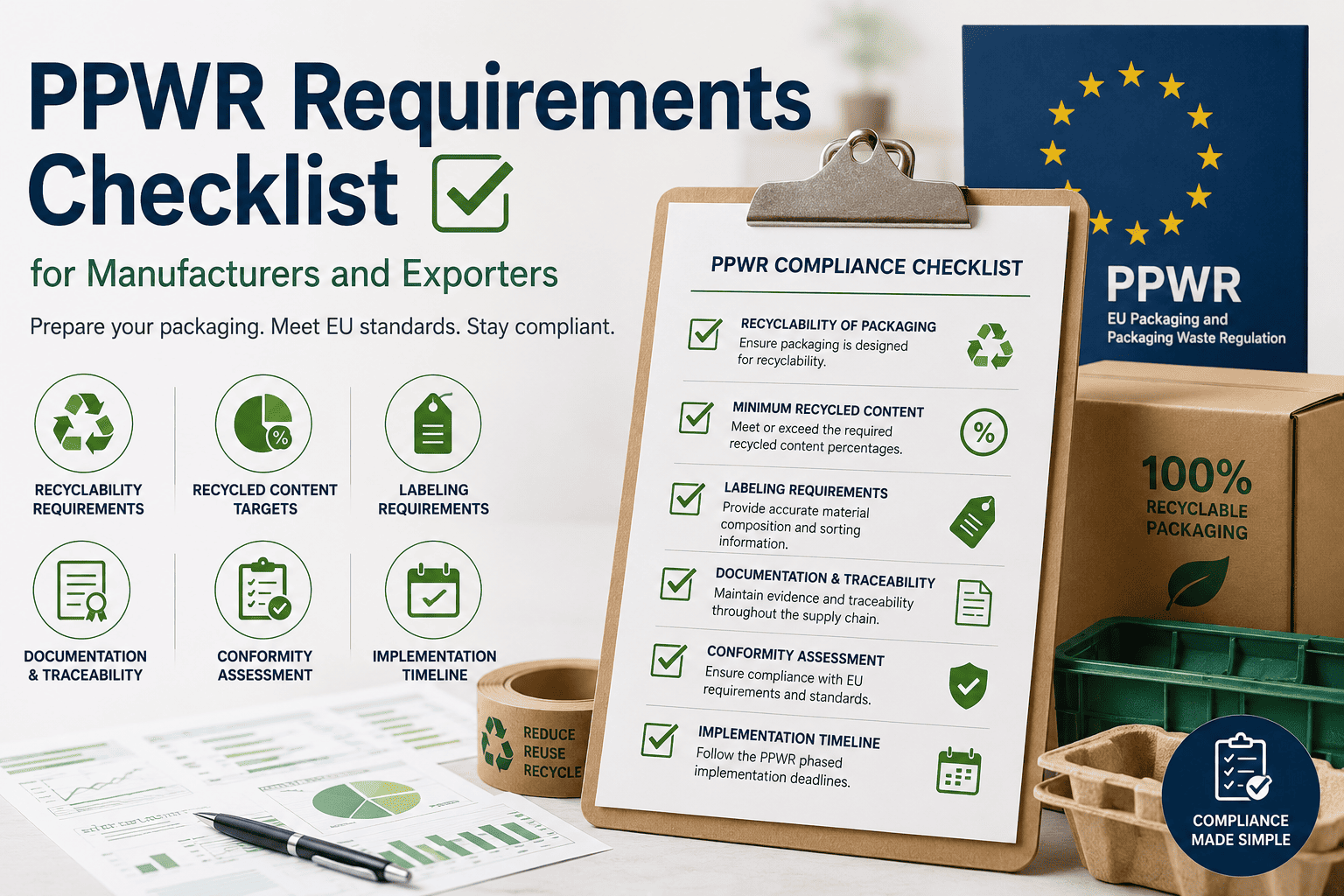
The PPWR Requirements Checklist breaks down into four categories: material composition verification, design compliance assessment, responsibility allocation, and documentation preparation. Most manufacturers discover their packaging already meets core requirements but lacks the proof trail EU importers need for Extended Producer Responsibility registration1. The compliance gap sits in the documentation system, not the packaging itself.
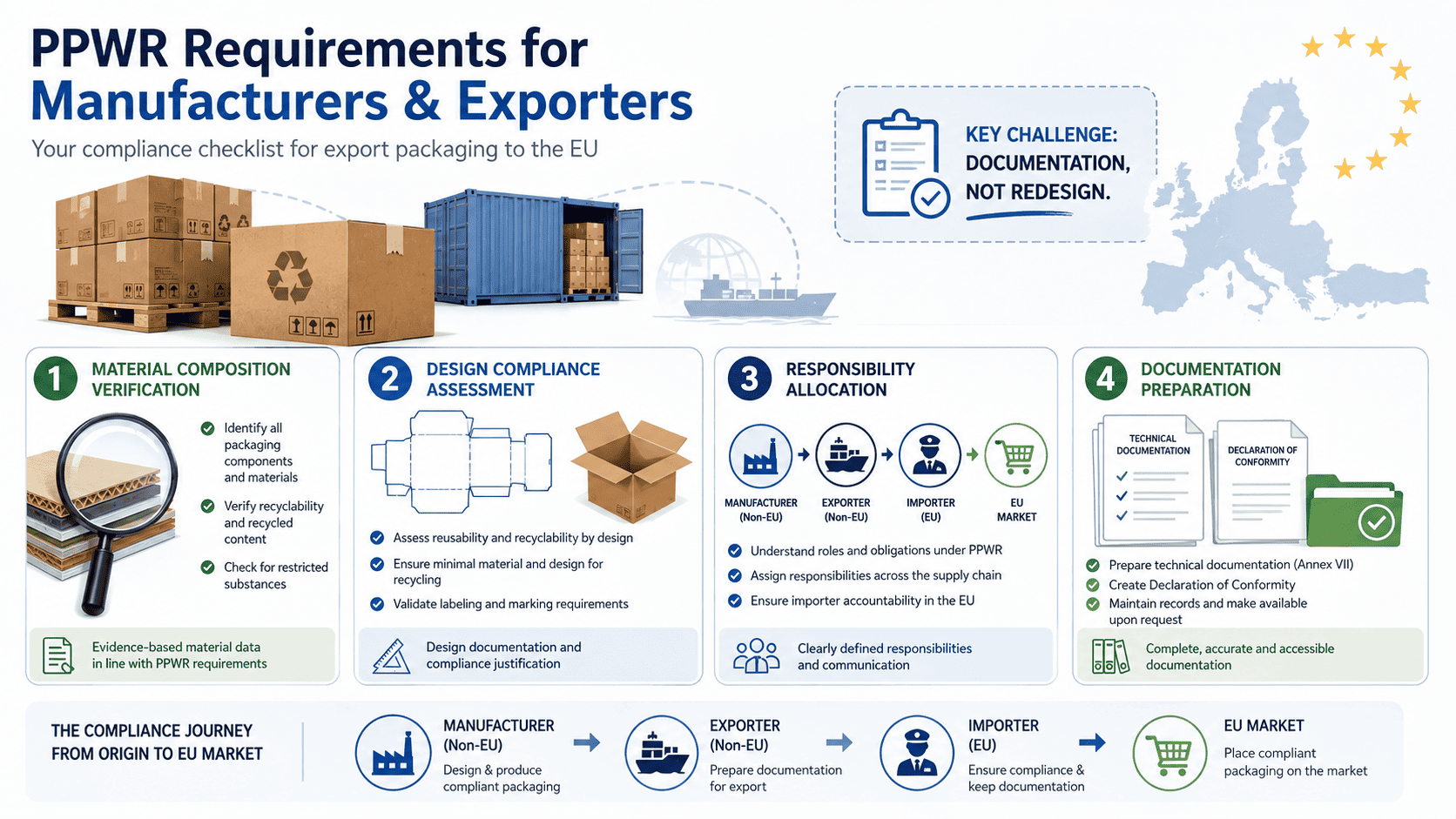
This checklist covers what we verify when EU clients ask about PPWR compliance. I'm not interpreting the regulation—I'm showing you the diagnostic questions we work through with clients' compliance teams to determine whether packaging needs material changes, design updates, or documentation. The answers always depend on what your specific importer requires and which compliance tasks they've assigned to you.
What Does PPWR Actually Require from Packaging Materials?
When clients first ask about PPWR requirements, they usually want to know if their materials are banned. That's the wrong starting question.
PPWR sets recyclability and recycled content requirements on rolling timelines2, not immediate material bans. Most questions actually center on whether you can document current material composition and supplier certifications, not whether you must source new materials.
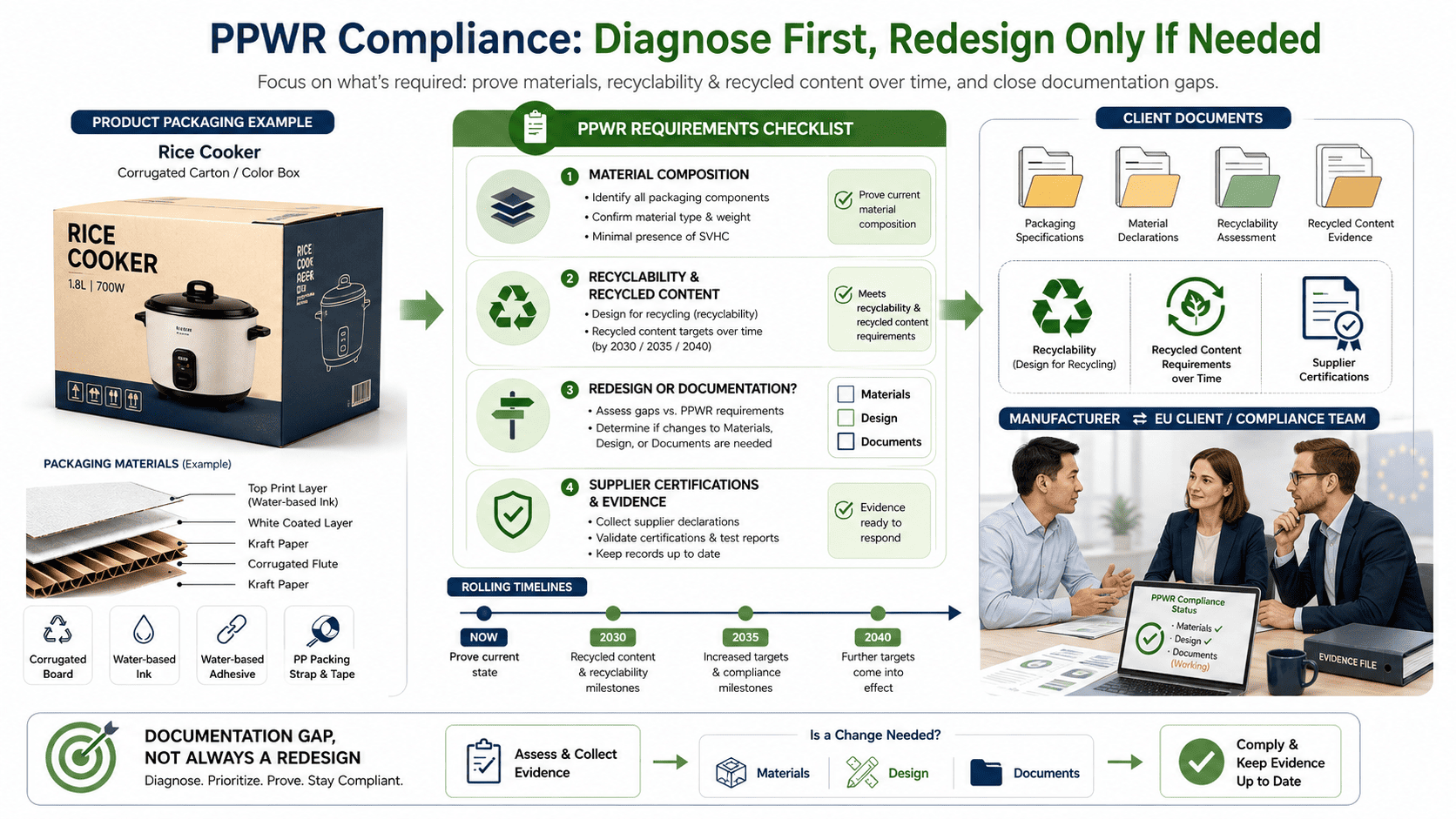
Material Composition Requirements We Verify
Based on official PPWR text (Article 6-7), these are the material requirements we check against our packaging specs:
Recyclability requirements
- All packaging must be designed for recycling by specific target dates3
- Certain material combinations face restrictions (exact combinations depend on final regulation amendments)
- Mono-material construction generally meets recyclability criteria more easily than multi-layer designs4
Recycled content minimums
- Plastic packaging faces minimum recycled content percentages phasing in over time5
- Percentages vary by packaging type (contact-sensitive vs. non-contact)
- Timeline begins later for certain product categories
Restricted substances
- PFAS limits in food-contact materials6
- Heavy metal concentration limits7
- Specific additive restrictions for certain plastics
Here's what this actually means at factory level. When a European client's compliance team asks us to verify PPWR readiness, they send specific questions:
- Can you provide material composition certificates from your corrugated box supplier?
- Does your inner plastic bag contain recycled content, and if so, what percentage?
- Can you confirm your printed boxes use water-based inks?
- Do your foam inserts contain restricted additives listed in [specific regulation reference]?
Notice what they're NOT asking: "Are your materials PPWR compliant?" They're asking for proof of specific attributes because their compliance software or EPR scheme needs that data. Your job isn't to interpret whether those attributes satisfy PPWR—your job is to supply the documentation or identify what you can't prove.
The Documentation Gap Most Factories Face
I can tell you our corrugated boxes are recyclable. I cannot tell you the exact recycled fiber percentage without requesting updated certificates from our box supplier. That certificate gap is the real compliance issue for most manufacturers.
Our packaging material breakdown looks like this:
| Material Component | Current Spec | Documentation Status | Compliance Question |
|---|---|---|---|
| Outer corrugated box | Single-material kraft paper | Supplier provides basic spec sheet | Does client need recycled content percentage or just recyclability confirmation? |
| Inner plastic bag | LDPE film | No recycled content certification | Does timeline require recycled content yet for this product category? |
| Foam corner protectors | EPE foam | Material composition listed but no recycling certification | Does client's market allow EPE or require alternative? |
| Printed labels | Paper with water-based ink | Ink type confirmed but no formal certificate | Does labeling requirement demand specific certification? |
The issue isn't that our materials fail PPWR requirements. The issue is we can't prove compliance without requesting additional documentation from suppliers who didn't previously provide it. Some EU clients accept our existing specs. Others demand certified test reports from accredited labs.
Why Shipping Packaging Creates Hidden Compliance Risk
Clients focus on retail packaging because consumers see it. They forget PPWR covers transport packaging too.
Our rice cookers ship in retail boxes, then get packed in master cartons with plastic strapping, foam spacers, and sometimes plastic corner protectors. That shipping layer uses more material variety than the retail box, creating more compliance complexity:
- Mixed-material construction: Master cartons combine cardboard, plastic tape, metal staples, and foam inserts—harder to prove recyclability than mono-material retail boxes
- Difficult supplier documentation: We buy shipping materials from logistics suppliers who rarely maintain the same certification depth as packaging manufacturers
- Multiple responsibility handoffs: If we export FOB and the importer arranges shipping, who owns compliance for packaging added by the freight forwarder?
A UK client recently asked us to confirm all packaging met PPWR standards. After reviewing everything, I asked: "Does 'all packaging' include the stretch wrap and pallets your logistics partner adds before container loading?" They hadn't considered it. Their compliance consultant later clarified that UK regulations placed that responsibility on the importer, but only if shipping materials were added after import. If we added them at origin, responsibility stayed with us.
These boundary questions have no universal answer. They depend on your Incoterms, the specific client market's interpretation, and whether your contract specifies packaging compliance responsibility.
Who Owns Which PPWR Compliance Tasks?
Every compliance discussion eventually reaches this question: "Whose job is this?"
PPWR assigns different responsibilities to manufacturers, importers, and brand owners depending on who places the product on the EU market8. The regulation makes the "producer" responsible—but defining who counts as the producer depends on business structure, not just who physically makes the packaging.
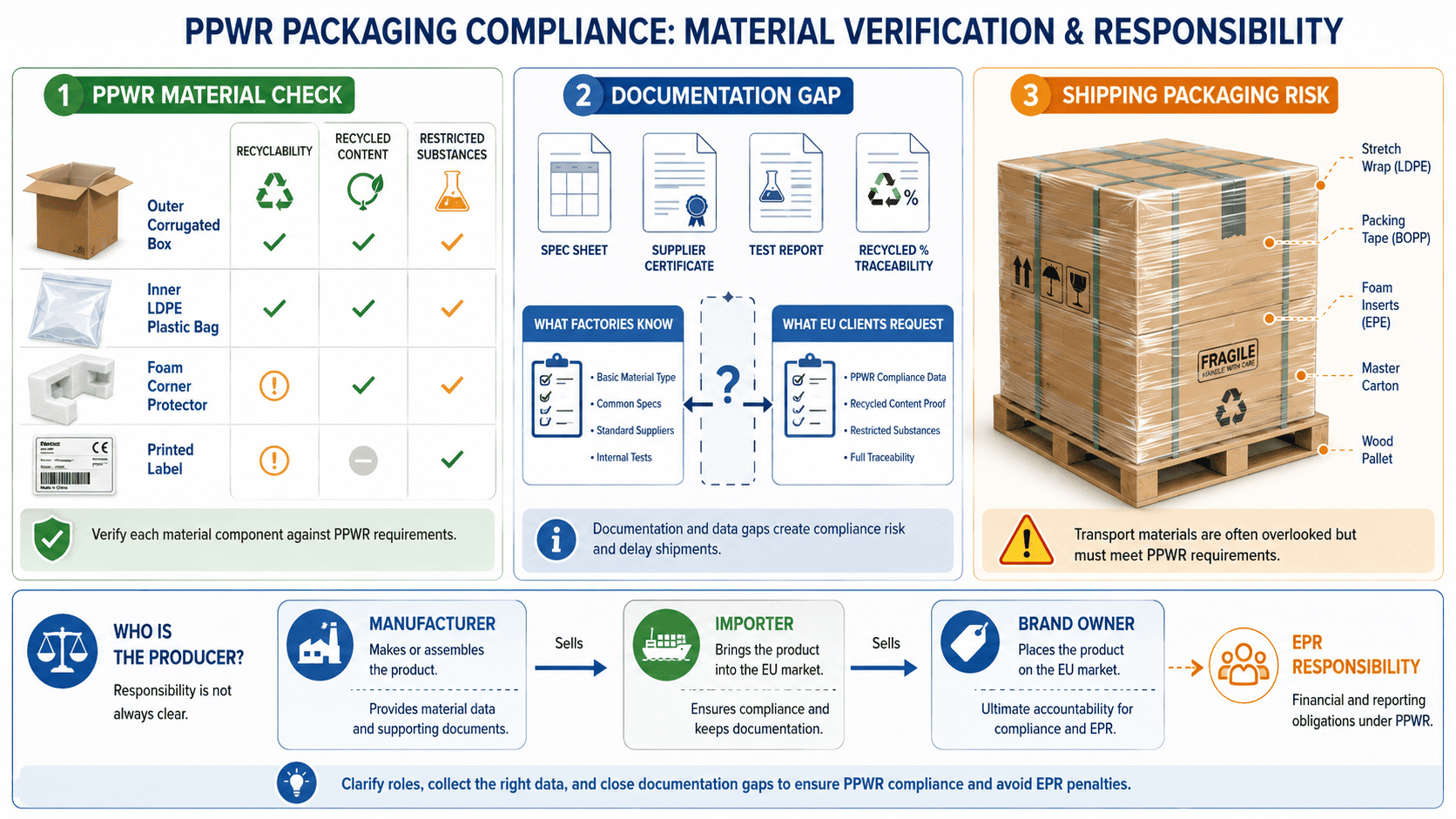
The Four Responsibility Categories We Clarify
When clients ask about PPWR readiness, I break responsibilities into four categories and confirm which ones they're assigning to us:
Material specification and sourcing
- Selecting packaging materials that meet composition requirements
- Obtaining supplier certificates proving material attributes
- Maintaining documentation trail from raw material to finished packaging
Design compliance
- Ensuring packaging design meets recyclability criteria
- Verifying design-for-recycling principles are implemented
- Calculating packaging-to-product weight ratios if minimization requirements apply
Data reporting and registration
- Registering packaging data with national EPR schemes
- Reporting annual packaging volumes and material types
- Maintaining digital product passports (when implemented)
Financial obligations
- Paying EPR fees to authorized schemes9
- Funding collection and recycling systems
- Contributing to packaging waste management costs
Here's the pattern I've seen across 20+ EU client relationships: Clients almost always retain EPR registration and financial obligations. They sometimes assign material specification to us. They rarely clarify upfront who handles data reporting until they receive their first EPR scheme questionnaire.
The "You Handle Everything" Trap
One client's purchase order included a clause: "Supplier guarantees all packaging meets PPWR requirements and assumes all compliance responsibilities." Sounds clear, right?
Three months later, their German distributor contacted them asking for specific packaging data to complete EPR registration. The distributor needed material composition percentages, supplier locations, and annual volume estimates. Our client forwarded the request to us.
The problem: That data feeds into EPR registration, which we cannot legally do because we don't place products on the EU market. The distributor is the producer under PPWR Article 3 (based on the official text as we understand it), which makes them responsible for EPR obligations. They needed data from us to fulfill their responsibility, but our contract claimed we "assumed all compliance responsibilities."
After involving lawyers, we clarified:
- We provide: Material specs, supplier certificates, and packaging documentation
- Client provides: EPR registration and data reporting using our documentation
- We do not provide: Direct EPR scheme registration, legal compliance verification, or regulatory interpretation
That split matches most of our EU client contracts now. But it took multiple messy situations to establish the pattern.
How Incoterms Affect Responsibility
Your delivery terms influence compliance responsibility more than most exporters realize.
Consider two scenarios for the same product:
Scenario A: FOB Guangzhou
- We manufacture, package, and deliver to Guangzhou port
- Client arranges ocean freight, customs clearance, and EU distribution
- Product enters EU market when client's customs broker files import declaration
Scenario B: DDP Hamburg
- We manufacture, package, and arrange delivery to client's Hamburg warehouse
- We handle export, ocean freight, and customs clearance
- Product enters EU market when we complete customs import
Under PPWR's producer definition (Article 3, based on official text), Scenario B potentially assigns us producer responsibilities because we're the entity placing products on the market. Scenario A assigns responsibility to the client because they handle market entry.
But here's the complication: Even under FOB terms, if the client's distributor contract states "all packaging provided by manufacturer is manufacturer's responsibility," your contract might assign you obligations the regulation would normally place on the importer.
I'm not providing legal interpretation here. I'm showing you why "who owns PPWR compliance" depends on three factors:
- What the regulation says about producers
- How your Incoterms define market entry
- What your contract specifically assigns
All three must align, or you'll face responsibility disputes when EPR schemes start requesting documentation.
Questions We Ask Clients Before Confirming Compliance Support
When a new EU client asks if we can "handle PPWR compliance," I ask these questions before committing:
- Has your importer or distributor specified which packaging attributes they need documented?
- Are you registered with an EPR scheme, and if so, what data fields does their reporting system require?
- Does your purchase order assign specific compliance tasks to us, or just require "compliant packaging"?
- If we provide material certificates and composition data, who inputs that into your EPR reporting system?
- Have you confirmed with your compliance advisor whether manufacturers can register directly with EU EPR schemes, or must registration go through the market-entry entity?
These questions separate clients who've done compliance homework from those who are forwarding regulatory pressure without clarity. I'm not refusing difficult clients—I'm identifying what they actually need so we can provide it accurately.
Does Your Current Packaging Need Redesign or Just Documentation?
After responsibility allocation, the next question is always: "Do we need new packaging?"
Most existing packaging designs already meet core recyclability requirements if they use mono-material construction and avoid restricted additives. The compliance gap sits in proving material attributes through documentation, not in redesigning packaging from scratch.
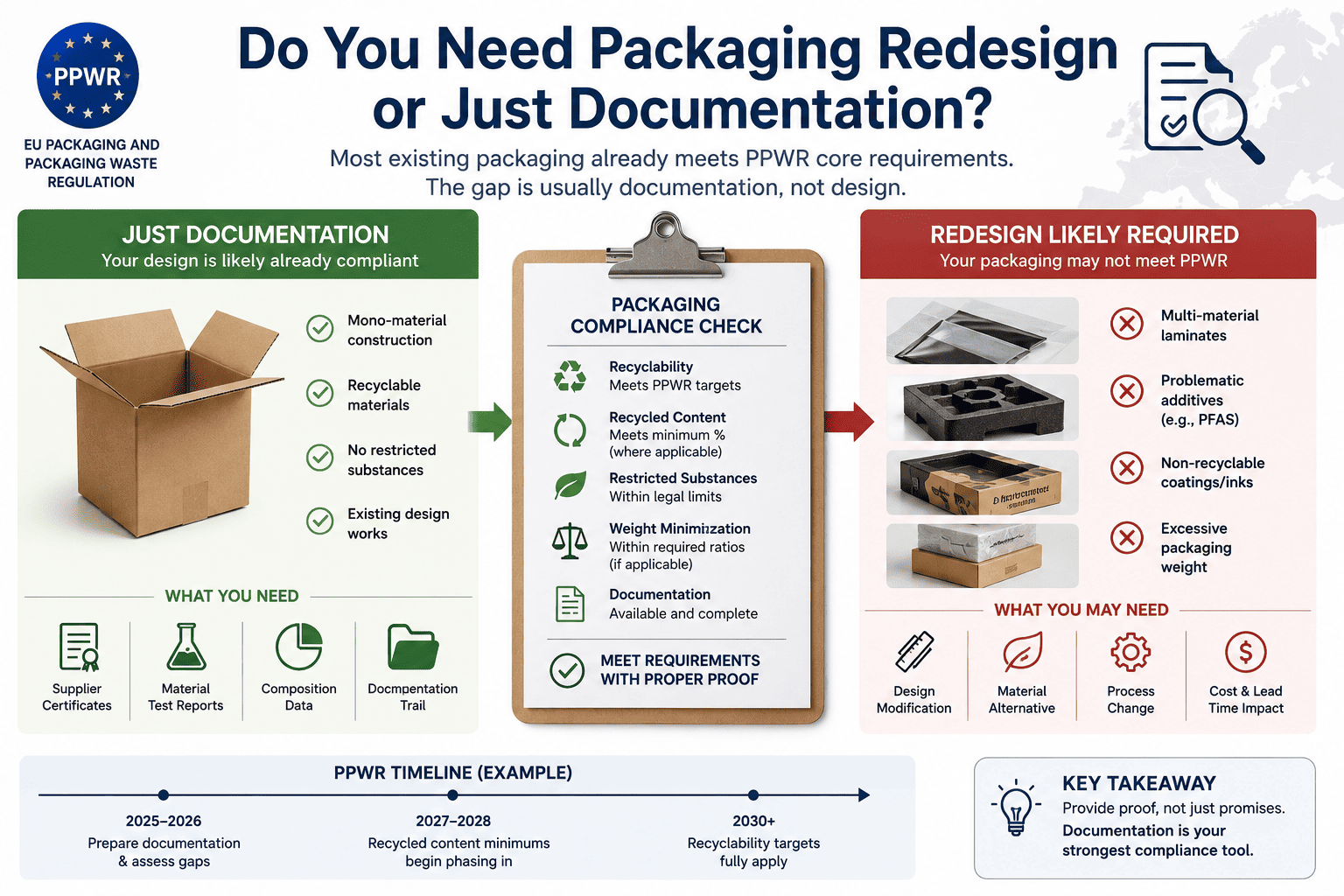
The Three-Level Design Assessment We Run
When clients ask if their packaging needs updates, we evaluate at three levels:
Level 1: Material composition
- Is packaging primarily mono-material or multi-layer?
- Do current materials contain restricted substances?
- Can material suppliers provide composition certificates?
Level 2: Design structure
- Are components easily separable for recycling?
- Does design use recyclable adhesives and inks?
- Are labels and closures compatible with main material recycling stream?
Level 3: Labeling and information
- Does packaging include required recycling labels?
- Are material identification codes visible?
- Does design accommodate digital watermarks or QR codes if required?
Here's a real example from our standard rice cooker packaging:
Retail box (corrugated cardboard)
- Level 1: ✓ Single material, no restricted substances, supplier can provide certificates
- Level 2: ✓ Mono-material design, water-based inks, no lamination
- Level 3: ⚠ Currently includes recycling symbol, may need additional country-specific labels
Inner bag (LDPE plastic)
- Level 1: ⚠ No recycled content, need to verify additive restrictions
- Level 2: ✓ Single material, easily removed, no adhesives
- Level 3: ✗ No material identification marking, no recycling instructions
Product manual (paper)
- Level 1: ✓ Recyclable paper stock, vegetable-based inks
- Level 2: ✓ No coatings or lamination
- Level 3: ⚠ No recycling guidance printed
Based on this assessment, redesign isn't necessary. We need:
- Updated certificates from our plastic bag supplier confirming additive compliance
- Material identification printing on plastic bags
- Additional labeling on retail boxes if specific markets require it
When Material Changes Actually Make Sense
I've had three situations where clients genuinely needed material changes rather than just documentation:
Client 1: German brand requiring 30% recycled plastic Their EPR scheme offered fee reductions for high recycled content. Our standard LDPE bags contained 0% recycled material. We sourced recycled-content film from a different supplier, increased piece cost by 8%, but the client's EPR fee savings offset the material cost increase.
Client 2: French retailer banning all plastic components Their corporate sustainability program exceeded legal requirements, demanding plastic-free packaging before PPWR mandated it. We replaced LDPE bags with biodegradable cellulose bags and foam corner protectors with molded pulp. Material cost increased 35%, but client absorbed the increase to meet their sustainability marketing claims.
Client 3: Netherlands importer needing full design-for-recycling certification Their compliance consultant required third-party recyclability assessment following specific EU testing protocols. Our existing design passed for the corrugated box but failed for the plastic bag due to specific additive levels. We reformulated the bag material to pass certification.
Notice the pattern: Material changes weren't driven by PPWR's legal text. They were driven by specific client requirements that exceeded or anticipated legal minimums. If we'd changed materials based on our interpretation of PPWR, we might have made changes clients didn't actually need.
The Packaging Minimization Requirement Nobody Asks About
PPWR Article 9 (based on official text) includes packaging minimization requirements10 that most clients overlook while obsessing over recycled content.
The requirement limits packaging weight to what's necessary for product protection and marketing. That sounds vague, but it translates into specific compliance questions:
- Can you justify every packaging component's necessity?
- Are you using more material than required for safe transport?
- Could you reduce box dimensions without compromising protection?
We had a UK client whose distributor questioned why our rice cookers shipped in boxes 40% larger than the product. Honest answer: We used a stock box size that accommodated multiple rice cooker models to minimize packaging SKUs. That inventory efficiency created a minimization compliance problem.
We ran a packaging optimization study and found we could reduce box volume by 25% with model-specific boxes, cutting shipping weight and meeting minimization criteria. But tooling costs for multiple box sizes exceeded the client's budget.
The solution: We documented the material savings from using universal boxes versus model-specific designs, proving that our approach actually minimized total packaging despite larger individual boxes. The client's compliance consultant accepted it.
This is why compliance isn't just "follow the rules." It's about documenting your decisions and proving they meet regulatory intent even when the specific approach varies.
What Documentation Do EU Clients Actually Request?
You can have perfectly compliant packaging and still fail client requirements if you can't provide proof.
EU importers typically request four documentation categories: material composition certificates, supplier compliance declarations, test reports proving recyclability or recycled content, and design specifications showing compliance with minimization and design-for-recycling requirements.
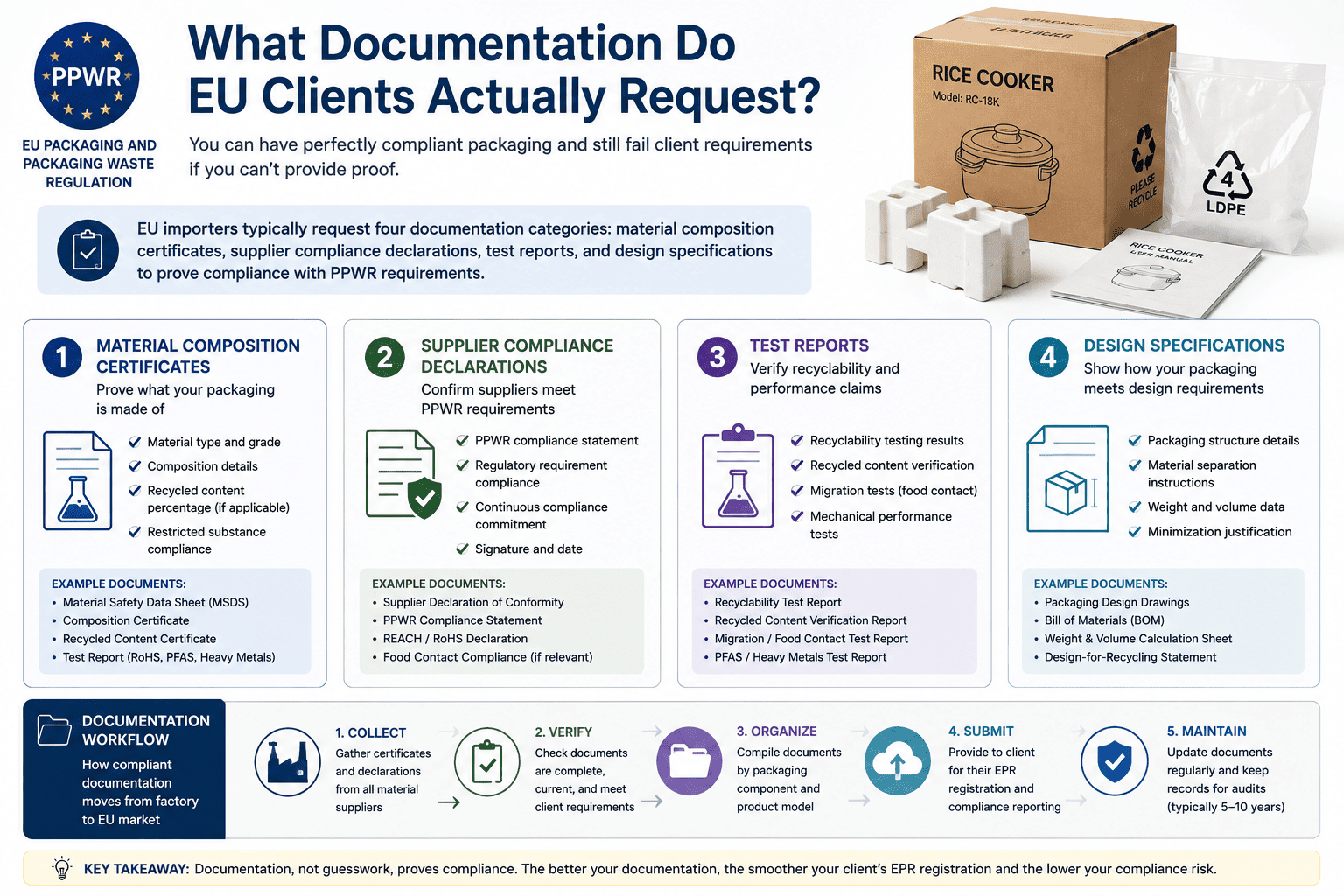
The Standard Documentation Package We Prepare
When EU clients ask for PPWR compliance verification, here's what we assemble:
Material certificates
- Composition analysis from each packaging material supplier
- Recycled content percentage (if applicable)
- Restricted substance test reports
- Material identification codes and recycling classifications
Supplier declarations
- Written confirmation that materials meet relevant EU directives
- Factory certifications (ISO, environmental management, etc.)
- Supply chain documentation proving material sourcing
- Country of origin for all packaging components
Design documentation
- Technical drawings showing component separation methods
- Material compatibility assessments for recycling
- Packaging-to-product weight ratios
- Justification for packaging dimensions and components
Compliance declarations
- Statement that packaging meets our understanding of PPWR requirements
- Clarification that final compliance verification is client's responsibility
- Reference to specific regulation articles we've addressed
- Disclaimer that we're not providing legal interpretation
Why "Just Send Your Compliance Documents" Never Works
Clients who request "all PPWR compliance documents" create impossible situations. PPWR doesn't define a standard compliance document package. Different markets, EPR schemes, and compliance software systems need different data formats.
I had a Belgian client request "complete PPWR documentation." I asked what their EPR scheme required. They didn't know yet—they were collecting documents in advance. I sent material certificates, supplier declarations, and design specs. Three months later, they came back: "Our EPR system
"New EU Packaging and Packaging Waste Regulation", https://sellercentral-europe.amazon.com/help/hub/reference/external/G22AA5MS5P7TLNYM. PPWR establishes Extended Producer Responsibility schemes requiring producers to register with national authorities and report packaging data, building on existing EPR frameworks in member states while harmonizing requirements across the EU. Evidence role: mechanism; source type: government. Supports: EPR registration obligations under packaging regulations. ↩
"Packaging waste - Environment - European Commission", https://environment.ec.europa.eu/topics/waste-and-recycling/packaging-waste_en. The EU Packaging and Packaging Waste Regulation establishes phased implementation timelines for recyclability design requirements and minimum recycled content percentages in plastic packaging, with specific target dates varying by packaging type and application. Evidence role: general_support; source type: government. Supports: official EU regulatory text establishing phased timelines for recyclability and recycled content minimums. Scope note: Specific percentages and dates may be subject to ongoing amendments during regulatory finalization ↩
"Recyclability of packaging under the PPWR (Article 6)", https://www.kivo.nl/en/knowledge-base/recyclability-of-packaging-according-to-ppwr-article-6/. Under PPWR Article 6, all packaging placed on the EU market must be designed to be recyclable, with criteria defining what constitutes recyclable design to be established through implementing acts. Evidence role: general_support; source type: government. Supports: regulatory text establishing design-for-recycling obligations. ↩
"Multilayer Packaging in a Circular Economy - PMC - NIH", https://pmc.ncbi.nlm.nih.gov/articles/PMC9103501/. Mono-material packaging designs facilitate mechanical recycling processes because they eliminate the need to separate bonded layers of different polymers, which is technically challenging and often economically unfeasible in existing recycling infrastructure. Evidence role: mechanism; source type: research. Supports: technical basis for recyclability differences between mono-material and multi-layer packaging. Scope note: Recyclability also depends on other design factors including additives, colorants, and contamination ↩
"Packaging waste - Environment - European Commission", https://environment.ec.europa.eu/topics/waste-and-recycling/packaging-waste_en. PPWR Article 7 establishes mandatory minimum recycled content levels for plastic packaging, with percentages increasing in phases through 2030 and beyond, differentiated by whether packaging is in contact with food. Evidence role: statistic; source type: government. Supports: official minimum recycled content percentages and implementation timeline. Scope note: Specific percentages are subject to final regulatory text and may include derogations for certain applications ↩
"PFAS In Packaging: EU PPWR Rules & Compliance", https://www.anthesisgroup.com/insights/forever-chemicals-new-rules-pfas-compliance-under-the-eus-ppwr/. PPWR includes restrictions on per- and polyfluoroalkyl substances (PFAS) in food-contact packaging materials, building on existing EU chemicals regulations addressing these persistent substances. Evidence role: general_support; source type: government. Supports: regulatory restrictions on PFAS in food-contact packaging. Scope note: Specific concentration limits and testing protocols may reference separate EU chemicals directives ↩
"EU Packaging Regulation - Heavy Metal Limits from 2026 - CDX", https://public.cdxsystem.com/en/web/cdx/w/eu-packaging-regulation-heavy-metals-concentration-limit-effective-august-2026. EU packaging regulations limit the sum of concentration levels of lead, cadmium, mercury, and hexavalent chromium in packaging materials, continuing requirements established under previous packaging directives. Evidence role: general_support; source type: government. Supports: regulatory limits on heavy metal concentrations in packaging. Scope note: Specific concentration thresholds and testing protocols reference existing EU directives that PPWR builds upon ↩
"PPWR: Distinguishing between manufacturers & producers", https://www.verpackungsregister.org/en/ppwr/distinguishing-between-manufacturers-producers. PPWR Article 3 defines the 'producer' as the entity that first places packaged products on the EU market, which determines Extended Producer Responsibility obligations, with specific responsibilities varying based on whether the entity is a manufacturer, importer, or brand owner. Evidence role: definition; source type: government. Supports: regulatory definition of producer and responsibility allocation. ↩
"How will the PPWR affect extended producer responsibility schemes?", https://www.averydennison.com/eu/en/industries/consumer-packaged-goods/resources/inspiration/trends-and-insights/how-will-the-PPWR-affect-extended-producer-responsibility-schemes. PPWR requires producers to contribute financially to covering the costs of separate collection, sorting, and recycling of packaging waste through payments to authorized EPR schemes in each member state, with fee structures based on packaging characteristics. Evidence role: general_support; source type: government. Supports: EPR financial obligations under packaging regulations. Scope note: Specific fee calculation methodologies vary by member state within harmonized EU framework ↩
"Packaging waste - Environment - European Commission", https://environment.ec.europa.eu/topics/waste-and-recycling/packaging-waste_en. PPWR Article 9 establishes that packaging shall be designed to minimize its weight and volume to the amount necessary for safety, hygiene, and consumer acceptance, with specific reduction targets to be established for certain packaging categories. Evidence role: general_support; source type: government. Supports: regulatory text establishing packaging minimization obligations. ↩