
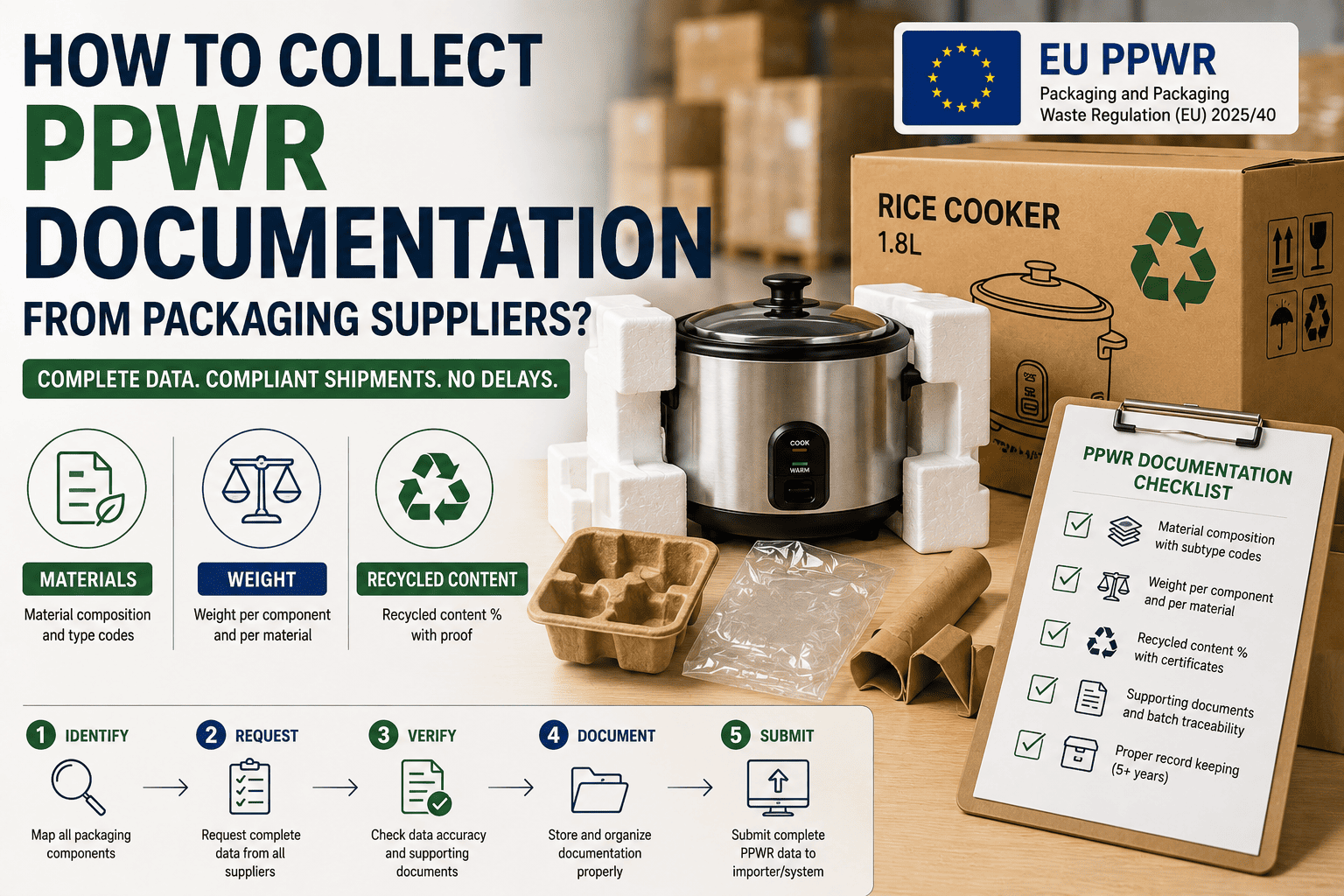
I still remember the day our client rejected an entire shipment at the port. The issue wasn't our rice cookers—those passed every quality check. The problem was a missing Material Composition Declaration from our cardboard box supplier. That single documentation gap cost us three weeks of delays, emergency air freight charges, and nearly lost us a major European retailer. The supplier insisted they'd sent "all the certificates," but what they provided was a generic recycled content claim—not the PPWR-compliant documentation our client actually needed.
The PPWR documentation process fails not because the regulation is complex, but because manufacturers treat it as a "get me a certificate" administrative task rather than a supplier management process. Successful documentation collection requires identifying three common supplier misconceptions (test reports equal compliance, cardboard needs no documentation, material composition is confidential), preparing verification checklists that translate legal requirements into supplier-fillable formats, and exposing documentation gaps before customer audits—not after shipment rejection.
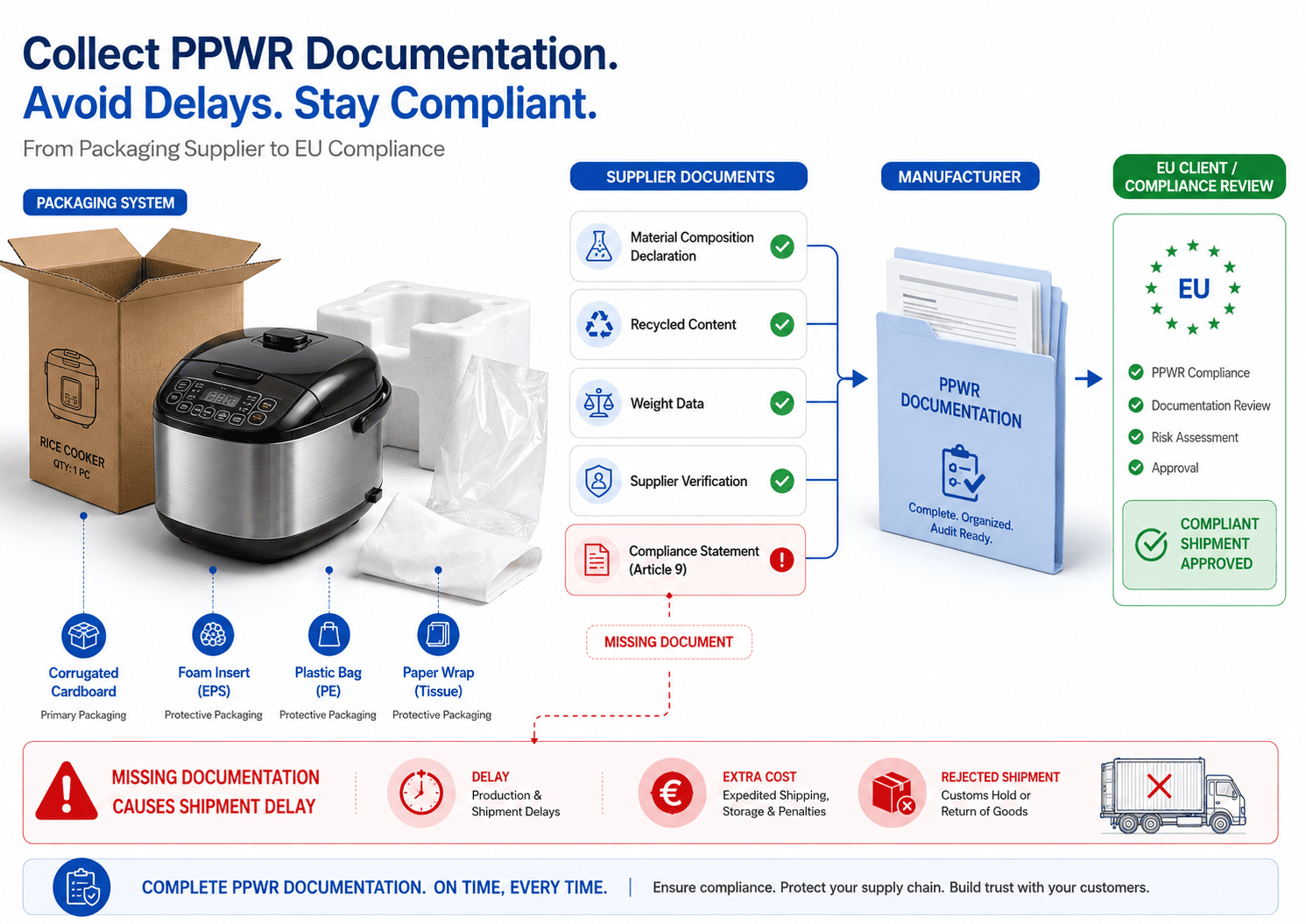
This isn't about understanding every PPWR regulation detail—that's your compliance consultant's job. This is about preventing the supplier-management mistakes that turn a straightforward documentation request into a shipment-blocking crisis. I'll walk you through the same process I now use to collect documentation from our packaging suppliers, from the initial communication that corrects supplier misconceptions to the early warning signs that tell you when to escalate or replace a non-cooperative supplier.
Why Do Suppliers Provide Wrong PPWR Documentation?
Most suppliers genuinely believe they're compliant—they just don't understand what PPWR compliance documentation actually looks like.
Suppliers provide incorrect PPWR documentation because they equate general material testing with regulatory compliance, assume packaging materials require no documentation, or treat composition disclosure as intellectual property protection rather than legal obligation. These misconceptions stem from treating PPWR as another export certificate request instead of recognizing it as a supply chain transparency requirement with specific traceability and declaration formats.1
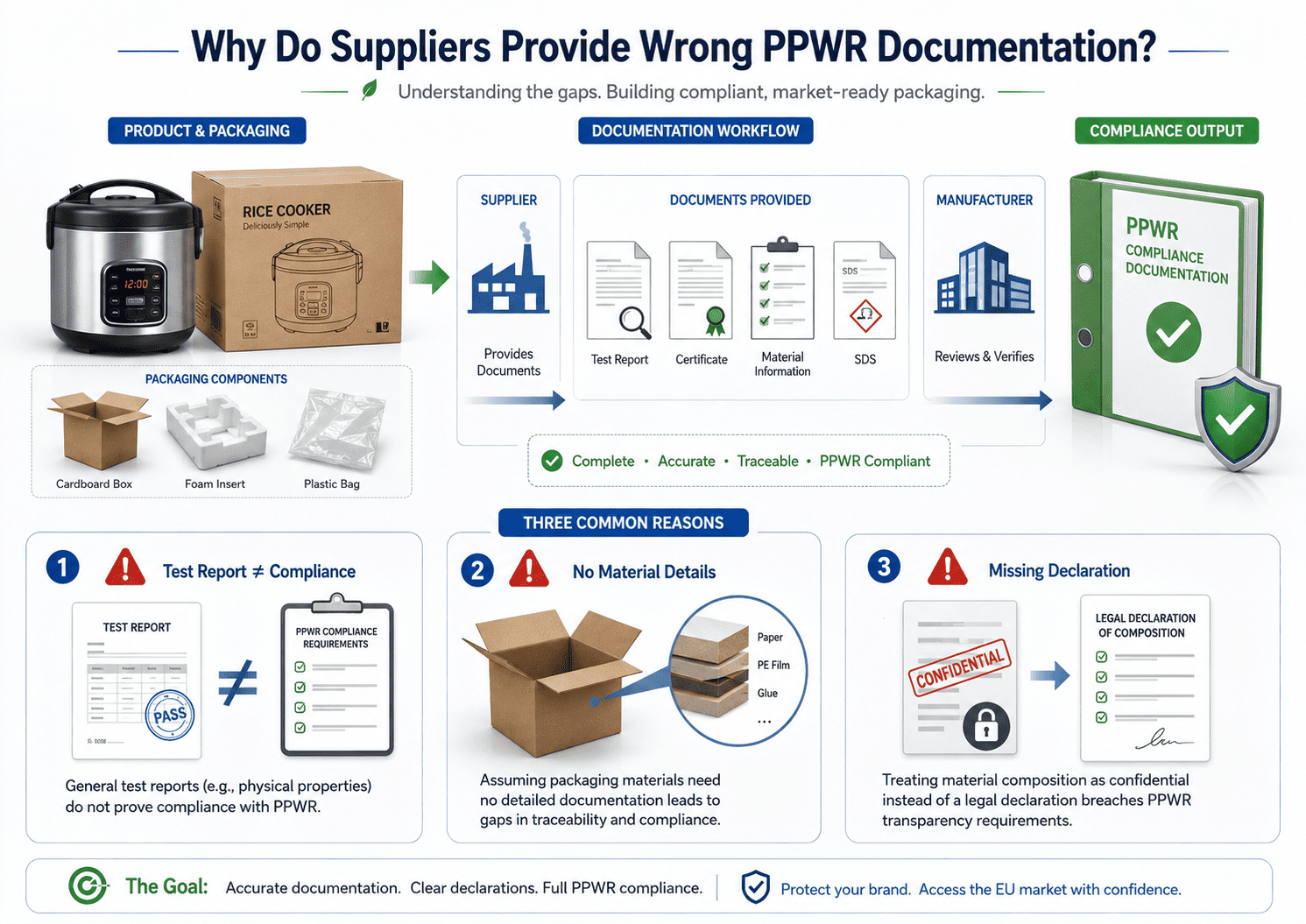
After our shipment rejection, I analyzed why our cardboard supplier's initial submission failed. They'd provided an SGS test report showing recycled content percentage—which looked official—but it lacked the CAS number declarations, laboratory accreditation proof, and formal supplier declaration our client required. The supplier wasn't trying to hide anything; they simply didn't know these three components were mandatory.
The Three Misconceptions That Cause Documentation Failures
Misconception 1: Test Reports Equal Compliance
Many suppliers believe an SGS or similar laboratory test report automatically satisfies PPWR requirements. In their previous export experience, a third-party test report was the gold standard proof. They don't realize PPWR requires documentation chains, not just test results.
Our plastic film supplier initially sent only a heavy metal test report. When I asked for material composition declarations, they seemed confused: "But SGS already tested it—what more do you need?" The gap was fundamental. Test reports verify properties; PPWR requires traceability of every material component through the supply chain.
I learned to explain it this way: "The test report proves what's in the material. The composition declaration proves where each component came from and meets recycling targets. Your customer auditors need both—one verifies performance, the other verifies legal compliance."
Misconception 2: Cardboard Doesn't Need Documentation
This one blindsided us initially. Our box supplier genuinely believed only plastic packaging fell under PPWR scrutiny. Their reasoning made sense from their perspective: "Cardboard is natural, recyclable, and has been used for decades—what's there to document?"
The reality is PPWR applies to all packaging materials entering the EU market2, regardless of whether they're paper, plastic, metal, or composite. The regulation focuses on recycled content percentages, recyclability targets3, and restricted substances4—criteria that apply equally to cardboard.
When our client's compliance team flagged the missing cardboard documentation, our supplier initially resisted: "We've shipped to Europe for ten years without this." I had to explain the regulation was new (2024 implementation)5, not a longstanding requirement they'd somehow missed.
Misconception 3: Material Composition Is Confidential
Several suppliers treated our composition declaration requests as industrial espionage attempts. One ink supplier flatly refused, citing "trade secret protection." Another coating supplier offered vague descriptions like "polymer-based" without specific chemical identifiers.
I understand their concern—they've invested in proprietary formulations. But PPWR compliance isn't negotiable. The regulation explicitly requires material composition disclosure including CAS numbers for regulatory verification purposes. This isn't about revealing production methods; it's about demonstrating absence of restricted substances.
The solution: I started referencing the legal liability transfer concept. I explained: "If your material causes our customer's shipment to fail customs inspection, both companies face penalties. The composition declaration protects you by documenting what you supplied and protects us by proving what we purchased. Without it, neither of us can defend against regulatory claims."
How These Misconceptions Create Audit Failures
When suppliers operate under these misconceptions, they provide documentation that looks complete to them but fails customer audits. Here's what happens:
| Supplier Provides | Customer Auditor Rejects Because | Result |
|---|---|---|
| SGS test report only | No CAS number declarations for components | Cannot verify restricted substance absence |
| Recycled content percentage | No traceability to material source | Cannot verify recycling target compliance |
| General "food-safe" certificate | Not PPWR-specific compliance declaration | Cannot demonstrate regulatory conformity |
| "Proprietary formulation" notation | Insufficient chemical composition disclosure | Cannot assess recyclability or substance restrictions |
Each rejection triggers delays. In our case, the three-week timeline broke down as: 1 week waiting for client feedback on initial submission, 1 week negotiating with supplier for correct documentation, 1 week for expedited document preparation and re-submission. During that time, our container sat at the port accumulating demurrage charges.
What Documentation Components Must Suppliers Provide?
Creating a comprehensive checklist prevents the "I thought we had everything" surprises that delay shipments.
Essential PPWR documentation includes material composition declarations with CAS numbers, laboratory test reports from accredited facilities, and formal supplier compliance declarations6. These three components answer different verification questions: composition declarations prove material content, test reports verify performance against targets, and supplier declarations assign legal responsibility for accuracy.
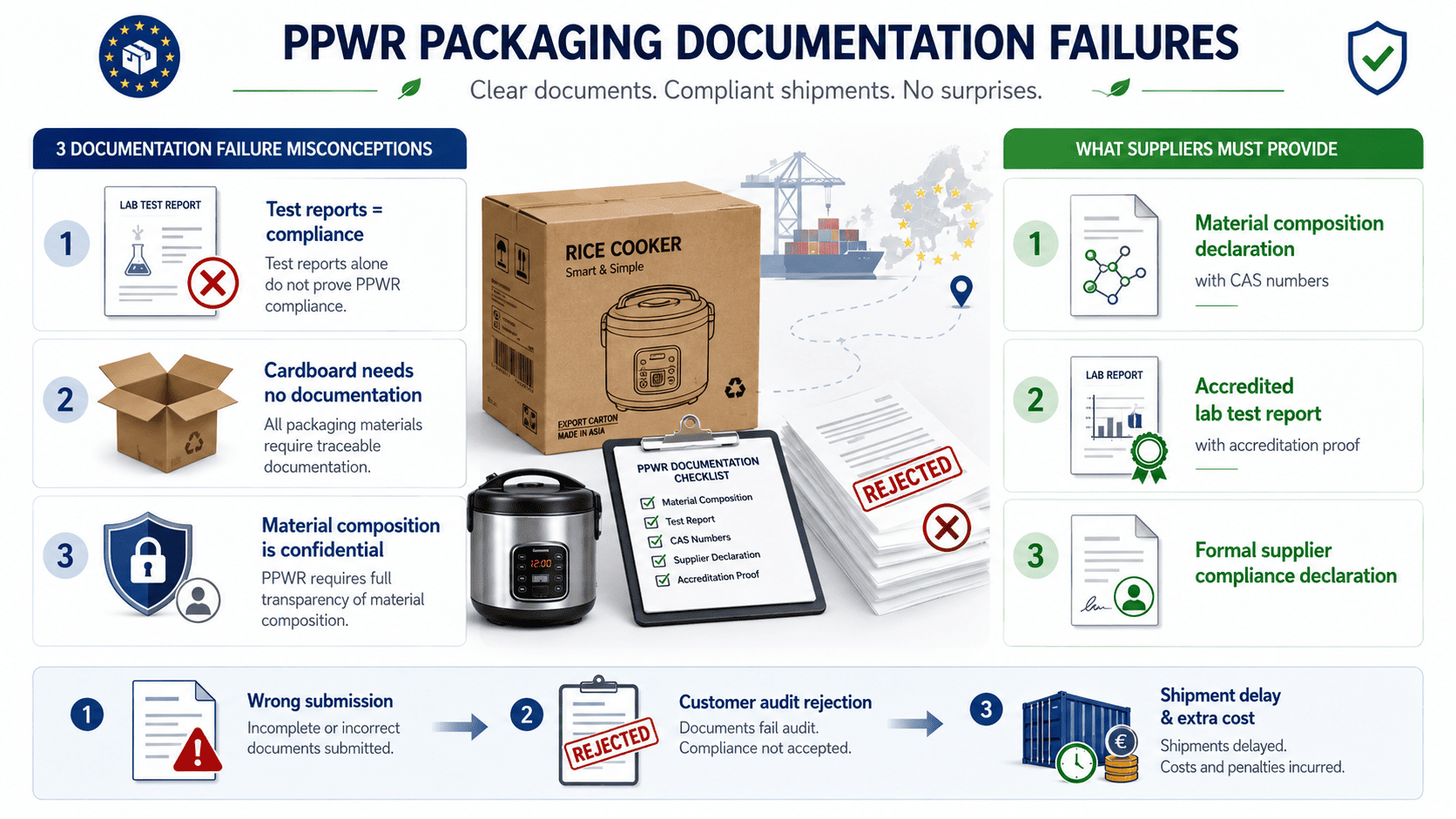
I developed this framework after our documentation failure forced me to reverse-engineer what our client's compliance team actually checked. They weren't looking for impressive-looking certificates—they were looking for specific data points they could trace through their audit trail.
Component 1: Material Composition Declaration
This document identifies every material component in the packaging by its chemical identity. It's the foundation of PPWR compliance because it enables verification of restricted substances and recyclability.
Required elements:
- CAS number for each chemical component (not just "plastic" or "adhesive")
- Percentage by weight of each component
- Material supplier name for traceability
- Batch/lot number linking to production records
I created a simple template that suppliers could fill in:
Material Composition Declaration Template
| Component Name | CAS Number | Weight % | Supplier | Batch/Lot |
|---|---|---|---|---|
| Polypropylene | 9003-07-0 | 87.5% | [Supplier A] | PP-2024-03 |
| Calcium Carbonate | 471-34-1 | 10.0% | [Supplier B] | CC-2024-15 |
| Titanium Dioxide | 13463-67-7 | 2.5% | [Supplier C] | TD-2024-08 |
When I first sent this template to our film supplier, they pushed back: "We don't track CAS numbers—we just order from our chemical supplier." I explained they needed to request this information from their own suppliers. PPWR creates a documentation chain obligation that flows backward through the supply network.
The breakthrough came when I offered to help them contact their material suppliers. I drafted a request letter they could forward, explaining the regulatory requirement. Within a week, they had the CAS numbers. The lesson: sometimes suppliers need help navigating their own supply chain, not just pressure to comply.
Component 2: Laboratory Test Reports
Test reports verify that materials meet performance targets—recycled content percentages, recyclability criteria, absence of restricted substances. But not all test reports satisfy PPWR requirements.
Critical requirements:
- Laboratory accreditation (ISO 17025 or equivalent7)
- Specific test methods referenced by standard number
- Test results showing compliance with targets
- Sampling procedure ensuring representative testing
Our cardboard supplier's initial test report failed because the laboratory wasn't ISO 17025 accredited. They'd used a local testing facility they trusted for quality control, but customer auditors require internationally recognized accreditation for regulatory compliance.
I learned to verify three things before accepting any test report:
-
Laboratory credentials: Check the accreditation body (CNAS, A2LA, UKAS).8 If the lab isn't internationally recognized, the report won't pass customer audits.
-
Test method references: The report must cite specific standards (e.g., "EN 13430 for recyclability assessment9"). Generic descriptions like "recyclability test" get rejected.
-
Sample traceability: The report must link the tested sample to the production batch through lot numbers. Our client once rejected a report because it tested a "representative sample" without batch identification.
Component 3: Formal Supplier Declaration
This is the legally binding statement where suppliers affirm their materials comply with PPWR requirements. It assigns responsibility and creates accountability.
Required content:
- Explicit compliance statement (e.g., "We declare this material complies with PPWR Article X requirements")
- Company signature and stamp (authorized representative)
- Date of declaration (must be current, not years old)
- Material identification linking to composition declaration and test reports
Many suppliers initially sent informal emails saying "our materials are compliant." These don't satisfy audit requirements. The declaration must be a formal document on company letterhead with clear legal language.
I developed a simple declaration template:
PPWR Compliance Declaration
Company: [Supplier Legal Name]
Material: [Specific material description]
Batch/Lot: [Production identification]
We hereby declare that the above material complies with the Packaging and Packaging Waste Regulation (EU) 2024/XXXX requirements, specifically:
- Recycled content: [X]% by weight
- Recyclability: Meets [specific standard]
- Restricted substances: Contains no substances listed in Annex [X]
This declaration is supported by:
- Material Composition Declaration dated [Date]
- Laboratory Test Report [Number] from [Accredited Lab]
Authorized Signature:
Name & Title:
Company Stamp:
Date: ___
When suppliers sign this declaration, they're taking legal responsibility for accuracy. That's why some resist—they're nervous about liability. I address this by emphasizing that accurate documentation protects them from false claims. If they provided truthful information but the manufacturer misused it, the declaration proves their good faith.
How to Verify Documentation Completeness Before Submission
Before sending documentation to your client, perform these checks:
Cross-reference verification:
- Do the CAS numbers in the composition declaration match the components tested in the laboratory report?
- Does the supplier declaration reference the same batch/lot numbers as the other documents?
- Are all three documents dated within a reasonable timeframe (not years apart)?
Regulatory alignment check:
- Does the recycled content percentage meet your client's target (often 25-30% for certain materials10)?
- Are all restricted substances explicitly confirmed absent (not just "meets requirements")?
- Does the recyclability assessment reference EU-recognized standards?
I run this verification the same day I receive supplier documentation. Waiting until your client rejects it wastes weeks. When I find gaps, I immediately contact the supplier with specific correction requests: "The test report shows 22% recycled content, but the composition declaration lists 25%. Please clarify which is accurate and update the document."
How Do You Identify Non-Cooperative Suppliers Early?
Some documentation failures signal deeper supplier issues that won't resolve with better communication.
Early warning signs of non-cooperative suppliers include delayed responses beyond 48 hours to documentation requests, responsibility deflection to upstream suppliers without follow-up actions, and unexpected fee demands for standard compliance documents. These patterns indicate unwillingness or inability to support PPWR compliance, requiring immediate assessment of replacement costs versus extended negotiation risks.
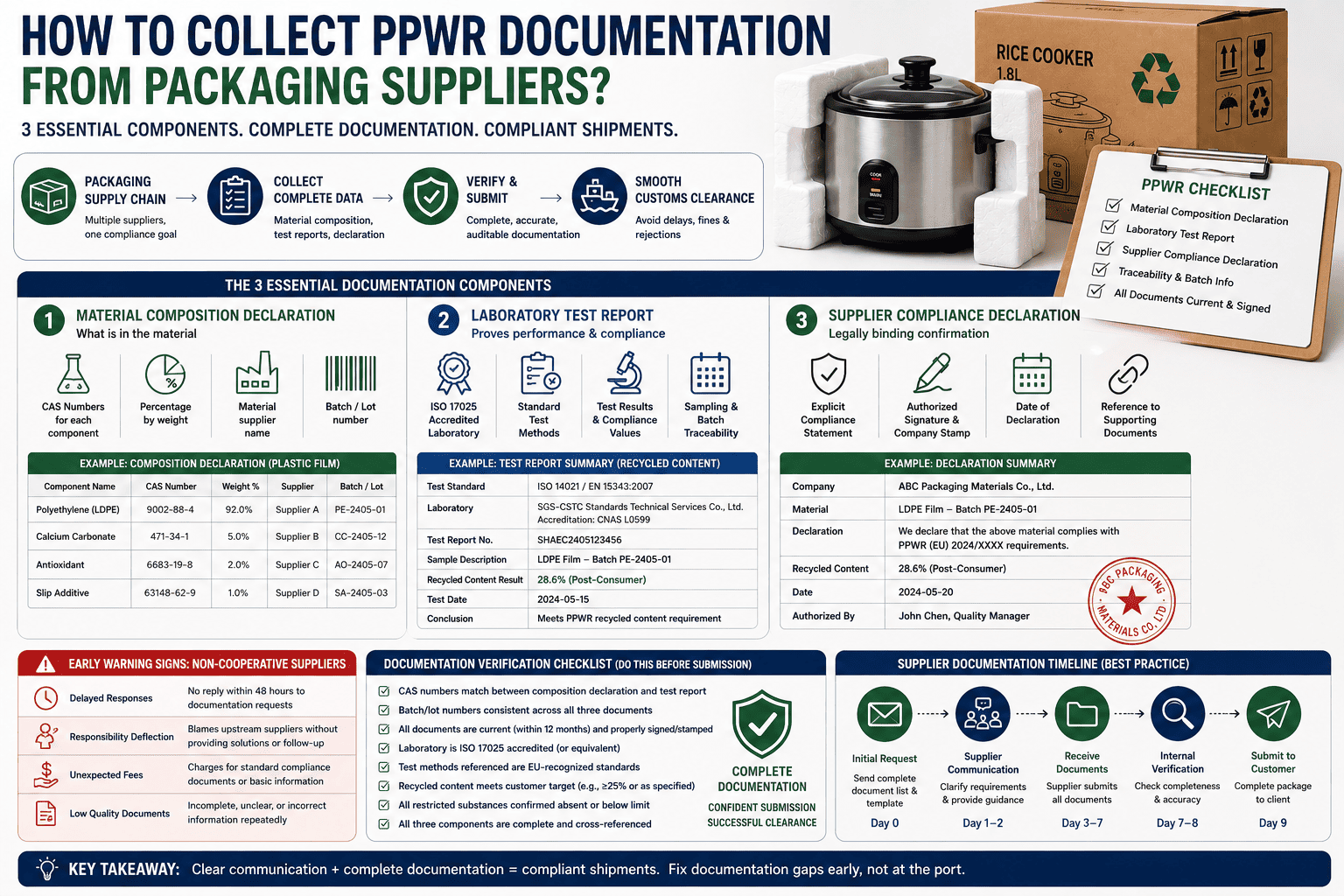
I've learned that early detection of these signals prevents the costly mistake of investing weeks in negotiations with suppliers who will ultimately fail to deliver usable documentation.
Red Flag 1: Slow or Evasive Responses
When I send a documentation request, I expect acknowledgment within 24 hours and a preliminary response within 48 hours—even if it's just "we're gathering information and will respond by Friday."
Suppliers who go silent for a week or respond with vague statements like "we're working on it" usually indicate one of two problems:
- They don't have the information and are scrambling to create it (risky—rushed documentation often contains errors)
- They're hoping you'll forget or accept incomplete responses (unacceptable for regulatory compliance)
Our adhesive supplier once went silent for ten days after I requested composition declarations. When I finally called them directly, they admitted they'd never collected CAS numbers from their raw material suppliers. That conversation saved me weeks—I immediately began qualifying backup suppliers instead of waiting for documentation that was months away.
Red Flag 2: Responsibility Deflection
Some suppliers respond to documentation requests by saying "you need to contact our material supplier directly" or "our upstream supplier handles all compliance documentation."
While it's true that composition information originates upstream, your direct supplier is responsible for collecting and providing it. When suppliers try to redirect you to their suppliers, they're either:
- Not managing their own supply chain (which creates risks for other quality issues too)
- Unwilling to assume compliance responsibility (a legal liability concern)
I had a coating supplier try this approach: "Our resin supplier has all the technical data—here's their contact information." I responded firmly: "I have a purchase agreement with you, not your resin supplier. You need to collect this documentation and provide it under your company declaration. If your supplier won't cooperate, that's a supply chain management issue you need to resolve."
In two cases, suppliers couldn't get cooperation from their own material suppliers. Both times, I helped them find alternative material sources that provided documentation—a process that took 3-4 weeks. If your supplier can't manage their upstream relationships, that's a critical risk factor.
Red Flag 3: Unexpected Fee Demands
PPWR compliance documentation is a standard requirement for EU market access. Suppliers who demand extra fees for providing composition declarations or compliance statements are often signaling:
- They don't routinely maintain this documentation (indicating poor compliance systems)
- They view compliance as a profit opportunity (risky—suggests they might cut corners elsewhere)
Our first box supplier requested a "documentation fee" of $500 for providing PPWR declarations. I explained this was a regulatory requirement, not a value-added service. They insisted the fee covered "administrative work to compile information."
I evaluated two options:
| Option | Cost | Risk | Timeline |
|---|---|---|---|
| Pay the fee | $500 one-time | Sets precedent for future fees | 1 week to receive documents |
| Find new supplier | $2,000 tooling + $1,500 MOQ | New supplier may have different issues | 4 weeks to qualify + produce samples |
For a high-volume customer relationship, I chose to replace the supplier. The upfront cost was higher, but the new supplier provided documentation as a standard service—no fees, no negotiations. For smaller volumes or urgent timelines, paying the fee might make sense as a temporary solution while qualifying alternatives.
Decision Framework: When to Replace vs. Continue Negotiating
Not every supplier challenge justifies replacement. Use this framework to decide:
Continue negotiating when:
- Supplier acknowledges gaps and commits to specific corrective timeline (e.g., "we'll have CAS numbers from our material supplier by March 15")
- Documentation issues are isolated to knowledge gaps, not capability or willingness problems
- Replacement would disrupt critical production timelines or create material quality risks
- Supplier shows progress on each follow-up (even small steps indicate commitment)
Replace supplier when:
- Supplier denies responsibility or refuses to engage with requests after 2-3 attempts
- Documentation gaps indicate systemic compliance weakness (e.g., no laboratory relationships, no upstream supplier management)
- Timeline to receive documentation exceeds timeline to qualify new supplier
- Supplier demands unreasonable fees or contractual changes for standard compliance
I replaced two packaging suppliers during our PPWR transition. Both showed the same pattern: initial engagement, followed by delays, followed by excuses. In each case, qualifying new suppliers took 4-6 weeks but eliminated ongoing compliance risks.
What Happens When Customers Reject Your Documentation?
Even with careful supplier management, documentation can fail customer audits. Your response speed determines whether
"Regulation (EU) 2025/40 of the European Parliament and of ...", https://eur-lex.europa.eu/legal-content/EN/TXT/PDF/?uri=OJ:L_202500040. Regulation (EU) 2025/40 establishes obligations for packaging economic operators concerning technical documentation, traceability, and EU declarations of conformity, supporting the characterization of PPWR compliance as a supply-chain documentation process. Evidence role: general_support; source type: institution. Supports: The source should show that PPWR requires packaging economic operators to maintain technical documentation, traceability information, and declarations of conformity.. ↩
"[PDF] Regulation (EU) 2025/40 of the European Parliament ... - EUR-Lex", https://eur-lex.europa.eu/legal-content/EN/TXT/PDF/?uri=OJ:L_202500040. Regulation (EU) 2025/40 defines its scope by reference to packaging placed on the Union market, supporting the statement that the rules apply across packaging materials rather than only to plastics. Evidence role: definition; source type: institution. Supports: The source should confirm the scope of PPWR across packaging types placed on the EU market.. ↩
"Packaging waste - Environment - European Commission", https://environment.ec.europa.eu/topics/waste-and-recycling/packaging-waste_en. The PPWR establishes requirements for packaging recyclability and minimum recycled content in specified packaging categories, supporting the article’s statement that both criteria are central to compliance documentation. Evidence role: general_support; source type: institution. Supports: The source should confirm that PPWR establishes recyclability and recycled-content requirements for packaging.. ↩
"Packaging and packaging waste directive - Wikipedia", https://en.wikipedia.org/wiki/Packaging_and_packaging_waste_directive. Regulation (EU) 2025/40 includes provisions on substances in packaging, including limits relevant to hazardous metals and other substances of concern, supporting the article’s references to restricted-substance verification. Evidence role: definition; source type: institution. Supports: The source should confirm that the PPWR contains requirements concerning substances present in packaging.. ↩
"EU PPWR – Packaging and Packaging Waste Regulation", https://www.business.gov.uk/campaign/europe/european-union-eu-regulations/eu-packaging-and-packaging-waste-regulation-eu-ppwr/. EUR-Lex records Regulation (EU) 2025/40 as adopted in December 2024, entering into force in February 2025, with most provisions applying from August 2026; this supports the novelty of the regime while qualifying any reference to a simple “2024 implementation.” Evidence role: historical_context; source type: institution. Supports: The source should establish the PPWR adoption, entry-into-force, and application timeline.. Scope note: The source supports the regulatory timeline but may require the article wording to distinguish adoption from legal application. ↩
"Regulation (EU) 2025/40 - EUR-Lex", https://eur-lex.europa.eu/eli/reg/2025/40/oj/eng. The PPWR provides for EU declarations of conformity and related technical documentation for packaging, supporting the article’s emphasis on formal compliance declarations rather than informal supplier assurances. Evidence role: mechanism; source type: institution. Supports: The source should show that PPWR uses formal declarations of conformity as part of compliance documentation.. Scope note: The regulation establishes conformity declarations for responsible economic operators; the exact format of an upstream supplier declaration may be determined by contracts, customer audit rules, or implementing practice. ↩
"ISO/IEC 17025:2017", https://www.iso.org/standard/66912.html. ISO/IEC 17025 specifies general requirements for the competence, impartiality, and consistent operation of testing and calibration laboratories, supporting the article’s reliance on accredited laboratories for compliance testing. Evidence role: expert_consensus; source type: institution. Supports: The source should explain that ISO/IEC 17025 specifies competence requirements for testing and calibration laboratories.. Scope note: The standard supports laboratory competence generally; it does not by itself establish every PPWR-specific testing requirement. ↩
"ILAC MRA and Signatories", https://ilac.org/ilac-mra-and-signatories/. The International Laboratory Accreditation Cooperation Mutual Recognition Arrangement lists recognized accreditation bodies, providing a basis for checking whether bodies such as CNAS, A2LA, and UKAS are internationally recognized. Evidence role: general_support; source type: institution. Supports: The source should show that named accreditation bodies participate in international mutual-recognition arrangements.. Scope note: Recognition of the accreditor does not automatically prove that a particular test report falls within the laboratory’s accredited scope. ↩
"Implementation of the Packaging Directive - EU Environment", https://environment.ec.europa.eu/topics/waste-and-recycling/packaging-waste/implementation-packaging-directive_en. EN 13430 concerns requirements for packaging recoverable by material recycling, supporting its use as an example of a standard referenced in recyclability assessment. Evidence role: definition; source type: institution. Supports: The source should identify EN 13430 as a standard concerning packaging recoverable by material recycling.. Scope note: The source supports the relevance of EN 13430 but does not prove that PPWR or every customer audit requires this specific standard. ↩
"Packaging waste - Environment - European Commission", https://environment.ec.europa.eu/topics/waste-and-recycling/packaging-waste_en. Regulation (EU) 2025/40 sets minimum recycled-content percentages for specified plastic packaging categories, including 2030 targets around 30% for some categories, supporting the article’s reference to customer targets in this range. Evidence role: statistic; source type: institution. Supports: The source should identify PPWR recycled-content percentages for relevant packaging categories.. Scope note: The regulation’s targets are category- and date-specific, so the article’s range should not be read as a universal PPWR threshold. ↩