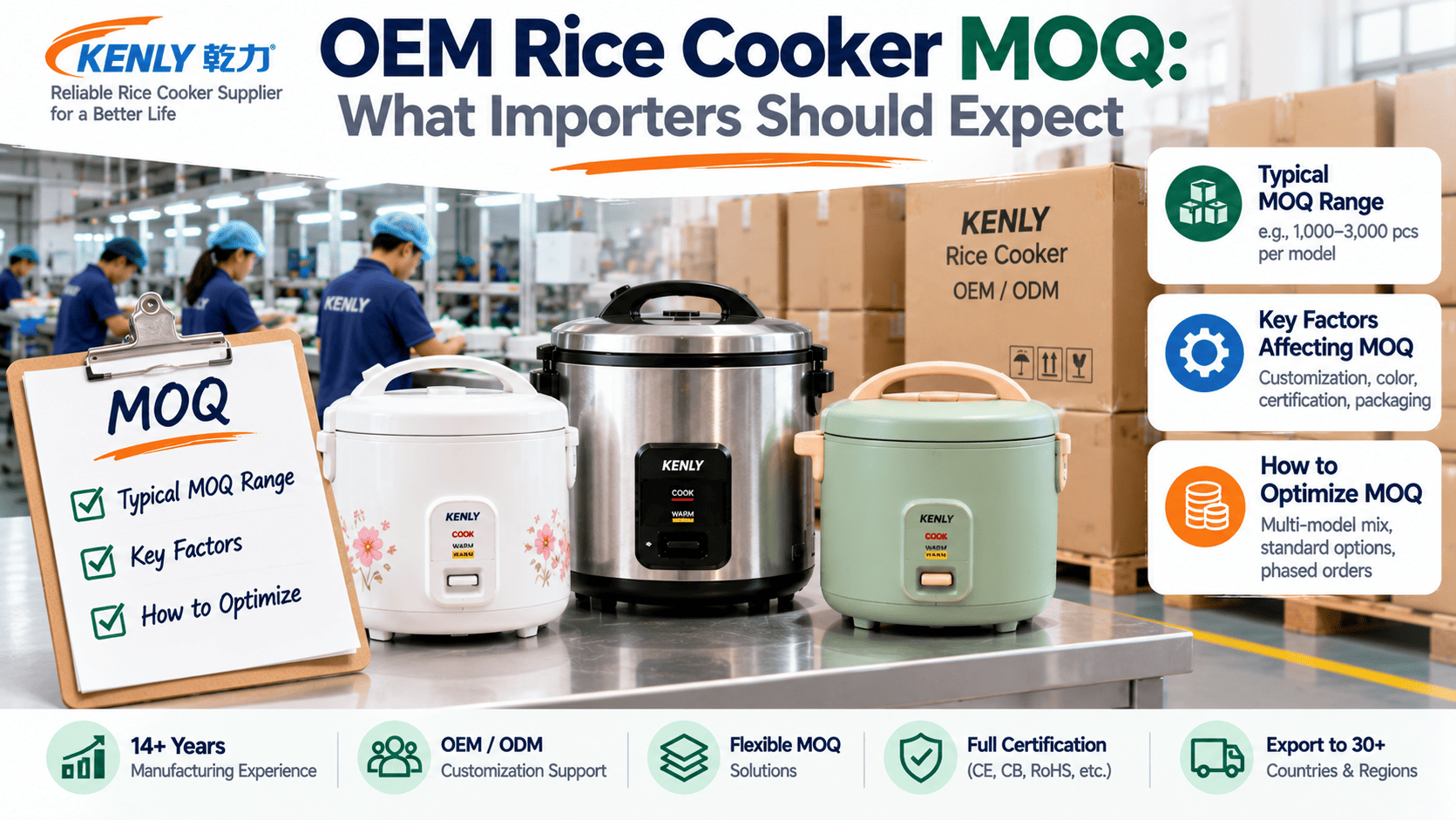
OEM Rice Cooker MOQ looks simple until two suppliers quote different minimums for similar products. That difference can affect budget, launch timing, packaging, certification, and even product consistency.
OEM Rice Cooker MOQ is the minimum production batch a supplier needs to run an order efficiently. In our experience at Kenly, standard rice cooker models may start around 500–1000 units, while deeper customization, special heating systems, multi-pot options, or extra certification work may require 1500–3000 units or more.
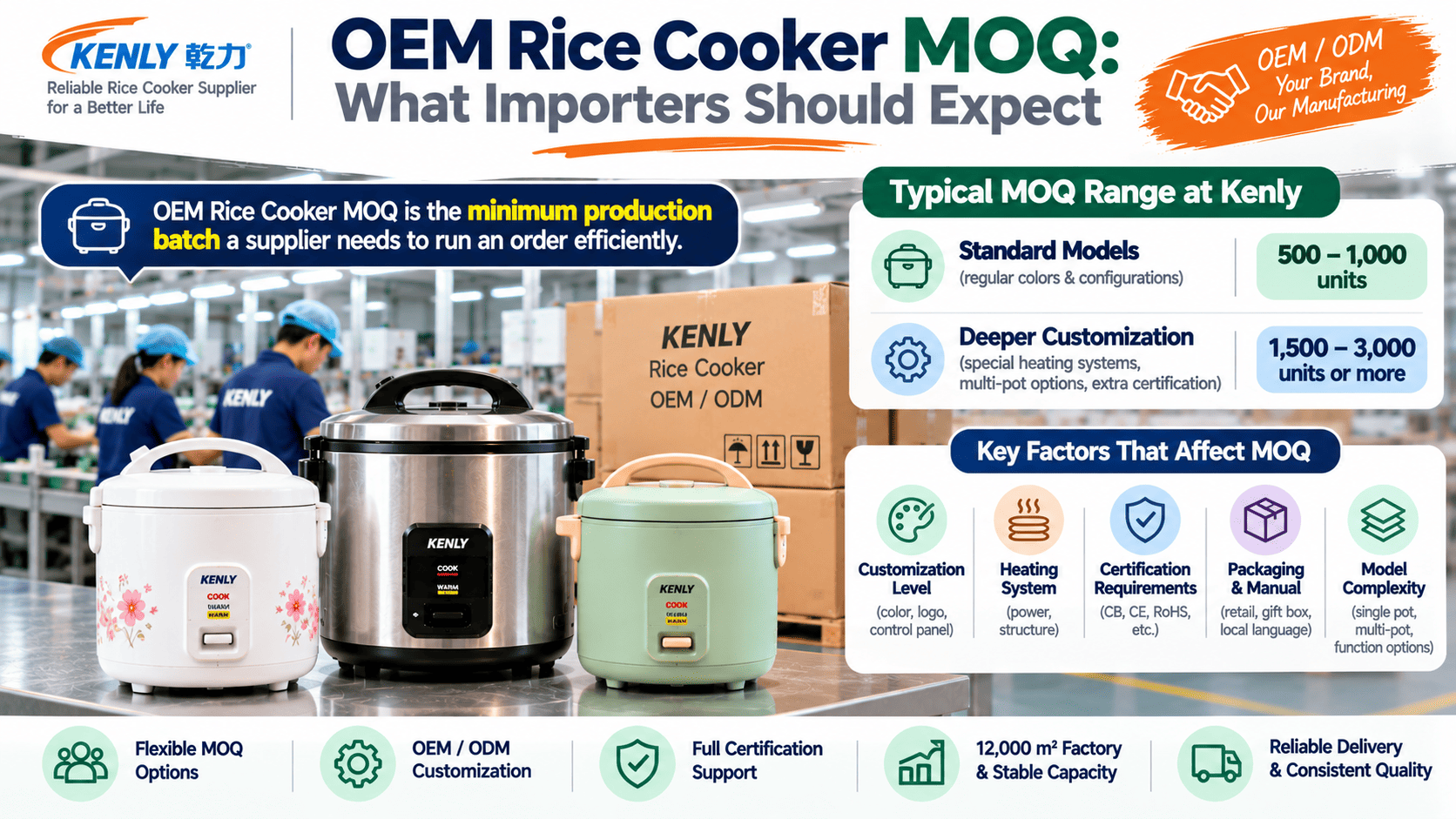
MOQ is not just a number on a price sheet. It reflects material purchasing, production setup, packaging, inspection workload, and risk control. The right MOQ depends on the exact model and how much you want to customize.
What OEM Rice Cooker MOQ Should First-Time Importers Expect?
First-time buyers often ask for the lowest MOQ before confirming the model, plug type, inner pot, packaging, or target market. That makes the answer unreliable.
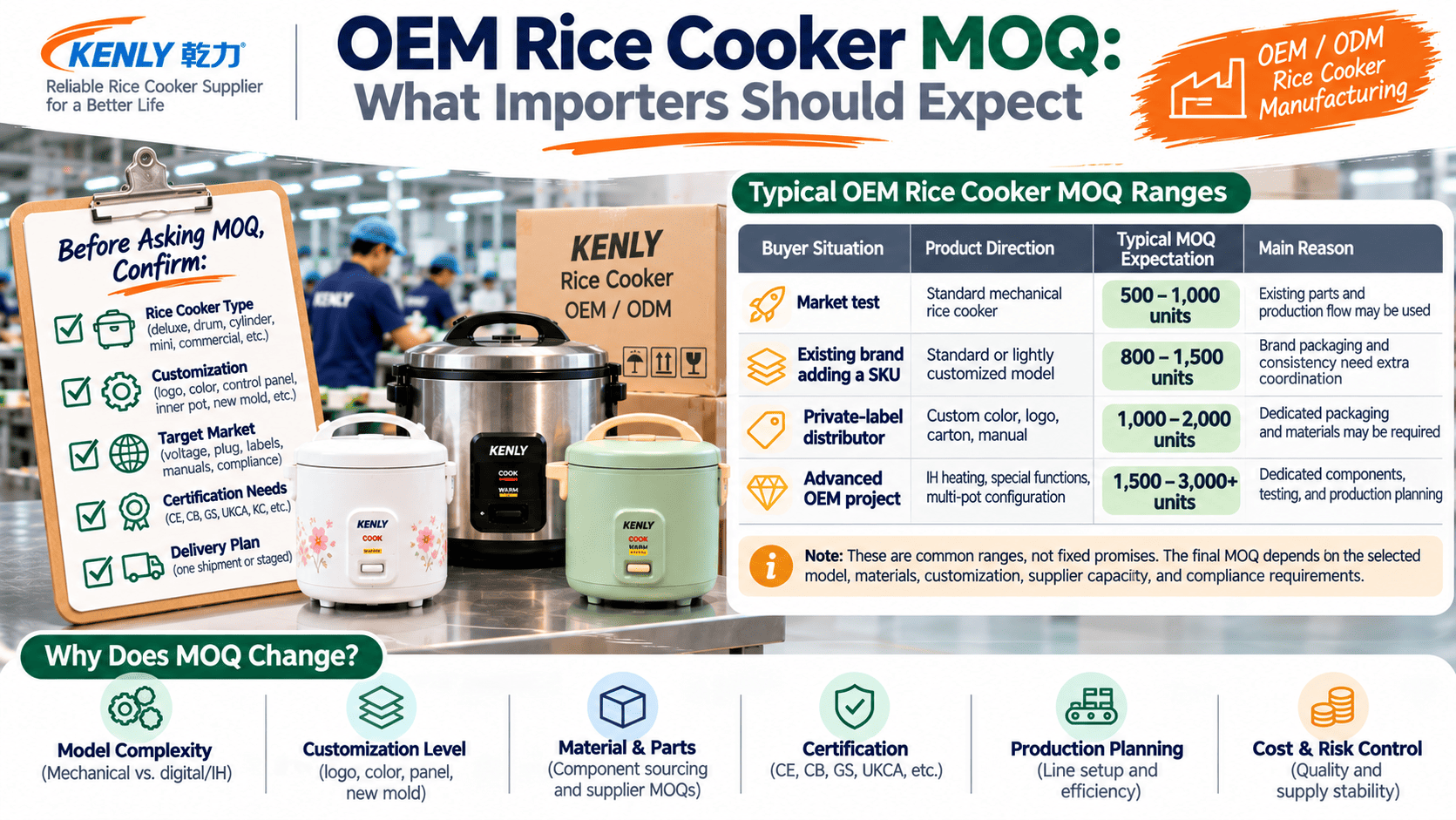
For planning purposes, these are common ranges we see in OEM work:
| Buyer situation | Product direction | Typical MOQ expectation | Main reason |
|---|---|---|---|
| Market test | Standard mechanical rice cooker | 500–1000 units | Existing parts and production flow may be used |
| Existing brand adding a SKU | Standard or lightly customized model | 800–1500 units | Brand packaging and consistency need extra coordination |
| Private-label distributor | Custom color, logo, carton, manual | 1000–2000 units | Dedicated packaging and materials may be required |
| Advanced OEM project | IH heating, special functions, multi-pot configuration | 1500–3000+ units | Dedicated components, testing, and production planning |
These are not fixed promises. The final MOQ depends on the selected model, materials, customization, supplier capacity, and compliance requirements.
Why “What is your MOQ?” should not be the first question
Before quoting a realistic MOQ, a supplier normally needs to know:
- Rice cooker type — deluxe, drum, cylinder, mini, commercial, or another category.
- Standard model or customization — logo only, custom color, new control panel, new inner pot, new mold, etc.
- Target market — voltage, plug, labels, manuals, and compliance differ by country.
- Certification needs — CE, CB, GS, UKCA, KC, RoHS or other market-specific documents.
- Delivery plan — one shipment or staged delivery.
A better RFQ question is:
“Please confirm the MOQ for this exact model and the customization listed below.”
That gives you a number you can actually use.
Why Does MOQ Change by Model and Customization?
Two rice cookers can look similar but have very different production economics.
A standard mechanical model may share existing heating plates, thermostats, inner pots, handles, cartons, and production fixtures. A customized model may require dedicated materials or supplier MOQs.
Standard models usually have lower MOQ pressure
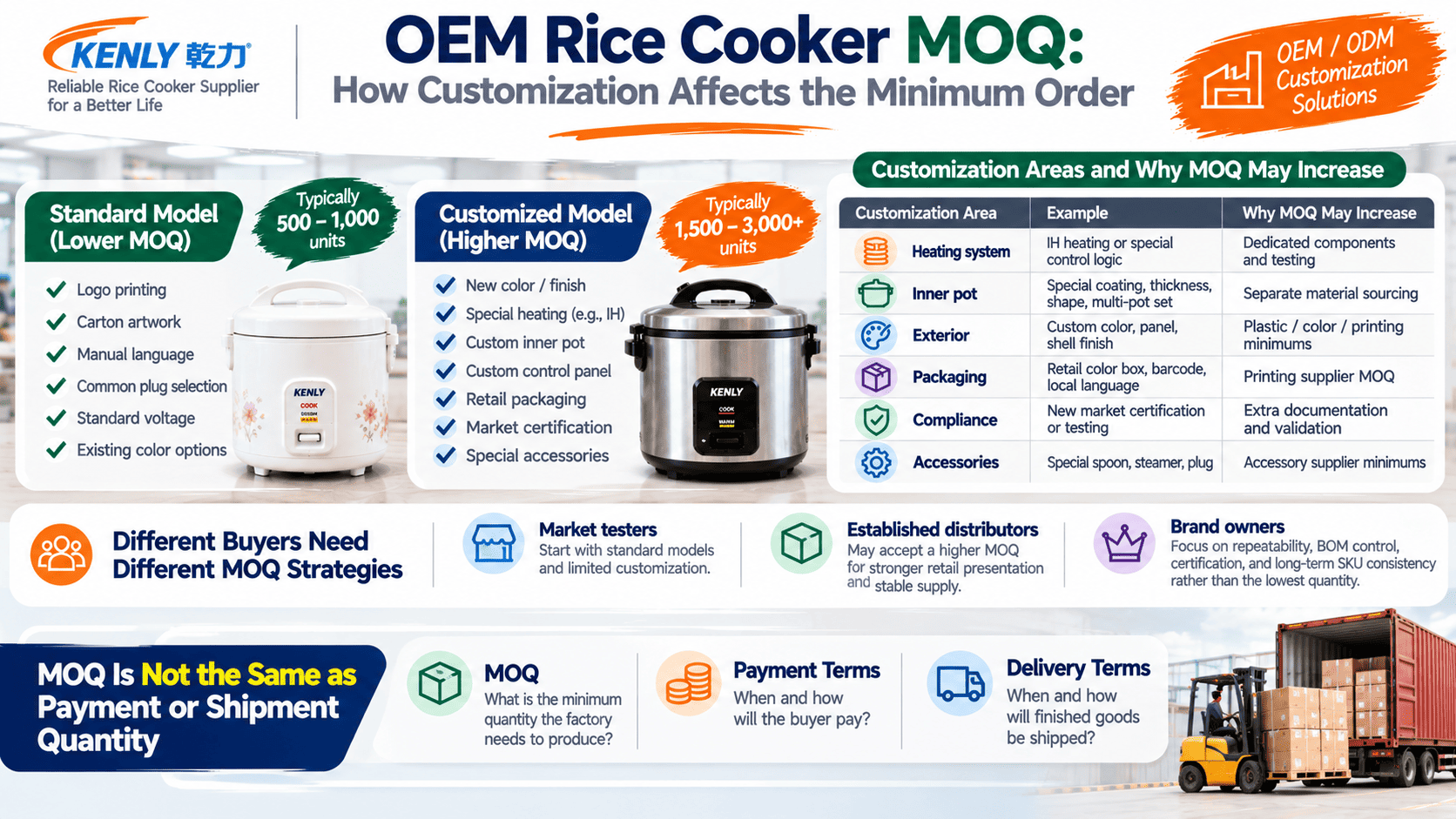
For standard models, buyers may only need:
- Logo printing
- Carton artwork
- Manual language changes
- Common plug selection
- Standard voltage
- Existing color options
Because these items stay close to normal production, the factory may be able to arrange a smaller batch.
Customization raises batch complexity
| Customization area | Example | Why MOQ may increase |
|---|---|---|
| Heating system | IH heating or special control logic | Dedicated components and testing |
| Inner pot | Special coating, thickness, shape, multi-pot set | Separate material sourcing |
| Exterior | Custom color, panel, shell finish | Plastic/color/printing minimums |
| Packaging | Retail color box, barcode, local language | Printing supplier MOQ |
| Compliance | New market certification or testing | Extra documentation and validation |
| Accessories | Special spoon, steamer, plug | Accessory supplier minimums |
A buyer may say, “I only want a new color and carton,” but the factory still has to check plastic color matching, raw-material MOQ, carton printing MOQ, labels, manual artwork, and inspection samples.
Different buyers need different MOQ strategies
Market testers usually benefit from standard models and limited customization.
Established distributors may accept a higher MOQ for stronger retail presentation and stable repeat supply.
Brand owners often care more about repeatability, BOM control, certification, and long-term SKU consistency than the absolute lowest first-order quantity.
MOQ is therefore not a random barrier. It reflects the production batch needed to make the project practical.
MOQ Is Not the Same as Payment or Shipment Quantity
MOQ, payment terms, and delivery schedule are related but different.
MOQ answers:
“What is the minimum quantity the factory needs to produce?”
Payment terms answer:
“When and how will the buyer pay?”
Delivery terms answer:
“When and how will finished goods be shipped?”
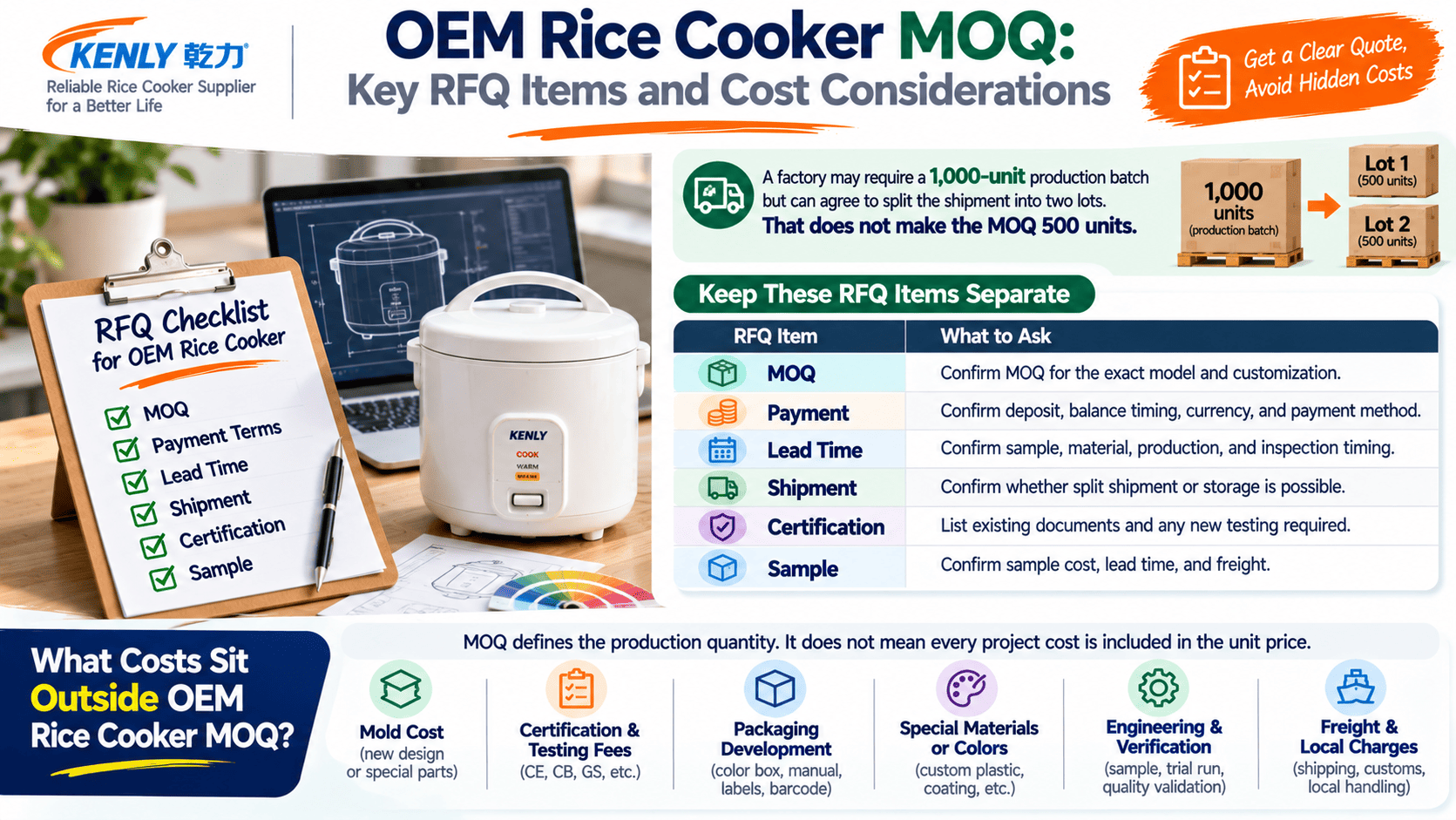
A factory may require a 1000-unit production batch but agree to split the shipment into two lots. That does not make the MOQ 500 units.
Keep these RFQ items separate
| RFQ item | What to ask |
|---|---|
| MOQ | Confirm MOQ for the exact model and customization |
| Payment | Confirm deposit, balance timing, currency, and payment method |
| Lead time | Confirm sample, material, production, and inspection timing |
| Shipment | Confirm whether split shipment or storage is possible |
| Certification | List existing documents and any new testing required |
| Sample | Confirm sample cost, lead time, and freight |
This format reduces back-and-forth and prevents an early “rough MOQ” from being treated as a final commitment.
What Costs Sit Outside OEM Rice Cooker MOQ?
MOQ defines production quantity. It does not mean every project cost is included in the unit price.
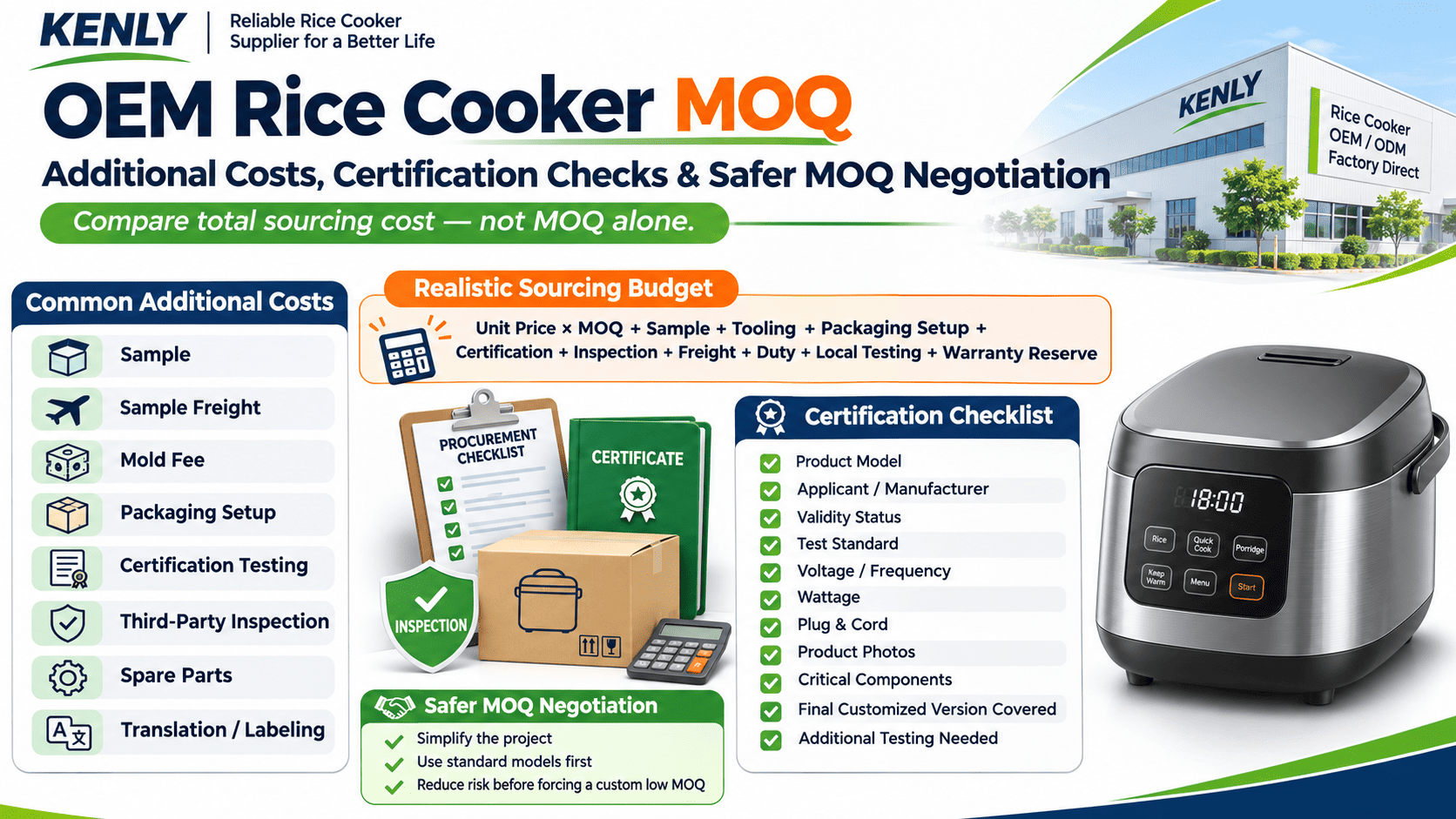
Common additional costs include:
| Cost item | When it appears | Buyer action |
|---|---|---|
| Sample | Before order confirmation | Confirm cost and refund policy |
| Sample freight | Courier shipment | Estimate DHL/FedEx/UPS cost |
| Mold fee | New plastic or metal parts | Confirm ownership and maintenance |
| Packaging setup | Custom carton, manual, barcode | Confirm print MOQ and artwork |
| Certification testing | New market or new configuration | Confirm scope before PO |
| Third-party inspection | Before shipment | Define AQL and defect criteria |
| Spare parts | After-sales planning | Agree ratio and parts list |
| Translation/labeling | Local market requirement | Verify local compliance |
A realistic sourcing budget is:
Unit price × MOQ + sample + tooling + packaging setup + certification + inspection + freight + duty + local testing + warranty reserve
This makes supplier comparison much more accurate than comparing FOB price alone.
Certification Requirements: What Should Buyers Verify?
A certificate is not just a logo in a catalog. It must match the actual product and target market.
Kenly works with products that may involve CE, CB, GS, UKCA, KC, RoHS and other market-specific requirements depending on model and destination. Buyers should verify the exact documents required for their SKU.
Certification checklist
Check:
- Product model covered
- Applicant and manufacturer/factory
- Validity or current status
- Test standard
- Rated voltage and frequency
- Rated wattage
- Plug and power cord configuration
- Product photos
- Critical components
- Whether the final customized version is covered
- Whether additional testing is required
Customization can affect compliance. Changes to the heating element, thermostat, thermal fuse, PCB, internal wiring, plug, voltage, capacity, or structure may require review.
For regulated markets, confirm requirements with the relevant testing body, importer, or local compliance professional before mass production.
How Can Importers Negotiate MOQ Without Increasing Risk?
MOQ can sometimes be reduced, but the safest negotiation is to simplify the project—not force the factory to run an uneconomic custom batch.
1. Start from an existing model
If you are testing market demand, keep the product close to the factory's normal production:
- Existing body
- Standard inner pot
- Standard control panel
- Common voltage and plug
- Logo
- Local-language manual
- Custom carton
This usually creates lower risk than launching a heavily customized SKU immediately.
2. Reduce customization depth
| Custom feature | First order? | Later upgrade? |
|---|---|---|
| Brand logo | Yes | — |
| Retail carton | Yes | — |
| Manual | Yes | — |
| Unique plastic color | Maybe | Yes |
| New control panel | Maybe | Yes |
| New mold | Usually no | Yes |
| Special coating | Depends on positioning | Yes |
| Extra accessories | Maybe | Yes |
Think of the first order as a launch version, not necessarily the final version.
3. Discuss repeat-order planning
A forecast does not guarantee a lower MOQ, but it helps the supplier plan materials and capacity.
Useful information includes:
- First-order quantity
- Expected repeat-order timing
- Annual volume estimate
- Target selling season
- SKU expansion plan
- Certification roadmap
- After-sales policy
4. Do not hide requirements
Asking for the lowest MOQ first and revealing customization later wastes time because the original quote becomes invalid.
A better message is:
“I want the lowest practical MOQ, but I need my logo, local-language manual, retail carton, and the required documents for my market. Please tell me which items affect MOQ most.”
That lets the supplier propose a workable solution.
Buyer Checklist Before Confirming OEM Rice Cooker MOQ
Use this checklist before approving a quotation.
Product
- [ ] Model and capacity confirmed
- [ ] Voltage and frequency confirmed
- [ ] Plug and power cord confirmed
- [ ] Inner pot material/coating confirmed
- [ ] Wattage and heating system confirmed
- [ ] Functions and accessories confirmed
Customization
- [ ] Logo method confirmed
- [ ] Product color confirmed
- [ ] Control panel confirmed
- [ ] Carton and manual requirements confirmed
- [ ] Barcode/label requirements confirmed
- [ ] New mold requirements identified
Commercial
- [ ] MOQ by model confirmed
- [ ] Unit price validity confirmed
- [ ] Deposit and balance terms confirmed
- [ ] Sample cost confirmed
- [ ] Tooling cost confirmed
- [ ] Certification cost confirmed
- [ ] Inspection cost confirmed
- [ ] Split-shipment terms confirmed
Quality
- [ ] Approved sample retained
- [ ] AQL standard agreed
- [ ] Critical/major/minor defects defined
- [ ] Key BOM items agreed
- [ ] Material-change approval rule written
- [ ] Pre-shipment inspection method agreed
Delivery
- [ ] Artwork deadline
- [ ] Material purchasing time
- [ ] Production lead time
- [ ] Inspection date
- [ ] Loading date
- [ ] Shipping schedule
This checklist prevents the MOQ discussion from being separated from the rest of the sourcing risk.
Factory Capability: What Should Importers Check?
A low MOQ is only useful if the factory can still maintain stable quality and delivery.
At Kenly, our QC process includes incoming material inspection and production testing. Depending on model and order requirements, controls include:
- AQL-based incoming inspection
- 100% high-voltage testing
- Watt testing
- Ground-wire testing
- Functional checks
- Finished-product random inspection
- Final inspection
Buyers should still verify factory capability rather than rely only on supplier claims.
Factory capability checklist
| Area | What to verify |
|---|---|
| Production | Actual production lines and current lead time |
| OEM/ODM | Similar customized projects |
| Incoming QC | Material inspection records |
| Electrical testing | What is tested on every unit |
| Cooking/function test | Whether real performance is checked |
| BOM control | Whether key parts are fixed in writing |
| Change control | Buyer approval before substitution |
| Traceability | Ability to trace a batch or component |
| Packaging | Artwork, carton, label, manual control |
| Certification | Documents for exact model and market |
| After-sales | Complaint analysis and spare-parts support |
Material change control matters
The purchase agreement should state that key items cannot change without buyer approval.
For rice cookers, this may include:
- Inner pot material and coating
- Heating plate
- Thermostat and thermal fuse
- Power cord and plug
- Plastic material/color
- Control panel
- Rated wattage and voltage
- Packaging and manual
- Accessories
This is especially important when a buyer pushes for a lower MOQ or lower price. Cost pressure should not become hidden component substitution.
How Should Procurement Managers Compare Suppliers?
OEM Rice Cooker MOQ should never be compared alone.
A supplier offering 300 units may look more attractive than one requiring 800 units, but the real question is whether both quotations include the same materials, testing, packaging, certification support, and quality controls.
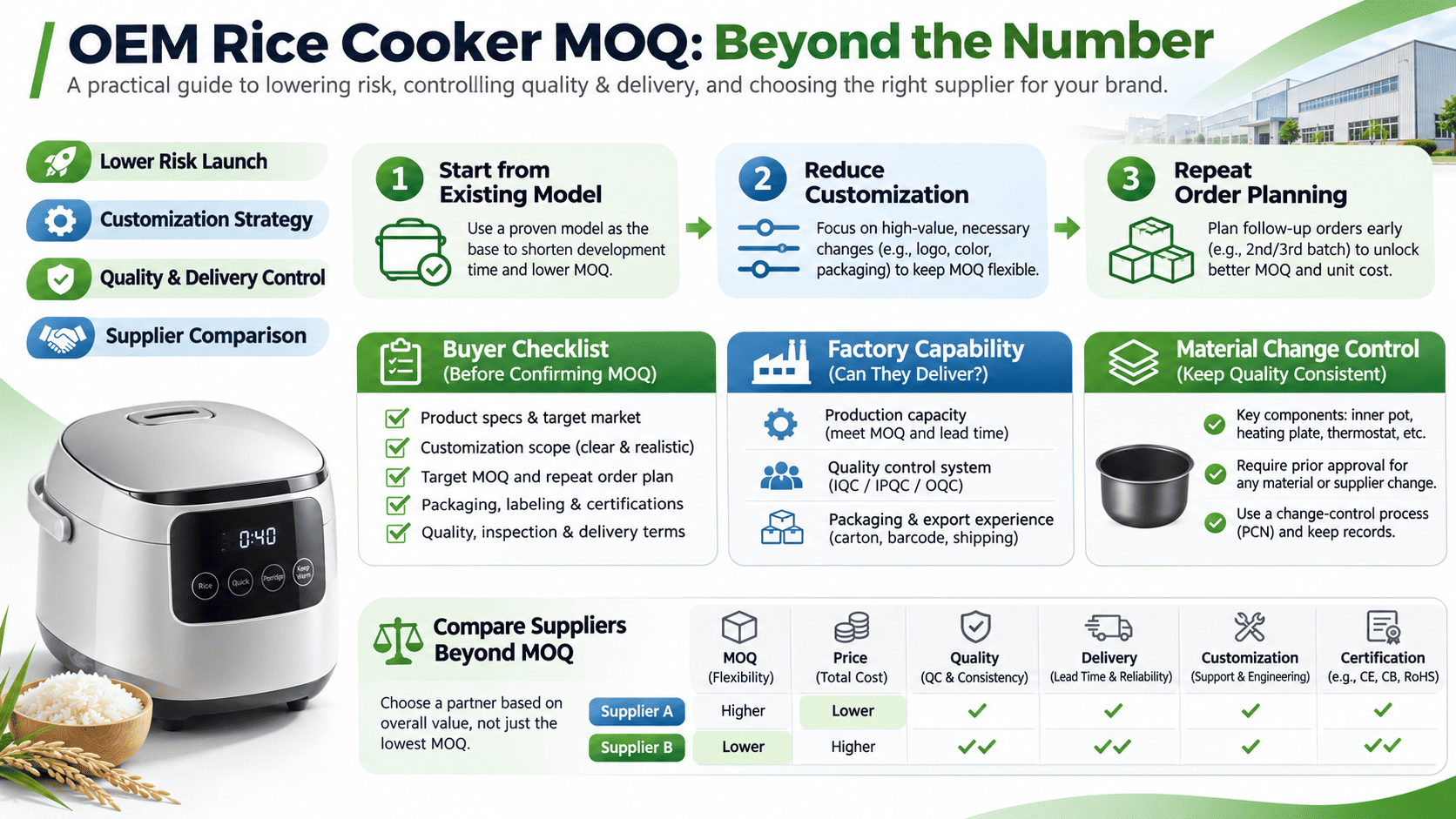
Use a wider comparison:
| Evaluation factor | What to verify |
|---|---|
| MOQ | By exact model and customization |
| Unit price | Materials and packaging included |
| Quality | Incoming QC, electrical tests, inspection |
| Certification | Exact model and target market |
| Capacity | Realistic production window |
| OEM experience | Similar projects |
| Material consistency | BOM and substitution rules |
| Lead time | Sample through loading |
| Communication | Technical clarity and response quality |
| After-sales | Warranty, spare parts, claim handling |
The safest supplier is not necessarily the one with the lowest MOQ. It is the one with the most reliable total sourcing plan.
Common Mistakes When Negotiating Rice Cooker MOQ
Mistake 1: Asking MOQ before defining the product
A low MOQ quoted for a standard model may no longer apply after you add custom color, carton, inner pot, or functions.
Mistake 2: Comparing MOQ without matching specifications
Two visually similar cookers may use different heating plates, inner pots, plugs, plastics, and packaging.
Standardize the specification before comparing MOQ.
Mistake 3: Assuming MOQ equals container quantity
MOQ is production quantity. Container loading is a logistics calculation.
Mistake 4: Forcing a very low MOQ with deep customization
A factory still faces fixed material, printing, setup, and inspection costs. If the order is too small, the project may become uneconomic or quality risk may increase.
Mistake 5: Ignoring packaging supplier MOQ
The rice cooker factory may accept the quantity while the color-box supplier requires a larger printing batch.
Mistake 6: Forgetting certification cost
A small order that needs a completely new certification project may not make commercial sense.
Mistake 7: Focusing only on first-order quantity
A slightly higher first MOQ may be acceptable if the model has strong repeat-order potential and stable materials.
Mistake 8: Accepting an unrealistically easy “yes”
When a supplier accepts every low-MOQ, low-price, special-color, custom-packaging request immediately, ask how they will source and control those materials.
FAQ About OEM Rice Cooker MOQ
What is a typical OEM rice cooker MOQ?
For planning purposes, standard models may start around 500–1000 units in our experience. Light private-label customization can move toward 1000–2000 units, while deeper customization may require 1500–3000 units or more.
The actual MOQ depends on the model and project.
Is MOQ the same for every rice cooker model?
No. Mini, cylinder, drum, deluxe, digital, IH, and commercial models can use different components, molds, materials, and production processes.
Can I order below MOQ for a trial order?
Sometimes existing stock, samples, or very limited branding may support a smaller trial. A fully customized mass-production order below the normal MOQ is less likely to be practical.
Can I combine several models to reach MOQ?
Sometimes, but only when the models share compatible materials or production arrangements. Two completely different models normally have separate minimums.
Ask the factory whether the MOQ applies per model, per color, per artwork, or per total order.
Does custom packaging increase MOQ?
It can. Color-box printers and manual suppliers often have their own minimum quantities. Using a standard carton with labels can sometimes reduce the first-order packaging threshold.
Does custom color increase MOQ?
Often yes, because plastic resin, paint, powder coating, or color matching may require a dedicated batch.
Does certification increase MOQ?
Not automatically, but new testing adds fixed project cost. For a small order, that cost may make the project commercially unattractive even if the factory can technically produce the quantity.
Is MOQ the same as one container?
No. A production MOQ may be lower or higher than the quantity that fits a 20GP or 40HQ container.
Can the order be produced together but shipped in two lots?
Possibly. That is a delivery and storage negotiation, not a change to the production MOQ.
How can I lower my first-order risk?
Use an existing model, limit customization, verify documents, approve samples, define inspection standards, and keep material-change rules in writing.
What should I send the supplier to get an accurate MOQ?
Send:
- Product/model reference
- Capacity
- Target market
- Voltage/frequency
- Plug
- Inner pot
- Functions
- Logo
- Color
- Packaging
- Certification needs
- Expected first order
- Annual forecast
The more complete your RFQ, the more reliable the MOQ.
Conclusion
OEM Rice Cooker MOQ is best understood as a production planning number, not a random supplier barrier and not a payment term.
Standard rice cooker models generally allow lower entry quantities because existing molds, components, materials, and production processes can be used. Custom colors, special inner pots, new control systems, unique packaging, advanced heating systems, and new certification requirements can raise the minimum batch.
For a first order, the safest strategy is usually:
- Choose an existing proven model
- Keep customization focused on branding and packaging
- Confirm certification for the target market
- Approve the product and packaging sample
- Define BOM and inspection standards
- Place a realistic production batch
- Add deeper customization after demand is proven
When you prepare an RFQ, share your target market, product type, customization list, compliance needs, expected quantity, and repeat-order plan from the beginning.
That allows the supplier to give you a realistic MOQ instead of a low number that changes later—and gives you a much clearer view of the true cost, quality risk, and delivery plan behind your OEM rice cooker project.