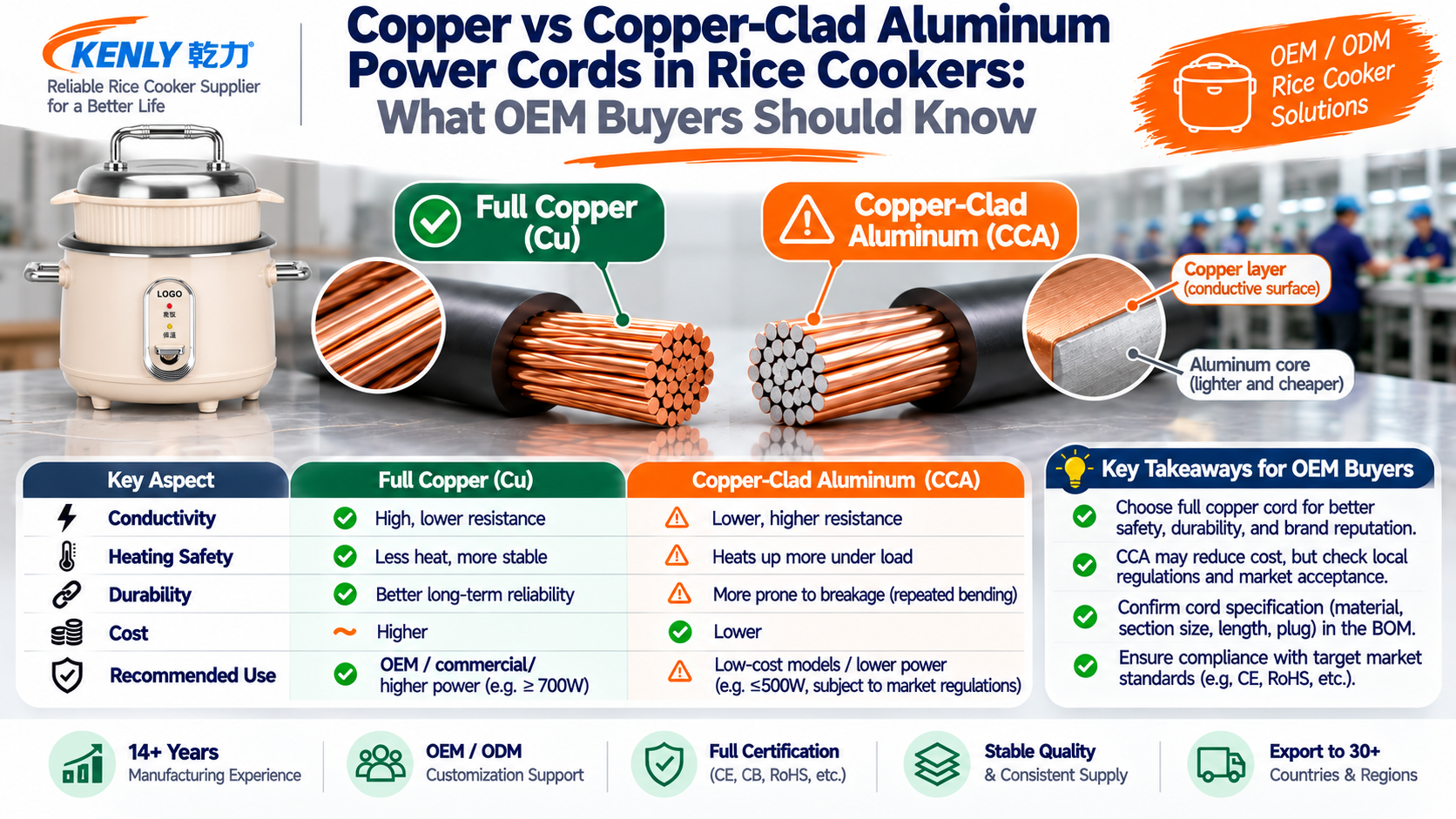
Copper vs Copper-Clad Aluminum Power Cords in Rice Cookers becomes a real procurement issue when a low unit price hides future warranty claims. A cheaper cord can look acceptable on paper, but heat, oxidation, and undisclosed substitution can create complaints after shipment. I believe buyers need a practical selection method, not a simple “good or bad” answer.
Copper power cords are generally more stable for higher-power or heavy-use rice cookers, while copper-clad aluminum power cords may be acceptable only when the product rating, wire gauge, certification, target market, and after-sales risk are properly controlled. OEM buyers should evaluate total cost of ownership, not only unit price.
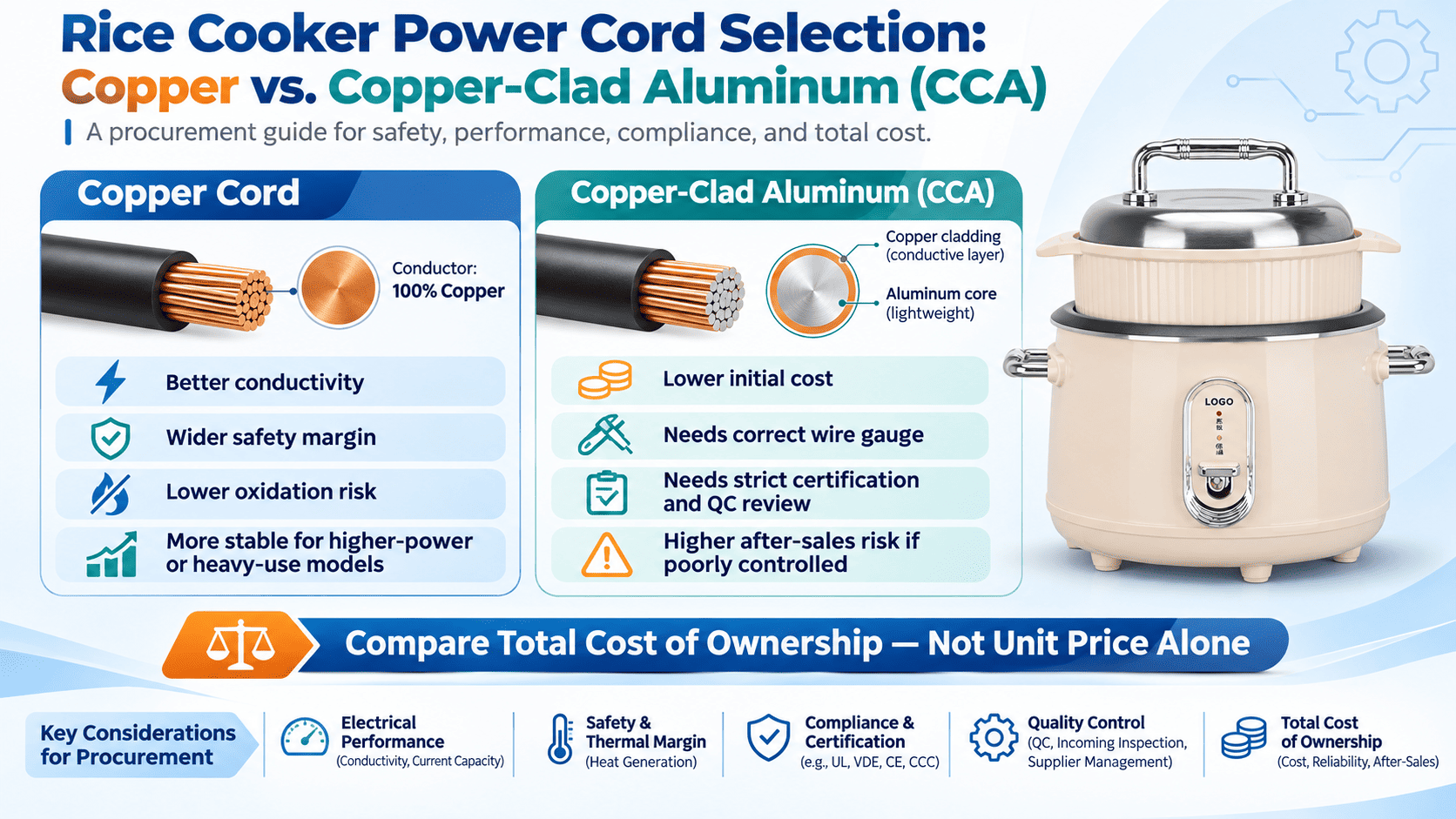
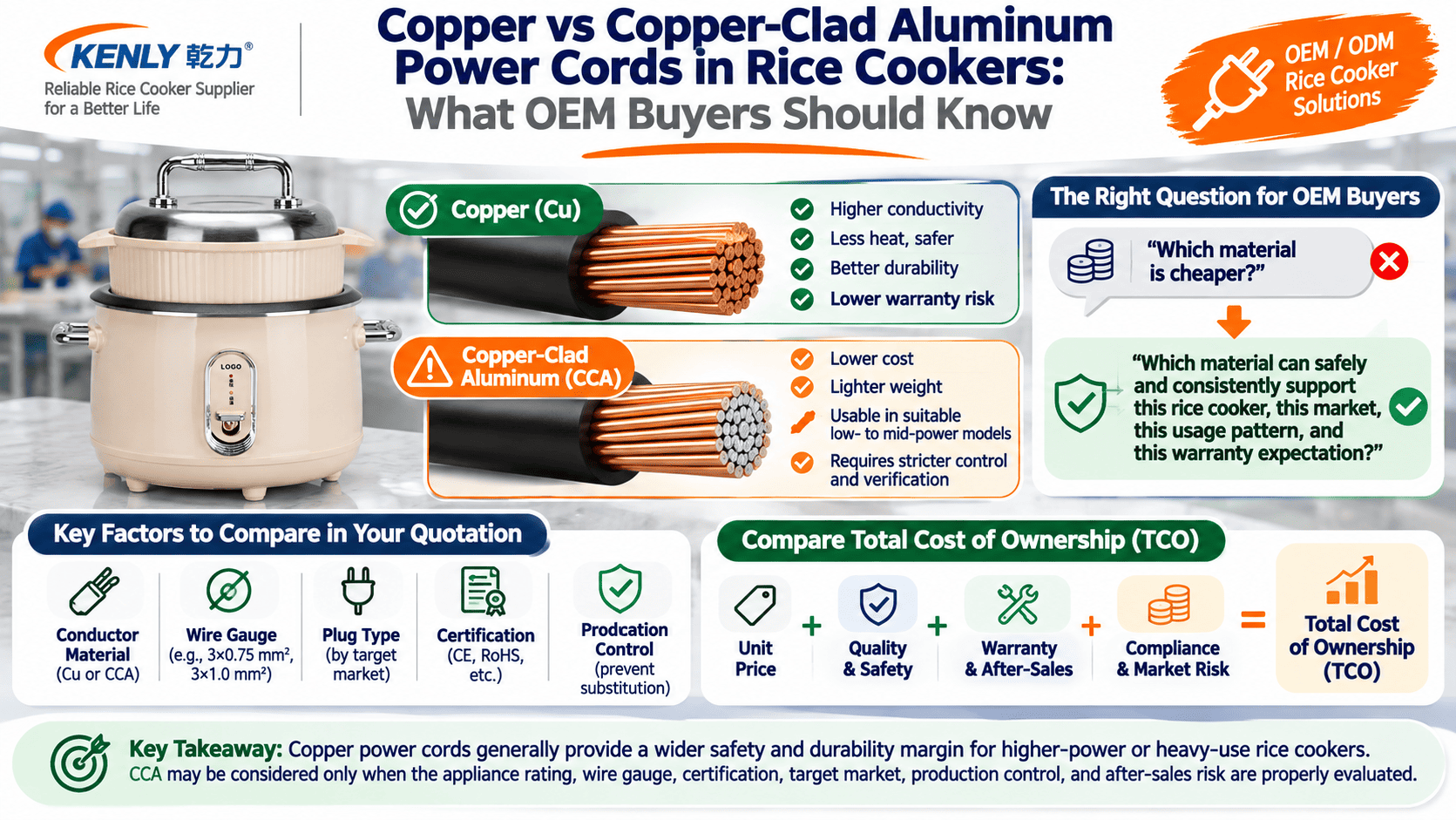
I have seen many power cord discussions start with price and end with complaints. The better question is not “Which material is cheaper?” The better question is “Which material can survive the buyer’s product, market, usage pattern, and warranty expectations?”
How should OEM buyers compare Copper vs Copper-Clad Aluminum Power Cords in Rice Cookers?
A buyer may receive two quotations for the same rice cooker model and wonder why one supplier is cheaper. The cord material is often one hidden reason. If the quotation does not clearly define copper or CCA, the buyer may approve a sample that does not match mass production.
Copper vs Copper-Clad Aluminum Power Cords in Rice Cookers should be compared by conductivity, heat behavior, connection stability, certification documents, market acceptance, and warranty exposure. Copper usually gives a wider safety margin, while CCA may reduce cost when power rating and usage conditions are controlled.
The comparison is not only about electrical conductivity
In procurement meetings, I often see buyers compare only the material price. That is understandable because rice cooker margins can be tight. However, power cords are part of the appliance safety chain. A small saving can become expensive if it causes returns during the selling season.
Pure copper has better conductivity than aluminum1. This means copper can carry current with less resistance under the same conditions. Lower resistance usually helps reduce heat build-up2. Copper also has better mechanical durability at terminals and connection points.
Copper-clad aluminum, often called CCA, uses an aluminum core covered by a copper layer. It can look like copper during a quick visual check. It is usually lighter and cheaper. In some applications, CCA can meet relevant specifications when the design is correct. However, the buyer must understand the limits.
Key procurement comparison points
| Factor | Copper Power Cord | Copper-Clad Aluminum Power Cord |
|---|---|---|
| Conductivity | Higher | Lower than copper |
| Heat margin | Usually better | More dependent on gauge and load |
| Mechanical strength | Stronger at connection points | More sensitive to bending and terminal stress |
| Oxidation risk | Lower in normal use | Higher concern at exposed or damaged points |
| Unit cost | Higher | Lower |
| Weight | Heavier | Lighter |
| Buyer risk | Lower for heavy-use models | Higher if poorly specified or substituted |
| Best fit | Higher wattage, premium, stricter markets | Cost-sensitive models with verified compliance |
What I check before accepting a quote
When I review a cord specification for an OEM rice cooker project, I do not stop at “certified cord.” I ask for details that connect the cord to the appliance:
- Rated current and voltage of the cord
- Conductor material, clearly stated as copper or CCA
- Wire gauge or cross-sectional area, such as 0.75 mm² or 1.0 mm²
- Plug type for the destination market
- Insulation material and temperature rating
- Certification documents that match the actual cord supplier and cord model
- Mass production control method, not only sample approval
A certified component can still be unsuitable if it is paired with the wrong wattage, poor assembly method, or unexpected usage intensity.
In our experience handling returns and complaints, failures rarely come from one factor alone. A power cord issue often combines several small risks: thinner conductor, high wattage, poor terminal crimping, humid storage, and heavy daily use. This is why I prefer to treat cord selection as a risk management decision.
For a buyer sourcing drum rice cookers or deluxe rice cookers, this issue becomes more important because the products often target mainstream families. A small failure rate can become a large number of claims when shipment volume is high3.
When do CCA power cords in rice cookers create real procurement risk?
CCA can look attractive when a supplier needs to reduce a rice cooker price by a few cents or a few dollars. The danger starts when the buyer accepts the material without matching it to wattage, usage intensity, and after-sales capability. Low cost can become high risk.
CCA power cords in rice cookers create real procurement risk when the appliance has higher wattage, long heating cycles, frequent daily use, weak terminal control, humid market conditions, or strict consumer protection expectations. The biggest danger is undisclosed substitution after sample approval.
Common failure patterns I have seen
I do not speak as a testing laboratory. I speak from the manufacturing and complaint-handling side. In our experience handling returns, power cord complaints often appear after products have been used in homes for weeks or months. The sample may pass inspection, but the market may still report problems.
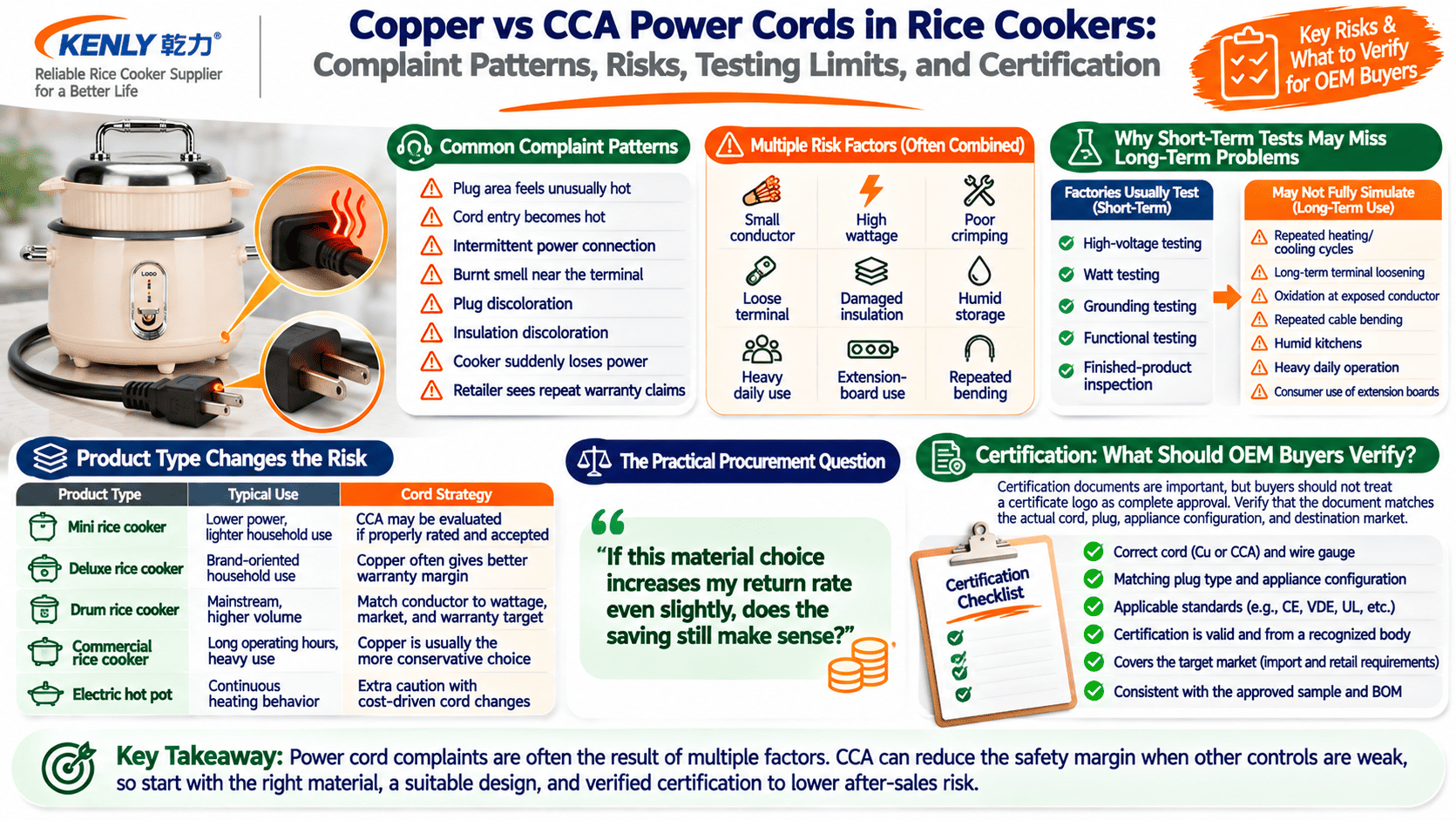
Common complaint patterns include:
- Plug or cord area feels too hot
- Intermittent power connection
- Burnt smell near the cord entry or terminal
- Visible discoloration of plug or cord insulation
- Consumer claims that the cooker stopped working suddenly
- Retailer complaints about repeat warranty cases
These issues do not always mean the cord material alone is the root cause. However, CCA can reduce the margin for error when other conditions are not well controlled.
Why short-term checks may miss long-term problems
A factory can perform high voltage testing4, watt testing, ground wire testing, and finished product random testing. These controls are necessary. At Kenly, for example, our production process includes incoming material inspection based on AQL standards5, 100% high voltage testing, watt testing, ground wire testing, and finished product random inspection. Buyers should still verify that the cord material in mass production matches the approved specification.
Short-term tests can confirm that the product works at the time of inspection. They may not fully show what happens after:
-
Repeated heating and cooling cycles
Rice cookers heat, hold warm, cool down, and heat again. This cycle can stress connection points. -
Thermal expansion differences6
Aluminum and copper behave differently under heat. If the connection design is poor, this can contribute to loosening or resistance increase. -
Oxidation at exposed points7
If the conductor is damaged during stripping or crimping, oxidation can become a long-term concern. -
User behavior in real kitchens
Consumers may bend cords sharply, use extension boards, cook several times daily, or operate in humid environments.
Power rating changes the risk level
A mini rice cooker used occasionally does not create the same load profile as a larger family rice cooker used every day. A commercial rice cooker used in a food stall or restaurant has a different duty cycle again.
| Product Type | Typical Buyer Concern | Cord Material Risk View |
|---|---|---|
| Mini rice cooker | Low price, compact size | CCA may be considered if compliant and properly rated |
| Deluxe rice cooker | Brand reputation, household use | Copper is often safer for warranty control |
| Drum rice cooker | Volume sales, mainstream market | Material choice must match wattage and target market |
| Commercial rice cooker | Long operation, heavy use | Copper is usually the more conservative choice |
| Electric hot pot | Continuous heating behavior | Buyer should be cautious with low-margin CCA designs |
I recommend that buyers avoid treating CCA as a universal cost-saving option. Instead, they should ask: “If this cord causes a 1% higher return rate, can my margin absorb it?”
For a procurement manager buying over USD 1 million per year, the answer is often no. A small defect rate can damage retailer confidence, delay repeat orders, and increase after-sales pressure.
How do regulations and certifications affect Copper vs Copper-Clad Aluminum Power Cords in Rice Cookers?
A buyer may see CE, CB, GS, UKCA, KC, RoHS, RGCCRF, or Energy Star8 documents and feel safe. Certifications are important, but they are not a substitute for market-specific review. The wrong cord material can still create customs, retailer, or consumer trust problems.
Regulations and certifications affect Copper vs Copper-Clad Aluminum Power Cords in Rice Cookers by defining what can be sold, imported, or accepted by retailers in each market. Buyers should verify current rules, certificate validity, cord model numbers, and whether CCA conductors are allowed for the destination appliance category.
Certification documents are evidence, not the whole decision
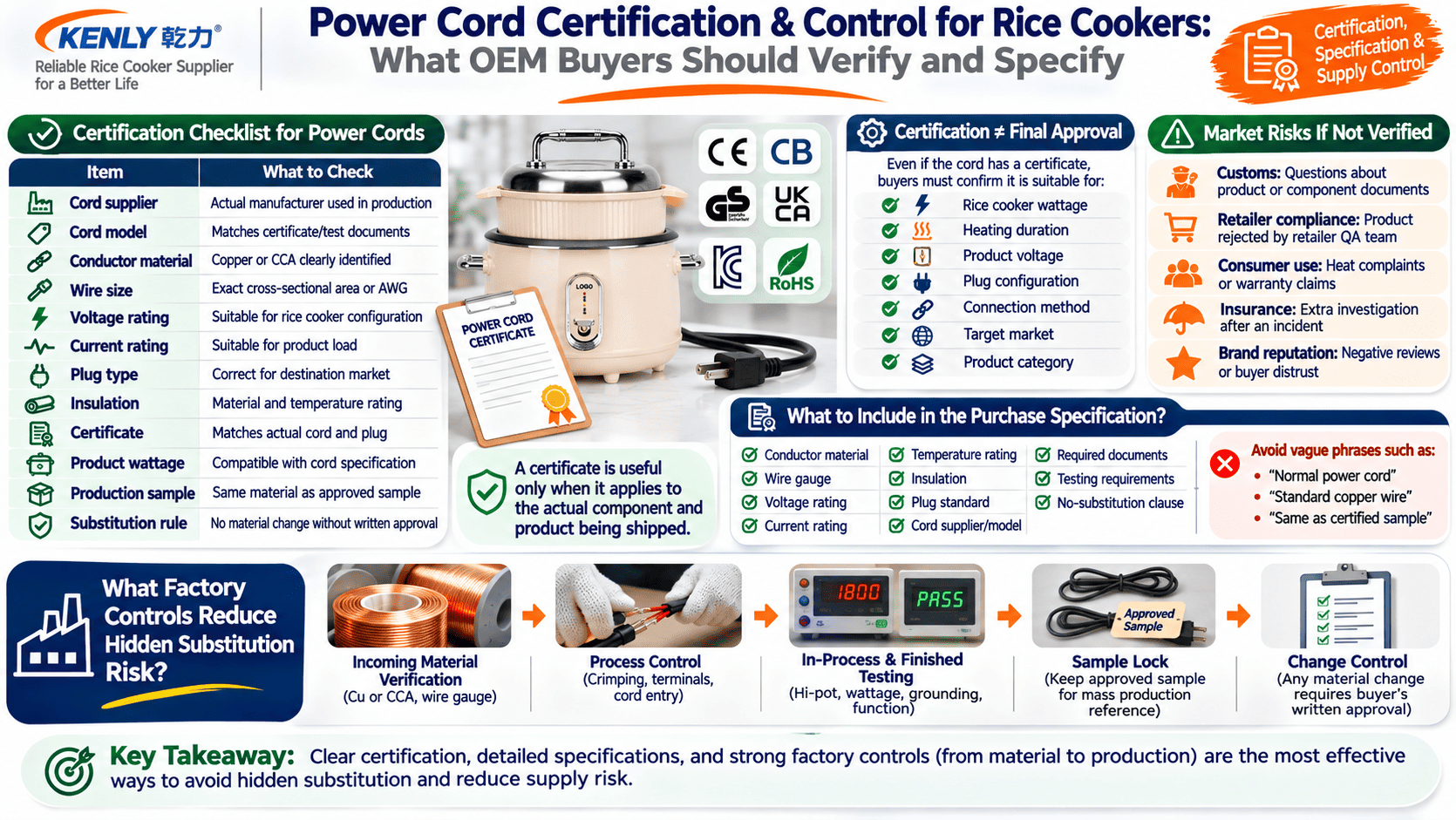
In OEM manufacturing, certification documents help buyers reduce risk. However, a certificate should be checked carefully. A buyer should not only ask, “Do you have CE?” The better questions are:
- Does the certificate match the actual cord supplier?
- Does the certificate match the cord model number?
- Does the certificate cover the plug type and rating?
- Does the certificate apply to the destination market?
- Does the approved sample use the same conductor as mass production?
- Does the appliance rating match the cord rating?
At Kenly, our rice cooker products can be manufactured according to requirements such as CE, CB, GS, UKCA, KC, RoHS9, RGCCRF, and Energy Star. I still tell buyers to verify documents for their own market and product scope. A certificate is only useful when it applies to the exact product being shipped.
Market risk is not the same everywhere
Some markets are more sensitive to CCA than others. Some buyers may face strict retailer rules even when national rules are less clear. Some countries may allow a product in one channel but reject it in another due to customer requirements or customs interpretation.
This creates three levels of risk:
| Risk Area | What Can Happen | Buyer Impact |
|---|---|---|
| Customs | Shipment inspection raises questions | Delay, storage cost, missed season |
| Retailer compliance | Retailer rejects product documentation | Lost order or forced rework |
| Consumer market | Users complain about heat or quality | Returns, negative reviews, brand damage |
| Insurance or claims | Incident requires technical investigation | Higher legal and claim handling cost |
| Reputation | Competitor uses material issue against brand | Long-term trust loss |
For buyers in competitive home appliance markets, these consequences can be more expensive than the cord saving. If a shipment misses the high season because documents are unclear, the unit cost advantage disappears quickly.
Why buyers should not rely on verbal promises
I have seen buyers accept statements like “same as copper” or “no problem for your market.” These phrases are dangerous because they are not specifications. A procurement file needs written confirmation.
A good purchase specification should include:
- Conductor material: copper or copper-clad aluminum
- Wire size: exact cross-sectional area or AWG10
- Cord rating: voltage, current, temperature
- Plug standard: destination market plug type
- Test requirements: factory tests and third-party tests if required
- Certificate list: document names, numbers, issuing bodies, validity
- Substitution rule: no material change without written buyer approval
I also suggest adding a clause that any conductor material change must be disclosed before production. This may seem simple, but it prevents many disputes.
Buyers should treat “certified” as the starting point. They should treat “verified and matched to my market” as the real approval point.
For application-specific decisions, especially in regulated markets or higher-wattage products, buyers should consult qualified compliance professionals or accredited testing bodies. A manufacturer can support documentation and production control, but the buyer should confirm final market acceptance.
Hidden substitution is one of the biggest risks in appliance sourcing. A buyer may approve a copper cord sample, then receive mass production with a lower-cost conductor if the supplier lacks discipline or if the purchase order is vague. The problem often appears only after delivery.
Supplier controls reduce hidden substitution risk in power cords in rice cookers when buyers define conductor material in writing, verify incoming materials, approve golden samples, require traceable certificates, inspect mass production, and link payment or shipment approval to material compliance.
The risk starts with unclear specifications
Many disputes begin because the buyer’s purchase order says only “power cord” or “standard cord.” That gives a weak supplier room to choose cheaper materials. It also makes complaint resolution difficult because the supplier can say the material was not defined.
I recommend that buyers write power cord details in the product specification sheet, quotation confirmation, purchase order, and quality agreement. The language should be simple and direct.
For example:
- “Power cord conductor must be 100% copper.”
- “CCA conductor may be used only for model X with written buyer approval.”
- “No change in conductor material, wire gauge, plug supplier, or insulation material without written approval.”
- “Supplier must provide updated certification documents before mass production.”
Factory controls buyers should request
At Kenly, our factory operates two production lines, and each line is supervised by experienced quality control staff. Our process includes incoming material inspection, product assembly controls, and electrical safety testing. Still, buyers should ask any supplier how they control cord material from purchasing to shipment.
A practical control plan may include:
| Control Point | Buyer Question | Why It Matters |
|---|---|---|
| Incoming inspection | How do you verify cord supplier and specification? | Prevents wrong material entering production |
| Golden sample | Is the approved cord sealed and recorded? | Creates reference for mass production |
| Production line check | Who confirms cord label and material before assembly? | Stops mistakes during production |
| Electrical testing | Is every unit high-voltage tested? | Confirms basic safety performance |
| Random finished inspection | What AQL level is used? | Measures batch consistency |
| Document review | Do certificates match the actual cord? | Reduces customs and retailer risk |
| Pre-shipment inspection | Can the buyer or third party inspect? | Adds final control before payment |
Why “same performance” is not enough
Some suppliers say CCA can perform the same if the wire gauge is adjusted. In some cases, that may be technically possible. But procurement risk is not only electrical performance. It also includes:
- Consumer perception
- Retailer requirements
- Warranty cost
- Customs interpretation
- Brand positioning
- Long-term durability
- Supplier transparency
If a supplier changes from copper to CCA without notice, the main issue is not only the material. The main issue is trust. A buyer cannot manage risk if the supplier hides changes.
My practical supplier selection checklist
When I evaluate a rice cooker supplier, I look for signals that the factory understands buyer risk:
-
The supplier answers material questions clearly.
A reliable supplier can explain copper, CCA, wire gauge, and certification limits without avoiding details. -
The supplier does not push one answer for every market.
Different markets require different decisions. A careful supplier recognizes this. -
The supplier links cost savings to risk.
A professional supplier can show the cost difference and the possible trade-offs. -
The supplier allows document verification.
Certificates should be available for review before shipment. -
The supplier has stable production control.
Quality staff, incoming inspection, and line testing reduce random failures.
For buyers who have suffered delayed shipments or surprise material changes, this control system is more valuable than a very low quote. A supplier who saves a few cents but creates a recall risk is not actually cheaper.
How should I choose power cord material by rice cooker model and market?
A buyer may want one simple answer for all rice cooker projects. I understand that because standardization saves time. However, rice cookers differ by wattage, capacity, cooking behavior, and customer expectations. A low-price mini model and a premium deluxe model should not always use the same cord strategy.
I should choose power cord material by rice cooker model and market after checking wattage, wire gauge, usage intensity, target regulations, retailer standards, and warranty tolerance. Copper is usually preferred for higher-risk products, while CCA may fit selected cost-sensitive models with clear approval and verification.
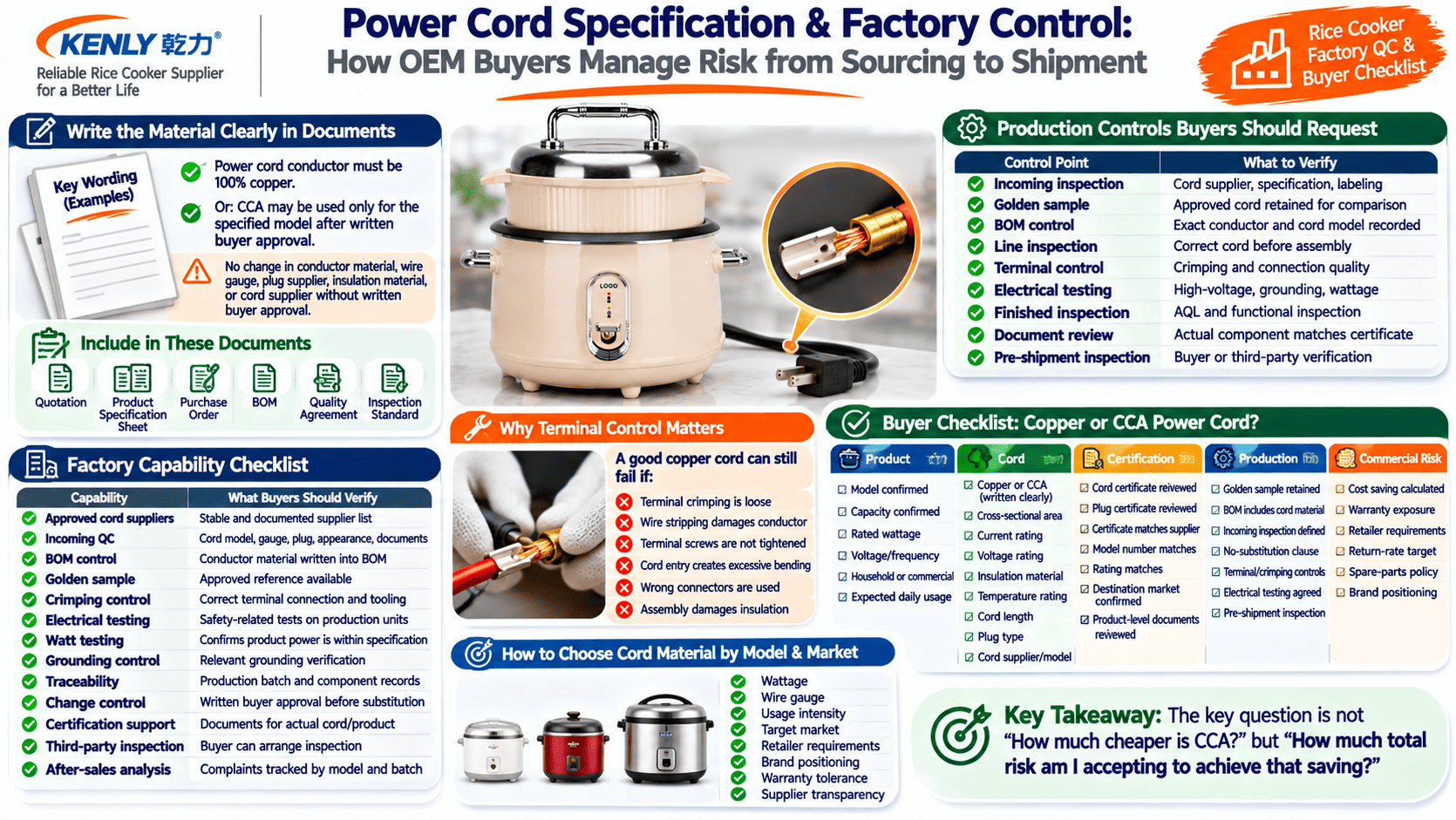
Build a decision matrix before negotiation
Before asking suppliers for a final price, I suggest buyers create a decision matrix. This avoids emotional price comparison and gives the supplier a clear technical and commercial target.
| Decision Factor | Lower Risk Choice | Higher Risk Situation |
|---|---|---|
| Wattage | Lower wattage | Higher wattage |
| Usage | Occasional household use | Daily heavy household or commercial use |
| Market | Flexible buyer standards | Strict retail or regulatory review |
| Brand level | Economy model | Mid-range or premium brand |
| Warranty tolerance | Buyer can handle small claim increase | Buyer has strict return targets |
| Supplier trust | Long-term transparent supplier | New supplier with unclear controls |
| Documentation | Complete and verified | Incomplete or verbal only |
This table does not mean CCA is always wrong. It means the buyer should only accept CCA when the risk is visible and controlled.
Example decision logic for OEM rice cookers
For a mini rice cooker, a buyer may prioritize low cost and compact design. If the wattage is modest, the cord is properly rated, and the target market accepts the material, CCA may be considered. The buyer should still require written approval and documentation.
For a deluxe rice cooker, the buyer often expects stronger durability and fewer after-sales complaints. I would usually advise a more conservative cord strategy because the product may carry the buyer’s brand reputation. Consumers who buy a better model expect safer, more stable performance.
For a drum rice cooker, the decision depends on wattage, volume, and market. A buyer selling large quantities in Thailand, for example, may care deeply about stable quality, reasonable price, and on-time delivery. If one material choice increases complaint risk during the selling season, the saving may not be worth it.
For a commercial rice cooker, I would be very cautious with CCA. These products often run longer and serve more demanding environments. The warranty risk and user safety expectations are higher.
Total cost of ownership matters more than unit price
A lower cord cost may reduce the FOB price. However, the buyer should also estimate the hidden costs:
- Replacement parts
- Warranty labor
- Retailer penalties
- Customer service workload
- Negative reviews
- Lost repeat orders
- Emergency air shipment for replacements
- Product rework before customs release
A simple calculation helps. If a cord change saves USD 0.20 per unit on 50,000 units, the saving is USD 10,000. That looks attractive. But if the change causes only 1,000 extra claims at USD 12 handling cost per claim, the buyer loses USD 12,000 before counting reputation damage.
This is why I prefer procurement decisions that consider both price and failure cost.
My recommended approval process
I would use this process before confirming mass production:
- Confirm the rice cooker wattage and heating cycle.
- Select the cord material and wire gauge together.
- Check destination market requirements.
- Review certificates and match them to the cord model.
- Approve a golden sample.
- Add a no-substitution clause to the purchase order.
- Request incoming material checks during production.
- Use pre-shipment inspection for high-volume orders.
- Track market complaints by model and batch.
This process gives buyers a better chance to control both cost and reliability. It also helps suppliers quote honestly because the specification is clear from the beginning.
Frequently Asked Questions
Is copper always better than copper-clad aluminum for rice cooker power cords?
Copper usually offers a better safety and durability margin, especially for higher-wattage or heavy-use rice cookers. However, CCA is not automatically unacceptable. Buyers should check product rating, wire gauge, market rules, certifications, supplier controls, and after-sales risk before deciding.
Can certified CCA power cords still cause problems in rice cookers?
Yes. A certified CCA cord may still create problems if it is poorly matched to the appliance, installed with weak terminal control, used in high-heat conditions, or substituted without notice. Certification should be verified, but buyers also need production and application review.
What is the biggest hidden risk when buying rice cookers with low quoted prices?
The biggest hidden risk is undisclosed material substitution. A supplier may reduce cost by changing copper to CCA, reducing wire gauge, or switching cord suppliers. Buyers should define the conductor material in writing and verify it before shipment.
Should OEM buyers reject all CCA cords?
No. OEM buyers should not reject all CCA cords automatically. They should evaluate whether CCA fits the rice cooker’s wattage, expected use, target market, and warranty tolerance. For premium, high-power, or strict-market products, copper is often the safer choice.
What documents should I ask suppliers for before approving power cords?
Buyers should request cord specifications, conductor material confirmation, wire gauge, plug rating, insulation details, relevant certificates, test reports when available, and supplier traceability records. Buyers should verify that these documents match the actual cord used in mass production.
Conclusion
Copper vs Copper-Clad Aluminum Power Cords in Rice Cookers is a procurement risk decision, not a simple material debate. Copper usually provides a stronger margin for durability, while CCA may work in selected low-risk models when specifications, certifications, and supplier controls are clear. I recommend that buyers compare total cost of ownership, verify documents, and prohibit undisclosed substitution. If you are developing OEM or ODM rice cookers for international markets, Kenly can support material selection, customization, and production control for your project.
"The Electrical Conductivity of the Copper-Aluminum Alloys.", https://digitalcommons.mtech.edu/cgi/viewcontent.cgi?article=1071&context=bach_theses. Copper exhibits approximately 60% higher electrical conductivity than aluminum at room temperature, with copper at 100% IACS (International Annealed Copper Standard) and aluminum at approximately 61% IACS. Evidence role: statistic; source type: encyclopedia. Supports: the relative electrical conductivity values of copper versus aluminum. ↩
"Joule heating", https://en.wikipedia.org/wiki/Joule_heating. According to Joule's first law, heat generated in a conductor is proportional to the square of the current multiplied by the resistance (P = I²R), establishing the direct relationship between resistance and thermal dissipation. Evidence role: mechanism; source type: encyclopedia. Supports: the physical mechanism by which electrical resistance generates heat in conductors. ↩
"Expected long-term defect rate of analytical performance in ...", https://pmc.ncbi.nlm.nih.gov/articles/PMC6039158/. In quality management, even low defect rates become significant in absolute terms at high production volumes; for example, a 1% defect rate in a shipment of 100,000 units results in 1,000 defective products requiring warranty service. Evidence role: general_support; source type: education. Supports: the mathematical relationship between defect rates and production volume. ↩
"The Dielectric Voltage Withstand Test", https://code-authorities.ul.com/wp-content/uploads/sites/40/2015/02/UL_WP_Final_The-Dielectric-Voltage-Withstand-Test_v5_HR.pdf. High voltage dielectric withstand testing, specified in standards such as IEC 60335 for household appliances, verifies insulation integrity by applying voltage significantly higher than operating voltage to detect potential breakdown paths. Evidence role: definition; source type: institution. Supports: the purpose and standardization of high voltage testing in appliance manufacturing. ↩
"ISO 2859-1", https://chemistry.unt.edu/~tgolden/courses/iso2859-1.pdf. Acceptable Quality Limit (AQL) is a statistical sampling method defined in ISO 2859 standards for determining acceptable defect rates in batch inspections, widely used in manufacturing quality control. Evidence role: definition; source type: institution. Supports: the definition and standardization of AQL sampling methodology. ↩
"Thermal expansion", https://en.wikipedia.org/wiki/Thermal_expansion. Aluminum exhibits a coefficient of linear thermal expansion approximately 40% higher than copper (23.1 × 10⁻⁶/°C versus 16.5 × 10⁻⁶/°C), which can create mechanical stress at dissimilar metal junctions during thermal cycling. Evidence role: statistic; source type: research. Supports: the difference in thermal expansion rates between copper and aluminum. ↩
"Electrical Conductivity of Alumina/Aluminum Composites Synthesized ...", https://modeling.matse.psu.edu/research_files/papers/1994JACS_Venu.pdf. Aluminum rapidly forms a thin aluminum oxide layer when exposed to air, which is electrically insulating and can increase contact resistance, whereas copper oxide formation is slower and less electrically resistive under typical conditions. Evidence role: mechanism; source type: research. Supports: the oxidation characteristics of aluminum compared to copper and the electrical implications. Scope note: The practical impact depends on connection design, environmental conditions, and whether protective measures are implemented ↩
"CE marking", https://en.wikipedia.org/wiki/CE_marking. These marks represent compliance frameworks across multiple jurisdictions: CE (European Union), CB (international mutual recognition), GS (German safety), UKCA (United Kingdom), KC (South Korea), RoHS (hazardous substance restriction), and Energy Star (energy efficiency program). Evidence role: general_support; source type: government. Supports: the regulatory framework represented by these certification marks. Scope note: Each mark has specific scope, requirements, and enforcement mechanisms that vary by product category and market ↩
"RoHS", https://en.wikipedia.org/wiki/RoHS. The Restriction of Hazardous Substances Directive (RoHS), codified as EU Directive 2011/65/EU, restricts the use of specific hazardous materials including lead, mercury, and cadmium in electrical and electronic equipment sold in the European Union. Evidence role: definition; source type: government. Supports: the purpose and scope of RoHS regulations. ↩
"American wire gauge", https://en.wikipedia.org/wiki/American_wire_gauge. American Wire Gauge (AWG) is a standardized wire diameter system predominantly used in North America, where gauge numbers inversely correlate with wire diameter and cross-sectional area (e.g., 18 AWG ≈ 0.82 mm²). Evidence role: definition; source type: institution. Supports: the AWG wire sizing system and its relationship to cross-sectional area. ↩