The Packaging and Packaging Waste Regulation (PPWR) is creating confusion across international supply chains. I've watched customers send us contradictory requirements, approve packaging that might fail compliance checks, and ask questions neither they nor their legal teams can answer clearly. The core problem isn't technical—it's about who holds legal responsibility and what evidence chain proves compliance when regulatory guidance remains incomplete.
The PPWR doesn't just regulate packaging materials—it creates compliance obligations that EU importers and brand owners often misunderstand, potentially assigning legal responsibility to parties who don't realize they're liable. Chinese exporters face unclear documentation requirements from upstream suppliers, customers who conflate recyclable materials with regulatory compliance, and cost evaluation decisions that balance contract risk against market competitiveness. Most customers ask "can our current packaging pass PPWR?" when they should be asking "who is legally responsible for compliance, what documents prove it, and how do we verify recyclable content claims without official testing standards?"
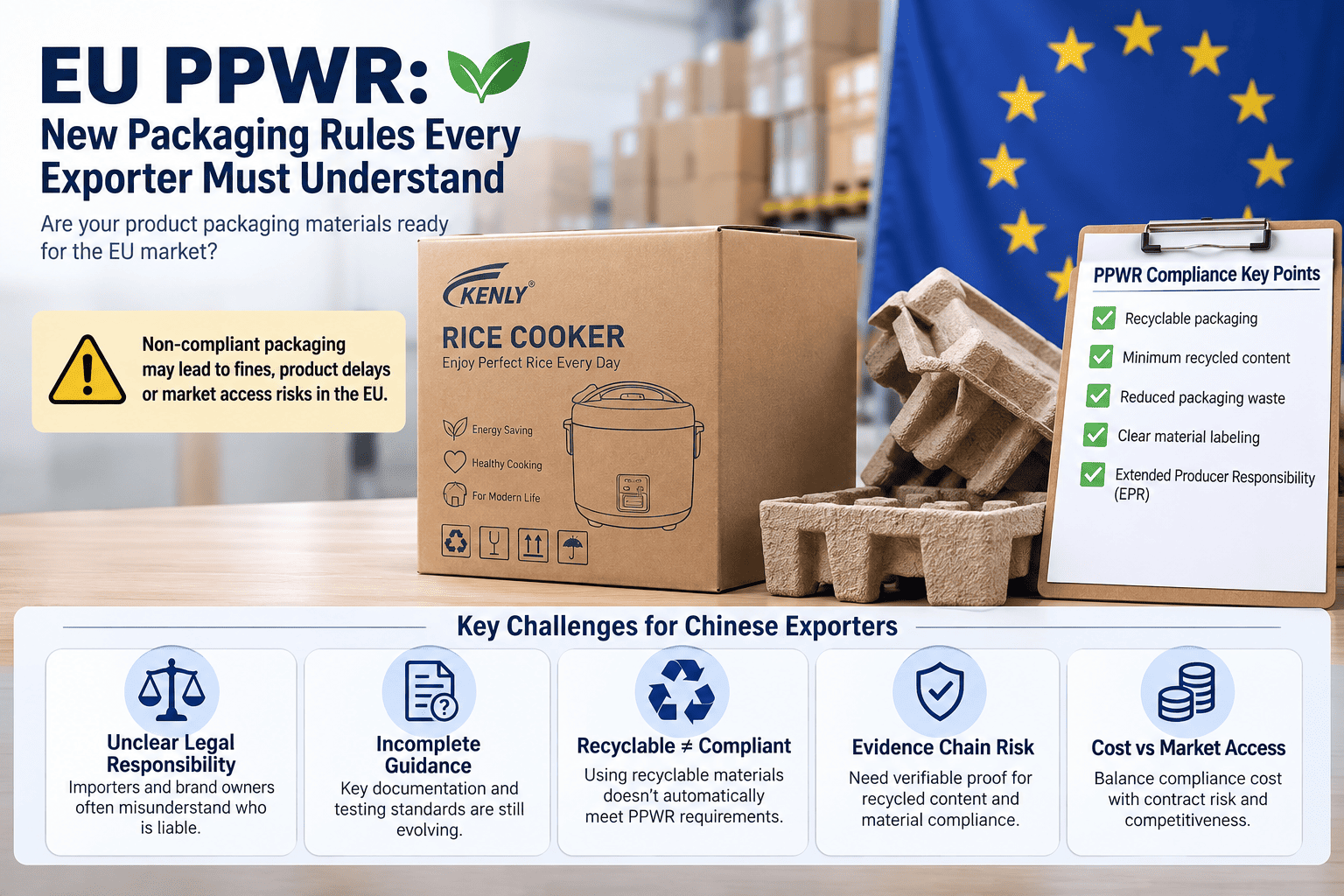
This isn't an abstract regulatory discussion. Last quarter, three customers asked me to confirm PPWR compliance for existing packaging designs. Each assumed different responsible parties, requested different documents, and had no clear verification method when I said our material suppliers couldn't provide the certificates they wanted. We're now working with a certification consultant to rebuild our evidence chain—but the process revealed gaps that most suppliers and buyers don't know exist until they fail a compliance check.
Who Is Legally Responsible for PPWR Compliance?
Customers regularly ask me to "make packaging PPWR compliant"—assuming responsibility stays with either the brand owner or us as the manufacturer.
Importers may be designated as Extended Producer Responsibility (EPR) subjects under PPWR1, making them legally liable for packaging compliance regardless of what their supplier contracts state. This becomes visible during customs clearance or market surveillance inspections when authorities request proof of recyclable content, labeling compliance, and material certificates2—documents the importer assumed the brand owner or supplier would provide.
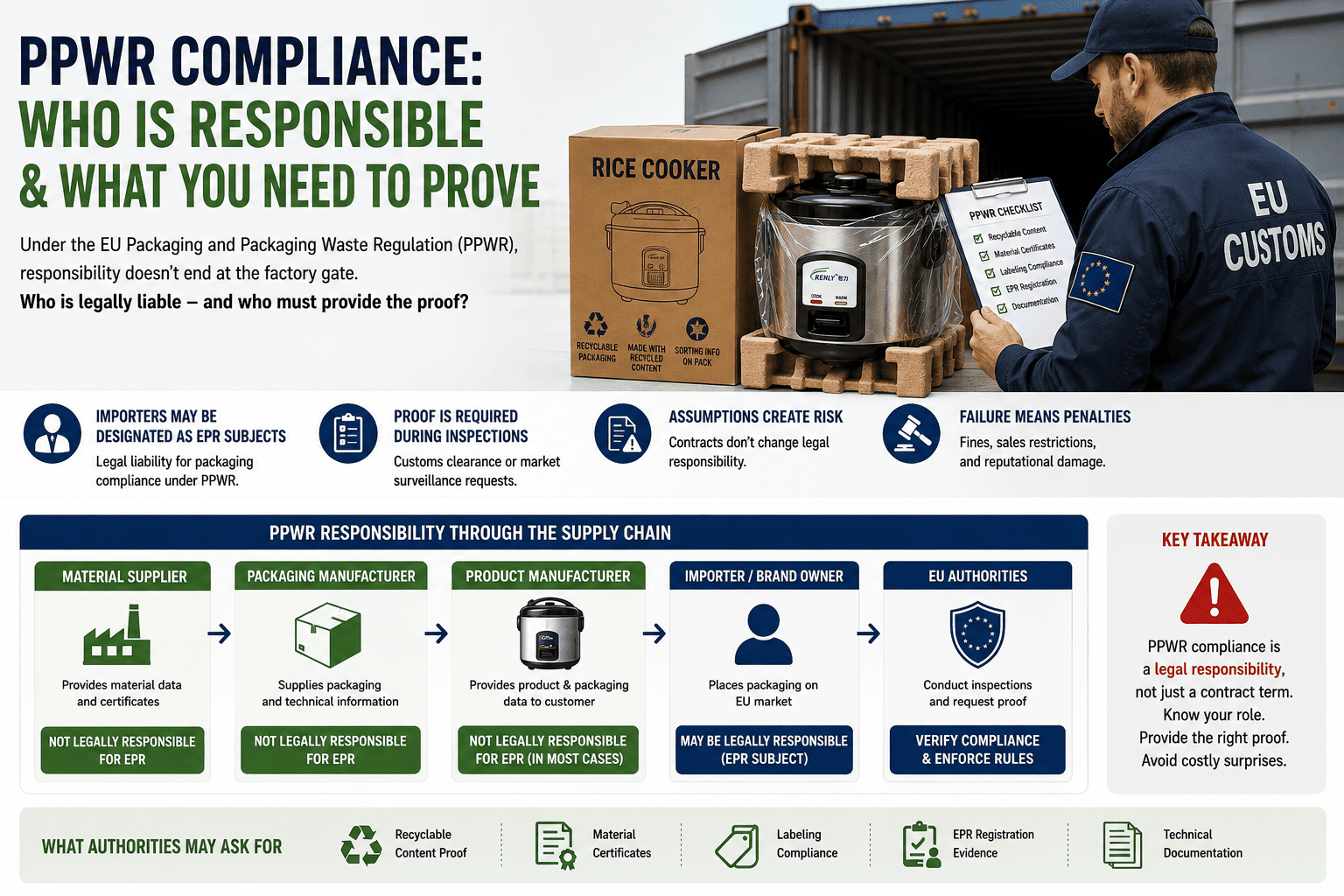
Based on client inquiries we've handled, here's what typically happens:
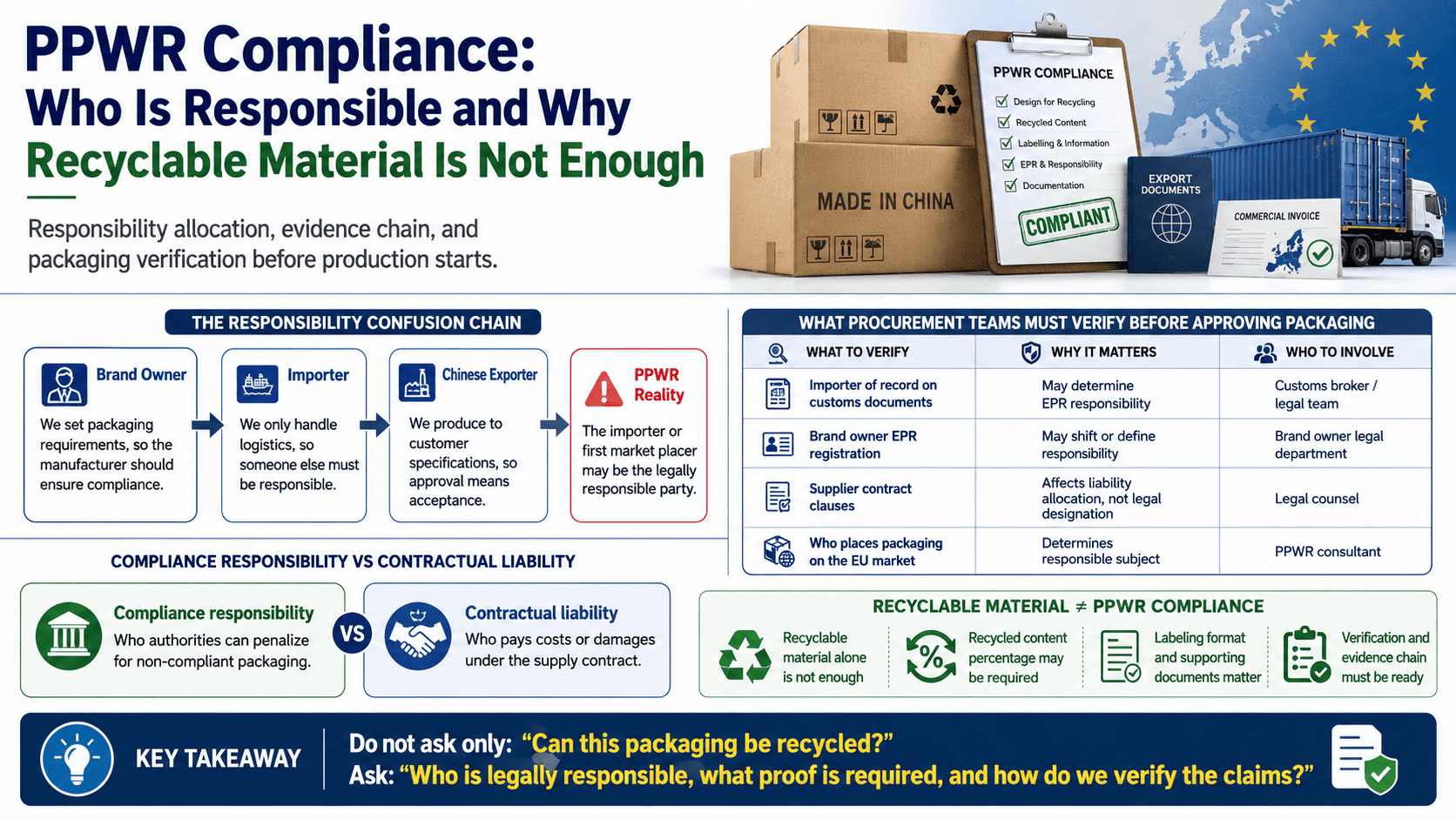
The Responsibility Confusion Chain
Most customers follow this broken logic:
-
Brand owner's perspective: "We specify packaging requirements in our purchase order. The manufacturer must ensure compliance."
-
Importer's perspective: "We're just the logistics entity. The brand owns the product; the factory produces it. Neither contract assigns us compliance responsibility."
-
Chinese exporter's perspective: "We manufacture according to customer specifications. If they approve the design, they accept responsibility."
-
What PPWR may actually designate: The importer bringing packaged goods into the EU market becomes the responsible party if they're the first to place packaging on the EU market.
I've seen purchase orders where the brand owner requires PPWR compliance but the commercial invoice shows the importer as the buyer. When I asked our certification consultant who holds legal responsibility in this scenario, they said: "It depends on how the product is registered, who appears on customs documents, and whether the brand owner has an EPR registration. This requires legal verification in each member state."
What This Means for Your Procurement Process
You need to verify responsibility allocation before you approve packaging, not after production starts:
| Question to Answer | Why It Matters | Who Should Verify |
|---|---|---|
| Who is listed as the importer of record on customs documents? | This party may be designated as the EPR subject3 | Customs broker, legal team |
| Does your brand owner have EPR registration in target markets? | Registration may transfer responsibility from importer to producer | Brand owner's legal department |
| What do supplier contracts state about compliance responsibility? | Contract clauses don't override regulatory designations but affect liability allocation | Legal counsel |
| Which party "places packaging on the EU market" under PPWR definitions? | This legal definition determines the responsible subject | PPWR compliance consultant |
According to customers we've worked with, the most dangerous assumption is believing your supplier contract settles the question. One customer discovered during a market surveillance audit that their importer subsidiary was liable for packaging that the brand owner had approved—because the importer appeared on shipping documents as the first market placer.
Compliance Responsibility vs. Contractual Liability
These are different issues:
Compliance responsibility: Who regulatory authorities can penalize for non-compliant packaging. PPWR may designate this based on market placement, not contract terms.
Contractual liability: Who pays penalties or damages when packaging fails compliance. Your supplier agreement can allocate financial risk, but it can't transfer regulatory responsibility that law assigns to another party.
The gap between these two concepts creates the problem I see most often: customers negotiate supplier indemnification clauses while remaining unaware they're the designated compliance subject.
Does Using Recyclable Material Mean PPWR Compliance?
The second most common question I receive: "We switched to recyclable cardboard for outer boxes. Are we PPWR compliant now?"
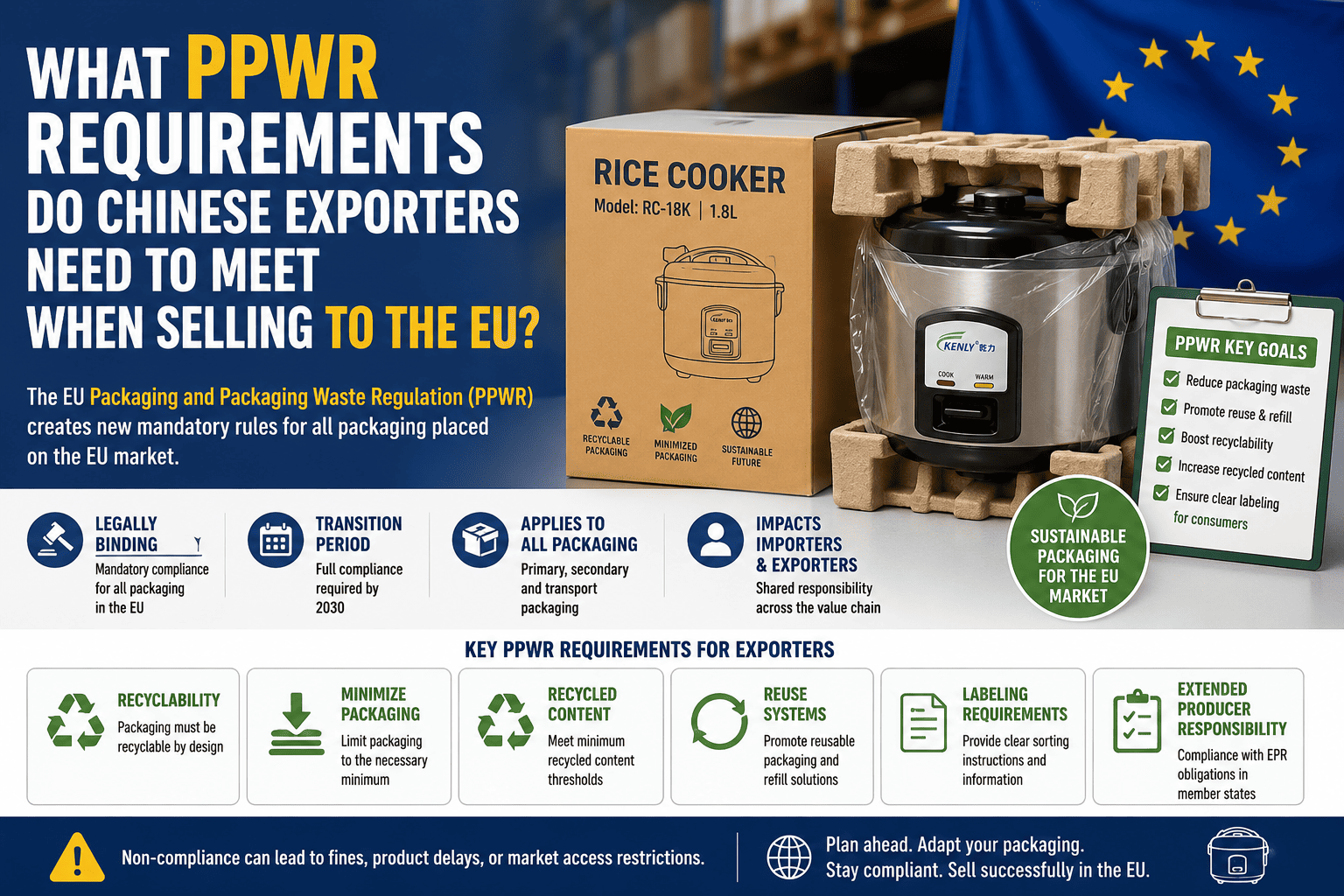
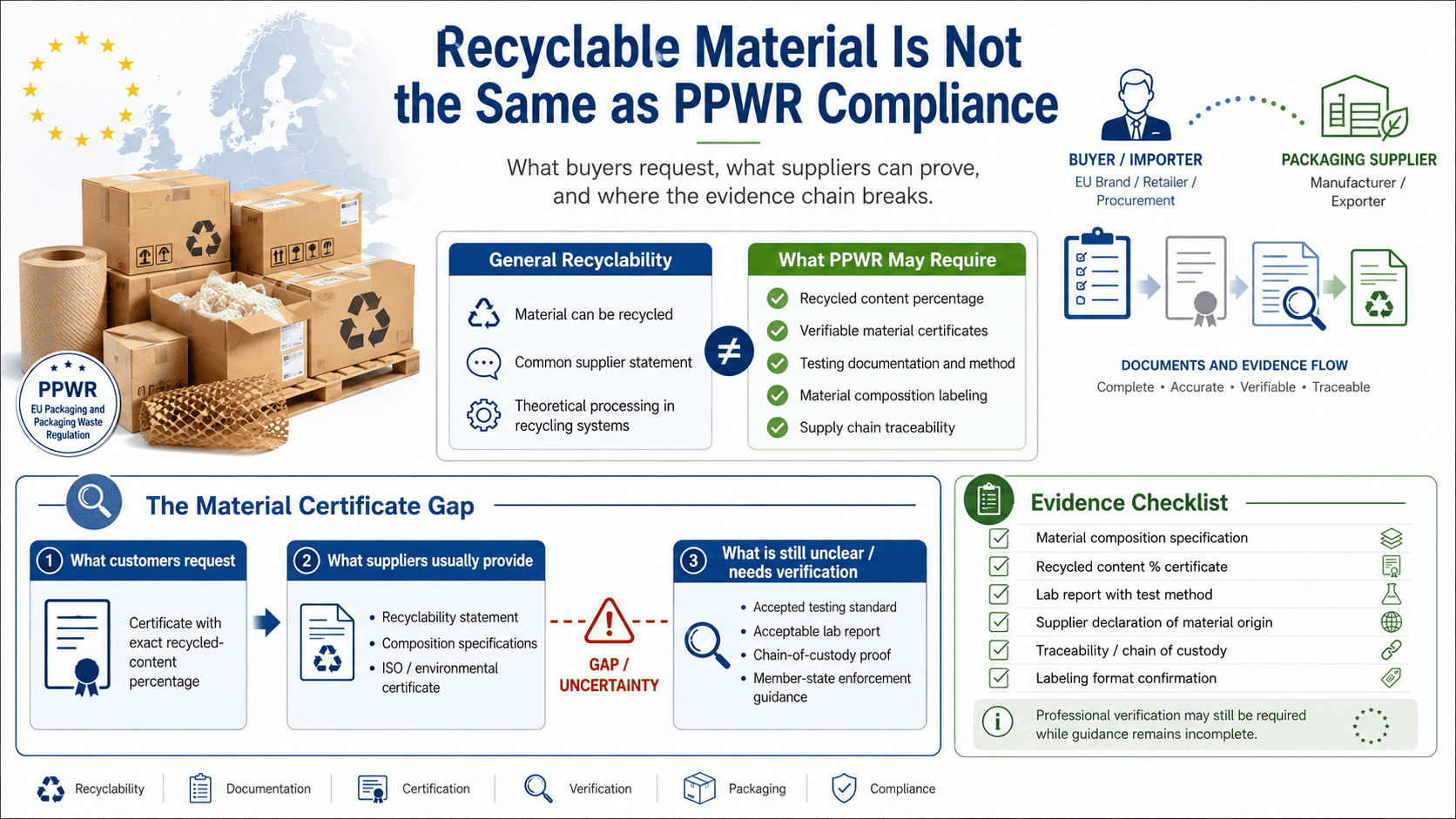
Material recyclability and PPWR compliance are not the same thing. Customers frequently conflate the two, approving packaging materials that meet general recyclability standards but fail PPWR's specific requirements for recyclable content percentages, labeling formats, material origin certificates, and testing documentation. The regulation doesn't just ask "can this be recycled?"—it asks "what percentage is recycled content, how is this verified, and how is it labeled?"
What "Recyclable" Actually Means vs. What PPWR Requires
Based on packaging adjustment projects we've handled:
General recyclability means the material can theoretically be processed through recycling systems. A cardboard box is recyclable if waste management facilities can break it down and reprocess it.
PPWR compliance requires:
- Minimum recyclable content percentages (varying by material and timeline)4
- Verifiable material origin certificates from suppliers
- Specific labeling indicating material composition
- Testing documentation proving content percentages
- Traceability through the supply chain
When a customer asked me to source "PPWR-compliant outer boxes," I contacted three cardboard suppliers. All provided recyclable cardboard. Only one could provide a certificate stating recycled content percentage. None could specify which testing standard they used to verify that percentage. Zero could provide supplier declarations tracing material origins.
The Material Certificate Gap
This is where most evidence chains break:
-
What customers request: "Please provide a recyclable material certificate for packaging."
-
What suppliers can typically provide: Material composition specs, general recyclability statements, sometimes ISO environmental management certificates.
-
What PPWR may actually require: Certificates stating specific recycled content percentages, testing lab reports using [standard to be verified], supplier declarations for upstream materials.
-
What we learned from our certification consultant: The specific certificate format, required testing standard, and acceptable documentation types aren't fully clarified in member state enforcement guidance yet.
I experienced this gap directly three months ago. A customer needed proof that our rice cooker packaging contained 65% recycled cardboard (their interpretation of upcoming PPWR thresholds). I requested certificates from our box supplier. They provided:
- A company statement: "Our cardboard contains recycled fibers."
- An environmental management system certificate
- A quality control report for structural strength
None specified recycled content percentage. None referenced a testing standard. When I asked them to test and certify the percentage, they said: "Which lab should we use? What standard should they follow? Will EU authorities accept Chinese lab results?"
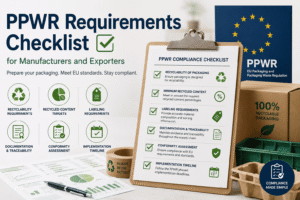
Creating a Material Evidence Checklist
Based on what we've learned while trying to solve this problem, here's what to request from packaging suppliers:
Basic Documentation (most suppliers can provide):
- Material composition specifications
- Recyclability statements for intended markets
- Safety and quality certificates (food contact compliance, etc.)
PPWR-Specific Documentation (requires verification of what's actually accepted):
- Recycled content percentage stated on a certificate
- Testing lab report with methodology and standard reference
- Supplier declarations for virgin vs. recycled material sources
- Chain-of-custody documentation if claiming certified recycled content
What to Mark as "Requires Professional Verification":
- Which testing standards EU authorities accept
- Whether Chinese lab results satisfy requirements or EU lab testing is mandatory
- Specific labeling format requirements for different member states
- Minimum acceptable recycled content percentages for different material types
The uncomfortable truth: I can't currently provide complete answers to the second list. Our certification consultant is working with us to identify accepted testing labs and documentation formats, but official enforcement guidance remains incomplete in many member states.
How Do You Verify Recyclable Content Claims Without Clear Standards?
Customers often ask: "How do we know your 70% recycled content claim is accurate?"
The evidence chain breaks at upstream material suppliers. Chinese exporters struggle to obtain verified recyclable content certificates because suppliers don't know which labs to use, which testing standards apply, or what documentation format satisfies EU requirements. Customers demand test reports but can't specify the acceptable standard—creating a documentation gap where neither buyers nor suppliers know how to close the verification loop until regulatory enforcement provides clearer guidance.
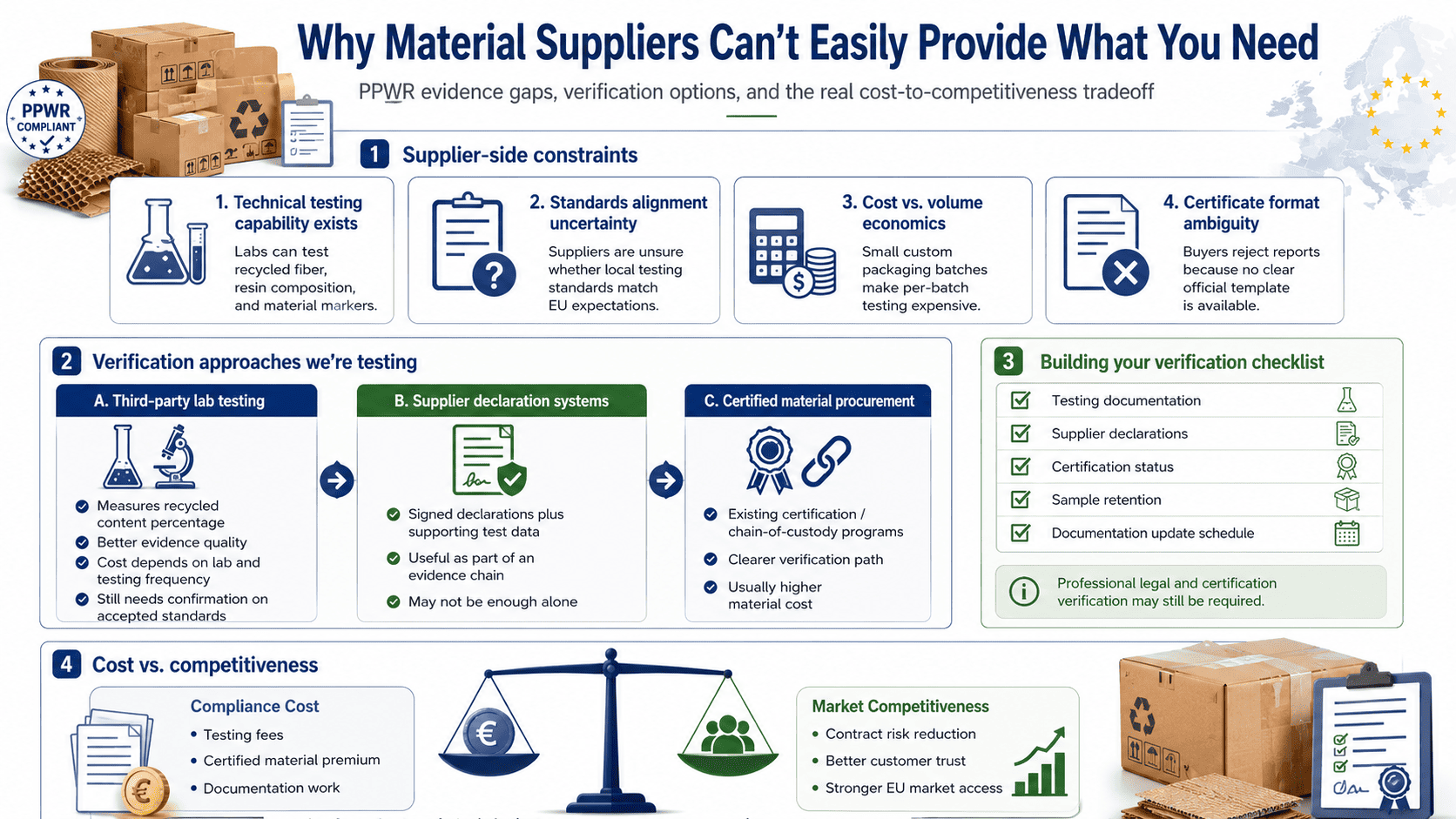
Why Material Suppliers Can't Easily Provide What You Need
Our experience requesting recyclable content certificates revealed these supplier-side constraints:
Technical testing capability exists — Chinese material testing labs can measure recycled fiber content, plastic resin composition, and material origin markers.
Standards alignment uncertainty — Suppliers don't know whether Chinese national standards (like GB/T standards for recycled content testing5) satisfy EU regulatory requirements, or if testing must follow specific European standards.
Cost vs. volume economics — Small-batch packaging materials (like custom rice cooker boxes at 10,000-unit MOQs) make per-batch testing expensive relative to material costs. Suppliers ask: "If we test every batch, do you accept the price increase?"
Certificate format ambiguity — When suppliers provide test reports, customers reject them because format doesn't match expected templates—but neither party has an official template to reference.
I sent our cardboard supplier a customer's certificate request form last month. It asked for: recycled content percentage, testing standard reference, lab accreditation proof, material origin country, and chain-of-custody number. My supplier called me: "We can test percentage using our usual method. We don't have chain-of-custody tracking. What's an acceptable lab accreditation for EU purposes? Can you send us a sample acceptable certificate?"
I couldn't answer those questions. My customer couldn't either. We're now working with a certification consultant to create a supplier requirement template—but this is our internal solution to an industry-wide documentation gap.
Verification Approaches We're Testing
Based on our supply chain adjustment process, here are potential verification methods (marking professional boundaries clearly):
Option 1: Third-Party Lab Testing
How it works: Send material samples to an accredited testing lab that measures recycled content percentage using a specified standard.
What we've learned:
- Chinese CNAS-accredited labs can test recycled content in most packaging materials6
- European labs may provide results that EU authorities accept more readily (requires verification)
- Testing costs approximately USD 200-800 per material type, depending on standard and lab7
- Batch frequency (every production run vs. annual verification) affects total cost significantly
Open questions:
- Which specific testing standards do member state authorities accept?
- Do Chinese lab results satisfy requirements, or is EU lab testing mandatory?
- How often must testing occur—per batch, quarterly, annually?
Option 2: Supplier Declaration Systems
How it works: Material suppliers provide signed declarations stating recycled content percentage, with testing reports attached as supporting evidence.
What we've learned:
- This is common practice in ISO environmental management systems8
- Declarations carry legal liability for suppliers making false claims9
- Some customers accept supplier declarations; others require independent verification
- Declaration templates vary significantly—no standardized format exists
What our certification consultant advised: "Supplier declarations can form part of your evidence chain, but regulatory authorities may not accept them as sole proof. Combine with periodic third-party testing."
Option 3: Certified Material Procurement
How it works: Source packaging materials from suppliers with existing certification (like FSC for paper, or certified recycled plastic programs10).
What we've learned:
- Certification availability varies significantly by material type
- Certified materials typically cost 15-30% more than uncertified alternatives11
- Certification chain-of-custody tracking satisfies many customer requirements
- Not all material types have established certification programs yet
What this means for procurement: If your packaging uses materials with established certification programs, this may be the clearest verification path—but requires evaluating whether cost increases affect your market positioning.
Building Your Verification Checklist
What to request from your Chinese supplier:
| Verification Element | What to Request | What to Clarify |
|---|---|---|
| Testing documentation | Lab report stating recycled content percentage | Which standard the lab used, whether lab accreditation is acceptable |
| Material supplier declarations | Signed supplier statement with supporting test data | Declaration format, legal liability terms |
| Certification status | FSC, recycled plastic certification, or equivalent | Chain-of-custody requirements, cost implications |
| Sample retention | Material samples matching tested batches | Sample storage duration, provision for re-testing |
| Documentation updates | Testing frequency, certificate renewal schedule | How often verification must occur |
The uncomfortable reality: I can provide the first column based on our procurement experience. The "what to clarify" column requires professional legal and certification consultation—because official enforcement guidance doesn't yet provide definitive answers for many of these questions.
What Are the Real Cost Implications of PPWR Compliance?
The question customers actually want answered: "Will PPWR compliance make us uncompetitive?"
Cost vs. competitiveness is the real decision point. Customers ask "can we still use existing packaging stock?" and "will price increases lose market share?"—not because they want to avoid compliance, but because they need to evaluate compliance costs against contract risk and competitor positioning. The decision isn't just technical feasibility; it's business strategy under regulatory uncertainty.
Cost Components Our Customers Are Facing
Based on packaging adjustment projects we've quoted:
Material Cost Increases
Switching from standard materials to verified recycled-content materials:
Cardboard outer boxes (for rice cooker packaging):
- Standard recyclable cardboard: baseline price
- 70% recycled content cardboard with supplier declaration: +12% cost
- Certified recycled cardboard with FSC chain-of-custody: +28% cost
- Same material with EU lab testing per batch: +35% cost (testing allocated across batch volume)
Plastic components (inner packaging, protective foam):
- Standard recyclable plastic: baseline price
- 50% recycled content plastic with Chinese lab testing: +20% cost
- Certified recycled plastic meeting EU standards: +40% cost
- Bio-based alternative materials: +60-120% cost (highly variable by material type)
These percentages come from real supplier quotes we received when adjusting our packaging supply chain. Your material costs will vary based on order volumes, supplier relationships, and specific material requirements.
Testing and Certification Costs
Verification creates ongoing expenses:
- One-time material testing: USD 200-800 per material type (cardboard, plastic insert, foam padding, etc.)
- Batch testing frequency: If required quarterly, annual testing costs for a typical rice cooker product with 4 material types: USD 3,200-12,800
- Certification program participation: FSC chain-of-custody for packaging suppliers: USD 1,000-5,000 annually depending on supplier size
- Consultant fees: PPWR compliance review and supplier audit: USD 3,000-8,000 per project
These numbers reflect our procurement experience. Your costs depend on material complexity, testing frequency requirements, and whether you need ongoing professional consultation.
Hidden Operational Costs
Changes customers often don't anticipate:
Supplier switching costs: If current packaging suppliers can't provide required certificates, changing suppliers involves:
- New supplier qualification and samples (2-3 months timeline)
- Mold or tooling adjustments if packaging dimensions change (USD 800-3,000 per tool)
- Inventory write-off for existing packaging stock (depends on volume)
Documentation management: Maintaining compliance evidence requires:
- Staff time to collect and verify supplier certificates
- Systems to track testing schedules and certificate expiration
- Audit trails linking material batches to test reports
Customer communication: If you pass costs to customers, you'll invest time:
- Explaining why prices increased
- Providing documentation proving compliance necessity
- Comparing your compliance costs to competitors who may not be complying fully
One customer told me last month: "We calculated material costs and testing fees. Then we realized we need a staff member spending 20% of their time managing compliance documentation. That labor cost exceeded our testing budget."
The "Use Existing Stock" Question
Every customer asks this. Here's what we've learned:
Can you use packaging materials purchased before PPWR takes effect?
According to our certification consultant: "PPWR implementation timelines vary by requirement type12. Some provisions apply to packaging placed on market after specific dates; some allow transition periods; enforcement timelines differ across member states. This requires legal verification for your specific situation."
What this means practically:
- Low-risk approach: Assume you can't use non-compliant stock after PPWR applicability dates. Calculate inventory
"Packaging waste - Environment - European Commission", https://environment.ec.europa.eu/topics/waste-and-recycling/packaging-waste_en. The EU Packaging and Packaging Waste Regulation establishes Extended Producer Responsibility obligations for economic operators who place packaged goods on the EU market, which may include importers depending on their role in the supply chain and market placement. Evidence role: general_support; source type: government. Supports: The designation of importers as potential EPR subjects under PPWR and their associated legal liability. Scope note: Specific designation criteria vary by member state implementation and require case-by-case legal analysis ↩
"Market surveillance - Internal Market, Industry, Entrepreneurship and SMEs", https://single-market-economy.ec.europa.eu/single-market/goods/building-blocks/market-surveillance_en. EU market surveillance frameworks authorize national authorities to verify regulatory compliance through documentation reviews and inspections, including requests for material certificates and labeling verification for products placed on the EU market. Evidence role: mechanism; source type: government. Supports: The role of market surveillance authorities in verifying packaging compliance through documentation requests. Scope note: Specific inspection procedures and documentation requirements vary by member state enforcement practices ↩
"Extended Producer Responsibility: Basic Facts and Key Principles", https://www.oecd.org/content/dam/oecd/en/publications/reports/2024/04/extended-producer-responsibility_4274765d/67587b0b-en.pdf. EPR designation under EU product regulations typically considers which economic operator first places products on the EU market, with customs documentation serving as one evidentiary factor in determining this status. Evidence role: mechanism; source type: government. Supports: The connection between customs documentation and EPR subject designation under EU packaging regulations. Scope note: Actual designation depends on multiple factors including business structure, contractual arrangements, and member state interpretation ↩
"Packaging and Packaging Waste Regulation (PPWR)", https://www.labelmaterials.upm.com/sustainable-packaging/ppwr/. The PPWR establishes mandatory minimum recycled content levels for specific packaging materials with phased implementation timelines, though exact thresholds depend on final regulatory text and member state transposition. Evidence role: statistic; source type: government. Supports: The existence of minimum recycled content percentage requirements under PPWR varying by material and timeline. ↩
"Report Name:China Notifies National Standard Restricting Excessive ...", https://apps.fas.usda.gov/newgainapi/api/Report/DownloadReportByFileName?fileName=China%20Notifies%20National%20Standard%20Restricting%20Excessive%20Packaging%20for%20Edible%20Agricultural%20Products_Beijing_China%20-%20People%27s%20Republic%20of_CH2023-0024. China's national standardization system (GB/T) includes recommended standards for testing material composition and recycled content in various materials, though specific standard numbers and methodologies require verification for particular applications. Evidence role: general_support; source type: government. Supports: The existence of Chinese national standards addressing recycled content testing. Scope note: Acceptance of GB/T standards for EU regulatory compliance requires verification of equivalence or mutual recognition ↩
"List of CPSC-Accepted Testing Laboratories | CPSC.gov", https://www.cpsc.gov/cgi-bin/labsearch/ViewDetail.aspx?ReqId=VvOKqmsMe6czUqpa6fYwCA%3D%3D&LabId=5BueQnYD59jHGno%2BdBiJug%3D%3D. The China National Accreditation Service (CNAS) accredits testing laboratories according to ISO/IEC 17025 standards, with many facilities capable of material composition analysis including recycled content determination. Evidence role: general_support; source type: institution. Supports: The capability of CNAS-accredited laboratories to perform material composition testing. Scope note: Acceptance of CNAS test results for EU regulatory purposes requires verification of mutual recognition agreements and specific standard compliance ↩
"Plastics recycled content requirements", https://www.oecd.org/content/dam/oecd/en/publications/reports/2024/05/plastics-recycled-content-requirements_c6de64b7/b311ee60-en.pdf. Material composition testing by accredited laboratories generally ranges from several hundred to over one thousand USD per sample depending on test complexity, accreditation requirements, and analytical methods required. Evidence role: general_support; source type: other. Supports: Typical cost ranges for laboratory testing of recycled content in packaging materials. Scope note: Actual costs vary significantly based on testing standard, laboratory location, sample complexity, and volume agreements ↩
"Frequent Questions About Environmental Management ...", https://www.epa.gov/ems/frequent-questions-about-environmental-management-systems. ISO 14001 environmental management systems include provisions for evaluating and documenting environmental aspects of supply chains, with supplier declarations serving as one mechanism for verifying environmental claims about materials and processes. Evidence role: general_support; source type: institution. Supports: The role of supplier declarations in ISO environmental management practices. Scope note: ISO standards establish frameworks but do not mandate specific documentation formats or regulatory acceptance ↩
"A Primer The False Claims Act (FCA), 31 U.S.C. §§ 3729", https://www.justice.gov/d9/civil/legacy/2011/04/22/C-FRAUDS_FCA_Primer.pdf. Commercial law frameworks generally establish liability for suppliers who provide false material declarations, with potential consequences including contract breach, fraud claims, and regulatory penalties depending on jurisdiction and circumstances. Evidence role: general_support; source type: other. Supports: The legal liability associated with false supplier declarations. Scope note: Enforcement depends on applicable law, contract terms, evidentiary standards, and practical detectability of misrepresentation ↩
"Division of Sustainable Waste Management | Recycled Content", https://dep.nj.gov/dshw/swpl/recycled-content/. The Forest Stewardship Council (FSC) operates chain-of-custody certification for paper and wood-based materials, while various industry programs certify recycled plastic content through verified tracking systems. Evidence role: general_support; source type: institution. Supports: The existence of third-party certification programs for recycled and sustainable packaging materials. ↩
"Plastics recycled content requirements", https://www.oecd.org/content/dam/oecd/en/publications/reports/2024/05/plastics-recycled-content-requirements_c6de64b7/b311ee60-en.pdf. Industry analyses indicate that certified sustainable packaging materials command price premiums over conventional alternatives due to certification costs, supply chain verification, and typically higher raw material costs for verified recycled content. Evidence role: general_support; source type: research. Supports: The cost premium associated with certified sustainable packaging materials. Scope note: Actual premiums vary widely based on material type, certification scheme, market conditions, and order volumes ↩
"Packaging waste - Environment - European Commission", https://environment.ec.europa.eu/topics/waste-and-recycling/packaging-waste_en. The EU Packaging and Packaging Waste Regulation establishes staggered implementation timelines with different provisions becoming applicable at different dates to allow industry adaptation to new requirements. Evidence role: general_support; source type: government. Supports: The phased implementation approach of PPWR requirements. Scope note: Specific timelines depend on final regulatory text, member state transposition, and particular requirement categories ↩