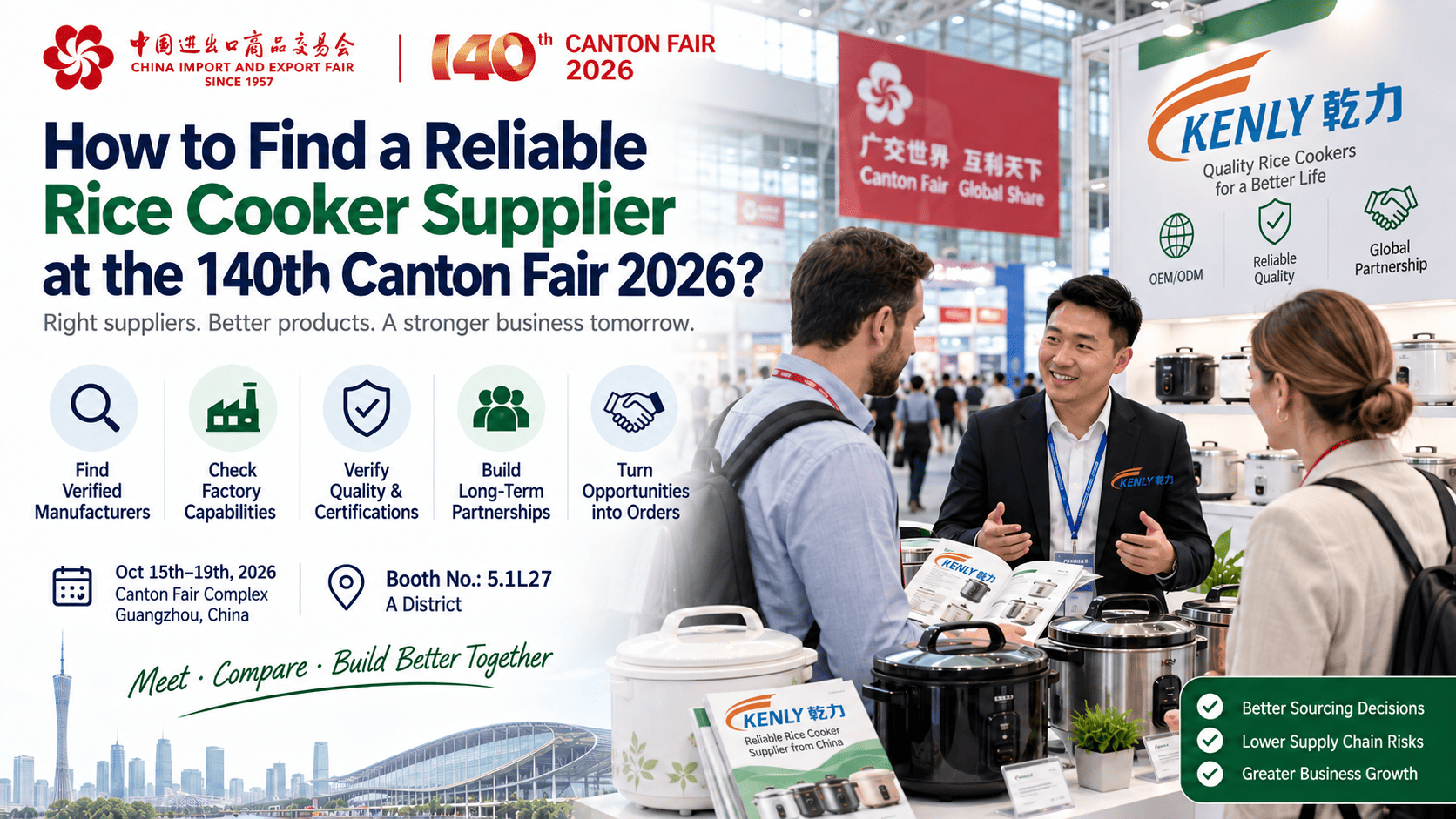
Walking through hundreds of rice cooker booths at Canton Fair can feel overwhelming. Many buyers leave the fair with business cards, product catalogs, and promises of customization—only to discover months later that their chosen supplier can't deliver on time, changes materials without notice, or worse, isn't even a factory. At Kenly, we've staffed our Canton Fair booth for over 15 years, and we've watched buyers make the same critical mistakes during those three rushed days on the exhibition floor.
The Canton Fair isn't where you find your final supplier—it's where you quickly identify which exhibitors are worth verifying after the fair. Reliability can't be judged from booth size or sales promises alone. Your real task during the fair is to eliminate trading companies, over-promisers, and unverifiable exhibitors, then schedule factory audits for the 5-10 candidates who pass your on-site screening tests.
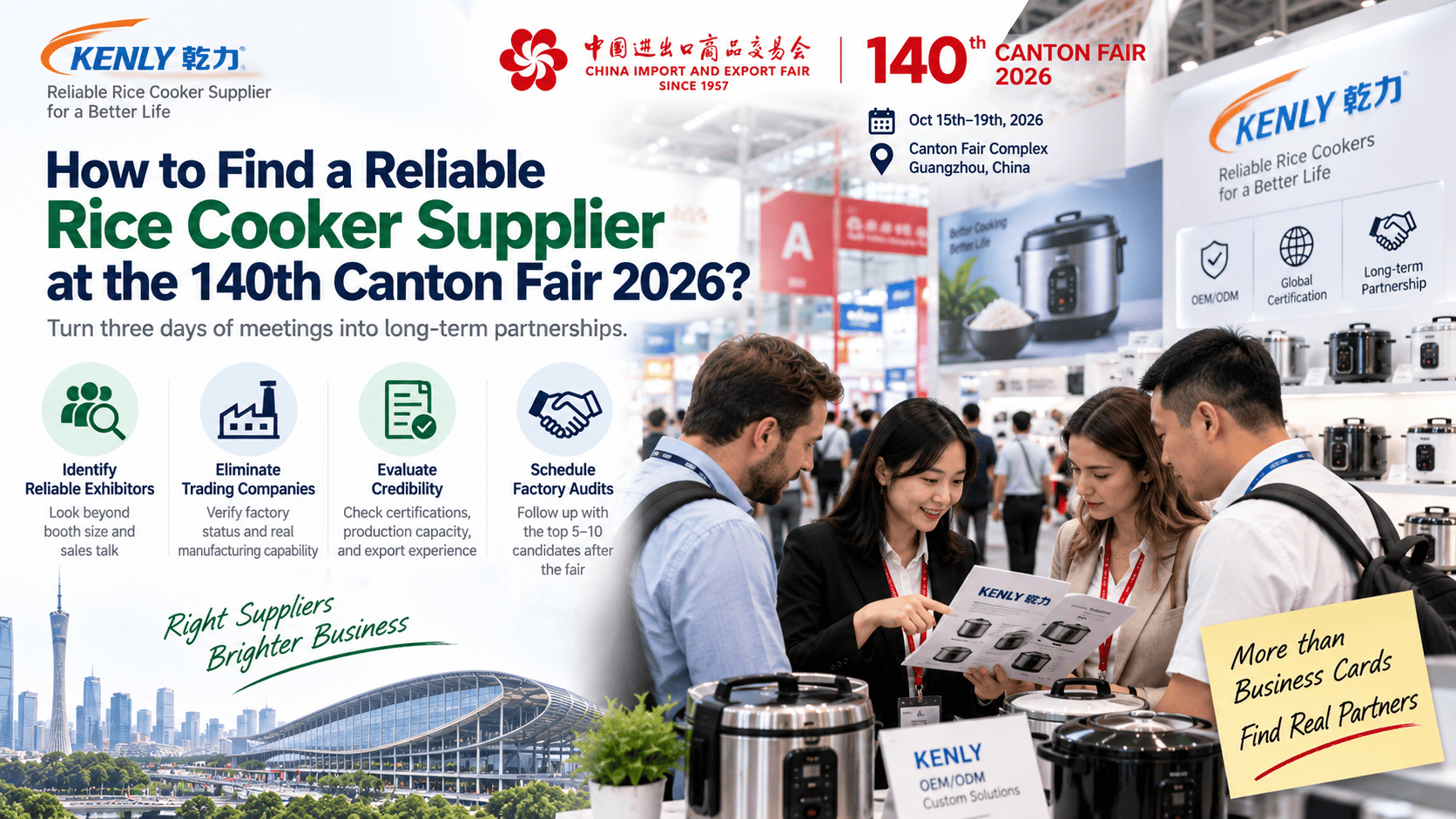
This article walks you through the systematic screening process we recommend to buyers who visit our booth. I'll show you the specific questions that expose whether an exhibitor actually controls production lines, the documentation that separates factories from middlemen, and the post-fair verification steps that prevent costly supplier mistakes.
What Documents Should You Request at a Rice Cooker Booth?
When buyers approach our booth, they often focus on product samples and price lists. That's natural—but it's backwards. Before you discuss customization options or MOQs, you need to establish whether the exhibitor can legally manufacture and export rice cookers.
Ask for business license photos, original certification documents (CE, CB, GS)1, and factory production line photos or videos. Legitimate manufacturers will have these materials readily available at their booth—often displayed on iPads or in organized folders. Trading companies typically can't show you original certificates or factory floor documentation.
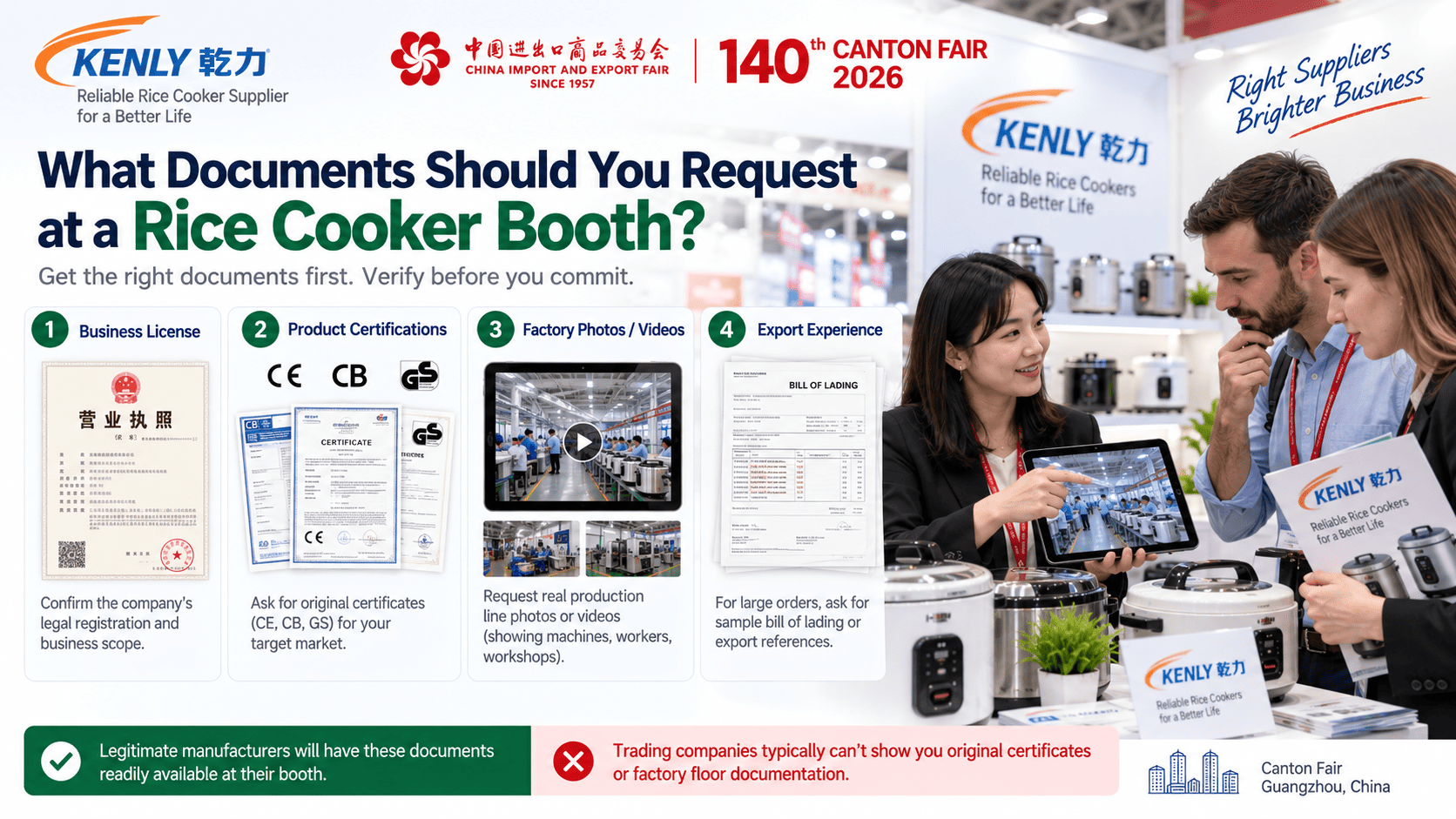
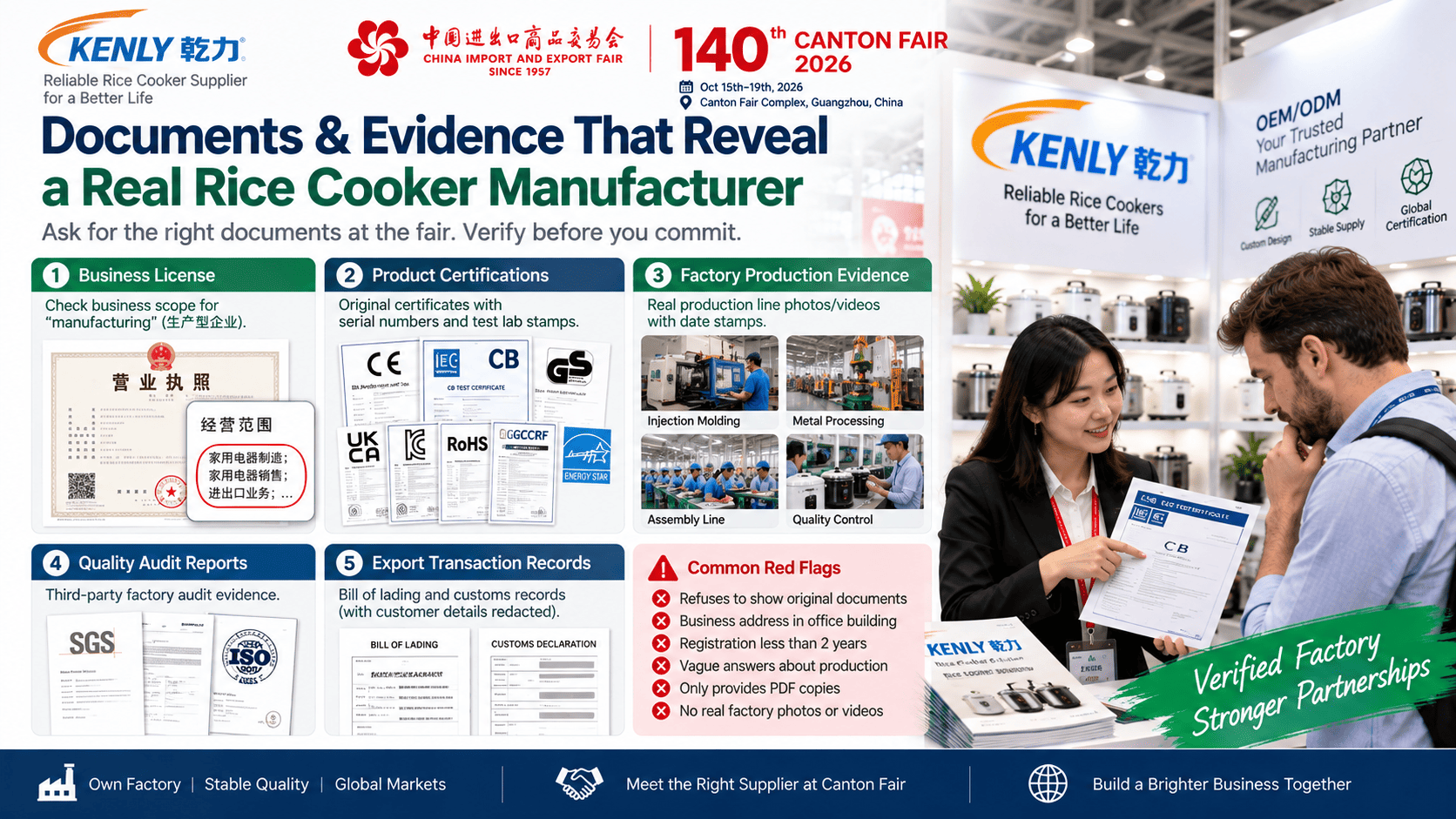
During the fair, we keep our original CE, CB, GS, UKCA, KC, RoHS, RGCCRF, and Energy Star certificates in clear folders at our booth, alongside timestamped photos from our two production lines. Here's what each document type actually tells you:
Business License and Registration Documents
The Chinese business license (营业执照) shows whether the company is registered as a manufacturer (生产型企业) or trading company (贸易型企业).2 The business scope section lists authorized activities—look for "manufacturing" or "production" rather than just "sales" or "import-export."3 Many trading companies register generic business scopes that sound manufacturing-adjacent.
Red flags: Reluctance to photograph the license, business addresses in office buildings rather than industrial zones, registration dates less than 2 years old (startups may lack stable processes).
Original Product Certifications
Original certificates have unique serial numbers, test lab stamps, and factory audit records.4 We commonly see buyers accept printed PDFs or photocopies, which could belong to a different factory's product. At our booth, I can show you the CB test report with our Lianjiang factory address, the inspector signatures, and the specific rice cooker models tested.
Verification questions to ask:
- Can I photograph the certificate serial number to verify with the issuing lab?
- Does the certificate list your factory address or a third-party address?
- Which specific rice cooker models are covered under this certification?
- When does the certificate expire, and what's your recertification process?
If the exhibitor hesitates or claims "we'll send everything after the fair," that's a clear warning sign.
Factory Production Documentation
Trading companies can rent conference rooms and set up impressive booths, but they can't fabricate legitimate factory floor evidence. When buyers ask to see our production setup, I pull up recent videos showing our plastic injection machines, sheet metal cutting equipment, and assembly lines—with visible date stamps and our QC staff in frame.
| Document Type | What It Proves | Red Flags |
|---|---|---|
| Production line photos/videos | Active manufacturing capability | Stock photos, no date stamps, suspiciously clean environments |
| Quality inspection reports | Systematic quality control | Generic templates, no specific product serial numbers |
| Supplier audit reports | Third-party verification | Only ISO certificates without factory audit evidence |
| Mold design files | ODM customization capability | Reluctance to show CAD files or tooling photos |
Export Transaction Records
For buyers planning container-level orders, ask about export documentation. Established manufacturers can show you bill of lading examples (with customer names redacted), customs declaration records, and shipping company relationships. We maintain documentation from our shipments to Thailand, Vietnam, and Middle East markets—though we keep specific customer details confidential.
How Can You Tell If the Exhibitor Is Actually a Factory?
This is the question we get asked most directly at our booth—and it's the right question to ask. The Canton Fair attracts both manufacturers and trading companies5, and distinguishing between them requires specific testing questions that sales representatives can't rehearse.
Trading companies typically hesitate or provide vague answers when you ask about production line decision-making authority, mold tooling timelines, engineering change procedures, and quality control staffing. Manufacturers can answer these questions immediately with specific numbers and names.
At Kenly, I've trained our booth staff to welcome these verification questions. When buyers ask detailed manufacturing questions, it shows they understand that supplier reliability depends on production control, not sales promises.
Questions That Expose Production Control
Ask these specific questions and watch how the exhibitor responds—both the content of their answer and their response speed:
Mold and Tooling Questions:
- If I want to modify this outer shell design, who approves the mold change?
- How many mold cavities do you run for this rice cooker model?
- What's your typical lead time from mold design to first article inspection?
- Can you show me photos of your mold storage area?
When buyers ask us about mold modifications, I can name our mold supervisor, show photos of our injection machine setup, and explain that our 2-cavity molds typically need 35-45 days from design approval to qualified samples. Trading companies often respond with "we can check with the factory" or provide unrealistic timelines like "7-10 days."
Quality Control Verification:
- How many QC inspectors work on each production line?
- What's your standard AQL sampling plan for incoming materials?
- Can you walk me through your high voltage testing procedure6?
- Who signs off on failed inspection batches?
Our QC supervisors each have 6+ years of experience, and we perform 100% high voltage testing, watt testing, and groundwire testing on every unit. We also conduct random finished product testing with a 99% pass rate. I can introduce buyers to our QC manager during factory visits—trading companies can't make that offer because they don't employ QC staff.
Supply Chain and Production Questions:
- Who are your steel sheet suppliers for the outer housing?
- How do you handle electronic component shortages mid-production?
- What's your capacity per production line per shift?
- How many days of raw material inventory do you typically hold?
These questions reveal production decision-making depth. At Kenly, we maintain direct relationships with material suppliers and hold strategic inventory to stabilize production schedules. When component shortages occur, our production manager makes substitution decisions based on safety testing margins—not sales staff checking with unknown "partner factories."
Behavioral Testing During Booth Conversations
Beyond direct questions, observe how the exhibitor handles unexpected scenarios:
Request modifications: Ask to change a specific feature (like heating power or inner pot capacity). Manufacturers will immediately discuss mold costs, MOQ implications, and certification requirements. Trading companies often say "sure, no problem" without addressing technical or economic constraints.
Technical boundary testing: Ask about performance specifications that seem ambitious (like "can this 400W model cook 8 cups in 15 minutes?"). Manufacturers will explain physical limitations. Sales-focused trading companies might promise anything to close the deal.
Decision authority probing: When discussing payment terms or delivery schedules, ask "who needs to approve this?" Manufacturers can name specific managers or department heads. Trading companies usually give vague answers like "our boss" or "headquarters."
What Questions Reveal Real Customization Capability?
At our booth, we frequently hear buyers say "we need OEM customization" without specifying what they actually mean. True ODM capability—the ability to modify heating systems, control boards, or structural designs—requires engineering resources and tooling infrastructure that many exhibitors claim but few actually possess.
Customization capability is proven by specific answers about mold investment limits, engineering change documentation systems, certification re-testing requirements, and minimum order quantities tied to tooling amortization. If an exhibitor promises "any customization, no problem," they likely don't understand—or don't care about—the actual constraints.
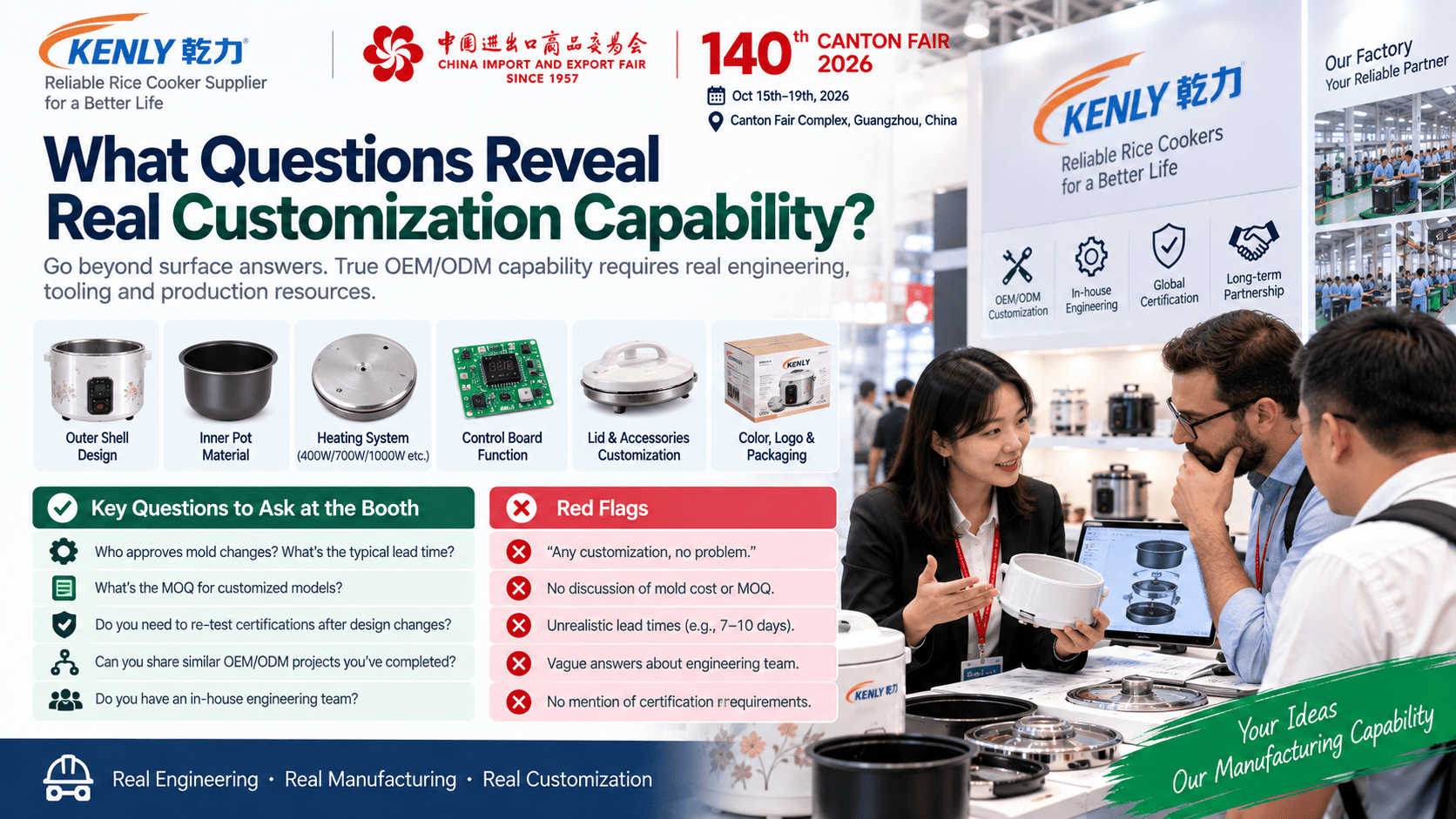
Let me break down what different levels of customization actually require, based on what we handle at our Lianjiang factory:
Cosmetic vs. Structural Customization
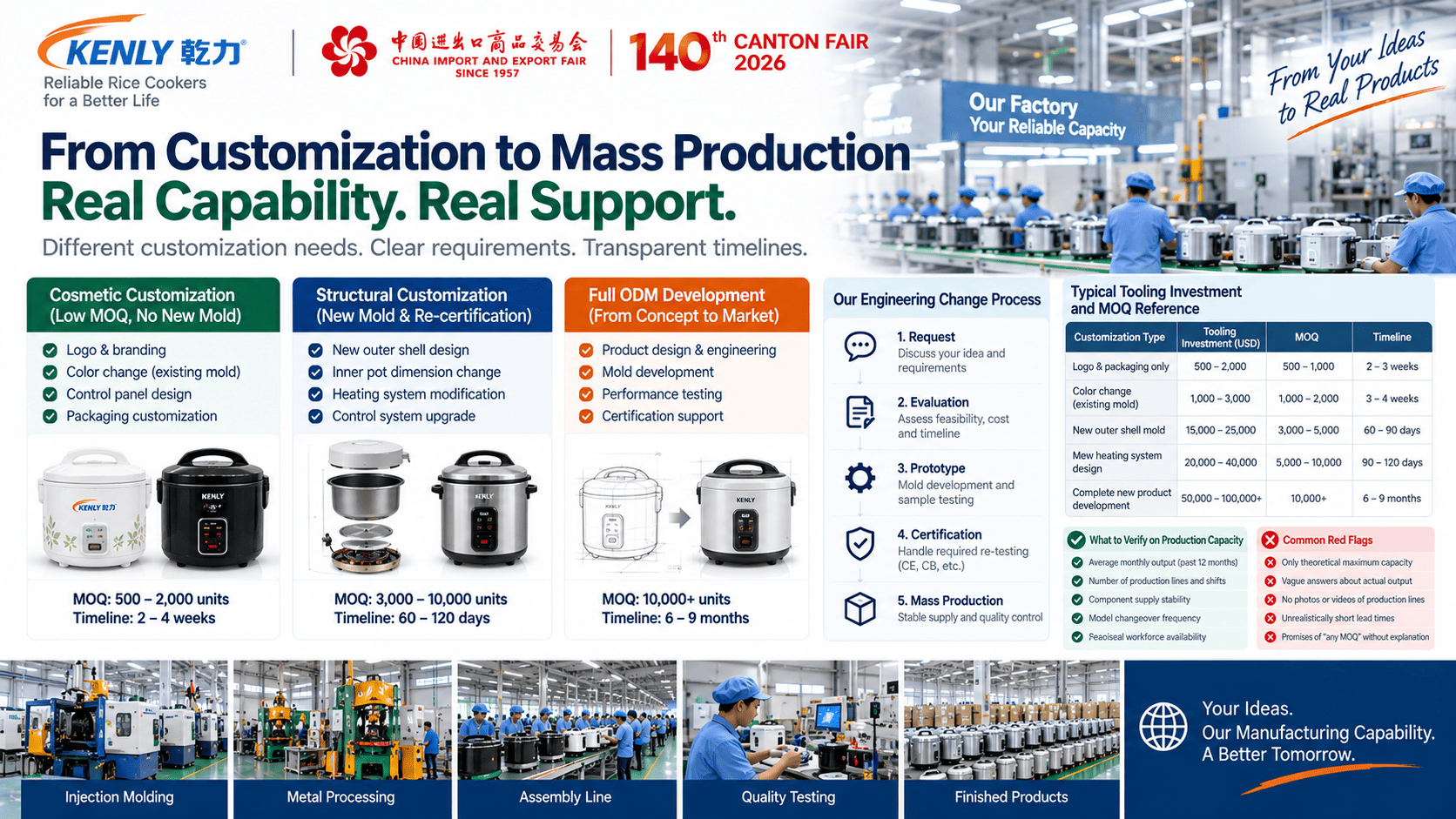
Surface-level changes include logo placement, color adjustments, control panel labeling, and packaging design. These modifications don't require new molds or safety recertification. At Kenly, we handle these through sticker application, silk screening, or label printing—with MOQs as low as 500-1,000 units for basic logo customization.
Structural modifications involve changing outer shell shapes, inner pot dimensions, heating element configurations, or control system functions. These changes require:
- New injection molds (USD 8,000-25,000 depending on complexity)
- First article inspection and validation runs
- Safety recertification for major changes7 (CE, CB testing costs USD 3,000-8,000)
- MOQs of 3,000-5,000 units minimum to amortize tooling costs
Ask the exhibitor: "If I want to change the outer shell from cylindrical to rectangular, what's the mold investment and MOQ?" Manufacturers will give you specific cost ranges and timeline estimates. Trading companies often deflect with "we'll check the factory" or provide unrealistically low figures.
Engineering Change Process Documentation
Legitimate OEM/ODM manufacturers have formal engineering change order (ECO) systems. When buyers request modifications, we document the change request, evaluate tooling and certification impacts, estimate costs, and provide approval timelines—typically 2-3 weeks for evaluation, then 30-60 days for implementation depending on complexity.
Questions to ask:
- What's your ECO approval process from request to prototype?
- Who signs off on design changes that affect safety testing?
- Can you show me an example of an ECO document from a previous customer project?
- How do you handle mid-production design changes if we discover an issue?
We keep sanitized ECO examples at our booth showing the documentation flow for a control panel modification we did for a Middle East customer (with their identity removed). Trading companies rarely have this level of process documentation.
Certification Re-Testing Requirements
Many buyers don't realize that significant customizations trigger recertification requirements. If you modify heating power, inner pot material, or control system logic, your CE or CB certificates may no longer be valid for the modified product.
At Kenly, I've seen buyers frustrated when they realize a "simple" control panel change requires USD 5,000 in re-testing costs and 8 weeks of lab time. We discuss certification implications upfront during the fair, before buyers commit to customization projects.
Red flag statements from exhibitors:
- "Certification isn't a problem, we'll share our existing certificates"
- "These small changes don't require retesting"
- "We have connections at testing labs, we can speed it up"
Sharing certificates for modified products is fraudulent. Claiming modifications don't require retesting shows ignorance of safety regulations. Promising "connections" at certification labs suggests ethical problems.
Minimum Order Quantities and Economics
Customization MOQs aren't arbitrary—they're driven by tooling amortization, material purchasing minimums, and production line changeover costs8. When exhibitors quote MOQs, ask them to break down the calculation:
| Customization Type | Typical Tooling Investment | MOQ to Amortize | Timeline |
|---|---|---|---|
| Logo and packaging only | USD 500-2,000 | 500-1,000 units | 2-3 weeks |
| Color change (existing mold) | USD 1,000-3,000 | 1,000-2,000 units | 3-4 weeks |
| New outer shell mold | USD 15,000-25,000 | 3,000-5,000 units | 60-90 days |
| New heating system design | USD 20,000-40,000 | 5,000-10,000 units | 90-120 days |
| Complete new product development | USD 50,000-100,000+ | 10,000+ units | 6-9 months |
If an exhibitor promises "100-unit MOQ for full customization," they're either quoting sample fees only, not production runs—or they're not actually a manufacturer.
How Should You Evaluate Production Capacity Claims?
Booth conversations often include impressive production capacity figures: "we produce 100,000 units monthly" or "we have 5 production lines." At Kenly, I've learned that buyers rarely probe these claims, then face capacity shortages during peak season months later.
Production capacity isn't just about line count—it depends on shift operations, model changeover frequency, component supply stability, and seasonal workforce availability.9 Ask for average monthly output over the past 12 months, not theoretical maximum capacity.
We operate 2 production lines at our Lianjiang factory, and buyers often ask how we can serve international customers with that capacity. The honest answer: we focus on stable, consistent production for existing customers rather than chasing maximum line count. Our lines run 2 shifts during normal seasons and 3 shifts during peak months, producing approximately 15,000-20,000 units monthly depending on model mix.
Capacity Verification Questions
Instead of accepting headline capacity numbers, dig into the operational details:
Production scheduling questions:
- What's your typical production schedule—1 shift, 2 shifts, or 3 shifts?
- How many days does it take to switch production from one rice cooker model to another?
- What percentage of your capacity is currently committed to existing customers?
- How many units of my specific model can you produce per month while maintaining quality?
The last question is critical. A factory might have 100,000 units monthly capacity across all models, but only 5,000-10,000 units monthly for your specific configuration. Model changeovers require mold changes, line recalibration, and first-article inspections—each taking 4-6 hours of downtime.
Peak season and workforce questions:
- How do you handle Chinese New Year production gaps10?
- What's your workforce size during normal vs. peak seasons?
- Do you hire temporary workers during busy periods, and how do you train them?
- Can you show me production output data from last year's peak season (Oct-Dec)?
At Kenly, we maintain core technical workers year-round and hire additional assembly staff during peak months. Our QC supervisors train temporary workers on inspection procedures, and we increase quality sampling rates when using new workforce members. This approach maintains consistent quality during scaling—but it also means our peak capacity is limited by our core workforce's supervision capacity, not just line count.
Supply Chain Constraints on Capacity
Production lines are useless without component supply. We've seen buyers focus entirely on assembly capacity while ignoring supply chain risks, then face delays when component shortages hit.
Questions to ask:
- Who supplies critical components like heating elements, control boards, and thermal fuses?
- How much component inventory do you typically hold?
- What happened to your production during recent global chip shortages?
- Do you have backup suppliers for critical components?
At Kenly, we maintain 30-45 days of strategic component inventory for high-volume models and dual-source critical electronic components when possible. During 2021-2022 chip shortages, we had to extend lead times by 2-3 weeks for certain models—but we maintained production for existing customers by prioritizing component allocation. Trading companies with no component inventory buffers often couldn't deliver at all during those periods.
What Quality Control Evidence Should You See at the Booth?
Many buyers ask general questions like "do you have quality control?" but accept vague positive answers. Quality control isn't binary—it's a spectrum from basic visual inspection to systematic testing and documentation. At our booth, I've learned to offer specific QC evidence without waiting for buyers to request it.
Look for testing equipment photos, inspection checklists with actual data, quality incident reports showing corrective actions, and QC staffing details with names and experience levels. Factories with real quality control systems proudly show documentation—they don't treat QC questions as adversarial.
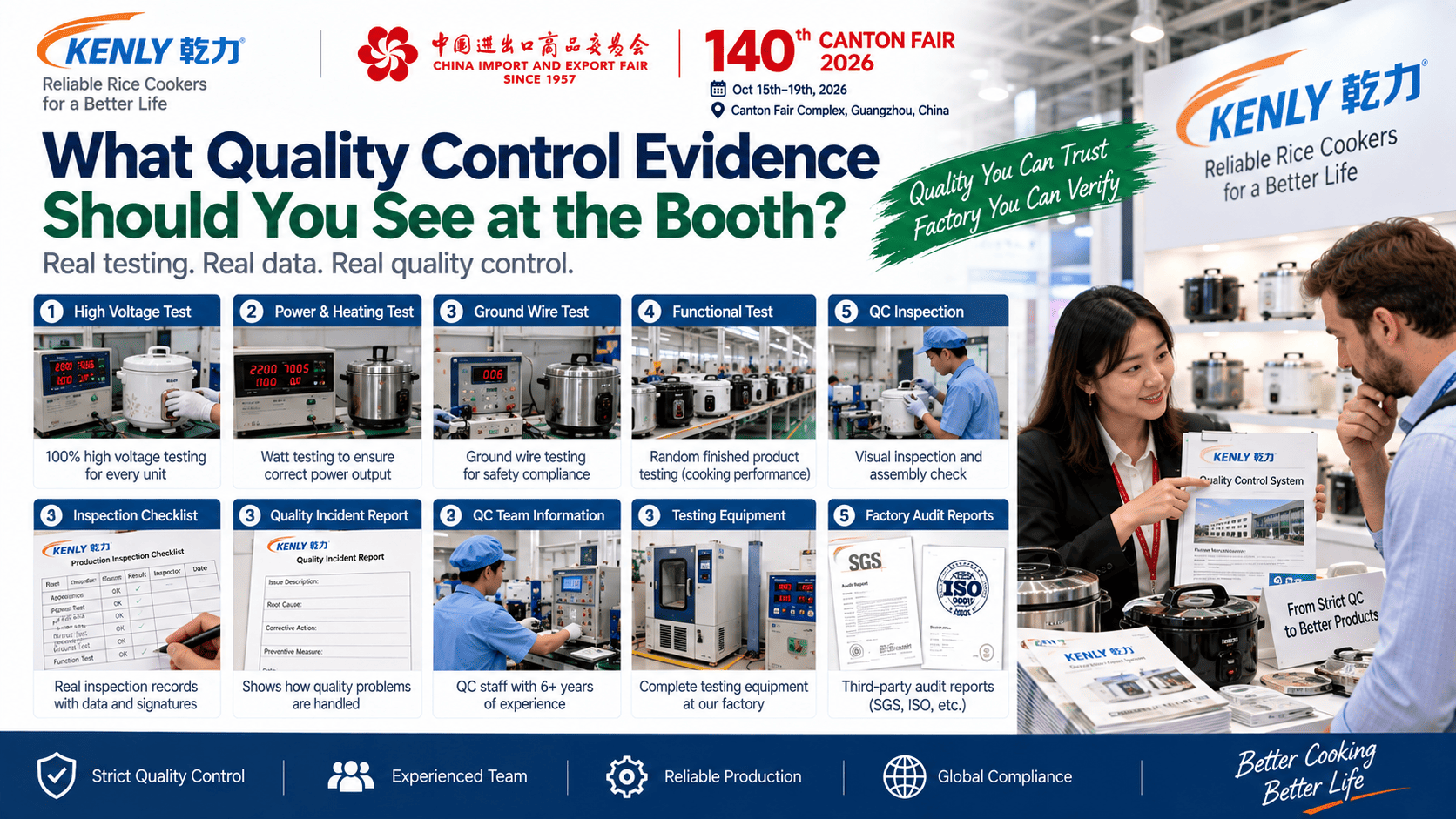
Our QC approach at Kenly has evolved over 15 years from basic final inspection to systematic process control. Each of our 2 production lines has a dedicated QC supervisor
"CE marking", https://en.wikipedia.org/wiki/CE_marking. Institutional descriptions of CE marking, the IECEE CB Scheme, and the German GS mark identify them as product-conformity or safety frameworks used for electrical goods, supporting their relevance as documentation for household-appliance suppliers. Evidence role: definition; source type: institution. Supports: Neutral institutional sources should define CE marking, the IECEE CB Scheme, and GS certification as conformity or safety frameworks relevant to electrical products.. Scope note: This establishes regulatory context; it does not prove that a particular supplier's certificates are valid or sufficient for a buyer's destination market. ↩
"China - Licensing Requirements for Professional Services", https://www.trade.gov/country-commercial-guides/china-licensing-requirements-professional-services. Chinese company-registration rules require business licenses and registration records to state core company information, including business scope, which supports using the license as evidence of the activities a company is registered to conduct. Evidence role: definition; source type: government. Supports: A government or legal source should explain that Chinese company registration records and business licenses include registered business scope and other company details.. Scope note: Registration scope indicates declared legal activities; it does not by itself prove that the company currently operates its own production lines. ↩
"China - Licensing Requirements for Professional Services", https://www.trade.gov/country-commercial-guides/china-licensing-requirements-professional-services. Chinese enterprise-registration materials treat business scope as the registered description of the activities an enterprise is permitted to conduct, supporting the article's advice to compare manufacturing terms with sales or import-export terms. Evidence role: general_support; source type: government. Supports: A source should support that registered business scope identifies the activities a Chinese entity is authorized to conduct.. Scope note: The source would support interpretation of the document, not independently confirm operational capability. ↩
"IECEE Certificates", https://certificates.iecee.org/. IECEE CB Scheme and GS certification materials describe certificates and test reports as traceable conformity documents identifying the product, standard, applicant or manufacturer, and issuing body; GS certification also involves factory inspection elements. Evidence role: definition; source type: institution. Supports: Certification-scheme documentation should show that certificates or test reports include traceable details such as certificate numbers, product models, standards, manufacturer information, and issuing bodies.. Scope note: Certificate contents vary by scheme, issuing body, and document type, so this supports the general verification principle rather than every listed document feature in every case. ↩
"Exhibits-Exhibitor - China Import and Export Fair (Canton Fair)", https://cief.cantonfair.org.cn/html/cantonfair/en/exhibitor/2012-09/24845.shtml. Official Canton Fair materials describe the event as a broad China import-export exhibition with exhibitors from many product sectors, supporting the contextual point that buyers may encounter different types of supplier organizations rather than factories alone. Evidence role: general_support; source type: institution. Supports: Official or institutional material should show that the Canton Fair hosts a broad range of export-oriented exhibitors, including producers and trading/export companies.. Scope note: This would support the general exhibitor context, not verify the status of any particular rice-cooker booth. ↩
"Dielectric withstand test", https://en.wikipedia.org/wiki/Dielectric_withstand_test. Household-appliance safety standards such as IEC 60335 include electric-strength requirements intended to verify insulation performance, supporting the relevance of high-voltage testing in appliance quality control. Evidence role: mechanism; source type: institution. Supports: An appliance safety standard or standards explanation should show that electric-strength or dielectric testing is used to assess insulation safety in household appliances.. Scope note: This supports the safety rationale for the test; it does not verify the test frequency or results at any specific supplier. ↩
"The Blue Guide on the implementation of the product rules ...", https://single-market-economy.ec.europa.eu/news/blue-guide-implementation-product-rules-2022-published-2022-06-29_en. The European Commission's Blue Guide explains that substantially modified products may need to be treated as new products for conformity-assessment purposes, supporting the article's statement that major design changes can trigger renewed safety certification work. Evidence role: general_support; source type: government. Supports: A regulatory source should explain that substantial modifications to a product can affect conformity assessment obligations.. Scope note: This directly supports the CE regulatory principle; requirements for CB or other schemes may differ by standard, market, and certification body. ↩
"How Quantity Affects Manufacturing Cost Per Part", https://www.fictiv.com/articles/manufacturing-cost-per-quantity. Operations-management literature links production lot sizes to fixed setup costs, purchasing constraints, and cost allocation over volume, supporting the article's explanation that customized-product MOQs are shaped by tooling amortization and changeover economics. Evidence role: mechanism; source type: education. Supports: An operations-management or manufacturing-economics source should explain how fixed setup/tooling costs and lot-sizing economics affect production quantities.. Scope note: This supports the general cost mechanism, not the specific MOQ ranges quoted in the article. ↩
"Capacity Planning for Resource Turnaround Operations", https://pubsonline.informs.org/doi/10.1287/msom.2025.0395. Operations-management texts distinguish nominal capacity from effective capacity and identify labor availability, scheduling, setup time, and material constraints as determinants of actual output, supporting the article's warning against relying on line count alone. Evidence role: mechanism; source type: education. Supports: A production-management source should explain that effective capacity is constrained by labor, scheduling, setup/changeover, and material availability.. Scope note: The source would support the general capacity-planning principle, not the stated capacity of any specific factory. ↩
"Chinese New Year and its Impact on Global Supply Chain", https://ctl.mit.edu/news/chinese-new-year-and-its-impact-global-supply-chain. Supply-chain research and logistics analyses describe recurring slowdowns around the Lunar New Year period as factories, ports, and transport networks adjust to holiday closures and labor travel, supporting the article's reference to Chinese New Year production gaps. Evidence role: historical_context; source type: research. Supports: A research or institutional source should document that Lunar New Year holidays affect factory operations and logistics in China.. Scope note: The size and timing of the disruption vary by industry, region, and individual factory planning. ↩