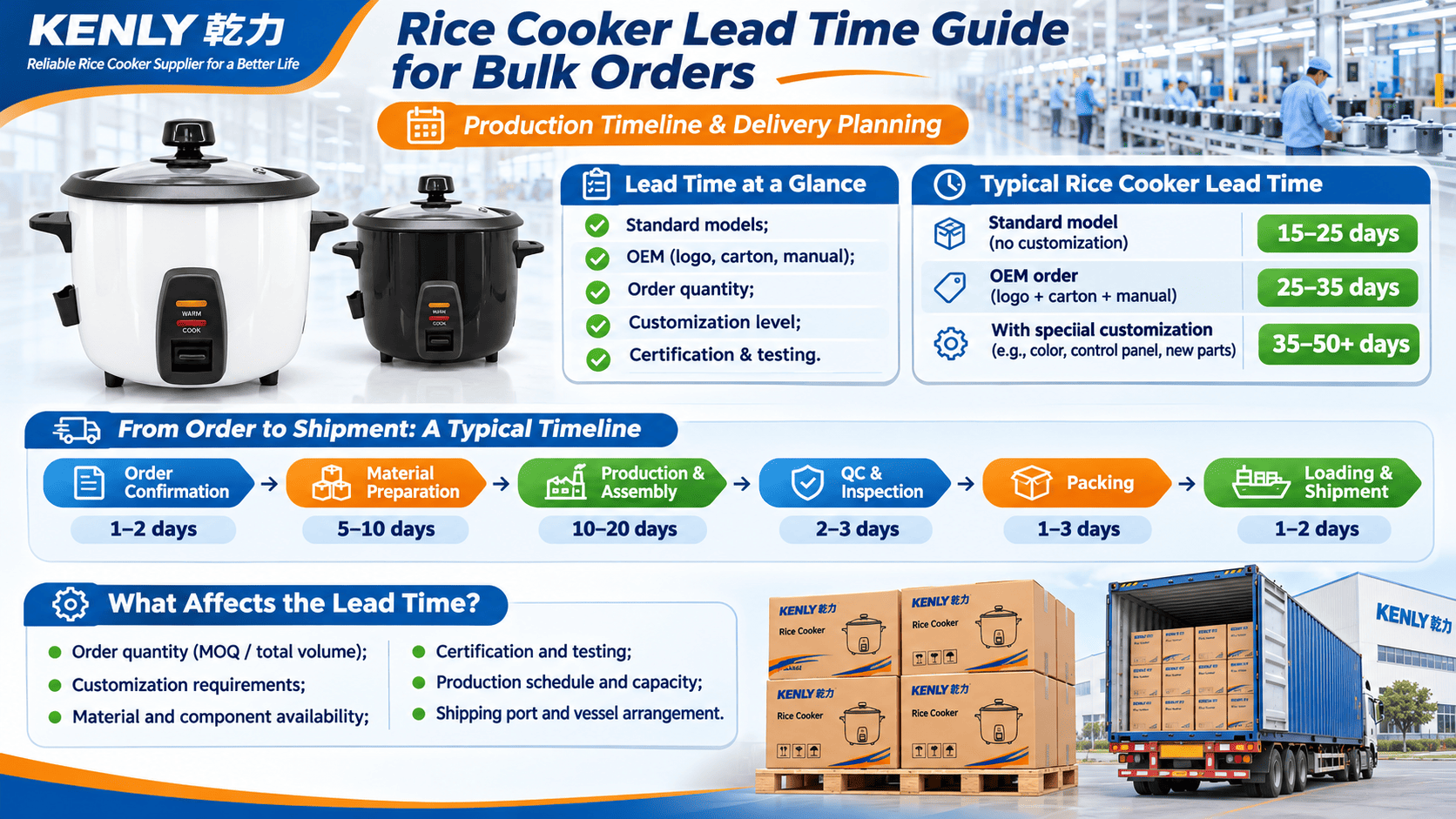
I've seen too many procurement managers ask "How fast can you ship?" before they tell me which model, what capacity, or whether they need custom packaging. That question sounds simple, but it creates unrealistic expectations that turn into missed selling seasons and strained supplier relationships. Lead time for bulk rice cooker orders is not a speed competition—it's a procurement risk-control question that depends on locked order conditions, confirmation milestones, and realistic buffers for production, inspection, and shipping.
Rice cooker lead time for bulk orders is not a single number. It is the full cycle from order confirmation through delivery to your warehouse, covering sample approval, material preparation, production scheduling, quality inspection, freight booking, and destination-side clearance. Reliable lead time depends on complete order details: model specification, capacity, order volume, customization scope, target delivery date, plug/voltage/packaging requirements, and certification needs. Factories cannot estimate realistic delivery plans without this information, and procurement managers who ask for speed before clarity often face delays, wrong assumptions, or supplier promises that collapse under real-world conditions.
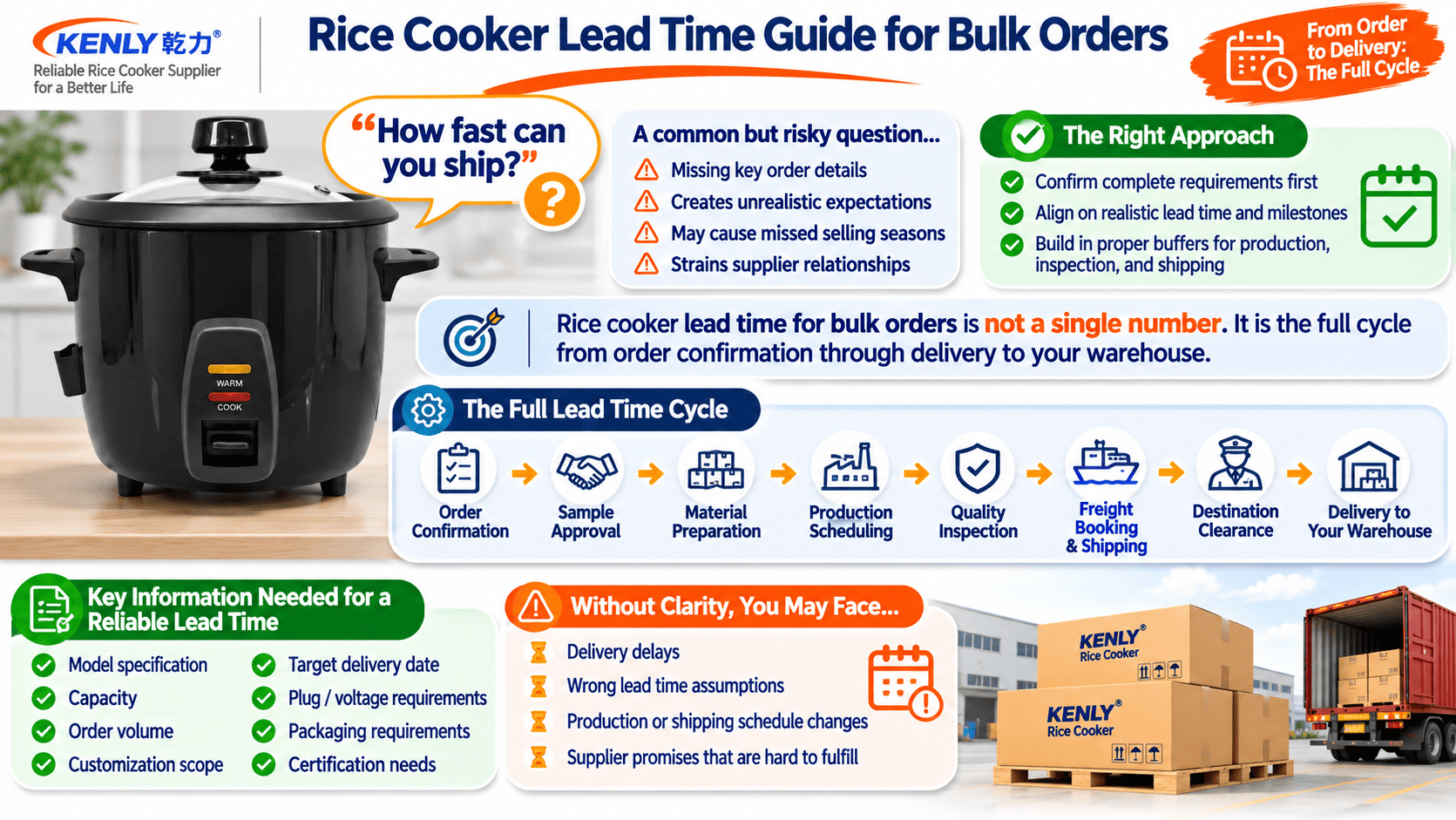
If you're managing bulk orders for brand distribution or wholesale markets, you know that wrong delivery estimates create warehouse gaps, lost sales windows, and emergency air freight costs. This guide breaks down what really controls rice cooker lead time, what information suppliers need to give you a trustworthy schedule, and how to plan backward from your sales season or warehouse arrival deadline.
What Does Rice Cooker Lead Time Actually Include?
Procurement managers often think lead time means production days. Buyers ask how long the factory needs to make the units, then add shipping days and assume they're done. That framing hides half the variables that control when your order actually arrives.
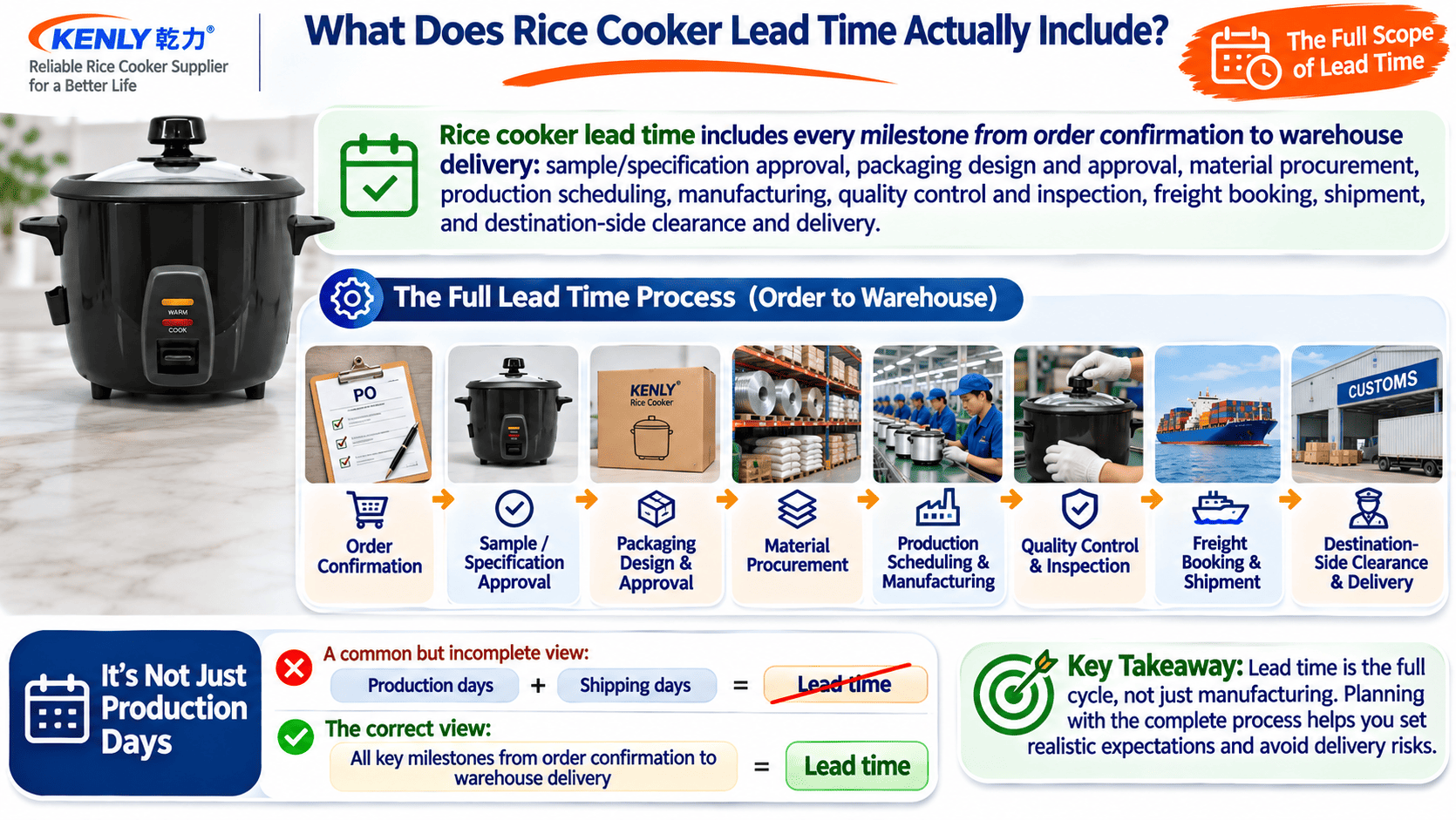
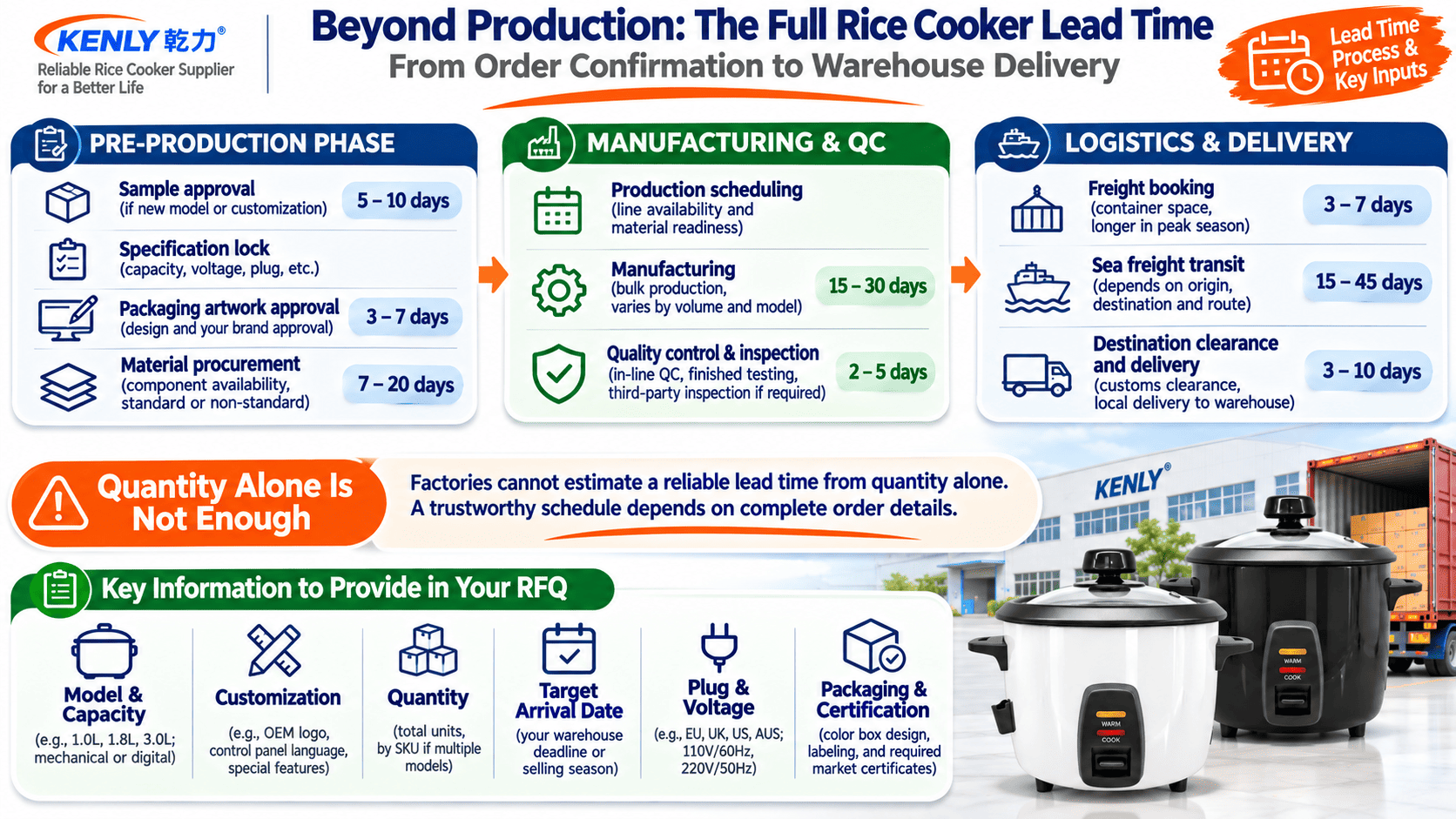
Rice cooker lead time includes every milestone from order confirmation to warehouse delivery: sample/specification approval, packaging design and approval, material procurement, production scheduling, manufacturing, quality control and inspection, freight booking, shipment, and destination-side clearance and delivery.
Breaking Down the Full Cycle
Real lead time starts the moment you confirm the order, not when the production line starts running. Here's what happens between those two points:
Pre-production confirmation phase:
- Sample approval (if the order involves a new model or customization): 5–10 days for production, shipping, and your internal review1
- Specification lock: confirming capacity, voltage, plug type, control panel language, packaging design, compliance documents
- Packaging artwork approval: 3–7 days for design iteration and your brand approval
- Material procurement: 7–20 days depending on component availability and whether you requested non-standard materials2
Production phase:
- Production scheduling: your slot depends on confirmed deposit, material readiness, and line availability
- Manufacturing: 15–30 days for typical bulk orders (varies by volume and model complexity)3
- Quality control and inspection: 2–5 days for in-line QC, finished product testing, and third-party inspection if required4
Logistics phase:
- Freight booking: 3–7 days to secure container space (longer during peak season)5
- Sea freight transit: 15–45 days depending on origin port, destination port, and shipping route6
- Destination clearance and delivery: 3–10 days for customs clearance, local delivery to your warehouse7
I've had procurement managers tell me "We need delivery in 30 days" before confirming which plug type they need or whether their market requires specific certification documents. When I explain that sample approval alone takes 7–10 days and material procurement takes another 10–15 days, the conversation changes. The question shifts from "How fast?" to "What do you need from us to lock in a realistic schedule?"
Why Factories Cannot Estimate Lead Time from Quantity Alone?
One of the most common mistakes I see: buyers provide only the order quantity and ask for delivery time. "We need 5,000 units of 1.8L rice cookers—how long will it take?" That question is missing too much information for any responsible supplier to answer accurately.
Factories cannot give reliable lead time from quantity alone because lead time depends on model specification, capacity, customization scope, target delivery date, plug/voltage/packaging requirements, and certification needs. Without these locked details, any delivery estimate is guesswork that risks missed deadlines and unmet expectations.
The Information Gap That Creates Delays
When procurement managers ask for lead time without providing complete order details, they force suppliers into a corner: either quote an optimistic timeline that assumes zero complications, or refuse to answer until the buyer provides proper specifications.
Here's what suppliers actually need to estimate realistic lead time:
| Information Category | What Buyers Should Provide | Why It Matters |
|---|---|---|
| Model specification | Capacity (1.0L, 1.8L, 3.0L, etc.), control type (mechanical, digital, fuzzy logic), inner pot material, power rating | Different models have different component lead times and production complexity |
| Customization scope | OEM brand logo, custom control panel language, packaging design requirements, special feature requests | Customization adds design approval cycles and may require non-standard materials with longer procurement times |
| Order volume | Total units, breakdown by SKU if ordering multiple models | Affects production scheduling, material bulk ordering discounts, and whether partial shipment is possible |
| Target delivery date | Your warehouse arrival deadline or selling season start date | Determines whether standard production schedule works or requires rush production and expedited shipping |
| Plug and voltage | Plug type (EU, UK, US, AUS, etc.), voltage/frequency (110V/60Hz, 220V/50Hz, etc.) | Different plugs and voltage standards require different power cord procurement and may affect certification timing |
| Packaging requirements | Color box design (your artwork or factory standard), master carton specifications, special labeling needs | Custom packaging design adds approval cycles and printing preparation time |
| Certification needs | Target market (EU, US, Japan, Korea, etc.), required certificates (CE, CB, GS, UKCA, KC, etc.) | Certification documents must match the final product specification; changes after production starts cause delays |
I've seen procurement managers provide partial information, get a preliminary estimate, then add "Oh, by the way, we need custom control panel language and special packaging" two weeks later. That change resets the timeline because packaging design approval takes 5–7 days and custom control panels may require different component ordering.
The "Fastest Delivery" Trap
Some buyers shop for lead time as if it were a price comparison: they ask five suppliers "How fast can you ship?" and choose whoever promises the shortest time. This strategy backfires when the winning supplier cannot actually deliver on their aggressive timeline.
The better approach: provide complete order details upfront and ask "What realistic delivery plan can you offer based on these locked conditions?" Reliable suppliers will break down the timeline milestone by milestone, explain which variables you control, and show you where buffers are needed for risk management.
What Question Should Buyers Ask Instead of "How Fast Can You Ship?"?
The most productive inquiries I receive start with context, not demands. Procurement managers who understand lead time as a planning problem, not a speed race, ask questions that help both sides build a realistic delivery schedule.
Instead of asking "How fast can you ship?", procurement managers should ask: "What information do you need to estimate a realistic delivery plan for this order?" This reframes the conversation from supplier capability to buyer-supplier collaboration, forces both sides to lock down the variables that control timing, and reduces the risk of missed deadlines caused by incomplete planning.
The Pre-Order Checklist Conversation
When buyers approach lead time as a planning question, the conversation becomes more productive. Here's the structure I recommend:
Opening context: "We're planning a bulk order of [capacity] rice cookers for [target market], targeting warehouse arrival by [date]. We need [quantity] units. What information do you need from us to build a delivery plan?"
Follow-up details to provide:
- Model preference: capacity, control type, feature requirements
- Customization scope: OEM branding, packaging design, special features
- Order volume and payment terms: total units, deposit/balance schedule
- Target delivery date and flexibility: your ideal arrival date and acceptable delay buffer
- Plug/voltage/certification: specific plug type, voltage standard, required compliance documents
- Packaging requirements: your artwork or factory standard, special labeling needs
This approach gives suppliers the information they need to estimate realistically. It also surfaces potential problems early—if your target delivery date requires rush production or air freight, the supplier can flag that cost implication before you commit to the order.
Common Buyer Mistakes That Create Unreliable Estimates
Asking for lead time before confirming OEM/ODM conditions: Buyers ask "How long for 10,000 units?" without specifying whether they want factory-standard packaging or custom brand packaging. Standard packaging might allow 45-day delivery; custom packaging requires design approval and adds 10–15 days.
Treating production time as total lead time: Buyers hear "25 days production" and assume they'll receive goods 25 days after order confirmation. They forget sample approval, material procurement, and shipping time.
Changing specifications after getting a lead time estimate: Buyers lock in a delivery schedule, then request control panel language changes or different inner pot material. These changes reset material procurement timelines and push delivery dates.
Ignoring peak season and holiday impacts: Buyers place orders in September expecting normal lead times, forgetting that October is peak manufacturing season in China and freight booking takes longer. Similarly, orders confirmed just before Chinese New Year face 2–3 week factory closures.
Assuming air freight solves all timing problems: When delivery deadlines get tight, buyers ask to switch to air freight. Air freight cuts shipping time from 30 days to 5–7 days, but it doesn't eliminate sample approval time, material procurement time, or production time.
The most successful procurement managers I work with treat lead time estimation as a collaborative planning process. They provide complete information upfront, ask about risk buffers, and build their sales schedule around realistic delivery windows rather than optimistic promises.
How Do Peak Season, Holidays, and Shipping Routes Affect Lead Time?
Lead time is not a fixed manufacturing capability—it's a variable schedule affected by production capacity, shipping availability, and calendar timing.
Peak season, holidays, and shipping routes are lead time risk variables, not footnotes. Rice cooker orders placed during high-demand manufacturing periods (September–November) face longer production queues and freight booking delays. Orders confirmed near Chinese New Year (late January to mid-February) encounter 2–3 week factory closures. Shipping routes determine transit time: Asian ports to Europe average 30–35 days, Asian ports to US West Coast average 15–20 days, Asian ports to US East Coast average 30–40 days.
Peak Manufacturing Season Realities
Rice cookers, like most home appliances, experience seasonal production pressure. September through November is peak season because buyers across multiple markets prepare for year-end holidays and winter sales8. During these months:
Production scheduling tightens: Factories receive more orders than production lines can immediately handle. What might be a 3-day scheduling wait in April becomes a 10-day wait in October.
Material procurement slows: Component suppliers face their own peak demand. Circuit boards, inner pot materials, and packaging materials take longer to procure.
Freight booking becomes competitive: Container space tightens as all exporters rush to ship before major holidays. Booking confirmation that takes 3 days in June takes 7–10 days in October.
Chinese New Year Planning Gap
Chinese New Year shuts down most manufacturing for 2–3 weeks, usually in late January or mid-February9. This holiday creates a planning gap:
Pre-holiday rush: Orders must be completed and shipped before the factory closure. If your order confirmation comes 30 days before Chinese New Year and your total lead time is 60 days, the factory cannot deliver before the holiday.
Post-holiday restart lag: Factories don't return to full capacity immediately. Workers return gradually, material suppliers restart operations on different schedules, and it takes 1–2 weeks for production lines to reach normal efficiency.
Procurement managers planning Q1 inventory should place rice cooker orders by early November to ensure pre-holiday delivery.
Shipping Route Variables
Not all destinations are equal in transit time:
| Route | Average Sea Freight Transit | Variables That Extend Transit |
|---|---|---|
| China to US West Coast | 15–20 days | Port congestion (LA/Long Beach often congested)10, weather delays |
| China to US East Coast | 30–40 days | Transit through Panama Canal or longer Pacific-Atlantic route |
| China to Europe | 30–35 days | Port of destination (Rotterdam faster than some Eastern European ports) |
| China to Southeast Asia | 7–15 days | Direct routes exist but smaller ports may have less frequent service |
| China to Middle East | 20–30 days | Route and port infrastructure vary significantly by country |
| China to Australia | 15–25 days | Major ports (Sydney, Melbourne) faster than regional ports |
Transit time is not the only shipping variable. Destination-side customs clearance and local delivery add 3–10 days depending on port efficiency, documentation completeness, and your warehouse location relative to the port.
How Should Procurement Managers Plan Backward from Sales Season Deadlines?
Missed selling seasons cost more than delayed delivery—they cost market opportunity, retail partner relationships, and revenue targets.
Procurement managers should plan lead time backward from their warehouse arrival deadline or sales season start date, adding realistic buffers for each milestone: freight transit, production and QC, material procurement, specification confirmation, and supplier selection. This backward planning approach identifies the latest order confirmation date that allows on-time delivery and surfaces risks early enough to mitigate.
The Backward Planning Framework
Start with your non-negotiable deadline and work backward through every lead time component:
Step 1: Identify your critical arrival date This is the last day your rice cookers can arrive at your warehouse and still support your sales plan.
Step 2: Add destination-side timing Subtract customs clearance and local delivery time: 5–10 days depending on port efficiency and warehouse location.
Step 3: Add sea freight transit Subtract shipping route average transit time plus 5-day buffer for booking delays or weather: 20–50 days depending on destination.
Step 4: Add production and QC timeline Subtract factory production time (15–30 days) plus quality control and inspection (3–5 days). Use the longer estimate if you're ordering during peak season.
Step 5: Add material procurement and pre-production confirmation Subtract material procurement time (10–20 days), packaging approval cycle (5–7 days if custom), and sample approval if needed (7–10 days).
Step 6: Add supplier selection and negotiation buffer Subtract time for supplier communication, quotation comparison, and order terms negotiation: 7–14 days.
The result is your latest order confirmation date. If that date has already passed, you're planning with no buffer and any delay will miss your deadline.
Real-World Backward Planning Example
Situation: You're launching new 1.8L digital rice cookers with OEM branding for Thanksgiving season sales in the US. Your retail partners need inventory by November 1st. Your warehouse is in California, 50 miles from the Port of Los Angeles.
Backward timeline:
- Critical arrival date: November 1st
- Destination delivery buffer: Subtract 1 week → October 25th
- Customs and local delivery: Subtract 5 days → October 20th
- Sea freight (China to LA, including booking buffer): Subtract 25 days → September 25th
- Production and QC: Subtract 25 days (buffer for peak season) → August 31st
- Material procurement and packaging approval: Subtract 15 days → August 16th
- Sample approval: Subtract 10 days → August 6th
- Supplier selection and negotiation: Subtract 10 days → July 27th
Conclusion: You must confirm your order by late July to have realistic confidence in November 1st arrival.
When buyers miss their backward planning window, options narrow to expensive compromises: paying for rush production, accepting partial shipment, or paying for air freight. All of these options cost more than proper lead time planning.
Building Risk Buffers into Your Timeline
Backward planning identifies your theoretical latest order date, but realistic procurement managers add buffers for common risks:
Specification change buffer (5–10 days): Even with careful planning, you might discover certification documentation issues, packaging design problems, or control panel language errors that require adjustments.
Peak season extension (1–2 weeks): If your production window falls during September–November, add extra time for scheduling delays and material procurement slowdowns.
Shipping uncertainty (5–7 days): Port congestion, weather delays, or freight booking complications happen. Build cushion into your shipping timeline.
Holiday planning (2–3 weeks): Orders scheduled near Chinese New Year or other major holidays need extra buffer for factory closure impacts.
A realistic backward planning timeline includes these buffers. The goal is not optimistic speed—it's reliable delivery that protects your sales season and retail relationships.
Frequently Asked Questions
Can factories offer faster lead time for urgent orders?
Rush production is possible but limited and expensive. Factories can sometimes prioritize your order by adjusting production schedules, but this requires available line capacity, material inventory, and willingness to delay other orders. Rush production typically costs 10–20% more11. More importantly, rush production cannot eliminate pre-production confirmation time (sample approval, packaging design, material procurement) or shipping transit time. If your total lead time is 60 days and you request delivery in 30 days, air freight might cut 25 days from shipping but cannot compress the 35 days needed for confirmation, material prep, and production.
How much should I pad lead time estimates to be safe?
Add 10–15% buffer to normal lead time estimates, more if you're ordering during peak season or around major holidays. For a 50-day standard lead time, plan for 55–60 days. For orders during September–November manufacturing peak, add 20–25% buffer. This buffer accounts for minor specification revisions, material procurement delays, freight booking slowdowns, and unexpected quality issues. The buffer is not wasted time—it's risk insurance.
What happens if specifications change after production starts?
Specification changes after production starts usually restart lead time from the change point. If you request different control panel language after production begins, the factory must order new control boards, delay your production run, and reschedule line capacity. This can add 15–30 days to your delivery timeline. Some changes are impossible to implement mid-production: different inner pot material, different capacity, different plug type. Lock all specifications before confirming your order and paying deposit—changes after that point carry serious timing and cost consequences.
Should I split orders across multiple suppliers to reduce risk?
Splitting bulk orders across multiple suppliers can reduce concentration risk but introduces coordination complexity. Multiple suppliers mean multiple quality control processes, multiple shipping schedules, multiple packaging standards, and potential inconsistency in finished products. For procurement managers sourcing rice cookers for brand distribution, product consistency across suppliers is critical. If you split orders, invest more time in specification documentation and QC alignment across suppliers. For most bulk orders, a single reliable supplier with clear lead time planning offers better results.
How does payment terms affect lead time?
Payment terms directly impact lead time because most factories schedule production after receiving order deposit. Standard OEM/ODM terms require 30% deposit before production starts and 70% balance before shipment12. If your payment process requires internal approvals that take 2 weeks, those 2 weeks extend your lead time. Plan your internal payment approval process as part of backward lead time planning—payment delays are delivery delays.
Conclusion
Rice cooker lead time for bulk orders is not a single number—it's a full procurement cycle controlled by specification clarity, milestone planning, and realistic risk buffers. Procurement managers who ask "How fast can you ship?" before providing complete order details create unreliable estimates that miss sales seasons and strain supplier relationships. The better approach: provide model specifications, customization scope, target delivery date, plug/voltage/packaging requirements, and certification needs upfront, then ask suppliers for realistic delivery plans broken down by milestone. Plan backward from your warehouse arrival deadline, add buffers for peak season and shipping uncertainty, and lock all specifications before confirming your order. Lead time management is procurement risk control—buyers who treat it seriously protect their sales seasons, retail partnerships, and brand reputation.
If you're planning bulk rice cooker orders for brand distribution or wholesale markets, start your supplier conversations at least 90 days before your critical arrival date. Provide complete order details from your first inquiry. Ask about lead time variables and risk buffers, not just optimistic speed promises. The procurement managers who plan lead time carefully get reliable delivery—the ones who chase fastest quotes get delayed shipments and missed opportunities.
"Current Good Manufacturing Practice (CGMP) Regulations", https://www.fda.gov/drugs/pharmaceutical-quality-resources/current-good-manufacturing-practice-cgmp-regulations. Industry research on manufacturing timelines indicates that sample approval cycles typically range from several days to two weeks, depending on product complexity and shipping logistics. Evidence role: general_support; source type: research. Supports: typical duration of sample approval cycles in manufacturing. Scope note: General manufacturing data may not be specific to rice cooker production ↩
"Consumer Appliance Manufacturing: Trends and Sourcing Options", https://www.zetwerk.com/blog/contract-manufacturing/consumer-appliance-manufacturing-trends-sourcing/. Supply chain management research documents that material procurement lead times vary significantly based on component complexity and supplier relationships, commonly ranging from one to several weeks. Evidence role: general_support; source type: research. Supports: typical material procurement timelines in manufacturing supply chains. Scope note: Timeframes vary widely by industry sector and geographic region ↩
"OEM Small Appliance Manufacturing Process: 8 Key Steps - Kodio", https://kodiohome.com/oem-small-appliance-manufacturing-process/. Manufacturing operations research indicates that small appliance production cycles typically span two to four weeks for bulk orders, with variation based on order volume and product complexity. Evidence role: general_support; source type: research. Supports: typical production cycle times for small appliance manufacturing. Scope note: Production times are highly dependent on specific factory capacity and automation levels ↩
"Quality assurance", https://en.wikipedia.org/wiki/Quality_assurance. Quality management research indicates that comprehensive quality control processes, including in-line inspection and finished product testing, typically require several days to complete, with duration dependent on product complexity and testing requirements. Evidence role: general_support; source type: research. Supports: typical duration of quality control and inspection processes in manufacturing. Scope note: Inspection timelines vary based on product type and whether third-party certification is required ↩
"Why Freight Booking Lead Time Is Increasing Explained", https://www.ddpexpert.com/blog-details/freight-booking-lead-time-increase. Maritime logistics research indicates that container booking lead times vary based on route demand and seasonal factors, with standard bookings typically processed within several days under normal conditions but extending during peak shipping periods. Evidence role: general_support; source type: research. Supports: typical lead times for securing container shipping space. Scope note: Booking times fluctuate significantly based on shipping route capacity and seasonal demand ↩
"Latest Supply Chain and Freight Indicators", https://www.bts.gov/freight-indicators. Maritime industry data shows that container shipping times vary significantly by route, with trans-Pacific routes typically requiring 2-3 weeks and longer routes to Europe or the East Coast requiring 4-6 weeks. Evidence role: statistic; source type: institution. Supports: typical sea freight transit durations for major international shipping routes. ↩
"I ordered goods from abroad, but the seller said they are being held up ...", https://www.help.cbp.gov/s/article/Article-1171. Customs processing times vary by country and port efficiency, with most developed markets completing standard clearance within several days to a week, though delays can occur with documentation issues or inspection requirements. Evidence role: general_support; source type: government. Supports: typical customs clearance and delivery timelines for imported goods. Scope note: Clearance times are highly variable based on documentation completeness and random inspection selection ↩
"Buying and Selling Seasonal Goods - Kellogg Insight", https://insight.kellogg.northwestern.edu/article/buying_and_selling_seasonal_goods. Supply chain research documents that consumer goods manufacturers experience heightened demand in late summer and fall as retailers prepare inventory for year-end holiday shopping seasons. Evidence role: general_support; source type: research. Supports: seasonal demand patterns in consumer goods manufacturing. Scope note: Seasonal patterns vary by product category and target market ↩
"Chinese New Year and its Impact on Global Supply Chain", https://ctl.mit.edu/news/chinese-new-year-and-its-impact-global-supply-chain. Chinese New Year, also known as Spring Festival, is China's most important traditional holiday, typically occurring in late January or February and resulting in widespread factory closures lasting one to three weeks as workers return to their hometowns. Evidence role: historical_context; source type: encyclopedia. Supports: the timing and typical duration of Chinese New Year factory closures. ↩
"Port of Los Angeles", https://en.wikipedia.org/wiki/Port_of_Los_Angeles. The Ports of Los Angeles and Long Beach, which together handle approximately 40% of US containerized imports, have experienced periodic congestion issues, particularly during periods of high import volume. Evidence role: case_reference; source type: government. Supports: congestion challenges at major US West Coast ports. Scope note: Congestion levels fluctuate significantly based on economic conditions and operational factors ↩
"The Sales Management Simulation: Integrate Theory with Practice", https://icsc.business.fsu.edu/sales/icscmedia/sms/smsteachermanual.pdf. Manufacturing operations research indicates that rush orders typically incur cost premiums due to overtime labor, production line disruption, and expedited material procurement, though specific premiums vary by industry and order characteristics. Evidence role: general_support; source type: research. Supports: cost premiums associated with expedited manufacturing schedules. Scope note: Cost increases depend heavily on factory capacity utilization and order specifics ↩
"International Comparisons of Hourly Compensation Costs in ...", https://www.bls.gov/fls/ichccindustryreport.htm. International trade practice in contract manufacturing commonly involves staged payment terms, with deposits securing production slots and balance payments required before shipment, though specific percentages vary by relationship and order value. Evidence role: general_support; source type: other. Supports: common payment term structures in OEM/ODM manufacturing relationships. Scope note: Payment terms are negotiable and vary significantly based on buyer-supplier relationships and order size ↩