Last month, a café owner from Chiang Mai contacted me frustrated. She bought what she called a "30-person rice cooker" based on the seller's claim, but during her lunch rush, she ran out of rice much earlier than expected.
The problem wasn't necessarily the cooker. It was the way capacity had been translated into "number of people."
This miscalculation happens more often than you'd think, and for a restaurant it can mean delayed orders, unhappy customers, and emergency batch cooking during the busiest hour of the day.
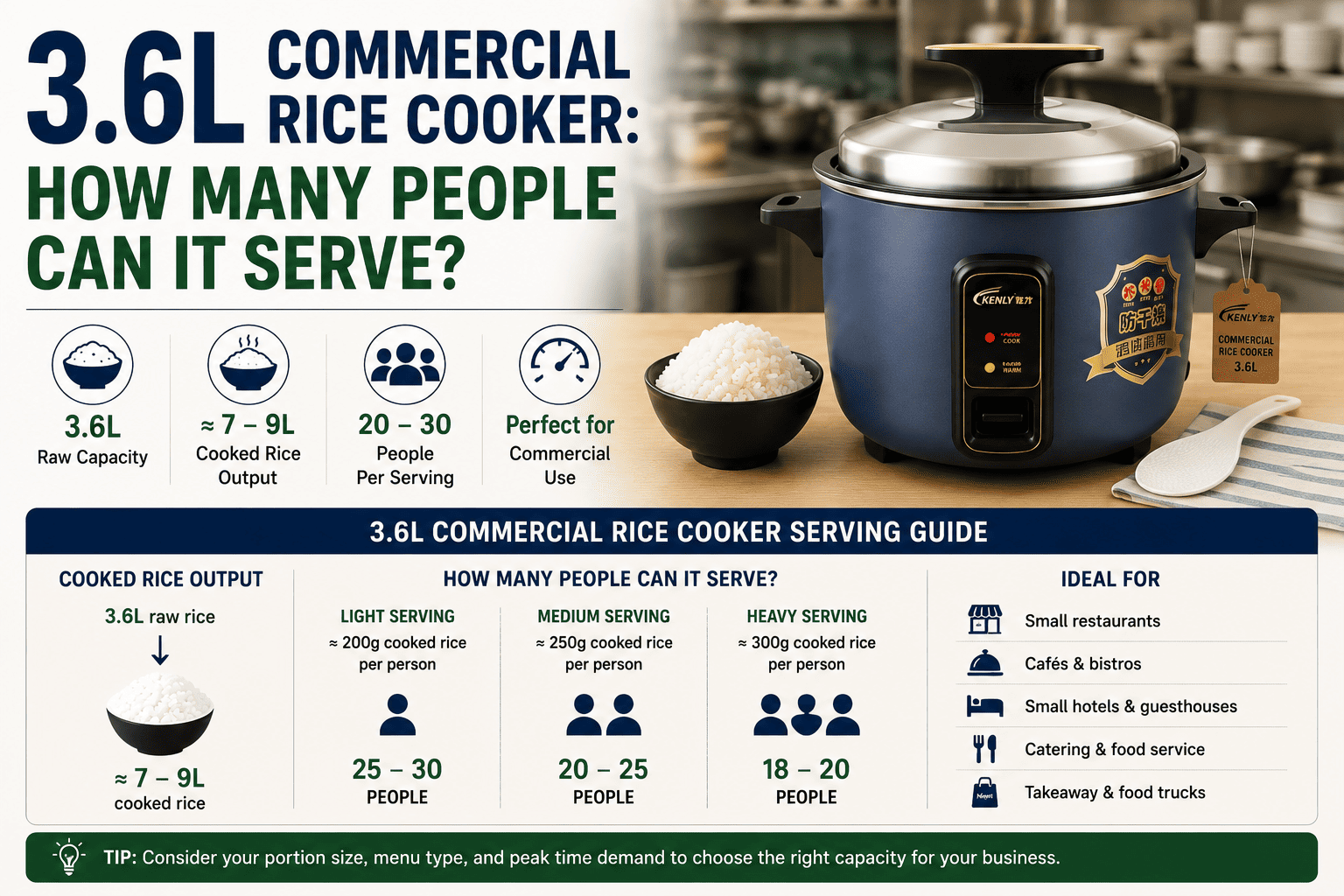
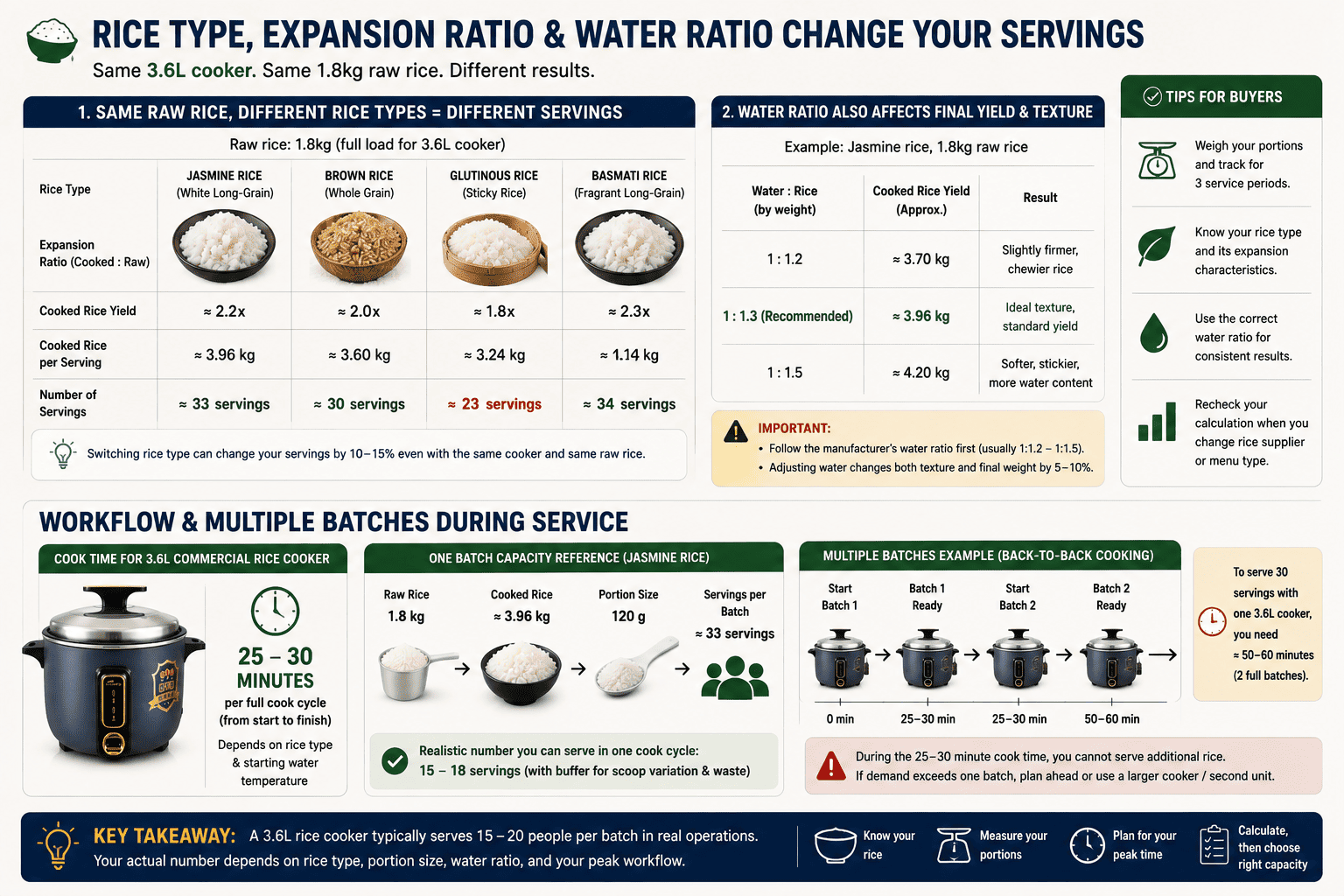
A 3.6L commercial rice cooker does not have one fixed serving number. Using the approximately 1.8–2.0kg raw-rice working range discussed in this guide, one full batch may produce roughly 3.6–4.5kg of cooked rice depending on rice variety and water ratio. That can mean around 20 servings at a large 200g restaurant portion, around 25–30 servings at 150g, or more than 30 servings at smaller side-dish portions. The correct capacity depends on portion size, rice type, usable cooking capacity, and—most importantly—your peak simultaneous demand.
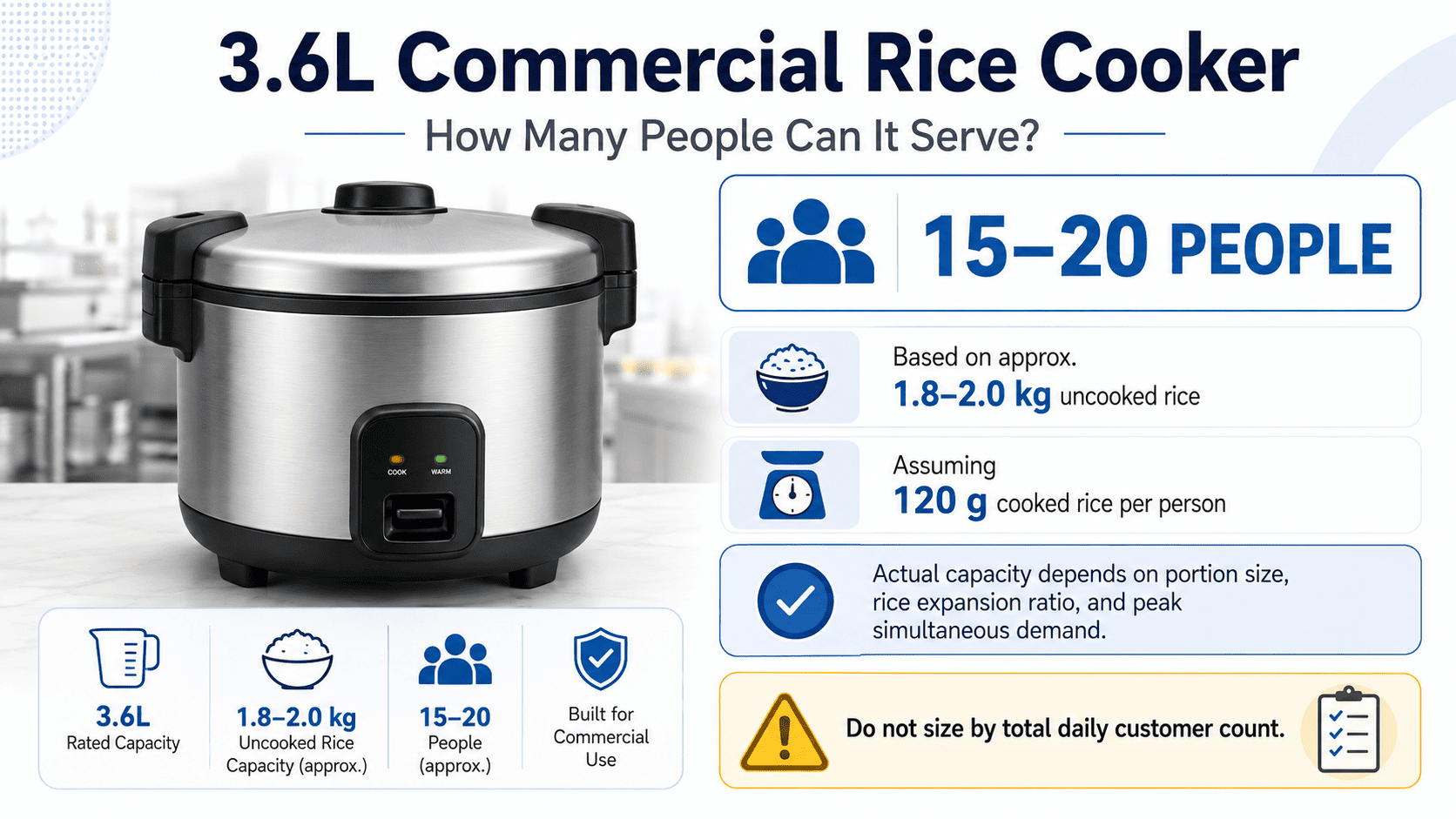
Most buyers ask:
"How many people can a 3.6L rice cooker serve?"
as if the answer were a fixed specification printed on the product.
It isn't.
The labeled 3.6L normally refers to the inner pot volume. What actually determines serving capacity is:
- How much raw rice the manufacturer recommends cooking
- How much the rice expands
- How large each restaurant portion is
- How much operational buffer you need
- How quickly customers arrive during peak service
I'll walk you through the same calculation method I use when restaurant buyers ask whether a 3.6L commercial rice cooker is large enough for their operation.
Why Does 3.6L Not Equal a Fixed Number of Servings?
When buyers look at a 3.6L rice cooker, they often assume the number translates directly into servings.
This creates the first sizing mistake.
The confusion comes from mixing up total inner pot volume with usable raw rice capacity.
A 3.6L inner pot cannot simply be filled with 3.6 liters of dry rice. The cooker also needs room for:
- Water
- Rice expansion
- Boiling
- Steam circulation
- Foaming
- Safe clearance below the lid
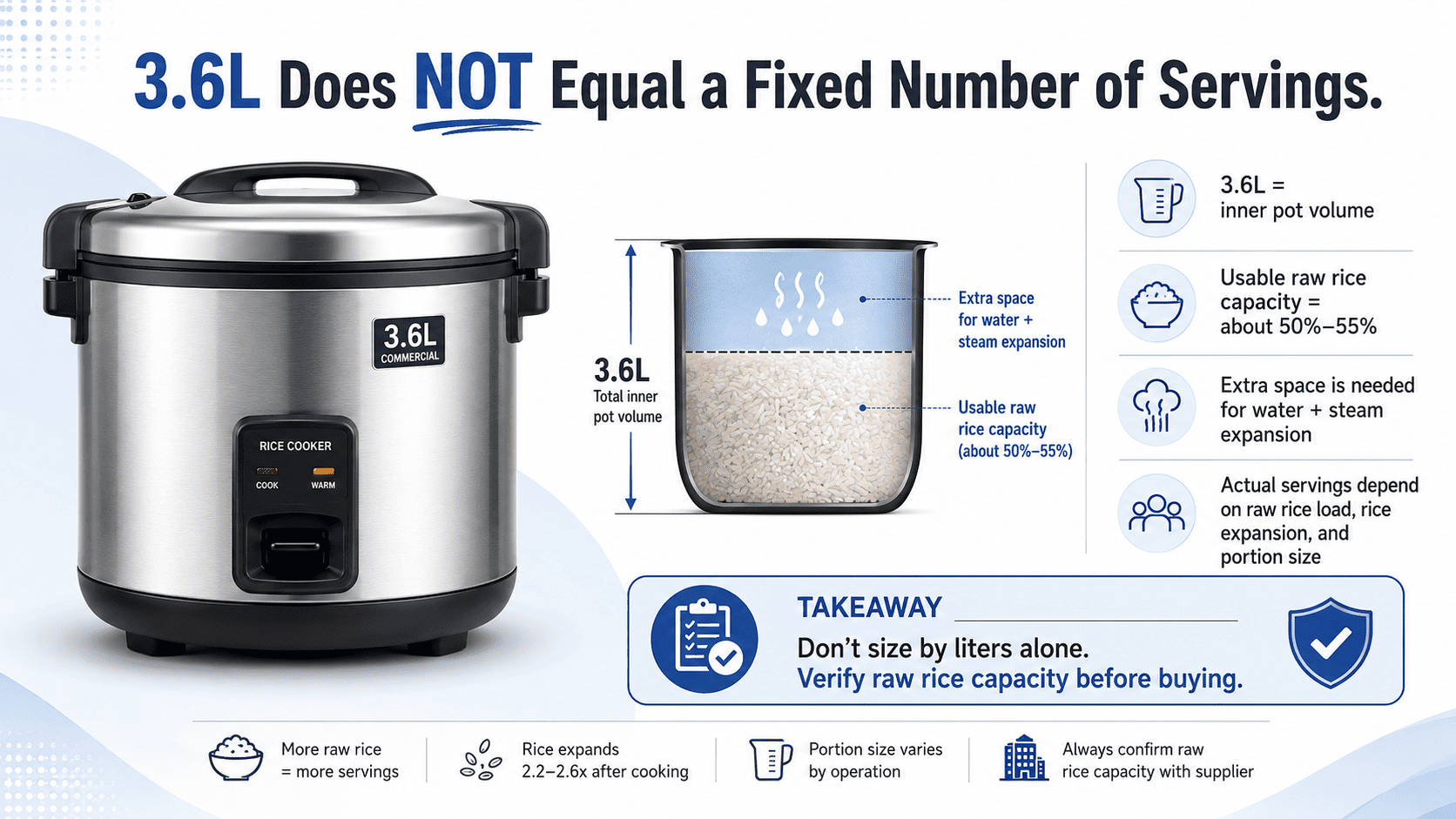
For the type of 3.6L commercial rice cooker discussed in this guide, assume approximately 1.8–2.0kg of raw rice as a practical reference range, but always confirm the manufacturer's actual maximum and recommended working capacity before ordering.
The serving number then depends heavily on portion size.
Approximate Serving Range by Portion Size
Using an illustrative cooked-rice yield of approximately 3.6–4.5kg per batch:
| Cooked Rice Portion Per Person | Approximate Servings Per Batch |
|---|---|
| 100g | 36–45 servings |
| 120g | 30–37 servings |
| 150g | 24–30 servings |
| 180g | 20–25 servings |
| 200g | 18–22 servings |
| 250g | 14–18 servings |
This table explains why two suppliers can describe the same cooker very differently.
One supplier might say:
"Serves 30 people."
Another might say:
"Serves 20 people."
Both claims could theoretically refer to the same cooker if they are assuming different serving sizes.
That is why "serves X people" is not a reliable technical specification unless the supplier also states the portion size used in the calculation.
The Three Variables That Change Serving Count
Three factors determine how many customers your 3.6L cooker can actually support.
1. Your Portion Size Per Customer
Restaurant portions vary much more than buyers expect.
For example:
- Small side dish: 100–120g cooked rice
- Bento or standard plated meal: 120–150g
- Rice bowl: 150–180g
- Large Asian restaurant portion: 180–220g
- Heavy rice-based meal or refill service: 220g+
A restaurant serving 120g portions can get significantly more servings from the same cooker than one serving 200g portions.
This is why I recommend weighing the rice portion actually used in your kitchen instead of estimating.
2. Rice Variety and Cooking Expansion
Different rice varieties absorb different amounts of water.
Typical cooking behavior can vary between:
- Jasmine rice
- Basmati rice
- Long-grain rice
- Japanese short-grain rice
- Brown rice
- Glutinous rice
The same weight of raw rice may therefore produce different final cooked weights.
3. Peak Demand Window vs. Daily Throughput
This is the variable buyers underestimate most.
A hotel breakfast buffet serving 50 guests over three hours does not have the same capacity requirement as a food court serving 30 rice bowls in 30 minutes.
Both may sell the same total amount of rice.
But their simultaneous capacity requirement is completely different.
You should size the rice cooker around:
How much cooked rice must be available at the busiest moment?
not:
How many customers do I serve in an entire day?
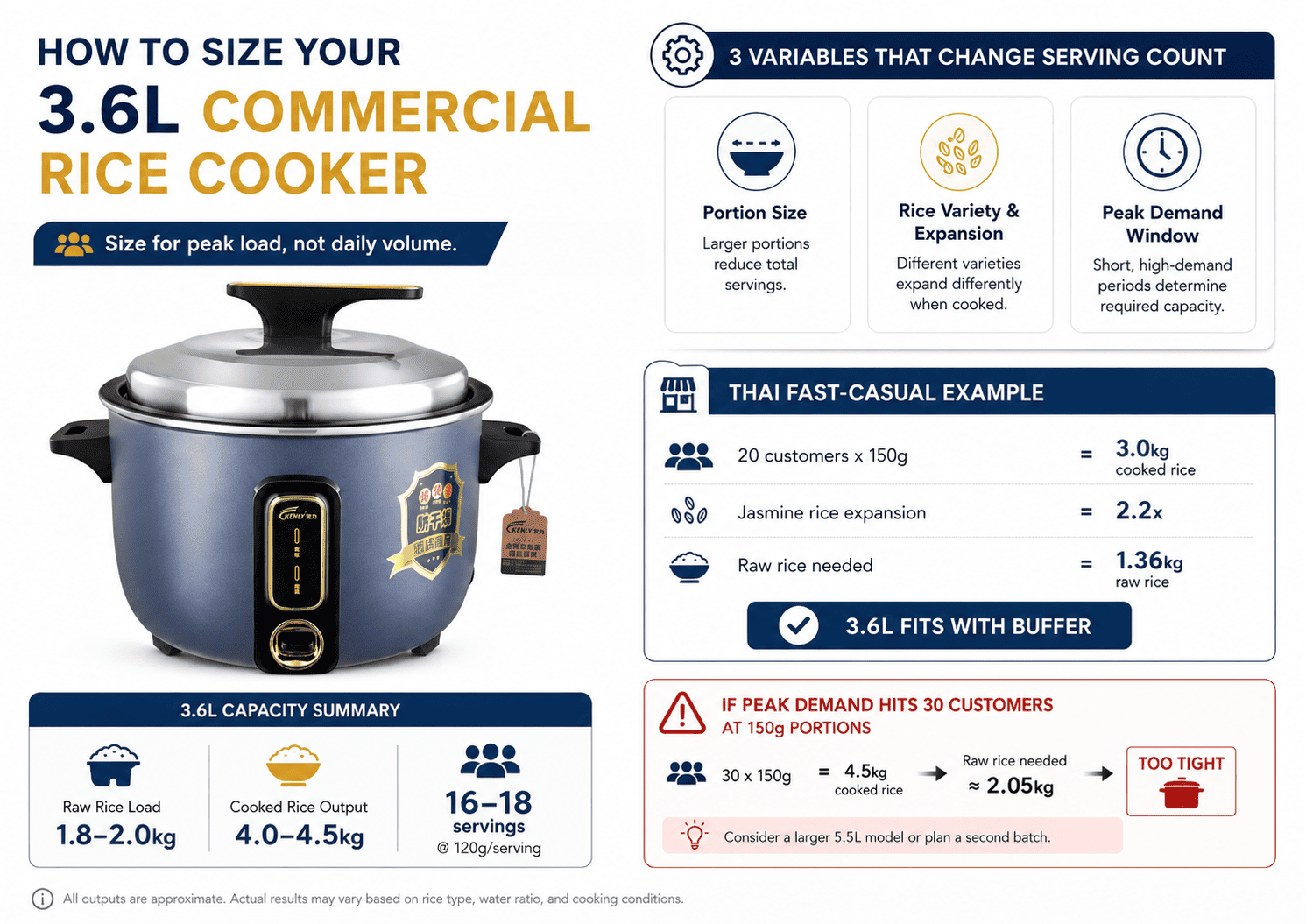
Example Calculation for a Thai Fast-Casual Restaurant
Let's use a simple restaurant example.
Your lunch rush runs from 12:00 to 13:00.
During that hour:
- 20 customers order rice dishes
- Each receives 150g of cooked rice
- You cook jasmine rice
- You estimate an approximate 2.2× cooked-weight expansion
Step 1: Calculate Cooked Rice Demand
20 customers × 150g = 3,000g
You need approximately 3.0kg of cooked rice.
Step 2: Convert to Raw Rice
3,000g ÷ 2.2 = approximately 1,364g raw rice
So you need around 1.36kg of raw rice.
Step 3: Compare With Cooker Capacity
If your selected 3.6L commercial rice cooker supports approximately 1.8–2.0kg raw rice, 1.36kg fits comfortably.
Result
A 3.6L commercial rice cooker should cover this peak period with some buffer.
Now change the scenario.
You have:
- 30 customers
- 150g each
30 × 150g = 4,500g cooked rice
4,500g ÷ 2.2 = approximately 2.05kg raw rice
Now you are at or above the assumed working range of the 3.6L cooker.
At that point, your choices become:
- Cook two batches
- Use two 3.6L cookers
- Move to a larger model
- Reduce peak pre-cooked requirement through workflow changes
For a busy fast-service restaurant, the larger cooker may be the safer option.
How Do I Calculate the Right Size for My Actual Operation?
Buyers often skip the calculation and rely on a seller saying:
"This cooker is good for 20 people."
or:
"This model is suitable for 30 people."
That is not enough information for commercial equipment purchasing.
The correct method starts with your restaurant's actual operating data.
Step 1: Identify Peak Simultaneous Demand
Count the maximum number of rice portions ordered during your busiest period.
Do not average the whole day.
For example:
- Tuesday lunch: 12 rice orders
- Friday dinner: 22
- Saturday dinner: 30
- Sunday lunch: 26
Your sizing number is closer to 30, not the daily average.
Track peak demand for at least one representative week.
Step 2: Measure Your Actual Portion
Use a kitchen scale.
Do not ask your chef:
"Roughly how much rice do we serve?"
because "one scoop" is not a technical measurement.
Measure several normal portions and calculate an average.
Suppose your actual portion is:
165g cooked rice
Use 165g in your calculation.
Step 3: Estimate the Cooked-to-Raw Ratio
Use the rice variety your restaurant actually serves.
For initial planning, you might use an approximate expansion factor, then confirm it with a real cooking test.
Formula:
Raw rice required = (Peak servings × Cooked portion weight) ÷ Expansion ratio
Step 4: Add Operating Buffer
I normally tell buyers not to size equipment exactly to their mathematical minimum.
Restaurants need room for:
- Extra customers
- Slightly larger portions
- Staff meals
- Takeaway orders
- Rice spills or waste
- Seconds
- Weekend fluctuations
- Growth
A 10–20% operating buffer is usually much safer than planning to use the cooker's maximum capacity every day.
Why Buyers Miscalculate Commercial Rice Cooker Capacity
The most common mistake is confusing daily traffic with peak capacity.
A buyer tells me:
"We serve 80 customers per day."
But maybe:
- 15 come at breakfast
- 20 at lunch
- 10 in the afternoon
- 35 at dinner
And only 60% order rice.
The actual peak requirement may be only 20–25 rice servings.
A very large commercial cooker could be unnecessary.
The opposite mistake also happens.
A restaurant serves only 60 customers per day, but 45 of them arrive during one lunch rush.
That restaurant may need more rice capacity than another restaurant serving 120 customers across 10 hours.
Don't Forget Cooking Time
Capacity is only half of the equation.
You must also ask:
"If the first batch runs out, how long until the second batch is ready?"
For the model assumed in this guide, a cooking cycle may take roughly 25–30 minutes depending on:
- Rice type
- Load
- Water temperature
- Voltage
- Heating wattage
- Cooker design
If customers cannot wait 25 minutes, the second-batch strategy may not be operationally realistic.
For high-turnover operations, I recommend planning around one dependable batch during the most intense peak window, unless your kitchen already has a proven batch-cooking workflow.
When Should I Consider a Larger Cooker Instead?
A 3.6L model is not right for every restaurant.
Consider a larger cooker if:
- Your peak raw rice requirement approaches the maximum working capacity
- You regularly need more than 25–30 standard portions at one time
- Rice is the primary base of most dishes
- You cannot cook another batch during service
- Weekend demand is significantly higher than weekday demand
- You are adding delivery platforms
- You are planning strong customer growth
- You operate a buffet
- You offer rice refills
- You handle catering orders
A larger model may also make sense when kitchen staff cannot monitor multiple batches during busy periods.
When 3.6L Is Often a Good Fit
A 3.6L commercial rice cooker can work well for:
- Small cafés
- Small restaurants
- Food stalls
- Small hotel breakfast areas
- Office canteens
- Limited-menu takeaway businesses
- Secondary rice stations
- Backup commercial rice cookers
- Restaurants testing a new rice-based menu
The important factor is not the label "small restaurant."
It is whether the cooker matches your peak rice requirement.
Does Rice Type Change the Number of Servings?
Yes.
Not because the physical cooker capacity changes, but because different rice varieties absorb water and expand differently.
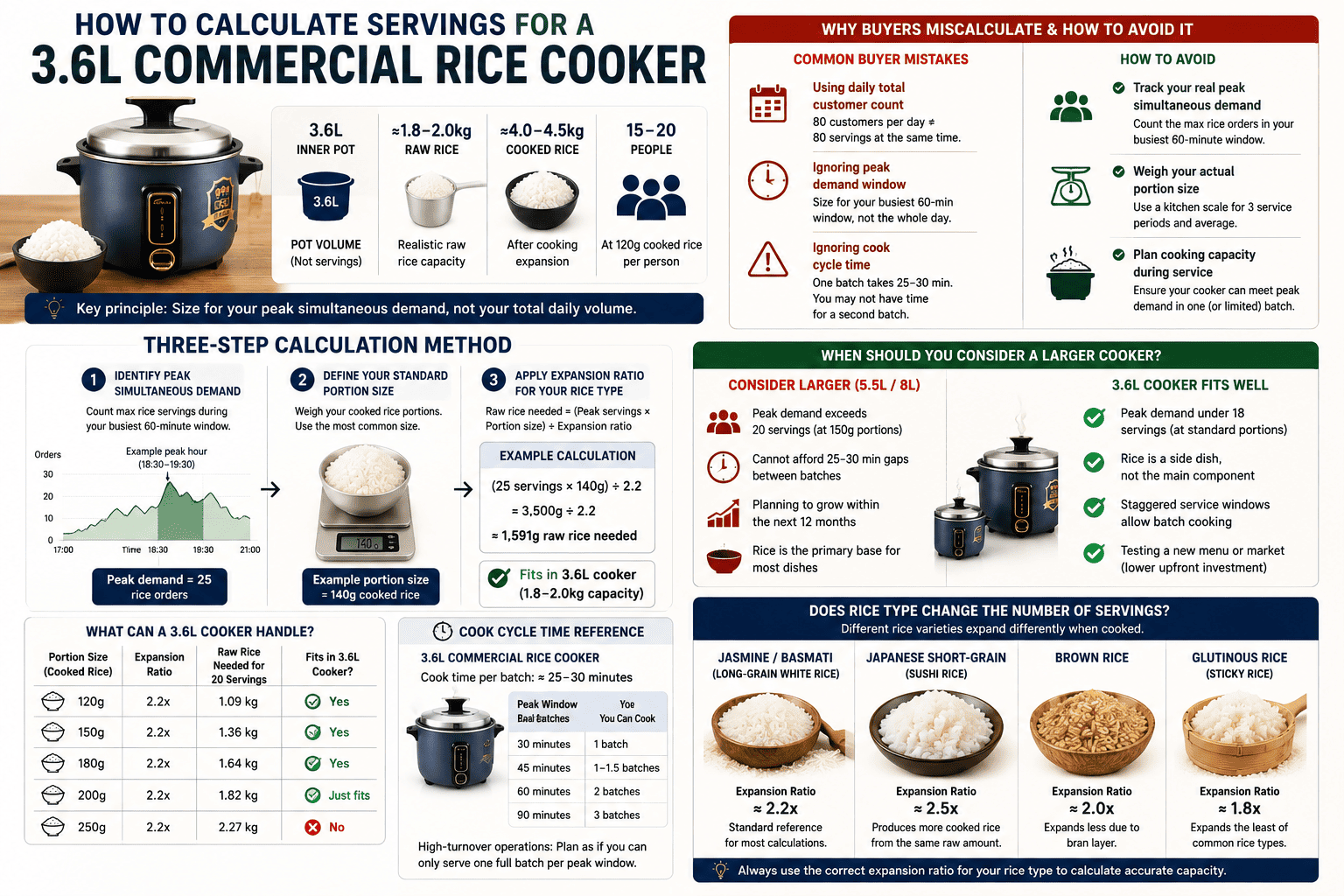
For example, if one rice variety produces around 3.96kg cooked rice from 1.8kg raw rice:
At:
- 120g portions → approximately 33 servings
- 150g portions → approximately 26 servings
- 180g portions → approximately 22 servings
- 200g portions → approximately 20 servings
If another rice type produces only 3.6kg cooked rice:
- 120g portions → 30 servings
- 150g portions → 24 servings
- 180g portions → 20 servings
- 200g portions → 18 servings
This is why your supplier cannot accurately answer:
"How many people does this serve?"
without knowing your rice type and portion size.
Sticky Rice and Glutinous Rice Require Different Calculations
Glutinous or sticky rice behaves differently from standard long-grain white rice.
It may:
- Use a different water ratio
- Expand differently
- Require soaking
- Require a different cooking program
- Create a different usable load
- Produce fewer portions from the same raw weight
For restaurants specializing in sticky rice, don't size equipment using jasmine rice assumptions.
Test the actual rice.
Water Ratio Also Affects Final Yield
Rice cookers automate heat control, but water ratio still changes:
- Cooked weight
- Texture
- Moisture
- Expansion
- Bottom condition
- Keep-warm quality
The first production test should use the rice supplier and water ratio that your restaurant plans to use commercially.
Changing water ratio changes the number of servings you obtain from one batch.
That is another reason why serving-count claims should be treated as estimates rather than fixed technical specifications.
What About Workflow and Multiple Batches During Service?
Capacity on paper is different from capacity in real kitchen operations.
A 3.6L cooker might have enough theoretical daily throughput to support a restaurant, but timing can still make it unsuitable.
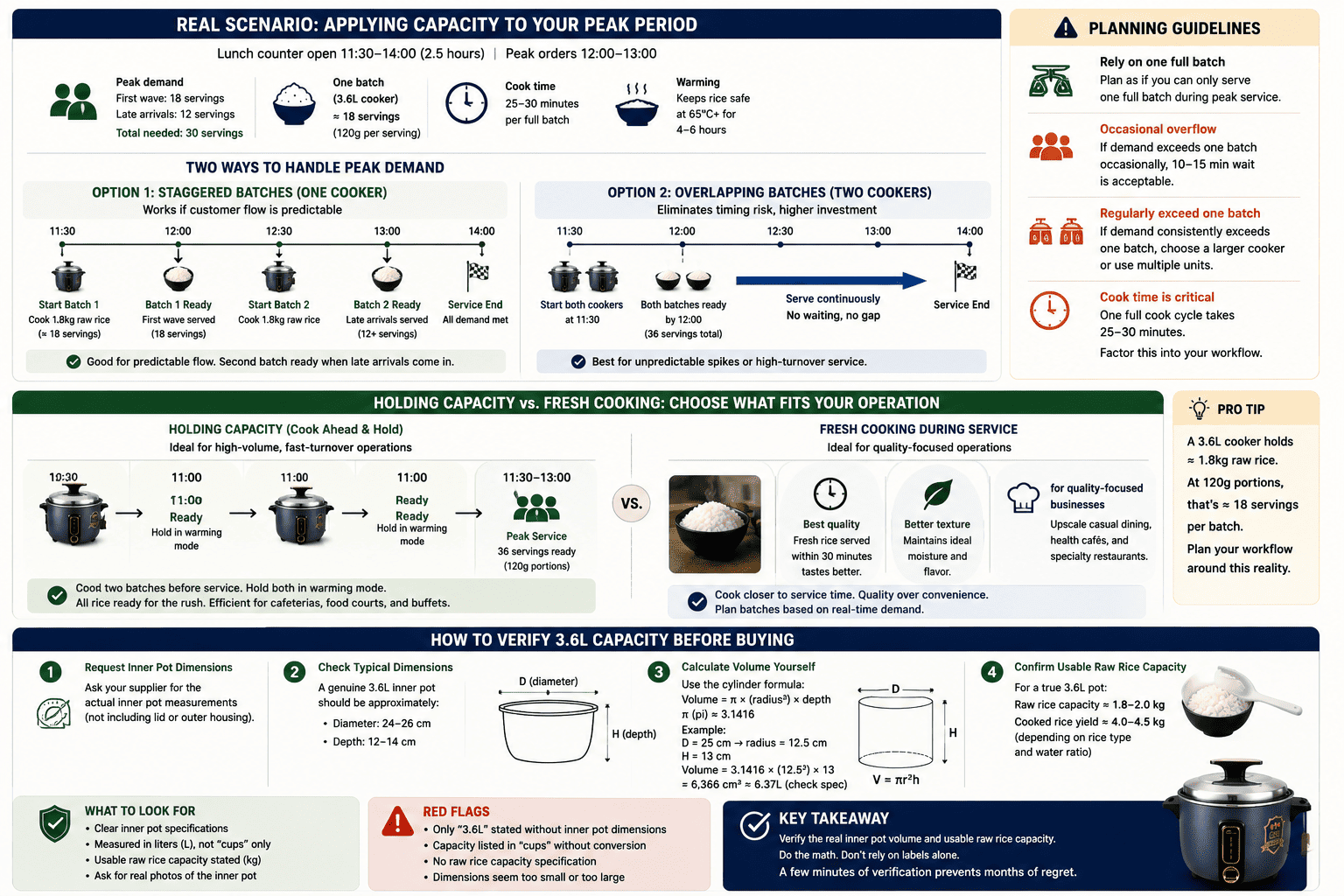
Suppose your restaurant operates:
11:30–14:00 lunch service
Your busiest period:
12:00–13:00
You need:
- 20 servings ready at 12:00
- Another 12 servings between 12:30 and 13:00
Option 1: Sequential Batch Cooking
Cook batch 1 before service.
As soon as batch 1 finishes, start batch 2.
This works when customer arrivals are predictable.
Option 2: Two Cookers in Parallel
Use two smaller cookers.
Advantages:
- Higher peak capacity
- Backup if one cooker fails
- Ability to cook different rice types
- Flexible batch sizes
Disadvantages:
- More counter space
- More electrical outlets
- Higher equipment investment
- More cleaning
Option 3: One Larger Cooker
Use a larger 5.5L or 8L model.
Advantages:
- One large pre-service batch
- Simpler workflow
- Less mid-service cooking
Disadvantages:
- Larger footprint
- Higher purchase price
- Potentially higher wattage
- Less flexibility for small batches
The right configuration depends on your kitchen.
Holding Capacity vs. Fresh Cooking
Commercial rice cookers commonly include a keep-warm function, but holding cooked rice creates another operational decision.
You need to balance:
- Capacity
- Food quality
- Safety
- Freshness
- Service speed
Rice held for long periods may gradually become:
- Drier
- Firmer
- Yellow
- Crusted at the bottom
- Less aromatic
Restaurants focused on food quality may prefer several smaller fresh batches.
Fast-turnover cafeterias may prefer larger pre-cooked batches held ready for service.
The correct cooker size depends partly on which operating model you use.
How Do I Verify Capacity Before Buying?
Buyers sometimes ask:
"How do I know the supplier's 3.6L claim is accurate?"
That's a good question.
The best answer is not to rely on the product title alone.
Ask the supplier for:
- Inner pot volume
- Inner pot dimensions
- Raw rice capacity
- Recommended working capacity
- Maximum rice line
- Measuring cup size
- Maximum raw rice weight
- Full-load cooking test
- Cooking time
Conduct a Real Cooking Test
Before placing a large commercial order:
Step 1: Use the exact rice your business plans to serve.
Step 2: Weigh the raw rice.
Step 3: Add water according to the recommended ratio.
Step 4: Measure cooking time.
Step 5: Weigh the final cooked rice.
Step 6: Portion it using your restaurant's actual serving size.
Step 7: Count the number of portions.
Step 8: Test the keep-warm function for the period your restaurant normally requires.
This gives you an answer based on your operation rather than a supplier's generic claim.
Red Flags When Evaluating Supplier Capacity Claims
I've seen buyers make poor purchasing decisions because two suppliers describe capacity differently.
Watch for these warning signs.
1. "Serves X People" Without a Portion Size
A supplier saying:
"This cooker serves 30 people."
doesn't tell you enough.
Ask:
"At how many grams of cooked rice per person?"
Without a portion size, the serving claim has little procurement value.
2. Capacity Given in "Cups" Without Clarifying Raw vs. Cooked Rice
Ask:
- Is the cup count raw rice or cooked rice?
- What is the cup volume?
- Is it 180ml, 200ml, or another size?
- How many grams of your standard rice fit in one cup?
Do not assume every manufacturer's "cup" means the same thing.
3. No Raw Rice Weight Specification
For commercial buyers, kilograms of raw rice are often more useful than marketing cup counts.
Ask:
"What is the maximum raw rice weight tested in this model?"
4. Supplier Cannot Give Inner Pot Dimensions
A manufacturer should know:
- Diameter
- Depth
- Pot material
- Thickness
- Volume
If the supplier cannot provide basic pot specifications, investigate further.
5. Maximum Capacity and Recommended Capacity Are Identical
A supplier may advertise the absolute maximum fill level.
That does not necessarily mean you should operate at that limit every batch.
Ask for the recommended commercial working range.
6. No Full-Load Cooking Test
Ask the supplier:
- What rice was used?
- How much raw rice?
- How much water?
- What voltage?
- What wattage?
- What was the cooking time?
- Was the rice evenly cooked?
Commercial capacity should be demonstrated through actual cooking performance, not only inner pot volume.
7. Serving Claim Changes Between Salespeople
If one salesperson says:
"15 people"
and another says:
"30 people"
the company probably does not have a standardized serving calculation.
Ask for the technical basis in writing.
8. No Clear Difference Between 3.6L, 5.5L, and 8L Models
The supplier should be able to explain how larger models differ in:
- Raw rice capacity
- Wattage
- Cooking time
- Inner pot
- Heating plate
- Electrical requirements
- Carton size
- Recommended application
9. Supplier Recommends the Largest Model Without Asking About Your Restaurant
A proper commercial recommendation should ask about:
- Peak demand
- Portion size
- Rice type
- Service pattern
- Kitchen space
- Electrical supply
- Growth
If the supplier immediately recommends the largest and most expensive cooker, the recommendation may be sales-driven rather than operationally driven.
What Specifications Should You Ask for Before Ordering a 3.6L Commercial Rice Cooker?
Before comparing quotations, request the same information from every supplier.
| Specification | What to Confirm |
|---|---|
| Nominal capacity | 3.6L |
| Inner pot actual volume | Supplier specification |
| Raw rice capacity | Maximum tested weight |
| Recommended working load | Normal commercial use |
| Measuring cup | Volume in ml |
| Rated voltage | 110–120V or 220–240V |
| Frequency | 50Hz / 60Hz |
| Rated wattage | Exact model specification |
| Full-load cooking time | Under stated test conditions |
| Inner pot material | Aluminum, coated aluminum, stainless, etc. |
| Inner pot thickness | Exact specification |
| Heating plate | Material and wattage |
| Thermostat | Type/specification |
| Thermal protection | Fuse/limiter specification |
| Power cord | Length and cable specification |
| Plug | Destination-market configuration |
| Keep-warm | Temperature/performance |
| Net weight | Product only |
| Gross weight | Packed unit |
| Carton dimensions | For freight calculation |
| Warranty | Period and scope |
| Spare parts | Inner pot, thermostat, heating plate, switch, cord |
This makes supplier comparisons much more meaningful than comparing only FOB price and "3.6L."
3.6L vs. Larger Commercial Rice Cooker: Quick Decision Guide
| Operating Situation | 3.6L | Larger Model |
|---|---|---|
| Small café | Good fit | Often unnecessary |
| Small food stall | Good fit | Depends on peak demand |
| Restaurant serving under ~20 large rice portions at peak | Usually suitable | Optional buffer |
| Restaurant serving 25–30 medium portions at peak | Borderline depending on portion/rice type | Often safer |
| 30+ large rice portions at once | Usually too small | Recommended |
| Multiple batches possible | More workable | Less necessary |
| One batch must cover entire rush | Risk increases | Better choice |
| Rapid growth expected | Limited buffer | More future-proof |
| Rice is a side dish | Good fit | Often unnecessary |
| Rice is main base for most dishes | Depends on traffic | Larger model often useful |
| Need two rice types | Two smaller cookers may be better | One large cooker less flexible |
The table is a starting point—not a substitute for actual demand calculation.
What Should You Do Before Placing a Large Order?
For restaurant buyers, distributors, or private-label customers, I recommend this sequence:
1. Calculate Your Peak Requirement
Use:
Peak customers × rice portion ÷ cooked expansion ratio
2. Add Buffer
Include:
- Weekend traffic
- Promotions
- Refills
- Takeaway
- Growth
3. Ask the Supplier for Raw Rice Capacity
Do not rely only on liters or cup count.
4. Test a Sample
Cook the exact rice you will use commercially.
5. Test Maximum Expected Load
Do not test only half a pot.
6. Measure Cooking Time
Confirm the cooker fits your service workflow.
7. Test Keep-Warm Quality
Use the actual holding duration required by your restaurant.
8. Check Electrical Infrastructure
Confirm:
- Voltage
- Frequency
- Wattage
- Plug
- Circuit capacity
9. Compare Larger Alternatives
Ask the supplier to quote:
- 3.6L
- 5.5L
- 8L
when available.
The small price difference between sizes may be worth paying if it removes a major operational bottleneck.
10. Plan Backup Capacity
If rice is critical to your menu, ask:
"What happens if this cooker fails during Friday dinner service?"
For some restaurants, two units are better than one oversized unit.
Conclusion
So, how many people can a 3.6L commercial rice cooker serve?
There is no single honest number.
Using the working assumptions in this guide, a 3.6L commercial rice cooker may produce roughly 3.6–4.5kg of cooked rice per batch, depending on raw rice load, rice variety, and water ratio.
That translates approximately to:
- 30–37 servings at 120g
- 24–30 servings at 150g
- 20–25 servings at 180g
- 18–22 servings at 200g
But those numbers are only a starting point.
For restaurant sizing, the better question is:
How many portions must be ready at the same time during my busiest predictable service period?
A 3.6L commercial rice cooker is often a good choice for small restaurants, cafés, food stalls, hotel breakfast areas, and operations with moderate peak demand.
It becomes risky when:
- Peak demand regularly approaches its maximum load
- Customers arrive in concentrated waves
- Rice is the main component of most dishes
- You cannot cook another batch during service
- Your business is growing rapidly
Before placing an order, confirm the supplier's actual raw rice capacity, recommended working load, measuring cup size, full-load cooking time, wattage, and inner pot specification.
Then cook your own rice in the sample and count your own portions.
That real kitchen test gives you a much more reliable answer than any supplier claiming:
"3.6L serves 20 people."
or:
"3.6L serves 30 people."
The cooker does not know how many customers are sitting in your restaurant.
It only knows how much rice you put inside.
Your job as a buyer is to connect that real capacity to your peak service demand before the lunch rush exposes the mistake.