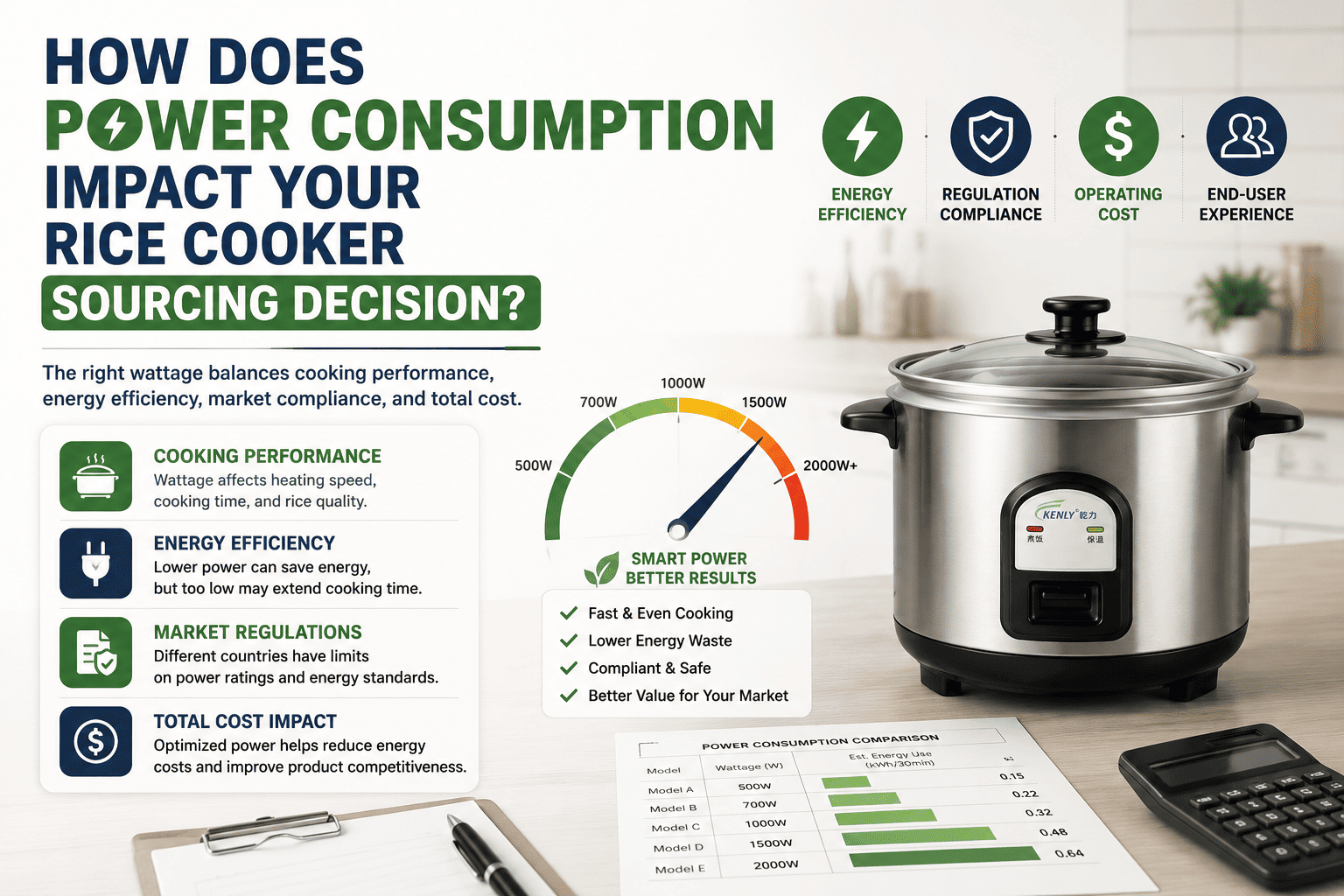
Rice cooker power consumption directly affects your compliance risk, household compatibility in target markets, and energy certification requirements. The rated power shown on the nameplate determines circuit breaker load, while actual operating consumption impacts energy label accuracy and cost declarations. Matching wattage specifications to local grid standards before placing orders prevents customs rejection and warranty claims.
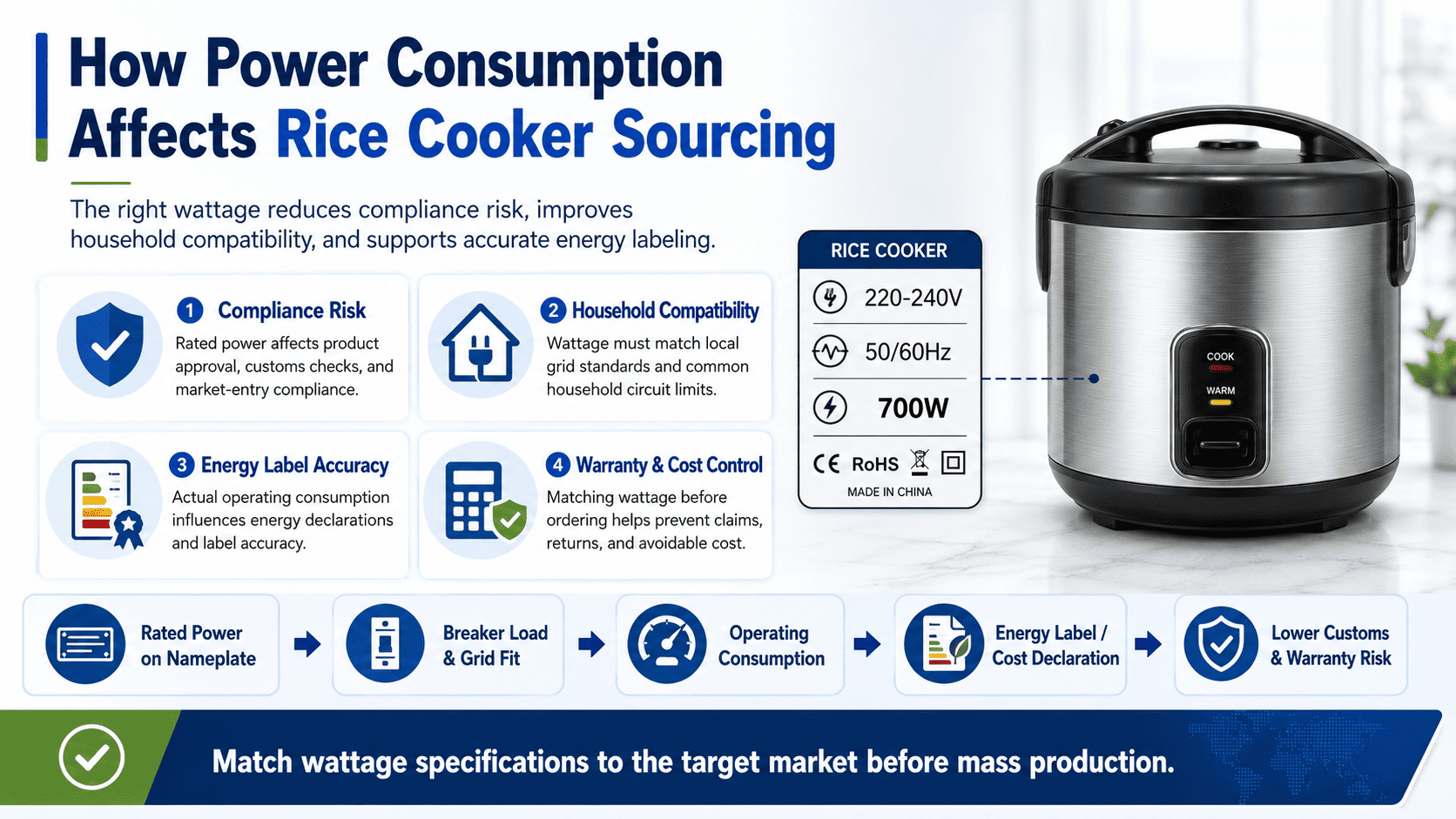
This matters because most procurement mistakes happen during specification handoff. I see buyers copy competitor product claims without verifying test standards. Then they discover their shipment needs additional certification documents at port. Let me walk you through what power consumption numbers actually mean for your sourcing decision.
What Does Rated Power vs Operating Power Mean in Rice Cooker Specifications?
You receive a quotation listing "Rated Power: 700W" on the spec sheet. Your colleague asks if that number represents the electricity cost customers will pay. This confusion creates problems later.
Rated power shows the maximum wattage draw during peak heating phases, typically listed on the product nameplate for electrical safety compliance. Operating power reflects the average consumption across a complete cooking cycle, usually 20-40% lower than rated power1 because rice cookers cycle between heating and warming modes.
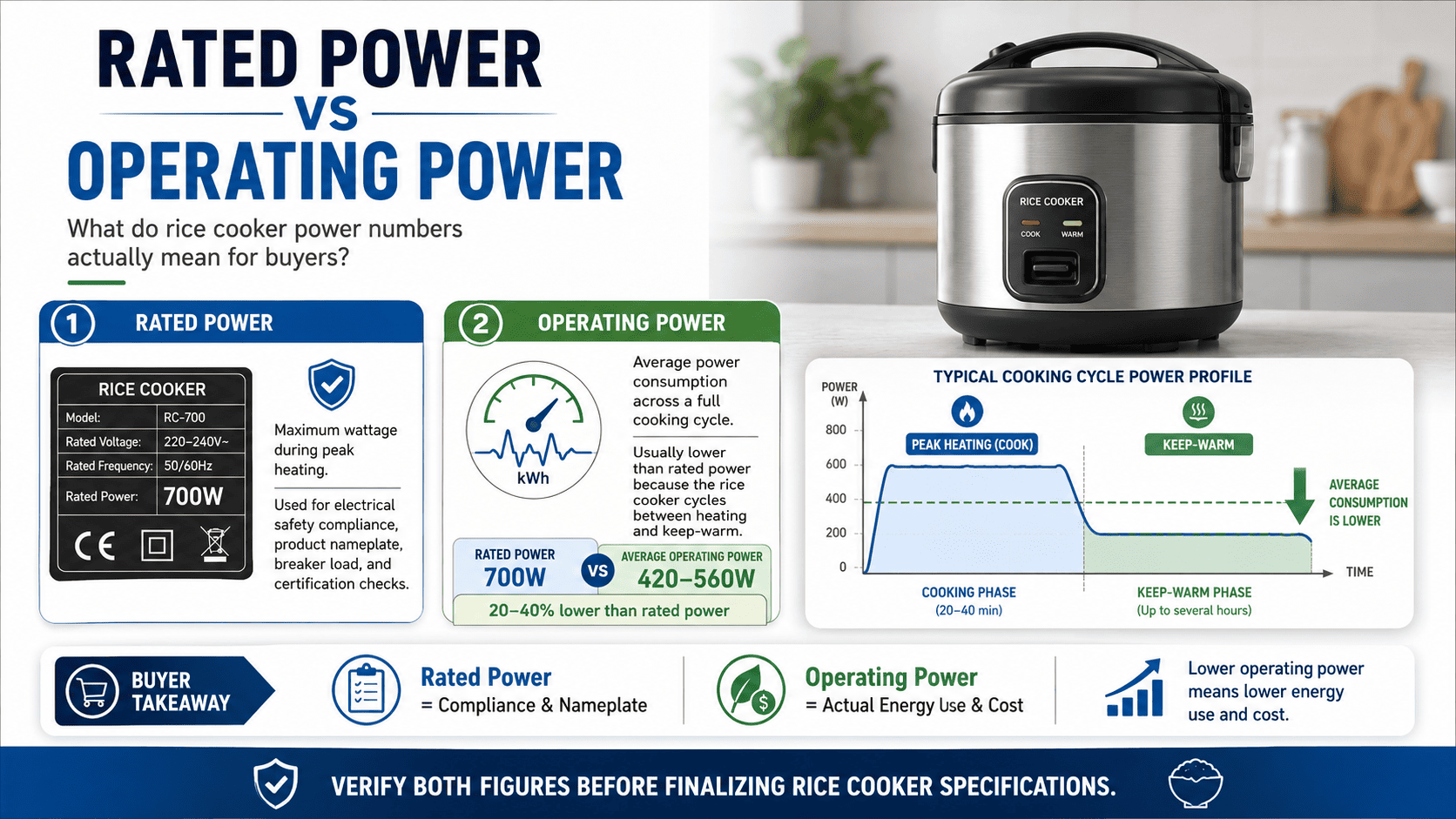
Why This Distinction Matters for Your Purchase Order
Most buyers focus only on the rated power number when comparing quotations. Questions like "Why does your 700W model cost more than competitor's 650W unit?" The answer often lies in heating element quality and insulation efficiency, not just peak wattage.
Rated power determines three factors. First, it sets the electrical safety testing parameters. A 700W rating means the product underwent high voltage testing at that load level. Second, it defines the household circuit compatibility. Thailand and Southeast Asian markets typically use 15-20A breakers at 220V, giving you roughly 3,300-4,400W total capacity per circuit2. Third, it appears on all compliance documentation including CE, CB, and energy certificates.
Operating power affects different concerns. It determines the actual energy label classification under EU ERP or Energy Star programs. It impacts your marketing claims about electricity cost savings. It also influences customer satisfaction because actual consumption differs from nameplate ratings.
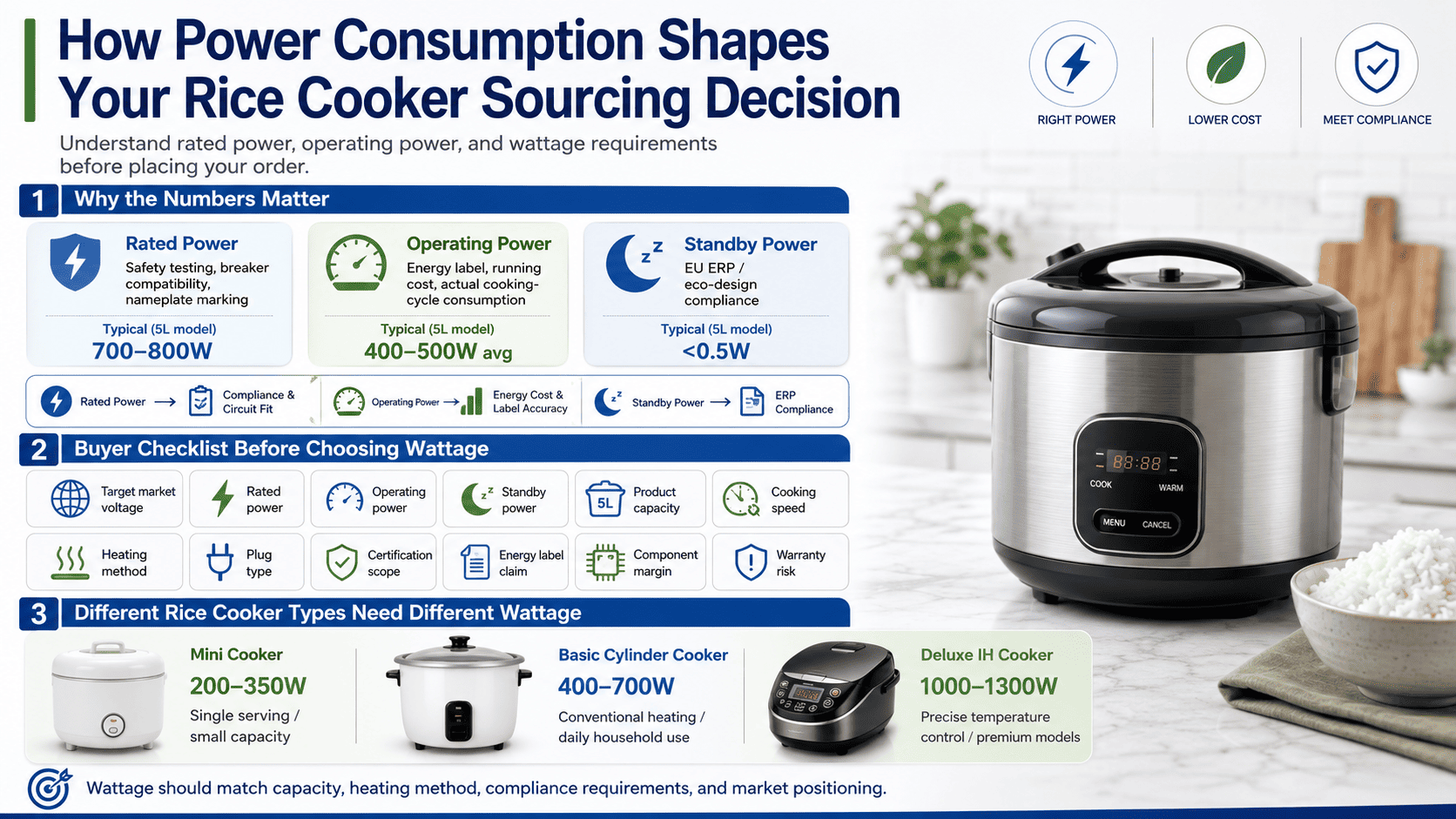
| Power Type | Determines | Document Source | Typical Value (5L model) |
|---|---|---|---|
| Rated Power | Safety testing parameters, breaker compatibility, nameplate marking | IEC 60335 test report, product certification | 700-800W |
| Operating Power | Energy label classification, consumption claims, running costs | EN 50564 standby test, energy efficiency report | 400-500W average |
| Standby Power | EU ERP compliance, eco-design requirements | Standby power measurement per EC 1275/2008 | <0.5W |
I verify these numbers with buyers before quoting because specification errors create liability gaps. You order based on rated power, then discover the operating consumption doesn't match your energy label application. The factory delivered exactly what you specified, but your documentation doesn't align with market requirements.
This happens frequently with drum rice cooker models. Buyers see a competitor listing "energy efficient 650W" without checking if figure represents rated or operating power. They request matching specifications. We clarify which number they actually need for their target certification. Many times, they realize they copied incomplete information from retail listings, not technical datasheets.
Buyer Checklist: What Should You Confirm Before Choosing Rice Cooker Wattage?
Before confirming a rice cooker order, buyers should not compare wattage only as a number on the quotation sheet. Power consumption affects safety testing, cooking speed, household compatibility, certification cost, energy label accuracy, and warranty risk.
Use this checklist before you finalize the model:
| Checklist Item | What to Confirm | Why It Matters |
|---|---|---|
| Target market voltage | 110-120V or 220-240V | The product must match local household power supply |
| Rated power | Maximum wattage on nameplate and specification sheet | Affects safety testing, label marking, and circuit compatibility |
| Operating power | Average consumption during a full cooking cycle | Affects energy label accuracy and marketing claims |
| Standby power | Power draw when the product is not actively cooking | Important for EU ERP and other energy efficiency requirements |
| Product capacity | 0.5L, 1.5L, 1.8L, 2.8L, 5L, or commercial size | Wattage must match cooking volume |
| Cooking speed | Actual cooking time for local rice type and portion size | Too-low wattage may create customer complaints |
| Heating method | Conventional heating plate or induction heating | IH models usually require higher rated power and stricter testing |
| Plug type | EU plug, BS plug, US plug, KC plug, AU plug, or other local plug | Wrong plug configuration can block sales or create user complaints |
| Certification scope | CE, CB, GS, UKCA, KC, Energy Star, ERP, GEMS, or local MEPS | Different markets require different test reports |
| Energy label claim | Whether you will claim low energy consumption or energy saving | Marketing claims must be backed by test data |
| Component margin | Heating element, thermostat, wiring, and insulation rating | Components should not operate at their maximum limit all the time |
| Warranty risk | Expected return rate caused by slow cooking, overheating, or breaker trips | Power mismatch can become an after-sales cost |
A practical sourcing decision should answer one question clearly: does this wattage match the target market's household power supply, cooking habit, compliance requirement, and retail price position?
How Do Different Rice Cooker Types Affect Power Consumption Requirements?
Your product line plan includes deluxe models, cylinder types, and mini cookers. Each category shows different wattage ratings on supplier quotations. You need to understand why these numbers vary and what that means for your market positioning.
Rice cooker power consumption correlates with cooking capacity, heating method, and feature sets. Deluxe IH models typically draw 1,000-1,300W for precise temperature control, while basic cylinder types use 400-700W for simple heating. Mini cookers designed for single servings consume 200-350W to match smaller heating elements and reduced cooking volumes.
Matching Product Category to Market Grid Infrastructure
I receive specification requests that don't account for household electrical capacity in the target market. A buyer wants to source 1,200W induction heating models for distribution in older apartment complexes. Then they discover many target households can't support that load without tripping breakers.
Deluxe rice cookers with IH technology require higher wattage because the heating method works differently. Instead of a simple bottom heating plate, these units use electromagnetic induction to heat the inner pot directly. This allows precise temperature curves but demands more peak power draw. The rated consumption typically ranges from 1,000W to 1,300W depending on capacity. Operating power averages 600-800W because the unit cycles on and off to maintain temperature zones.
We manufacture these models primarily for buyers targeting premium segments in markets with modern electrical infrastructure. Japan, Korea, and newer residential developments in Southeast Asia can support this specification. The key sourcing question: does your distribution channel sell into households with adequate circuit capacity?
Cylinder and drum rice cookers use conventional heating plates. These units show rated power between 400-700W for 1.5L to 5L capacities. Operating consumption runs lower, typically 300-450W average. This specification fits markets where customers use multiple appliances simultaneously on the same circuit. Thailand procurement managers often specify this range because household breakers commonly rate at 15A, about 3,300W total capacity at 220V.
Mini rice cookers serve single-person households or office pantries. Rated power usually falls between 200-350W because the heating element and cooking volume scale down. Some buyers assume lower wattage always means better marketability. That logic breaks when customers compare cooking speed. A 200W mini cooker takes 35-40 minutes to cook one cup of rice, while a 350W unit completes the same portion in 22-25 minutes3.
| Category | Typical Capacity | Rated Power Range | Operating Power | Grid Compatibility Note |
|---|---|---|---|---|
| Deluxe IH | 3-10L | 1,000-1,300W | 600-800W average | Requires dedicated 20A circuit in most markets |
| Cylinder/Drum | 1.5-5L | 400-700W | 300-450W average | Compatible with standard 15A household circuits |
| Mini Cooker | 0.5-1.5L | 200-350W | 150-280W average | Safe for multi-appliance office environments |
| Commercial | 10-30L | 2,000-3,500W | 1,200-2,000W average | Requires commercial three-phase or dedicated circuits |
The sourcing decision connects to your distribution channel. If you supply retailers serving older apartment buildings, high-wattage IH models create customer complaints about tripped breakers. If you target premium kitchen appliance stores, basic cylinder types don't meet buyer expectations for feature sets and brand positioning.
I ask buyers about their channel mix before recommending product categories. A procurement manager once specified 1,100W deluxe models for mass-market distribution without checking end-customer electrical capacity. After the first container arrived, their retailer reported returns from customers who couldn't use the product without upgrading home wiring. The factory met all specifications, but the product didn't fit the actual use environment.
What Energy Efficiency Standards Apply to Your Target Import Markets?
You prepared technical specifications and supplier quotations look acceptable. Then your freight forwarder mentions energy efficiency compliance documents. You realize you never verified which certifications your target market actually requires.
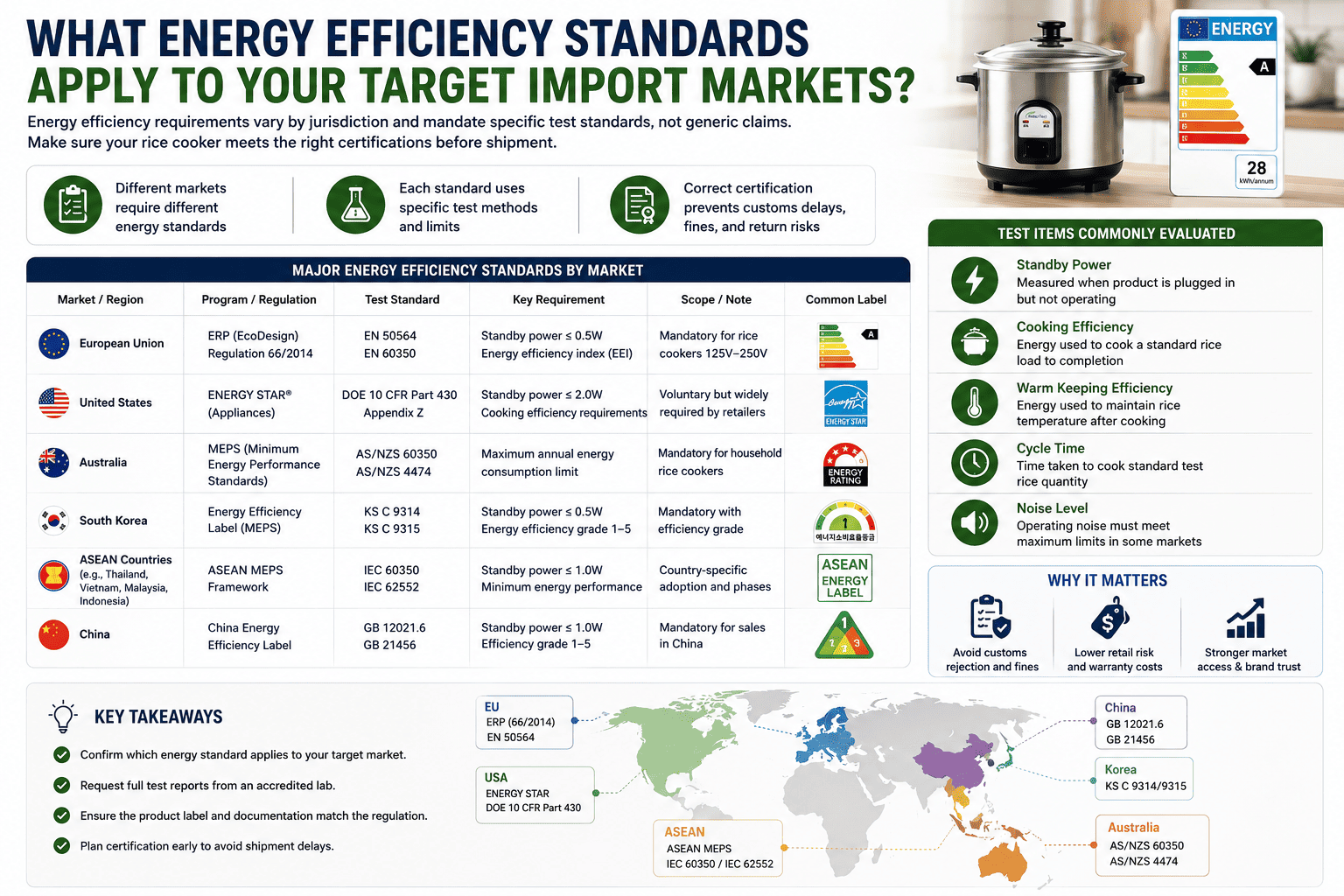
Energy efficiency requirements vary by jurisdiction and mandate specific test standards, not generic claims. EU markets require ERP compliance under regulation 66/2014 with standby power limits4. Energy Star certification applies to US and some Asian markets using DOE test procedures5. MEPS programs in Australia, Korea, and ASEAN countries each specify different measurement protocols and minimum performance thresholds.
Verification Steps Before Purchase Order Confirmation
Most specification confusion happens because buyers don't distinguish between different certification frameworks. I receive requests saying "we need energy efficient models" without specifying which standard applies. This creates problems during customs clearance when authorities request specific test reports.
EU markets operate under the ERP directive for household rice cookers. This regulation sets maximum standby power consumption at 0.5W and requires specific test procedures per EN 50564. The product must display energy label information showing annual energy consumption calculated from standardized test cycles. Some buyers assume a generic "energy efficient" claim suffices. It doesn't. Customs authorities request the actual EU test report and energy label registration.
We maintain CB test reports covering safety standards like IEC 60335, but energy efficiency requires separate testing. When buyers confirm EU as the target market, I verify if they need us to arrange EN 50564 testing or if they'll handle certification independently. The test costs roughly USD 800-1,200 per model and takes 3-4 weeks. This timeline affects your launch schedule if you didn't budget for it upfront.
Energy Star applies primarily to US markets but some Asian retailers recognize the certification. The DOE test procedure measures energy consumption during both cooking and keep-warm modes across multiple cycles6. The performance threshold changes periodically, so checking the current specification version matters. Products meeting Version 3.0 requirements might not automatically qualify under Version 4.0 without retesting.
Some buyers see "Energy Star" on competitor products and request matching claims. I ask them to provide the test report or registration number so we can verify the specification. Many times, they copied marketing language without confirming actual certification status. Energy Star maintains a public database of certified models. If your competitor's product isn't listed there, the claim might be inaccurate regardless of what appears on their packaging.
MEPS programs in Australia, Korea, Thailand, Vietnam, and Singapore each use different test standards and registration procedures. Australia requires GEMS registration with minimum energy performance standards7. Korea uses KC certification with specific power consumption limits8. ASEAN countries are implementing MEPS frameworks but acceptance varies by member state9. Thailand currently doesn't mandate rice cooker energy labeling but may adopt requirements following regional harmonization efforts.
| Market | Regulation | Test Standard | Key Requirement | Registration Process |
|---|---|---|---|---|
| European Union | ERP 66/2014 | EN 50564 | Standby ≤0.5W, energy label display | Test report + energy label registration through national authority |
| United States | Energy Star Program | DOE Test Procedure | Version-specific consumption thresholds | EPA Energy Star partner application with test data |
| Australia | GEMS | AS/NZS 61121 | MEPS compliance, registration | GEMS database registration with test evidence |
| South Korea | MEPS (KC) | KC 60350 | Efficiency grade classification | KC certification with Korean lab test report |
| ASEAN | Harmonized MEPS (developing) | Varies by country | Country-specific adoption status | Check individual member state requirements |
The sourcing risk appears when you assume one certification covers multiple markets. A buyer once placed orders with EU ERP compliance, then discovered their Australia distribution needed separate GEMS registration. The test procedures differ slightly, requiring additional lab work and documentation. The factory met the agreed EU specification but couldn't provide Australia compliance without extra certification costs.
I recommend buyers create a compliance matrix before finalizing specifications. List each target market, identify the mandatory energy efficiency standard, confirm the test procedure, and allocate budget for certification. Then share this matrix with suppliers during RFQ stage so quotations reflect actual compliance costs. This prevents surprises when you're ready to ship.
Many factories claim "we can meet your energy requirements" without clarifying which specific standards they've tested against. I ask buyers to request actual test report numbers and verification that reports came from accredited labs. Some suppliers provide test data from non-recognized facilities. Those documents won't satisfy customs authorities in regulated markets.
Certification Requirements Buyers Should Confirm
Power consumption is directly connected to certification. A rice cooker with the wrong rated power, plug type, voltage, or standby power may fail the target market's safety or energy efficiency requirements.
Before confirming the purchase order, buyers should check these certification-related points:
| Requirement Area | What Buyers Should Check | Why It Matters |
|---|---|---|
| Electrical safety certification | CE, CB, GS, UKCA, KC, SAA, UL, ETL, or local approval | Confirms that the product meets electrical safety requirements |
| Energy efficiency compliance | ERP, Energy Star, GEMS, MEPS, or local energy label program | Required in some markets and useful for energy-saving claims |
| Rated power marking | Wattage shown on rating label, carton, manual, and test report | Inconsistent wattage creates customs and compliance risk |
| Operating power test | Average consumption during cooking and keep-warm cycle | Supports energy label and marketing claims |
| Standby power test | Standby consumption, especially for digital or timer models | Important for EU ERP and other eco-design rules |
| Voltage and frequency | 110-120V / 60Hz or 220-240V / 50Hz | Must match the destination country's power grid |
| Plug and power cord | Local plug type, cable rating, and certification mark | Prevents user complaints and safety issues |
| Heating element specification | Rated capacity, insulation, thermal protection, and component margin | Poor component matching increases overheating and failure risk |
| Label and manual | Power rating, warning text, safety instructions, and local language | Retailers and customs may require correct documentation |
| Test report scope | Whether the final model, wattage, plug, PCB, and configuration are covered | Customized models may require additional testing |
For example, if a buyer sells rice cookers in Europe, CE, RoHS, ERP standby power, correct voltage, rating label, plug type, manual language, and importer information should be checked before production. If the buyer sells in South Korea, KC certification and Korean labeling requirements should be confirmed. If the buyer sells in Australia, GEMS registration may be required depending on the product category and current local rules.
The safest approach is to confirm certification requirements during quotation and sampling. If the buyer changes wattage, heating element, thermostat, PCB, plug, or voltage after certification planning, the existing test report may no longer cover the final product.
How Do You Calculate Total Cost Impact of Power Consumption Specifications?
Your finance team approved the sourcing budget based on unit FOB costs. Now you realize power consumption affects multiple cost categories beyond the purchase price. You need to understand the total impact before final vendor selection.
Power consumption specifications influence certification costs, shipping classifications, market positioning, and post-import warranty exposure. High-wattage models require additional electrical safety testing and may trigger higher customs duty rates in markets using HS code classifications that consider power ratings. Operating consumption affects your energy label claims and customer electricity cost comparisons against competing brands.
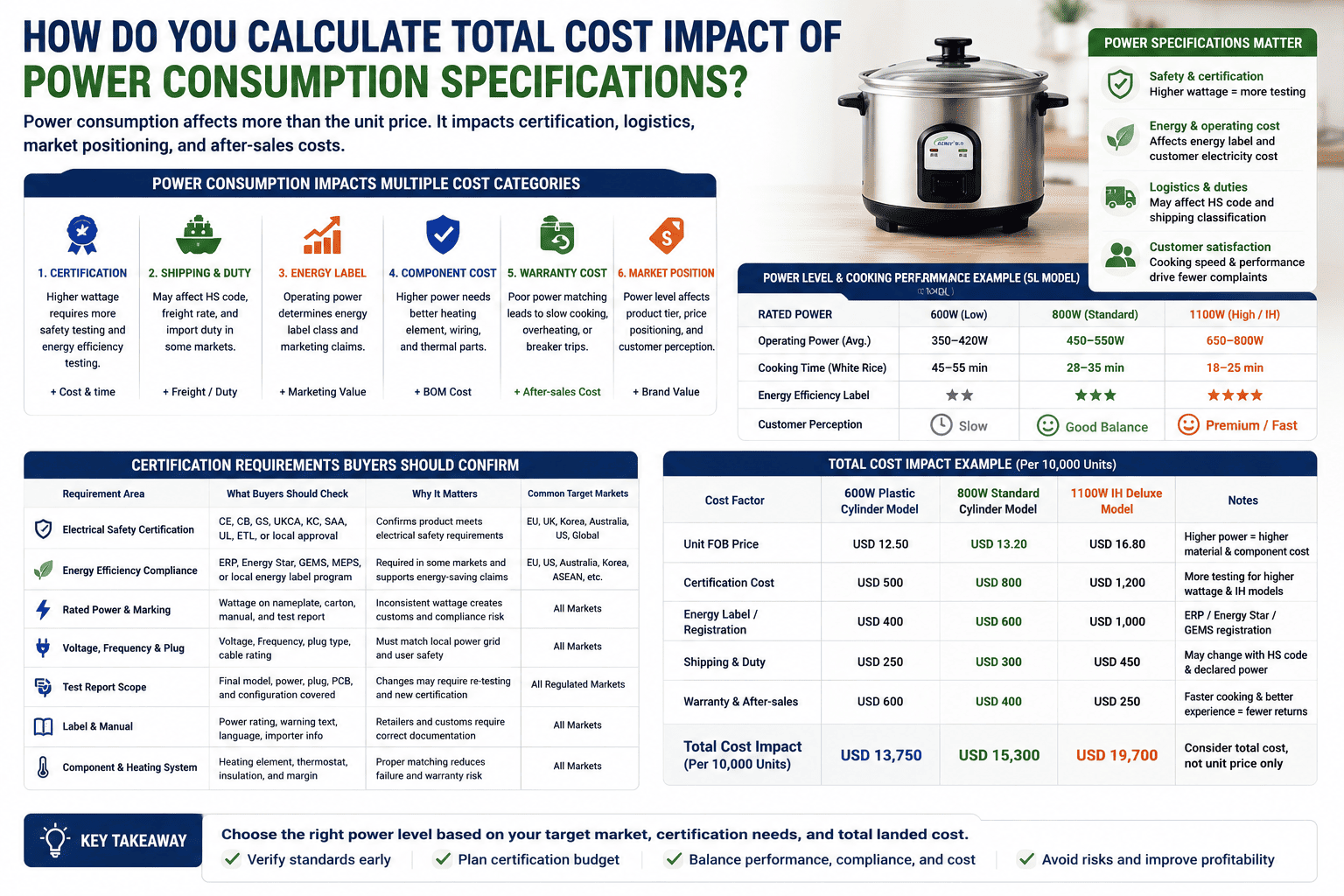
Building Your Specification Cost Model
I work with buyers who focus only on the unit FOB price when comparing suppliers. Then they discover the lower-priced quotation requires extra certification work that eliminates the cost advantage. A complete cost analysis includes several power-related factors.
Certification testing costs scale with power rating and number of target markets. A 700W cylinder rice cooker needs basic safety testing for most markets, typically covered by CB scheme reports. Cost runs around USD 1,500-2,500 per model for initial certification. Adding energy efficiency testing adds another USD 800-1,500 per target market standard. A 1,200W IH model requires additional electromagnetic compatibility testing because of the induction heating system, adding USD 1,000-1,800 to certification expenses.
Some HS code classifications use power rating as a determining factor for duty rates10. This varies by import country, but I've seen cases where models above 1,000W rated power fell into different tariff categories than lower-wattage units. The duty difference might be 2-3 percentage points, which compounds across large order quantities. Your customs broker should verify classifications before you commit to specifications.
Market positioning affects gross margin more than unit cost. If you source 350W basic models while competitors offer 550W units at similar retail pricing, customers perceive inferior performance. Your cost advantage disappears because you can't match competitor pricing without sacrificing margin. Conversely, if you specify 1,100W deluxe models for a price-sensitive market segment, the higher specification doesn't justify premium pricing in that channel.
Operating consumption influences customer acquisition costs through marketing claims. If your 700W model consumes 420W average during operation, you can calculate annual electricity costs versus competitor models. This creates marketing content: "Saves USD X per year compared to typical 500W operating consumption units." That claim requires verified test data, which means investing in proper energy efficiency testing upfront.
Warranty exposure connects to power specification through product lifespan. Higher wattage models generate more heat stress on components over time. If you specified the highest power rating to achieve fastest cooking times, component degradation might increase warranty claims after 18-24 months. This doesn't mean high-wattage designs are inherently unreliable, but it requires verification that the supplier designed adequate thermal management for sustained operation at peak loads.
| Cost Category | Power Specification Impact | Typical Budget Range | Decision Point |
|---|---|---|---|
| Safety Certification | Higher wattage requires more stringent testing parameters | USD 1,500-4,500 per model, varies by markets | RFQ stage: confirm which tests supplier provides |
| Energy Testing | Each market standard requires separate test procedure | USD 800-1,500 per standard per model | Before PO: identify mandatory vs optional certifications |
| Customs Duties | Some HS codes consider power rating in classification | 0-3% rate variation, country-specific | Pre-shipment: verify with customs broker |
| Marketing Content | Operating consumption enables cost-saving claims | USD 500-2,000 for verified test data usable in marketing | Product launch preparation |
| Warranty Reserve | Higher thermal stress may increase failure rates | 1-3% of COGS depending on specification and quality | Quality agreement negotiation with supplier |
I ask buyers to map specifications against their channel margin structure. A procurement manager once chose the lowest FOB price without accounting for certification costs. When we added required testing for EU and Australia markets, the total landed cost exceeded the next supplier quotation that included all certifications. The "cheapest" option became the most expensive because specification costs weren't evaluated completely.
Another common gap appears in warranty cost assumptions. Buyers see two quotations at similar FOB pricing but different power specifications. They assume quality is equivalent. Later they discover the higher-wattage model uses lower-grade components to hit the same price point. Warranty claims spike after six months because thermal stress exceeded component ratings. The supplier met the agreed specification but didn't disclose the tradeoffs in component selection.
This is why I recommend buyers request component specifications alongside power ratings. A 700W model using a 750W-rated heating element has thermal margin. A 700W model using a 700W-rated element runs at maximum component capacity, increasing long-term failure risk. Not all suppliers disclose this information voluntarily, but buyers who ask demonstrate they understand the engineering implications of power specifications.
Factory Capability: What a Reliable Rice Cooker Supplier Should Support
Choosing the right power specification is not only a product decision. It also depends on whether the factory can control heating element selection, electrical testing, certification documents, label consistency, and production stability.
A reliable rice cooker factory should support the following capabilities:
| Factory Capability | What It Means for Buyers |
|---|---|
| OEM/ODM wattage matching | The factory can recommend wattage based on capacity, cooking speed, market voltage, and target price |
| Heating element matching | The heating element is selected with enough thermal margin instead of running at its maximum limit |
| Voltage and plug customization | The factory can support 110-120V or 220-240V and different plug types for target markets |
| Certification support | The factory can help prepare CE, CB, GS, UKCA, KC, SAA, RoHS, ERP, or other required documents |
| 100% electrical testing | Each unit is tested for high voltage, power, insulation, leakage current, and basic function |
| Power consistency control | Finished products are checked to ensure actual wattage matches the rating label and test report |
| Label and manual checking | Rating label, carton, manual, and specification sheet are checked for consistent power information |
| Energy testing coordination | The factory can coordinate third-party testing for operating power, standby power, or energy label requirements |
| Thermal protection control | Thermostat, temperature limiter, thermal fuse, wiring, and insulation are matched with power rating |
| After-sales feedback tracking | The factory records complaints related to slow cooking, overheating, breaker trips, or power failure |
A strong supplier should not simply quote "700W" or "900W" on a specification sheet. They should explain why that wattage fits the rice cooker capacity, target market, certification requirement, and expected cooking performance.
When evaluating a rice cooker supplier, buyers can ask these practical questions:
- What wattage do you recommend for this capacity and why?
- Is this wattage covered by your existing CB, CE, KC, or other test reports?
- What is the actual operating power during a full cooking cycle?
- What is the standby power for digital or timer models?
- What heating element rating do you use for this model?
- Is there enough safety margin between rated power and component capacity?
- Do you perform 100% high voltage and power testing before packing?
- Can the rating label, manual, carton, and test report all show consistent power information?
- Can you support energy efficiency testing if our market requires it?
These questions help buyers judge whether the factory understands the relationship between power consumption, safety, compliance, and after-sales risk.
Common Mistakes When Choosing Rice Cooker Power Specifications
Many sourcing problems happen because buyers treat wattage as a simple number. In real procurement, power consumption affects compliance, customer experience, and total cost.
Mistake 1: Confusing rated power with operating power
Rated power is the maximum wattage shown on the nameplate. Operating power is the average consumption during actual cooking. Buyers who confuse these two numbers may create wrong energy label claims or misleading marketing content.
Mistake 2: Copying competitor wattage without checking test standards
A competitor may advertise 650W, but that number may come from a retail description, not a technical test report. Buyers should confirm whether the figure is rated power, operating power, or marketing language.
Mistake 3: Choosing lower wattage only to reduce cost
Lower wattage may reduce component cost, but it can also increase cooking time. If customers feel the cooker is too slow, the product may receive complaints even if it technically works.
Mistake 4: Choosing high wattage without checking household circuit capacity
High-wattage IH or large-capacity models may not suit older apartments or markets with limited household circuit capacity. Breaker trips can become a major after-sales issue.
Mistake 5: Ignoring standby power for digital models
Digital models, timer models, and display models may consume standby power. In regulated markets, standby power limits may be part of energy efficiency compliance.
Mistake 6: Assuming one energy report covers all markets
EU ERP, Energy Star, GEMS, KC, and other programs may use different test procedures. One report may not satisfy every target market.
Mistake 7: Not checking rating label consistency
The wattage on the rating label, manual, carton, specification sheet, and certification report must match. Inconsistent information can delay customs clearance or create retailer rejection.
Mistake 8: Ignoring component safety margin
A model may be marked 700W, but buyers should ask whether the heating element, thermostat, wiring, and thermal protection are designed with enough margin. Running components at their limit increases long-term failure risk.
FAQ About Rice Cooker Power Consumption
1. Is higher wattage always better for a rice cooker?
No. Higher wattage can shorten cooking time, but it also increases component stress, energy consumption, and circuit load. The right wattage should match capacity, heating method, target market voltage, and customer expectations.
2. Is lower wattage always more energy-saving?
Not necessarily. A lower-wattage rice cooker may take longer to cook, so the total energy consumed during a full cycle may not be much lower. Buyers should compare operating power and full-cycle energy consumption, not only rated power.
3. What is the difference between rated power and operating power?
Rated power is the maximum power draw shown on the nameplate. Operating power is the average consumption during a cooking cycle. Rice cookers usually cycle between heating, temperature control, and keep-warm mode, so operating power is often lower than rated power.
4. What wattage is common for a 1.8L rice cooker?
Many basic 1.8L rice cookers use around 400W to 700W depending on heating design, cooking speed, and market requirement. The exact wattage should be tested with the local rice type and expected cooking time.
5. What wattage is common for a 5L rice cooker?
A conventional 5L rice cooker often uses around 700W to 900W. Higher-end or induction heating models may require more power. Buyers should confirm whether local household circuits can support the selected wattage.
6. Does rice cooker power consumption affect certification?
Yes. Rated power, standby power, operating power, voltage, plug type, and component design can all affect certification. Safety certifications and energy efficiency programs may require different test reports.
7. Do I need energy efficiency testing for every market?
Not always. Some markets require energy efficiency registration or energy label testing, while others may not. Buyers should confirm requirements by target country before placing the order.
8. Can I use one rice cooker model for both 110V and 220V markets?
Usually the model needs different electrical configurations for different voltage markets. Heating element, wiring, plug type, rating label, and test reports must match the final voltage version.
9. Why does a 700W model from one factory perform differently from another 700W model?
Because wattage alone does not determine cooking performance. Heating element design, pot contact, insulation, thermostat accuracy, body structure, and control logic all affect actual cooking speed and energy use.
10. What should I ask the factory before confirming power specification?
Ask about rated power, operating power, standby power, voltage, plug type, heating element rating, certification scope, test reports, label consistency, and 100% electrical testing during production.
Conclusion
Power consumption specifications determine compliance risk, market fit, and total sourcing costs beyond unit FOB pricing. Verify rated versus operating power distinctions, match wattage requirements to target market infrastructure, confirm jurisdiction-specific energy certifications with test documentation, and calculate complete cost impact including testing and warranty exposure before finalizing your purchase order.
"Investigation of home appliances industry and devices ... - PMC", https://pmc.ncbi.nlm.nih.gov/articles/PMC11300863/. Appliance testing standards document that cyclic heating devices typically show operating power 20-40% below rated capacity due to thermostat cycling and standby periods during normal operation. Evidence role: statistic; source type: research. Supports: the typical percentage difference between rated and operating power in cyclic heating appliances. Scope note: This range may vary based on specific appliance design, insulation quality, and cooking cycle characteristics. ↩
"IEC 60364", https://en.wikipedia.org/wiki/IEC_60364. National electrical codes in Thailand and several Southeast Asian countries specify residential circuit protection typically rated at 15-20A for 220-240V systems, consistent with regional harmonization efforts under ASEAN electrical safety frameworks. Evidence role: general_support; source type: government. Supports: typical residential circuit breaker ratings and voltage standards in Thailand and Southeast Asian countries. Scope note: Actual installations may vary, particularly in older buildings or rural areas not meeting current code requirements. ↩
"[PDF] User's Influence on Energy Consumption with Cooking Systems usi", https://vtechworks.lib.vt.edu/server/api/core/bitstreams/74cb18a8-0e42-4708-ad9b-a6244d535ece/content. Appliance performance testing demonstrates that cooking time for small rice portions correlates inversely with heating power, with lower-wattage units (200W) requiring approximately 35-40 minutes compared to 22-25 minutes for higher-wattage models (350W) due to differences in heat transfer rates. Evidence role: general_support; source type: research. Supports: the relationship between rice cooker wattage and cooking duration for small portions. Scope note: Actual cooking times depend on rice type, water ratio, ambient temperature, and specific cooker design efficiency. ↩
"[PDF] COMMISSION REGULATION (EU) No 66/2014 - EUR-Lex", https://eur-lex.europa.eu/LexUriServ/LexUriServ.do?uri=OJ:L:2014:029:0033:0047:en:PDF. Commission Regulation (EU) No 66/2014 implements ecodesign requirements for household cooking appliances under the Energy-related Products (ERP) Directive, establishing standby power consumption limits and energy efficiency measurement protocols. Evidence role: definition; source type: government. Supports: the specific EU regulation governing energy-related product requirements for rice cookers. ↩
"Commercial Steam Cookers | ENERGY STAR", https://www.energystar.gov/products/commercial_steam_cookers. The Energy Star program, administered by the US Environmental Protection Agency, uses Department of Energy test procedures for appliance certification and primarily applies to the US market, though some international retailers recognize the certification as a voluntary efficiency indicator. Evidence role: general_support; source type: government. Supports: the geographic scope and testing procedures of the Energy Star certification program. Scope note: Energy Star certification does not constitute mandatory compliance in markets outside the United States. ↩
"International Experience in Standards and Labeling Programs ...", https://energyanalysis.lbl.gov/publications/international-experience-standards. Department of Energy test procedures for rice cookers specify energy consumption measurement across complete cooking cycles including both active cooking and keep-warm modes, using standardized rice quantities and multiple test repetitions to establish representative performance values. Evidence role: mechanism; source type: government. Supports: the methodology used in DOE test procedures for measuring rice cooker energy consumption. ↩
"International Experience in Standards and Labeling Programs ...", https://eta-publications.lbl.gov/publications/international-experience-standards. Australia's Greenhouse and Energy Minimum Standards (GEMS) Act establishes registration requirements and minimum energy performance standards for various household appliances, administered through the GEMS Registry database. Evidence role: general_support; source type: government. Supports: Australia's regulatory framework for appliance energy efficiency. Scope note: Specific MEPS requirements vary by appliance category; rice cooker inclusion and thresholds should be verified in current GEMS determinations. ↩
"International Experience in Standards and Labeling Programs for ...", https://energyanalysis.lbl.gov/publications/international-experience-standards. South Korea's KC (Korea Certification) system includes energy efficiency requirements for household appliances, with specific testing standards and performance thresholds established by the Korean Agency for Technology and Standards. Evidence role: general_support; source type: government. Supports: South Korea's certification framework for appliance energy efficiency. Scope note: Specific power consumption limits and testing protocols for rice cookers should be verified in current KC certification requirements. ↩
"International Experience in Standards and Labeling Programs ...", https://eta-publications.lbl.gov/publications/international-experience-standards. The ASEAN Standards and Conformance framework includes initiatives to harmonize Minimum Energy Performance Standards (MEPS) across member states, though implementation timelines and mandatory adoption vary by country based on national regulatory priorities and technical capacity. Evidence role: historical_context; source type: institution. Supports: the development and implementation status of harmonized energy efficiency standards in ASEAN. Scope note: Current implementation status requires verification with individual member state authorities as harmonization is ongoing. ↩
"956227 - CROSS Ruling - U.S. Customs and Border Protection", https://rulings.cbp.gov/ruling/956227. The Harmonized System maintained by the World Customs Organization provides classification criteria for electrical appliances that may include technical specifications such as power ratings, though specific classification rules and resulting duty rates vary by importing country's tariff schedule. Evidence role: general_support; source type: institution. Supports: the potential use of technical specifications including power ratings in customs classification. Scope note: Actual classification and duty implications must be verified with customs authorities in specific importing countries. ↩