When I review supplier proposals with procurement managers, I notice many dismiss Lianjiang factories based on assumptions about manufacturing capability tied to city tier—then experience 8–12 day longer lead times coordinating with Pearl River Delta alternatives they initially preferred. This pattern repeats frequently enough that I track the cost differential: additional factory audits, extended verification processes, and third-party testing add 4–7% to total procurement cost beyond quoted unit price, simply because buyers distrust production locations they haven't researched properly.
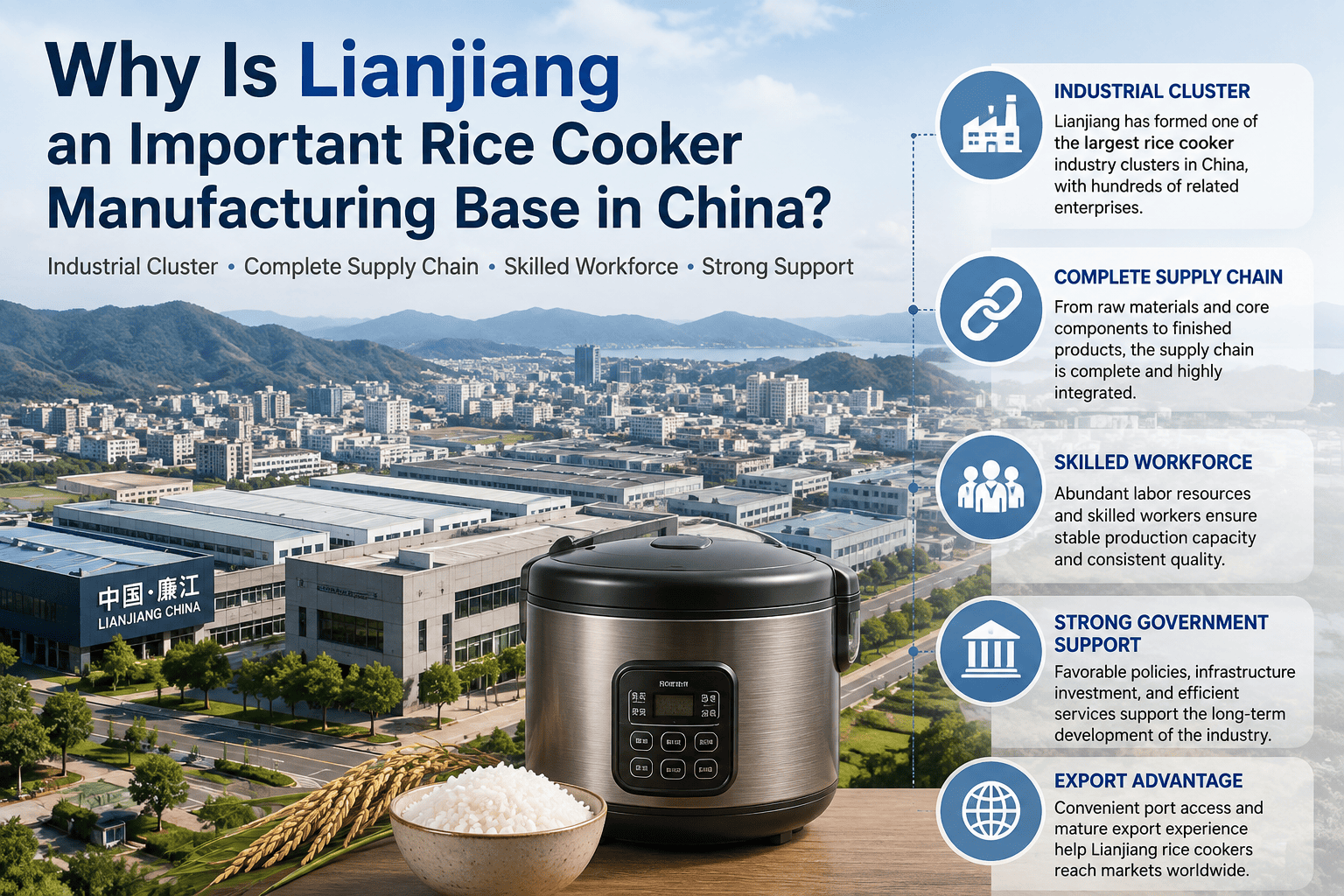
Lianjiang functions as an important rice cooker manufacturing base in China due to concentrated supply chain infrastructure that measurably reduces component procurement cycles, enables rapid customization response, and provides supplier ecosystem backup options that distributed manufacturing locations cannot replicate. For procurement managers evaluating suppliers, understanding how industrial cluster density affects total cost of ownership—not just unit price—determines whether lead time commitments and supply stability claims prove accurate.
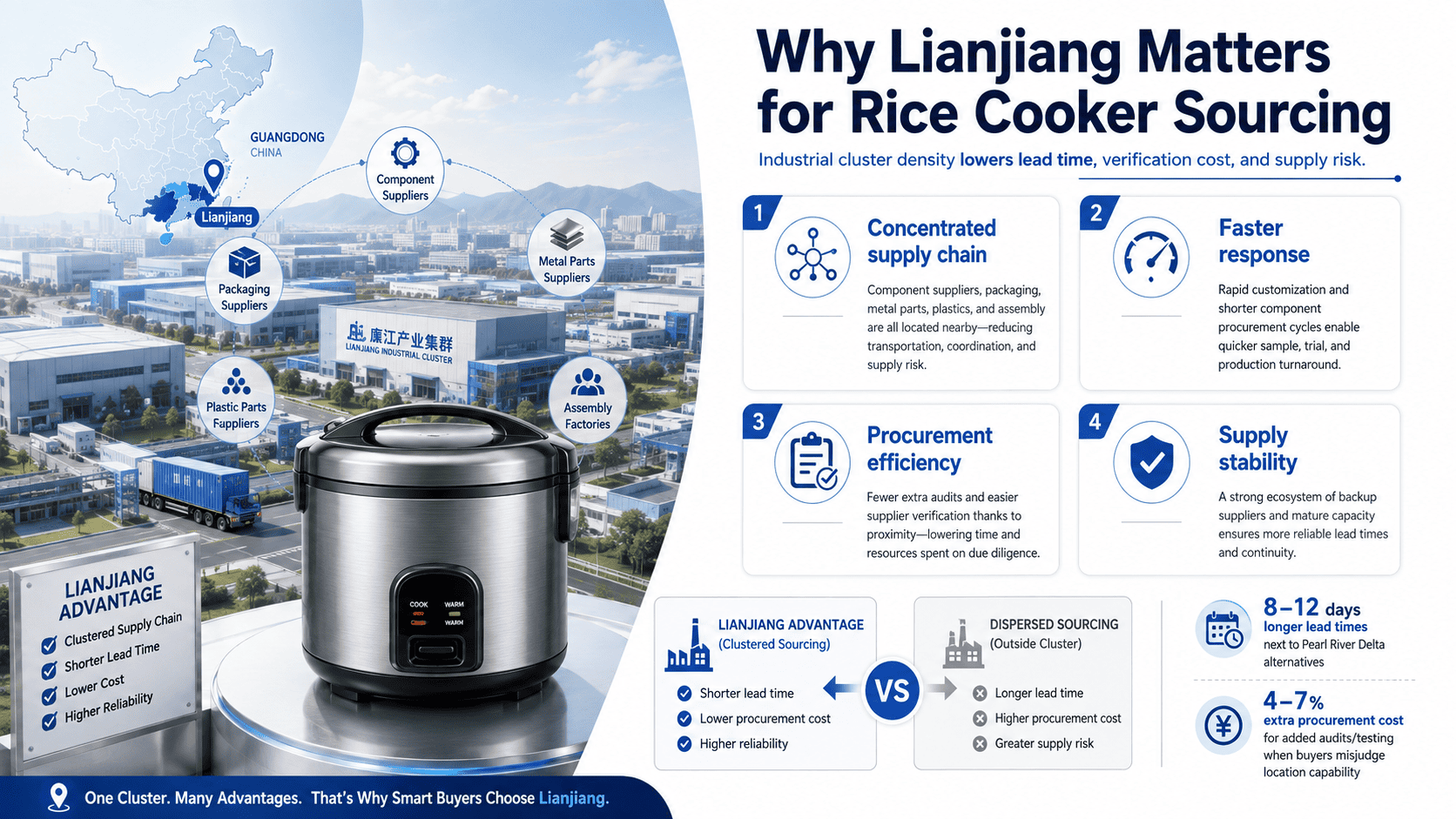
After managing production operations and communicating directly with procurement teams for over a decade in Lianjiang, I've learned that buyers who understand supply chain geography make more accurate cost calculations. Let me show you the specific operational advantages and hidden cost factors that procurement managers should evaluate when considering Lianjiang-based suppliers.
What Geographic Advantages Does Lianjiang Offer for Rice Cooker Manufacturing?
The question matters because procurement managers frequently attribute lead time delays to factory efficiency when root causes trace to component sourcing geography. I've watched buyers penalize suppliers for delays actually caused by distant component suppliers the buyers themselves specified during customization negotiations.
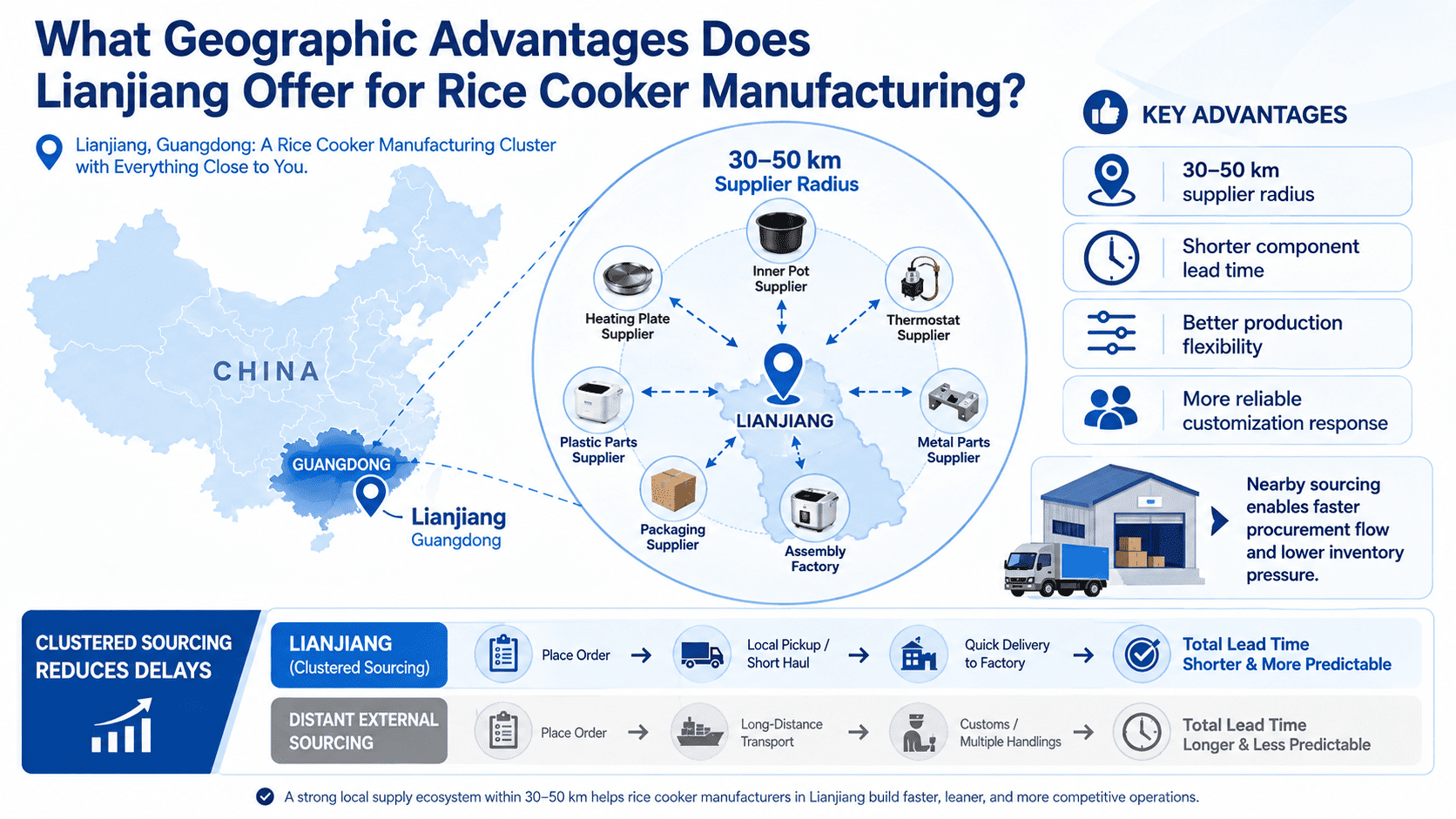
Lianjiang's location provides measurable supply chain density advantages that directly affect production scheduling flexibility and component procurement reliability. The concentration of specialized suppliers within 30–50 km radius creates quantifiable lead time benefits compared to manufacturing bases requiring external component sourcing.
Proximity to Component Suppliers
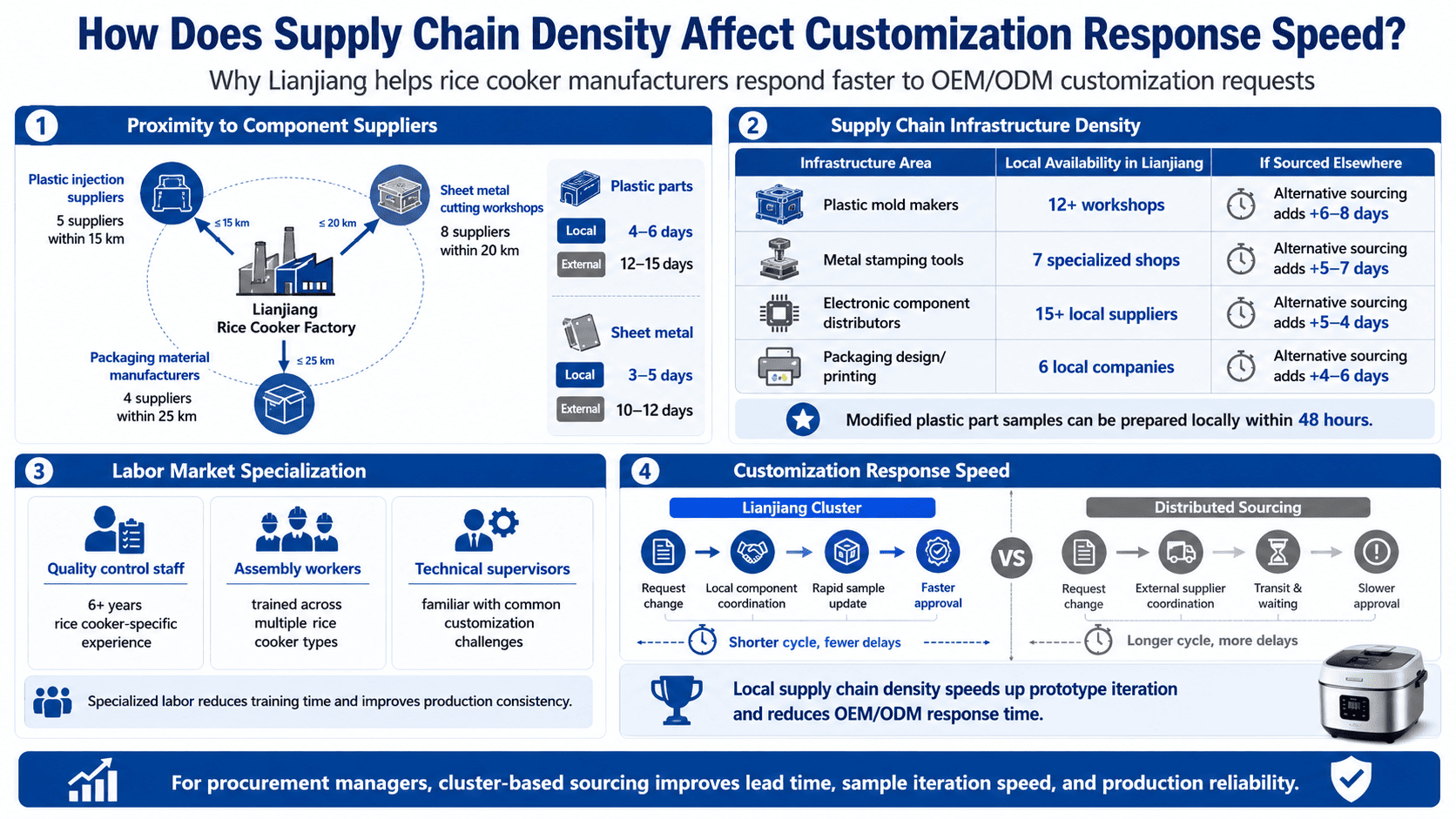
From my experience managing component procurement for OEM/ODM projects, local sourcing reduces plastic parts procurement from 12–15 days (external suppliers) to 4–6 days (Lianjiang suppliers). Sheet metal components follow similar patterns: 10–12 days from Pearl River Delta suppliers versus 3–5 days from local metal fabrication shops.
These differences compound across customization projects. When procurement managers request outer shell modifications, I coordinate with:
- Plastic injection suppliers (5 suppliers within 15 km)
- Sheet metal cutting workshops (8 suppliers within 20 km)
- Packaging material manufacturers (4 suppliers within 25 km)
For comparison, factories in cities lacking local rice cooker industrial clusters source these components from distributed locations, adding coordination complexity and transit time.
Supply Chain Infrastructure Density
The operational advantage extends beyond individual component suppliers. Lianjiang hosts shared infrastructure that procurement managers often overlook during factory evaluations:
| Infrastructure Type | Local Options | Alternative Sourcing Lead Time |
|---|---|---|
| Plastic mold makers | 12+ workshops | +6–8 days setup time |
| Metal stamping tools | 7 specialized shops | +5–7 days production time |
| Electronic component distributors | 15+ local suppliers | +3–4 days procurement time |
| Packaging design/printing | 6 local companies | +4–6 days sample approval time |
When procurement teams request rapid prototype iterations, this density matters. I can get modified plastic parts sampled within 48 hours locally; the same process takes 7–10 days when coordinating with distant suppliers.
Labor Market Specialization
Technical worker retention often determines whether suppliers meet quality consistency targets across production runs. Lianjiang's concentration of rice cooker manufacturers creates a specialized labor market that procurement managers should consider during supplier capability evaluations.
Our production lines employ:
- Quality control staff with 6+ years rice cooker-specific experience
- Assembly workers trained across multiple rice cooker types
- Technical supervisors familiar with common customization challenges
This specialization reduces training time and quality variation compared to factories where workers rotate between unrelated product categories. I've observed measurable differences: workers experienced only in rice cooker assembly identify potential quality issues during production that general appliance assembly workers miss.
How Does Supply Chain Density Affect Customization Response Speed?
Procurement managers evaluating customization capability often focus on factory equipment and production capacity while underestimating how component supplier coordination affects response time. I track this discrepancy because customization delays represent the most common cause of buyer dissatisfaction in OEM/ODM projects.
Customization response speed depends primarily on how quickly factories can iterate component modifications, sample adjustments, and specification changes—not just internal production scheduling. Supply chain density determines these response times.
Component Modification Coordination
When procurement teams request outer shell color changes, material adjustments, or capacity modifications, I coordinate multiple component suppliers simultaneously. Local supplier concentration enables parallel processing that distributed supply chains cannot replicate.
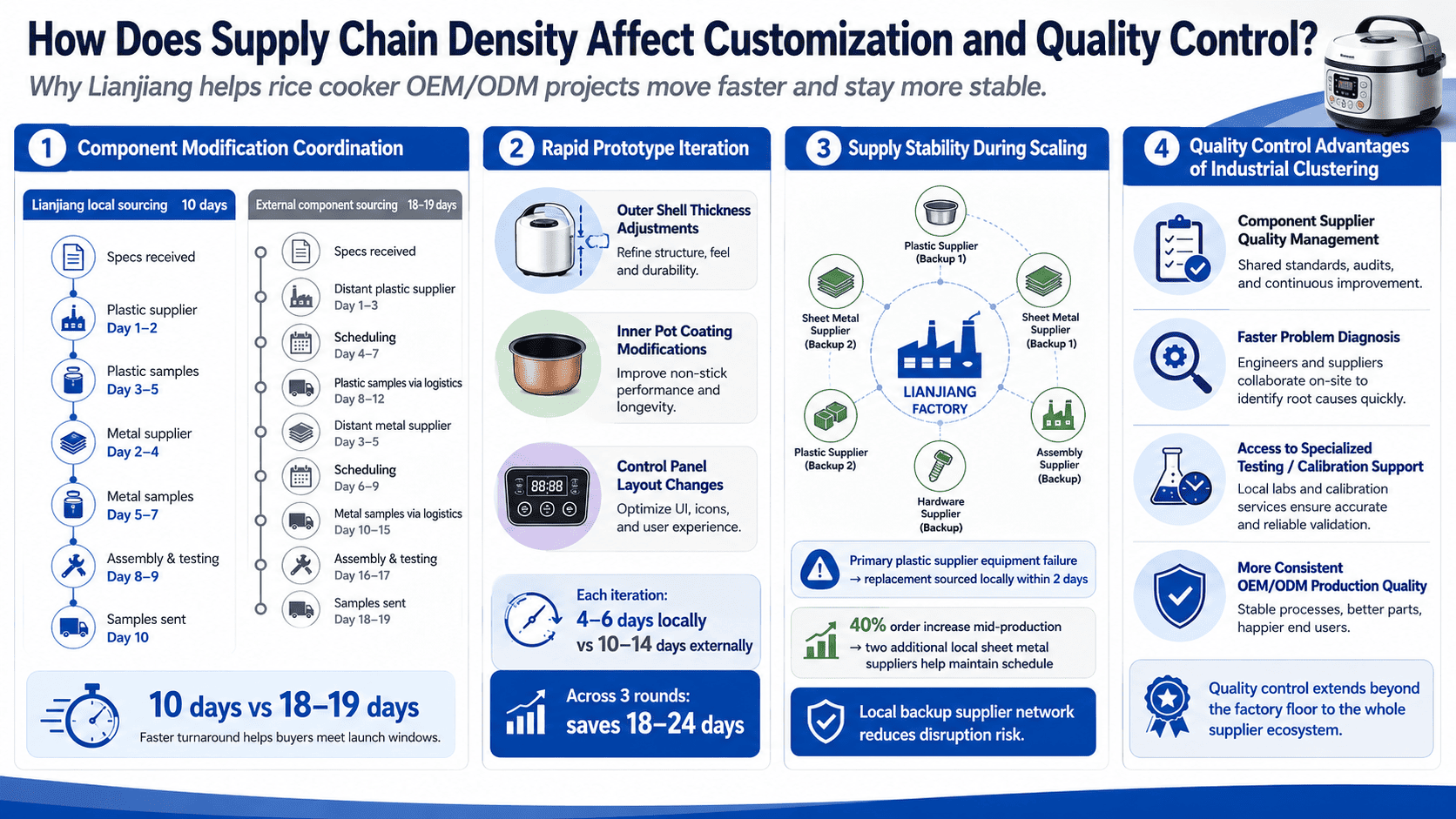
Typical customization timeline (Lianjiang local sourcing):
- Receive customization specifications from procurement team
- Coordinate with plastic injection supplier (Day 1–2)
- Receive modified plastic part samples (Day 3–5)
- Coordinate with sheet metal supplier for matching outer shell (Day 2–4)
- Receive metal component samples (Day 5–7)
- Assembly and performance testing (Day 8–9)
- Send customization samples to procurement team (Day 10)
Comparable timeline (external component sourcing):
- Receive customization specifications
- Coordinate with distant plastic supplier (Day 1–3, accounting for communication delays)
- Wait for supplier production scheduling (Day 4–7)
- Receive plastic samples via logistics (Day 8–12)
- Coordinate with distant metal supplier (Day 3–5)
- Wait for metal supplier production scheduling (Day 6–9)
- Receive metal samples via logistics (Day 10–15)
- Assembly and testing (Day 16–17)
- Ship samples to procurement team (Day 18–19)
The difference—10 days versus 18–19 days—directly affects how quickly procurement teams can finalize specifications and place production orders. For buyers working against tight market launch windows, this gap matters.
Rapid Prototype Iteration
Beyond initial samples, customization projects typically require 2–3 adjustment rounds before procurement teams approve final specifications. Local supplier density enables rapid iteration that keeps projects on schedule.
I've managed projects where procurement teams requested:
- Outer shell thickness adjustments (discovered during drop testing)
- Inner pot coating modifications (required after cooking performance evaluation)
- Control panel layout changes (feedback from market testing)
Each iteration takes 4–6 days locally versus 10–14 days with external suppliers. Across three iteration rounds, local sourcing saves 18–24 days—often the difference between meeting and missing seasonal sales windows.
Supply Stability During Scaling
Procurement managers accurately forecast component availability when evaluating production capacity, but frequently underestimate backup supplier importance during demand surges or component quality issues.
Lianjiang's supplier concentration provides practical backup options I've relied on multiple times:
When our primary plastic injection supplier experienced equipment failure during a large OEM order, I secured replacement components from an alternative local supplier within 2 days. The procurement team never experienced production delays because the component switch happened transparently.
When a procurement manager requested a 40% volume increase mid-production (retail customer expanded initial order), I coordinated with two additional local sheet metal suppliers to maintain delivery schedule. Factories without local supplier networks would require 2–3 weeks to onboard new component suppliers for such adjustments.
What Quality Control Advantages Does Industrial Clustering Provide?
Procurement managers conducting factory audits correctly emphasize quality control processes, but often miss how supplier ecosystem density affects quality consistency. I've observed this gap when buyers focus entirely on internal testing procedures while overlooking component quality management across the supply chain.
Quality control in OEM/ODM manufacturing extends beyond factory floor testing—it includes managing component supplier quality, maintaining testing equipment calibration, and accessing specialized technical expertise during quality issues.
Component Quality Management
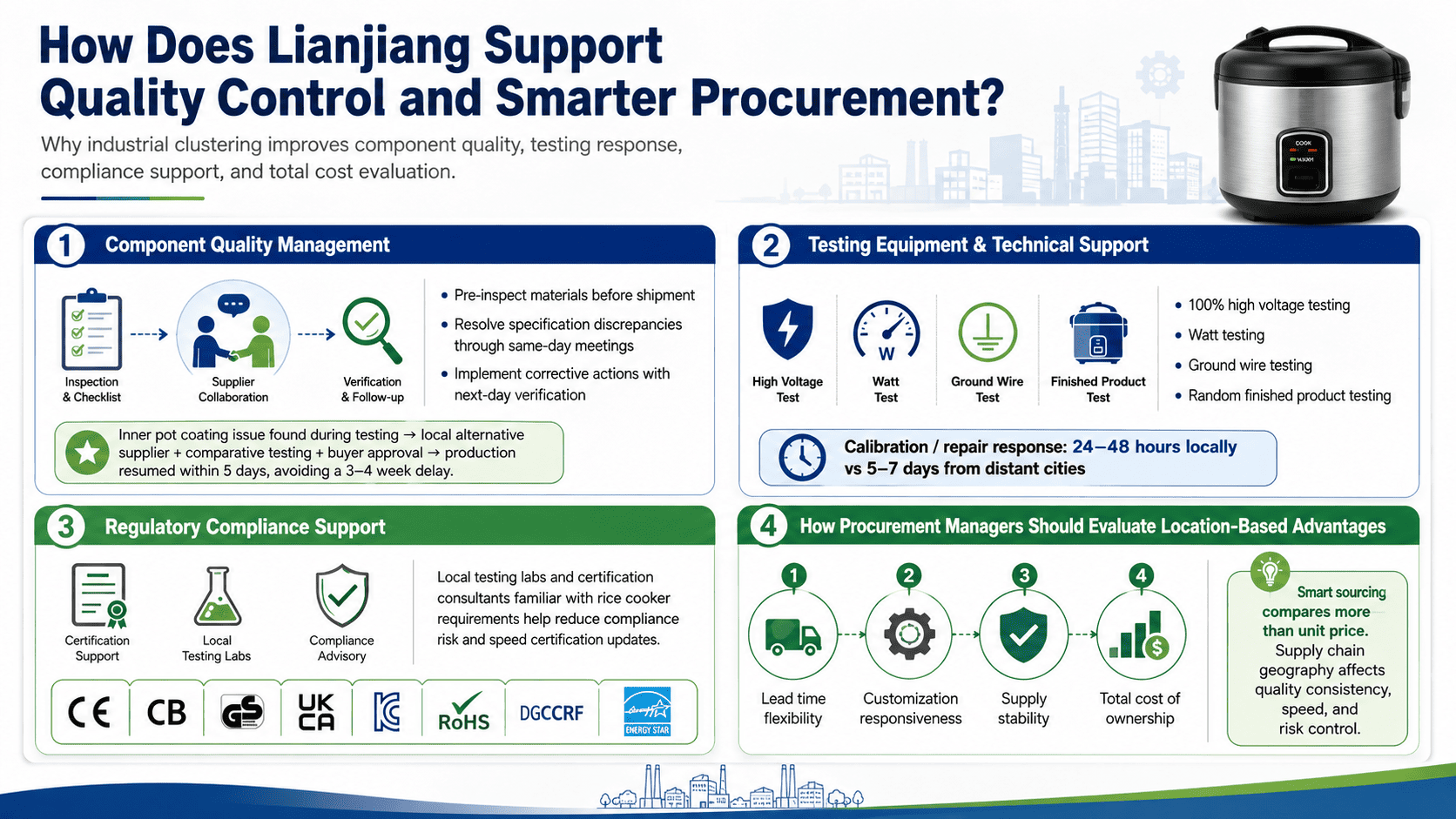
Our incoming material inspection follows AQL standards, but effective component quality control requires supplier cooperation that geographic proximity enables. I work with component suppliers to:
- Pre-inspect materials before shipment to our facility
- Resolve specification discrepancies through same-day meetings
- Implement corrective actions with next-day verification
When procurement teams specify particular materials or components, quality issues occasionally emerge during production. Local supplier proximity enables rapid problem resolution that maintains production schedules.
In one case, a procurement manager specified a particular inner pot coating supplier for a deluxe rice cooker order. During our performance testing, we discovered the coating failed our durability standards. I coordinated with a local alternative coating supplier, conducted comparative testing, received procurement team approval, and resumed production within 5 days. The buyer avoided a 3–4 week delay that would have occurred coordinating with their originally specified distant supplier.
Testing Equipment and Technical Support
Our quality control procedures include:
- 100% high voltage testing (electrical safety verification)
- Watt testing (power consumption verification)
- Ground wire testing (electrical safety verification)
- Random finished product testing (99% pass rate targeting)
Maintaining testing equipment calibration and accessing specialized technical support benefits from Lianjiang's industrial concentration. When we need testing equipment calibration or repair, local service providers respond within 24–48 hours versus 5–7 days for equipment suppliers based in distant cities.
Technical expertise for troubleshooting quality issues also concentrates in industrial clusters. I've consulted with neighboring factory quality managers, component suppliers' technical staff, and local testing equipment specialists to resolve unusual quality issues that procurement teams flagged during their own testing.
Regulatory Compliance Support
Procurement managers correctly prioritize compliance with CE, CB, GS, UKCA, KC, RoHS, RGCCRF, and Energy Star requirements. What buyers sometimes underestimate is how certification maintenance and compliance verification depend on local technical service providers.
Lianjiang hosts multiple testing laboratories and certification consulting firms familiar with rice cooker-specific compliance requirements. When procurement teams request new certifications or regulatory updates affect existing certifications, I coordinate with local compliance specialists who understand rice cooker manufacturing specifics.
This specialization reduces compliance risk compared to general appliance testing providers unfamiliar with rice cooker regulatory nuances.
How Should Procurement Managers Evaluate Location-Based Supply Chain Advantages?
After years of communicating with procurement teams during supplier evaluation processes, I've identified specific evaluation gaps that lead to inaccurate cost calculations and unrealistic lead time expectations. Understanding these gaps helps buyers make better sourcing decisions.
Procurement managers who accurately assess total cost of ownership account for supply chain geography effects on lead time, customization responsiveness, and supply stability—not just unit price comparisons.
Measuring Lead Time Components
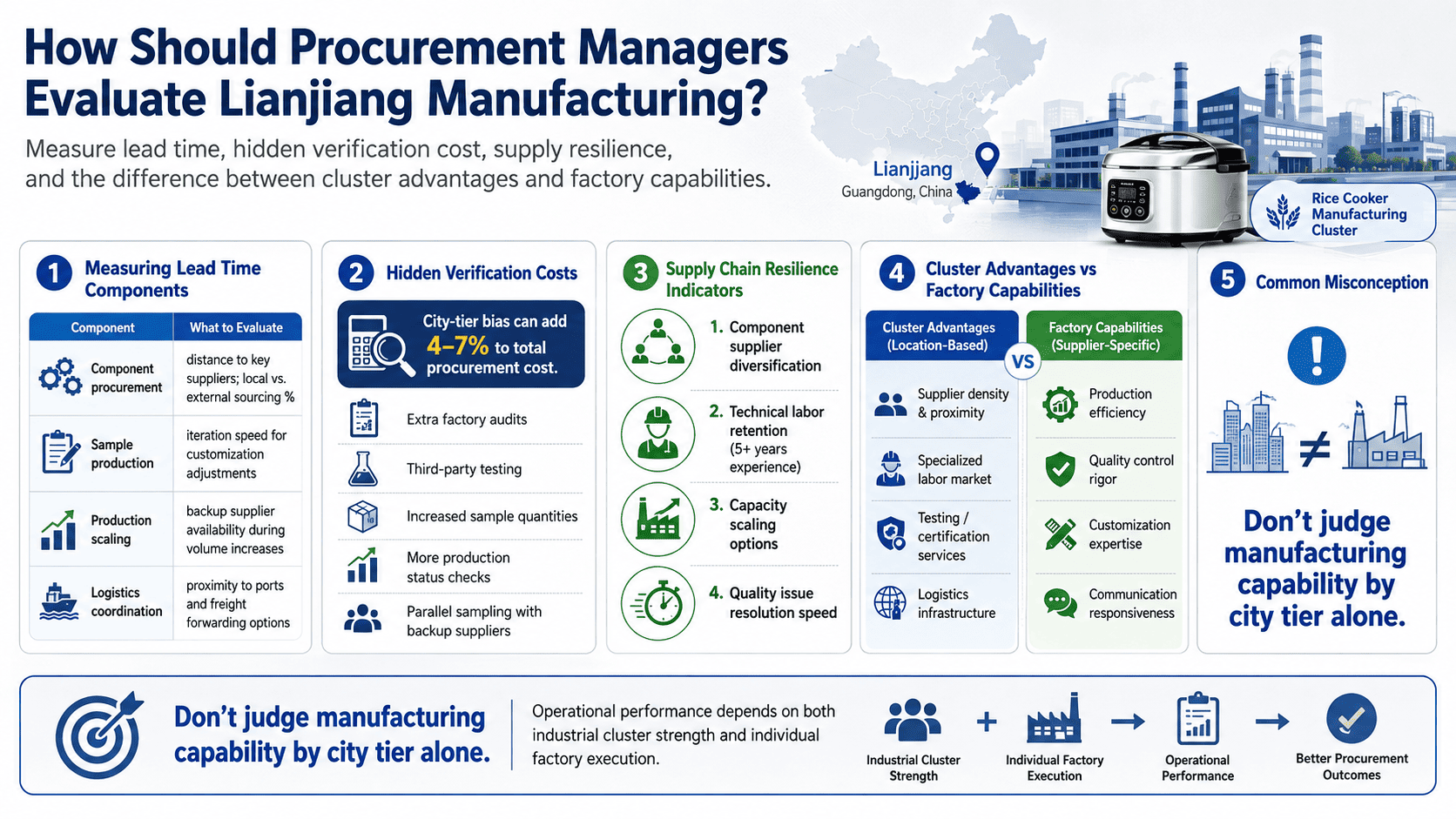
When procurement teams evaluate lead time commitments, I recommend breaking total lead time into measurable components to identify where geographic factors create differences:
| Lead Time Component | Questions to Ask Suppliers |
|---|---|
| Component procurement | Distance to key component suppliers? Local vs. external sourcing percentages? |
| Sample production | Iteration speed for customization adjustments? |
| Production scaling | Backup supplier availability during volume increases? |
| Logistics coordination | Proximity to ports, freight forwarding options? |
Suppliers in distributed manufacturing locations may quote similar total lead times but achieve those timelines through compressed production schedules rather than efficient component procurement. This compression increases quality risk and reduces flexibility for specification changes during production.
Calculating Hidden Verification Costs
City-tier bias—assuming lower manufacturing capability based on production location—generates measurable costs during supplier evaluation and ongoing relationship management. I've observed procurement teams add verification steps for Lianjiang suppliers they wouldn't require from Pearl River Delta factories:
Additional verification activities I've experienced:
- Extra factory audit rounds (2–3 versus standard 1 audit)
- Third-party testing beyond standard certifications
- Increased sample quantities before production orders
- More frequent production status verification
- Parallel sampling with alternative suppliers "just in case"
Each activity adds cost and time. When I calculate total procurement cost for buyers, these verification expenses typically add 4–7% to quoted unit prices. Procurement managers should quantify these costs rather than treating them as standard due diligence.
Evaluating Supply Chain Resilience Indicators
Supply stability—the supplier's ability to maintain consistent delivery, quality, and communication during disruptions—depends significantly on supplier ecosystem density. Procurement managers should evaluate specific resilience indicators:
- Component supplier diversification: How many alternative suppliers exist for critical components within reasonable distance?
- Technical labor retention: What percentage of quality control and technical staff have 5+ years rice cooker manufacturing experience?
- Capacity scaling options: Can the supplier access additional production capacity through local manufacturing networks during demand surges?
- Quality issue resolution speed: How quickly can suppliers coordinate with component manufacturers to resolve quality problems?
I provide specific answers to these questions during procurement evaluations because they predict supplier performance more accurately than factory size or equipment lists.
Distinguishing Cluster Advantages from Factory Capabilities
Procurement managers should separate industrial cluster benefits (shared by location) from individual factory capabilities (specific to the supplier under evaluation). This distinction prevents incorrect conclusions during supplier comparisons.
Cluster advantages (location-based):
- Component supplier density and proximity
- Specialized labor market depth
- Testing and certification service availability
- Logistics infrastructure options
Factory capabilities (supplier-specific):
- Production line efficiency and capacity
- Quality control process rigor
- Customization design expertise
- Customer communication responsiveness
Both categories matter, but they answer different questions. Cluster advantages indicate supply chain resilience and lead time reliability; factory capabilities indicate production quality and project management competence.
When procurement teams dismiss Lianjiang suppliers due to city-tier assumptions, they forfeit cluster advantages while potentially selecting factories with comparable individual capabilities in locations with weaker supply chain density.
What Common Misconceptions Do Procurement Managers Hold About Lianjiang Manufacturing?
I've tracked recurring misconceptions that procurement managers express during factory evaluations and supplier negotiations. Addressing these directly helps buyers make more informed sourcing decisions and set realistic expectations.
Understanding actual operational differences between manufacturing locations—rather than assumed differences based on city tier—improves procurement accuracy.
Misconception: Lower City Tier Equals Lower Manufacturing Capability
Procurement managers sometimes assume Lianjiang factories operate with less advanced equipment or weaker quality systems compared to manufacturers in larger cities. This assumption doesn't match what I observe during factory-to-factory comparisons.
Our production lines utilize the same injection molding machines, assembly equipment, and testing instruments that Pearl River Delta factories employ. CE, CB, GS, UKCA, KC, RoHS, RGCCRF, and Energy Star certifications require specific quality management systems and testing procedures regardless of factory location.
The meaningful difference isn't equipment capability—it's supply chain coordination efficiency. Procurement managers who audit factory equipment often approve our capabilities, then express surprise when we deliver samples faster than suppliers they assumed were more advanced based on city location.
Misconception: External Component Sourcing Provides Better Quality
Some procurement teams prefer suppliers who source components from "premium" suppliers in larger manufacturing centers, assuming geographic reputation transfers to component quality. I manage component quality through specification compliance and testing procedures, not supplier location assumptions.
Component quality depends on:
- Clear specification documentation
- Incoming material inspection procedures
- Component supplier quality management systems
- Testing and verification processes
Local Lianjiang component suppliers who specialize in rice cooker parts often demonstrate better specification understanding than distant general appliance component manufacturers. Specialization matters more than location.
When procurement managers specify external component suppliers, I coordinate accordingly—but the specification and testing requirements remain identical regardless of component origin.
Misconception: Larger Manufacturing Centers Provide More Supplier Options
Procurement managers sometimes assume larger cities offer more supplier alternatives during quality issues or capacity constraints. This reverses actual operational dynamics.
Lianjiang's rice cooker manufacturing concentration means higher supplier density for rice cooker-specific components within accessible distance. Pearl River Delta cities host more manufacturers across diverse product categories but fewer specialized rice cooker component suppliers per square kilometer.
When I need backup suppliers quickly, I access rice cooker-specialized options locally rather than general appliance component suppliers in distant cities. The procurement manager's perception of "more options" doesn't translate to "more relevant options within practical coordination distance."
Misconception: Local Sourcing Limits Customization Options
I've encountered procurement teams who assume local component sourcing restricts customization capabilities compared to accessing "the full range" of suppliers across broader geographic areas. This misunderstands how customization actually works in OEM/ODM manufacturing.
Customization success depends on iteration speed and coordination efficiency, not component supplier geographic distribution. I can implement more customization variations faster with local suppliers who respond to modification requests within days than with distant suppliers offering broader catalogs but requiring weeks for each adjustment.
Procurement managers benefit more from suppliers who rapidly iterate toward their specific requirements than from suppliers offering extensive standard options requiring long modification cycles.