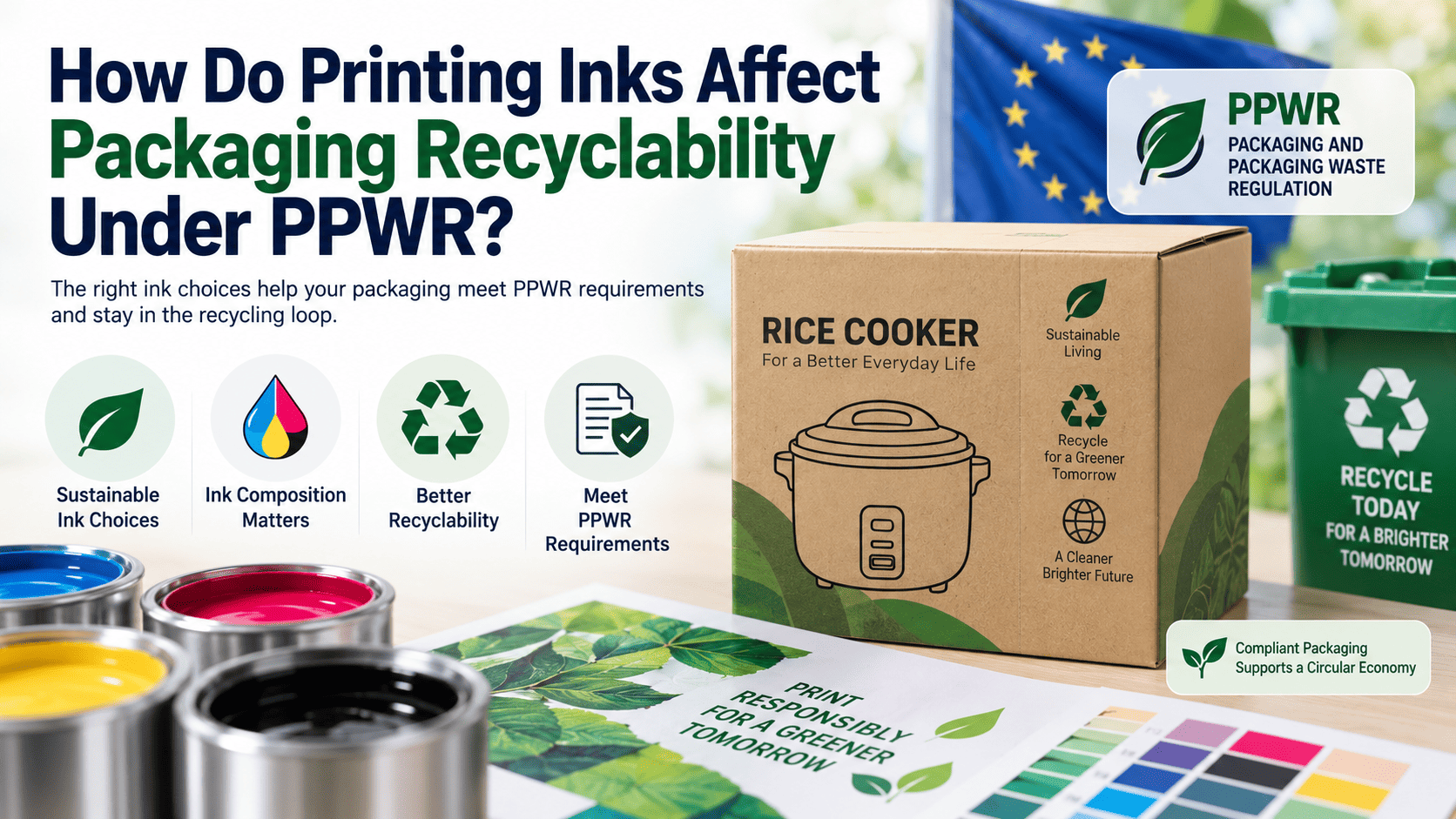
When our Thai client's shipment of rice cooker packaging was flagged for potential ink contamination risk last year, I learned that even perfectly recyclable cardboard becomes contaminated waste if the printing ink poisons the recycling stream. PPWR shifts ink compliance from an eco-label checkbox to a supply chain evidence requirement that procurement managers must address before production starts, not after customs flags the problem.1
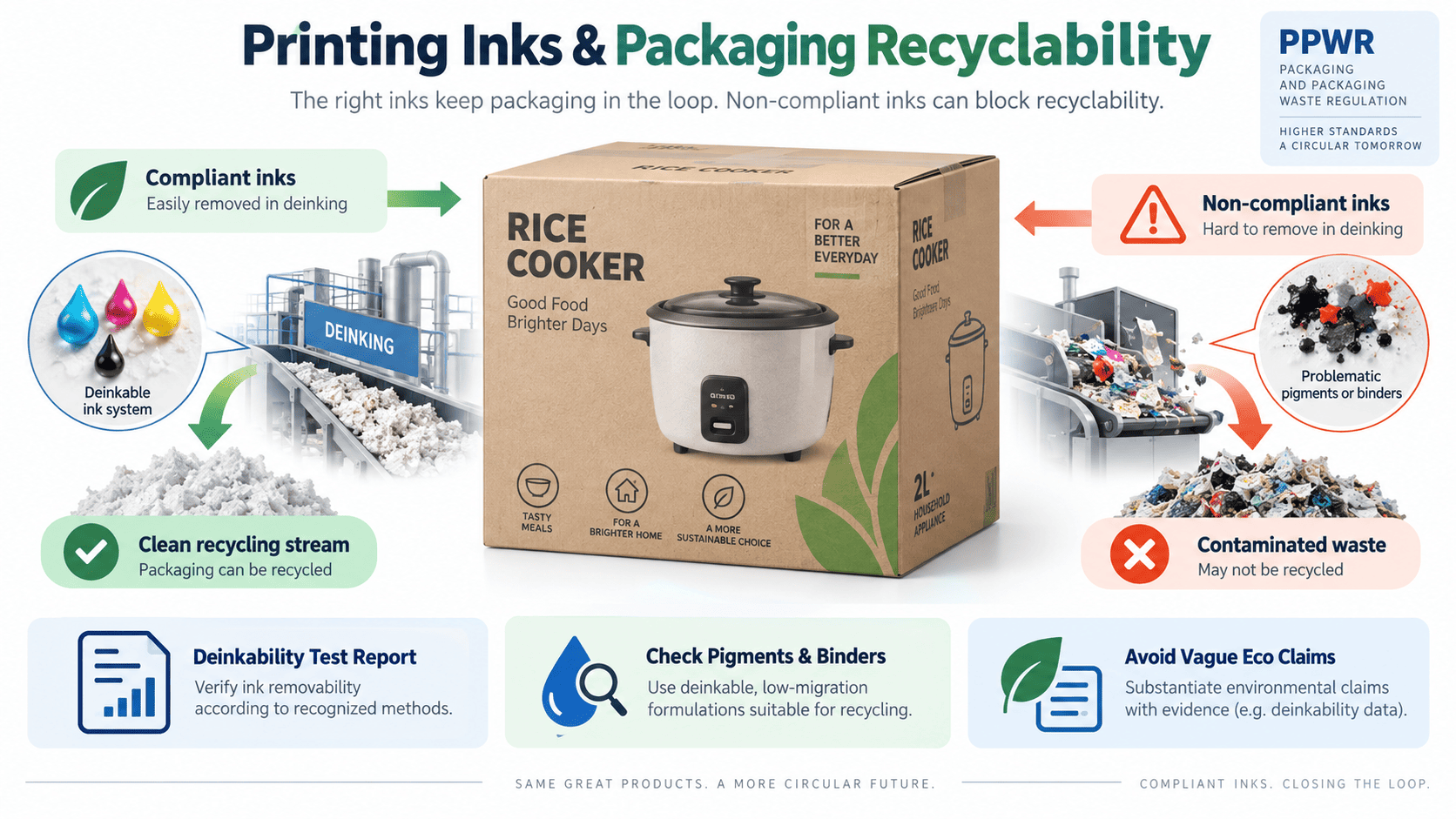
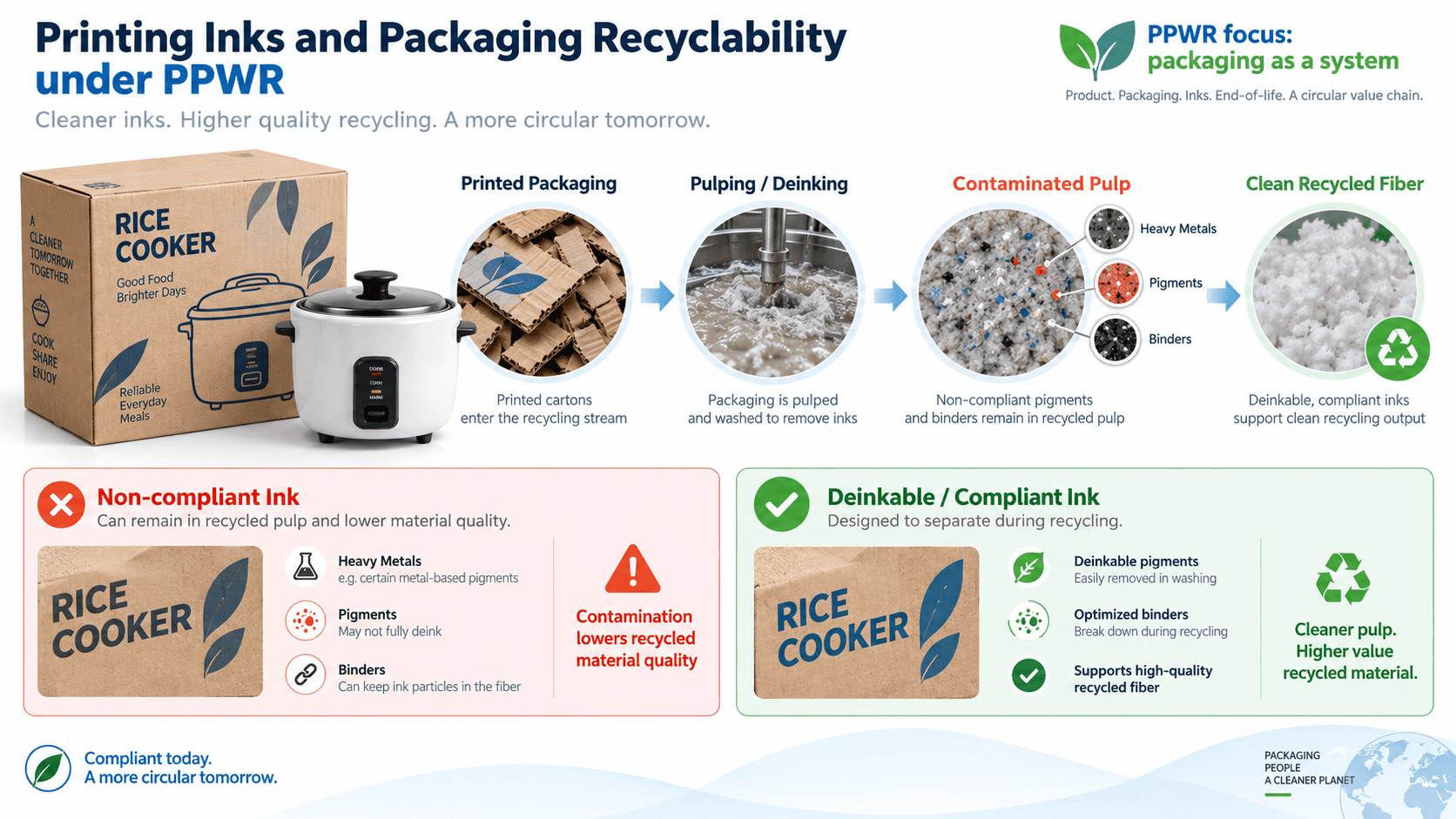
Under PPWR, printing inks directly determine whether packaging enters clean recycling streams or becomes contaminated waste.2 Non-compliant inks contain pigments and binders that cannot be removed during industrial deinking processes, rendering otherwise recyclable materials unsuitable for reprocessing.3 Compliance requires procurement to verify deinkability test reports in supplier contracts, not rely on generic "eco-friendly" marketing claims that lack regulatory substance.
Most procurement managers I speak with assume that if packaging material is recyclable, the ink automatically qualifies. That assumption creates regulatory liability under PPWR because the regulation treats packaging as a system—materials, inks, adhesives, and coatings must all support recycling. I'll walk through what I've learned coordinating supplier switches and auditing ink certifications, focusing on the verification steps procurement needs to take.
Why Do Printing Inks Contaminate Recycling Streams?
Industrial recycling processes assume that inks can be separated from packaging materials during pulping or washing stages. When inks contain pigments or binders that resist removal, they contaminate the recycled output, making it unsuitable for food-contact applications or high-grade paper products. PPWR targets this contamination because it reduces the economic value of recycled materials and increases waste sent to incineration.4
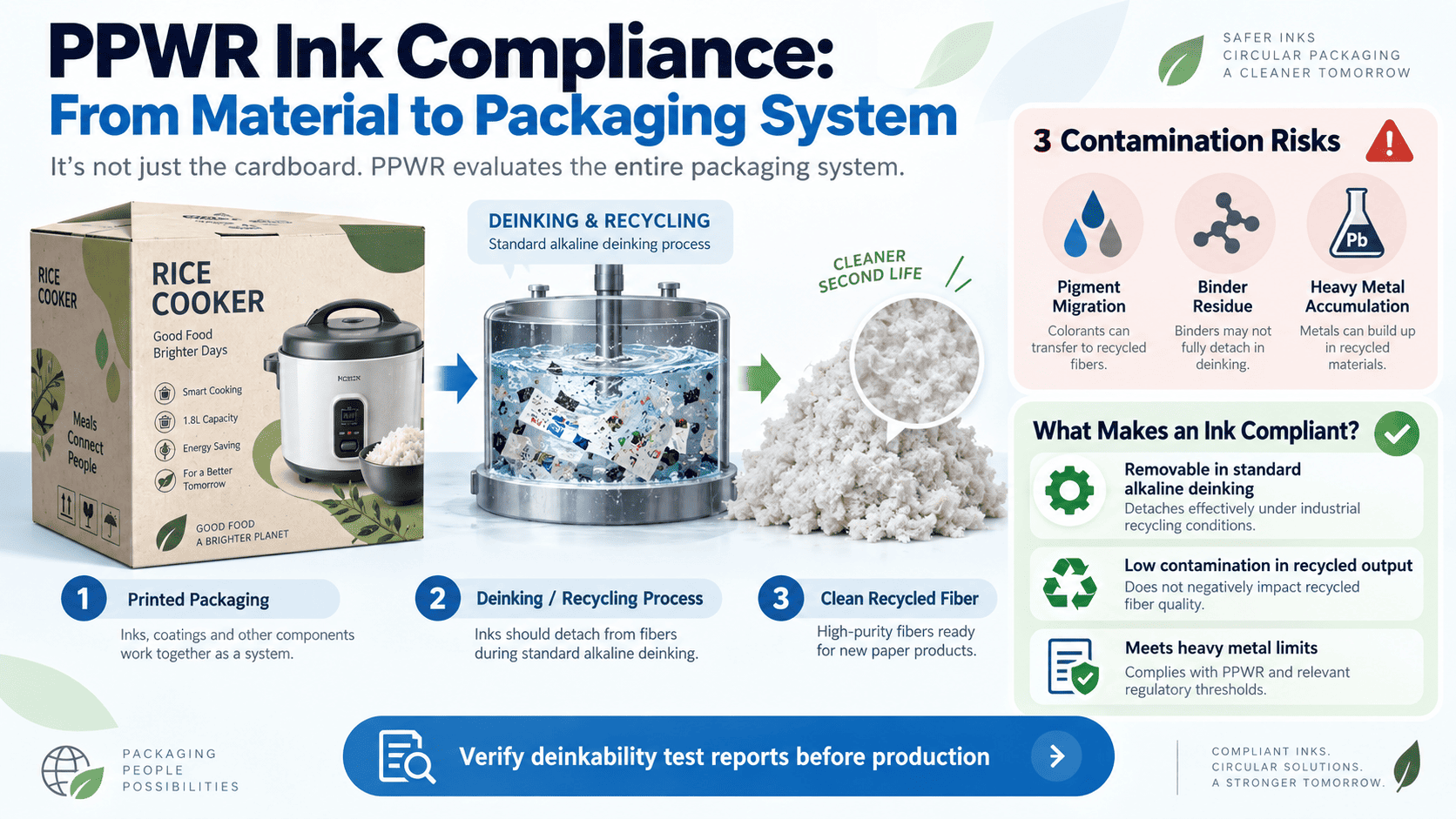
Printing inks contaminate recycling when they contain pigments that dissolve into recycled pulp, binders that cannot be broken down by alkaline deinking processes, or heavy metals that accumulate in recycled output. These substances don't disappear during recycling—they transfer into the next product cycle, degrading quality and limiting reuse applications. PPWR compliance requires inks that can be removed without leaving residual contamination in recycled streams.
The Compliance Shift: From Material to System
I used to review packaging specs by checking cardboard grade and recyclability symbols. That approach misses half the compliance picture under PPWR because the regulation evaluates whether the entire packaging system—not just the substrate material—supports recycling infrastructure.
When I coordinated our first supplier switch to compliant inks, the printer pushed back, arguing their existing inks were "plant-based" and therefore eco-friendly. The problem wasn't whether the ink came from renewable sources—it was whether industrial deinking equipment could remove it during recycling without contaminating output. Plant-based inks can fail deinkability tests if the binder chemistry resists alkaline washing, which is the standard process in European recycling facilities.
Three Contamination Mechanisms Procurement Must Verify
1. Pigment Migration
Some pigments dissolve into recycled pulp instead of separating cleanly. This creates color contamination in recycled paper and cardboard, making the output unsuitable for white or light-colored products. Procurement needs to verify that supplier inks use pigments rated for low migration under the specific deinking process the recycling facility uses.
2. Binder Residue
Ink binders hold pigments to the packaging surface. If the binder chemistry resists breakdown during alkaline deinking, it leaves residue in recycled materials. This residue reduces paper strength and creates surface defects. Suppliers should provide test reports showing complete binder removal under EN 13432 deinkability protocols.
3. Heavy Metal Accumulation
Some pigments contain heavy metals (cadmium, lead, mercury, hexavalent chromium) that concentrate in recycled materials with each reprocessing cycle.5 PPWR restricts these substances because they eventually render recycled streams toxic. Procurement must verify that supplier inks comply with heavy metal limits under the Packaging and Packaging Waste Directive annexes.
What Makes an Ink PPWR-Compliant?
PPWR doesn't specify approved ink formulations—it requires that packaging design supports existing recycling infrastructure.6 For inks, this means deinkability: the ink must be removable during standard industrial recycling processes without contaminating output or requiring specialized equipment that most facilities lack.
PPWR-compliant inks meet three criteria: they can be removed using standard alkaline deinking processes, they do not contain substances that accumulate in recycled streams above regulatory limits, and they do not degrade the quality of recycled output below usable grades. Compliance requires test reports demonstrating these properties, not supplier declarations or eco-label certifications that lack deinkability verification.
Why "Eco-Friendly" Claims Don't Equal Compliance
I've reviewed dozens of supplier ink certifications over the past year. Most include eco-labels like "bio-based content" or "low VOC," which address environmental impact during manufacturing but say nothing about deinkability during recycling.7 PPWR creates regulatory liability for brands if packaging enters the market without proof that inks support recycling infrastructure.
When I audit supplier certificates, I look for three documents:
Deinkability Test Reports
These show whether the ink can be removed during industrial recycling without leaving residue or contamination. The test should specify the deinking process used (alkaline, enzymatic, solvent-based) and the substrate material tested. Generic deinkability claims without test data don't meet PPWR evidence requirements.
Heavy Metal Compliance Certificates
These confirm that pigments don't contain cadmium, lead, mercury, or hexavalent chromium above the limits specified in Directive 94/62/EC Annex II. Some suppliers provide certificates stating "heavy metal free," which is technically impossible—all pigments contain trace metals. Procurement needs concentration values, not zero-claim statements.
Recycled Output Quality Data
Some advanced suppliers provide data showing that recycled materials produced using their inks meet quality standards for specific applications (e.g., food-contact paperboard, white office paper). This data isn't required under PPWR, but it demonstrates that the supplier understands how their inks affect downstream recycling.
The Standards Procurement Should Reference
Suppliers claim compliance with various standards. I've learned to ask which specific test protocols were used because the scope varies significantly:
| Standard | Scope | Procurement Relevance |
|---|---|---|
| EN 13432 | Compostability and biodegradation | Includes deinkability test protocols for water-based inks |
| ISO 16000 | Deinkability of printed paper products | Measures ink removability during pulping and washing |
| EuPIA Exclusion List | Lists substances to avoid in food-contact inks | Useful for verifying pigment safety but doesn't cover deinkability |
| Cradle to Cradle Certified | Product sustainability across lifecycle | May include deinkability requirements depending on certification level |
Procurement should verify that supplier test reports reference specific sections of these standards, not just mention the standard name. For example, EN 13432 covers multiple criteria—biodegradability, compostability, ecotoxicity—but PPWR compliance specifically requires the deinkability portion.8
How Do Different Ink Types Perform Under PPWR?
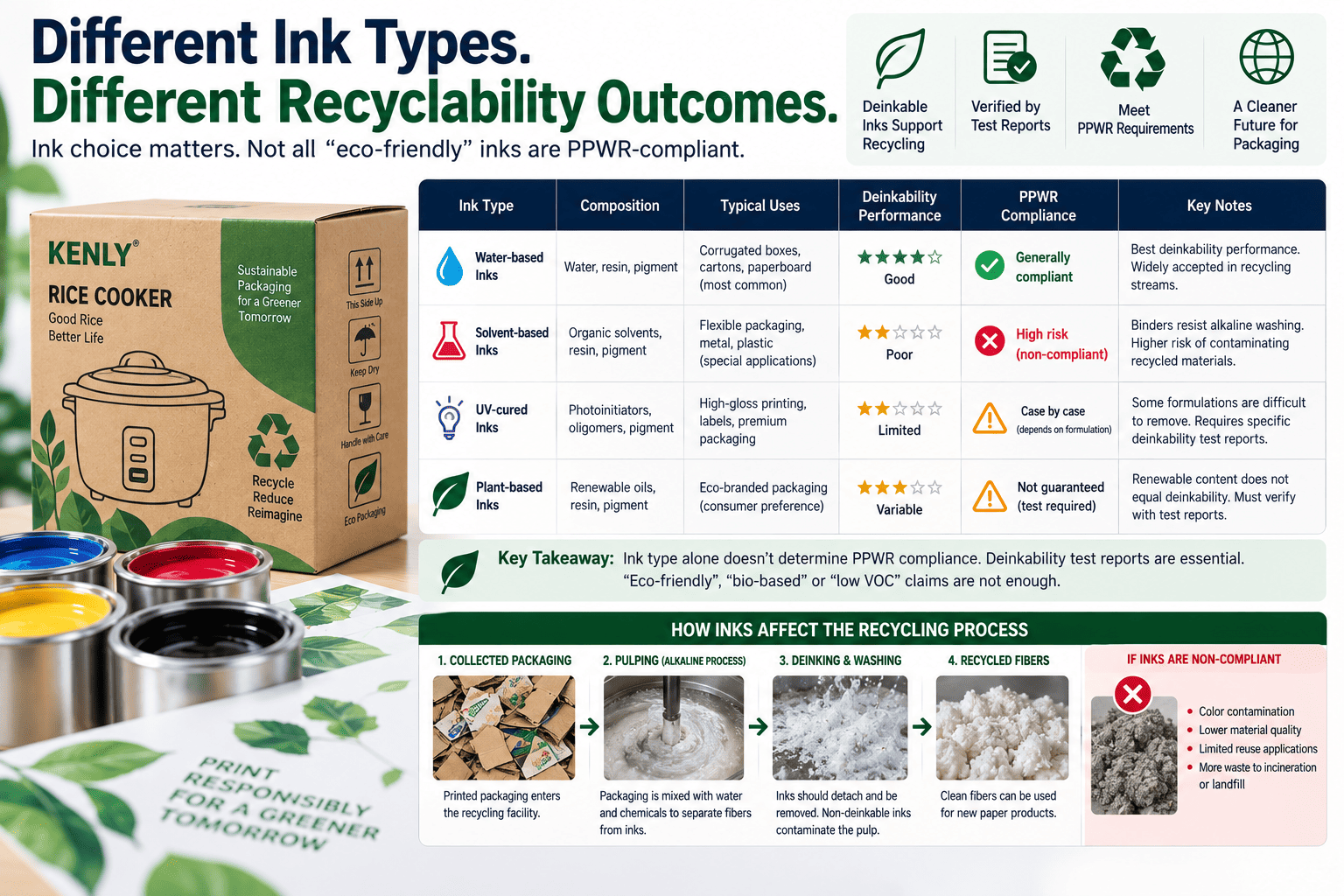
I've coordinated supplier switches across four ink technologies: water-based, solvent-based, UV-cured, and plant-based. Each technology has different deinkability characteristics that affect PPWR compliance.
Water-based inks generally support deinkability better than solvent-based or UV-cured alternatives because they use binders that break down during alkaline washing.9 However, compliance depends on specific pigment and binder formulations, not ink type alone. Plant-based inks offer no compliance advantage unless the supplier provides deinkability test reports—renewable raw materials don't guarantee removability during recycling.
Water-Based Inks: Default Choice for Paper and Cardboard
Most packaging printers already use water-based inks for paper and cardboard because they're compatible with standard printing equipment and meet VOC regulations. These inks typically perform well in alkaline deinking processes, which is the standard method European recycling facilities use.
When I audit water-based ink suppliers, I verify three points:
- Binder chemistry: Does the supplier use acrylic, polyurethane, or other binders? Acrylic binders generally show better deinkability.
- Pigment selection: Are pigments rated for low migration? Some organic pigments dissolve into pulp during recycling.
- Test substrate: Was deinkability tested on the same paper/cardboard grade we're using for production?
The challenge with water-based inks isn't compliance—it's performance. Some formulations show poor adhesion on coated surfaces or limited colorfastness when exposed to moisture. Procurement needs to balance deinkability with practical printing performance, which means involving the printer in supplier selection discussions.
Solvent-Based Inks: Higher Risk for Recyclability
Solvent-based inks use petroleum-derived carriers that resist alkaline deinking. I've worked with suppliers who claimed their solvent inks were recyclable because they used "eco-solvents," but the deinkability test reports showed incomplete removal during standard washing processes.
For flexible packaging (plastic films), solvent inks remain common because they provide better adhesion and colorfastness than water-based alternatives. However, plastic film recycling infrastructure in Europe is less developed than paper recycling, which creates additional PPWR complications beyond ink compliance.
If procurement must use solvent-based inks, I recommend:
- Requesting deinkability tests using the recycling process the target market actually operates (not idealized lab conditions)
- Verifying that residual solvent levels meet VOC regulations in the destination country
- Building contract terms that allow switching to water-based inks if recycling infrastructure develops
UV-Cured Inks: Performance vs. Compliance Trade-Off
UV-cured inks dry instantly under ultraviolet light, which allows high-speed printing and excellent color saturation. The problem for PPWR compliance is that UV binders form cross-linked polymer structures that resist breakdown during alkaline deinking.10
I encountered this issue when a client requested premium packaging with metallic UV inks. The printer provided beautiful samples, but the deinkability test showed that the UV binder left significant residue in recycled pulp. We switched to water-based metallic inks, which increased printing costs but eliminated compliance risk.
Some UV ink manufacturers now offer "deinkable UV" formulations that use modified binders designed to break down during washing. Procurement should verify these claims with third-party test reports, not supplier declarations, because UV ink chemistry varies significantly between manufacturers.
Plant-Based Inks: Marketing vs. Regulatory Reality
Plant-based inks derive pigments or carriers from renewable sources like soy, linseed, or algae. Marketing materials emphasize sustainability, but PPWR compliance requires deinkability proof regardless of raw material origin.
I've reviewed plant-based ink certifications claiming "100% bio-based content" without any deinkability testing. The renewable feedstock reduces carbon footprint during manufacturing, but it doesn't automatically make the ink easier to remove during recycling. Some plant-based binders actually increase deinking difficulty because they create stronger adhesion to paper fibers than synthetic alternatives.11
When evaluating plant-based inks, I separate sustainability claims from compliance evidence:
- Bio-based content percentage: Useful for corporate sustainability reporting but irrelevant to PPWR compliance
- Deinkability test reports: Required for PPWR compliance regardless of bio-based content
- Recycled output quality data: Shows whether the bio-based formulation supports practical recycling
The best plant-based suppliers provide both sustainability credentials and deinkability verification. Procurement shouldn't assume that "natural" equals "recyclable"—verify the specific evidence PPWR requires.
How Should Procurement Lock Ink Compliance into Contracts?
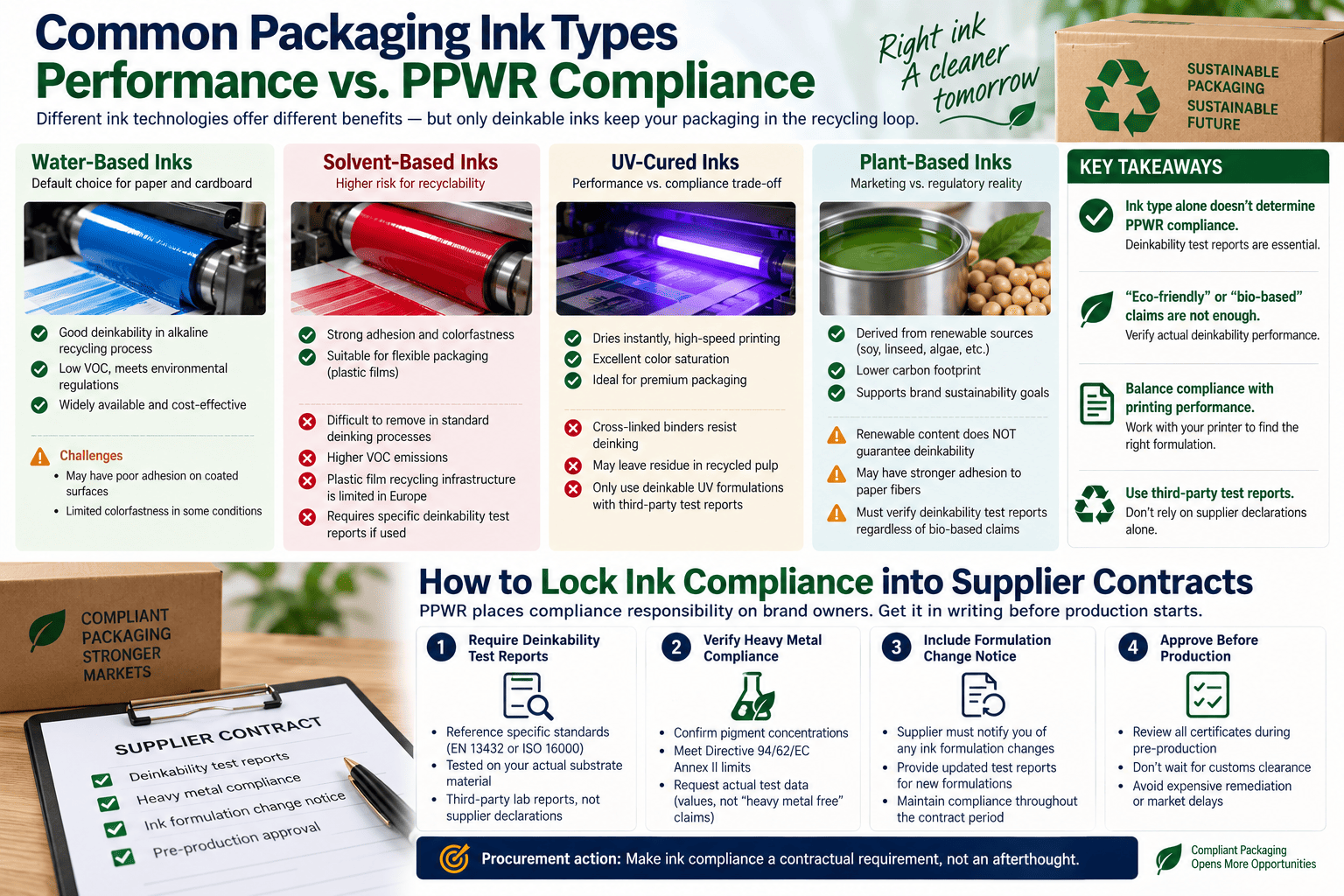
PPWR places compliance responsibility on brand owners, not printers or packaging converters.12 This means procurement must specify ink requirements in purchase orders and verify compliance before production starts, not after packaging is printed and shipped.
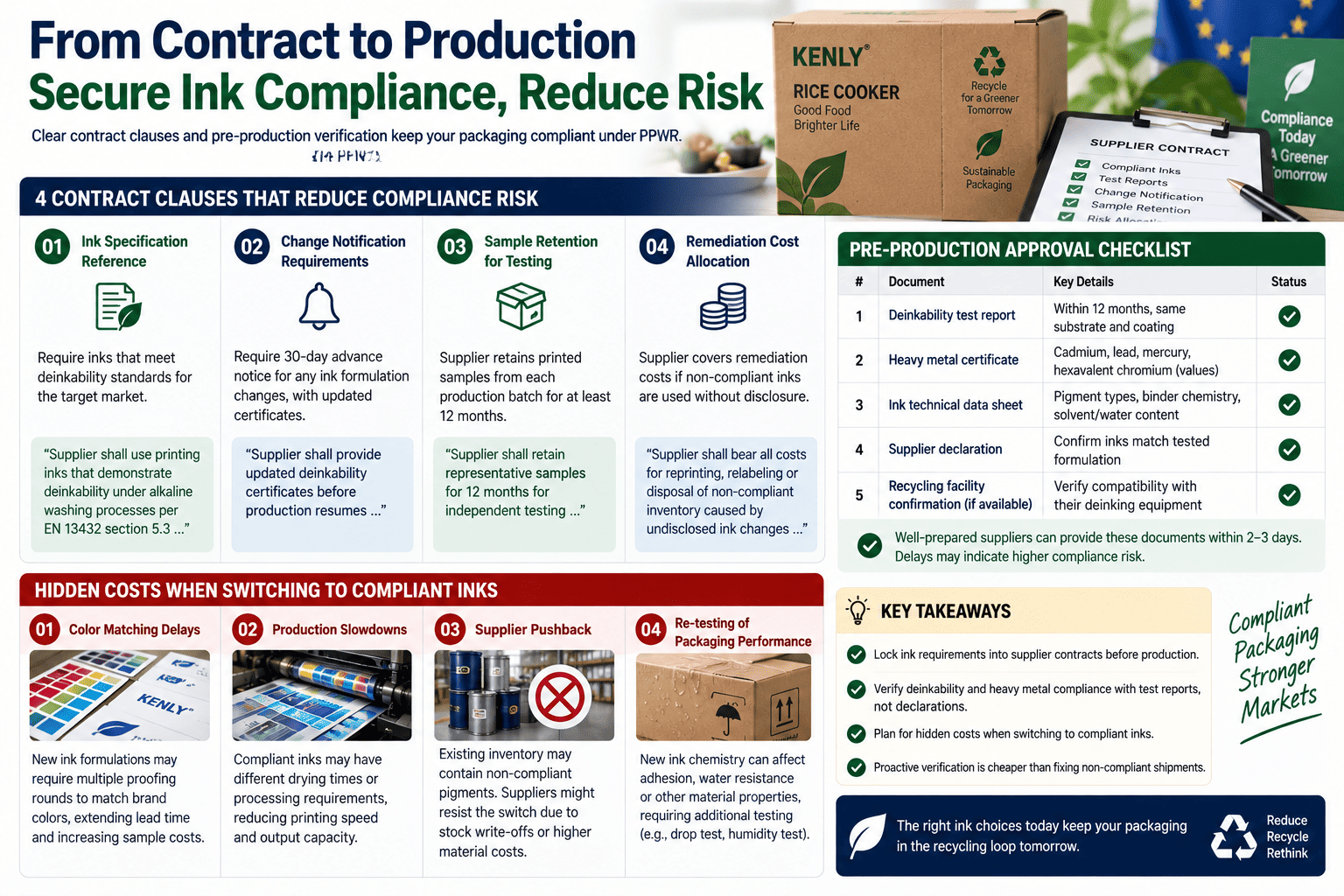
Procurement should include three ink requirements in supplier contracts: deinkability test reports referencing specific standards (EN 13432 or ISO 16000), heavy metal concentration certificates meeting Directive 94/62/EC limits, and supplier agreement to provide updated certificates if ink formulations change during the contract period. Verification should occur during pre-production approval, not during customs clearance when remediation is expensive.
Four Contract Clauses That Reduce Compliance Risk
1. Ink Specification Reference
I include a clause requiring the supplier to use inks that meet deinkability standards under the recycling processes operated in the target market. This sounds obvious, but it shifts legal responsibility to the supplier if they substitute non-compliant inks without approval.
Example language: "Supplier shall use printing inks that demonstrate deinkability under alkaline washing processes per EN 13432 section 5.3. Supplier shall provide test reports verifying deinkability on the same substrate material and coating used in production."
2. Change Notification Requirements
Some suppliers switch ink formulations mid-contract to reduce costs or address supply shortages. If the new formulation lacks deinkability verification, the brand owner faces compliance risk.
I require 30-day advance notice of any ink formulation changes, with updated deinkability certificates provided before production resumes. This creates a buffer period for verification without disrupting delivery schedules.
3. Sample Retention for Testing
Contract terms should specify that the supplier retains printed samples from each production batch for at least 12 months. If regulatory authorities question compliance, procurement needs samples for independent testing without relying on supplier archives that may not exist.
4. Remediation Cost Allocation
If packaging fails compliance verification after production, someone must pay for remediation—either reprinting, relabeling, or disposing of non-compliant inventory. I negotiate upfront that the supplier covers remediation costs if they used non-compliant inks without disclosing formulation changes.
Pre-Production Approval Checklist
Before approving production, I verify five documents:
- Deinkability test report dated within 12 months, tested on the same substrate and coating used in production
- Heavy metal certificate showing concentration values for cadmium, lead, mercury, and hexavalent chromium
- Ink technical data sheet listing pigment types, binder chemistry, and solvent/water content
- Supplier declaration confirming the inks used match the tested formulation
- Recycling facility confirmation (if available) that the ink type is compatible with their deinking equipment
This verification takes 2-3 days if suppliers maintain organized documentation. If suppliers can't provide these documents quickly, it signals compliance risk.
What Hidden Costs Emerge When Switching to Compliant Inks?
I've coordinated four supplier switches to PPWR-compliant inks over the past 18 months. Each switch created operational complications that aren't obvious from reviewing ink specs on paper.
Switching to PPWR-compliant inks mid-contract creates four hidden costs: color matching delays when printers adjust formulations to achieve brand standards, production slowdowns if compliant inks require different drying times, supplier pushback if existing inventory uses banned pigments, and potential re-testing of packaging performance if ink chemistry affects material properties.
Color Matching Complications
Brand owners care deeply about color consistency. When we switched from solvent-based to water-based inks for a client's rice cooker packaging, the printer needed five proof runs before achieving acceptable color matching. Water-based pigments have different transparency and saturation characteristics than solvent formulations, which affects how colors appear on coated versus uncoated cardboard.
This color matching process added 12 days to the production schedule and increased proofing costs by approximately USD 1,200. Procurement should budget 2-3 weeks for color approval when switching ink technologies, not assume the printer can match colors immediately.
Production Speed Adjustments
Ink drying time affects printing speed. Water-based inks generally dry slower than UV-cured alternatives, which means the printer may need to reduce press speed to prevent smudging or offsetting.
For one high-volume client, switching to compliant water-based inks reduced production speed by 15%, which translated to 3 additional days per 50,000-unit order. The printer initially proposed increasing the per-unit price to compensate for lower throughput. We negotiated a smaller price increase by accepting longer lead times instead.
Supplier Inventory Conflicts
Printers maintain ink inventory to support multiple clients. When we requested a switch to compliant inks, the printer had approximately USD 8,000 of non-compliant ink in stock that they couldn't use for our orders.
Some printers try to delay compliance switches until existing inventory depletes. Procurement needs to establish clear cutoff dates tied to PPWR enforcement timelines, not supplier inventory management preferences.
"Regulation - EU - 2025/40 - EN - PPWR - EUR-Lex - European Union", https://eur-lex.europa.eu/eli/reg/2025/40/oj/eng. Regulation (EU) 2025/40 establishes EU-wide requirements for packaging recyclability and conformity assessment, supporting the point that compliance must be documented within the supply chain rather than treated as a voluntary environmental label. Evidence role: general_support; source type: government. Supports: PPWR establishes mandatory recyclability and conformity obligations for packaging placed on the EU market.. Scope note: The regulation supports the compliance-documentation context but may not mention printing inks as a standalone procurement category. ↩
"Investigation of Recycled Paper Deinking Mechanisms", https://scholarworks.wmich.edu/cgi/viewcontent.cgi?article=1210&context=dissertations&ref=ghost.packmojo.com. EU and industry design-for-recycling guidance treats inks, coatings, and adhesives as packaging components that can affect sorting, deinking, and material quality, providing contextual support for the claim that inks influence whether packaging remains in clean recycling streams. Evidence role: general_support; source type: institution. Supports: Design-for-recycling assessments consider inks, coatings, and adhesives as components that can affect recyclability.. Scope note: Such guidance supports the mechanism and assessment context, but it does not prove that every non-compliant ink will automatically convert recyclable packaging into contaminated waste. ↩
"Investigation of Recycled Paper Deinking Mechanisms", https://scholarworks.wmich.edu/cgi/viewcontent.cgi?article=1210&context=dissertations&ref=ghost.packmojo.com. Deinking research shows that ink formulation, including pigment dispersion and binder chemistry, affects ink detachment and removal during pulping and flotation or washing, supporting the claim that poorly deinkable inks can reduce the suitability of recovered paper for reprocessing. Evidence role: mechanism; source type: research. Supports: Ink formulation affects deinking efficiency and residual contamination in recycled pulp.. Scope note: The evidence is mechanistic and formulation-specific, so it should not be read as proof that all pigments or binders in non-compliant inks fail industrial deinking. ↩
"Plastic pollution is growing relentlessly as waste ... - OECD", https://www.oecd.org/en/about/news/press-releases/2022/02/plastic-pollution-is-growing-relentlessly-as-waste-management-and-recycling-fall-short.html. Waste-management assessments by public institutions describe contamination as a factor that lowers recyclate quality, reduces market value, and can lead to rejection or diversion from recycling routes, providing contextual support for the article's claim. Evidence role: general_support; source type: institution. Supports: Contamination can lower recycled material quality and undermine recycling economics.. Scope note: The source may address recycling contamination generally rather than PPWR-specific ink contamination. ↩
"Toxic metals in paper and paperboard food packagings", https://bioresources.cnr.ncsu.edu/resources/toxic-metals-in-paper-and-paperboard-food-packagings/. Directive 94/62/EC sets a combined concentration limit for lead, cadmium, mercury, and hexavalent chromium in packaging, supporting the article's identification of these metals as regulated contaminants relevant to recycled packaging streams. Evidence role: mechanism; source type: government. Supports: EU packaging law restricts cadmium, lead, mercury, and hexavalent chromium, and these metals are relevant contaminants in packaging materials.. Scope note: The directive establishes legal limits but does not by itself demonstrate accumulation rates across repeated recycling cycles. ↩
"Packaging waste - Environment - European Commission", https://environment.ec.europa.eu/topics/waste-and-recycling/packaging-waste_en. Regulation (EU) 2025/40 defines packaging recyclability through design-for-recycling and recyclability-at-scale criteria, supporting the statement that compliance turns on packaging performance in recycling systems rather than on an official list of approved ink formulations. Evidence role: definition; source type: government. Supports: PPWR regulates packaging recyclability through design and performance criteria rather than lists of approved ink formulations.. ↩
"What is the Most Sustainable Ink?", https://www.ecoenclose.com/blog/what-is-the-most-sustainable-ink/?srsltid=AfmBOoodkAkmTOVqinr1t7w6EzHXCt-iHqiJ0XgqsnKPEdlm_iyp8ABB. Technical deinking guidance distinguishes ink removability during recycling from attributes such as volatile organic compound emissions or renewable feedstock content, supporting the article's point that bio-based or low-VOC labels do not establish deinkability. Evidence role: definition; source type: research. Supports: VOC content, bio-based content, and deinkability measure different properties of printing inks.. Scope note: The support is categorical and does not evaluate any specific ecolabel named by a supplier. ↩
"EN 13432 defines requirements for composting and biodegradation", https://www.candianidenim.com/en/hub-activism/en-13432-defines-requirements-for-composting-and-biodegradation/113. Standards documentation for EN 13432 identifies the standard as covering packaging recoverable through composting and biodegradation, including biodegradation, disintegration, and ecotoxicity-related requirements, which supports the article's description of its compostability scope. Evidence role: definition; source type: institution. Supports: EN 13432 specifies requirements for packaging recoverable through composting and biodegradation, including biodegradation, disintegration, and ecotoxicity-related criteria.. Scope note: This support is contextual and may not directly substantiate the article's statement that EN 13432 contains a deinkability portion relevant to PPWR ink compliance. ↩
"(PDF) Novel solutions to new problems in paper deinking", https://www.academia.edu/12174004/Novel_solutions_to_new_problems_in_paper_deinking. Studies of printed-paper deinking report that ink chemistry and curing method influence detachment and removal, and that cross-linked or highly adherent systems can be more difficult to deink than conventional water-based formulations. Evidence role: expert_consensus; source type: paper. Supports: Ink chemistry and curing method affect deinkability, with some UV-cured and solvent-based systems presenting greater deinking challenges than conventional water-based systems.. Scope note: Comparative performance depends on the specific substrate, binder, pigment, and deinking process, so the evidence supports a general tendency rather than a universal rule. ↩
"Applicability of UV-Curable Binders in High Solid ... - PMC - NIH", https://pmc.ncbi.nlm.nih.gov/articles/PMC10623509/. Research on radiation-cured printing inks explains that UV curing forms cross-linked polymer networks, a structure associated with reduced ink detachment and poorer removal in conventional alkaline deinking processes. Evidence role: mechanism; source type: paper. Supports: UV curing creates cross-linked polymeric ink films, and this curing chemistry can hinder ink fragmentation and removal in deinking.. Scope note: Newer deinkable UV formulations may behave differently, so the source supports the general mechanism rather than all UV-cured inks. ↩
""The Deinkability of Different Papers Printed with Soy and ...", https://scholarworks.wmich.edu/honors_theses/508/. Deinking literature indicates that ink removability depends on binder adhesion, film formation, and interaction with paper fibers, supporting the article's point that plant-derived content alone does not guarantee easier deinking. Evidence role: mechanism; source type: paper. Supports: Bio-based or plant-derived ink components do not automatically improve deinkability, and adhesion or binder properties can affect ink removal.. Scope note: The evidence may support the general dependence on binder chemistry rather than directly proving that specific plant-based binders are worse than synthetic alternatives. ↩
"EU PPWR – Packaging and Packaging Waste Regulation", https://www.business.gov.uk/campaign/europe/european-union-eu-regulations/eu-packaging-and-packaging-waste-regulation-eu-ppwr/. Regulation (EU) 2025/40 assigns packaging compliance obligations to defined economic operators, including manufacturers, importers, and distributors, supporting the article's broader point that market-facing companies cannot rely solely on upstream printers for compliance. Evidence role: definition; source type: government. Supports: PPWR assigns obligations to defined economic operators that place packaging or packaged products on the EU market.. Scope note: The regulation's allocation of responsibility is more nuanced than the article's shorthand reference to brand owners, because obligations may also apply to other economic operators depending on the transaction. ↩