I talk to procurement managers every month. Many assume stainless steel bodies mean better safety. That is not always true. The real question is whether stainless steel fits your handling scenario and after-sales structure.
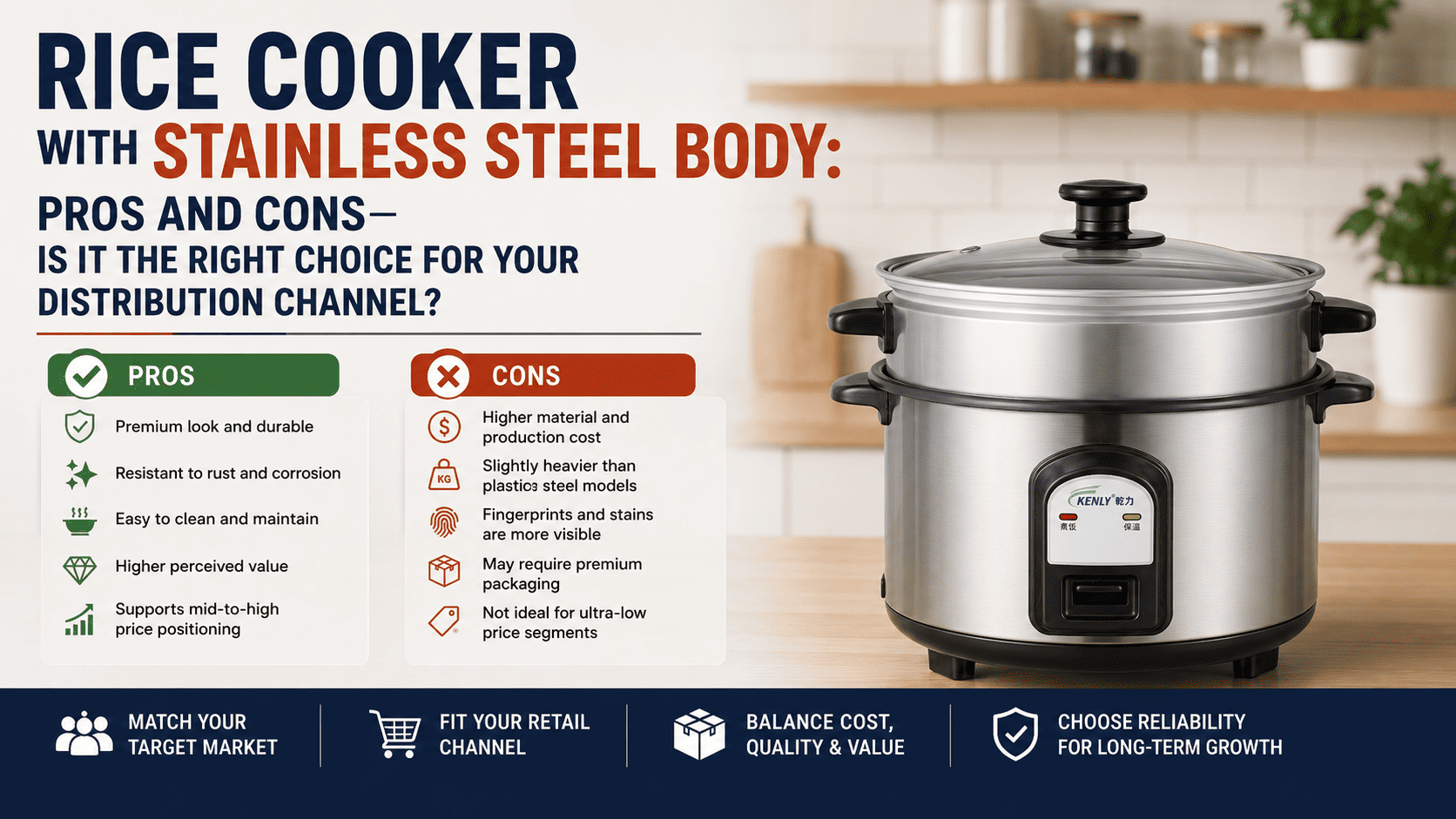
Stainless steel bodies offer better drop resistance and appearance retention, but they add weight and may increase logistics costs. The right choice depends on your distribution channel, customer handling frequency, and warranty cost structure—not on a universal "safer = stainless" assumption.
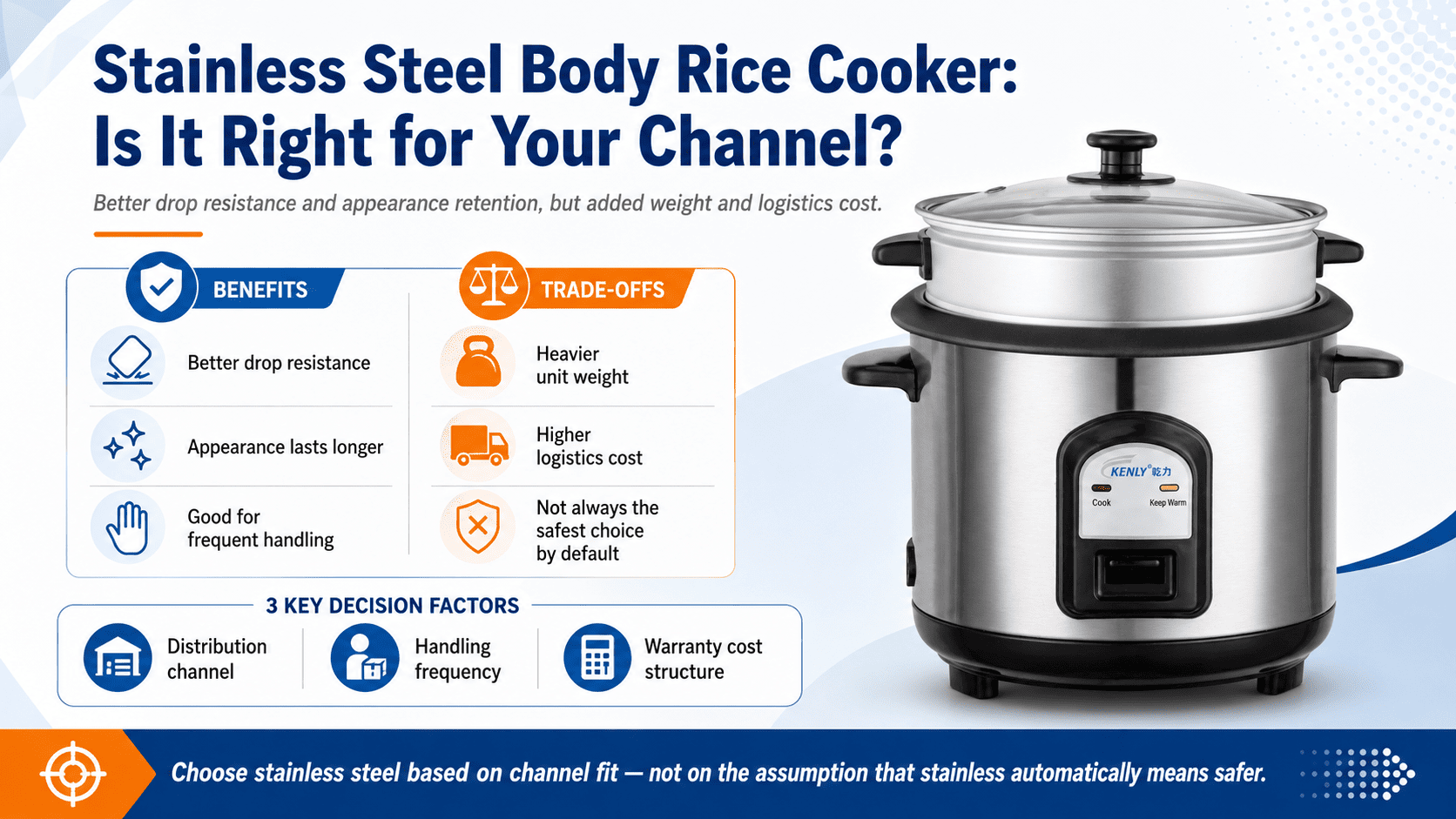
Before I explain the details, I need to tell you something. Stainless steel does not automatically mean higher quality. I have seen buyers pay more for stainless bodies, only to realize their customers never drop the product. The extra cost does not reduce their warranty claims. Let me show you when stainless steel actually helps and when it does not.
Does Stainless Steel Body Mean Better Safety for Food Contact?
Many buyers think stainless steel bodies make rice cookers safer. I hear this often. But this mixes two different things. Stainless steel affects durability, not food safety compliance.
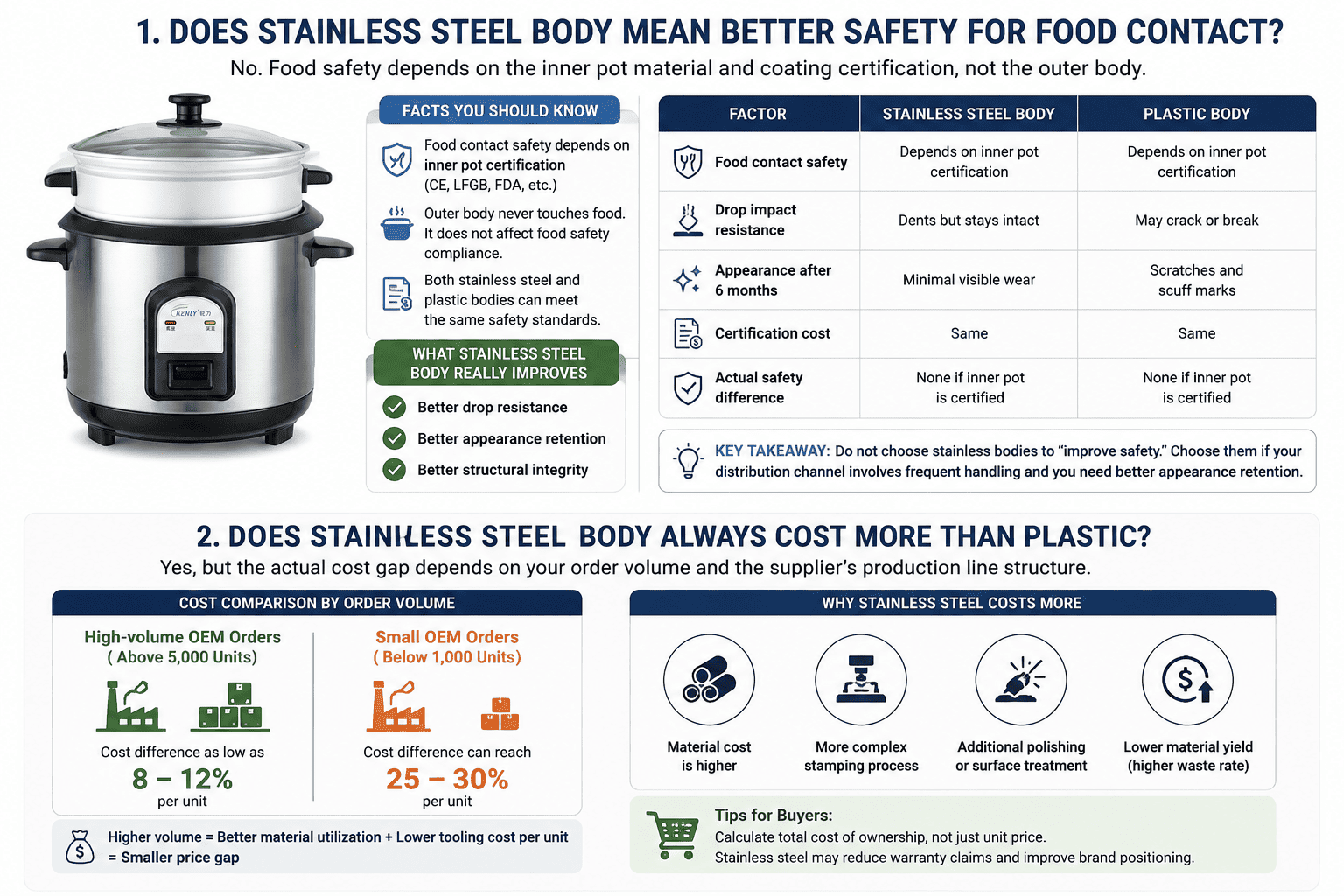
Food safety depends on the inner pot material and coating certification, not the outer body. Both stainless steel and plastic bodies can meet CE, LFGB, or FDA food contact standards if the inner pot is properly certified.
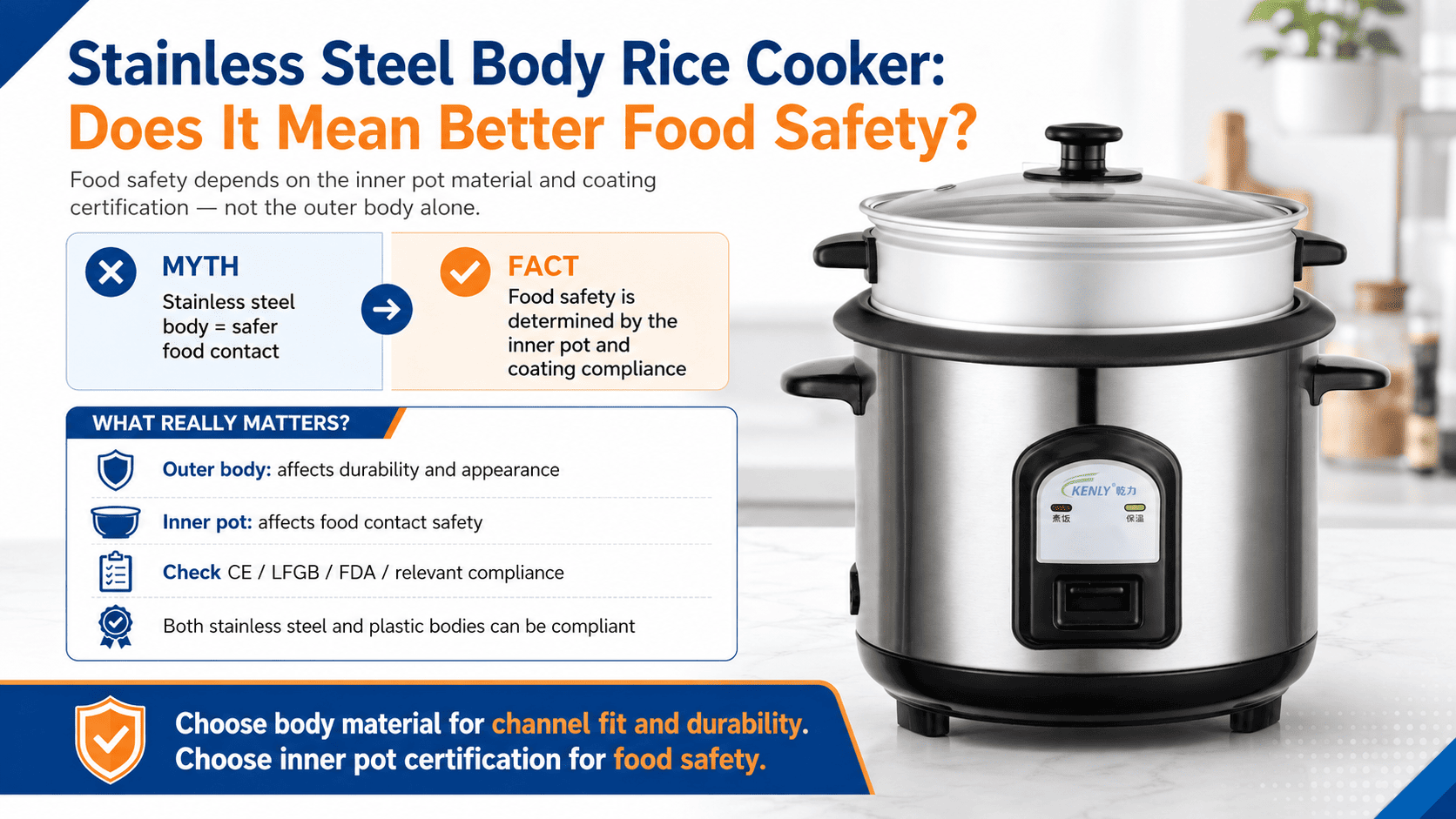
Let me explain what happens in OEM projects. Moo from Thailand once asked me if stainless bodies reduce contamination risk. I showed him our certification documents. The inner pot coating—whether non-stick aluminum or stainless steel—must pass food migration tests. The outer body never touches food. It does not matter if the body is plastic or stainless for food safety compliance.
Here is the real difference. Stainless steel bodies resist dents and scratches better. If a rice cooker falls during shipping or retail handling, a plastic body might crack. A stainless body might dent but will not break open. This affects appearance retention and structural integrity, not food safety.
I have seen this in real projects. One client distributed rice cookers through small retail stores. Staff restocked shelves twice a week. After six months, plastic-body units showed scratches and scuff marks. Stainless-body units looked newer. But food safety test results were identical for both. The difference was cosmetic durability.
Now think about your distribution channel. If your rice cookers sit in warehouses and get delivered once to end customers, the body material does not affect safety. If your products go through multiple handling points—retail staff, delivery workers, customer homes—stainless bodies protect appearance. But this is a market positioning decision, not a safety upgrade.
Here is a comparison table:
| Factor | Stainless Steel Body | Plastic Body |
|---|---|---|
| Food contact safety | Depends on inner pot certification | Depends on inner pot certification |
| Drop impact resistance | Dents but stays intact | May crack or break |
| Appearance after 6 months | Minimal visible wear | Scratches and scuff marks |
| Certification cost | Same | Same |
| Actual safety difference | None if inner pot is certified | None if inner pot is certified |
The key takeaway is this. Do not choose stainless bodies to "improve safety." Choose them if your distribution channel involves frequent handling and you need better appearance retention. Safety comes from inner pot certification, which applies to both body types.
Does Stainless Steel Body Always Cost More Than Plastic?
Most buyers assume stainless steel bodies increase unit cost significantly. I understand why. Stainless steel material is more expensive than polypropylene plastic. But the actual cost gap depends on your order volume and the supplier's production line structure.
In high-volume OEM orders above 5,000 units, the cost difference between stainless and plastic bodies can be as low as 8-12% per unit. In smaller orders below 1,000 units, the gap can reach 25-30% because of tooling and material waste factors.
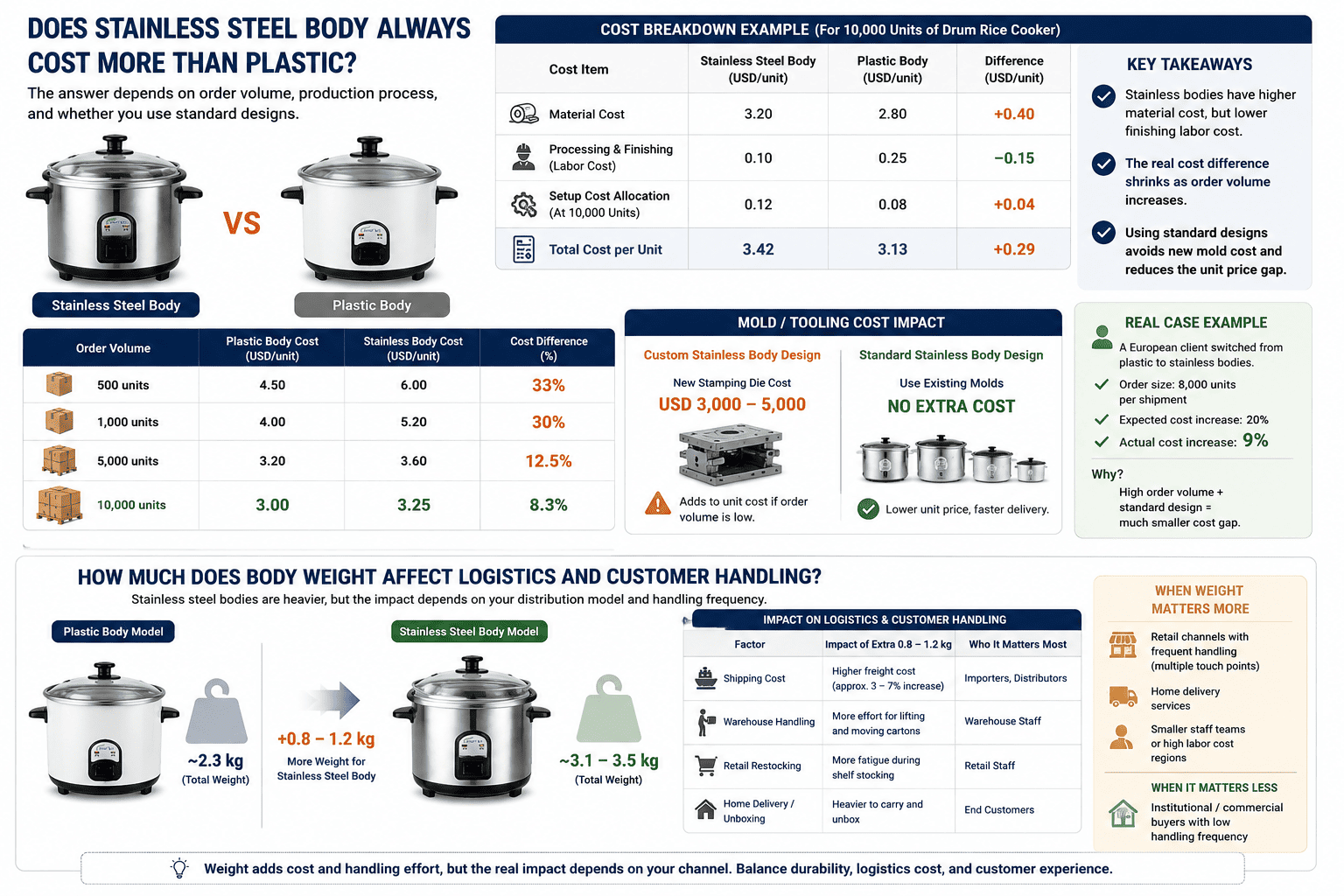
Let me share what I see in our factory. We run two production lines. One line handles plastic-body rice cookers. The other handles stainless-body models. When we produce 10,000 units of a drum rice cooker, the material cost for a stainless body is about USD 3.20 per unit. The plastic body costs USD 2.80 per unit. That is a USD 0.40 difference.
But there is more. Stainless bodies require fewer post-processing steps. Plastic bodies need surface coating, UV protection treatment, and quality checks for color consistency. Stainless bodies skip these steps. The labor cost for plastic-body finishing is about USD 0.25 per unit. For stainless bodies, it is USD 0.10 per unit. So the real cost difference is USD 0.40 minus USD 0.15, which equals USD 0.25 per unit.
Now add the order volume factor. If you order 1,000 units, we need to set up the production line, adjust tooling, and manage material inventory separately. The setup cost is fixed—around USD 800 for plastic bodies and USD 1,200 for stainless bodies. For 1,000 units, this adds USD 0.80 per unit for plastic and USD 1.20 per unit for stainless. The gap widens.
But if you order 10,000 units, the setup cost spreads thinner. It becomes USD 0.08 per unit for plastic and USD 0.12 per unit for stainless. The gap shrinks to almost nothing. This is why high-volume buyers get better cost parity between stainless and plastic bodies.
Here is another thing I notice. Some buyers negotiate better stainless steel pricing by accepting standardized body designs. Custom body shapes require new stamping dies, which cost USD 3,000 to USD 5,000. If you use our existing stainless body molds, you avoid this cost entirely. The unit price difference drops even more.
One client from Europe switched from plastic to stainless bodies last year. His order size was 8,000 units per shipment. He expected a 20% cost increase. The actual increase was 9%. He was surprised. I explained that his order volume and willingness to use standard designs reduced the cost gap significantly.
Here is a breakdown:
| Order Volume | Plastic Body Cost (USD/unit) | Stainless Body Cost (USD/unit) | Cost Difference (%) |
|---|---|---|---|
| 500 units | 4.50 | 6.00 | 33% |
| 1,000 units | 4.00 | 5.20 | 30% |
| 5,000 units | 3.20 | 3.60 | 12.5% |
| 10,000 units | 3.00 | 3.25 | 8.3% |
The lesson is simple. Do not assume stainless bodies blow your budget. Get quotes for your actual order volume. Ask if the supplier has existing stainless body tooling you can use. High-volume orders and standard designs bring costs closer to plastic-body levels. The real cost difference might be smaller than you think.
How Much Does Body Weight Affect Logistics and Customer Handling?
Weight is a real concern. I have heard this from many procurement managers. Stainless steel bodies are heavier than plastic. But the impact on logistics and customer handling depends on your distribution model and where the product gets handled most.
A stainless steel body adds 0.8 to 1.2 kg to the total product weight. This affects shipping costs, retail shelf restocking, and home delivery unboxing. For institutional or commercial buyers who rarely move the product, weight does not matter. For retail channels with frequent handling, it increases labor and logistics burden.
Let me show you the numbers. A standard 1.8-liter drum rice cooker with a plastic body weighs about 3.2 kg when packed. The same model with a stainless body weighs about 4.3 kg. That is a 1.1 kg difference. It does not sound like much, but it adds up fast in logistics.
I worked with a client who ships 2,000 units per container. With plastic bodies, the total container weight is 6,400 kg. With stainless bodies, it is 8,600 kg. That is a 2,200 kg difference. Shipping rates often have weight tiers. If your container crosses a weight threshold, the freight cost jumps. For this client, the cost increased by USD 0.15 per unit. Over 2,000 units, that is USD 300 extra per shipment.
Now think about retail handling. I visited a retail chain in Thailand last year. Staff restock shelves twice a week. Each staff member moves about 40 rice cookers per shift. With plastic bodies, that is 128 kg of lifting. With stainless bodies, it is 172 kg. The staff told me they prefer lighter products. Heavier products slow them down and increase physical strain. The store manager said heavier products also increase the risk of dropping during restocking. More drops mean more damaged units and warranty claims.
But weight does not always matter. I have another client who sells rice cookers to commercial kitchens and cafeterias. These buyers install the rice cooker once and rarely move it. The extra 1.1 kg does not affect their daily use. For them, the heavier stainless body feels more stable on the countertop. They see it as a quality signal, not a burden.
Home delivery is another variable. If you sell through e-commerce and ship directly to customers, weight affects unboxing experience. I heard feedback from end customers who said heavier rice cookers feel more premium when they lift the box. But elderly customers or people with limited mobility sometimes struggle with heavier products. One client switched back to plastic bodies after receiving complaints from older customers in Japan.
Here is a comparison of weight impact across scenarios:
| Handling Scenario | Plastic Body (3.2 kg) | Stainless Body (4.3 kg) | Weight Impact |
|---|---|---|---|
| Container shipping (2,000 units) | 6,400 kg total | 8,600 kg total | +USD 0.15/unit in freight cost |
| Retail restocking (40 units/shift) | 128 kg lifted | 172 kg lifted | Slower restocking, higher drop risk |
| Commercial kitchen installation | 3.2 kg | 4.3 kg | No impact after installation |
| E-commerce home delivery | 3.2 kg | 4.3 kg | Feels premium to some, heavy to elderly customers |
The decision is not about weight alone. It is about who handles the product and how often. If your distribution channel involves frequent lifting—retail staff, delivery workers, multiple warehouse transfers—plastic bodies reduce logistics costs and labor strain. If your customers install the product once and never move it, stainless bodies add perceived stability without creating handling problems.
When Does Stainless Steel Body Reduce Total Cost Through Lower Warranty Claims?
This is the part most buyers miss. Stainless steel bodies can reduce total cost if your distribution channel has high drop damage rates. But you need to calculate whether the upfront cost increase is smaller than the warranty and return cost reduction.
If your product return rate from drop damage or appearance defects exceeds 3-4%, stainless bodies can reduce total landed cost by lowering warranty claims, reverse logistics, and customer dissatisfaction. If your return rate is below 2%, the extra upfront cost usually does not pay off.
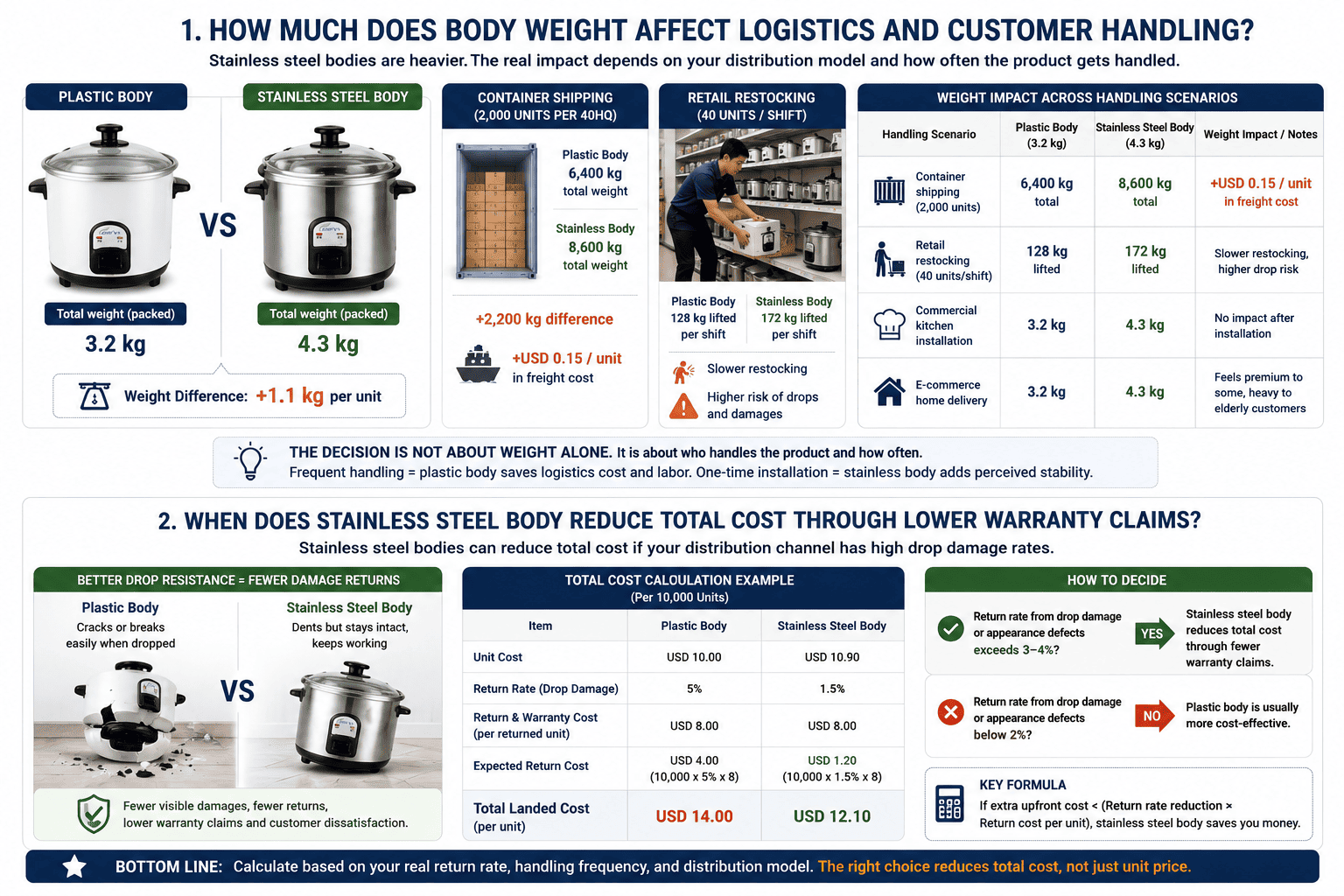
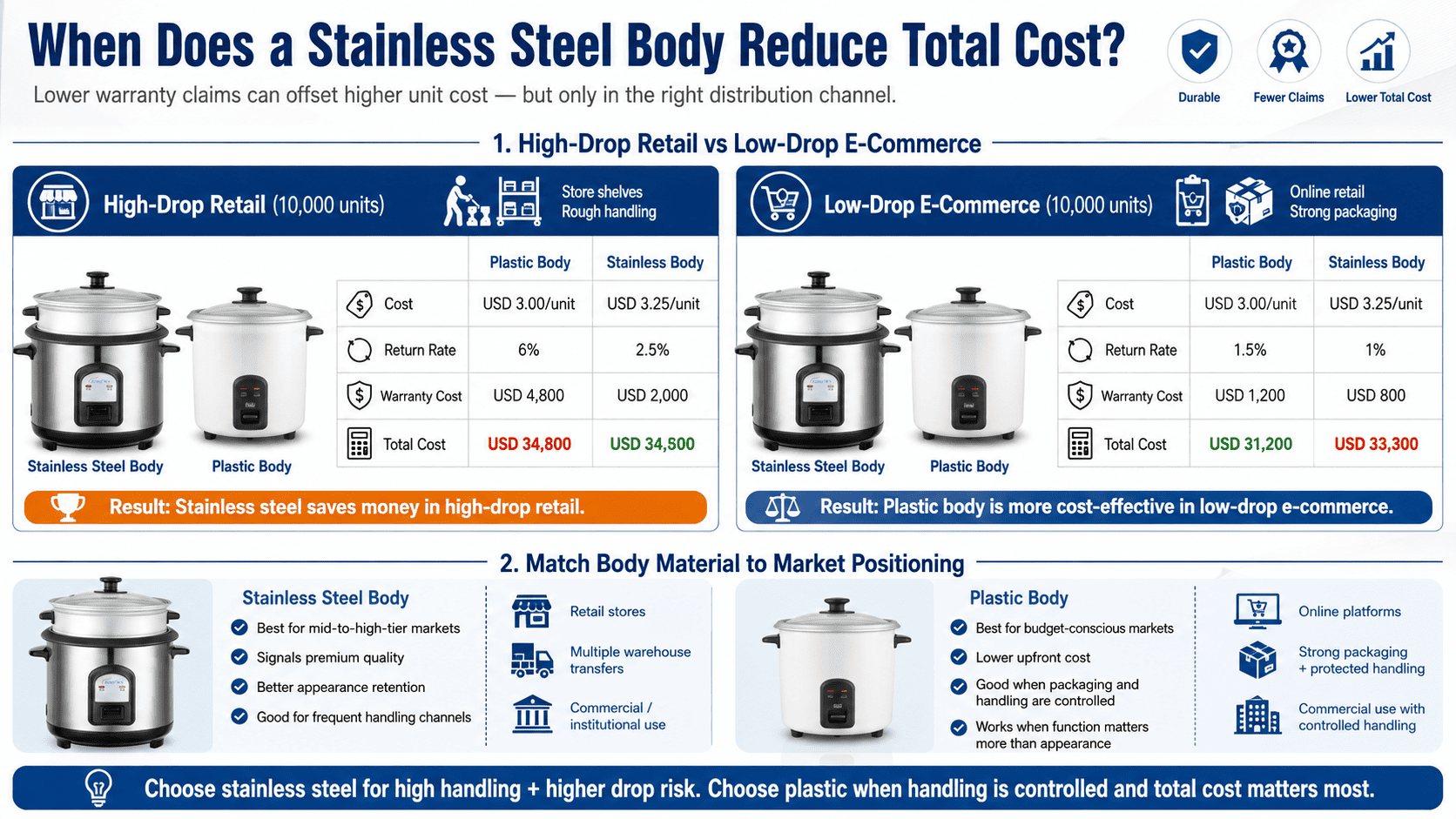
I learned this from a client in Thailand. Moo told me his return rate was 6% in the first year. Most returns were from cracked plastic bodies after customer drops or retail handling damage. Each return cost him USD 8 in reverse logistics, inspection, and replacement. With 10,000 units sold, that was 600 returns and USD 4,800 in warranty costs.
He switched to stainless bodies the next year. The return rate dropped to 2.5%. Most damage was cosmetic dents, which customers did not return. The warranty cost fell to USD 2,000. He saved USD 2,800 in warranty costs. The stainless body added USD 0.25 per unit in upfront cost—USD 2,500 total. His net savings were USD 300, plus improved brand reputation from fewer customer complaints.
But this does not work for everyone. Another client sells through online platforms with careful packaging and low drop rates. His return rate is 1.5%. Switching to stainless bodies would add USD 0.30 per unit in cost but only save about USD 600 in warranty claims. The math does not work. He stays with plastic bodies.
The key variables are these. First, how often does the product get dropped during its lifecycle? Retail stores with frequent shelf restocking see more drops. E-commerce packaging protects the product better. Second, what is your reverse logistics cost? If you operate in remote areas or across borders, return shipping is expensive. Stainless bodies reduce return frequency and save more. Third, how do customers perceive damage? Small scratches on plastic look cheap. Small dents on stainless steel look acceptable.
Here is a cost comparison table:
| Scenario | Plastic Body Cost | Stainless Body Cost | Return Rate (Plastic) | Return Rate (Stainless) | Warranty Cost (Plastic) | Warranty Cost (Stainless) | Total Cost (Plastic) | Total Cost (Stainless) |
|---|---|---|---|---|---|---|---|---|
| High-drop retail (10,000 units) | USD 3.00/unit | USD 3.25/unit | 6% | 2.5% | USD 4,800 | USD 2,000 | USD 34,800 | USD 34,500 |
| Low-drop e-commerce (10,000 units) | USD 3.00/unit | USD 3.25/unit | 1.5% | 1% | USD 1,200 | USD 800 | USD 31,200 | USD 33,300 |
The decision is clear. If your distribution channel has high drop damage rates—retail stores, multiple warehouse transfers, rough handling—stainless bodies reduce total cost. If your packaging is strong and handling is careful, plastic bodies cost less overall. You need to know your return rate and reverse logistics cost before choosing.
How Should Procurement Managers Match Body Material to Market Positioning?
Body material is not just a functional choice. It is a market positioning signal. I see buyers make mistakes when they choose materials without thinking about customer expectations in their specific market tier.
Stainless steel bodies signal premium quality in mid-to-high-tier markets where customers equate metal with durability. Plastic bodies work better in budget-conscious markets where customers prioritize function over appearance. Mismatching body material and market tier creates customer perception gaps that hurt sales.
I worked with a client who sold rice cookers in Germany. His target market was mid-tier customers who shop at department stores. He initially used plastic bodies to keep costs low. Sales were slow. Customer reviews mentioned "cheap feel" and "not worth the price." He switched to stainless bodies and increased the retail price by 15%. Sales improved. Customers said the product "feels solid" and "looks premium." The material change matched the market expectation.
But the opposite happened with another client in Southeast Asia. He targeted budget-conscious customers in rural areas. He used stainless bodies to differentiate his product. The retail price was 20% higher than competitors. Sales were poor. Customers did not care about the metal body. They wanted lower prices and basic functionality. He switched back to plastic bodies and lowered the price. Sales recovered.
The lesson is this. Stainless steel bodies work when your target customers value appearance and durability as quality signals. This happens in markets where customers compare products in stores, read reviews online, and expect premium-looking appliances. Plastic bodies work when your target customers prioritize price and function over appearance. This happens in markets where customers buy based on specifications and price tags, not tactile feel.
Here is another factor. Retail environment matters. If your products sit on shelves next to competitors, body material affects side-by-side comparison. A stainless body stands out next to plastic competitors. Customers touch the products and feel the weight difference. This influences buying decisions. If your products sell online with only photos and descriptions, body material matters less. Customers cannot touch the product. They judge by price and reviews.
I also see differences across regions. In Japan and South Korea, customers expect kitchen appliances to look premium. Stainless steel bodies are common. Plastic bodies feel cheap even if they work well. In India and some Southeast Asian markets, customers focus on price and capacity. Body material is secondary. In Europe, customers expect durability and recyclability. Stainless steel fits these values better.
Here is a market fit comparison:
| Market Tier | Better Body Choice | Why It Fits |
|---|---|---|
| Budget retail | Plastic body | Keeps unit price low and supports price-sensitive buyers |
| Mid-range retail | Stainless steel or high-quality plastic | Depends on whether customers value appearance or price more |
| Premium retail | Stainless steel body | Supports stronger visual value and better shelf comparison |
| Wholesale distribution | Plastic body or standard stainless body | Decision depends on handling frequency and return rate |
| E-commerce | Plastic body with strong packaging or stainless body for premium positioning | Photos, reviews, packaging protection, and return cost matter |
| Institutional or commercial use | Stainless steel body | Extra weight is less important, while durability and stability matter more |
The body material should support your market strategy. Stainless steel is not always the best choice, and plastic is not always the cheaper-looking choice. The right decision depends on your target customer, retail price, channel handling, and after-sales cost.
Buyer Checklist: Should You Choose Stainless Steel Body or Plastic Body?
Before confirming a stainless steel body rice cooker, buyers should not compare only appearance and unit price. The body material affects product positioning, logistics cost, damage risk, warranty cost, and customer perception.
Use this checklist before placing an OEM/ODM rice cooker order:
| Checklist Item | What to Confirm | Why It Matters |
|---|---|---|
| Sales channel | Retail shelf, wholesale, e-commerce, project order, or commercial kitchen | Different channels have different handling frequency and appearance requirements |
| Target market tier | Budget, mid-range, or premium | Stainless steel fits premium positioning better; plastic fits price-sensitive markets better |
| Handling frequency | How many times the product is moved before reaching the end user | Frequent handling increases scratch, crack, and drop damage risk |
| Return rate history | Current return rate for cracked body, scratches, dents, or appearance defects | Helps calculate whether stainless steel reduces total cost |
| Product weight | Packed weight of stainless body vs plastic body | Affects container shipping, retail restocking, delivery, and customer handling |
| Order quantity | 500 units, 1,000 units, 5,000 units, or 10,000+ units | Higher volume reduces the cost gap between stainless and plastic bodies |
| Tooling status | Existing body mold or customized body design | Custom stainless body design may require additional tooling cost |
| Inner pot certification | Food contact test, coating report, LFGB/FDA-related documents if required | Food safety depends on the inner pot, not the outer body |
| Certification scope | Whether the selected body material and final model are covered by test reports | Customized changes may require updated documentation |
| Packaging strength | Inner foam, carton thickness, drop protection, and container loading | A strong package may reduce body damage even with plastic body |
| Warranty structure | Replacement cost, reverse logistics cost, repair policy, and after-sales support | Determines whether higher upfront cost can reduce long-term loss |
| Competitor positioning | What body material competitors use at the same retail price | Helps avoid looking either too cheap or overpriced in the market |
A practical sourcing decision should answer this question clearly: will stainless steel help you sell more, reduce returns, or improve brand value enough to justify the higher cost and weight?
Certification Requirements Buyers Should Confirm
Many buyers connect stainless steel with safety, but the compliance logic is more specific. Stainless steel outer body usually relates to durability and appearance. Food contact safety mainly depends on the inner pot, coating, steam tray, lid, and any parts that touch food or steam.
Before choosing stainless steel body or plastic body, buyers should check these certification-related points:
| Requirement Area | What Buyers Should Check | Why It Matters |
|---|---|---|
| Food contact safety | Inner pot material, non-stick coating, steam tray, and lid components | These parts contact food or steam directly |
| Electrical safety | CE, CB, GS, UKCA, KC, or local safety approval | Confirms the rice cooker meets electrical safety requirements |
| Restricted substances | RoHS or similar hazardous substance requirements | Important for electrical products sold in regulated markets |
| Body material declaration | Stainless steel grade or plastic material type if required by buyer or retailer | Helps support retailer documentation and product specification |
| Surface finishing | Stainless steel surface treatment, anti-rust handling, scratch resistance, or plastic UV resistance | Affects long-term appearance and customer complaints |
| Rating label | Voltage, frequency, power, model number, capacity, and warning marks | Must match the final product configuration |
| Plug and power cord | Local plug type, voltage standard, cable length, and certification | Affects market access and user safety |
| Manual and packaging | Required language, safety warnings, importer information, barcode, and recycling marks | Helps avoid customs delay or retailer rejection |
| Test report scope | Whether the final configuration is covered by existing certificates | Changing body, heating element, thermostat, or plug may affect documentation |
For example, if your buyer sells rice cookers in the EU, CE, RoHS, correct rating label, plug type, manual language, and importer information should be checked before production. If the buyer sells in South Korea, KC certification and Korean labeling may be required. If the buyer sells through supermarkets or e-commerce platforms, barcode, packaging marks, and product claims must also match the final specification.
The safest approach is to confirm certification requirements during quotation and sampling. Do not wait until the order is finished to check whether the certificate, rating label, manual, and packaging information are consistent.
Factory Capability: What a Reliable Rice Cooker Supplier Should Support
Choosing stainless steel body or plastic body is not only a material decision. It also depends on whether the factory can control body forming, surface finishing, assembly, testing, packaging, and after-sales feedback.
A reliable rice cooker factory should support the following capabilities:
| Factory Capability | What It Means for Buyers |
|---|---|
| OEM/ODM body options | The factory can offer stainless steel body, plastic body, or existing standard body designs |
| Standard tooling support | Buyers can use existing molds to reduce tooling cost and shorten lead time |
| Material matching | The factory can match body material with inner pot, heating plate, thermostat, lid, handle, and packaging |
| Surface inspection | Stainless steel scratches, dents, fingerprints, and plastic color differences are checked before packing |
| Incoming material inspection | Stainless sheets, plastic parts, inner pots, heating plates, plugs, and wires are inspected before assembly |
| In-line quality control | Body assembly, lid fitting, switch position, handle strength, and base stability are checked during production |
| 100% electrical testing | Each unit is tested for high voltage, power, basic function, and safety before packing |
| Packaging protection design | The factory can recommend inner foam, carton thickness, and drop protection for different body materials |
| Certification support | The factory can help prepare CE, CB, RoHS, UKCA, KC, or other required documentation |
| After-sales feedback tracking | The factory records repeated issues such as cracks, dents, scratches, loose handles, or power failures |
A strong supplier should not simply say "stainless steel is better." They should explain when stainless steel helps, when plastic is more cost-effective, and how the production process controls the risks of each body material.
When evaluating a rice cooker supplier, buyers can ask these practical questions:
- Do you have existing stainless steel body tooling?
- What is the cost difference at 1,000, 5,000, and 10,000 units?
- What is the packed weight difference between stainless body and plastic body?
- How do you check scratches, dents, and surface defects before packing?
- Can you calculate container loading quantity for both body options?
- Can you provide certification documents for the final configuration?
- What packaging solution do you recommend to reduce drop damage?
- What are the most common after-sales complaints for each body type?
These questions help buyers judge whether the factory understands both manufacturing and distribution risk.
Common Mistakes When Choosing Stainless Steel Body Rice Cookers
Many sourcing problems happen because buyers choose body material based on a simple assumption: stainless steel looks better, so it must be better. In real procurement, that assumption is not enough.
Mistake 1: Treating stainless steel as a food safety upgrade
The outer body does not normally touch food. Food contact safety depends on the inner pot, coating, lid, steam tray, and other food-contact parts. Buyers should check food contact certification instead of assuming stainless body means safer food.
Mistake 2: Ignoring product weight
Stainless steel bodies add weight. This may increase freight cost, slow retail restocking, and make home delivery less convenient for some customers. Buyers should compare packed weight and container loading before confirming the model.
Mistake 3: Comparing only unit price
A stainless body may cost more upfront but reduce return costs in high-drop retail channels. A plastic body may be cheaper upfront but create more claims if the product is handled roughly. Buyers should compare total landed cost, not just FOB price.
Mistake 4: Choosing stainless steel for a budget market
If the target customer mainly cares about low price and basic function, stainless steel may push the retail price too high. In that case, a well-made plastic body may sell better.
Mistake 5: Choosing plastic body for a premium retail channel
If the rice cooker is placed beside higher-end competitors, a plastic body may look less valuable even if the function is acceptable. Premium retail buyers may expect better appearance and stronger material feel.
Mistake 6: Ignoring tooling and order volume
Small orders with custom stainless steel body designs may become expensive because tooling and setup costs are spread across fewer units. Buyers should ask whether the factory has existing standard stainless body designs.
Mistake 7: Not checking packaging protection
A plastic body with strong packaging may survive shipping better than a stainless body with weak packaging. Body material and packaging design should be considered together.
Mistake 8: Changing body material after certification planning
If the buyer changes material, body structure, plug, wattage, heating plate, or internal components after certification planning, the existing documents may not fully cover the final product. This can delay shipment or create compliance risk.
FAQ About Stainless Steel Body Rice Cookers
1. Is a stainless steel body rice cooker safer than a plastic body rice cooker?
Not necessarily. Food safety depends mainly on the inner pot, coating, steam tray, and food-contact parts. The outer body material affects durability and appearance more than food contact safety.
2. Does stainless steel body always cost much more?
Not always. The cost gap depends on order volume, tooling, body design, and factory production structure. For high-volume orders using existing standard designs, the cost difference may be much smaller than buyers expect.
3. Is stainless steel body better for retail sales?
It can be better for mid-range or premium retail channels where customers compare appearance and material feel. However, for budget retail channels, plastic body may be more competitive because it keeps the retail price lower.
4. Is plastic body always low quality?
No. A well-designed plastic body can be durable, lightweight, and cost-effective. The key is material quality, assembly control, surface finishing, and packaging protection.
5. Does stainless steel body reduce warranty claims?
It can reduce claims caused by cracked bodies, scratches, and rough handling damage. But if your return rate is already low, the extra cost may not pay off. Buyers should compare return rate and reverse logistics cost before deciding.
6. Does stainless steel body increase shipping cost?
Usually yes, because it increases packed weight. The actual freight impact depends on container weight, carton size, shipping method, and destination. Buyers should ask for packed weight and loading quantity before confirming the order.
7. Which body material is better for e-commerce?
For e-commerce, both can work. Plastic body may be better for price-sensitive online sales, especially with strong packaging. Stainless steel body may be better for premium listings where appearance and perceived value support a higher selling price.
8. Which body material is better for commercial kitchens?
Stainless steel body is often suitable for commercial kitchens, cafeterias, and institutional buyers because the product is usually installed once and moved less often. The heavier body may also feel more stable.
9. Should I choose stainless body for my first OEM order?
Only if your market positioning, retail price, order quantity, and channel handling justify it. For a first order or market test, a standard plastic body or existing stainless body design may reduce risk.
10. What should I ask the factory before choosing body material?
Ask about body material options, existing tooling, unit cost by order quantity, packed weight, carton size, loading quantity, certification documents, packaging protection, surface inspection, and common after-sales issues.
Conclusion
A rice cooker with stainless steel body is not automatically safer or better than a plastic-body rice cooker. It is better in the right situation.
If your products go through frequent retail handling, multiple warehouse transfers, premium shelf display, or markets where customers value metal appearance, stainless steel body can improve perceived quality and reduce appearance-related claims. It may even reduce total cost if your current return rate from cracked plastic body or handling damage is high.
If your market is price-sensitive, your packaging protection is strong, your return rate is low, or your customers care more about basic function than appearance, plastic body may be the more profitable choice.
For procurement managers, the best decision is not "stainless or plastic." The best decision is to match body material with sales channel, order quantity, logistics cost, warranty structure, certification requirements, and customer expectations. When these factors are clear, the right body material becomes much easier to choose.