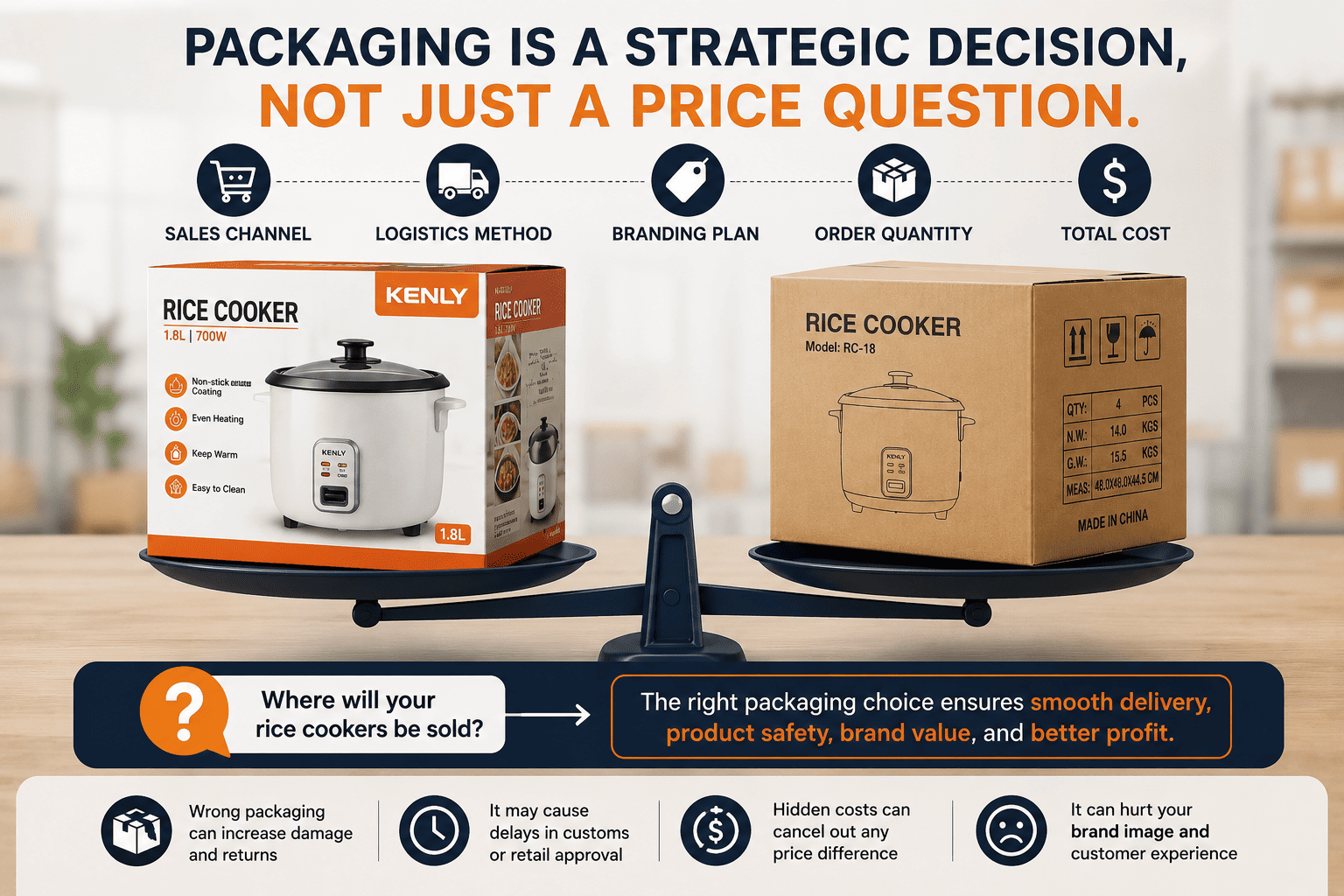
I often receive inquiries asking simply: "Can you quote the rice cooker in color box?" or "How much cheaper is brown carton?" But before I reply with a price, I always ask back: "Where will your rice cookers be sold?"
The packaging decision is not about "premium" versus "cheap." It is about matching your packaging to your sales channel, logistics method, branding plan, order quantity, and total procurement cost. Choosing the wrong type can delay shipment, increase damage, or add hidden costs that cancel the price difference.
I work in OEM/ODM manufacturing. I have seen customers change packaging after sampling, rework entire batches because of missing barcodes, or pay extra air freight because of carton size. The packaging you choose is part of your order execution, not a final design detail you confirm at the last minute.
What is the real difference between color box and brown carton for rice cookers?
Many buyers assume color box means high-end presentation and brown carton means budget option. But that is not the full picture.
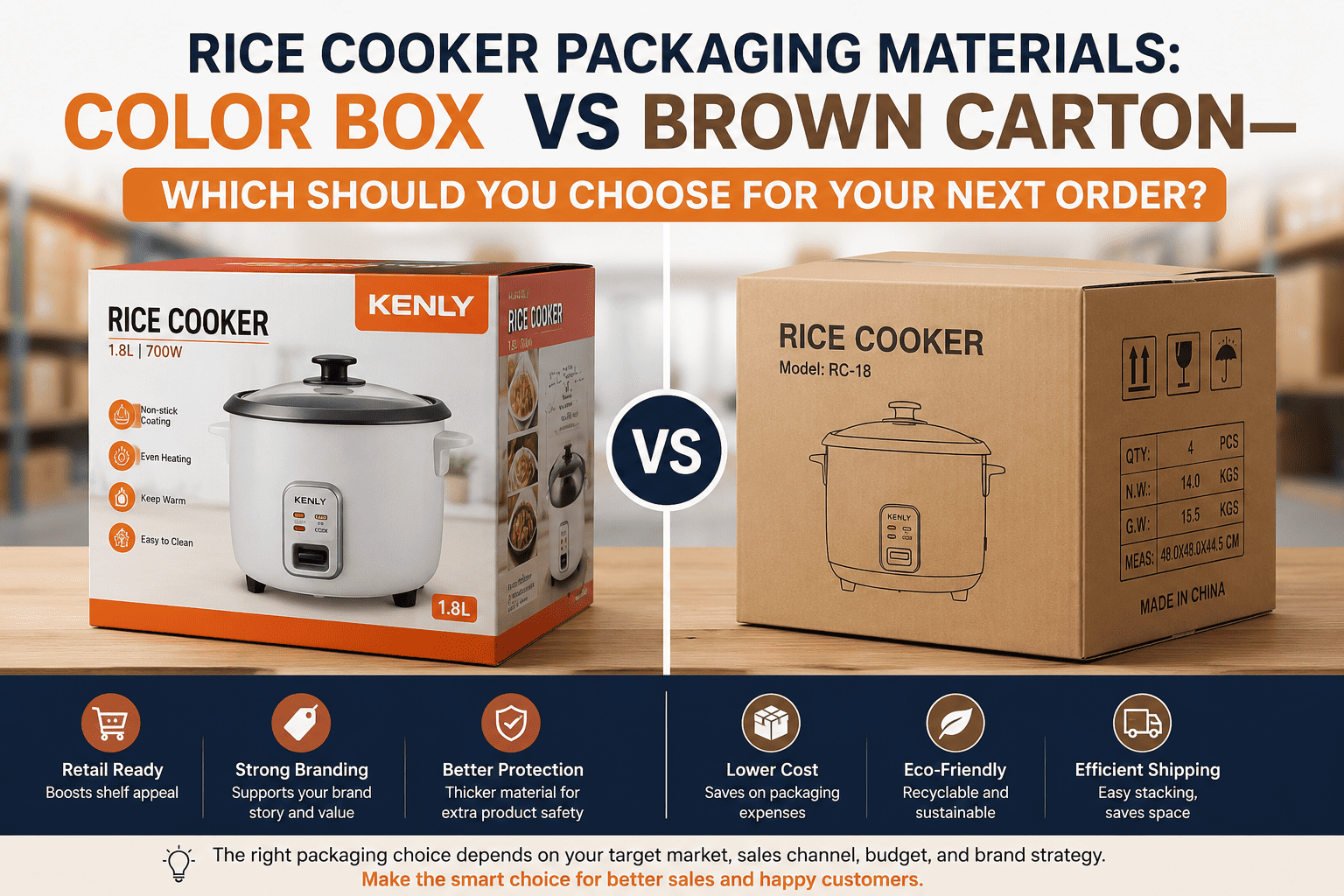
Color box is a printed carton designed to display product information, branding, images, and compliance marks directly on the retail shelf. Brown carton is a plain corrugated box, often used to protect rice cookers during wholesale, import, or project distribution where the outer packaging will not be visible to the end customer.
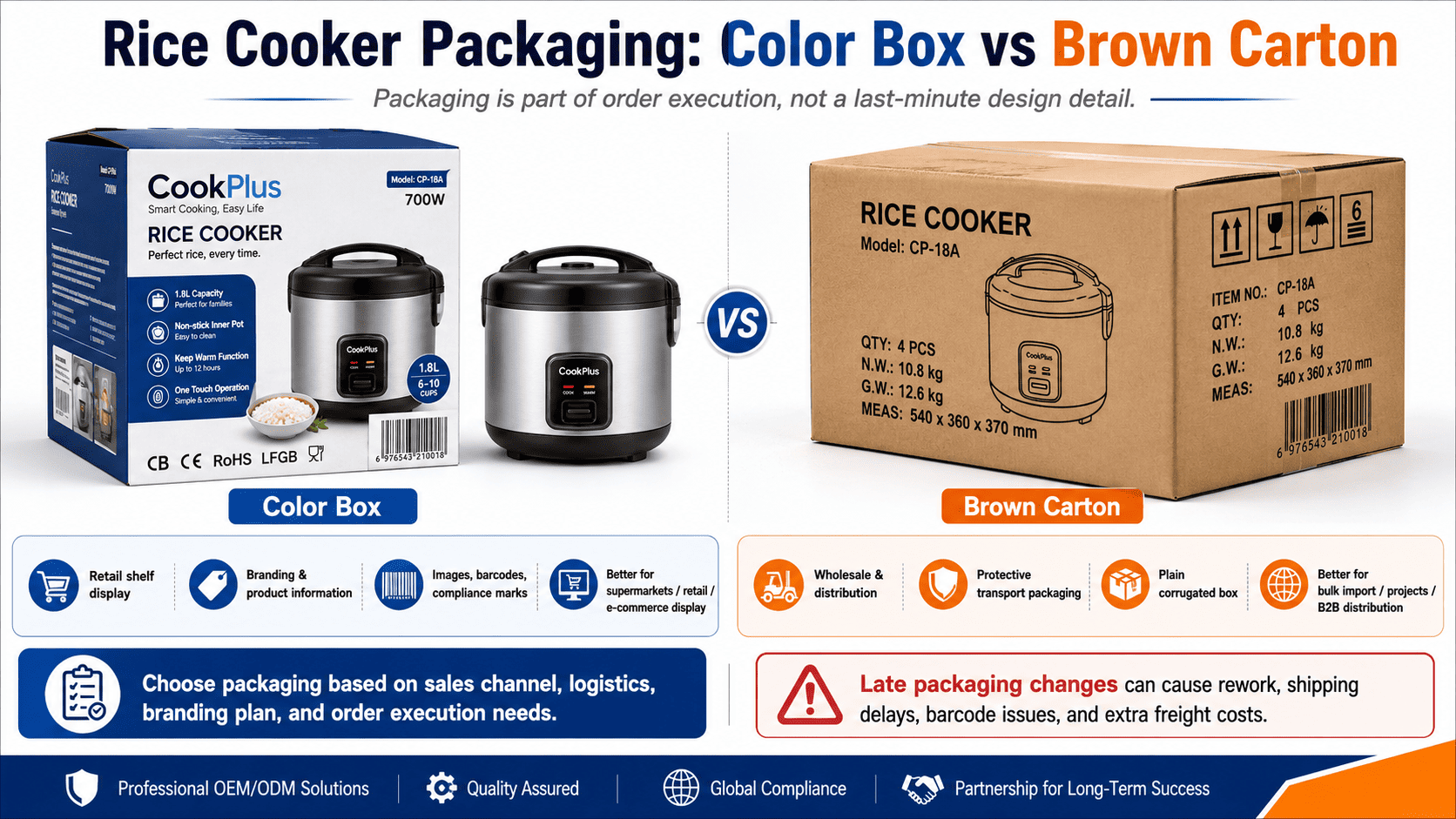
Color boxes are usually printed with 4-color offset or flexographic printing1. They carry your brand logo, product photos, feature icons, multilingual instructions, barcodes, energy labels, and certification marks. The printing requires artwork files, color proofing, and printing plate preparation. This adds lead time and increases the minimum order quantity because printing setup cost is distributed across the batch.
Brown cartons use plain kraft paper with minimal or no printing. Some customers apply a simple one-color logo or product code. Others apply printed labels or stickers after the carton arrives at the warehouse. Brown cartons are faster to produce, require smaller minimum quantities per design, and cost less per unit. But they do not communicate brand or product features visually.
The key difference is not just appearance. It is how the packaging fits into your sales channel and order workflow. If your rice cookers go directly to a retail shelf, the color box becomes your silent salesperson. If your rice cookers go to a distribution warehouse and then are repacked or shelved in store-branded packaging, the brown carton protects the product without adding unnecessary printing cost.
I have worked with customers selling to supermarket chains who need full-color boxes with multiple barcodes and recycling symbols. I have also worked with project buyers purchasing 500 units for a hotel chain who only need the rice cookers protected in plain cartons with a shipping mark on the side. Both packaging types served their purpose.
When does color box make sense for your rice cooker order?
Color box is not automatically better. It fits specific sales and branding situations.
Use color box when:
- Your rice cookers will be displayed on retail shelves in supermarkets, appliance stores, or e-commerce fulfillment centers where the packaging must attract buyers and communicate product benefits.
- You are building or maintaining a brand identity and need consistent visual presentation across your product line.
- Your target market requires specific printed information such as energy labels, recycling marks, multilingual instructions, or retailer-specific barcodes directly on the packaging.
- Your order quantity is large enough to absorb the printing setup cost and meet the factory's minimum order quantity per design.
Color boxes increase brand recognition. A shopper comparing rice cookers on a shelf will see your logo, product image, and key features immediately. The packaging becomes part of your product presentation.
But color boxes also add complexity to your order. You need to prepare print-ready artwork files in the correct format and resolution. You need to confirm Pantone colors, barcode placement, text accuracy, and compliance mark positions. Printing requires color proofing and approval before mass production. This adds at least one week to the sampling timeline2.
If you change artwork after printing plates are made, the factory may charge a new plate fee. If you order a small quantity, the per-unit printing cost becomes high because setup cost is divided by fewer pieces. Many factories set a minimum order quantity of 500 to 1000 units per color box design3 to make printing economical.
I once worked with a customer who needed three different language versions for the same rice cooker model. The factory required separate printing plates for each version. The customer reduced the total design count by using multilingual labels instead of printing all languages directly on the box. This lowered the minimum order quantity and allowed the customer to adjust language distribution based on actual market demand.
When does brown carton make sense for your rice cooker order?
Brown carton is not a compromise. It is the right choice when packaging does not need to perform a sales function.
Use brown carton when:
- Your rice cookers will be distributed through wholesale channels, repackaged by retailers, or sold in bulk to projects, institutions, or corporate buyers who do not display the factory packaging.
- You want to minimize packaging cost per unit and reduce the minimum order quantity per design.
- You plan to apply your own branded labels, stickers, or sleeves at your warehouse or distribution center.
- Your order quantity is small or you are testing a new market and need flexibility to adjust branding or information without reprinting cartons.
Brown cartons protect the product during shipping and storage. They are faster to produce because they do not require printing plate preparation or color proofing. The factory can begin production as soon as carton structure and size are confirmed.
Many importers and wholesalers prefer brown cartons because they allow flexibility. You can apply different language labels or retailer-specific barcodes after the rice cookers arrive at your warehouse. You can test multiple markets without committing to large quantities of pre-printed packaging. You can also update product information or certifications by changing labels instead of scrapping printed cartons.
Brown cartons also simplify order management when you source multiple models or sizes. The factory can use the same carton design for similar products and differentiate them with labels or shipping marks. This reduces the number of packaging SKUs you need to manage and lowers the risk of using the wrong carton during packing.
I have worked with customers who order brown cartons for the first shipment, sell the product in local stores, gather feedback, and then switch to color boxes for the second order after they confirm demand. This approach reduces upfront risk and allows the customer to design packaging based on real customer feedback instead of assumptions.
How does packaging choice affect your total procurement cost?
Packaging cost is not just the per-unit carton price. It affects printing fees, minimum order quantity, carton size, loading efficiency, damage risk, and order lead time.
Factors that increase total cost:
| Cost factor | Color box impact | Brown carton impact |
|---|---|---|
| Printing setup | Plate fee, proofing, artwork preparation | Minimal or none |
| Minimum order quantity | Higher MOQ per design to absorb setup cost | Lower MOQ, easier to split designs |
| Lead time | Longer due to printing and proofing | Shorter, carton production starts faster |
| Carton size and weight | Larger size if design prioritizes shelf appearance | More flexible, can optimize for loading |
| Loading efficiency | May use more container space per unit | Can pack tighter if carton dimensions are optimized |
| Damage risk | Similar if carton structure is the same | Similar if carton structure is the same |
| Flexibility to update | Requires new plates and reprinting | Can change labels or stickers easily |
Printing setup cost is a one-time fee for each design, but it must be included in your total cost calculation. If the factory charges 200 USD for printing plates and you order 500 units, the setup cost adds 0.40 USD per unit. If you order 2000 units, it adds 0.10 USD per unit. The larger your order, the smaller the per-unit impact.
Carton size affects how many rice cookers fit in a shipping container. If your color box is designed with large surface area for better shelf display, each carton may take more space. If you can reduce carton dimensions by 2 centimeters on each side, you may fit 50 more units in a 40-foot container4. Over a full container load, that difference can lower your per-unit freight cost by several percent.
I once worked with a customer who insisted on a tall, narrow color box because it looked premium on the shelf. But the carton dimensions reduced loading efficiency by 12 percent5. The customer eventually chose a shorter, wider box design that maintained brand appearance but increased container capacity. The freight savings covered the extra printing cost.
Damage risk depends more on carton structure and inner packaging than whether the carton is printed or plain6. Both color boxes and brown cartons can use the same corrugated material and inner padding. If your rice cooker has a glass lid or delicate control panel, the inner structure matters more than the outer appearance.
Flexibility is often overlooked. If you print certification marks, barcodes, or energy labels on the color box and those requirements change, you may need to scrap the old packaging and reprint. If you use brown cartons with labels, you can print new labels without discarding the cartons.
How does your sales channel determine packaging choice?
Packaging is part of your sales strategy. The channel where your rice cookers are sold determines how the packaging will be used and what it must communicate.
Retail shelf sales:
If your rice cookers are displayed in supermarkets, appliance stores, or mass retailers, the packaging must attract attention and communicate product benefits within seconds. Shoppers compare multiple brands on the same shelf. Your color box must show product images, key features, capacity, power rating, and certification marks clearly.
Retailers often require specific packaging standards. Some retailers require barcodes in specific positions. Some require shelf-ready packaging that can be opened and displayed without unpacking individual units. Some require recycling symbols or disposal instructions printed in local languages7. You must confirm these requirements with the retailer before finalizing your packaging design.
I have worked with customers supplying to large retail chains in Europe. The retailer provided a packaging manual specifying barcode size, logo placement, multilingual text, and carton opening method. The customer submitted packaging samples for approval before mass production. This process added two weeks to the timeline but prevented the shipment from being rejected at the distribution center.
Wholesale and distribution:
If your rice cookers are sold to distributors, independent retailers, or online sellers who repackage or relabel the product, color box may add unnecessary cost. The distributor may discard the factory packaging and apply their own branded labels or boxes. In this case, brown carton protects the product during shipping and allows the distributor to add their branding later.
Wholesale buyers often prioritize packaging durability and loading efficiency over appearance. They want cartons that stack well, resist crushing during multi-stop delivery, and have clear shipping marks for warehouse handling. Brown cartons meet these requirements at lower cost.
E-commerce fulfillment:
E-commerce sellers face a unique situation. The rice cooker may be shipped directly to the customer in the factory packaging, or it may be stored in a fulfillment center and repacked in a branded shipping box. If the factory packaging is the final customer-facing box, it must look professional and include all product information. If the seller uses additional outer packaging, the factory box only needs to protect the product during handling.
Some e-commerce sellers use brown cartons with branded labels or sleeves. This allows them to control branding, update product information easily, and reduce packaging cost. Others prefer color boxes because unboxing experience affects customer reviews and repeat purchases8.
Project and bulk sales:
If you are supplying rice cookers to hotels, corporate offices, institutions, or project buyers, packaging usually serves a protective function only. The buyer does not display the packaging to end customers. They care about product quality, delivery schedule, and total cost. Brown cartons with clear shipping marks and model numbers are sufficient.
I worked with a customer who supplied 800 rice cookers to a hotel chain. The buyer did not require color boxes. They only needed each rice cooker protected in a brown carton with a model code and serial number label. The customer saved 1.50 USD per unit on packaging cost and used the savings to improve the inner foam padding.
What packaging information must you prepare before requesting a quotation?
Many buyers ask for a quotation without providing complete packaging requirements. This delays the quotation process and increases the risk of miscommunication during order execution.
Minimum information needed for color box quotation:
- Sales channel and whether packaging will be displayed on retail shelves
- Brand logo, product images, and marketing text in print-ready format
- Required certifications, energy labels, barcodes, and recycling symbols
- Language versions and whether text will be printed or applied as labels
- Expected order quantity and whether you plan repeat orders with the same design
- Target packaging cost per unit and total budget including printing setup
If you cannot provide print-ready artwork immediately, tell the factory you need a structural sample first and will supply artwork later. This allows the factory to confirm carton size, material, and protection performance before committing to printing.
Minimum information needed for brown carton quotation:
- Sales channel and how the packaging will be used
- Requirement for printed shipping marks, logos, or model codes
- Whether you will apply labels or stickers after receiving the shipment
- Expected order quantity and flexibility to adjust in future orders
- Target packaging cost per unit
Even for brown cartons, you should confirm whether the factory will print a simple logo or shipping mark. Some factories offer one-color printing on brown cartons at low cost. This allows you to identify your shipment without applying labels manually.
Buyer Checklist: What should you confirm before choosing rice cooker packaging?
Before confirming color box or brown carton, buyers should check more than the packaging price. The right choice depends on sales channel, logistics method, compliance requirements, order quantity, and brand strategy.
Use this checklist before asking your supplier for the final quotation:
| Checklist item | What to confirm | Why it matters |
|---|---|---|
| Sales channel | Retail shelf, wholesale, e-commerce, project order, or distributor channel | Determines whether packaging needs to sell the product or only protect it |
| Packaging type | Color box, brown carton, brown carton with label, or color sleeve | Avoids overpaying for packaging that the end customer may never see |
| Branding requirement | Logo, product photo, feature icons, brand color, and marketing text | Important for retail display and brand consistency |
| Language version | English, Spanish, Arabic, French, local language, or multilingual version | Prevents reprinting or relabeling after production |
| Barcode requirement | EAN, UPC, retailer barcode, warehouse code, or Amazon FNSKU | Reduces warehouse rejection and retail listing problems |
| Certification marks | CE, UKCA, CB, RoHS, energy label, recycling mark, or local compliance mark | Helps avoid customs, retailer, or platform compliance issues |
| Carton structure | Single wall, double wall, inner foam, egg crate, corner protection, or paper pulp tray | Directly affects damage rate during shipping and handling |
| Carton size | Exact inner and outer dimensions | Affects container loading quantity and freight cost |
| Artwork status | Print-ready artwork, draft artwork, or no artwork yet | Affects sampling time, proofing time, and mass production schedule |
| MOQ per design | Quantity required for each printed design | Important when you have multiple models, colors, or language versions |
| Label strategy | Printed directly on carton or applied by sticker | Gives flexibility when market requirements change |
| Final packing method | One unit per color box, color box inside master carton, or one unit per brown carton | Affects cost, loading, warehouse handling, and customer experience |
A practical rule is this: if the packaging will face the final consumer, treat it as part of your product marketing. If the packaging will only move through warehouses and distributors, treat it as part of your logistics control.
Certification Requirements: What packaging information may be required?
Packaging is not only a design issue. In many markets, rice cooker packaging also carries compliance information. If this information is missing, wrong, or placed incorrectly, the shipment may face customs delays, retailer rejection, or relabeling costs.
The most common packaging-related certification and compliance requirements include:
| Requirement | Usually appears on | What buyers should check |
|---|---|---|
| CE mark | Color box, rating label, manual | Required for many electrical products sold in the EU |
| UKCA mark | Color box, rating label, manual | Required for products placed on the Great Britain market |
| RoHS mark or declaration | Packaging, manual, compliance file | Important for electrical product material compliance |
| CB test reference | Technical file, sometimes packaging or manual | Useful for proving electrical safety test basis |
| Energy label | Color box or product surface, depending on market | Some markets require energy information to be visible |
| Recycling symbols | Color box, brown carton, manual | Needed in markets with packaging waste regulations |
| Importer information | Color box, rating label, manual, or sticker | Often required for customs and retail compliance |
| Voltage and frequency | Color box, rating label, manual | Must match the actual product configuration |
| Plug type | Packaging, manual, product specification | Important for market suitability and customer satisfaction |
| Warning labels | Color box, manual, product body | Needed for safe use and local-language compliance |
| Barcode | Color box, brown carton, master carton | Required for retail, warehouse, and e-commerce systems |
For example, if a buyer sells rice cookers in the EU, the packaging may need CE-related information, importer details, recycling symbols, correct voltage information, multilingual safety warnings, and a barcode that matches the retailer's system. If the buyer sells in the Middle East, Arabic information, plug type, importer details, and energy-related labels may be required. If the buyer sells through e-commerce platforms, platform-specific labels may be just as important as traditional certification marks.
The most important point is timing. Certification marks, importer information, barcode, voltage, plug type, and language version should be confirmed before printing. Do not wait until mass production is finished to check whether the packaging information is correct.
A small mistake on packaging can create a large cost. If a barcode is wrong, the retailer may reject the goods. If voltage information is wrong, customs may question the shipment. If importer information is missing, the buyer may need to relabel every unit after arrival. These costs are usually higher than checking the artwork carefully before printing.
How does packaging affect order lead time and sampling?
Packaging is part of the order timeline, not a separate process you finalize after confirming the rice cooker design.
Sampling stage:
If you request a color box sample, the factory must prepare artwork, print a sample carton, and pack the rice cooker before sending it to you. This takes longer than packing the rice cooker in a plain carton. If you are testing multiple designs or comparing suppliers, request the first sample in a brown carton to save time. After you confirm the rice cooker meets your requirements, request a color box sample with final artwork.
I have seen customers approve rice cooker samples quickly but delay orders for weeks because they had not prepared packaging artwork. The factory cannot start printing until artwork is approved. This delay affects the production schedule and may push your shipment into the next month.
Mass production stage:
Color box printing adds 5 to 10 days to the production timeline compared to brown cartons9. The factory must print cartons, wait for ink to dry, and conduct quality checks before packing. If your delivery deadline is tight, brown carton may be the only option to meet the schedule.
If you change artwork after printing has started, the factory may need to reprint cartons and discard the old batch. This adds cost and delays shipment. Always confirm all artwork details, including spelling, barcode accuracy, and certification marks, before approving printing.
Shipping and customs:
Some countries require specific product information, importer details, or safety warnings printed on the packaging10. If you use brown cartons and plan to apply labels later, confirm whether customs authorities accept labels as equivalent to printed information11. In some cases, printed information is required for customs clearance.
I worked with a customer shipping to a Middle Eastern market. Customs required the energy label and importer contact information printed directly on the carton, not applied as a sticker. The customer had already ordered brown cartons with labels. The shipment was delayed until the customer provided a letter from the local authority accepting labels. The customer switched to color boxes with printed information for the next order to avoid the issue.
Factory Capability: What a reliable rice cooker supplier should support
A packaging decision is only useful when the factory can execute it correctly. Buyers should not only compare color box and brown carton prices. They should also check whether the supplier has the capability to control artwork, carton structure, compliance information, packing method, and final inspection.
A reliable rice cooker factory should support the following packaging-related capabilities:
| Factory capability | What it means for buyers |
|---|---|
| OEM/ODM packaging support | The factory can support buyer logo, color box design, brown carton mark, sticker, manual, and rating label requirements |
| Carton structure advice | The factory can recommend carton thickness, inner protection, foam, paper pulp tray, or master carton solution |
| Artwork checking | The factory can check die-cut line, barcode position, warning text, certification marks, and print area before production |
| Multi-market packaging | The factory can help buyers prepare different language versions or market-specific labels |
| Packaging sample support | The factory can provide plain carton samples, color box samples, or digital artwork proofing before mass production |
| Loading quantity calculation | The factory can calculate carton dimensions and container loading quantity before the buyer confirms packaging |
| Label and manual consistency | The factory checks that carton, manual, rating label, and product information match each other |
| Incoming packaging inspection | The factory checks printed cartons before packing to avoid wrong artwork, color difference, or damaged cartons |
| Final packing inspection | The factory checks whether the correct model, plug, manual, label, and carton are used before shipment |
For buyers, this capability reduces risk. A beautiful color box is not enough if the barcode is wrong. A cheap brown carton is not a saving if the carton collapses during shipping. A supplier should be able to explain not only how much the packaging costs, but also how the packaging will be produced, inspected, packed, and shipped.
When evaluating a rice cooker supplier, ask these practical questions:
- Can you provide the carton dieline before artwork design?
- Can you check barcode size and position before printing?
- Can you support different packaging versions for different markets?
- Can you calculate container loading quantity based on final carton size?
- Can you check whether manual, rating label, color box, and carton information are consistent?
- Can you provide packaging photos before shipment?
- Can you help us avoid wrong labels or wrong cartons during mass production?
A factory with strong packaging control can save buyers time, reduce mistakes, and make repeat orders easier.
What common mistakes should you avoid when choosing rice cooker packaging?
I have worked with many customers during packaging discussions. Some mistakes appear repeatedly and cause delays, cost increases, or shipment issues.
Mistake 1: Choosing packaging based only on per-unit price
You ask the factory to quote color box and brown carton, see that brown carton is 0.50 USD cheaper per unit, and choose brown carton without considering printing setup amortization, loading efficiency, or sales channel requirements. Later you realize your retailer requires color boxes, and you must delay the order or pay extra for a small-batch printing run.
Always calculate total procurement cost, including packaging, freight, minimum order quantity, and flexibility for future orders. Sometimes paying 0.30 USD more per unit for color box saves 2.00 USD per unit in freight and customs handling.
Mistake 2: Not preparing artwork until after confirming the order
You place the order, confirm the rice cooker design, and then start designing the color box artwork. You send artwork to the factory three weeks later. The factory checks the artwork and finds barcode placement conflicts with the carton opening flap. You revise the artwork and send it again. Another week passes. By the time printing starts, your original delivery schedule has slipped by a month.
Prepare artwork in parallel with rice cooker sampling. Confirm carton structure, print area, and fold lines with the factory before designing. Provide artwork files at least two weeks before the planned production start date.
Mistake 3: Assuming brown carton means lower quality
You believe brown carton will make your brand look cheap and insist on color box even though your rice cookers will be sold to distributors who will repackage them. You pay extra for printing that no customer will see and increase your minimum order quantity.
Brown carton does not mean low quality. It means functional packaging optimized for distribution. Many premium brands use brown cartons for wholesale channels and reserve color boxes for retail.
Mistake 4: Not confirming retailer packaging requirements early
You design a color box based on your own brand idea, but the retailer later asks for a different barcode position, warning label, carton opening direction, recycling mark, or language layout. At that point, the artwork may already be approved or printed. The result is rework, extra cost, and shipment delay.
Before confirming artwork, ask the retailer or distributor for their packaging manual. If there is no official manual, confirm barcode, label, language, carton mark, and display requirements by email before printing.
Mistake 5: Printing too many language versions too early
Some buyers want separate color boxes for English, Spanish, Arabic, French, and other languages in the first order. This sounds professional, but it may create high MOQ pressure and slow-moving packaging stock if market demand is still uncertain.
For the first shipment, a multilingual box or brown carton with market-specific labels may be safer. After the buyer confirms actual sales volume by country, separate language versions can be prepared for repeat orders.
Mistake 6: Ignoring carton size and container loading
A color box may look good in design, but if the carton size is not optimized, it can reduce container loading quantity. This increases freight cost per unit. In a full container order, packaging dimensions can affect profit more than buyers expect.
Before approving packaging, ask the factory to calculate loading quantity for 20GP, 40GP, and 40HQ containers. Compare the loading quantity between color box and brown carton options before making the final decision.
Mistake 7: Treating packaging as the last step
Packaging is often left until the end of the order. This creates problems because artwork, barcode, certification marks, manuals, rating labels, and carton dimensions all affect production and shipment.
The better approach is to confirm packaging requirements during the quotation and sampling stage. Packaging should be discussed together with product specification, plug type, voltage, certification, and delivery time.
FAQ About Rice Cooker Color Box and Brown Carton Packaging
1. Is color box always better than brown carton?
No. Color box is better when the packaging needs to attract consumers, show brand identity, and display product information on retail shelves. Brown carton is better when the packaging mainly needs to protect the rice cooker during wholesale, distribution, project delivery, or warehouse handling.
2. Which packaging is better for a new market test order?
For a new market test order, brown carton with labels is often safer. It reduces packaging cost, lowers MOQ pressure, and allows buyers to adjust language, barcode, or market information later. After demand is confirmed, the buyer can switch to color box for repeat orders.
3. Does brown carton make the product look cheap?
Not necessarily. Brown carton is commonly used for wholesale, project orders, and logistics-focused shipments. If the final consumer will not see the factory packaging, brown carton can be the more professional and cost-effective choice.
4. What information should be printed on a rice cooker color box?
A rice cooker color box usually includes brand logo, product image, model number, capacity, voltage, power, plug type, key features, barcode, certification marks, recycling symbols, warning information, importer information, and language-specific product descriptions.
5. Can I use stickers instead of printing everything on the carton?
Yes, in many cases stickers are a flexible solution. They are useful for barcodes, language versions, importer information, and market-specific labels. However, buyers should confirm whether the destination market, retailer, or customs authority accepts stickers for the required information.
6. How does color box affect delivery time?
Color box usually adds extra time because artwork must be checked, proofed, approved, printed, dried, and inspected before packing. If artwork is not ready, packaging can become the main reason for shipment delay.
7. What is the MOQ difference between color box and brown carton?
Color box usually has a higher MOQ per design because printing setup cost must be spread across enough units. Brown carton usually has a lower MOQ and is easier to use across different models or markets with labels or shipping marks.
8. Should e-commerce sellers use color box or brown carton?
It depends on the fulfillment method. If the factory packaging is shipped directly to the final customer, color box or a branded carton can improve customer experience. If the product is repacked by a fulfillment center or stored in another outer box, brown carton with a professional label may be enough.
9. What packaging should importers choose for supermarket sales?
For supermarket sales, color box is usually more suitable because the packaging must display the product, brand, barcode, certification marks, and selling points. Retailers may also have their own packaging requirements, so buyers should confirm them before printing.
10. What packaging should wholesalers choose?
For wholesalers, brown carton is often more practical. It reduces cost, improves flexibility, and focuses on product protection and warehouse handling. The wholesaler can apply labels, stickers, or local branding after receiving the goods.
Conclusion
Color box and brown carton are not simply "premium" and "cheap" packaging choices. They serve different business purposes.
If your rice cookers will be displayed on retail shelves, sold under your own brand, or handled by large retailers, color box can support branding, product communication, and compliance presentation. But it requires artwork preparation, printing approval, higher MOQ, and more careful timeline control.
If your rice cookers will go through wholesale, distribution, project sales, or market testing, brown carton can reduce cost, improve flexibility, and simplify order execution. It can also support labels, stickers, and simple shipping marks without locking you into one printed design too early.
The best choice depends on your sales channel, target market, order quantity, compliance requirements, logistics plan, and branding stage. Before choosing packaging, do not only ask which option is cheaper. Ask which option reduces the most risk for your next order.
"eTools : Printing Industry - Flexography - OSHA", http://www.osha.gov/etools/printing-industry/flexography. Offset and flexographic printing are established methods for producing color packaging, with flexographic printing particularly common for corrugated materials due to its ability to print on rough surfaces. Evidence role: mechanism; source type: education. Supports: that offset and flexographic printing are standard methods for color packaging. Scope note: Source describes printing methods generally; application to rice cooker packaging specifically may vary by manufacturer. ↩
"Prepress proofing - Wikipedia", https://en.wikipedia.org/wiki/Prepress_proofing. Color proofing in packaging production involves multiple steps including digital proofs, physical press proofs, and client approval cycles, which extend production timelines beyond unprinted packaging. Evidence role: general_support; source type: other. Supports: that color proofing and approval processes add time to packaging production. Scope note: Actual timeline varies by manufacturer capabilities, client responsiveness, and complexity of artwork; one week represents a minimum estimate. ↩
"The cost of printing a corrugated box - Digital Repository", https://d.lib.msu.edu/etd/723. Printing setup costs, including plate preparation and color calibration, create economies of scale that typically require minimum order quantities to achieve cost-effective per-unit pricing in custom packaging production. Evidence role: general_support; source type: research. Supports: that printing setup costs drive minimum order quantities in packaging manufacturing. Scope note: Specific MOQ ranges vary by manufacturer, printing technology, and market; the 500-1000 unit range represents one segment of the industry. ↩
"Intermodal container - Wikipedia", https://en.wikipedia.org/wiki/Intermodal_container. Container loading efficiency is highly sensitive to carton dimensions due to the fixed internal dimensions of shipping containers; small reductions in package size can enable additional rows or layers, substantially increasing unit capacity. Evidence role: mechanism; source type: education. Supports: that small dimensional changes in packaging can significantly affect container loading efficiency. Scope note: The specific 50-unit increase depends on original carton size, product dimensions, and stacking configuration; actual gains vary by case. ↩
"Container port loading and unloading efficiency calculation method ...", https://patentscope.wipo.int/search/en/detail.jsf?docId=CN346609873. Loading efficiency in container shipping is calculated by comparing actual loaded volume to available container volume; inefficient carton dimensions that create unusable gaps can reduce capacity by 10-20% compared to optimized packaging. Evidence role: mechanism; source type: education. Supports: that packaging shape affects container loading efficiency through dimensional optimization. Scope note: The 12% figure is from a specific case; actual efficiency losses depend on container type, carton dimensions, and stacking patterns. ↩
"Understanding Shipping Box Strength - EcoEnclose", https://www.ecoenclose.com/blog/understanding-shipping-box-strength/?srsltid=AfmBOooVACFX95wzmEYLXy8AtrMHuAGD4PZlVhZG7j8WnYrZEyTdxhAQ. Packaging protective performance is determined by material properties, corrugated board strength, flute type, structural design, corner reinforcement, closure method, and internal cushioning rather than surface printing, which does not significantly affect mechanical properties. Evidence role: expert_consensus; source type: research. Supports: that structural factors rather than printing determine packaging protective performance. ↩
"SB 343: Accurate Recycling Labels - CalRecycle Home Page - CA.gov", https://calrecycle.ca.gov/wcs/recyclinglabels/. Many jurisdictions require packaging to display recycling symbols, material identification codes, and disposal instructions to support waste management systems and consumer recycling behavior, with specific requirements varying by country and product category. Evidence role: general_support; source type: government. Supports: that recycling and disposal information on packaging is subject to regulatory requirements. Scope note: Requirements vary significantly by jurisdiction; specific symbol types, languages, and placement rules differ across markets. ↩
"The Impact of Visual Elements of Packaging Design on Purchase ...", https://pmc.ncbi.nlm.nih.gov/articles/PMC11851823/. Consumer research indicates that packaging presentation contributes to overall product satisfaction and brand perception, particularly in e-commerce where unboxing is often the first physical brand interaction, with studies showing correlations between packaging quality and review ratings. Evidence role: expert_consensus; source type: research. Supports: that packaging presentation influences customer perception and behavior in e-commerce. Scope note: Effect size varies by product category, price point, and customer segment; packaging is one factor among many influencing reviews and repurchase. ↩
"A History of Packaging | CFAES Knowledge Hub", https://cfaes.osu.edu/fact-sheet/history-packaging. Printed packaging production includes additional steps beyond plain carton manufacturing: artwork preparation, printing plate creation, press setup, printing runs, drying time, and quality inspection, which collectively extend lead times compared to unprinted alternatives. Evidence role: general_support; source type: other. Supports: that printed packaging requires additional production time for printing processes. Scope note: Actual time addition varies by printing method, order size, factory capabilities, and artwork complexity; 5-10 days represents a typical range but not a universal standard. ↩
"EU - Labeling/Marking Requirements", https://www.trade.gov/country-commercial-guides/eu-labelingmarking-requirements. International trade in consumer products is subject to destination country regulations that may mandate specific packaging information including importer identification, safety warnings, product specifications, and compliance marks, with requirements varying significantly across jurisdictions. Evidence role: general_support; source type: government. Supports: that packaging labeling is subject to country-specific regulatory requirements. ↩
"EU - Labeling/Marking Requirements", https://www.trade.gov/country-commercial-guides/eu-labelingmarking-requirements. Customs and product safety regulations may specify whether required information must be permanently printed on packaging or can be applied via labels, with requirements varying by country, product category, and type of information, affecting import clearance procedures. Evidence role: general_support; source type: government. Supports: that customs and regulatory authorities have varying requirements for how product information is presented on packaging. Scope note: Specific requirements vary widely by jurisdiction and product type; generalization across all countries is not possible. ↩