Most overseas buyers ask me one question first: "Which rice cooker inner pot material is best?" I understand the urgency behind that question. But after handling hundreds of quotations, samples, and production batches for brand owners and wholesale procurement managers, I learned that the question itself can lead to the wrong decision.
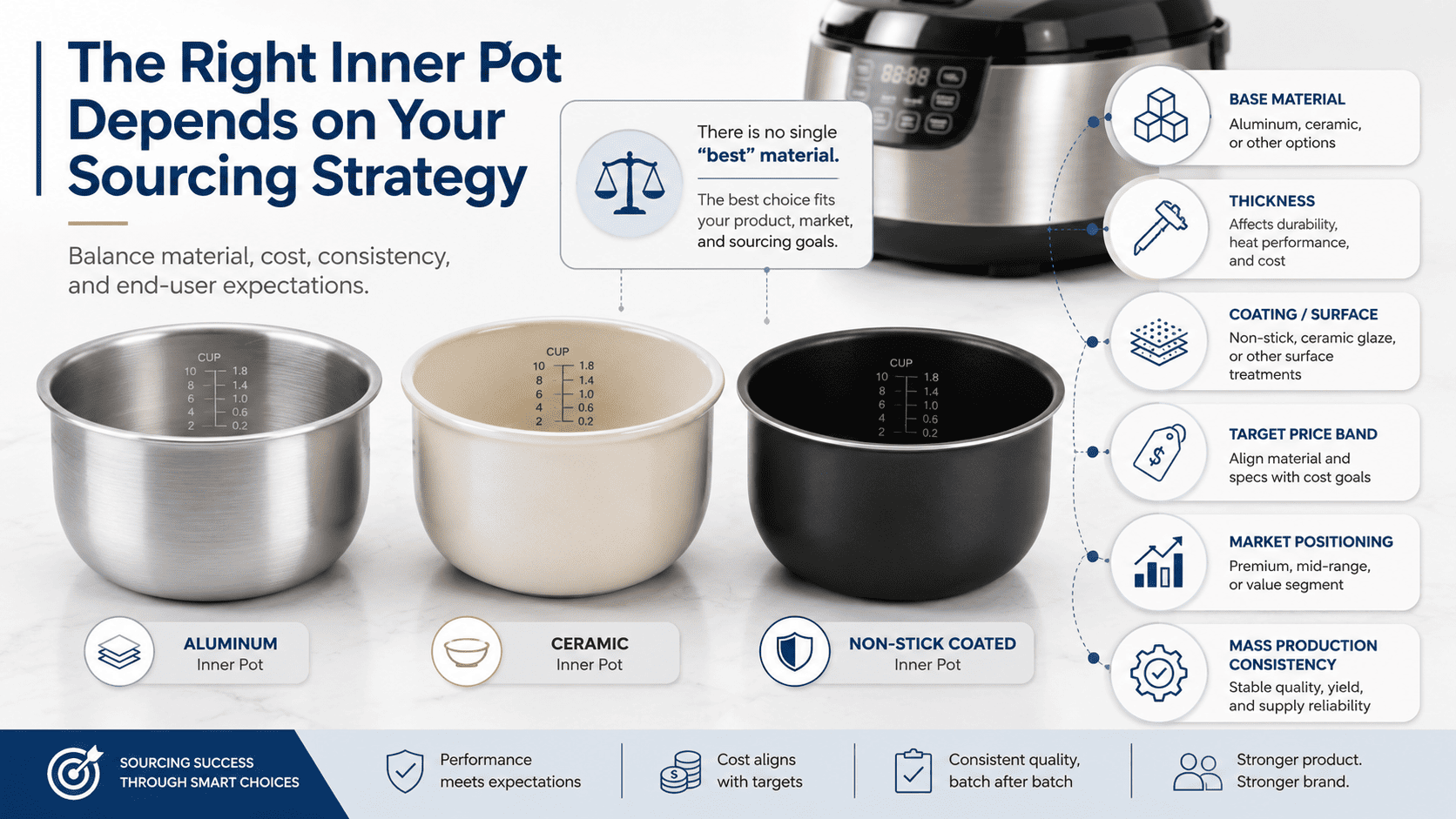
The right rice cooker inner pot is not decided by whether aluminum, ceramic, or non-stick is "best." It is decided by how the base material, thickness, coating or surface treatment, target price band, market positioning, and mass-production consistency fit your procurement risk profile and end-user expectations.
If you source rice cookers in bulk, you already know that a low quotation can look attractive in the beginning. But the real cost shows up later. Delayed shipments. Inconsistent product performance. Customer complaints. Return costs. In this article, I will walk you through the real material choices, the hidden risks, and the practical decision framework that can help you avoid those problems.
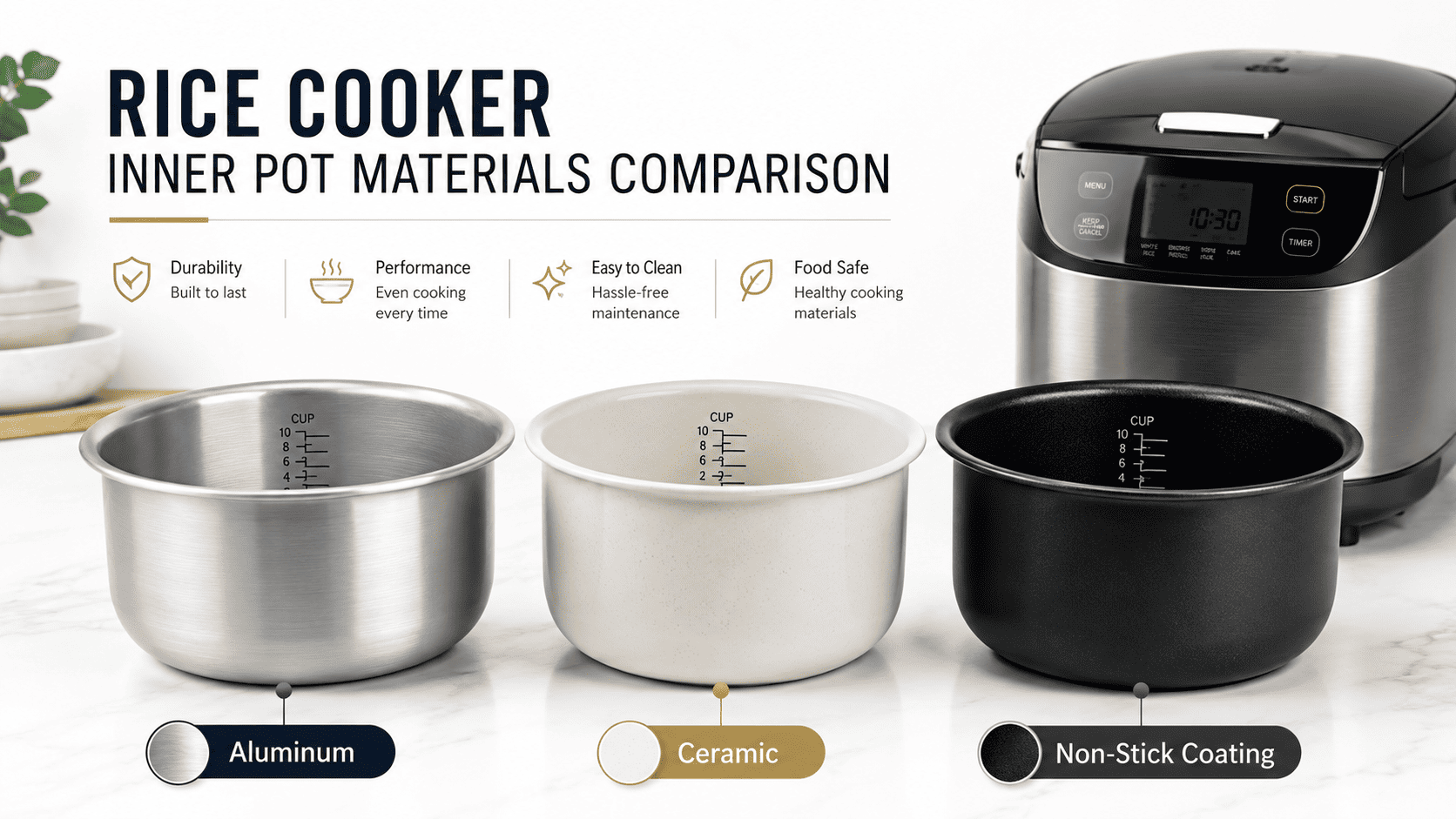
What Do Aluminum, Ceramic, and Non-Stick Actually Mean in Rice Cooker Inner Pots?
Many buyers treat aluminum, ceramic, and non-stick as if they are three separate material categories. But that is not how the manufacturing process works.
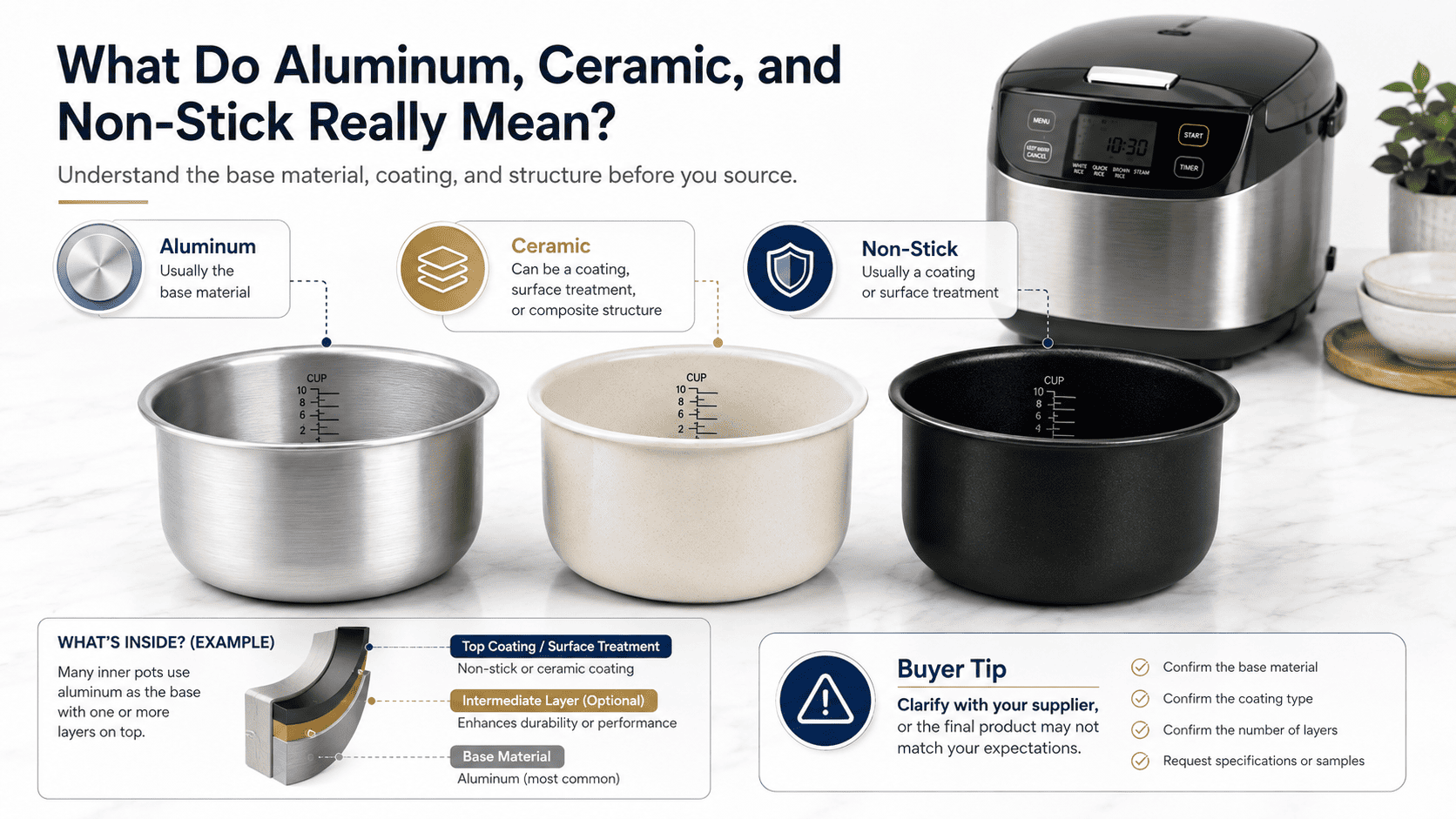
Aluminum is usually the base material. Non-stick is usually a coating or surface treatment applied on top of the base material. Ceramic can be either a coating, a surface treatment, or a composite material structure. If you do not clarify this distinction with your supplier, you may receive a product that does not match your expectations.
Aluminum as the Base Material
Aluminum is the most common base material for rice cooker inner pots. It conducts heat quickly. It is lightweight. It is easy to form during manufacturing. Most OEM suppliers use aluminum as the base because it keeps production costs lower and allows for faster heating.
But aluminum alone is not enough. Without a coating or surface treatment, aluminum can react with acidic or alkaline ingredients1. It can also wear out quickly under repeated cooking and cleaning. That is why most aluminum inner pots come with a coating or surface treatment applied on top.
Non-Stick as a Coating
Non-stick is not a base material. It is a coating. The most common non-stick coating is made from polytetrafluoroethylene (PTFE), often called Teflon2. Some suppliers also offer ceramic-based non-stick coatings.
Non-stick coatings make rice release easily. They reduce cleaning time. They improve user experience. But the quality of the non-stick coating can vary widely. A low-grade coating can peel off after a few months. A high-grade coating can last for years. If your supplier does not specify the coating grade, layer count, or application process, you are taking a risk.
Ceramic as a Coating or Composite Material
Ceramic can mean different things. Some suppliers use ceramic as a coating applied on top of aluminum. Others use ceramic-infused composite materials. Some use pure ceramic inner pots, but these are rare because they are heavier, more expensive, and more fragile.
Ceramic coatings are often marketed as safer, more natural, or more durable. Some buyers ask for ceramic because they want a premium positioning in their market. But ceramic is not automatically better. Its value depends on whether your target customers will pay for that positioning and whether the ceramic coating is applied consistently across mass production.
The Real Question You Should Ask Your Supplier
Do not ask only "Is it aluminum, ceramic, or non-stick?" Ask this instead:
- What is the base material?
- What is the coating or surface treatment?
- What is the thickness of the base material and the coating?
- How many layers does the coating have?
- What is the coating application process?
- Can you provide a specification sheet and mass-production consistency guarantee?
If your supplier cannot answer these questions clearly, you should reconsider that supplier.
Why You Should Not Ask "Which Material Is Best?" First
I have handled inquiries from hundreds of overseas buyers. Many of them start by asking "Which inner pot material is best?" But that question skips the most important step.
Before you choose an inner pot material, you should first clarify your target market, price band, expected order volume, repeat-order plan, and end-user usage habits. The material choice comes after that.
Reframe the Material Question
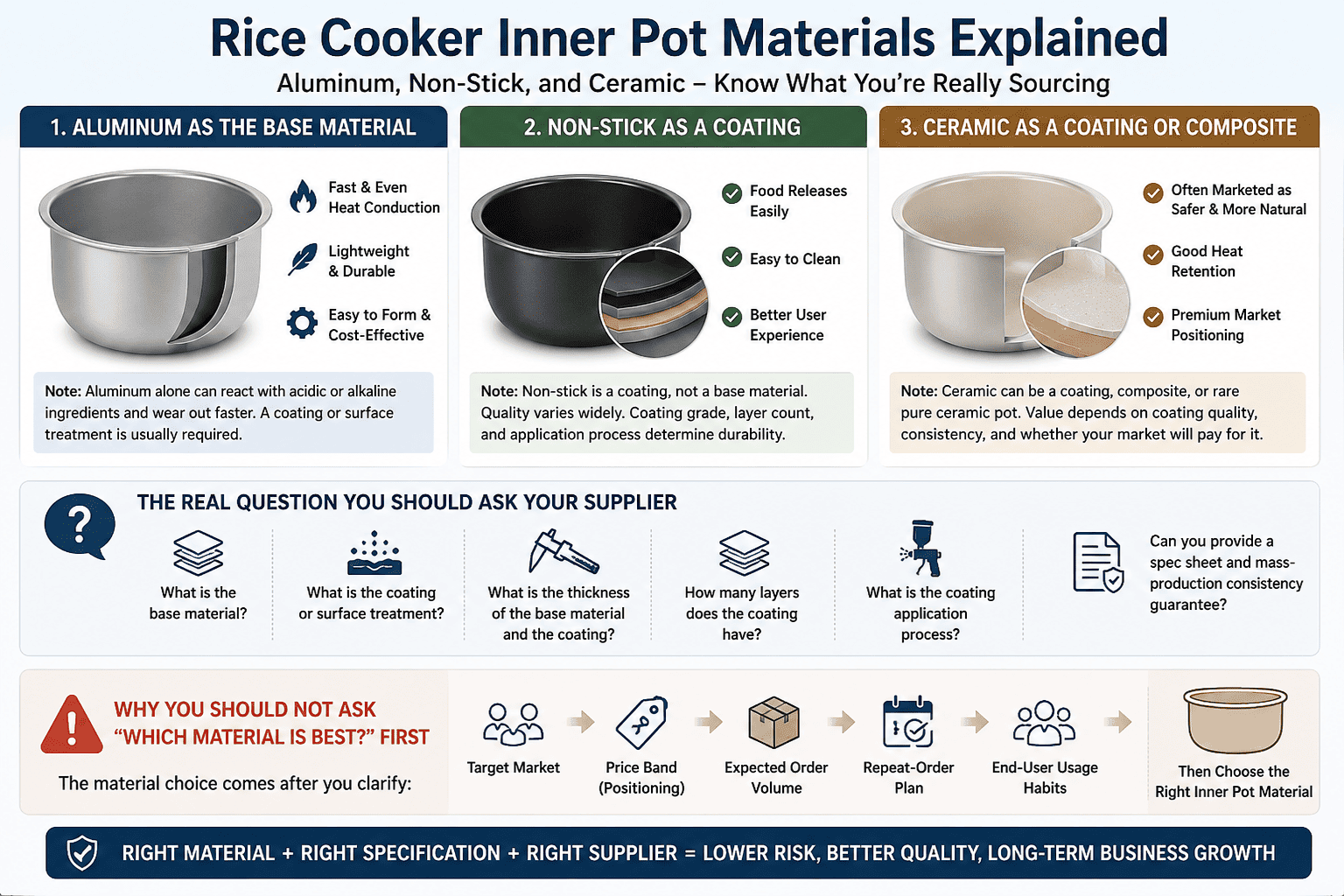
Let me share a real example. A buyer from Thailand contacted us. He asked for a quotation on 5,000 units of drum rice cookers. He wanted to know whether ceramic or non-stick was better. I asked him several questions:
- Who is your target customer? Home users or commercial users?
- What is your target retail price?
- How often do your customers cook rice? Once a day or multiple times?
- Do your customers prefer easy cleaning or long-term durability?
- Are you planning to order once or multiple times?
He was surprised by my questions. He thought the material choice was independent of these factors. But after we discussed his answers, we realized that a mid-grade non-stick coating on an aluminum base was the right choice for his market. Ceramic would have increased his cost without giving him a strong enough marketing advantage.
Align Material Choice with Market Positioning
Your material choice must align with your market positioning. If you are targeting budget-conscious customers, a basic non-stick coating on a thin aluminum base may work. If you are targeting premium customers, a multi-layer ceramic coating on a thicker aluminum base may be necessary.
Do not choose ceramic just because it sounds premium. Do not choose the cheapest non-stick just because it lowers your unit cost. Choose based on what your target customers expect and what price they are willing to pay.
Consider End-User Usage Habits
End-user usage habits matter. In some markets, customers cook rice once a day and clean the inner pot immediately. In other markets, customers cook multiple times a day and sometimes leave rice in the pot overnight.
If your customers clean the inner pot frequently and carefully, a thinner non-stick coating may last long enough. If your customers are rougher with the pot, a thicker coating or a ceramic-based coating may reduce after-sales complaints.
Are Ceramic Inner Pots Always Safer and More Durable?
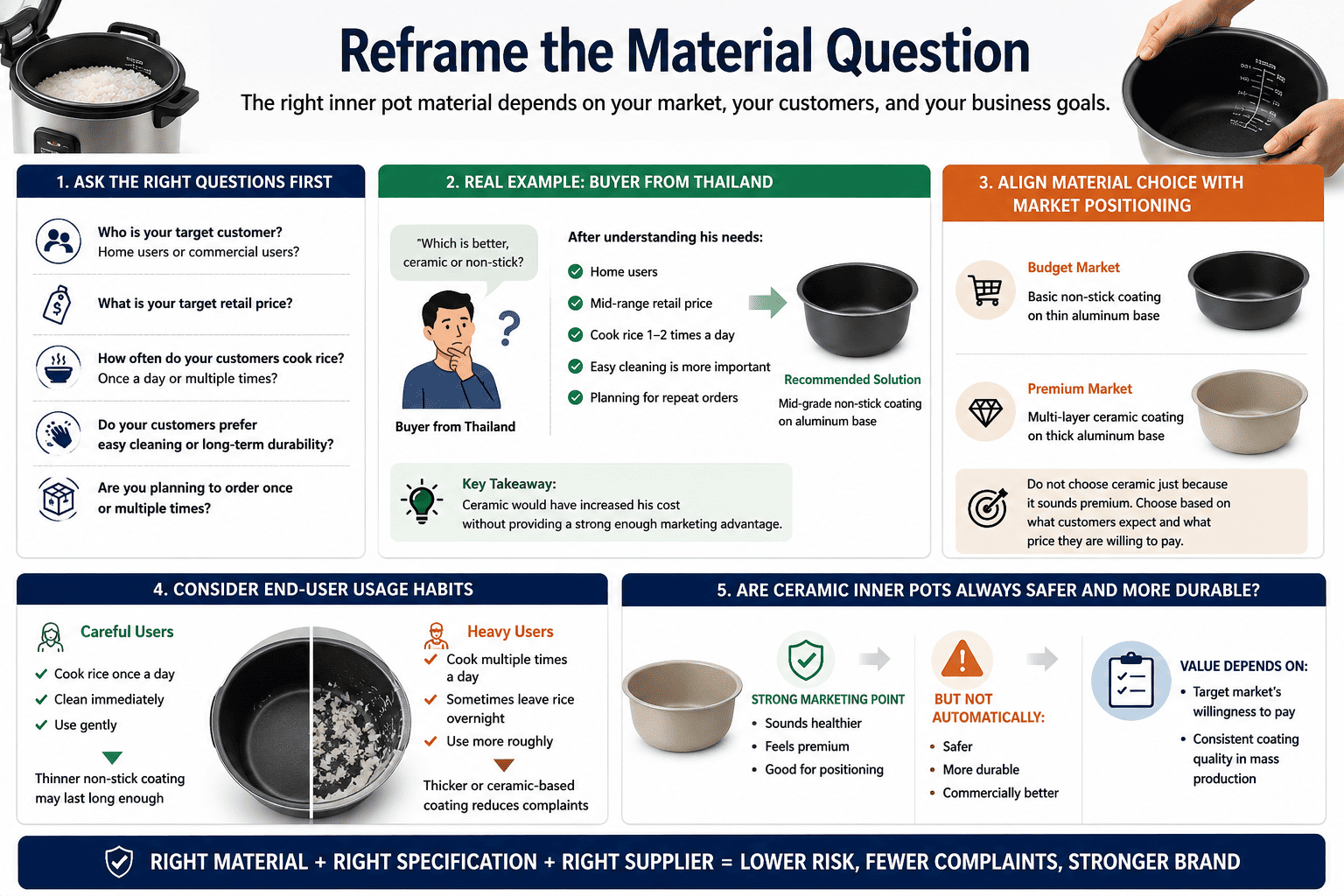
Many buyers assume that ceramic is automatically safer, more natural, and more durable than non-stick. I understand why. Ceramic sounds healthier. It sounds premium. But this assumption can lead to wrong decisions.
Ceramic can be a stronger marketing point, but it should not be treated as automatically safer, more durable, or commercially better. Its value depends on whether the target market will pay for that positioning and whether the supplier applies the ceramic coating consistently in mass production.
Ceramic Is Not Always Safer
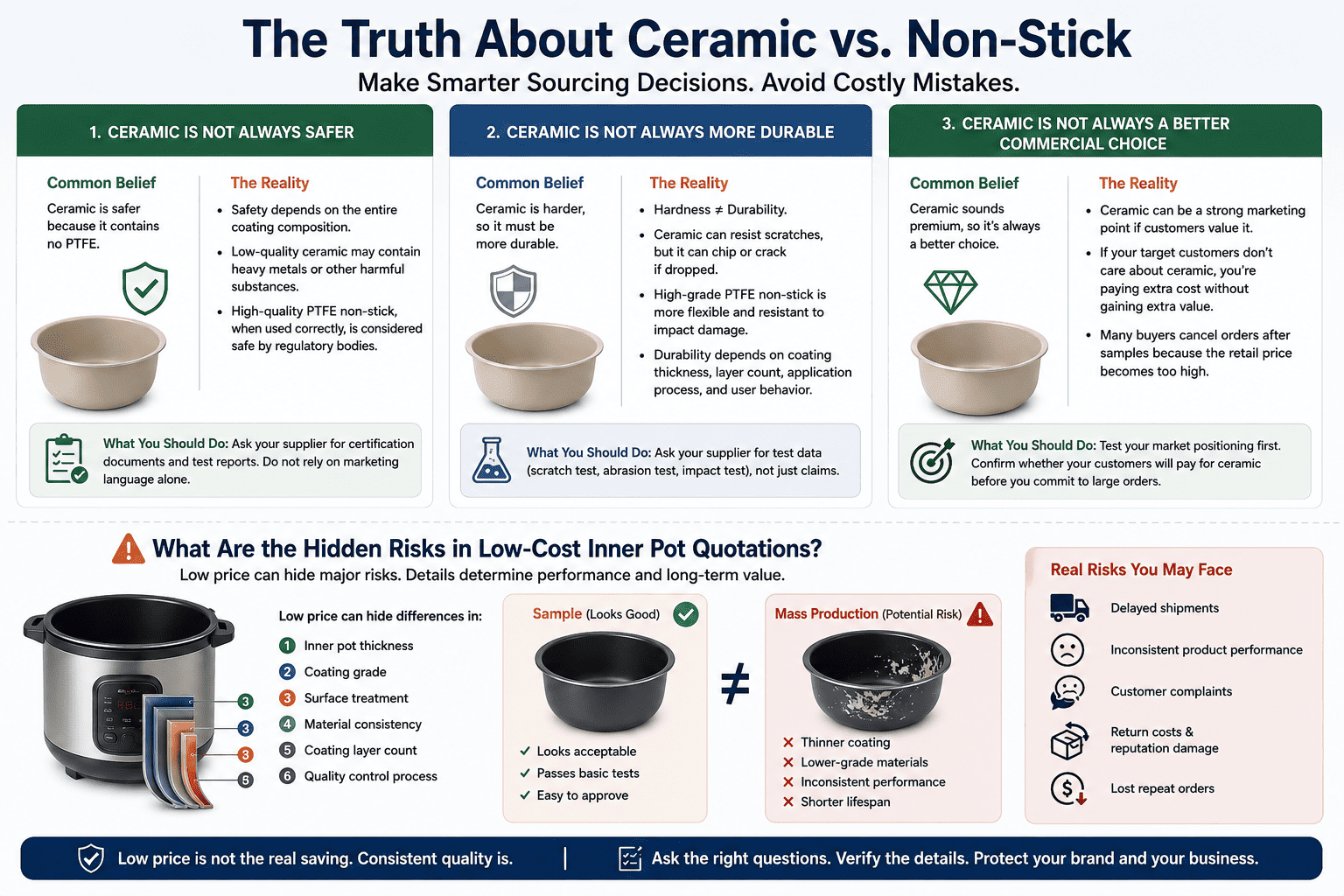
Some buyers believe that ceramic is safer because it does not contain PTFE. But safety depends on the entire coating composition, not just the absence of one chemical. A low-quality ceramic coating can contain heavy metals or other harmful substances3. A high-quality PTFE-based non-stick coating, when used correctly, is considered safe by regulatory bodies4.
If safety is your concern, ask your supplier for certification documents. Ask for test reports. Do not rely on marketing language alone.
Ceramic Is Not Always More Durable
Some buyers believe that ceramic is more durable because it is harder. But hardness is not the same as durability. A ceramic coating can be more resistant to scratching, but it can also chip or crack if dropped5. A high-grade PTFE-based non-stick coating can be more flexible and resistant to impact damage.
Durability depends on coating thickness, layer count, application process, and how the end user treats the pot. Ask your supplier for test data, not just claims.
Ceramic Is Not Always a Better Commercial Choice
Ceramic can be a good marketing point if your target customers associate it with premium quality. But if your target customers do not care about ceramic, you are paying extra cost without gaining extra value.
I have seen buyers request ceramic inner pots, order samples, and then cancel the order because the retail price became too high for their market. Do not make that mistake. Test the market positioning first. Confirm whether your customers will pay for ceramic before you commit to large orders.
What Are the Hidden Risks in Low-Cost Inner Pot Quotations?
Low quotations can look attractive. But they can hide differences in inner pot thickness, coating grade, surface treatment, and material consistency. If you do not ask the right questions, you may receive a product that performs poorly or fails after a few months.
A sample that looks acceptable is not enough unless you also confirm mass-production consistency. I have handled cases where customers approved a sample, placed a bulk order, and then discovered that the mass-production batch had thinner coatings or lower-grade materials.
Thickness Differences
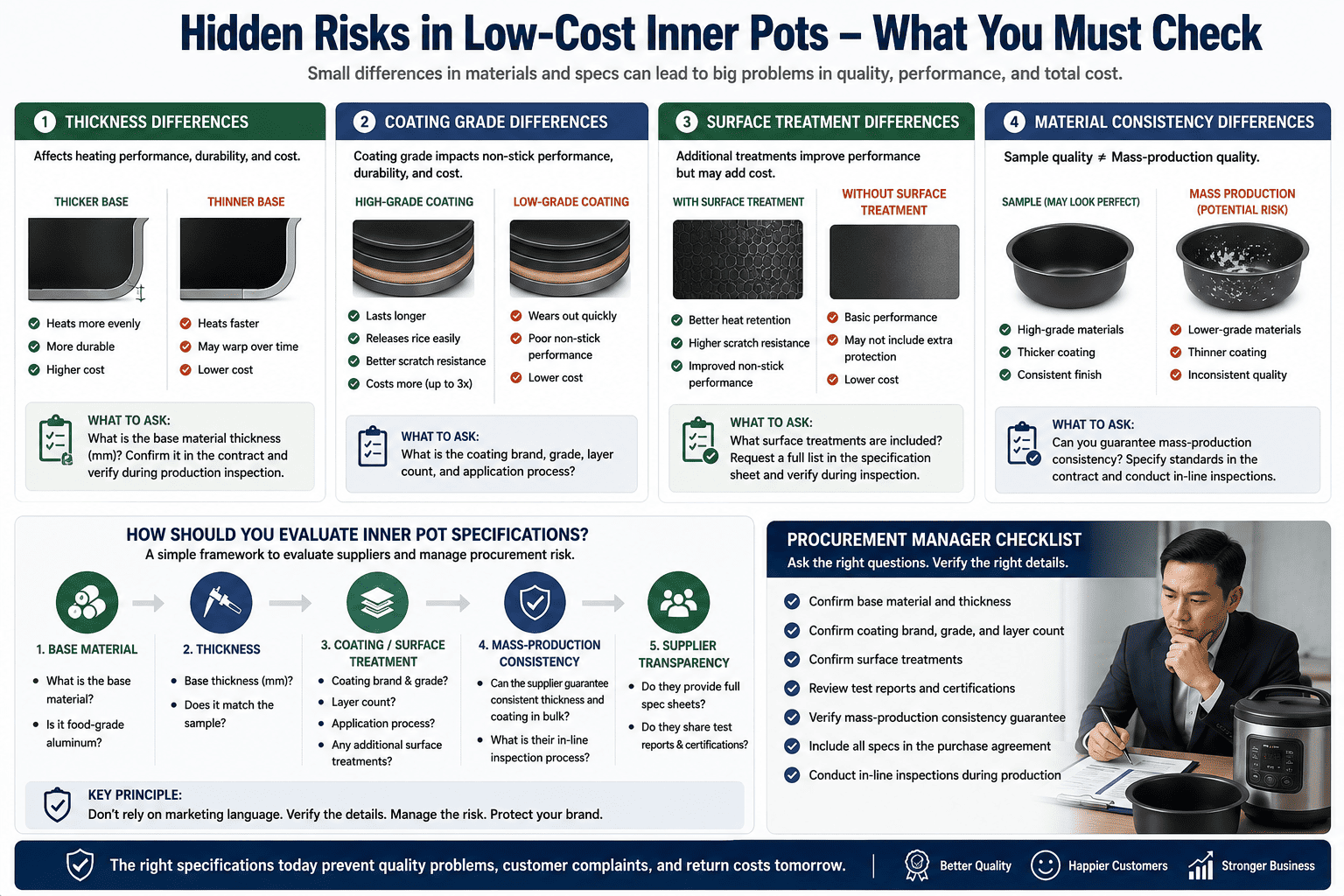
Inner pot thickness affects heating performance, durability, and cost. A thicker base material heats more evenly6 but costs more. A thinner base material heats faster but may warp after repeated use7.
Some suppliers reduce base material thickness to lower the quotation. If you do not specify thickness in your purchase agreement, you may receive a thinner pot than the sample. Always ask for thickness specifications and confirm them during production inspection.
Coating Grade Differences
Non-stick coatings come in different grades. A high-grade coating can cost three times more than a low-grade coating8. A high-grade coating lasts longer, releases rice more easily, and resists scratching better.
If your supplier offers a low quotation without specifying the coating grade, you should ask why. Do not assume that all non-stick coatings are the same. Ask for the coating brand, grade, layer count, and application process.
Surface Treatment Differences
Some inner pots have additional surface treatments to improve heat retention, scratch resistance, or non-stick performance. These treatments can add cost. If your supplier does not mention them in the quotation, they may not be included.
Ask your supplier to list all surface treatments in the specification sheet. Confirm them during production inspection.
Material Consistency Differences
Mass-production consistency is one of the biggest risks. A sample can be perfect, but the mass-production batch can vary. Some suppliers use higher-grade materials for samples and lower-grade materials for bulk orders.
To reduce this risk, ask your supplier for a mass-production consistency guarantee. Specify material grades, thickness, coating brand, and layer count in your purchase agreement. Conduct random inspections during production, not just after shipment.
How Should You Evaluate Inner Pot Specifications as a Procurement Manager?
As a procurement manager, your job is not to become a materials scientist. Your job is to ask the right questions, evaluate supplier answers, and manage procurement risk.
Focus on base material, thickness, coating or surface treatment, mass-production consistency, and supplier transparency. Do not rely on marketing language or vague claims.
Request a Clear Specification Sheet
Ask your supplier for a specification sheet that covers:
| Specification Item | Required Information |
|---|---|
| Base Material | Material type, alloy grade |
| Base Thickness | Minimum thickness in millimeters |
| Coating Type | Coating brand, chemical composition |
| Coating Grade | Grade level, layer count |
| Coating Thickness | Minimum thickness in micrometers |
| Surface Treatment | Additional treatments, application method |
| Mass-Production Tolerance | Acceptable variation range |
| Certification | Compliance with CE, RoHS, food safety standards |
If your supplier cannot provide this information, that is a red flag.
Compare Quotations Based on Specifications, Not Just Price
When you receive multiple quotations, do not compare only the unit price. Compare the specifications. A lower price with a thinner base material and a lower-grade coating may cost you more in the long run.
Calculate the total cost, including after-sales complaints, returns, warranty claims, and brand reputation damage. A slightly higher unit price with better specifications may reduce your total cost.
Confirm Mass-Production Consistency
During production, conduct random inspections. Check base material thickness. Check coating thickness. Check coating adhesion. Do not wait until the shipment arrives.
If possible, visit the factory during production. Inspect the incoming materials. Inspect the coating application process. Inspect the finished products. This is the best way to confirm mass-production consistency.
Build a Long-Term Relationship with Transparent Suppliers
Procurement is not just about finding the lowest price. It is about finding a supplier who is transparent, consistent, and responsive.
A good supplier will answer your questions clearly. A good supplier will provide detailed specification sheets. A good supplier will not change materials or specifications without notifying you. A good supplier will work with you to solve problems, not hide them.
If you find a supplier like that, invest in a long-term relationship. That will reduce your procurement risk and improve your product quality over time.
Conclusion
The right rice cooker inner pot is not decided by one material being "best." It is decided by how the base material, thickness, coating, and supplier transparency fit your procurement risk profile. Ask the right questions, compare specifications, and confirm mass-production consistency before you commit to large orders.
"Aluminium - Wikipedia", https://en.wikipedia.org/wiki/Aluminium. Aluminum exhibits amphoteric properties, reacting with both acids and bases to form soluble aluminum compounds, which is relevant to food contact applications. Evidence role: mechanism; source type: research. Supports: the chemical reactivity of aluminum with acidic and alkaline substances. Scope note: This describes general chemical behavior; specific food safety implications depend on exposure levels and regulatory standards. ↩
"Polytetrafluoroethylene - Wikipedia", https://en.wikipedia.org/wiki/Polytetrafluoroethylene. Polytetrafluoroethylene (PTFE) is a synthetic fluoropolymer; Teflon is a registered trademark of Chemours for PTFE-based products. Evidence role: definition; source type: encyclopedia. Supports: the chemical identity of PTFE and its commercial brand name. ↩
"[PDF] Ceramic coatings for high-temperature protection of steel", https://nvlpubs.nist.gov/nistpubs/jres/38/jresv38n3p293_A1b.pdf. Ceramic glazes and coatings can contain heavy metals such as lead and cadmium if not properly formulated; regulatory agencies test ceramic cookware for leachable heavy metals to ensure compliance with food safety standards. Evidence role: general_support; source type: government. Supports: the potential presence of heavy metals in ceramic coatings. Scope note: This addresses potential contamination in improperly manufactured products; properly certified ceramic coatings meet safety standards. ↩
"Authorized Uses of PFAS in Food Contact Applications - FDA", https://www.fda.gov/food/process-contaminants-food/authorized-uses-pfas-food-contact-applications. The U.S. Food and Drug Administration has determined that PTFE is safe for use in cookware when used according to manufacturer instructions and at recommended temperatures. Evidence role: expert_consensus; source type: government. Supports: regulatory safety evaluations of PTFE in cookware applications. Scope note: Safety assessments typically specify temperature limits and proper usage conditions; overheating can produce degradation products. ↩
"[PDF] How does one determine the fracture toughness of a ceramic material", https://www.osti.gov/servlets/purl/1286775. Ceramic materials exhibit high hardness and scratch resistance due to strong ionic and covalent bonding, but typically have low fracture toughness, making them susceptible to brittle failure under impact or stress concentration. Evidence role: mechanism; source type: research. Supports: the mechanical property trade-offs in ceramic materials. Scope note: Coating performance depends on substrate adhesion, coating thickness, and specific ceramic composition. ↩
"What kind of pan conducts heat more evenly? : r/cookingforbeginners", https://www.reddit.com/r/cookingforbeginners/comments/19da371/what_kind_of_pan_conducts_heat_more_evenly/. Thicker cookware bases have greater thermal mass and lower temperature gradients, which can reduce hot spots and promote more uniform heat distribution across the cooking surface. Evidence role: mechanism; source type: research. Supports: the effect of material thickness on heat distribution. Scope note: Heat distribution also depends on heat source type, material thermal conductivity, and cookware geometry. ↩
"Why Pans and Baking Sheets Warp (And How to Fix It) - YouTube",
. Thin metal cookware bases have lower structural rigidity and are more susceptible to thermal stress-induced warping, particularly when subjected to rapid heating cycles or uneven heat sources. Evidence role: mechanism; source type: research. Supports: the susceptibility of thin metal bases to thermal deformation. Scope note: Warping susceptibility also depends on alloy composition, manufacturing process, and heat source characteristics. ↩"The Best Nonstick Pans Are Nontoxic Now - Bon Appetit", https://www.bonappetit.com/story/best-nonstick-pans?srsltid=AfmBOorC5t_1tpAFpu98Qd0gRwTIj2qMykLTpoAVUoK-BtbjKaPXTD0X. Non-stick coating costs vary significantly based on formulation, layer count, and application process; premium multi-layer systems with reinforced particles can cost several times more than single-layer basic coatings. Evidence role: general_support; source type: other. Supports: cost variations among non-stick coating grades. Scope note: Specific cost multiples vary by supplier, volume, and market conditions; the stated ratio is illustrative rather than a fixed industry standard. ↩