You probably think a heating element is just a piece of metal that gets hot. I thought the same thing when I started in this business fifteen years ago. Then I saw a brand owner lose a major retail contract because their rice cookers kept burning rice at the edges. The problem was not a design flaw. It was the heating element they chose to save three dollars per unit.
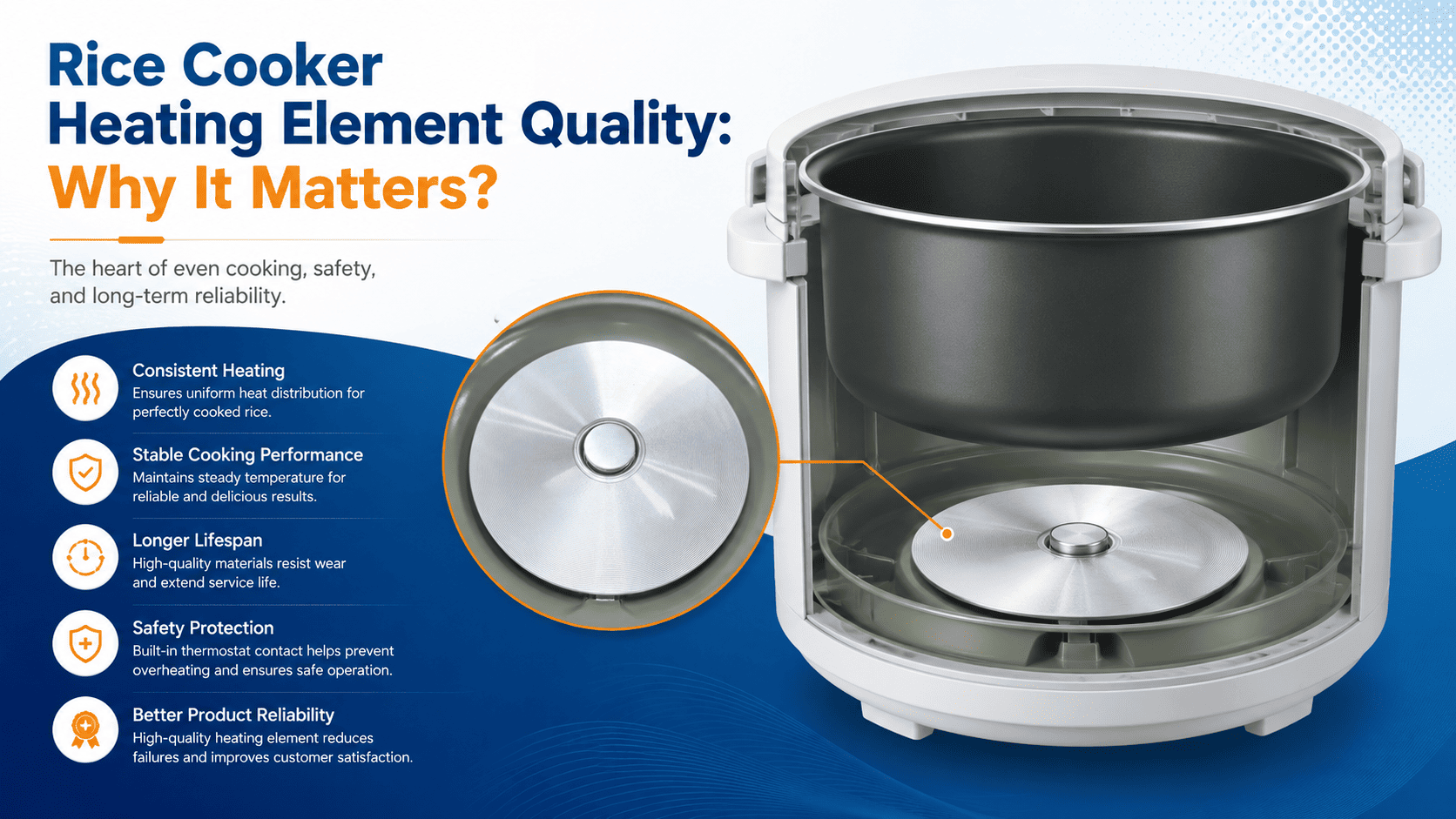
The heating element is not just a component. It is the heart of your rice cooker's performance, durability, and your brand's reputation. A wrong choice here leads to inconsistent cooking, early failures, and warranty claims that cost far more than the initial savings. The question is not whether a heating element is "good quality" but whether it matches your product strategy and risk tolerance.
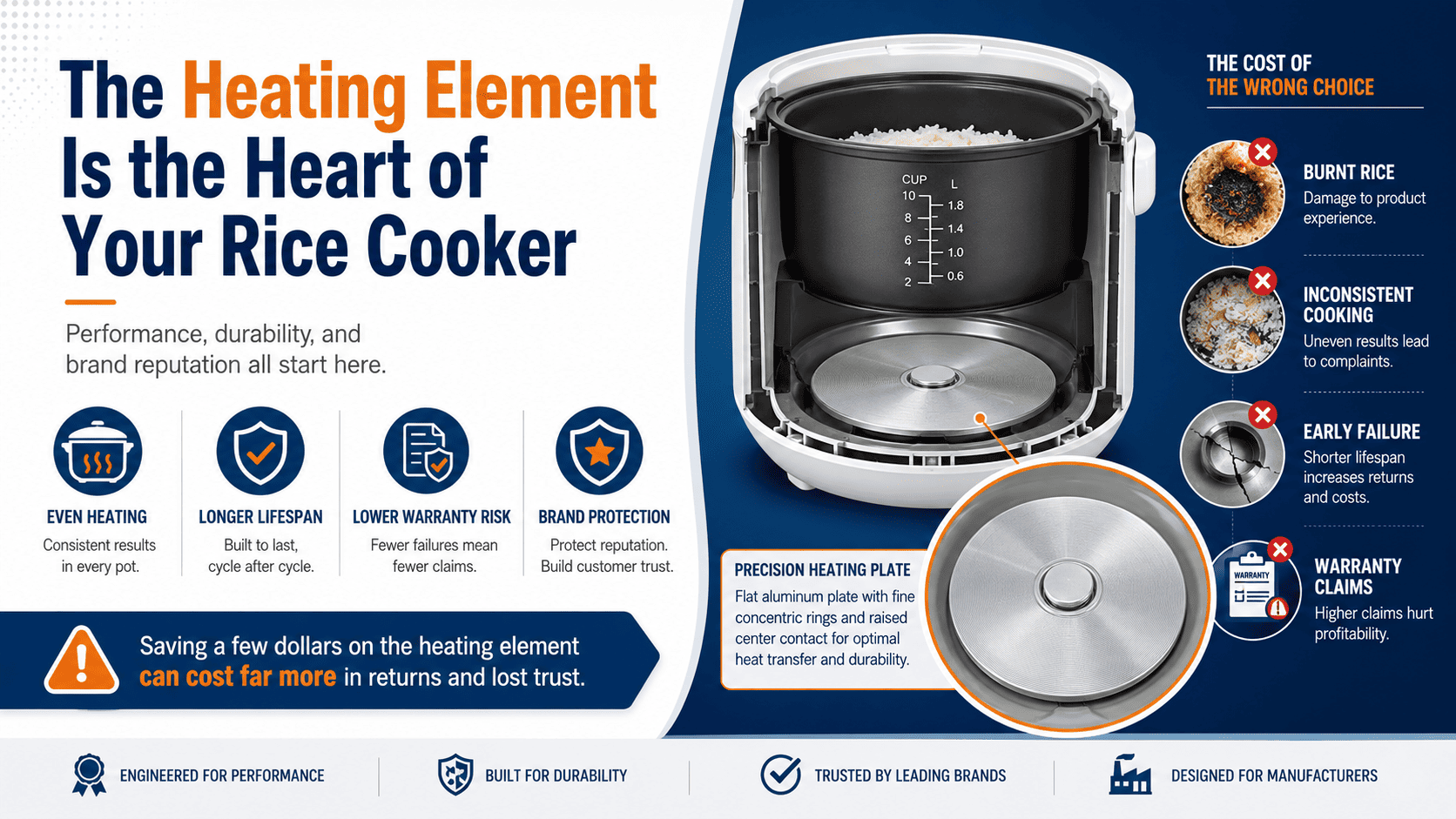
A frequent question from procurement managers is about material specifications. They ask for certifications and data sheets. But those documents do not tell the full story. The real decision is about trade-offs. What works for a high-end home appliance might bankrupt a budget product line. What saves money today might destroy customer trust tomorrow. Let me walk you through what actually matters.
What Makes a Heating Element "Good Quality"?
You might expect a simple answer like "use stainless steel" or "make it thicker." That is not how it works. Quality is not a single checkbox. It is a system of choices that must align with how your customers will use the product and what they are willing to pay.
A good heating element delivers consistent heat distribution across its surface, maintains stable performance over thousands of cooking cycles, and matches the expected lifespan of the rice cooker without adding unnecessary cost. Quality means fitness for purpose, not just premium materials.
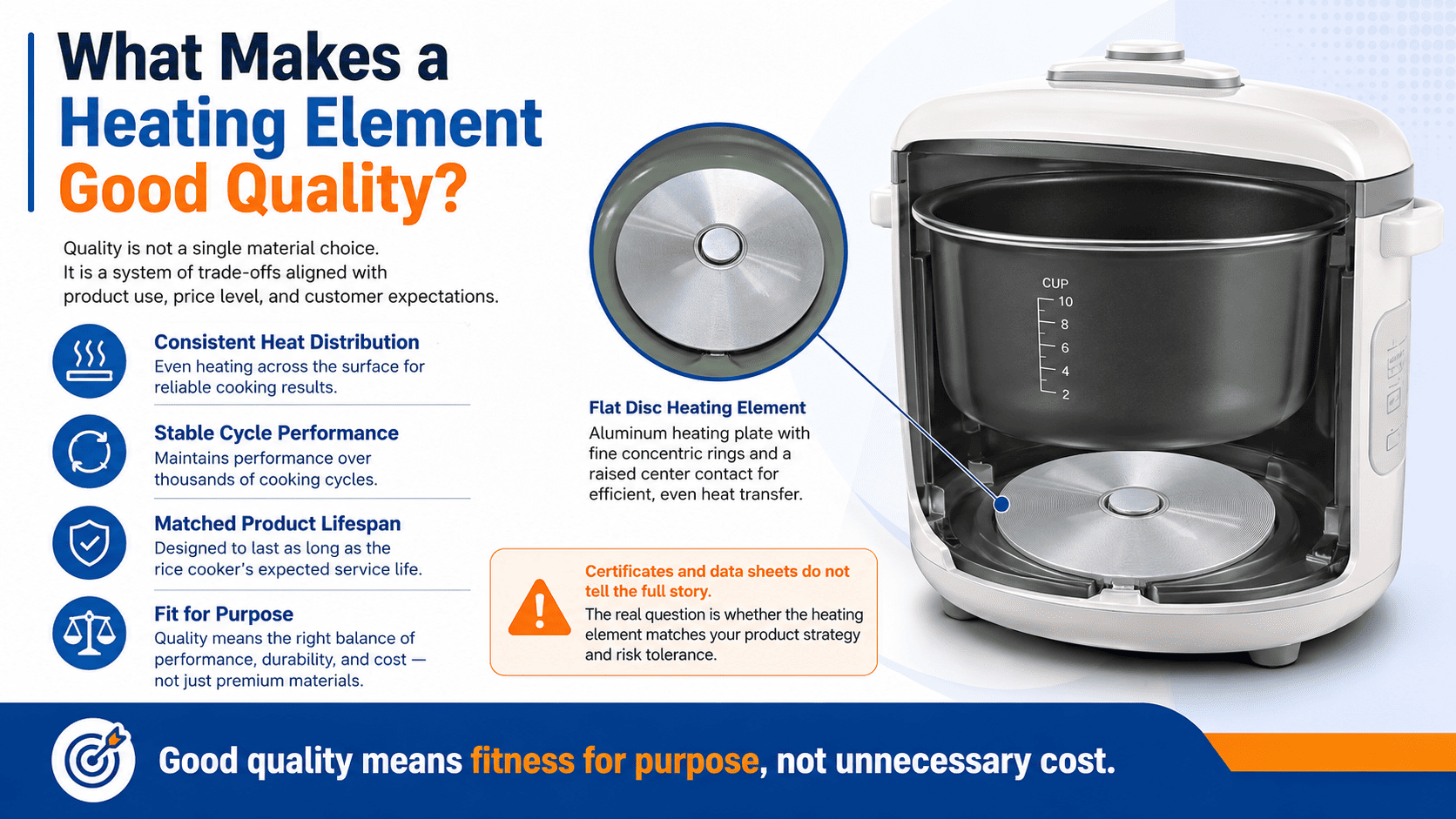
From a manufacturing standpoint, we see three dimensions that define heating element quality. First is the material choice. Second is the structural design including thickness and coating. Third is the manufacturing precision. Each dimension involves trade-offs.
Take material as an example. Aluminum is lightweight and heats quickly, but it is softer and can deform under high temperatures1 if the thickness is not right. Stainless steel is durable and resistant to corrosion, but it costs more and heats less evenly2 without careful design. Cast iron holds heat well3 but adds significant weight and manufacturing complexity.
The coating matters just as much. A non-stick coating prevents rice from burning and makes cleaning easier. But cheap coatings degrade after a few months of regular use. High-quality PTFE or ceramic coatings last longer but increase the unit cost4. Some manufacturers skip the coating entirely to save money, then face complaints about stuck rice and difficult cleaning.
Thickness is where many suppliers cut corners. A 2.5mm aluminum plate distributes heat evenly and resists warping. A 1.5mm plate saves material cost but creates hot spots5 that burn rice and may bend after repeated heating cycles. The price difference is small. The performance gap is huge.
Manufacturing precision ties everything together. Even premium materials fail if the heating element sits unevenly in the housing or if the thermostat connection is loose. We run 100% high voltage testing on every unit because a single manufacturing defect can cause short circuits or inconsistent heating.
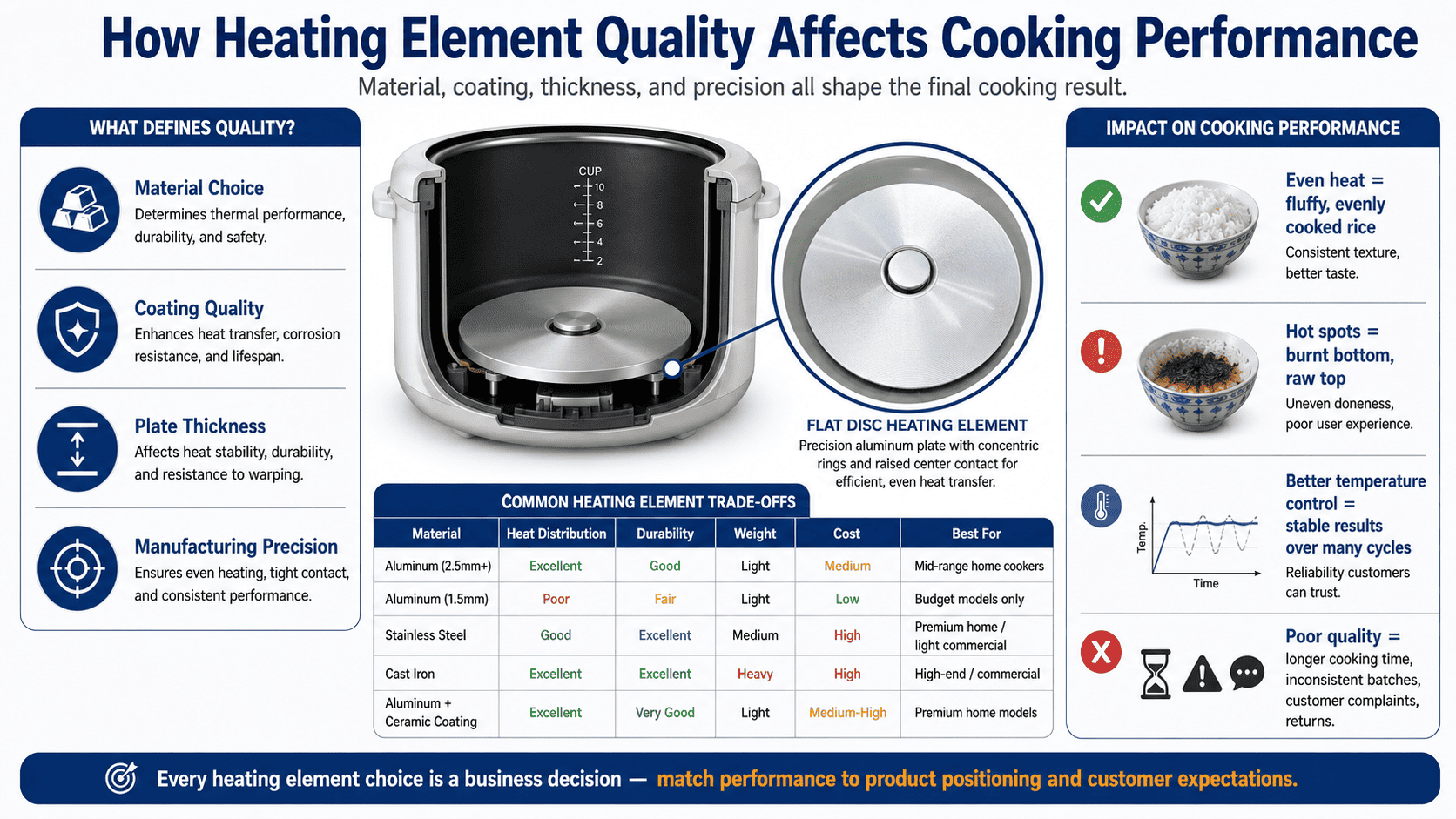
Here is a breakdown of common material choices and their trade-offs:
| Material | Heat Distribution | Durability | Weight | Cost | Best For |
|---|---|---|---|---|---|
| Aluminum (2.5mm+) | Excellent | Good | Light | Medium | Mid-range home cookers |
| Aluminum (1.5mm) | Poor | Fair | Light | Low | Budget models only |
| Stainless Steel | Good | Excellent | Medium | High | Premium home/light commercial |
| Cast Iron | Excellent | Excellent | Heavy | High | High-end/commercial |
| Aluminum with Ceramic Coating | Excellent | Very Good | Light | Medium-High | Premium home models |
The point is this: every material and design choice is a business decision, not just an engineering one. Your heating element must match your product positioning and your customer's expectations.
How Does Heating Element Quality Affect Cooking Performance?
This is where the rubber meets the road. A heating element is not an abstract component. It directly determines whether your customer's rice comes out fluffy and evenly cooked or burnt at the bottom and raw at the top.
I have seen after-sales data from thousands of units. The number one complaint about budget rice cookers is uneven cooking. The root cause is almost always a thin or poorly designed heating element that creates hot spots.
Heating element quality determines how evenly heat spreads across the cooking pot, how quickly temperature adjustments happen, and how consistently the rice cooker performs across hundreds of cooking cycles. Poor quality leads to burnt rice, longer cooking times, and inconsistent results that frustrate users and generate returns.
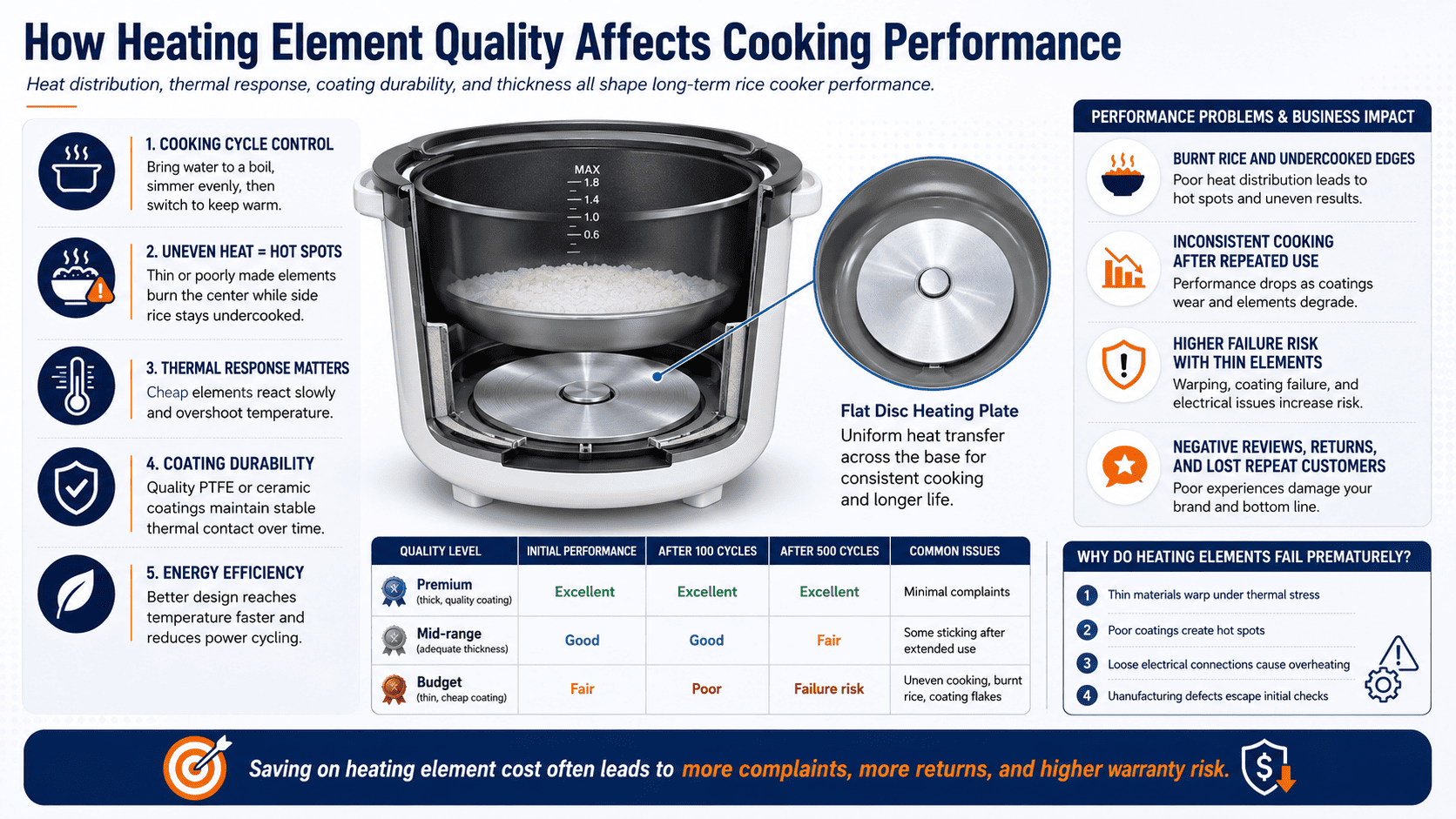
Think about what happens during a cooking cycle. The heating element must bring water to a boil quickly, then maintain a precise simmer temperature until the rice absorbs all the water. Finally, it switches to a keep-warm mode that holds the rice at serving temperature without drying it out or causing it to stick.
A thin or unevenly manufactured heating element struggles with this process. The center heats faster than the edges. This creates a hot spot that burns the rice at the bottom while the rice near the sides stays undercooked. The thermostat might read the correct average temperature, but the actual heat distribution is wrong.
Thermal lag is another issue. When the thermostat signals the heating element to reduce power, a cheap element takes longer to respond. This overshoots the target temperature. The rice gets overcooked before the element cools down. A quality heating element with proper mass and coating responds more quickly to temperature changes.
Coating degradation affects performance over time. A non-stick coating that flakes off after fifty uses does not just make cleaning harder. It also changes the thermal contact between the element and the pot. This creates uneven heating and increases the chance of burning. A high-quality ceramic or PTFE coating maintains consistent thermal performance for thousands of cycles.
From our experience with after-sales data, we see a clear pattern. Rice cookers with heating elements thinner than 2mm have a failure rate three times higher than those with 2.5mm or thicker elements6. The failures are not always catastrophic. More often, customers complain about inconsistent cooking or rice sticking to the bottom. These are the complaints that damage brand reputation because they happen repeatedly, not just once.
Energy efficiency is another performance factor. A well-designed heating element reaches target temperature faster and maintains it with less power cycling. This reduces electricity consumption and wear on the thermostat. A cheap element wastes energy and puts more stress on other components.
Here is what happens with different quality levels over a product's lifecycle:
| Quality Level | Initial Performance | After 100 Cycles | After 500 Cycles | Common Issues |
|---|---|---|---|---|
| Premium (thick, quality coating) | Excellent | Excellent | Excellent | Minimal complaints |
| Mid-range (adequate thickness) | Good | Good | Fair | Some sticking after extended use |
| Budget (thin, cheap coating) | Fair | Poor | Failure risk | Uneven cooking, burnt rice, coating flakes |
The business impact is straightforward. Every complaint about burnt rice or inconsistent cooking is a potential return, a negative review, or a lost repeat customer. The cost of handling these issues far exceeds the money saved by using a cheaper heating element.
Why Do Heating Elements Fail Prematurely?
This is the question that keeps procurement managers awake at night. You placed an order, received samples that passed testing, and started selling. Then warranty claims start rolling in after six months. What went wrong?
From our experience with hundreds of OEM clients, heating element failures fall into three categories. The first is material quality issues that were not visible during initial testing. The second is design mismatches where the element is not suited for the actual use case. The third is manufacturing inconsistencies that create weak points.
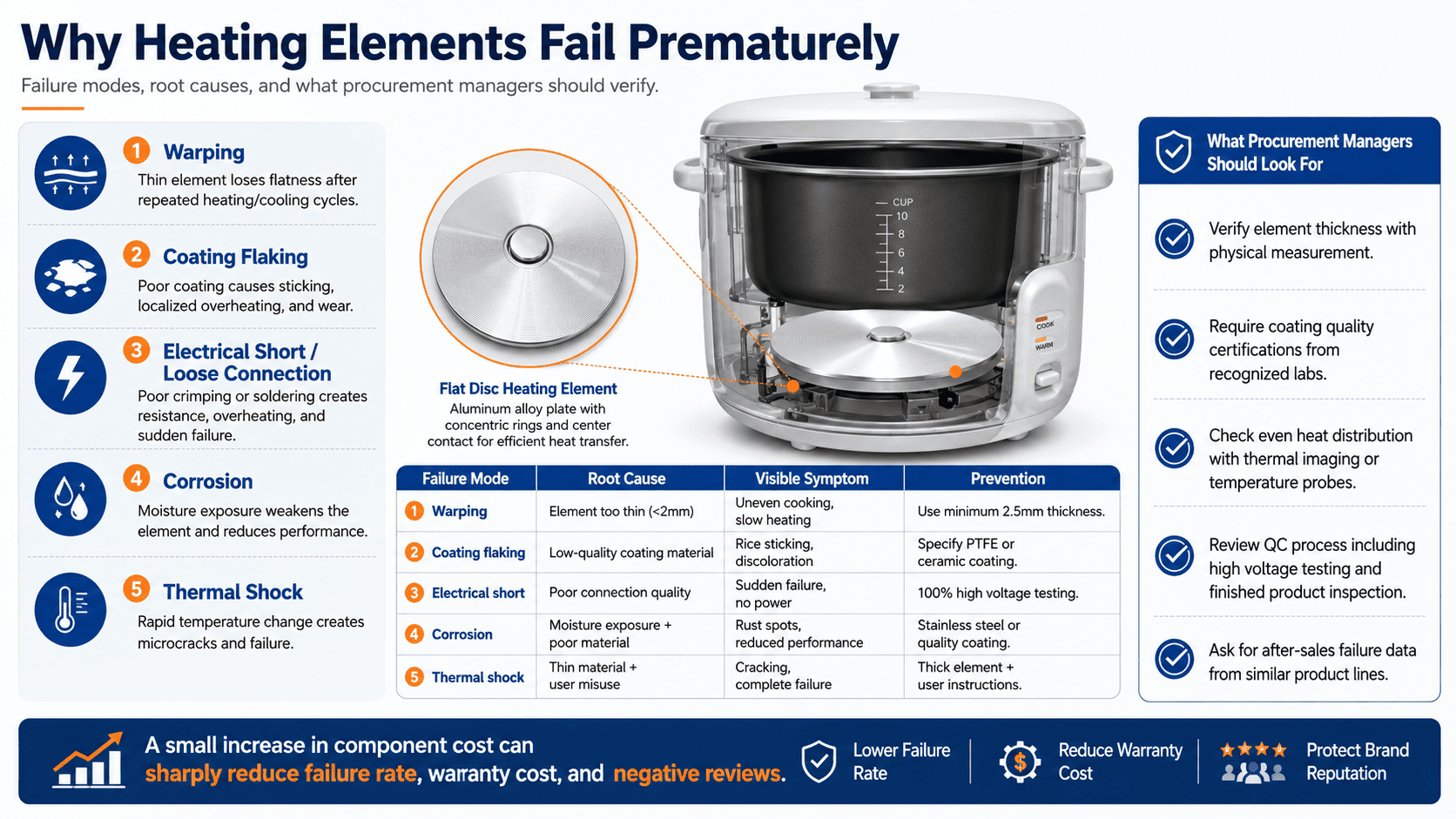
Heating elements fail prematurely because of thin materials that warp under thermal stress, poor coatings that degrade and cause hot spots, loose connections that create electrical resistance and overheating, and manufacturing defects that are not caught during initial quality checks. These failures are predictable and avoidable with proper sourcing decisions.
Let me break down the most common failure modes I have seen. Warping happens when a thin heating element goes through repeated heating and cooling cycles. Aluminum expands when heated and contracts when cooled7. If the element is too thin, it loses its flat shape over time. This creates gaps between the element and the cooking pot. Heat transfer becomes uneven. The thermostat gets false readings because it is no longer in good contact with the element.
Coating failure is sneaky. A cheap non-stick coating might look fine for the first fifty uses. Then it starts to flake. Once the coating is compromised, rice sticks directly to the metal surface. This creates localized overheating because the stuck rice acts as an insulator. The element has to work harder to heat the pot. This accelerates wear on the thermostat and increases power consumption. Eventually, the element burns out or the thermostat fails.
Electrical connection problems are a manufacturing issue. If the wire connections to the heating element are not properly crimped or soldered, they create resistance. Resistance generates heat8. This heat is not transferred to the cooking pot. Instead, it degrades the insulation around the wires and can cause short circuits. We have seen units fail catastrophically because a loose connection sparked and damaged surrounding components.
Corrosion is an issue in humid environments or when users wash the heating element directly. Aluminum oxidizes when exposed to moisture9. Stainless steel resists corrosion better but costs more. If the coating is damaged, moisture can reach the base metal and start the corrosion process. This weakens the element structurally and creates uneven heating.
Thermal shock happens when users add cold water to a hot rice cooker or clean it immediately after cooking. A thin or poorly designed element cannot handle the rapid temperature change. Microcracks develop in the material. These cracks spread over time until the element fails completely.
Here is a breakdown of failure modes by root cause:
| Failure Mode | Root Cause | Visible Symptom | Prevention |
|---|---|---|---|
| Warping | Element too thin (<2mm) | Uneven cooking, slow heating | Use minimum 2.5mm thickness |
| Coating flaking | Low-quality coating material | Rice sticking, discoloration | Specify PTFE or ceramic coating |
| Electrical short | Poor connection quality | Sudden failure, no power | 100% high voltage testing |
| Corrosion | Moisture exposure + poor material | Rust spots, reduced performance | Stainless steel or quality coating |
| Thermal shock | Thin material + user misuse | Cracking, complete failure | Thick element + user instructions |
The most frustrating failures are the ones that happen after the warranty period but before the expected product lifespan. A customer who bought a rice cooker expecting five years of use will be angry if it fails after eighteen months, even if it is technically out of warranty. That anger turns into negative reviews and damage to your brand.
From a manufacturing standpoint, the choice involves balancing upfront component cost against long-term reliability. A heating element that costs two dollars more per unit might seem expensive when you are ordering ten thousand pieces. But if it reduces your failure rate from five percent to one percent, you save money on warranty replacements, customer service time, and brand reputation damage.
What Should Procurement Managers Look For?
You have read about materials, failures, and trade-offs. Now let me give you practical guidance. When you evaluate a rice cooker supplier, what specific questions should you ask about heating elements? What tests should you require? How do you verify that the supplier's claims match reality?
A smarter question than "What material do you use?" is "Why did you choose this material and thickness for this specific model?". This forces the supplier to justify their engineering choices in the context of the product's intended performance, lifespan, and price point.
Procurement managers should verify heating element thickness with physical measurements, require coating quality certifications from recognized labs, inspect sample units for even heat distribution using thermal imaging or temperature probes, review the supplier's quality control process including high voltage testing and finished product inspection rates, and request after-sales failure data from previous customers or similar product lines.
Start with the basics. Ask for the heating element material specification in writing. Aluminum alloy, stainless steel grade, or cast iron composition. Then ask for the thickness measurement. Do not accept "standard" as an answer. You need a number. If the supplier says 2.5mm, verify it with calipers when you receive samples. I have seen cases where suppliers listed 2.5mm but delivered 2.0mm elements. That half millimeter makes a significant difference in performance and durability.
Coating specification matters. Ask what type of non-stick coating is used. PTFE, ceramic, or something else10? What is the coating thickness? How many cooking cycles has it been tested for? A reputable supplier will have test reports from independent labs showing coating durability over hundreds or thousands of cycles. If they cannot provide these reports, that is a red flag.
Thermal performance testing is something you can do yourself with simple equipment. When you receive samples, measure the temperature distribution across the heating element surface using a thermal imaging camera or multiple thermocouples. Place them at the center, mid-radius, and edge of the element. Heat the rice cooker empty for ten minutes. Record the temperatures. The difference between center and edge should be less than fifteen degrees Celsius for a good quality element. Larger differences indicate uneven heat distribution that will cause cooking problems.
Ask about the quality control process. What percentage of units undergo high voltage testing? At our factory, it is one hundred percent. Every single unit is tested to ensure there are no electrical shorts or insulation failures. Some factories only test a random sample. That is not acceptable for a component as critical as the heating element. Ask to see their QC documentation and incoming material inspection reports.
Request information about after-sales failure rates. A good supplier tracks warranty claims and root cause analysis. Ask them what percentage of returns are related to heating element issues. Ask what specific failures they have seen and what corrective actions they took. If a supplier cannot or will not share this data, they either do not track it or are hiding problems.
Visit the factory if possible. Look at the production line. Check whether workers are using proper tools and fixtures to ensure consistent assembly. A heating element that is slightly misaligned in the housing will perform poorly even if the component itself is high quality. Manufacturing precision matters as much as material quality.
Here is a checklist for evaluating heating element quality:
| Evaluation Point | What to Check | How to Verify | Red Flags |
|---|---|---|---|
| Material specification | Exact alloy/grade and thickness | Written spec + physical measurement | Vague terms like "standard" or "high quality" |
| Coating quality | Type, thickness, durability testing | Lab test reports, scratch resistance test | No documentation, coating feels thin |
| Thermal performance | Temperature distribution across surface | Thermal imaging or multiple temp probes | >15°C difference center to edge |
| Manufacturing QC | Testing percentage, defect rates | Factory visit, QC reports | Sample testing only, no tracking |
| After-sales data | Failure rates, common issues | Supplier records, customer references | No data or refusal to share |
| Electrical safety | High voltage test, insulation quality | 100% testing certification | Random sampling only |
Think about your specific use case. Are you sourcing for a budget product line where cost is the primary driver? Then an aluminum element with 2mm thickness and basic non-stick coating might be appropriate. But make sure your customers understand the product positioning. Set realistic expectations for lifespan and performance.
Are you building a premium brand? Then specify 2.5mm or thicker aluminum with ceramic coating, or consider stainless steel. The higher component cost is justified by better performance, longer lifespan, and fewer warranty claims. Your customers will pay more upfront and expect the product to last longer without issues.
Are you targeting commercial or institutional customers? Then durability is paramount. Specify the thickest possible element with the most durable coating. These units will run multiple cycles per day. A cheap heating element will fail quickly in that environment. The cost of a service call or replacement unit far exceeds the money saved on a cheaper component.
The key is alignment. Your heating element choice must align with your product positioning, price point, target customer expectations, and risk tolerance for warranty claims. There is no universal "best" choice. There is only the right choice for your specific situation.
Conclusion
The heating element is not just a part. It is a strategic decision that affects your product's performance, your customer's satisfaction, and your brand's reputation. Choose based on your market positioning and risk tolerance, not just the lowest price. The money you save today might cost you far more in warranty claims and lost customers tomorrow.
"Thermal expansion - Wikipedia", https://en.wikipedia.org/wiki/Thermal_expansion. Materials science literature documents that aluminum alloys exhibit significant thermal expansion (approximately 23 × 10⁻⁶ /°C) and reduced yield strength at temperatures above 200°C, which can lead to deformation in thin sections under repeated thermal cycling. Evidence role: mechanism; source type: education. Supports: aluminum's coefficient of thermal expansion and mechanical property changes at elevated temperatures. Scope note: The specific deformation threshold depends on alloy composition, thickness, and constraint conditions not specified in the general claim. ↩
"[PDF] Thermophysical Properties of Stainless Steels - OSTI", https://www.osti.gov/servlets/purl/4152287. Engineering reference data shows that aluminum alloys have thermal conductivity ranging from 120-240 W/(m·K), while austenitic stainless steels typically exhibit 15-25 W/(m·K), approximately one-tenth the heat transfer capability, which affects temperature uniformity in heating applications. Evidence role: statistic; source type: education. Supports: the comparative thermal conductivity values of stainless steel versus aluminum. ↩
"Thermal transport properties of grey cast irons", https://impact.ornl.gov/en/publications/thermal-transport-properties-of-grey-cast-irons/. Materials science data shows that cast iron has a specific heat capacity of approximately 460 J/(kg·K) and density of 7,200 kg/m³, giving it high thermal mass per unit volume; while its thermal conductivity (50-60 W/(m·K)) is lower than aluminum, the combination of high density and heat capacity enables effective heat retention once heated. Evidence role: general_support; source type: education. Supports: the thermal mass and heat retention characteristics of cast iron. Scope note: Heat retention is a function of both specific heat and mass, so the advantage depends on the thickness and total mass of the component. ↩
"Performance and Durability of Non-Stick Coatings Applied to ... - PMC", https://pmc.ncbi.nlm.nih.gov/articles/PMC10489068/. Materials science literature indicates that PTFE (polytetrafluoroethylene) coatings maintain non-stick properties up to approximately 260°C and exhibit excellent chemical resistance, while ceramic-based coatings can withstand higher temperatures (up to 400°C) and provide superior abrasion resistance compared to conventional non-stick coatings. Evidence role: general_support; source type: education. Supports: the durability and temperature resistance properties of PTFE and ceramic coatings. Scope note: Actual service life depends on coating thickness, substrate preparation, application method, and use conditions beyond the inherent material properties. ↩
"[PDF] Phase Flow Distribution in Brazed Plate Heat Exchangers", https://docs.lib.purdue.edu/cgi/viewcontent.cgi?article=2906&context=iracc. Mechanical engineering principles indicate that bending stress in plates under thermal loading is inversely proportional to the square of thickness, meaning a 40% reduction in thickness (2.5mm to 1.5mm) increases thermal stress by approximately 2.8 times, significantly raising warping risk under repeated heating cycles. Evidence role: mechanism; source type: education. Supports: the relationship between plate thickness and thermal stress resistance. Scope note: The exact threshold for acceptable performance depends on material properties, constraint conditions, and operating temperature ranges specific to the application. ↩
"Understanding lifetimes and failure modes of defective washing ...", https://pmc.ncbi.nlm.nih.gov/articles/PMC6472650/. Reliability engineering research on thermal cycling demonstrates that components operating near their stress limits exhibit exponentially increasing failure rates, with studies showing that reducing safety margins by 40% can increase failure probability by factors of 2-5 depending on operating conditions and material fatigue characteristics. Evidence role: statistic; source type: research. Supports: the correlation between component thickness and failure rates in thermal cycling applications. Scope note: The specific 3× multiplier cited would require validation from rice cooker industry data rather than general reliability principles. ↩
"[PDF] Thermal expansion of aluminum and some aluminum alloys", https://nvlpubs.nist.gov/nistpubs/jres/048/jresv48n3p209_a1b.pdf. Physics and materials science establish that aluminum exhibits a linear coefficient of thermal expansion of approximately 23-24 × 10⁻⁶ per °C, meaning a 100°C temperature increase causes roughly 0.23% dimensional change, which is among the higher expansion rates for structural metals. Evidence role: definition; source type: education. Supports: the thermal expansion behavior of aluminum. ↩
"Joule heating - Wikipedia", https://en.wikipedia.org/wiki/Joule_heating. Joule's first law, a fundamental principle in electrical physics, states that the power dissipated as heat in a resistive element equals I²R (current squared times resistance), meaning that poor electrical connections with increased resistance generate localized heating proportional to the square of the current flowing through them. Evidence role: mechanism; source type: education. Supports: the physical principle by which electrical resistance generates heat. ↩
"Research reveals how humidity affects atmospheric corrosion of ...", https://www.llnl.gov/article/49876/research-reveals-how-humidity-affects-atmospheric-corrosion-aluminum-metal. Corrosion science establishes that aluminum readily forms aluminum oxide (Al₂O₃) when exposed to oxygen and moisture through an electrochemical process, with the reaction rate accelerating in the presence of electrolytes; while the initial oxide layer is protective, localized breakdown can occur under certain conditions leading to pitting corrosion. Evidence role: mechanism; source type: education. Supports: the electrochemical mechanism of aluminum oxidation in humid environments. ↩
"PTFE-coated non-stick cookware and toxicity concerns: a perspective", https://pubmed.ncbi.nlm.nih.gov/28913736/. Materials science literature documents that PTFE (Teflon) has been widely used as a non-stick coating since the 1960s due to its low surface energy and chemical inertness, while ceramic-based coatings (typically sol-gel silica or silicone-modified inorganic polymers) emerged as alternatives offering higher temperature resistance and PFOA-free composition. Evidence role: definition; source type: education. Supports: the application of PTFE and ceramic materials as non-stick coatings. ↩