Choosing the wrong product capacity can leave you with slow-moving inventory. Many buyers find the 1.8L rice cooker is a safer bet1, but the reasons go beyond just its size.
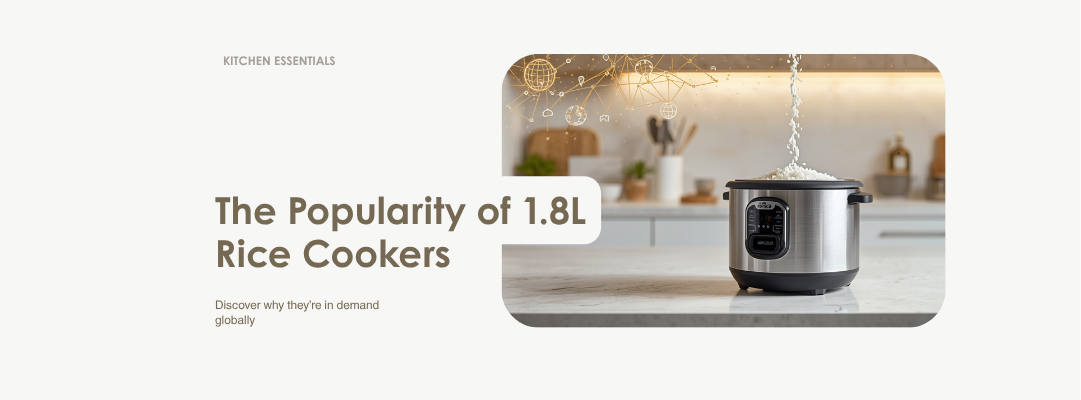
The popularity of the 1.8L rice cooker comes from its excellent balance. It serves a wide range of households, is widely accepted by retail channels2, lowers inventory risk, and offers flexible cost-performance options for OEM/ODM buyers, making it a strategic mainstream product.
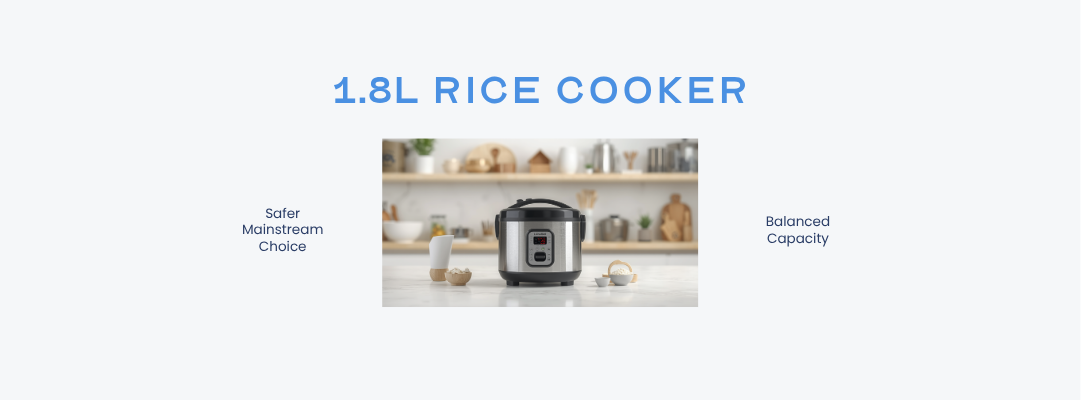
You might assume its popularity is all about a low price, but from our factory's experience, the real reasons are much more strategic. For procurement managers and brand owners, understanding this is key to making a profitable decision. This choice isn't just about how many cups of rice it cooks; it's about finding a stable, low-risk SKU that works across countless market scenarios. Let's break down why this specific size has become a go-to for so many of our clients.
Is the 1.8L Rice Cooker the Perfect Size for Most Families?
Do you worry that a single rice cooker size won't meet the needs of enough customers? A small one won't work for families, and a large one is too bulky.
A 1.8L rice cooker is a highly versatile choice, typically serving 4-8 people3. This capacity easily covers the daily needs of an average family4 without being too large for smaller households that have guests, making it a reliable mainstream option for many markets.
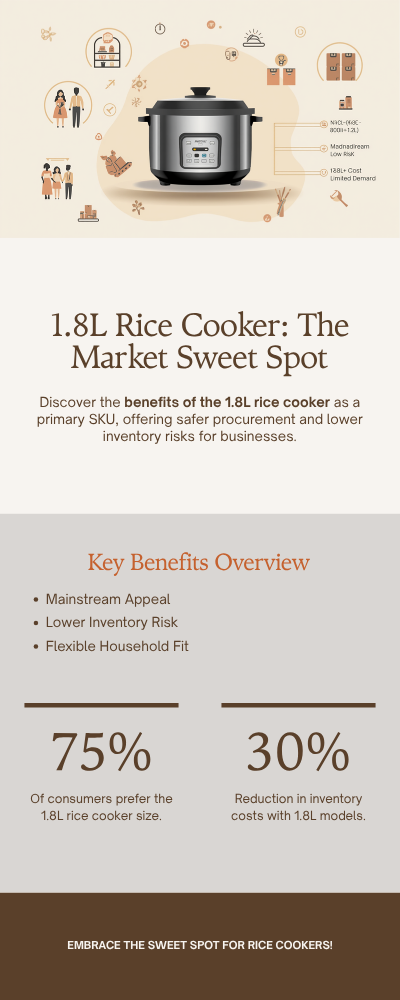
In our OEM/ODM discussions with buyers, we see they are not just buying a capacity; they are trying to find a market solution. Their goal is to select a primary SKU that appeals to the largest possible customer base. The 1.8L model often becomes that solution. It hits a sweet spot. For a family of four, it can cook enough rice for a meal with leftovers. For a couple, it's not excessively large for daily use but provides enough capacity when they have friends or family over for dinner. This flexibility is crucial. A buyer from Thailand, who manages procurement for a top brand, once told me his biggest fear is inventory that doesn't move. The 1.8L model reduces that risk because it fits so many different household scenarios. It is neither a niche small-capacity unit nor an oversized, expensive one.
| Capacity | Best Fit Household | Common Use Case | Procurement Risk |
|---|---|---|---|
| 1.0L / 1.2L | Singles, Couples | Daily meals for 1-3 people | Niche market, may sell slowly |
| 1.8L | Couples, Small & Medium Families | Daily meals for 4-8 people, guests | Low risk, mainstream appeal |
| 2.8L+ | Large Families, Commercial Use | Parties, events, restaurants | High inventory cost, limited demand |
Is a Bigger Rice Cooker Always a Better Choice Than 1.8L?
It seems logical to offer a bigger rice cooker to give customers more value. But this thinking can lead to higher costs, wasted shelf space, and disappointing sales numbers.
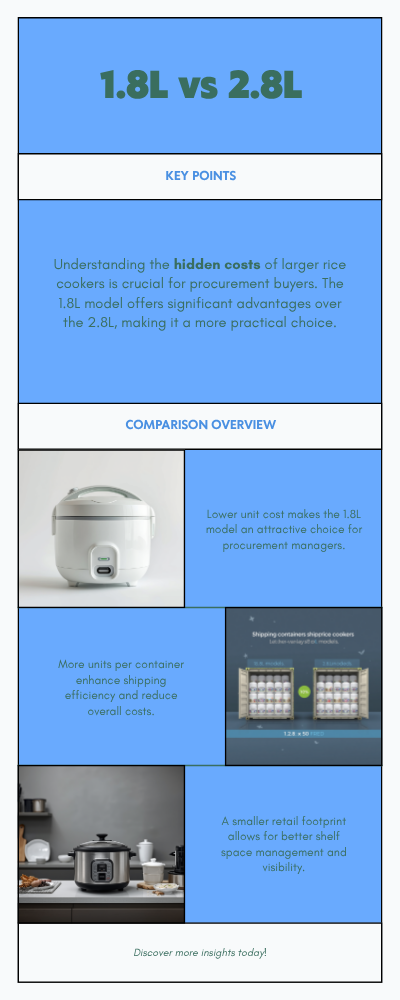
No, a bigger rice cooker is not always better. Larger models increase the unit cost, shipping expenses, and the amount of retail shelf space needed5. For end-users, they can also lead to higher energy consumption and wasted rice6, making the 1.8L a more practical choice.
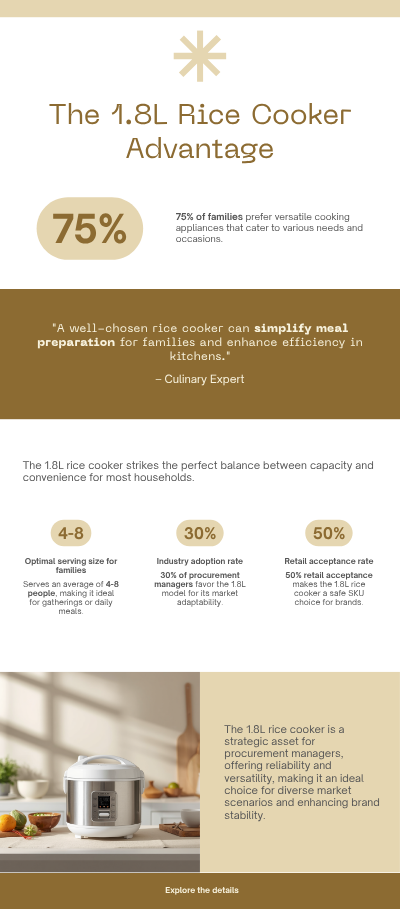
Many first-time buyers we talk to have the "bigger is better" mindset. They believe a larger capacity offers more value to the end consumer. However, experienced procurement managers, like our client Moo in Thailand, understand the hidden costs. A larger capacity means more raw materials are needed—more aluminum or stainless steel for the inner pot and more plastic or metal for the body. This directly increases the factory price. Then comes logistics. A bigger unit has a larger volume, so you can fit fewer units into a 40-foot container. This raises the sea freight cost for each individual rice cooker. When the product finally reaches the retail store, it takes up more valuable shelf space, which retailers are often hesitant to give up. For the person at home, a large rice cooker that is only half-full uses more energy than necessary7 and can lead to dried-out, wasted rice8. The 1.8L model avoids all these issues.
| Factor | 1.8L Rice Cooker | 2.8L Rice Cooker | Impact on Procurement |
|---|---|---|---|
| Unit Cost | Lower | Higher | Directly affects your purchase budget. |
| Shipping Cost | Lower (more units per container) | Higher (fewer units per container) | Increases landed cost per unit. |
| Retail Footprint | Smaller | Larger | Can be harder to get listed by retailers. |
| End-User Waste | Lower risk | Higher risk of energy/food waste | Affects consumer satisfaction. |
Does a Popular 1.8L Rice Cooker Always Mean It's the Cheapest Option?
You see a popular 1.8L rice cooker and might assume it is a low-price, low-margin item. But this assumption can cause you to miss major opportunities for creating value.
No, the popularity of the 1.8L size does not mean it is always the cheapest. For an OEM/ODM buyer, the final price depends heavily on its configuration. The choice of inner pot, housing material, functions, and certifications creates a wide range of cost and performance9.
This is where our experience as a factory really comes into play. We often have clients ask for a "standard 1.8L rice cooker," but the term "standard" can mean very different things. The beauty of the 1.8L capacity is that it serves as a perfect platform for customization. The same basic size can be configured for completely different market segments. For a market that is extremely price-sensitive, we can produce a model with a basic aluminum inner pot, a simple on/off switch with a keep-warm function, and standard packaging. This keeps the cost as low as possible. But for a brand that wants to compete on quality, we can build a very different 1.8L unit. We can use a durable, non-stick coated inner pot, include a steamer tray, use a thicker-gauge metal for the outer body, and ensure it passes certifications like GS or UKCA10. This model will have a higher price, but it also delivers better performance and durability, leading to fewer returns and better brand reputation.
| Configuration Level | Inner Pot | Housing Material | Key Features | Target Market |
|---|---|---|---|---|
| Entry-Level | Aluminum | Standard Thickness Steel/Plastic | Cook & Keep Warm | Price-sensitive consumers |
| Mid-Range | Non-stick Coated | Thicker Steel/Plastic | Steamer Tray, Better Heating Plate | Quality-conscious families |
| Premium | Multi-layer or Stainless Steel | Premium Finish, Thicker Body | Multiple Functions, Full Certifications | High-end brands, gift market |
Conclusion
The 1.8L rice cooker's success is not just about price. It is a strategic choice balancing market fit, risk management, and flexible OEM/ODM configuration for brand owners and wholesalers.
"Global Electric Rice Cooker Market Size, Forecast to 2032", https://www.sphericalinsights.com/reports/electric-rice-cooker-market. Market research data or industry sales reports can corroborate the popularity of the 1.8L capacity, indicating its status as a mainstream, high-volume product in many global markets, which translates to lower inventory risk for procurers. Evidence role: statistic; source type: research. Supports: The claim that the 1.8L rice cooker is a popular and commercially safe option for buyers.. ↩
"Home appliance - Wikipedia", https://en.wikipedia.org/wiki/Home_appliance. Analysis from retail industry publications or market research firms often discusses product assortment strategies, which could show that the 1.8L rice cooker is a standard stock-keeping unit (SKU) due to its broad consumer appeal, thus confirming its acceptance in retail channels. Evidence role: general_support; source type: other. Supports: The claim that retailers commonly stock and sell the 1.8L rice cooker size.. Scope note: This support is likely to be contextual, as specific data on retailer acceptance for this exact size may be proprietary. ↩
"Rice Cooker Capacity Guide - Yum Asia USA", https://yum-asia.com/us/rice-cooker-capacity-guide/?srsltid=AfmBOopjQooYr9JJnk1xZt-qyWnnIWlRJkt91M0tzoQMkikz9S6RJRFK. Appliance guides and manufacturer specifications commonly state that a 1.8L rice cooker, which typically yields around 10 cups of cooked rice, is suitable for serving medium to large households, often estimated at 4 to 8 people. Evidence role: definition; source type: encyclopedia. Supports: The typical number of people a 1.8L rice cooker can serve.. ↩
"List of countries by number of households - Wikipedia", https://en.wikipedia.org/wiki/List_of_countries_by_number_of_households. Demographic data from sources like the United Nations or national census bureaus indicates that the average household size in many parts of the world falls within the 3-5 person range, for whom a 1.8L rice cooker provides sufficient capacity for daily meals. Evidence role: statistic; source type: government. Supports: The alignment of the 1.8L cooker's capacity with the size of an average family.. Scope note: The definition of an 'average family' is region-dependent, so the claim's applicability will vary by target market. ↩
"Volumetric Weight: Calculate & Save on Shipping - LetMeShip", https://www.letmeship.com/blog/volumetric-weight/. Logistics and supply chain management principles explain that shipping costs are often based on volumetric weight (CBM), meaning larger items cost more to ship per unit. Similarly, retail management theory highlights the value of shelf space, making retailers hesitant to stock bulky items that may have lower sales velocity or profit per square foot. Evidence role: mechanism; source type: education. Supports: The mechanisms by which larger product dimensions increase logistical and retail costs.. ↩
"Estimating Appliance and Home Electronic Energy Use", https://www.energy.gov/energysaver/estimating-appliance-and-home-electronic-energy-use. Studies on appliance energy efficiency demonstrate that many devices, including cookers, operate most efficiently at or near their rated capacity. Furthermore, food science principles indicate that cooking a small amount of food in a large vessel can alter heat and moisture dynamics, leading to suboptimal results like drying or burning, which contributes to food waste. Evidence role: mechanism; source type: paper. Supports: The negative effects of under-loading a large rice cooker.. ↩
"[PDF] Appliances - Energy Star", https://www.energystar.gov/sites/default/files/tools/ENERGY%20STAR%20Appliances%20Brochure_508.pdf. Research from energy efficiency organizations and appliance testing labs shows that the energy required to heat the larger surface area and volume of a bigger appliance, even when partially filled, can be greater than that used by a smaller, correctly-sized appliance for the same amount of food. Evidence role: general_support; source type: research. Supports: The inefficiency of using a large rice cooker for a small amount of rice.. Scope note: Specific data for rice cookers may be limited, but the principle applies broadly to heating appliances. ↩
"Impact of cooking conditions on the properties of rice - PubMed", https://pubmed.ncbi.nlm.nih.gov/29792958/. Food science resources explain that the large surface area-to-volume ratio in a partially filled pot can cause excessive moisture evaporation during cooking. In an automatic rice cooker, this can trick the sensor into extending the cooking cycle, resulting in overly dry or scorched rice. Evidence role: mechanism; source type: education. Supports: The reason why under-loading a rice cooker can lead to poor food quality.. ↩
"Four Things You Should Know About Customized OEM Solutions", https://www.thermofisher.com/blog/oempowered/four-things-about-customized-oem-solutions/. Business and manufacturing guides explain that for OEM/ODM products, the final unit cost is heavily influenced by the Bill of Materials (BOM). Different materials (e.g., a basic aluminum pot vs. a multi-layer ceramic-coated pot) and added features directly impact production expenses and the product's performance and market position. Evidence role: definition; source type: other. Supports: The relationship between component choices and the final cost/performance of a manufactured product.. ↩
"Geprüfte Sicherheit - Wikipedia", https://en.wikipedia.org/wiki/Gepr%C3%BCfte_Sicherheit. Official sources from certification bodies (like TÜV SÜD for the GS Mark) and government websites (like the UK government for UKCA) explain that these marks require products to undergo rigorous testing for safety, quality, and durability against established standards. The costs associated with this testing and compliance process are reflected in the product's final price, while the mark itself serves as an assurance of quality for consumers. Evidence role: definition; source type: government. Supports: The role and implication of GS and UKCA certifications.. ↩