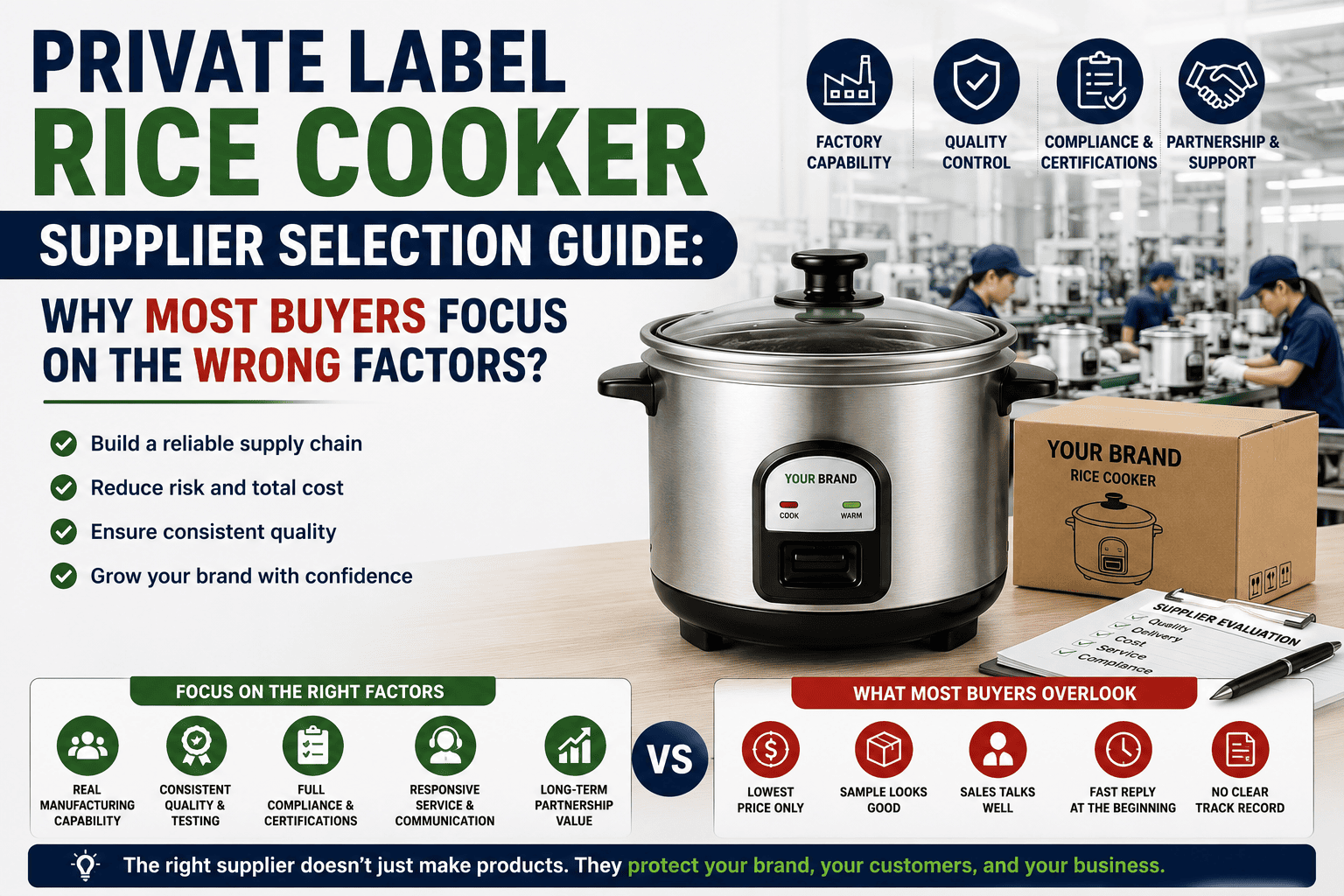
I spent 15 years working with brand owners and retailers who source private label rice cookers, and I've watched dozens of buyers make the same mistake: they treat supplier selection as a price negotiation exercise when it should be a risk management decision. The procurement managers who focus exclusively on getting the lowest unit price often end up paying far more in warranty claims, delayed shipments, and batch inconsistencies than the buyers who invest time evaluating production reliability and communication clarity upfront.
The real cost of private label rice cooker sourcing comes from what happens after you sign the contract—certification delays that hold your inventory at customs, capacity mismatches that push delivery into the off-season, material substitutions that trigger return rates above 3%1, and miscommunication that wastes entire development cycles. When I compare the total cost of ownership across our client projects, the difference between an $18 unit from a fragile supplier and a $21 unit from a reliable manufacturer disappears within the first year of after-sales expenses.
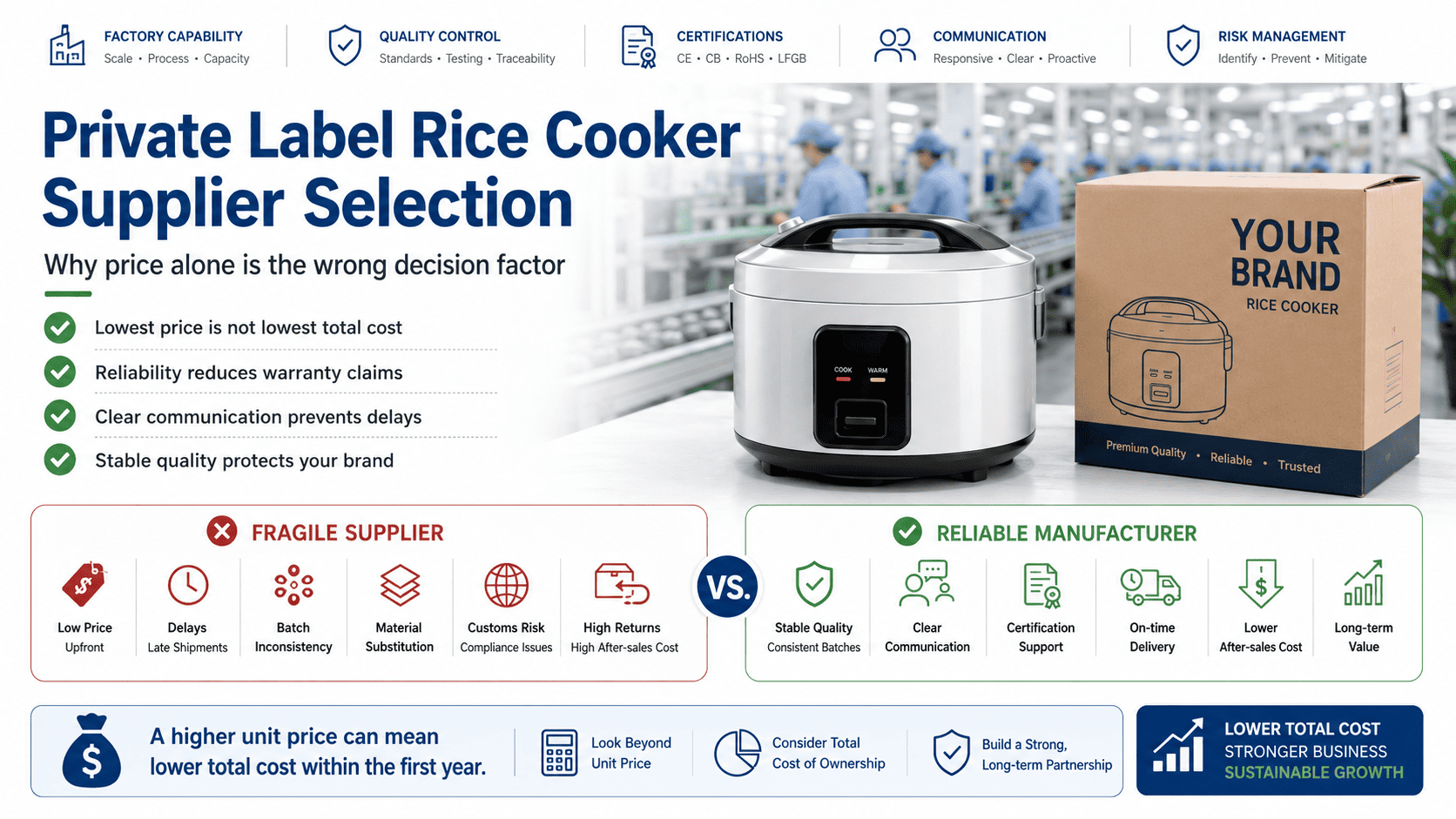
In the following sections, I'll walk you through the supplier evaluation criteria that actually predict long-term procurement success. These insights come from observing what separated our smoothest client relationships from the ones that required constant firefighting—and the patterns repeat across markets from Thailand to Europe.
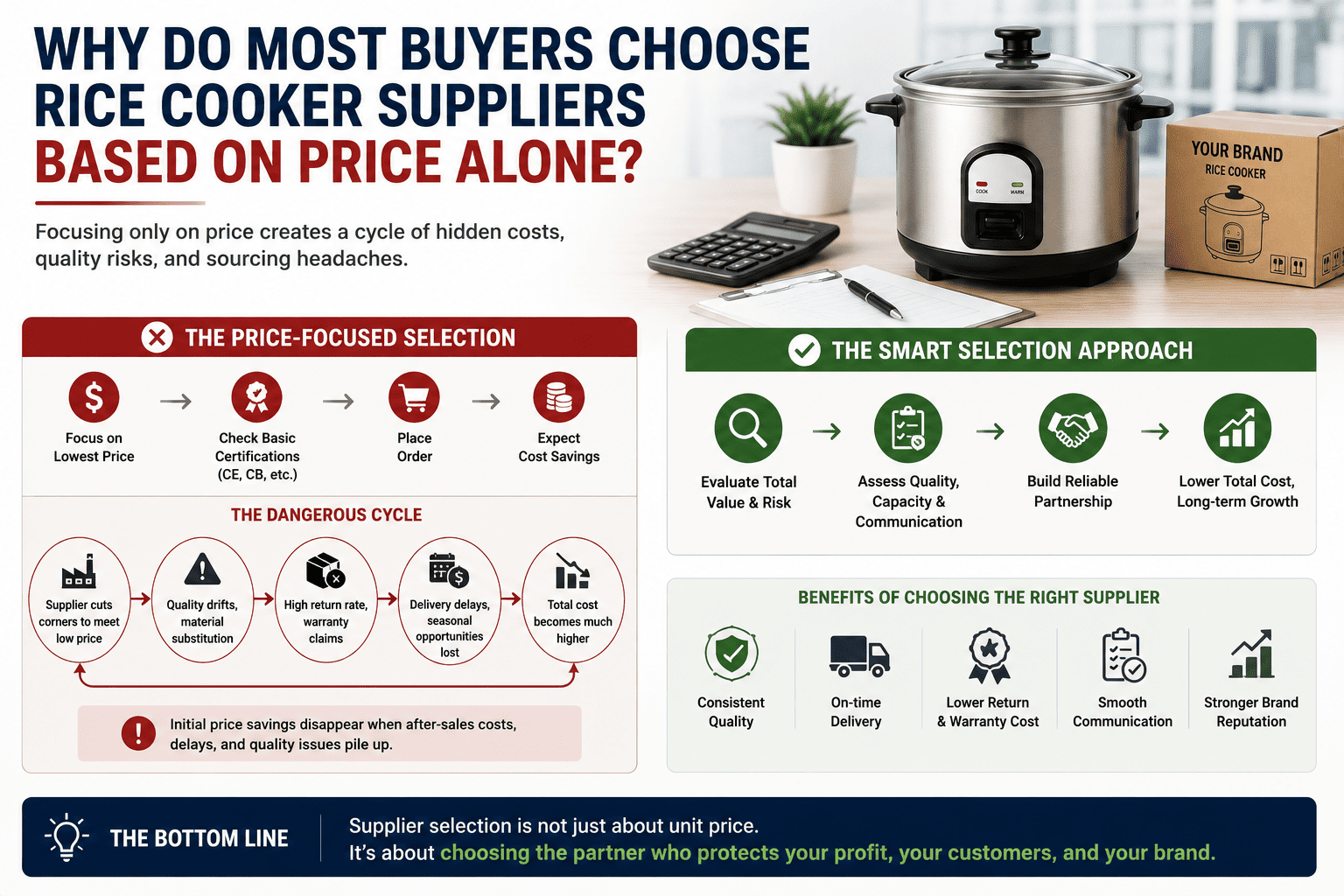
Why Do Most Buyers Choose Rice Cooker Suppliers Based on Price Alone?
I've sat through hundreds of supplier evaluation meetings where procurement teams focus 80% of the conversation on unit price differences and 20% on everything else. The logic seems rational: if three suppliers offer similar-looking products with CE and CB certifications2, why pay more?
But this approach assumes that certifications equal quality reliability and that quoted prices remain stable after the contract is signed—two assumptions that fail frequently in real procurement situations.
The price-focused selection process creates a dangerous cycle: buyers push suppliers toward their lowest acceptable quote, suppliers compensate by simplifying manufacturing processes or substituting materials after confirmation, and the resulting quality drift appears months later when return rates exceed forecasts and warranty costs eliminate the initial price savings.
The Real Cost Components Most Buyers Miss
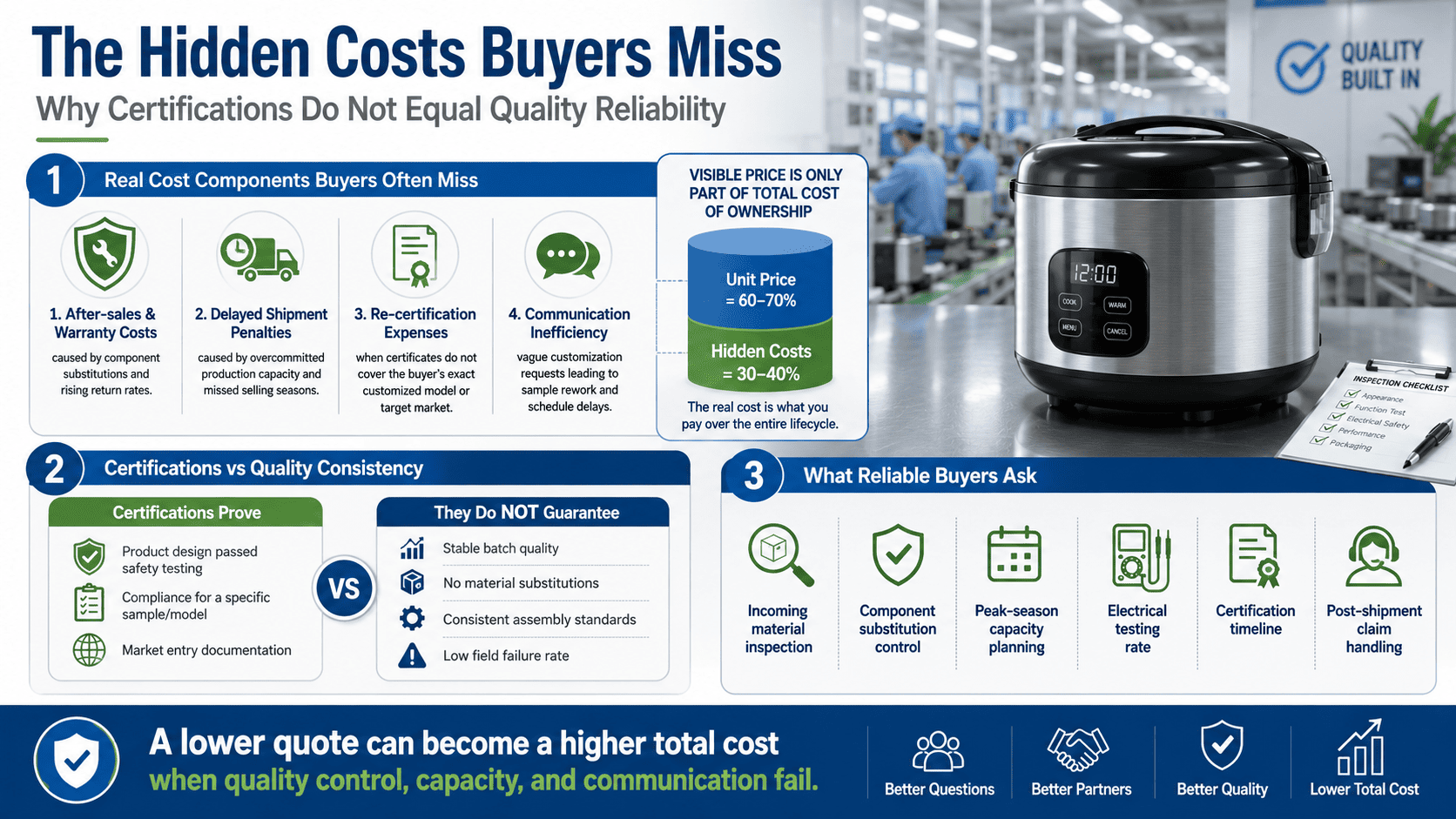
In our experience working with procurement managers who order $500,000–$2 million annually, the visible unit price typically represents only 60–70% of the total cost of ownership. The hidden expenses surface gradually.
After-sales and warranty costs increase when suppliers substitute heating elements or liner materials after price negotiation. A procurement manager in Thailand once told me his company's return rate jumped from 1.8% to 4.2% after switching to a supplier who quoted $2.30 lower per unit.
The supplier had replaced a branded thermal fuse3 with a generic equivalent that failed under continuous high-temperature operation—a substitution that was not visible during pre-shipment inspection but became obvious when warranty claims started arriving three months after retail launch.
Delayed shipment penalties multiply when suppliers overcommit production capacity. We typically operate two production lines under ISO 9001 quality management4, and we have learned that we cannot flexibly absorb seasonal surges beyond 30% of baseline capacity without either outsourcing to secondary factories, which introduces quality inconsistency, or pushing delivery dates.
Buyers who select suppliers based on claimed annual capacity rather than verified line occupancy during their order window often discover this constraint after purchase orders are placed—when penalties for missing selling seasons can exceed 15% of order value.
Re-certification expenses emerge when suppliers' existing certificates do not cover the buyer's specific market requirements. A buyer might see “CE certified” on the supplier's profile and assume European market compliance, only to discover during customs clearance that the certification covers the supplier's standard 1.5L model but not the customized 1.8L version the buyer ordered.
This can trigger a long delay while additional testing is completed.
Communication inefficiency costs appear as wasted development cycles. When buyers request customization using vague requirements such as “change the handle to look more premium,” suppliers without strong pre-sales clarification processes may produce samples based on guesses.
Those samples may fail to address the buyer's actual constraints around mold investment, lead time, target retail price, or retailer requirements. Each unnecessary iteration can consume several weeks and put the launch schedule at risk.
Why Procurement Teams Default to Price Competition
The irony is that procurement managers understand these hidden costs conceptually, but organizational incentives often push them toward price-focused selection anyway.
In many companies, procurement performance is measured primarily by cost reduction against previous-year benchmarks. This makes the $2 unit price difference highly visible, while warranty claims, delayed launches, and customer complaints may be recorded under different departments.
From the buyer's perspective, choosing a supplier with the second-lowest quote requires justifying the price premium with concrete risk-reduction evidence.
This justification is easier for experienced procurement managers who have already dealt with a batch recall, a missed selling season, or a customs hold. After that experience, buyers start asking different questions:
- What is your incoming material inspection standard?
- How do you control component substitutions?
- How do you manage production capacity during peak season?
- What percentage of units receive electrical testing?
- What is your typical certification timeline?
- How do you handle quality claims after shipment?
These questions reveal much more about supplier reliability than another round of price negotiation.
How Do Certifications Relate to Actual Rice Cooker Quality Reliability?
I remember a procurement conversation where a buyer from Europe asked if we had CB and CE certificates. I said yes, and he moved to pricing discussion within two minutes.
Six months later, after his first shipment cleared customs successfully, he called me frustrated: “You have all the certifications, so why am I seeing a 3.1% failure rate in the first month after retail sale?”
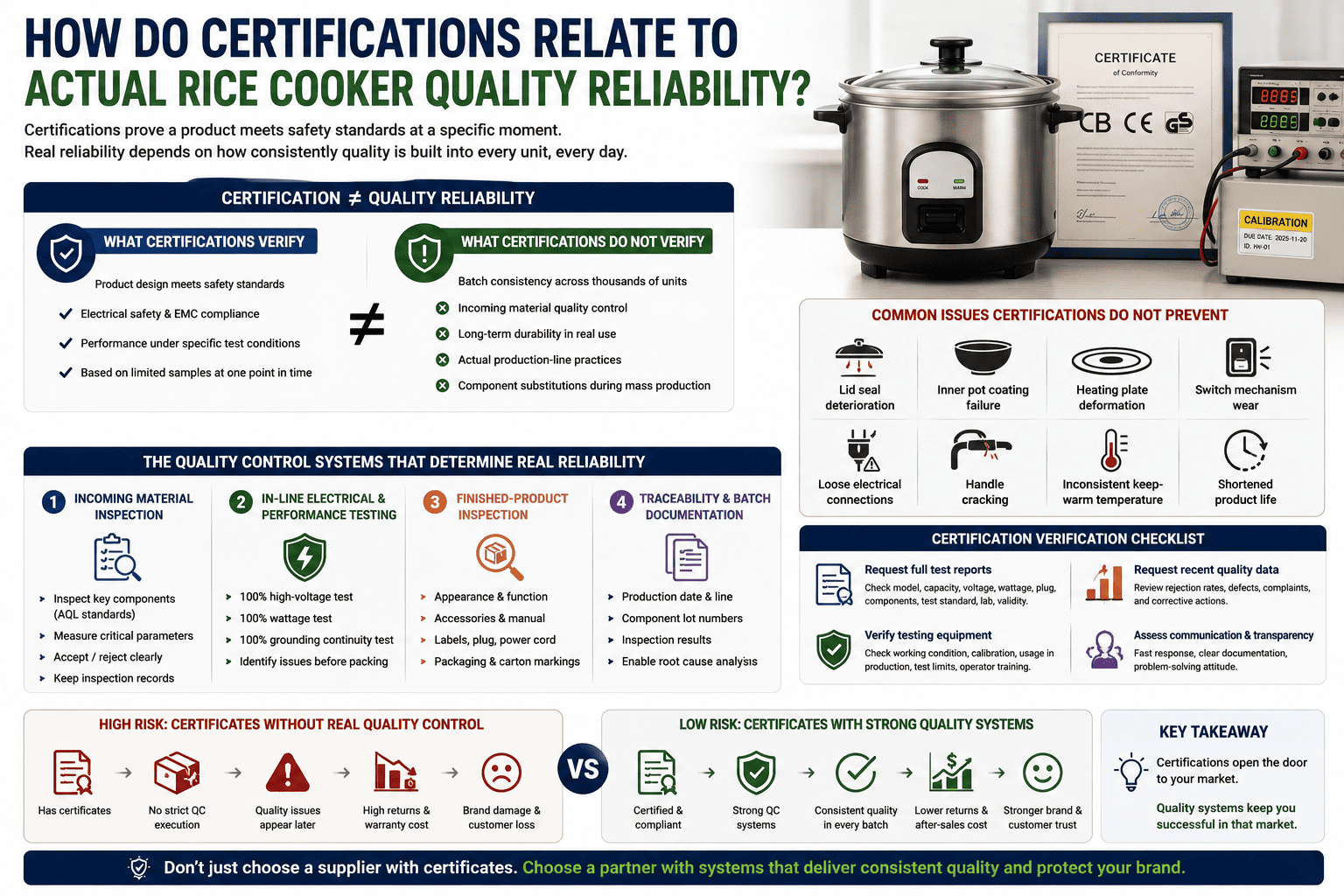
The disconnect reveals a common misunderstanding: certifications prove that a product design meets safety standards at a specific moment, but they do not guarantee that every manufactured unit maintains those standards across thousands of units and multiple production batches.
Certification existence and quality consistency are separate capabilities. A supplier can obtain valid CE, CB, and GS certificates5 by submitting carefully prepared samples to testing laboratories while simultaneously running production lines with inconsistent material sourcing, inadequate in-line testing, and minimal finished-product verification.
What Certifications Actually Verify—and What They Do Not
Standard rice cooker certifications such as CE, CB, GS, UKCA6, and KC7 may assess product design against electrical safety, electromagnetic compatibility8, and other market-specific requirements.
A testing laboratory may verify that the submitted samples do not create shock hazards, do not generate excessive electromagnetic interference, and meet the declared electrical specifications.
However, certificates do not automatically verify the following areas.
Batch consistency across production runs
Certification testing covers a limited number of samples. It does not prove that a 10,000-unit production order will maintain the same component quality, assembly precision, wattage, and performance.
A supplier may submit samples with high-quality thermal cutoffs and heating elements, then substitute lower-cost alternatives during mass production unless component control is clearly written into the order documents.
Incoming material quality control
Certification laboratories do not inspect every incoming component used in mass production. Suppliers must establish their own material inspection procedures.
In our facility, we use AQL acceptance criteria9 for incoming components such as heating elements, thermal fuses, power cords, thermostats, inner pots, and plastic parts.
Suppliers who skip incoming inspection may assemble products with nonconforming components while still holding valid certificates.
Performance stability over the product lifetime
Certification tests focus mainly on safety and conformity under defined conditions. They do not automatically prove durability over two or three years of regular consumer use.
A rice cooker may pass its initial safety tests but later develop:
- Lid seal deterioration
- Inner-pot coating failure
- Heating plate deformation
- Switch mechanism wear
- Loose electrical connections
- Handle cracking
- Inconsistent keep-warm temperature
These problems are influenced by material selection and manufacturing consistency, not merely certificate ownership.
Actual production-line practices
A factory may display valid quality certificates while workers ignore torque specifications, assembly fixtures, component traceability, or inspection instructions.
For example, incorrect heating-element mounting may not cause an immediate failure, but it can create poor contact, uneven heating, and shortened product life.
The Quality Control Systems That Determine Real Reliability
When buyers ask how to evaluate whether a supplier's certificates translate into reliable products, I recommend examining four execution-level controls.
1. Incoming material inspection
Ask suppliers to explain their inspection process with specific details:
- Which components are inspected?
- Which parameters are measured?
- What sampling standard is used?
- What is the acceptance level?
- What happens when a batch fails?
- Are failed materials isolated and recorded?
- Can the supplier show recent inspection records?
Suppliers with a genuine system can usually provide measurable answers. A vague statement such as “we inspect everything carefully” is not enough.
2. In-line electrical and performance testing
The most important quality verification happens during production, not after packing.
We conduct 100% high-voltage testing10, wattage testing, and grounding continuity testing on every finished unit.
These checks identify problems such as:
- Insulation weakness
- Electrical leakage
- Incorrect power consumption
- Poor grounding
- Loose electrical connections
- Wrong heating-element configuration
Ask potential suppliers what percentage of units receive safety-critical testing. For electrical safety parameters, random sample testing may leave unacceptable batch risk.
3. Finished-product inspection
Even after 100% in-line electrical testing, finished products should receive random inspection before shipment.
This inspection should verify:
- Appearance
- Function
- Accessories
- Plug type
- Power cord
- Manual
- Rating label
- Barcode
- Packaging
- Carton markings
- Model consistency
A supplier's willingness to disclose actual inspection findings is often a better reliability signal than claims of “zero defects.”
4. Traceability and batch documentation
When a quality problem appears in the market, the supplier should be able to identify:
- Production date
- Production line
- Component lot number
- Material supplier
- Inspection results
- Operator or work group
- Packing date
- Shipment batch
Without traceability, suppliers may replace defective units but fail to prevent the same issue from recurring.
Certification Verification During Supplier Selection
Buyers should focus on evidence, not only supplier claims.
Request actual test reports
Do not review only the certificate cover page. Check:
- Model number
- Capacity
- Rated voltage
- Frequency
- Wattage
- Plug configuration
- Heating system
- Product photos
- Critical component list
- Test standard
- Report validity
- Laboratory name
A certificate for a standard model may not automatically cover a customized model.
Verify testing equipment
During a factory audit, check whether testing machines:
- Are in working condition
- Have current calibration labels
- Are used during actual production
- Have defined pass/fail limits
- Generate or record test results
- Are operated by trained workers
Testing equipment should have calibration records11, not merely sit in the factory for customer visits.
Request recent quality data
Ask for rejection or defect information from:
- Incoming inspection
- In-line testing
- Finished-product inspection
- Customer complaints
- After-sales claims
The goal is not to find a supplier claiming zero defects. The goal is to find one that measures defects, identifies causes, and takes corrective action.
Certification Requirements for Private Label Rice Cooker Projects
Private label orders create more compliance risk than standard product purchases because buyers often change the logo, model number, plug, voltage, wattage, manual, packaging, or internal components.
These changes can affect whether existing certificates and test reports remain applicable.
Before confirming a private label rice cooker order, buyers should review the following compliance areas.
| Compliance Area | What the Buyer Should Confirm | Main Risk if Ignored |
|---|---|---|
| Target market | Exact destination country or countries | Different markets may require different approvals |
| Electrical safety | Applicable CE, CB, GS, UKCA, KC, SAA, UL, ETL, INMETRO, or local requirements | Customs rejection, retailer rejection, or legal exposure |
| EMC requirements | Whether the final model requires electromagnetic compatibility testing | Product may fail market-entry requirements |
| Food-contact materials | Inner pot, coating, steamer, lid, measuring cup, and food-contact reports | Consumer safety claims or retailer rejection |
| Restricted substances | RoHS or other material restrictions | Compliance failure in regulated markets |
| Voltage and frequency | 110–120V or 220–240V; 50Hz or 60Hz | Product may be unsafe or unusable |
| Plug and power cord | Local plug type, cable rating, certification, and cord length | Market incompatibility and user complaints |
| Rating label | Brand, model, voltage, wattage, frequency, manufacturer, importer, and warnings | Customs or traceability problems |
| Manual language | Required local language and safety instructions | Retailer or regulatory rejection |
| Packaging markings | Barcode, recycling marks, importer details, certification marks, and warnings | Relabeling costs or warehouse rejection |
| Certificate scope | Whether the final customized model is covered | Existing certificate may not support the actual order |
| Factory audit | Whether the retailer or certification body requires a social or technical audit | Delayed approval or lost retail program |
What Changes May Affect Existing Certification Coverage?
Buyers should ask the laboratory or certification body whether additional testing is needed when changing:
- Rated voltage
- Wattage
- Heating element
- Thermostat
- Thermal fuse
- PCB or control system
- Plug or power cord
- Internal wiring
- Inner pot material
- Body structure
- Product capacity
- Model number
- Safety-critical components
A logo or packaging change may be relatively simple, but an electrical or structural change can affect test-report coverage.
Questions to Ask Before Paying Certification Fees
- Is the supplier's existing certificate valid and verifiable?
- Does it cover the exact model being quoted?
- Is the report issued by an accepted laboratory?
- Which customization changes are allowed?
- Who will own the new certificate?
- Who pays for testing?
- How long will testing take?
- What happens if the product fails?
- Are annual factory inspections required?
- Are renewal or surveillance fees involved?
- Can the same report support additional target markets?
Certification planning should happen during RFQ and sample development—not after mass production has started.
What Production Capacity Details Actually Predict Delivery Reliability?
I learned the hard way that “production capacity” is one of the most misleading specifications in supplier evaluation.
A buyer from Thailand once selected us partly because we stated “two production lines with annual capacity of 500,000 units,” which sounded sufficient for his 80,000-unit order. Four months later, he called me frustrated because we pushed his delivery date by three weeks.
The problem was not necessarily dishonesty about annual capacity. It was the assumption that annual capacity meant we could absorb the order at any time of year.
Claimed annual capacity is a theoretical maximum that assumes full-year operation with an optimal product mix and no seasonal concentration. Real capacity availability depends on the supplier's existing backlog, production-line occupancy during the required delivery window, product complexity, material readiness, and willingness to overcommit.
Why Annual Capacity Numbers Mislead Buyers
When suppliers state annual production capacity, they may calculate:
Number of production lines × Units per line per day × Working days × Efficiency rate
For example:
2 lines × 800 units per line per day × 250 working days × 0.85 efficiency ≈ 340,000 units per year
This calculation may be mathematically reasonable, but it hides several important variables.
Seasonal demand concentration
Rice cooker orders are not distributed evenly across 12 months.
Buyers may place orders around:
- Lunar New Year
- Ramadan and Eid
- Q4 retail season
- Back-to-school campaigns
- National holidays
- Retail promotions
- Trade-show launches
A factory may have enough annual capacity but insufficient available capacity during the buyer's required production month.
Product mix complexity
Different models use different amounts of production time.
A standard mechanical rice cooker may move through assembly quickly. A customized model with extra functions, special wiring, unique packaging, or more inspection requirements may reduce line output.
The buyer's order quantity may remain the same, but its actual capacity requirement increases.
Changeover time
Production lines cannot instantly switch between models.
Changeovers may require:
- Fixture adjustment
- Tool replacement
- Testing-equipment recalibration
- Material change
- Worker instruction
- First-piece approval
- Packaging-line adjustment
Factories handling many small customized orders may lose a significant amount of production time to changeovers.
Material availability
A factory cannot start production merely because assembly-line time is available.
It also needs:
- Heating elements
- Thermostats
- Power cords
- Plugs
- Inner pots
- Plastic parts
- Metal bodies
- Packaging
- Manuals
- Labels
- Accessories
Long-lead components or buyer-delayed artwork can affect delivery even when assembly capacity is available.
The Outsourcing Risk That Emerges From Overcommitment
When a factory is fully booked, some suppliers outsource production to another factory.
Outsourcing can introduce several risks.
Inconsistent component sourcing
Secondary factories may not use the same approved suppliers for heating elements, thermal fuses, power cords, thermostats, or inner pots.
Equivalent-looking components can differ in:
- Thermal response
- Material composition
- Coating durability
- Dimensional tolerance
- Electrical life
- Certification status
Different quality-control standards
The primary supplier may perform 100% electrical testing, while the subcontractor performs only random testing.
A buyer receiving mixed production may experience inconsistent defect rates without knowing that the goods came from different facilities.
Weakened traceability
When a defect appears, it may be difficult to determine:
- Which factory produced the unit
- Which component batch was used
- Which inspection process applied
- Who is responsible for corrective action
Unapproved manufacturing location
Some certifications, retailer programs, and audit approvals are connected to a specific production site. Moving production to another facility without approval may create compliance problems.
Capacity Questions Buyers Should Ask
Instead of asking only “What is your annual capacity?”, ask:
- How many production lines do you currently operate?
- What is the normal daily output for this exact model?
- What is the current backlog?
- Which production weeks are available for my order?
- What is the lead time for critical components?
- How many model changeovers are planned during my production period?
- Will any part of my order be subcontracted?
- Can you guarantee that all units will be produced at the audited facility?
- What happens if packaging artwork is delayed?
- How do you manage production before Chinese New Year?
- Can you provide a production schedule after receiving the deposit?
- How often will you update production progress?
A reliable supplier should discuss realistic available capacity, not only theoretical annual output.
Factory Capability: What Should a Private Label Rice Cooker Supplier Be Able to Support?
Factory capability should be evaluated as a complete system. Owning assembly lines is not enough if the supplier cannot manage customization, testing, certification, packaging, documentation, and after-sales problems.
A capable private label rice cooker factory should support the following areas.
| Factory Capability | What Buyers Should Verify | Why It Matters |
|---|---|---|
| OEM/ODM experience | Previous projects involving customized logo, packaging, color, plug, voltage, and configuration | Reduces development mistakes |
| Product engineering | Ability to match capacity, wattage, heating plate, thermostat, inner pot, and structure | Protects cooking performance and safety |
| Existing tooling | Available body, lid, handle, switch, and component molds | Reduces tooling cost and development time |
| Incoming inspection | Inspection records for key components and raw materials | Reduces batch inconsistency |
| In-line quality control | Defined checks at assembly stages | Finds problems before final packing |
| Electrical testing | 100% high-voltage, wattage, grounding, and function testing where applicable | Controls safety-critical risk |
| Cooking testing | Actual cooking and keep-warm verification | Confirms real product performance |
| Certification support | Ability to provide reports and coordinate new testing | Reduces compliance delays |
| Packaging development | Dielines, artwork checking, carton structure, manuals, labels, and barcodes | Prevents packaging rework |
| Container-loading calculation | Accurate carton dimensions and loading quantity | Helps calculate landed cost |
| Production planning | Clear material and assembly schedule | Reduces late-delivery risk |
| Batch traceability | Component and production records | Supports root-cause analysis |
| After-sales support | Complaint investigation, spare parts, corrective action, and claim handling | Protects long-term cooperation |
Product Customization Capability
A private label supplier should be able to clarify which changes are simple and which require additional investment.
Common customization items include:
- Brand logo
- Product color
- Control panel
- Switch panel
- Capacity
- Voltage
- Plug type
- Power cord
- Inner pot
- Heating plate
- Lid
- Handle
- Steamer
- Measuring cup
- Rice spoon
- Rating label
- Manual
- Color box
- Master carton
The supplier should explain:
- MOQ
- Tooling fee
- Sample cost
- Sample lead time
- Production lead time
- Certification impact
- Packaging impact
- Unit-cost impact
A strong supplier does not simply answer “yes” to every customization request. It explains the technical and commercial consequences.
Quality-Control Capability
Buyers should verify that the factory has clear controls for:
- Incoming materials
- Pre-production samples
- First-piece approval
- In-line assembly
- Electrical testing
- Cooking and function testing
- Appearance inspection
- Packaging verification
- Final random inspection
- Shipment records
Communication Capability
Communication is a production capability, not merely a sales skill.
A reliable supplier should confirm specifications in writing and maintain one consistent source of truth, such as:
- Approved specification sheet
- Approved sample
- Bill of materials
- Artwork file
- Rating-label file
- Manual
- Packaging standard
- Inspection standard
- Production schedule
- Change-confirmation record
If important decisions remain scattered across WhatsApp, WeChat, email, and verbal calls, the risk of production mistakes increases.
Buyer Checklist: How to Evaluate a Private Label Rice Cooker Supplier
Use this checklist before selecting a supplier or placing a trial order.
1. Company and Factory Verification
- Is the supplier a manufacturer, trading company, or a combination of both?
- Is the factory address consistent across certificates and business documents?
- How many years has the company manufactured rice cookers?
- Which markets does it currently export to?
- Can it provide recent factory videos or accept a factory audit?
- Will the order be produced at the audited facility?
- Does the supplier have experience with your target market?
2. Product and Engineering Fit
- Does the supplier already manufacture your required capacity and body shape?
- Is the wattage suitable for the capacity?
- Does the inner pot match your retail positioning?
- Can the supplier explain component trade-offs?
- Are critical components identified in writing?
- Does the product cook the rice varieties used in your market?
- Does the keep-warm performance meet your expectations?
- Are spare parts available?
3. Certification and Compliance
- Which certificates are already available?
- Are the certificates valid?
- Do the test reports cover the exact model?
- Are voltage, wattage, plug, capacity, and product photos consistent?
- Are food-contact reports available?
- Does customization require new testing?
- Who pays for certification?
- Who owns the certificate?
- Are factory audits or annual surveillance required?
4. Quality-Control System
- Are incoming materials inspected?
- Is AQL or another sampling standard used?
- Are safety-critical electrical tests performed on 100% of units?
- Are cooking tests performed?
- Is test equipment calibrated?
- Are results recorded?
- Is final inspection performed before shipment?
- Can the supplier provide recent defect data?
5. Production Capacity and Lead Time
- What is the daily output for the exact model?
- What is the current order backlog?
- Which production window is available?
- Are critical materials in stock?
- Will production be subcontracted?
- How are delays communicated?
- How does the factory manage peak season and Chinese New Year?
- Can it provide a written production schedule?
6. Private Label and Packaging Support
- Can the factory provide packaging dielines?
- Can it check barcodes and certification marks?
- Can it support multilingual manuals?
- What is the MOQ per artwork version?
- Can multiple language versions be combined?
- Does it calculate container loading quantity?
- Does it conduct packaging drop tests or transport simulations?
- Are all artwork approvals recorded?
7. Commercial Terms
- Is the quotation based on a complete specification?
- Are tooling, certification, packaging, and sample costs clearly separated?
- How long is the quotation valid?
- What can trigger a price adjustment?
- What are the payment terms?
- What is the warranty period?
- How are quality claims calculated?
- Who pays for replacement parts or rework?
- Are delivery penalties or claim procedures written into the contract?
8. Communication and Project Management
- Does the salesperson answer technical questions accurately?
- Is there an engineer or QC contact?
- Are changes confirmed in writing?
- Does the supplier provide regular progress updates?
- Does it identify risks before they become delays?
- Does it give realistic answers instead of agreeing to everything?
- Can it provide documents on time?
Supplier Evaluation Scorecard
Buyers can score each supplier from 1 to 5.
| Evaluation Area | Suggested Weight | Supplier Score |
|---|---|---|
| Product and engineering fit | 15% | |
| Certification coverage | 15% | |
| Quality-control system | 20% | |
| Production capacity and delivery | 15% | |
| Private label capability | 10% | |
| Packaging and documentation | 10% | |
| Communication quality | 10% | |
| Unit price and commercial terms | 5% | |
| Total | 100% |
Price should remain part of the decision, but it should not overpower quality, compliance, and delivery reliability.
Common Mistakes When Selecting a Private Label Rice Cooker Supplier
Mistake 1: Comparing Quotations Without Matching Specifications
Two rice cookers may look identical while using different:
- Heating elements
- Thermostats
- Thermal fuses
- Inner pots
- Coatings
- Power cords
- Plugs
- Plastic materials
- Metal thicknesses
- Packaging structures
A price comparison is meaningless unless the specifications are aligned.
Mistake 2: Accepting “Same Quality” Without a Written Bill of Materials
“Same quality” is not measurable.
Buyers should define critical components, material grades, dimensions, and approved alternatives in writing. Otherwise, the supplier may interpret “same quality” differently during mass production.
Mistake 3: Checking Certificates but Not Test Reports
A certificate title may look correct while the detailed report covers a different:
- Model
- Capacity
- Wattage
- Voltage
- Plug
- Heating system
- Production facility
Always review the underlying report.
Mistake 4: Believing Annual Capacity Equals Available Capacity
Annual capacity does not reveal whether the production lines are available during your required delivery window.
Ask for actual available weeks, daily output, component lead time, and current backlog.
Mistake 5: Ignoring Subcontracting Risk
Do not assume all products will be made at the supplier's main factory.
Put the approved production location into the purchase agreement and require written approval before subcontracting.
Mistake 6: Approving Only an Appearance Sample
A sample should be evaluated for:
- Cooking performance
- Keep-warm performance
- Power consumption
- Electrical safety
- Inner-pot quality
- Handle strength
- Plug and cord
- Packaging
- Labeling
- Certification consistency
A good-looking sample is not enough.
Mistake 7: Leaving Quality Standards Until Pre-Shipment Inspection
Quality requirements should be agreed before mass production.
The contract should define:
- Critical defects
- Major defects
- Minor defects
- AQL level
- Electrical test requirements
- Function-testing method
- Packaging standard
- Claim process
Mistake 8: Starting Artwork Too Late
Color-box artwork, manuals, labels, barcodes, and importer information can delay production.
Packaging work should run in parallel with sample confirmation.
Mistake 9: Choosing the Lowest Quote Without Calculating Total Cost
Calculate:
- FOB cost
- Tooling
- Certification
- Testing
- Packaging
- Freight
- Duties
- Inspection
- Warranty
- Returns
- Rework
- Delayed-launch cost
The lowest FOB price may not produce the lowest total cost.
Mistake 10: Ignoring Communication Quality
Slow, vague, or inconsistent communication before the order usually becomes more serious after the deposit is paid.
The supplier should be able to explain problems clearly, document decisions, and warn buyers about foreseeable risks.
Mistake 11: Placing a Large First Order Without a Controlled Trial
A first order should verify:
- Product consistency
- Production lead time
- Packaging execution
- Document accuracy
- Inspection cooperation
- Communication reliability
- After-sales response
A controlled trial order can reveal problems before the buyer commits to a large annual program.
FAQ About Private Label Rice Cooker Supplier Selection
1. What is the most important factor when choosing a private label rice cooker supplier?
The most important factor is the supplier's ability to deliver consistent products that match the approved specification, certification requirements, quality standards, and delivery schedule.
Price matters, but it should be evaluated together with quality, compliance, capacity, and communication.
2. Is the lowest-priced rice cooker supplier always the highest risk?
Not always. A competitive supplier may have efficient production, existing tooling, strong purchasing power, or a suitable standard model.
The risk appears when a low price cannot be explained or when it depends on vague specifications, unapproved substitutions, reduced testing, or unrealistic production assumptions.
3. How can I verify whether a supplier is a real factory?
You can review:
- Business registration
- Factory address
- Production videos
- Audit reports
- Certification documents
- Equipment
- Production records
- Factory visit
- Video inspection
- Employee and production-line evidence
Also confirm whether the order will actually be produced at that facility.
4. Which certifications should a rice cooker supplier have?
The required certifications depend on the destination market.
Common requirements may include CE, CB, GS, UKCA, KC, SAA, RoHS, INMETRO, UL, ETL, or other local approvals. Food-contact reports may also be required for the inner pot and related components.
Buyers should verify current local requirements before ordering.
5. Does a CE or CB certificate guarantee product quality?
No. Certificates demonstrate conformity of a tested design under specific standards. They do not automatically guarantee batch consistency, long-term durability, incoming material control, or 100% production testing.
6. What quality tests should a rice cooker factory perform?
Depending on the product and market, important tests may include:
- High-voltage testing
- Insulation resistance
- Leakage current
- Grounding continuity
- Wattage
- Function
- Cooking
- Keep-warm
- Temperature rise
- Thermostat operation
- Appearance
- Packaging
- Drop testing
Safety-critical electrical testing should generally be controlled on every unit where applicable.
7. How do I know whether a supplier has enough production capacity?
Ask for the daily output of your exact model, current backlog, available production weeks, material lead time, and planned subcontracting.
Do not rely only on annual-capacity claims.
8. What should be included in a private label rice cooker specification sheet?
The specification should include:
- Model
- Capacity
- Voltage
- Frequency
- Wattage
- Plug
- Power cord
- Heating element
- Thermostat
- Thermal fuse
- Inner pot
- Coating
- Body material
- Lid
- Accessories
- Functions
- Logo
- Rating label
- Manual
- Packaging
- Certifications
- Inspection standard
9. Should I place a trial order before a large order?
For a new supplier, a controlled trial order is usually advisable. It allows the buyer to verify production consistency, delivery performance, packaging, documents, inspection cooperation, and after-sales response.
10. How should buyers compare supplier quotations?
First standardize the product specification. Then compare:
- Unit price
- Component quality
- Certification coverage
- Tooling
- Testing
- Packaging
- Lead time
- Payment terms
- Warranty
- Inspection
- Claim handling
- Total landed cost
11. What should I do if a supplier refuses to disclose component details?
The supplier may have legitimate confidentiality concerns, but critical safety and performance components should still be defined sufficiently for quality control.
At minimum, agree on:
- Component type
- Performance rating
- Certification
- Approved manufacturer or equivalent standard
- Change-approval process
12. How can I prevent material substitutions during mass production?
Use an approved sample, written specification, critical-component list, bill of materials, inspection standard, and contractual requirement that substitutions need written buyer approval.
Pre-shipment inspection alone may not detect every internal substitution.
13. Who should own a new certificate created for a private label project?
This should be negotiated before testing begins.
The agreement should specify:
- Certificate applicant
- Certificate holder
- Factory listed
- Brand or model listed
- Ownership of reports
- Rights to use the certificate
- Renewal fees
- Surveillance fees
- Consequences if cooperation ends
14. What is a reasonable supplier evaluation process?
A practical process includes:
- Initial supplier screening
- Document and certificate verification
- Technical specification comparison
- Sample testing
- Factory audit or video audit
- Commercial negotiation
- Trial order
- Pre-shipment inspection
- Market-performance review
- Supplier scorecard and repeat-order decision
15. What is the biggest warning sign during supplier selection?
The biggest warning sign is a supplier that agrees to every price, specification, certification, and delivery request without explaining limitations or trade-offs.
Reliable suppliers sometimes say no, request more information, or identify risks before accepting an order.
Conclusion
Choosing a private label rice cooker supplier is not primarily a search for the lowest quotation. It is a decision about which supplier can consistently protect your product specification, certification, delivery schedule, retail reputation, and after-sales cost.
The strongest supplier is not necessarily the factory with the largest building, the highest claimed annual capacity, or the longest certificate list. It is the supplier that can provide clear evidence of:
- Controlled materials
- Stable production
- Valid certification coverage
- Realistic capacity planning
- 100% safety-critical testing where required
- Accurate documentation
- Effective traceability
- Honest communication
- Reliable corrective action
A small unit-price saving can disappear quickly through warranty claims, missed selling seasons, customs delays, packaging mistakes, or repeated sample development.
Before placing your next private label rice cooker order, compare suppliers using a structured scorecard. Define the exact specification, review the complete test reports, verify available production capacity, agree on quality standards, and calculate total cost rather than FOB price alone.
The best sourcing decision is not the cheapest supplier today. It is the supplier that creates the fewest expensive surprises after the order is confirmed.
"Understanding lifetimes and failure modes of defective washing ... - PMC", https://pmc.ncbi.nlm.nih.gov/articles/PMC6472650/. Industry benchmarks for consumer electronics typically establish acceptable return rates, providing context for evaluating product quality performance. Evidence role: statistic; source type: research. Supports: typical return rate thresholds for consumer electronics or small appliances. Scope note: General consumer electronics data may not specifically address rice cooker category norms. ↩
"CE marking", https://en.wikipedia.org/wiki/CE_marking. CE marking indicates conformity with European health, safety, and environmental protection standards, while the CB Scheme facilitates international acceptance of electrical product safety test reports. Evidence role: definition; source type: institution. Supports: the purpose and scope of CE and CB electrical safety certifications. ↩
"What is a Thermal Fuses", https://www.swe-check.com.au/editorials/thermal_fuses.php. Thermal fuses serve as one-time safety devices that permanently interrupt electrical current when temperature exceeds a predetermined threshold, preventing overheating hazards in appliances. Evidence role: mechanism; source type: encyclopedia. Supports: the safety function of thermal fuses in electrical appliances. ↩
"ISO 9001:2015 - Quality management systems — Requirements", https://www.iso.org/standard/62085.html. ISO 9001 specifies requirements for quality management systems, establishing criteria for consistent product and service delivery in manufacturing contexts. Evidence role: definition; source type: institution. Supports: the scope and requirements of ISO 9001 quality management certification. ↩
"Geprüfte Sicherheit", https://en.wikipedia.org/wiki/Gepr%C3%BCfte_Sicherheit. The GS mark is a voluntary German certification indicating that products meet applicable safety requirements and is widely recognized in European markets. Evidence role: definition; source type: institution. Supports: the scope and recognition of GS safety certification. ↩
"UKCA marking", https://en.wikipedia.org/wiki/UKCA_marking. UKCA is a conformity marking used for certain products placed on the market in Great Britain. Buyers should verify current transitional rules and acceptance arrangements for their product category. Evidence role: definition; source type: government. Supports: the purpose of UKCA marking. ↩
"South Korea Certification (KC) System", https://www.trade.gov/market-intelligence/south-korea-certification-kc-system. The KC mark indicates compliance with applicable South Korean safety and electromagnetic compatibility requirements for covered electrical and electronic products. Evidence role: definition; source type: government. Supports: the scope and requirements of KC certification. ↩
"Electromagnetic compatibility", https://en.wikipedia.org/wiki/Electromagnetic_compatibility. Electromagnetic compatibility testing verifies that electrical devices neither emit excessive electromagnetic interference nor are excessively susceptible to interference from other devices. Evidence role: definition; source type: institution. Supports: the purpose and scope of electromagnetic compatibility testing. ↩
"Acceptable quality limit", https://en.wikipedia.org/wiki/Acceptable_quality_limit. Acceptable Quality Limit defines a statistical acceptance threshold used during random sampling inspection and is commonly associated with ISO 2859 sampling systems. Evidence role: definition; source type: institution. Supports: the definition and application of AQL sampling. ↩
"Dielectric Withstand Test Guide | Hipot Safety & Compliance", https://vitrek.com/dielectric-withstand-test-a-complete-guide-to-insulation-safety-and-compliance/?srsltid=AfmBOoqNi3WKFazky9XXDDZf-cDWn90kjpBdQWJFfSJdbTyz3Zo3alj1. High-voltage dielectric testing applies a voltage above normal operating conditions to evaluate insulation integrity and identify potential electrical leakage paths. Evidence role: mechanism; source type: education. Supports: the purpose of high-voltage testing. ↩
"GMP 11 Assignment and Adjustment of Calibration ...", https://www.nist.gov/document/gmp-11-calibration-intervals-20190506pdf. Quality-management practices require appropriate calibration intervals and documentation for measurement and test equipment to support reliable results. Evidence role: general support; source type: institution. Supports: the importance of test-equipment calibration. ↩