10L commercial rice cookers often look similar online, so the RM300 to RM600+ price gap can feel confusing. That confusion becomes expensive when a buyer chooses by capacity alone. In my experience handling Malaysian distributor and restaurant buyer inquiries, the real answer is usually hidden inside the heating system, inner pot, and duty-cycle design.
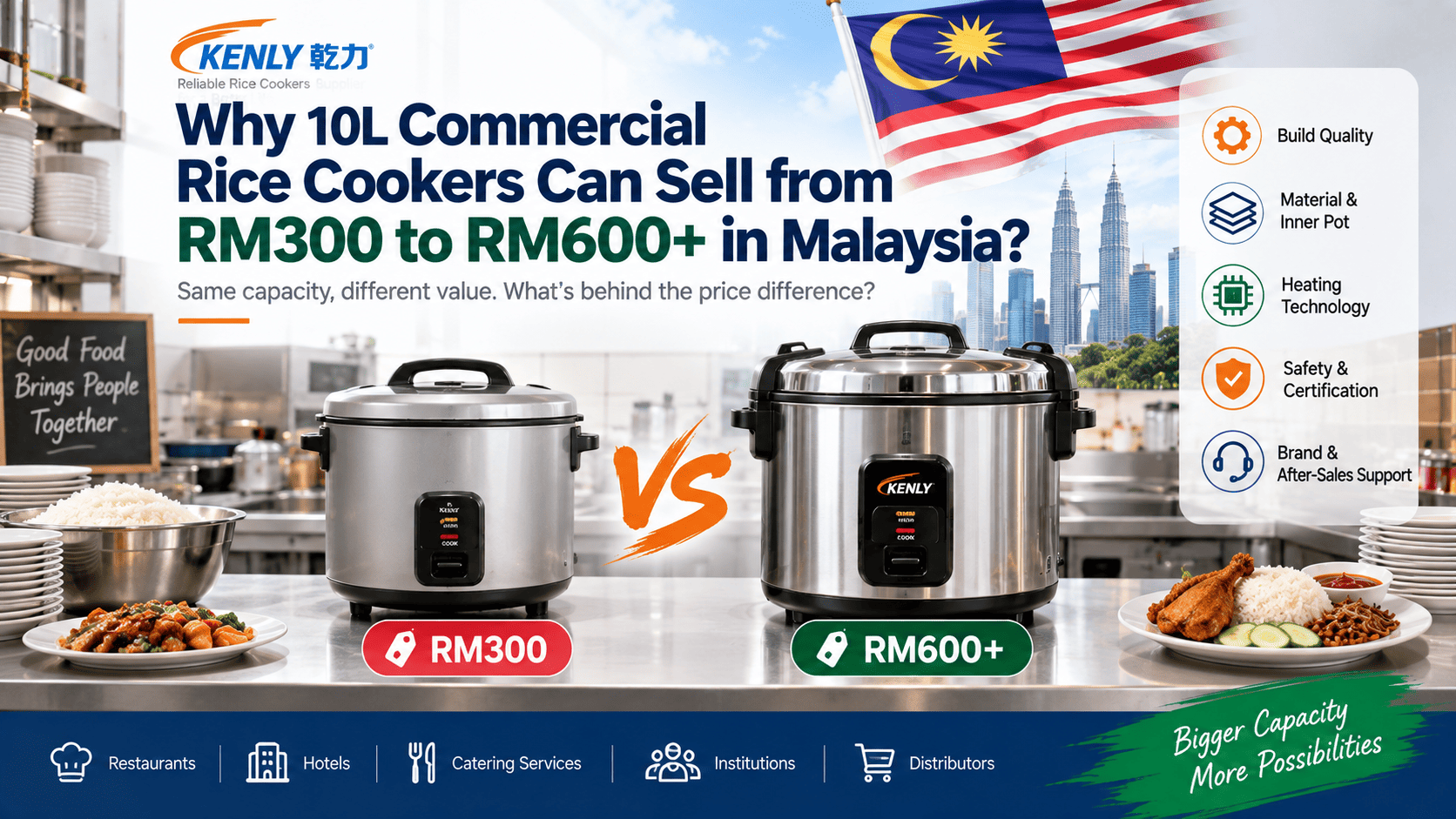
10L commercial rice cookers sell from RM300 to RM600+ in Malaysia because different models use different heating structures, inner pot materials, insulation, control components, and thermal protection designs. Lower-priced units may suit light use, while higher-priced units are usually built for longer daily operation, repeated batches, and lower failure risk under commercial load.
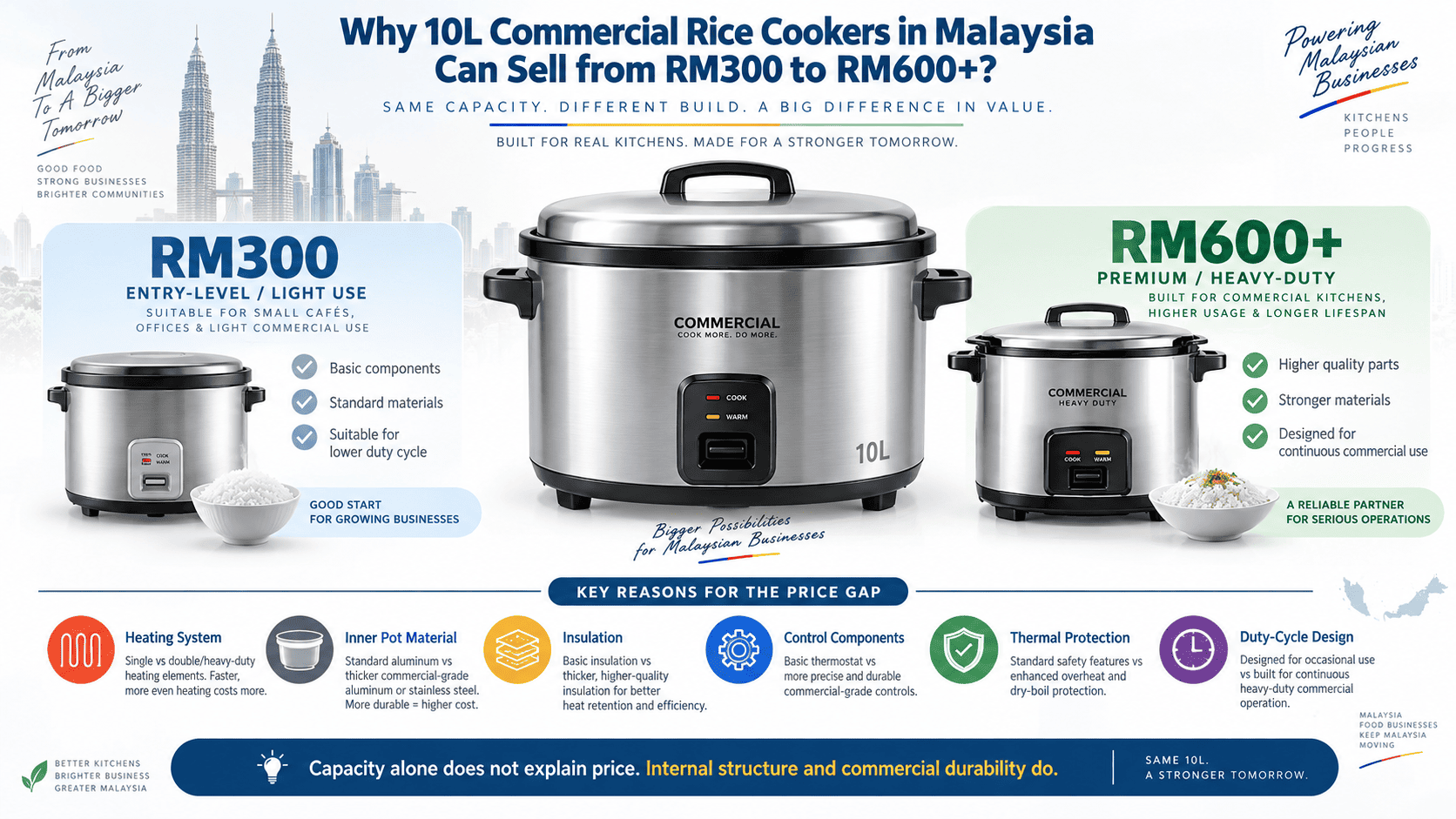
Many buyers first ask me, “What is your 10L price?” I understand why. Price matters. But after several RFQs, I have learned that the better question is, “What configuration supports my actual cooking load?” That question changes the buying decision completely.
Why Do 10L Commercial Rice Cookers Have Such Different Heating Systems?
Many Malaysian buyers assume 10L commercial rice cookers are only larger versions of household cookers. That assumption creates risk. A bigger body does not automatically mean stronger heat recovery, better temperature stability, or safer continuous operation1 during busy lunch and dinner cycles.
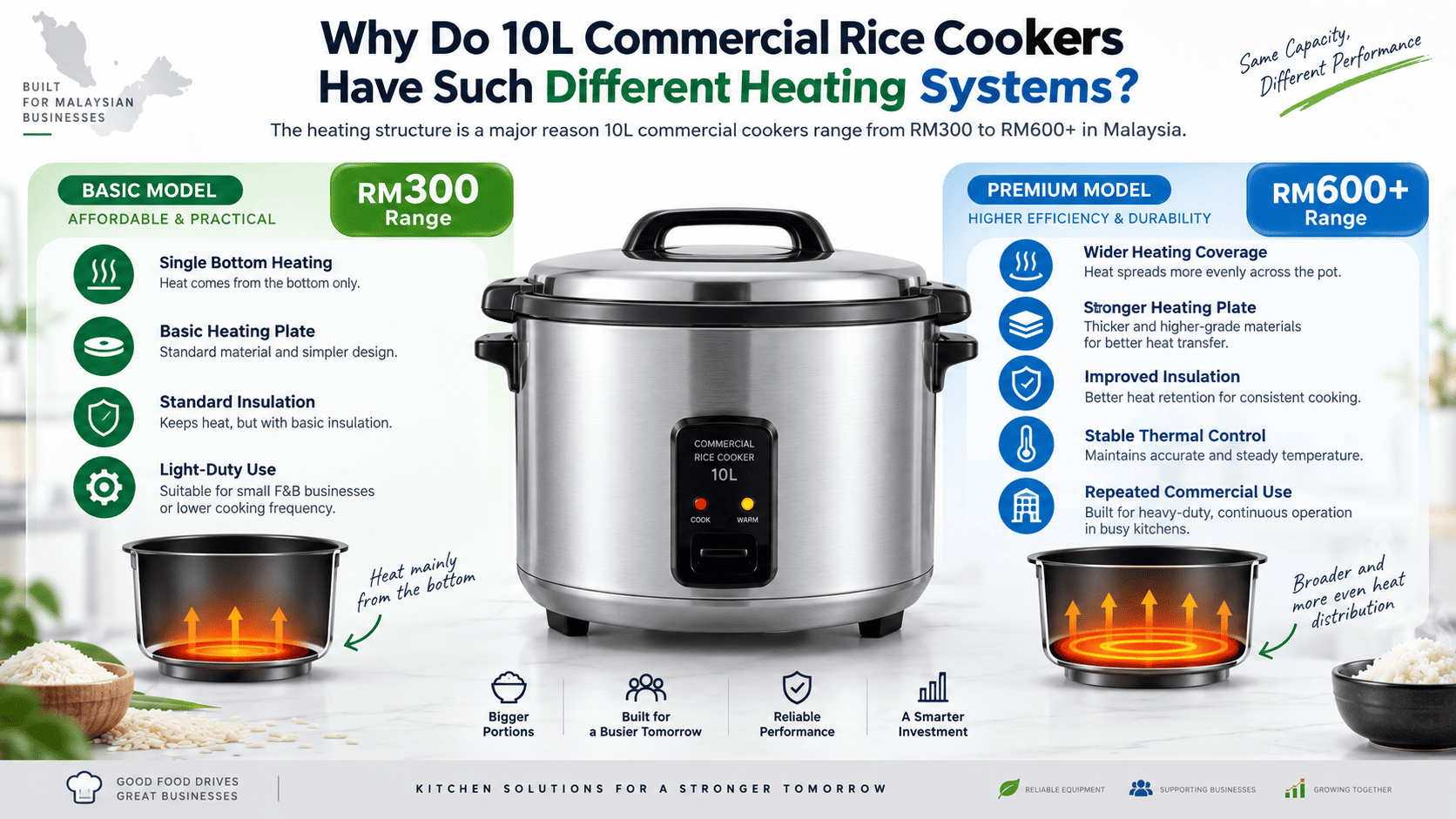
The heating system is one of the biggest reasons 10L commercial rice cookers vary from RM300 to RM600+. Basic models often use single bottom heating2, while higher-priced models may add wider heating coverage, stronger heating plates, improved insulation, and more stable thermal control for repeated commercial use.
Bottom Heating vs. Wider Heat Coverage
A basic commercial rice cooker normally depends on a bottom heating plate. This design can work well for light commercial use, especially when the operator cooks one or two batches per day and gives the appliance enough rest time. The cost is lower because the structure is simpler.
However, commercial kitchens often use rice cookers differently. A small restaurant may cook rice in the morning, refill before lunch, and cook again before dinner. A catering operator may need several consecutive batches. In that case, the cooker must recover heat quickly and distribute it more evenly.
A higher-priced unit may include:
- Thicker or stronger bottom heating plate
- Wider heat transfer area
- Wrap-around or assisted side heating design
- Improved insulation to reduce heat loss
- More stable thermostat and thermal cutoff components
These parts are not decorative. They affect how the cooker behaves after repeated use.
Why Heat Recovery Matters
When a cooker finishes one batch, the internal components remain hot. If the next batch starts immediately, the unit must manage stored heat, fresh water, and a heavy rice load. Cheaper models may still work, but they may reach thermal limits sooner.
A procurement manager should ask:
- Can the unit handle 6+ consecutive batches?
- Can it operate 8+ hours daily in a restaurant environment?
- Does the supplier define the intended duty cycle?
- What thermal protection design is used?
- What happens if staff start another batch before the unit cools down?
I often see buyers focus on wattage only. Wattage matters, but wattage alone does not explain heating stability3. Two cookers may show similar rated power, but the one with better heat transfer, insulation, and protection design can behave very differently under load.
The real question is not only “How fast can it cook?”
The real question is “How stable is it after repeated commercial use?”
Heating Design and Price Tier
| Price Range in Malaysia | Typical Heating Structure | Suitable Use Case | Main Procurement Risk |
|---|---|---|---|
| RM300–RM400 | Basic bottom heating | Light shop use, low daily batch count | Slower recovery under repeated use |
| RM400–RM500 | Stronger bottom heating or assisted heat coverage | Medium restaurant use | Needs configuration confirmation |
| RM500–RM600+ | Heavy-duty heating structure with better heat management | High-volume kitchens, distributors, chains | Higher upfront approval needed |
This does not mean RM300 units are bad. It means buyers should match them to the right use case. A low-volume stall may not need the same configuration as a chain operator. But a distributor selling into restaurants may avoid very low-end units because after-sales returns can damage reputation faster than a small margin can help profit.
How Do Inner Pot Materials Push the Price from RM300 to RM600+?
A 10L rice cooker’s inner pot looks simple, so buyers sometimes treat it as a minor accessory. That is a mistake. The pot controls heat transfer, rice texture consistency, coating life, and user complaints.4 A thin pot can save cost upfront but raise replacement and warranty pressure later.
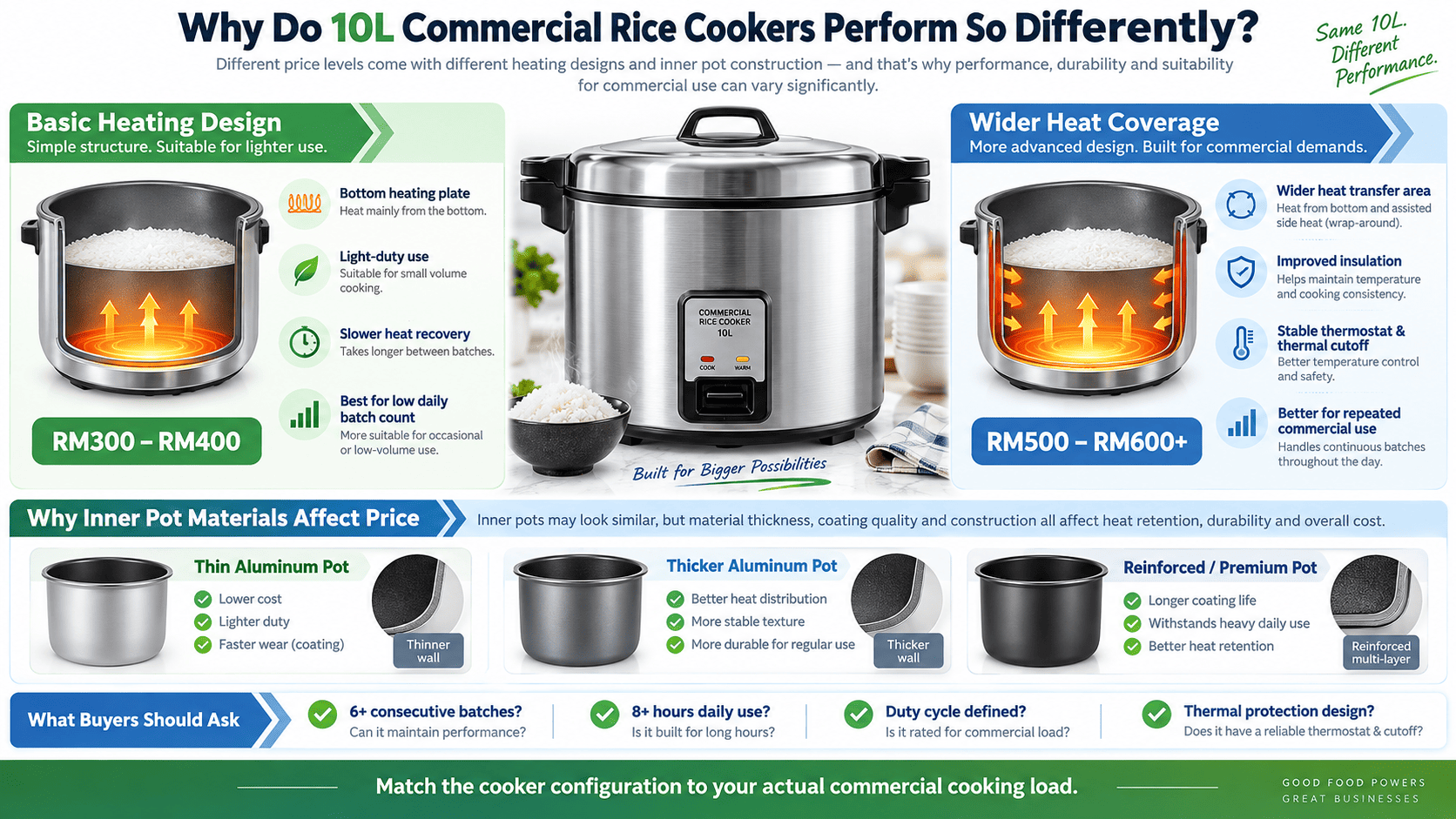
Inner pot material, thickness, coating, and bottom structure strongly affect the price of 10L commercial rice cookers. Lower-priced models often use thinner aluminum pots, while higher tiers may use thicker aluminum, reinforced coatings, stainless steel, or composite structures designed for repeated washing and heavy daily cooking.
The Pot Is Part of the Heating System
Many buyers separate the cooker body from the inner pot when they compare quotations. In real use, those two parts work together. Heat moves from the plate into the pot, then from the pot into water and rice. If the pot is too thin, heat may concentrate in certain areas.5 If the coating is weak, rice may stick sooner. If the base does not contact the heating plate well, cooking time and texture may vary.
Common inner pot options include:
-
Thin aluminum pot
Lower cost, lighter weight, suitable for lighter use. -
Thicker aluminum pot
Better heat distribution and stronger feel, usually higher cost. -
Non-stick coated pot
Easier cleaning, but coating quality and thickness matter6. -
Stainless steel pot
Stronger surface for some users, but heating behavior differs from aluminum7. -
Composite or reinforced bottom pot
Designed to improve heating contact and reduce deformation risk.
What Buyers Ask vs. What They Should Ask
In RFQs, buyers often ask:
- “Is it non-stick?”
- “How many liters?”
- “What is the price?”
- “Can you print our brand?”
Those are valid questions. But I usually recommend adding more practical questions:
- What is the pot thickness?
- What material is used for the pot body?
- What coating type and coating thickness are used?
- Is the pot bottom flat after repeated heating?
- Can spare inner pots be supplied for after-sales service?
- How is pot quality checked before shipment?
The spare pot question is especially important for distributors. A cooker may be accepted by the market, but if replacement pots are hard to source, small complaints become bigger service problems.
Inner Pot Choices by Buyer Type
| Buyer Type | Typical Priority | Recommended Pot Focus |
|---|---|---|
| Small eatery | Low upfront cost | Pot that is easy to clean and available as spare part |
| Restaurant group | Daily repeat cooking | Thicker pot with stable heating contact |
| Distributor | Low return rate | Coating consistency and replacement pot supply |
| Chain operator | Lifecycle cost | Stronger pot structure and documented specification |
Why Thickness Changes Cost
Pot thickness sounds like a small detail, but it affects material cost, forming process, transport weight, and quality control. A thicker pot uses more raw material. It may require more careful forming to maintain shape.8 It also needs checking for surface defects and bottom contact.
If a buyer compares only “10L rice cooker” against “10L rice cooker,” the cheaper offer may look attractive. But if one pot is thinner and another is reinforced, the comparison is not equal.
I do not recommend choosing the thickest pot automatically. A buyer should match the pot to expected use. But I do recommend asking for the specification in writing. If a supplier changes pot material or coating without notice, the distributor carries the market risk. Clear specifications reduce that risk.
Can 10L Commercial Rice Cookers Handle 6+ Consecutive Batches?
Some 10L commercial rice cookers can handle repeated batches, but not every model is designed for that workload. This is where procurement mistakes happen. A unit may pass a simple cooking demonstration, yet still struggle when staff use it continuously during peak service hours.
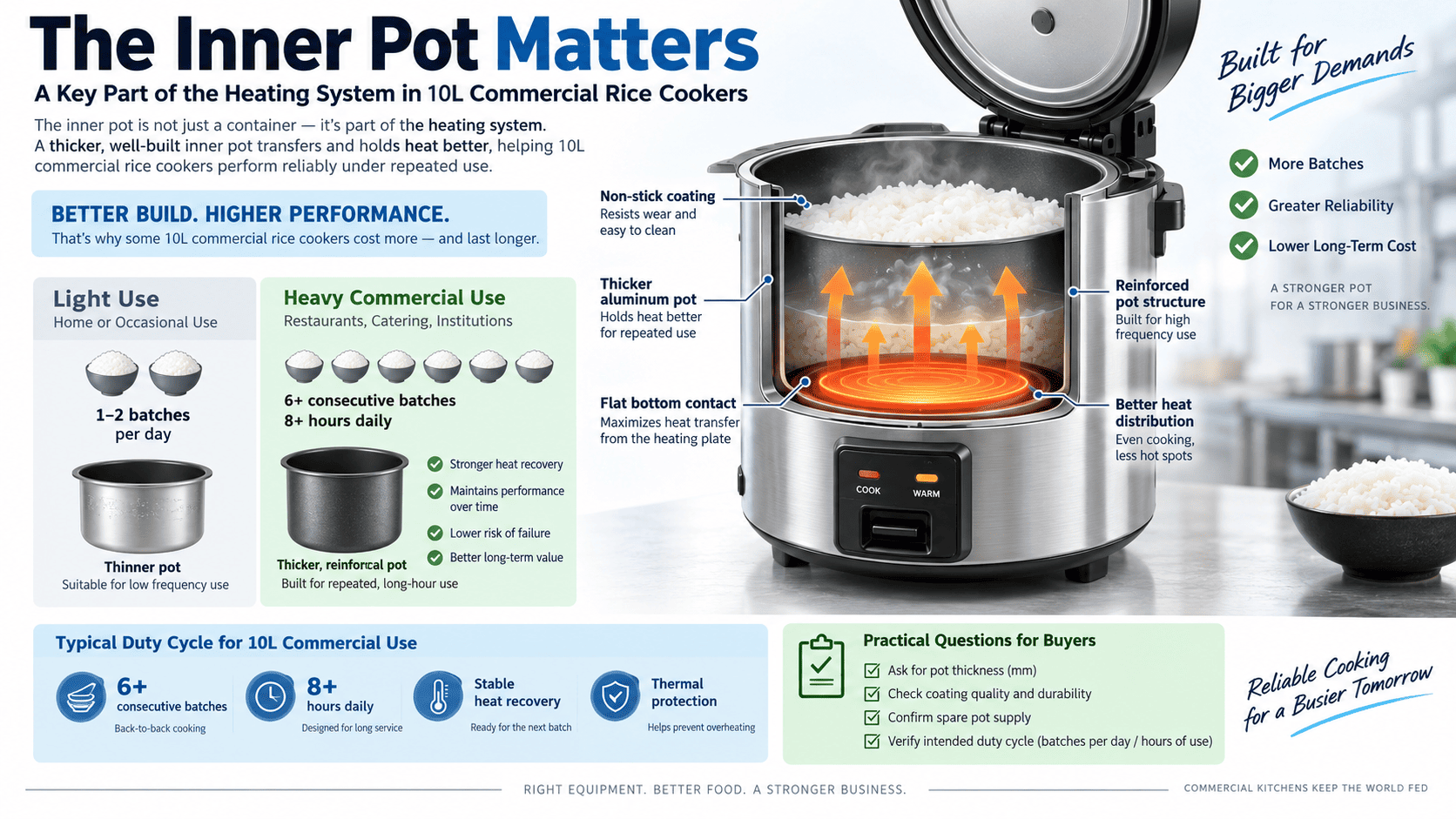
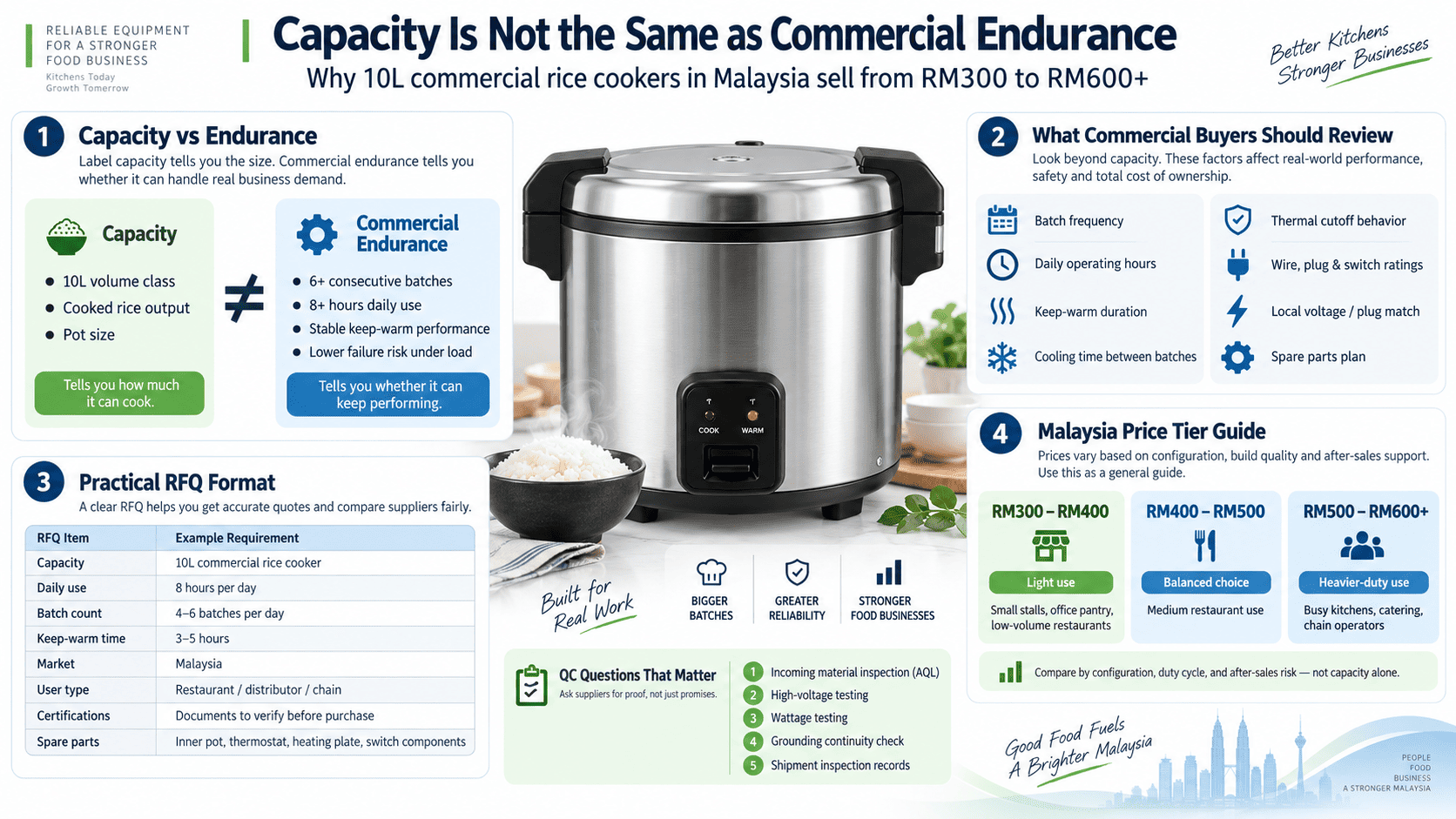
10L commercial rice cookers should be evaluated by duty cycle, not capacity alone. Buyers should confirm whether the unit can cook 6+ consecutive batches, operate 8+ hours daily, and recover safely after each cycle without frequent thermal shutdown, unstable cooking, or accelerated component wear.
Capacity Is Not the Same as Commercial Endurance9
A 10L label tells you the volume class. It does not tell you how the product behaves under real kitchen pressure. In a commercial setting, staff may not follow ideal operating conditions. They may start the next batch quickly. They may use the cooker near steam, oil, and heat sources. They may clean the pot roughly. They may keep rice warm for long periods.
That is why I separate capacity from endurance.
A commercial buyer should review:
- Batch frequency
- Daily operating hours
- Keep-warm duration
- Cooling time between batches
- Thermal cutoff behavior
- Wire, plug, and switch component ratings
- Local voltage and plug requirements
- Spare parts plan
Thermal Protection Is Not a Weakness
Some buyers become worried when I mention thermal protection. They think shutdown means poor quality. In reality, thermal protection is necessary. It protects the appliance and reduces safety risk when the product is overheated, misused, or operated beyond its intended duty cycle.
The procurement question is not, “Does it have protection?”
The better question is, “At what operating condition does protection activate?”
For example, a lighter configuration may be acceptable for:
- Small food stalls
- Office pantry use
- Low-volume restaurants
- Backup cooking
A stronger configuration may be needed for:
- Busy lunch shops
- Catering kitchens
- Chain restaurants
- Distributors selling to unknown end users
- Buyers who need lower return rates
How to Ask Suppliers About Duty Cycle
A clear RFQ should not only say “10L commercial rice cooker.” It should include expected usage.
Here is a practical format:
| RFQ Item | Example Requirement |
|---|---|
| Capacity | 10L commercial rice cooker |
| Daily use | 8 hours per day |
| Batch count | 4–6 batches per day |
| Keep-warm time | 3–5 hours |
| Market | Malaysia |
| User type | Restaurant / distributor / chain |
| Certifications | Documents to verify before purchase |
| Spare parts | Inner pot, thermostat, heating plate, switch components |
This simple table helps suppliers recommend a suitable configuration instead of quoting the cheapest model.
QC Questions That Matter
For procurement evaluation, I would ask suppliers about quality control in practical terms:
- Is there incoming material inspection based on AQL standard10?
- Is high-voltage testing performed on finished units?
- Is wattage testing performed?
- Is grounding continuity checked?
- Is finished product random inspection documented?
- Can the supplier provide inspection records for the shipment?
These checks do not replace local regulatory review or professional technical evaluation. But they help buyers separate serious factories from suppliers that only compete on low price.
For Malaysian import and distribution, buyers should also verify applicable electrical compliance, labeling, plug requirements, and documentation11 with qualified local professionals or authorities. Certificates should be treated as documents to check, not marketing slogans to accept without review.
How Should Malaysian Buyers Compare 10L Commercial Rice Cookers by Price Tier?
Price pressure is real in Malaysia, especially when buyers serve price-sensitive restaurants. But a low first cost can become expensive if the cooker fails during peak season or creates high return rates. A good comparison connects price tier to actual cooking load and after-sales risk.
Malaysian buyers should compare 10L commercial rice cookers by configuration, not by listed capacity alone. RM300–RM400 models can suit light use, RM400–RM500 models often balance cost and endurance, and RM500–RM600+ models usually target heavier daily operation, stronger pot structures, and lower service risk.
The RM300–RM400 Tier
This tier often attracts small eateries and first-time importers. The main advantage is obvious: low upfront cost. If the buyer needs a basic cooker for limited daily use, this range may be reasonable.
Typical characteristics may include:
- Single bottom heating
- Thin aluminum inner pot
- Basic keep-warm control
- Simpler body structure
- Lower spare-part cost
The risk appears when the unit is sold or used as if it were a heavy-duty machine. If a restaurant runs repeated batches every day, the lower price may be offset by replacement cost, downtime, and customer complaints.
The RM400–RM500 Tier
This middle range is often where practical buyers spend the most time. It may include better heating coverage, improved pot coating, stronger housing, or more stable control components.
This tier can fit:
- Medium restaurants
- Rice-focused food operators
- Distributors seeking fewer returns
- Buyers who need a balance between price and operating confidence
When I discuss this range with buyers, I usually suggest checking exactly which component has been upgraded. The supplier should not only say “better model.” The quotation should show what is different.
Useful comparison points include:
| Component | Basic Question | Why It Matters |
|---|---|---|
| Heating plate | Is it standard or strengthened? | Affects recovery and batch stability |
| Inner pot | What thickness and coating? | Affects sticking, cleaning, and lifespan |
| Thermostat | What control design is used? | Affects shutdown and keep-warm behavior |
| Wiring | Is it rated for commercial load? | Affects safety and reliability |
| Spare parts | Are parts available? | Affects after-sales cost |
The RM500–RM600+ Tier
The upper tier is usually not about smart features. In many cases, the cost is in the structure. Buyers may pay for heavier heating design, stronger inner pot, better insulation, improved controls, and more consistent production requirements.
This tier may make sense for:
- Chain operators
- High-volume restaurants
- Catering suppliers
- Distributors protecting brand reputation
- Buyers with strict return-rate targets
However, a higher price does not automatically mean the best match. A buyer should still verify the actual bill of materials, sample performance, compliance documents, packaging, and shipment quality. I have seen buyers assume a premium-looking shell means stronger internals. That assumption is risky.
A Practical Decision Framework
I recommend using a simple three-step decision framework:
-
Define the workload
Ask how many batches the user cooks per day and how long the cooker stays warm. -
Match configuration to workload
Choose heating, pot, and control components based on use, not only budget. -
Verify supplier consistency
Confirm that mass production will match the approved sample and written specification.
For procurement managers, this framework helps justify a higher price to management. The argument is not “we want a more expensive cooker.” The argument is “we need a configuration that reduces downtime, returns, and replacement cost.”
For distributors, the same logic protects reputation. A few ringgit saved per unit can disappear quickly if return rates rise after the selling season.
Frequently Asked Questions
Are RM300 10L commercial rice cookers bad?
No. RM300 models are not automatically bad. They may suit light commercial use, backup cooking, or buyers with strict first-cost limits. The risk appears when buyers expect them to handle long daily operation, repeated batches, or heavy restaurant use without confirming the configuration.
Is a RM600+ 10L commercial rice cooker always worth it?
Not always. A RM600+ model should still be evaluated by heating structure, pot material, thermal protection, compliance documents, and spare-part support. The higher price is easier to justify when the cooker will face heavy daily use or when after-sales returns are costly.
What should I ask before buying 10L commercial rice cookers for Malaysia?
You should ask about heating design, inner pot thickness, coating type, duty cycle, thermal protection, plug requirements, inspection process, spare parts, packaging, and shipment lead time. You should also verify applicable Malaysia compliance requirements with qualified local professionals before importing or distributing.
Why do distributors avoid the cheapest commercial rice cooker models?
Distributors often consider return rate, customer complaints, warranty handling, and brand reputation. A very low-cost model may be profitable per unit, but it can become expensive if end users operate it heavily and return it during peak sales periods.
Can one 10L commercial rice cooker model serve all restaurant buyers?
No. Different users have different cooking patterns. A small eatery, catering kitchen, chain restaurant, and distributor need different risk levels. The best model depends on batch frequency, daily operating hours, keep-warm time, and the buyer’s tolerance for service claims.
Conclusion
10L commercial rice cookers sell from RM300 to RM600+ in Malaysia because the internal configuration changes the real use case. Heating coverage, inner pot thickness, coating, insulation, thermal protection, QC control, and spare-part support all affect price and lifecycle cost. I suggest that buyers compare workload first, then match the configuration to that workload. If you are sourcing for distribution or restaurant supply, prepare your duty-cycle requirements before requesting quotations so suppliers can recommend the right model instead of only the lowest price.
"Functional Materials and Innovative Strategies for Wearable ...", https://pmc.ncbi.nlm.nih.gov/articles/PMC10310690/. Heat-transfer teaching materials describe temperature recovery and stability as outcomes of heat-transfer pathways, thermal mass, insulation, and control response; this supports the article's engineering rationale, although it does not evaluate the specific 10L rice cooker models discussed. Evidence role: mechanism; source type: education. Supports: Heat recovery and temperature stability are functions of heat-transfer area, thermal mass, insulation, and control response, not only container volume.. Scope note: Contextual support only; it explains the mechanism but does not test Malaysian commercial rice cookers. ↩
"Rice cooker", https://en.wikipedia.org/wiki/Rice_cooker. General technical descriptions of electric rice cookers identify the bottom heating element or plate as a common heat source beneath the inner pan; this supports the design description, without establishing how frequently this design appears in each Malaysian price tier. Evidence role: definition; source type: encyclopedia. Supports: Conventional electric rice cookers commonly use a heating element or plate beneath the inner cooking pan.. Scope note: Contextual support only; it supports the design concept rather than the price-tier distribution. ↩
"Energy Efficient Process Heating: Insulation and Thermal ...", https://ecommons.udayton.edu/cgi/viewcontent.cgi?article=1161&context=mee_fac_pub. Heat-transfer references explain that a system's thermal response depends on power input, heat losses, thermal mass, and material properties; therefore rated wattage alone is not a complete measure of heating stability. Evidence role: mechanism; source type: education. Supports: Thermal performance depends on power input together with heat losses, thermal mass, material properties, and control response.. ↩
"Influence of heating temperature and time on mechanical ...", https://pmc.ncbi.nlm.nih.gov/articles/PMC11324993/. Studies of rice cooking and cookware materials report that heat-transfer conditions and surface properties can affect cooked rice quality and coating durability; this supports the technical basis of the claim, although it does not directly measure customer complaint rates for the products discussed. Evidence role: general_support; source type: paper. Supports: Cooking vessel heat transfer and surface properties can influence rice cooking quality and coating durability.. Scope note: The source would support the technical mechanism, not the article's specific assertion about user complaints. ↩
"Thermal conduction", https://en.wikipedia.org/wiki/Thermal_conduction. Heat-conduction references show that temperature gradients and heat spreading depend on material thickness and thermal conductivity; this supports the claim that a very thin pot may be more prone to localized heating. Evidence role: mechanism; source type: education. Supports: Material thickness and thermal conductivity influence temperature gradients and heat spreading in cookware or similar conductive systems.. ↩
"Influence of heating temperature and time on mechanical ...", https://pmc.ncbi.nlm.nih.gov/articles/PMC11324993/. Research on polymer and non-stick coatings reports that coating thickness, adhesion, and surface quality influence abrasion resistance and service life; this supports the article's statement that coating quality and thickness matter. Evidence role: mechanism; source type: paper. Supports: Coating thickness, adhesion, and material quality affect non-stick coating wear and durability.. ↩
"Material Properties: 304 Stainless (UNS S30400)", https://trc.nist.gov/cryogenics/materials/304Stainless/304Stainless_rev.htm. Material-property tables from technical institutions list aluminum as having much higher thermal conductivity than common stainless steels; this supports the claim that stainless steel and aluminum pots heat differently. Evidence role: mechanism; source type: institution. Supports: Aluminum and stainless steel have substantially different thermal conductivity values, which affects heat distribution in cookware.. ↩
"11 Ways to Cut Sheet Metal Fabrication Costs", https://www.protolabs.com/resources/design-tips/11-ways-to-cut-sheet-metal-fabrication-costs/. Manufacturing references on sheet-metal forming explain that increased thickness raises material volume and influences forming force, springback, and dimensional control; this supports the article's explanation of why thicker pots can cost more. Evidence role: mechanism; source type: education. Supports: Thicker sheet metal uses more material and can affect forming forces, springback, and dimensional control.. ↩
"Duty cycle", https://en.wikipedia.org/wiki/Duty_cycle. Technical standards and appliance-rating guidance distinguish product capacity from operating conditions such as duty cycle, continuous operation, and intermittent use; this supports the article's distinction between 10L capacity and commercial endurance. Evidence role: definition; source type: institution. Supports: Equipment ratings often distinguish capacity from operating conditions such as duty cycle, continuous operation, and intermittent use.. Scope note: Contextual support only; it defines the rating concept but does not certify any specific rice cooker's endurance. ↩
"Acceptable Quality Limit, AQL", https://www.qima.com/aql-acceptable-quality-limit. Acceptance-sampling standards such as ISO 2859 define AQL as an acceptance quality limit used to plan sampling inspections; this supports the article's reference to AQL-based incoming material inspection. Evidence role: definition; source type: institution. Supports: AQL is an acceptance-sampling concept used in standardized inspection systems such as ISO 2859 or ANSI/ASQ Z1.4.. ↩
"Electrical", https://asean.org/wp-content/uploads/2012/10/Guideline_for_Approval_of_Electrical_Equipment_2018.pdf. Guidance from Malaysian electrical authorities describes approval, labeling, documentation, and conformity requirements for regulated electrical equipment; this supports the article's instruction to verify compliance before importing or distributing rice cookers in Malaysia. Evidence role: general_support; source type: government. Supports: Malaysian electrical appliance rules require applicable approval, labeling, documentation, and conformity checks for regulated electrical products.. Scope note: The exact obligations may depend on product classification and current Malaysian regulations. ↩