Your supplier's quote says "non-stick inner pot." But you know a bad batch can damage your brand. Here's how to ensure you get what you pay for.
A non-stick inner pot's quality is defined by its base material, thickness, coating type, and application process1. As a buyer, you must specify these details with your supplier. This helps you manage costs, ensure consistent quality, and reduce after-sales risks like customer complaints.
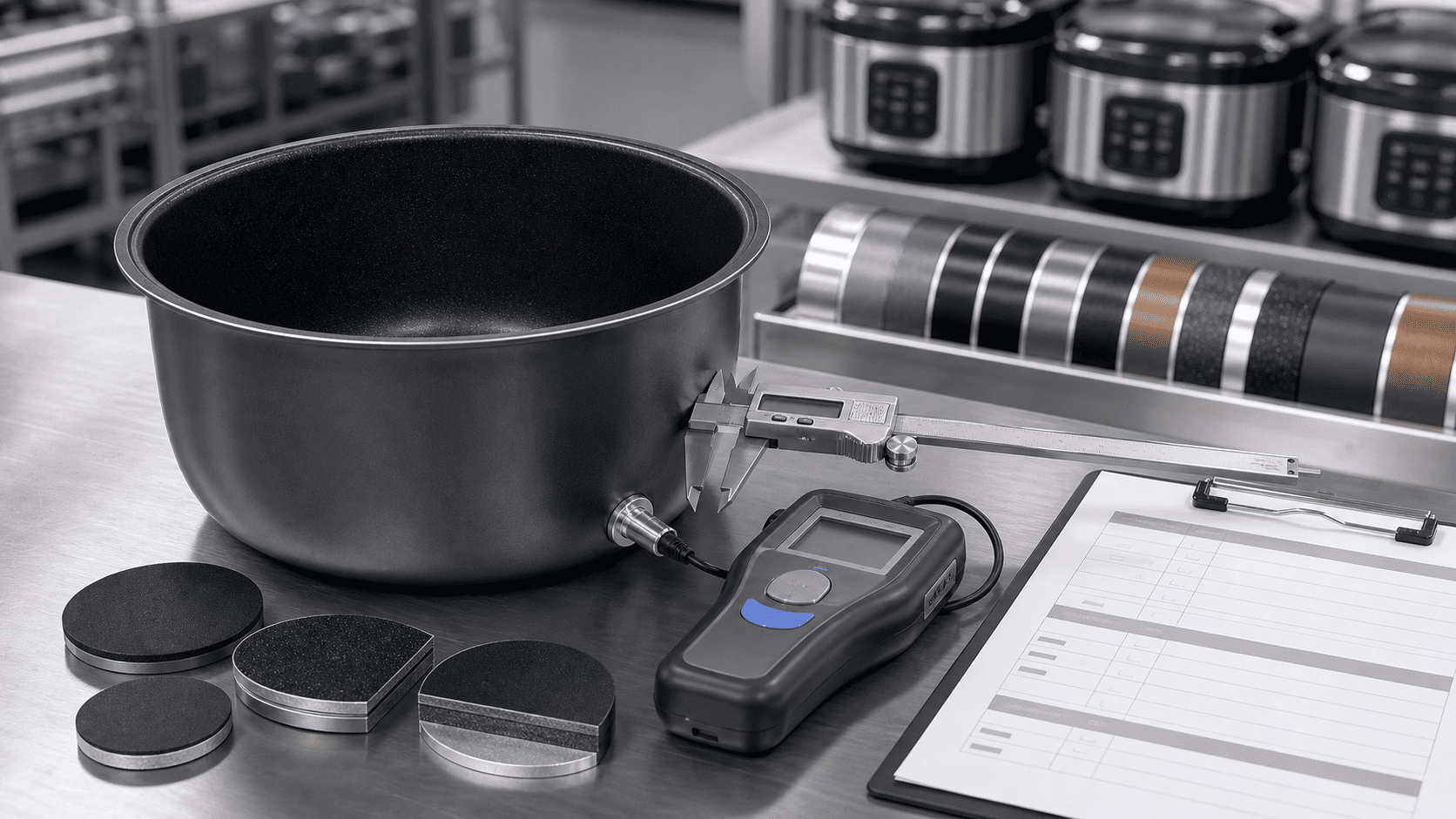
In my 15 years of making rice cookers, I've seen many buyers start with one simple question: "Is the inner pot non-stick?" This is a good starting point, but it's not the end of the conversation. The real work is in defining what "non-stick" means for your product, your brand, and your customers. A low price on a quote can be tempting, but if that pot scratches easily or the coating fails, the cost of returns and warranty claims will erase those initial savings. Let's break down what you really need to ask to protect your business.
Aren't All Non-Stick Coatings Basically the Same?
You approved a great sample, but you worry the mass production batch won't be the same. A cheaper coating could lead to bad reviews. Here's what to check.
No, coatings vary widely in material, layers, and application process. These details directly affect durability, performance, and cost. You must specify the coating type and layers to prevent quality issues and protect your brand's reputation with customers.
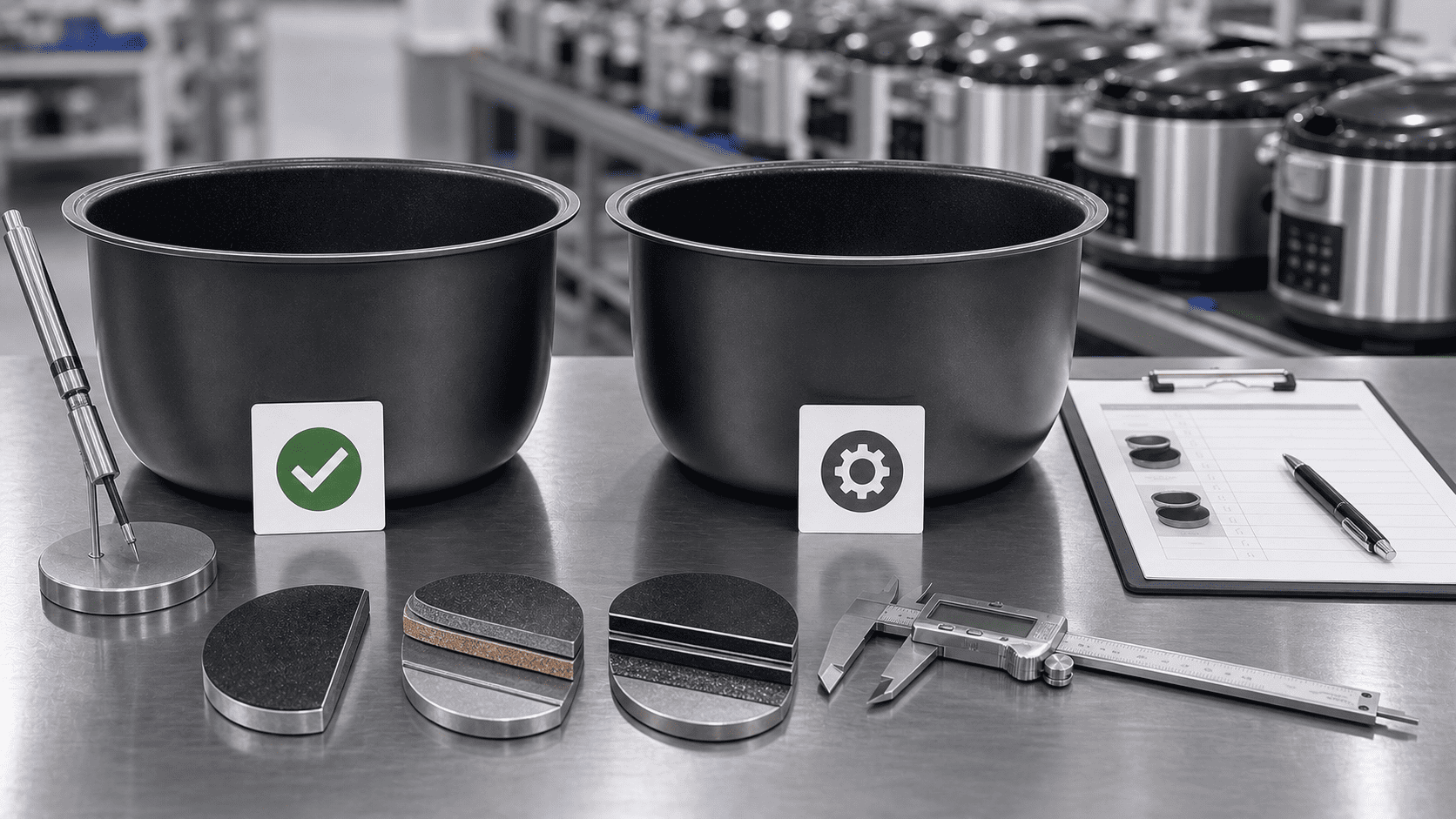
When I discuss specifications with procurement managers, I always emphasize that "non-stick" is a category, not a single item. Assuming all coatings are the same is a common mistake that can lead to problems down the line. The performance and durability of the inner pot depend on a combination of factors that you, the buyer, should define.
Break Down the Specification
Instead of just asking for a non-stick pot, you need to discuss the specific components with your manufacturer. This turns a vague feature into a clear technical specification.
- Base Material: The metal pot underneath the coating is the foundation. Aluminum is common because it heats up quickly and evenly2. Its thickness is also important; a thicker pot is more durable and less likely to warp.
- Coating System: Non-stick coatings are not just one layer. They are often a system of primers and top coats. A simple, single-layer coating might be cheaper but is less durable. A double-layer system usually offers better longevity.
- Coating Material: The most common material is PTFE3. You may also see ceramic coatings4. Each has different performance characteristics and cost implications.
Here is a simple table to help guide your conversation with a supplier:
| Feature | What to Ask Your Supplier | Why It Matters |
|---|---|---|
| Base Material | What is the aluminum alloy and thickness (in mm)? | Durability, heat distribution, dent resistance |
| Coating Type | Is this a single or double-layer coating system? | Longevity and abrasion resistance |
| Application | Is the coating sprayed or rolled on? | Adhesion and evenness of the coating |
By asking these questions, you show the supplier that you understand quality and are serious about getting a consistent product.
How Can a Low Price Hide Higher Costs?
That low unit price looks great on paper. But what happens if it leads to high return rates and warranty claims? Let's connect the unit price to your total cost.
A cheap non-stick pot that scratches or peels leads to customer returns, warranty claims, and brand damage. The true cost includes these after-sales expenses5, which can quickly outweigh any savings you made on the initial purchase price.
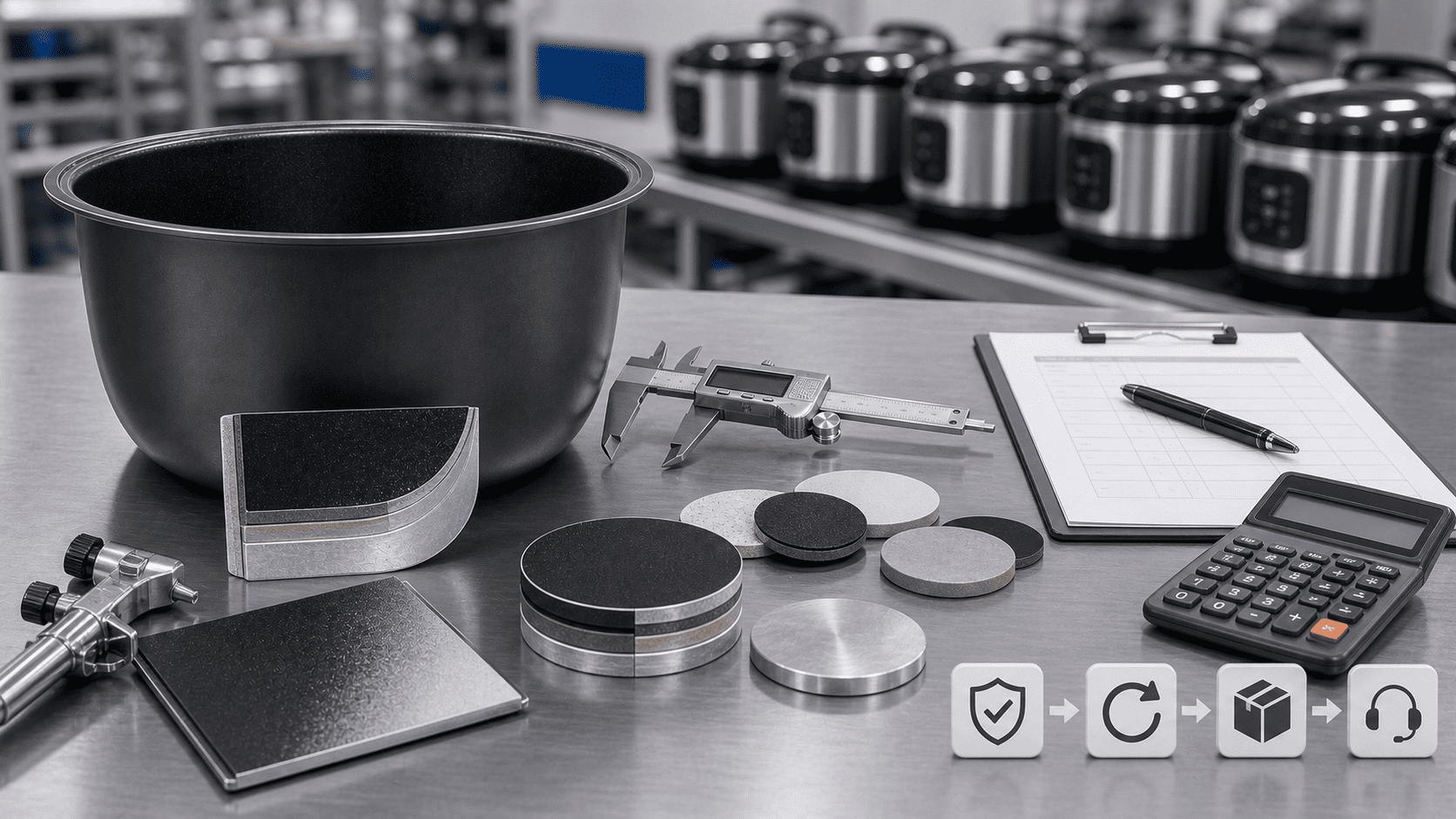
Many times, a buyer will push for the lowest possible price. I understand the pressure to control costs. However, with non-stick inner pots, the unit price is only part of the story. A pot that costs $0.20 less might seem like a win, but it can cost you much more in the long run.
The True Cost of a "Cheap" Pot
Let’s think about the journey of a low-quality inner pot.
- Initial Purchase: You save $0.20 per unit, which looks like a victory for your department.
- Customer Use: After a few weeks of use with plastic or wooden utensils, your customer notices scratches. Food starts sticking.
- Customer Complaint: The customer is unhappy. They either leave a negative online review, contact your support team, or return the product to the retailer.
- The Ripple Effect:
- Returns: The retailer sends the product back to you. You now have shipping costs and administrative work.
- Warranty Claims: You have to send the customer a replacement inner pot or a whole new rice cooker, costing you parts, labor, and shipping.
- Brand Damage: Negative reviews tell other potential buyers to avoid your product6. Your brand reputation suffers.
- Channel Confidence: If retailers see a high return rate for your product, they may be less willing to give it good shelf space or order it again7 next season.
Suddenly, that $0.20 saving is gone. You've spent money on reverse logistics, replacement parts, and customer service labor. More importantly, you've lost customer trust. A good quality inner pot is an investment in your brand's reputation.
Why Isn't Approving a Sample Enough?
You approved a perfect sample. The pot felt solid and the coating was smooth. But the first mass production shipment arrives, and customers say the pots are different. What happened?
A sample only proves a supplier's capability; it does not guarantee mass production consistency8. Buyers must lock in the approved sample's key specifications—like pot thickness, weight, and coating feel—into the formal purchase order and quality control plan.
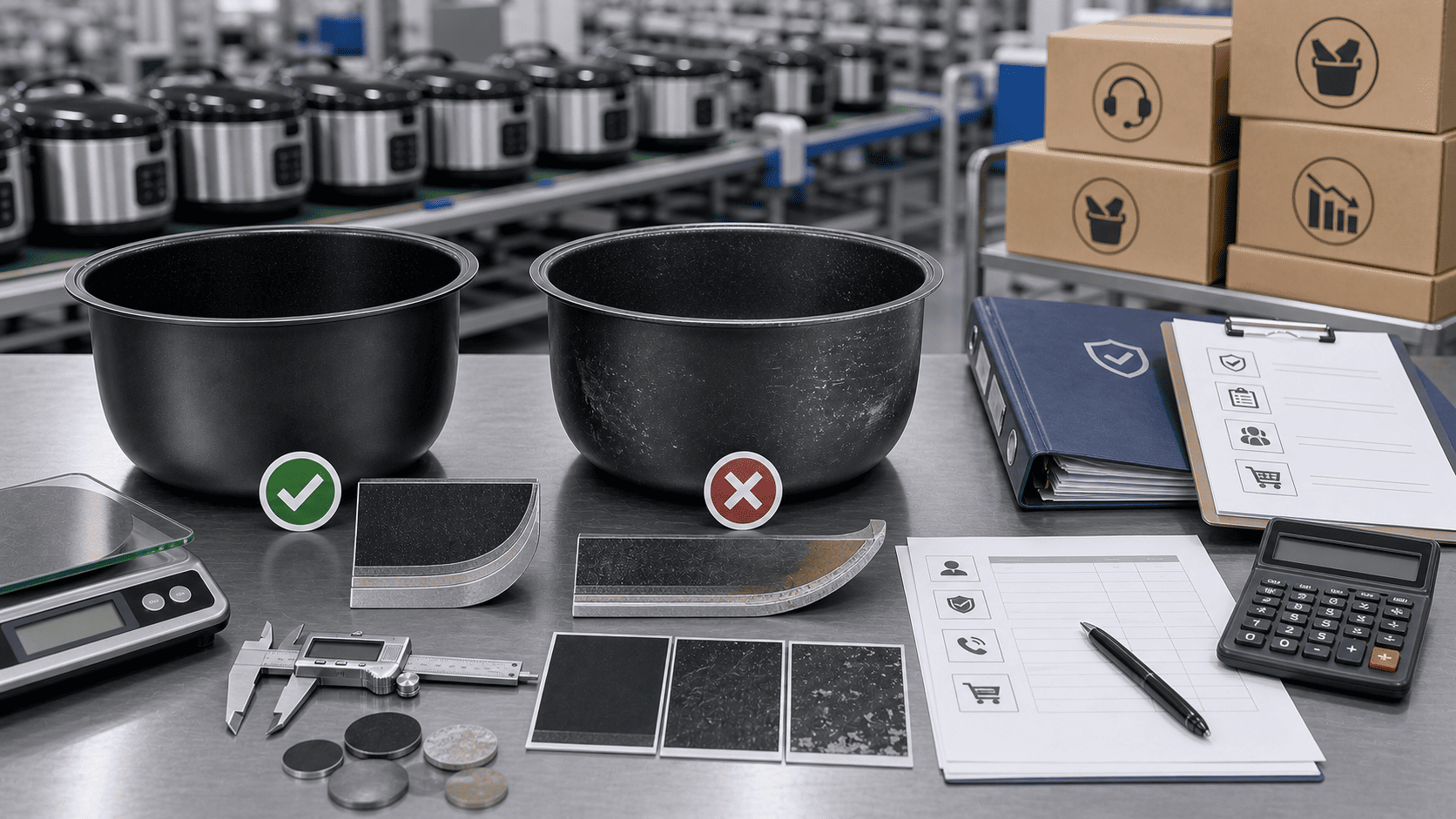
I often send samples to potential clients. When they approve the sample, they are approving a benchmark. But the most important step comes next: ensuring that every single one of the thousands of pots in your mass production order is the same as that benchmark. This is where many sourcing projects fail. The buyer approves the sample but doesn't formalize its characteristics.
From Benchmark to Binding Specification
Once you approve a sample inner pot, you need to document it with your supplier. Don't just rely on memory or a general feeling. Use tools to create objective data. This data becomes part of your contract.
Here’s a simple checklist I recommend to my clients:
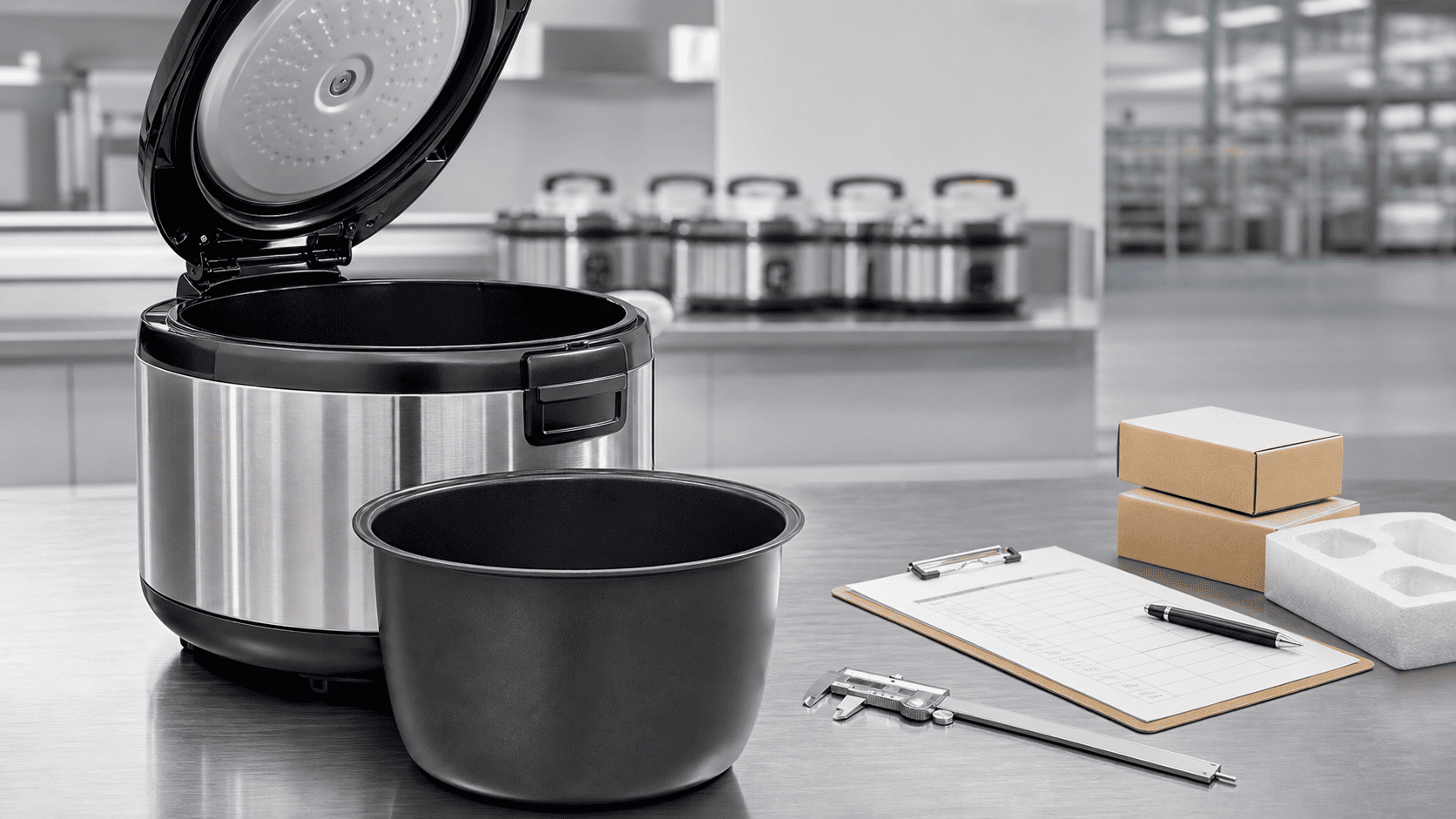
- 1. Weigh the Pot: Use a digital scale and record the weight in grams. A lighter pot in mass production could mean the supplier used thinner aluminum to save costs.
- 2. Measure the Thickness: Use digital calipers to measure the thickness of the pot's wall and base. Record these numbers in millimeters. This is a critical check for durability.
- 3. Document the Coating: Take clear photos. Note the color, the texture (is it smooth or slightly textured?), and the evenness. Check for any bumps, pits, or uneven areas on the sample and specify that these are defects.
- 4. Confirm the System: Get it in writing from the supplier that the mass-produced pots will use the exact same base material, coating material, and number of layers as the approved sample.
Put these numbers, photos, and descriptions into a formal document. Attach it to your purchase order. Now, your quality control team—whether it's your own staff or a third-party inspector—has objective standards to check against before the shipment leaves the factory. This changes "it doesn't feel right" to "the pot is 15 grams lighter than the approved spec."
How Do I Verify Quality and Compliance?
Your supplier says the coating is durable and safe. How can you be sure without just taking their word for it? Let's talk about how to verify their claims with documents.
Verify quality by requesting the supplier's internal test reports for durability, like abrasion test9s. Verify safety by asking for food-contact compliance reports from third-party labs (e.g., SGS, TUV). Always check that the company name and product details on the reports match.
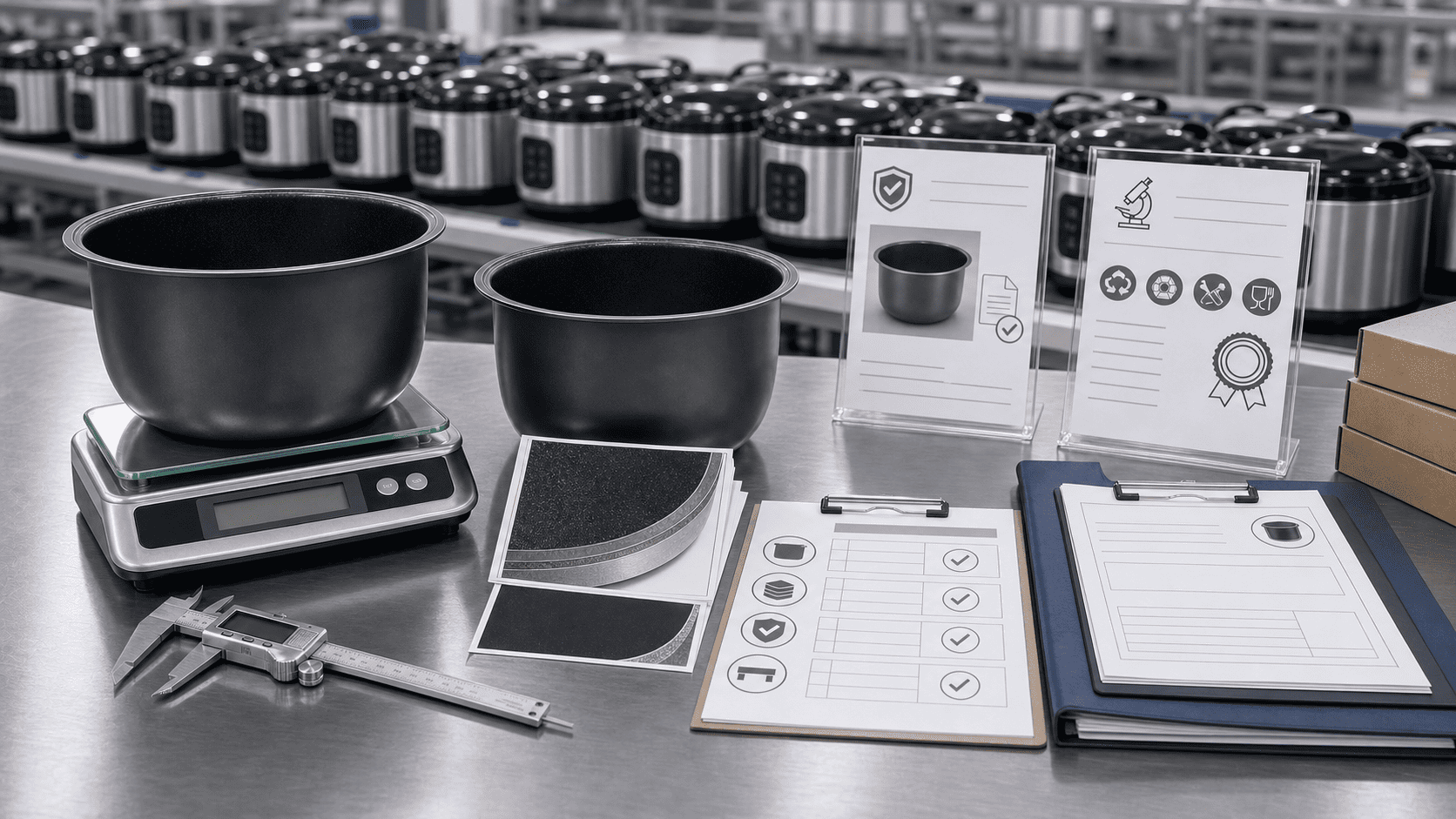
Trust is important in a supplier relationship, but verification is essential for protecting your business. As a manufacturer, we perform many tests and have our products certified. A good supplier will be transparent and share this documentation with you. You just need to know what to ask for and how to check it.
Separating Durability from Safety
It's helpful to think about verification in two parts: quality/durability and food-contact safety.
-
Quality & Durability Testing: These are often internal tests the factory performs. A common one for non-stick coatings is an abrasion test. In this test, a machine rubs the coating with a standardized pad (sometimes steel wool) for a set number of cycles. This simulates long-term use. Ask your supplier: "What durability tests do you perform on your non-stick pots? Can I see the procedure or report?" This shows them you are thinking about long-term performance.
-
Food-Contact Safety & Compliance: This is not optional. The materials that touch food must be certified as safe for your target market. These tests must be done by accredited third-party labs.
- Ask for the full test report, not just a certificate.
- Check the name of the applicant on the report. Does it match your supplier's company name?
- Check the product description. Does it accurately describe the rice cooker or inner pot you are buying?
- Check the date to ensure the report is still valid.
- Common standards include FDA (for the USA), LFGB (for Germany/EU), and DGCCRF (for France)10. Make sure the report is for the standard required in your country of sale.
A supplier who hesitates to provide these documents should be a red flag. A transparent partner will understand that providing these reports is a normal and necessary part of doing business.
Conclusion
Specifying the details of your non-stick inner pot is not an extra step. It is a critical part of managing quality, controlling total costs, and protecting your brand's reputation.
"Non-stick surface - Wikipedia", https://en.wikipedia.org/wiki/Non-stick_surface. Sources in materials science and cookware manufacturing confirm that the performance and durability of non-stick pots are determined by a combination of factors, including the thermal properties of the base material, its thickness (which affects heat retention and warp resistance), and the composition and application method of the non-stick coating. Evidence role: general_support; source type: education. Supports: The claim that the quality of non-stick cookware is determined by factors including the base metal, its thickness, and the type and application of the coating.. ↩
"What kind of pan conducts heat more evenly? : r/cookingforbeginners", https://www.reddit.com/r/cookingforbeginners/comments/19da371/what_kind_of_pan_conducts_heat_more_evenly/. Materials science resources note that aluminum is widely used in cookware due to its high thermal conductivity, which allows it to absorb and distribute heat rapidly and uniformly across the cooking surface. Evidence role: mechanism; source type: education. Supports: The claim that aluminum heats quickly and evenly.. ↩
"PTFE-coated non-stick cookware and toxicity concerns", https://pubmed.ncbi.nlm.nih.gov/28913736/. Polytetrafluoroethylene (PTFE), a synthetic fluoropolymer, is the most widely used material for non-stick coatings on cookware due to its very low coefficient of friction. Evidence role: definition; source type: encyclopedia. Supports: The claim that PTFE is the most common material for non-stick coatings.. ↩
"Non-stick surface - Wikipedia", https://en.wikipedia.org/wiki/Non-stick_surface. So-called 'ceramic' non-stick coatings are typically based on sol-gel technology, which creates a silica-based coating. These are marketed as an alternative to traditional PTFE-based coatings and are often noted for their different thermal properties and surface hardness. Evidence role: definition; source type: research. Supports: The claim that ceramic coatings are an alternative to PTFE and have different properties.. ↩
"Can Product Returns Make You Money?", https://sloanreview.mit.edu/article/can-product-returns-make-you-money/. The business concept of Total Cost of Ownership (TCO) assesses the full lifecycle cost of a product, which includes not only the initial purchase price but also post-sale expenses such as warranty claims, returns processing, customer support, and the financial impact of brand damage from poor quality. Evidence role: definition; source type: education. Supports: The claim that the total cost of a product includes post-purchase expenses.. ↩
"How Online Reviews Influence Sales - Spiegel Research Center", https://spiegel.medill.northwestern.edu/how-online-reviews-influence-sales/. Studies in marketing and consumer behavior have consistently shown that a high volume of negative online reviews correlates with decreased sales, as a majority of consumers consult reviews before making a purchase and are significantly influenced by the experiences of others. Evidence role: statistic; source type: research. Supports: The claim that negative reviews have a significant impact on consumer purchasing behavior.. ↩
"Return Policies Become a Balancing Act for Retailers", https://business.fiu.edu/business-now/2024/spring-2024/return-policies-become-a-balancing-act.html. Retail industry analysis indicates that high product return rates are a key concern for retailers, as they increase logistical costs and signal poor customer satisfaction. Consequently, products with consistently high returns risk being delisted or receiving less favorable shelf placement in future seasons. Evidence role: expert_consensus; source type: other. Supports: The claim that high return rates negatively affect a product's standing with retailers.. Scope note: The source is likely to be a trade publication or business journal rather than a peer-reviewed academic paper. ↩
"Production Part Approval Process (PPAP) - Quality-One", https://quality-one.com/ppap/. In manufacturing quality management, the approval of a 'golden sample' is only the first step. Formal systems like the Production Part Approval Process (PPAP) are used to ensure that the processes for mass production are capable of consistently reproducing the specifications of the approved sample. Evidence role: definition; source type: education. Supports: The claim that a sample's quality may not be replicated in mass production without specific controls.. ↩
"Cooking Without Limits with PPG's Non-Stick Coatings.", https://www.ppg.com/en-US/industrialcoatings/industrial-blog/non-stick-coatings-performance. Standardized test methods, such as those developed by organizations like ASTM International, are used to evaluate the durability of coatings. These often include abrasion tests where a surface is subjected to a specified number of cycles of rubbing with an abrasive material to simulate wear and assess its resistance. Evidence role: definition; source type: institution. Supports: The claim that abrasion testing is a standard method for evaluating coating durability.. ↩
"Authorized Uses of PFAS in Food Contact Applications - FDA", https://www.fda.gov/food/process-contaminants-food/authorized-uses-pfas-food-contact-applications. Regulations for food-contact materials vary by jurisdiction. In the United States, the Food and Drug Administration (FDA) sets requirements. In the European Union, materials must comply with framework regulation (EC) 1935/2004, with some member states like Germany (LFGB) and France (DGCCRF) maintaining additional national provisions. Evidence role: definition; source type: government. Supports: The claim that FDA, LFGB, and DGCCRF are standards for food-contact materials in their respective regions.. ↩