I've watched procurement managers scramble to fix packaging data issues three weeks before their container ships to Rotterdam. The supplier confirmed "PPWR compliant packaging" two months earlier. The buyer approved samples. Then the importer's compliance team sends back a spreadsheet with red cells everywhere—missing material codes, no recycled content percentages, foam insert data completely absent. The container gets held. The selling season doesn't wait.1
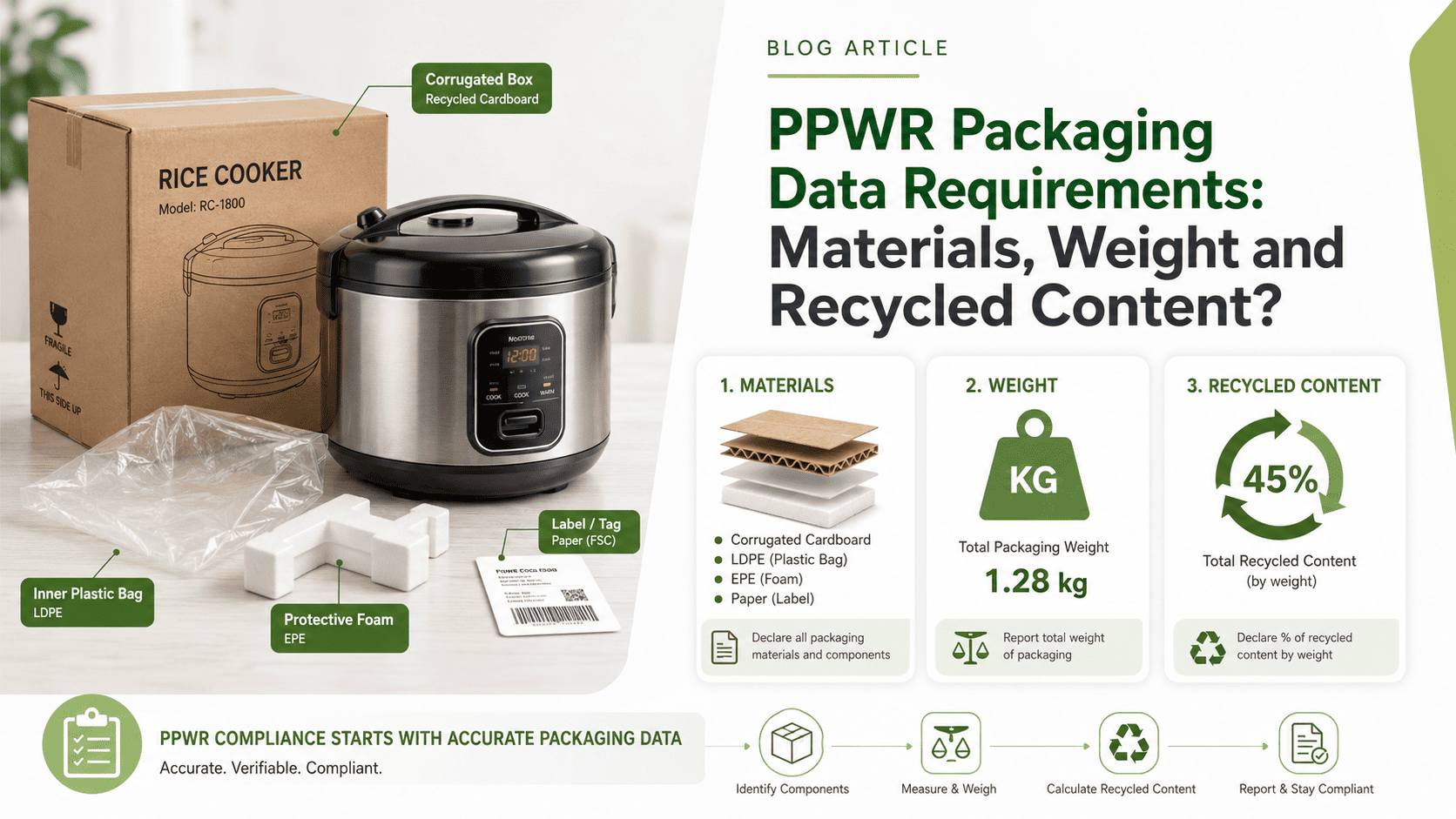
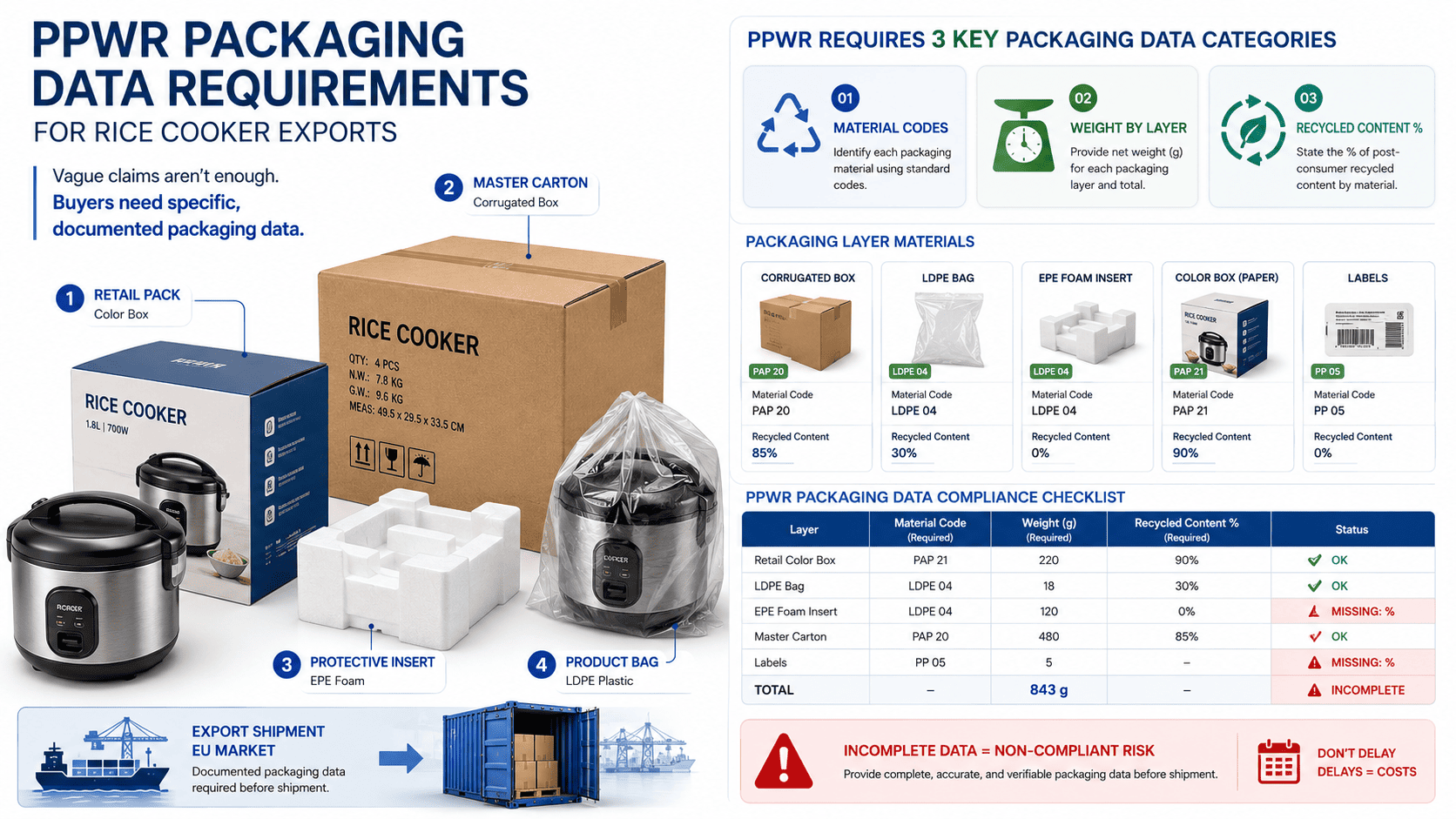
PPWR packaging data requirements force you to collect three distinct data types from your packaging supplier before shipping: material composition codes for each component, weight measurements per layer, and recycled content percentages tied to actual batch testing.2 Suppliers who respond with "compliant packaging" or provide only total carton weight leave compliance gaps that surface during customs documentation review or importer verification audits.
This article breaks down what specific data points to demand from your packaging supplier and how to verify you have complete documentation before your shipment leaves the factory. The examples come from actual supplier responses I've seen fail compliance checks.
What three data types does PPWR require for packaging documentation?
Most buyers assume packaging weight satisfies regulatory requirements. Then their documentation gets flagged for missing material specifications or recycled content proof.
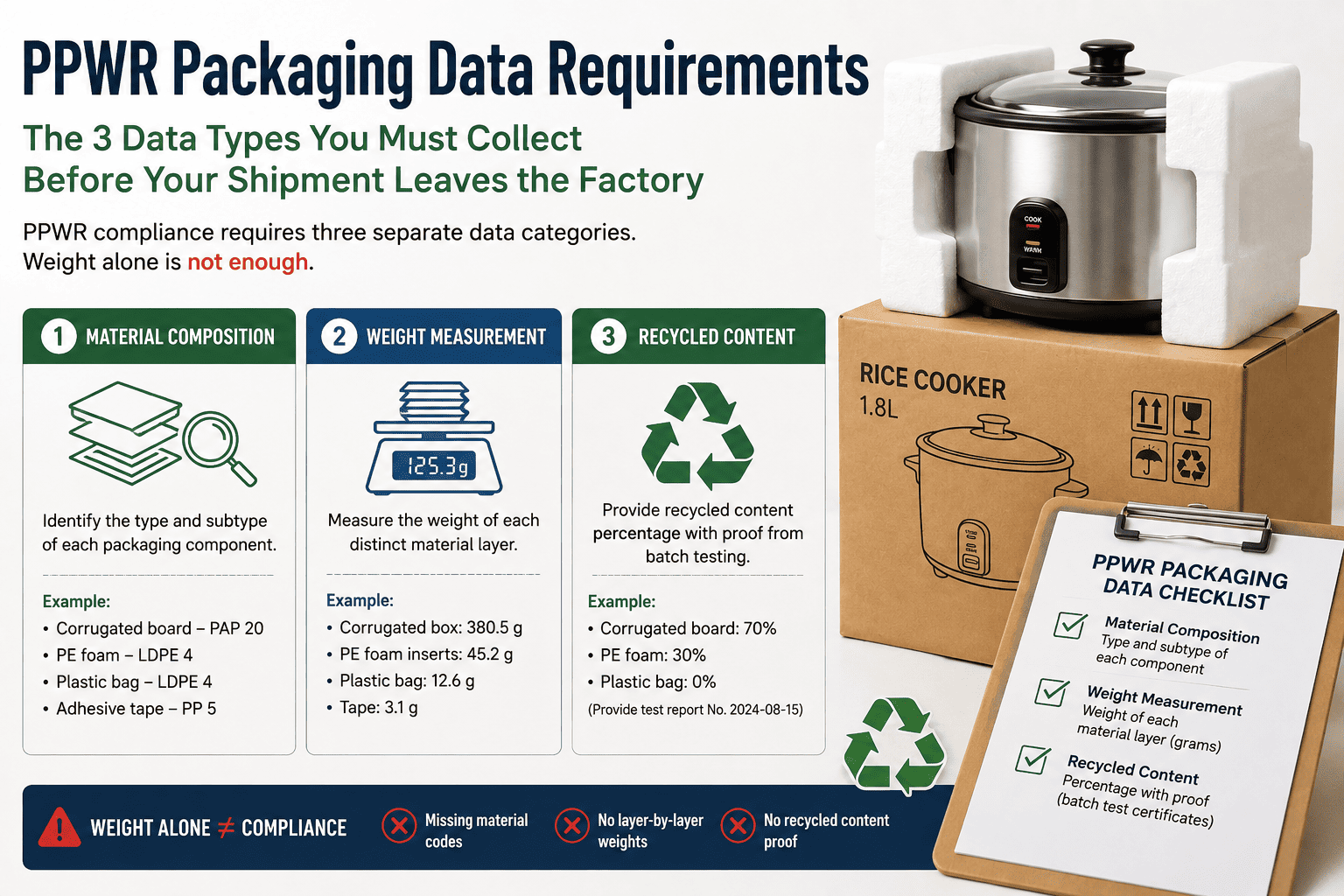
PPWR compliance requires three separate data categories: material composition identification showing the type and subtype of each packaging component, weight measurements for each distinct material layer, and recycled content percentages supported by batch testing certificates. Weight alone doesn't prove what the packaging is made from or whether it contains post-consumer recycled content.
Why material composition matters more than material names
Suppliers routinely write "plastic film" or "cardboard" on packing lists. This creates the first compliance gap. PPWR data systems require material type precision that generic names don't provide3.
When I request packaging specifications from suppliers, about 60% initially respond with broad categories:
| Supplier Response | Why It's Incomplete | What Buyers Actually Need |
|---|---|---|
| "Plastic film" | Doesn't specify polymer type | LDPE, HDPE, PET, or PP classification |
| "Cardboard box" | Doesn't identify paper type or coating | Corrugated cardboard, coated paperboard, or kraft paper |
| "Foam insert" | Doesn't distinguish foam material | EPE, EPS, or PU foam designation |
| "Paper wrap" | Doesn't indicate if coated/treated | Uncoated paper, PE-coated paper, or wax-coated paper |
The reason matters for compliance documentation. PPWR tracking systems categorize packaging materials by specific polymer types and paper grades4. "Plastic film" could be six different materials with different recycling pathways and recyclability rates.
One client discovered this gap when their importer's compliance team rejected their packaging declaration. The supplier had listed "plastic bag" for the dust cover. The compliance system needed to know if it was LDPE film (recyclable in most EU collection systems) or multi-layer metallized film (requires specialized recycling)5. The supplier took four days to check their production records and confirm it was single-layer LDPE.
Weight requirements for multi-component packaging
The second data type addresses packaging configurations with multiple layers. A rice cooker typically ships in a cardboard carton with foam inserts, plastic bag dust cover, and sometimes cardboard dividers. Each component needs separate weight documentation.
Suppliers often provide total packaging weight—"carton weight: 850g" —without breaking down components. This fails PPWR data requirements because the regulation tracks each material type separately.
Complete weight documentation requires:
- Outer carton weight (cardboard only, excluding printing ink if significant)
- Foam insert weight per piece
- Plastic film/bag weight
- Cardboard dividers or paper wrap weight
- Corner protectors or edge guards weight
I ask suppliers to weigh components separately during production QC sampling. Most factories already weigh the outer carton for shipping calculations. The blind spot is auxiliary materials—the foam, film, and paper inserts that protect the product during transport.
One foam supplier initially couldn't provide foam insert weight. Their production process cut foam to size but didn't weigh individual pieces. We added a sampling step: weigh 50 random foam inserts during production, calculate average weight, record it as component data. This created the weight value buyers need for PPWR documentation.
Recycled content verification beyond supplier claims
The third data requirement creates the most significant supplier communication gap. Many packaging suppliers respond to recycled content questions with "compliant" or "meets EU standards" without providing actual percentages or test documentation.
PPWR data submissions require numeric recycled content values: "37% post-consumer recycled content" backed by batch testing certificates6. "Compliant" or "≥25%" is marketing language that doesn't populate compliance databases.
The verification gap appears in two patterns:
Pattern 1: Suppliers state compliance without measurement The supplier confirms their cardboard contains recycled content but cannot provide the percentage or supporting test reports. Often this means they source cardboard from a paper mill that produces recycled-content grades but don't track actual percentages per production batch.
Pattern 2: Suppliers provide range estimates instead of measured values "20-40% recycled content" based on supplier estimates rather than analytical testing. PPWR systems need specific values tied to material batch numbers, not range approximations.
When I request recycled content certificates from packaging suppliers, approximately 40% can provide manufacturer declarations from their cardboard or plastic resin suppliers. About 10% have actual third-party test reports showing recycled content percentage for specific production batches.
The remaining 50% offer compliance statements without numeric backing. These suppliers often purchase packaging materials from distributors rather than directly from mills or resin manufacturers, creating a documentation chain gap.
How do you identify missing data in supplier packaging specifications?
Most incomplete packaging data looks complete at first glance. The supplier sends a specification sheet with material names, weights, and "compliant" statements. The gaps emerge when you check against the three-data-type requirement.
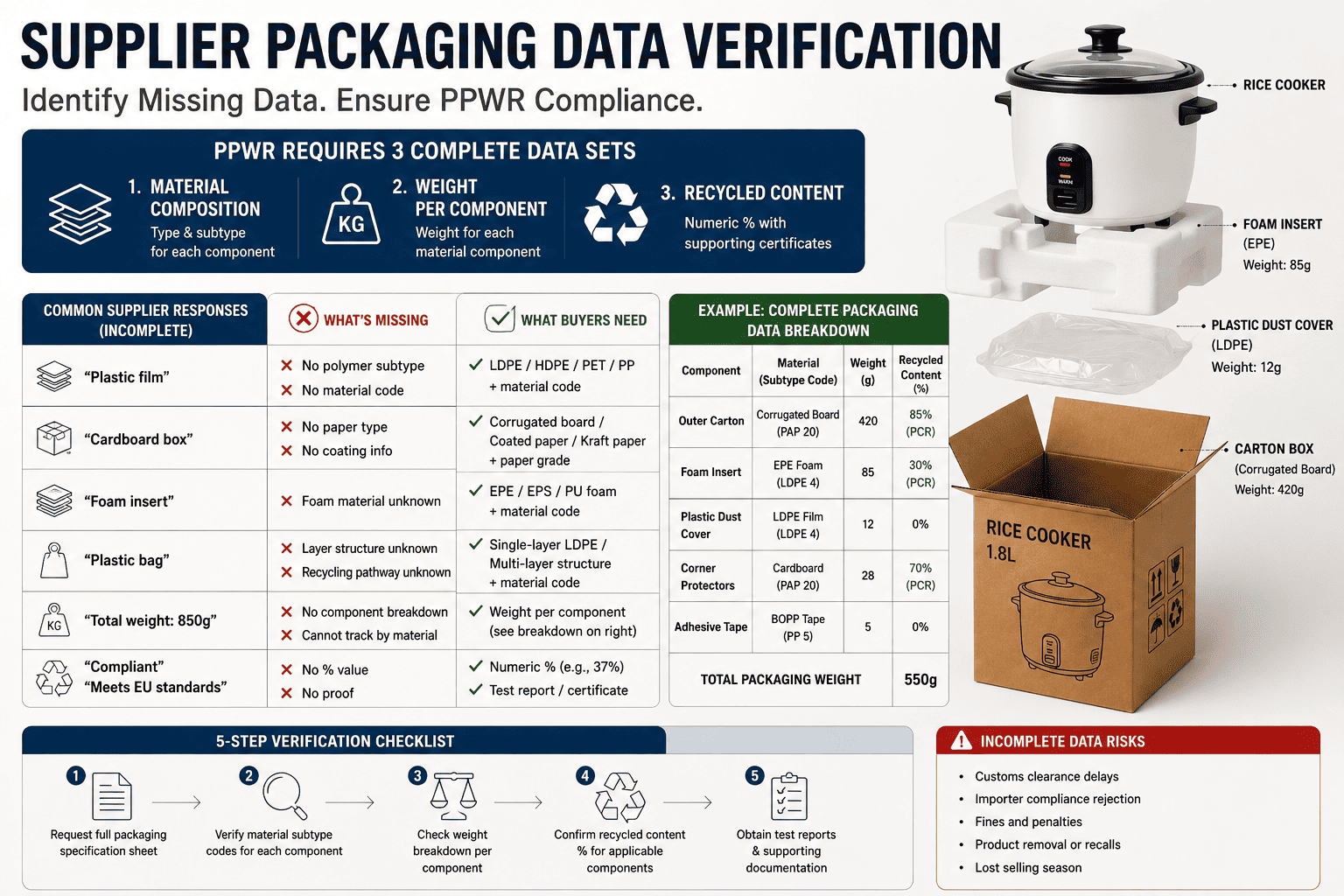
Run supplier packaging data through a completeness verification that checks for material subcategory codes, component-level weight measurements, and numeric recycled content values with supporting documentation. Specification sheets that list materials without subtypes, provide total weight without component breakdown, or state compliance without percentages indicate incomplete data sets.
Red flags in material composition documentation
I review packaging specifications by checking material names against the question "Can I look at this product and identify which specific material type it is?"
Generic material names create verification ambiguity:
- "Plastic bag" → Which polymer? LDPE, HDPE, PET?
- "Foam" → EPE, EPS, or polyurethane?
- "Cardboard" → Corrugated, solid board, or folding carton?
- "Paper wrap" → Coated, uncoated, or wax-treated?
Complete material documentation includes subtype classification. Instead of "plastic film," the spec should state "LDPE film, 50μm thickness." Instead of "cardboard box," it should specify "B-flute corrugated cardboard, 3-layer construction."
The material subtype determines recycling pathway classification. LDPE film can go in flexible plastic recycling streams in many EU regions. Multi-layer laminated films require specialized processing or aren't recyclable in most systems. PPWR data tracking needs this distinction.
Component weight verification for layered packaging
The second completeness check addresses packaging with multiple material types. I ask procurement managers to count distinct packaging components, then verify they have weight data for each one.
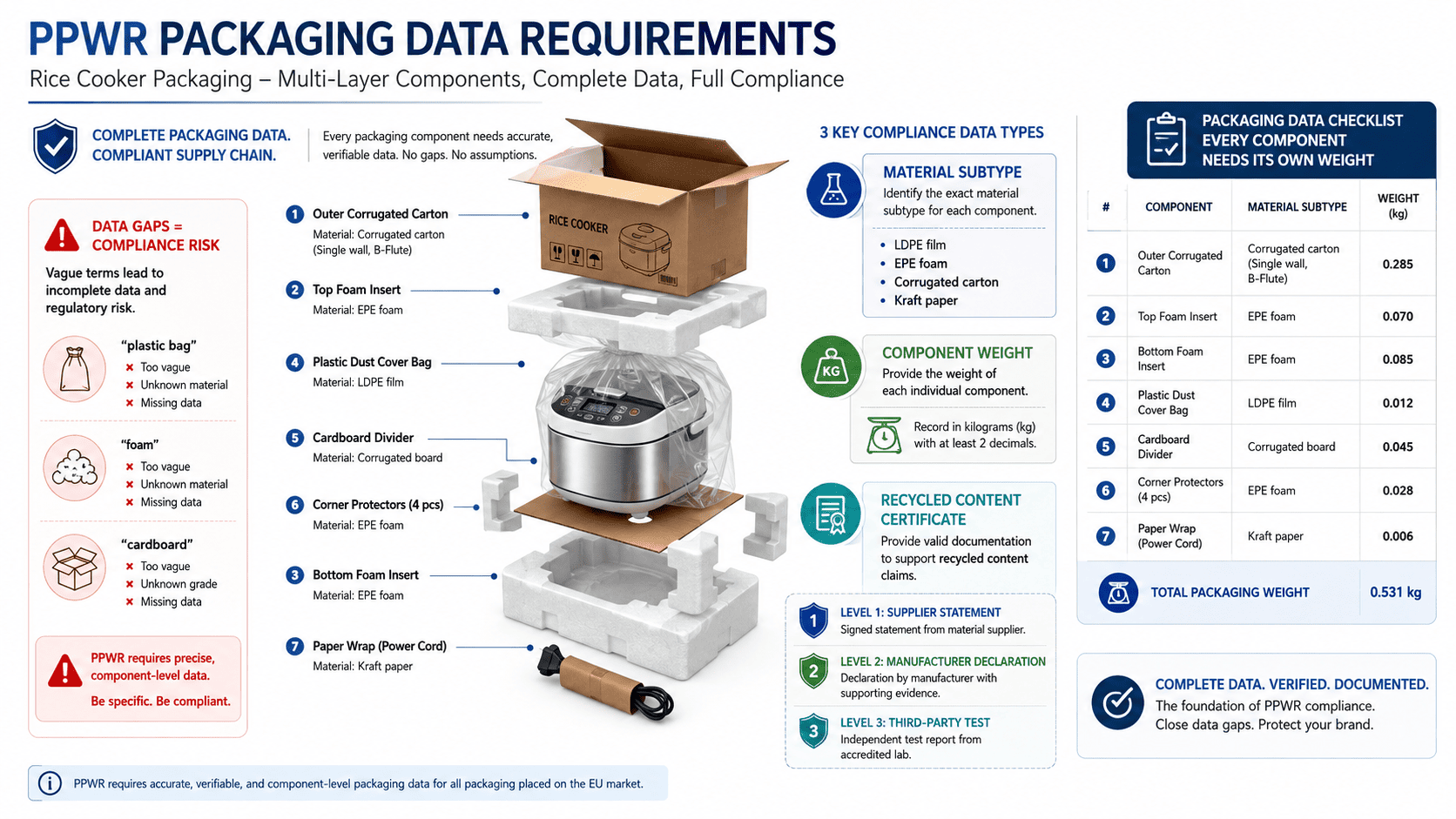
Typical rice cooker packaging components:
- Outer corrugated carton
- Top foam insert
- Bottom foam insert
- Plastic dust cover bag
- Cardboard divider (if present)
- Corner protectors (if present)
- Paper wrap for power cord (if present)
Each component needs individual weight measurement. Suppliers who provide "total packaging weight: 950g" without component breakdown leave the buyer unable to complete PPWR data submissions that require material-specific weights.
The verification method I use is straightforward: take the supplier's specification sheet and match each listed material to a specific weight value. If "EPE foam insert" appears in the materials list but has no corresponding weight measurement, that's a data gap.
One challenge appears with very light components. Plastic bags weighing 15-20g sometimes don't get measured because suppliers focus on structural packaging (carton, foam). The weight seems insignificant, but PPWR documentation requires it7. I've started requesting "all components >10g" to capture auxiliary packaging that gets overlooked.
Recycled content certificate requirements
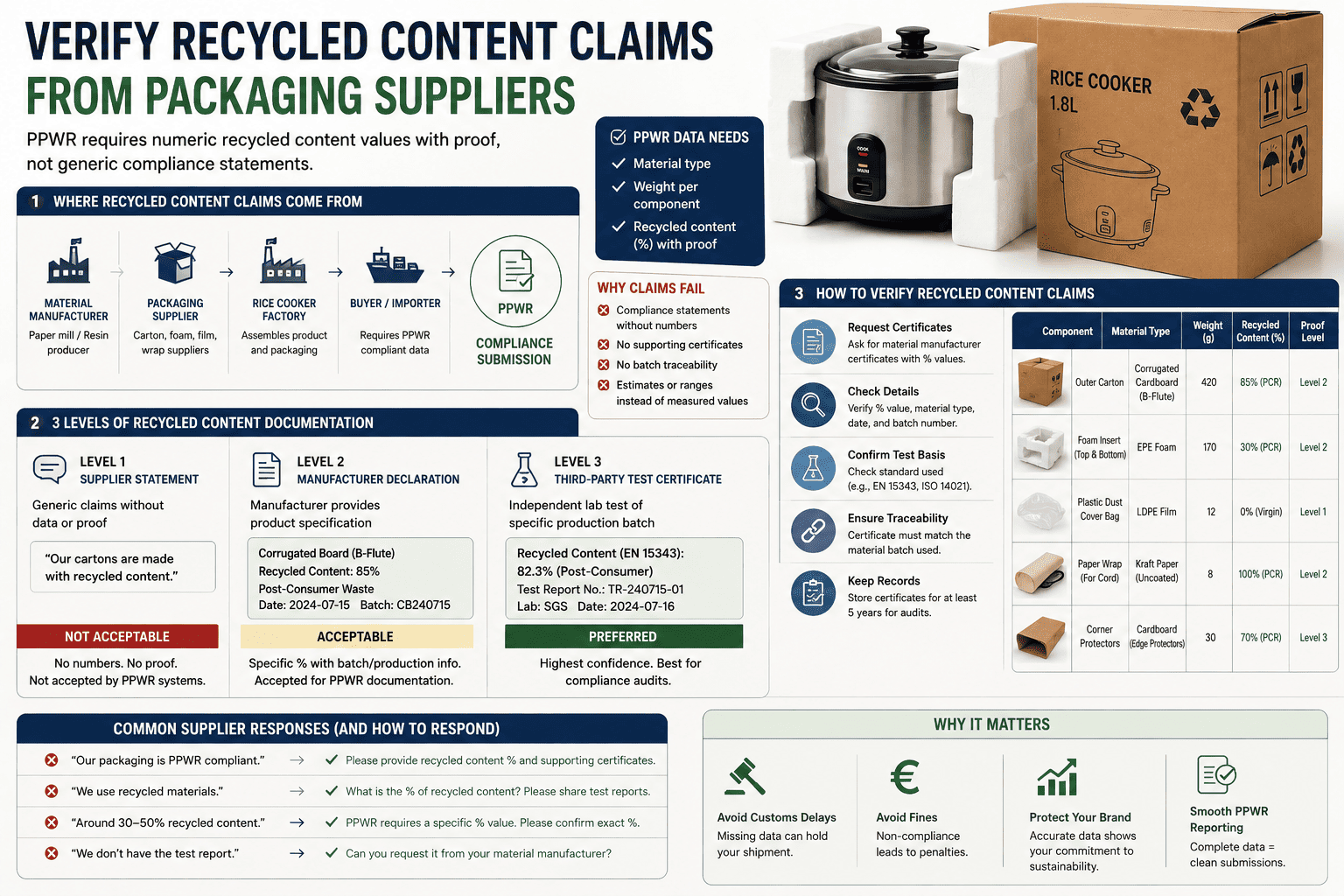
The third completeness check verifies recycled content documentation exists beyond supplier declarations. I distinguish between three documentation levels:
Level 1: Supplier statement The packaging supplier writes "contains recycled content" or "compliant with EU recycled content requirements" without supporting data. This doesn't meet PPWR verification needs.
Level 2: Material manufacturer declaration The cardboard mill or plastic resin supplier provides a product specification sheet stating recycled content percentage for their material grade. This works for PPWR documentation if it includes batch or production date information.
Level 3: Third-party test certificate Independent laboratory analysis showing recycled content percentage for a specific production batch. This provides the highest verification confidence.
Most suppliers I work with can reach Level 2 for cardboard packaging—paper mills routinely provide recycled content specifications for their grades. Plastic film and foam suppliers struggle more with documentation. Many cannot provide specific recycled content percentages because they source mixed-grade resin or don't request recycled content data from their suppliers.
When recycled content documentation is missing, buyers face a decision: accept the documentation gap and note "recycled content not verified" in PPWR submissions, or require the supplier to source packaging materials from manufacturers who provide recycled content certificates. Neither option is simple three weeks before shipment.
What causes multi-layer packaging data gaps?
Multi-component packaging creates the most frequent compliance documentation failures. The supplier provides complete data for the primary packaging—usually the outer carton—but auxiliary materials like plastic film, foam inserts, or paper wrap arrive without specifications.
Multi-layer packaging data gaps occur because buyers request "packaging specifications" and suppliers interpret this as "outer carton specifications." Foam manufacturers, film suppliers, and paper wrap vendors operate as sub-suppliers to the carton manufacturer, creating a documentation chain where auxiliary material data doesn't reach the final buyer unless specifically requested.
Primary packaging versus auxiliary material documentation
I've seen this pattern dozens of times: the buyer requests packaging specifications from their rice cooker supplier. The rice cooker factory asks their carton supplier for documentation. The carton supplier provides complete specifications for the corrugated box—material type, weight, recycled content percentage.
The buyer receives the carton specs and checks the box: "Packaging data: complete." Then during PPWR documentation preparation, the importer's compliance team asks about the foam inserts. The buyer discovers their "complete" packaging data covered only 60% of actual packaging materials by weight.
The root cause is supply chain structure. Rice cooker factories typically source packaging from multiple specialized suppliers8:
- Carton supplier → provides printed corrugated boxes
- Foam supplier → provides protective inserts cut to size
- Film supplier → provides plastic dust cover bags
- Accessories packager → provides paper wrap, cord ties, desiccant packets
Each supplier operates independently. The carton supplier doesn't have foam specifications. The foam supplier doesn't track whether their customer uses plastic film. The rice cooker factory coordinates component delivery but doesn't necessarily collect compliance documentation from each packaging sub-supplier.
Requesting complete packaging data across all suppliers
The solution requires specific supplier communication about documentation scope. Instead of requesting "packaging specifications," buyers need to request "material composition, weight, and recycled content data for all packaging components including auxiliary materials."
I recommend procurement managers ask their supplier this specific question: "Who manufactures the foam inserts, plastic bags, and any paper wrap used in our product packaging? Can you collect material specifications from each of these sub-suppliers?"
This forces the supplier to map their packaging supply chain and identify all material sources. Often the rice cooker factory doesn't directly communicate with the foam supplier—they purchase foam through the carton manufacturer. This means requesting foam specifications requires an additional documentation request from the carton manufacturer to their foam supplier.
The timeline impact matters for procurement planning. Collecting packaging data from multiple sub-suppliers typically adds 1-2 weeks compared to getting only carton specifications9. Some auxiliary material suppliers need time to prepare documentation they don't routinely provide to customers.
Common missing auxiliary materials
Based on packaging data gaps I've helped clients fix, these auxiliary materials most frequently lack complete documentation:
Foam inserts: Material type usually clear (EPE or EPS), but weight per piece and recycled content often missing. Foam suppliers manufacture to density specifications (kg/m³) rather than finished piece weight. They need to add a weighing step for PPWR documentation.
Plastic dust cover bags: Material composition sometimes unclear—is it LDPE, HDPE, or co-extruded film? Weight often estimated rather than measured. Recycled content rarely documented because many film suppliers produce from virgin resin.
Paper wrap for power cords: Often overlooked entirely in packaging specifications because it's a minor component. Material type (coated vs uncoated paper) and recycled content need documentation despite low weight.
Corner protectors: Material varies—might be cardboard edge protectors or EPE foam corners. Suppliers sometimes source these as commodity items from distributors who don't provide material specifications.
The practical approach I use is creating a packaging component checklist during sample approval. Before approving production, identify every distinct material in the packaging system and request specifications for each one. This prevents discovering missing data after 5,000 units are already manufactured and packaged.
How do you verify recycled content claims from packaging suppliers?
Recycled content verification creates the biggest supplier communication friction. Suppliers want to claim "compliant" packaging without providing measured percentages. Buyers need numeric values for documentation systems that don't accept descriptive claims.
Verify recycled content claims by requesting material manufacturer certificates that state specific percentages for production batches, not supplier declarations of compliance. If the supplier cannot provide manufacturer documentation, require them to confirm whether their packaging materials contain measured recycled content or virgin materials only.
Material manufacturer declarations versus supplier statements
The documentation hierarchy for recycled content affects verification confidence:
Tier 1: Material mill/manufacturer test certificate Paper mill laboratory analysis showing recycled fiber content for a specific production run, or resin manufacturer certificate stating post-consumer recycled content percentage in plastic pellets. These certificates typically include:
- Material batch or lot number
- Production date range
- Recycled content percentage (often with methodology: "23% post-consumer recycled content per ISO 1402110")
- Manufacturer name and facility location
This documentation level satisfies PPWR verification requirements because it traces to actual material production and testing.
Tier 2: Product specification sheet with recycled content Material manufacturer's standard product specification stating recycled content range for a material grade. Example: "Kraft liner board, 40-50% recycled fiber content." Less specific than batch certificates but indicates measured recycled content in the material grade.
Tier 3: Packaging supplier declaration The carton or film manufacturer states "our packaging contains recycled content" without supporting documentation from their material suppliers. This represents unverified claims that may be accurate but can't be traced to material sourcing.
Most packaging suppliers can provide Tier 2 documentation for cardboard—paper grades routinely specify recycled fiber content. Tier 1 batch-specific certificates are less common unless the buyer specifically requests them.
For plastic packaging (film, foam), documentation quality drops. Many plastic film suppliers source resin from distributors rather than directly from resin manufacturers, creating a documentation gap. The film supplier may not have access to resin specifications showing recycled content.
Questions that reveal documentation availability
I've learned to ask suppliers specific questions that reveal whether they can provide verified recycled content data or only general claims:
Question 1: "What percentage of recycled content does your cardboard/plastic contain?"
Suppliers with documentation answer with specific numbers: "35% post-consumer recycled content" or "minimum 40% recycled fiber." Suppliers without documentation answer with regulatory terms: "compliant with EU requirements" or "meets recycled content standards."
Question 2: "Can you provide a certificate from your paper mill or resin supplier showing recycled content percentage?"
This directly asks for Tier 1 or Tier 2 documentation. Suppliers who source materials with recycled content tracking can request these certificates from their suppliers. Suppliers who purchase commodity-grade materials through distributors often cannot access manufacturer documentation.
Question 3: "Is the recycled content measured for each production batch, or is it a general specification for your material grade?"
Batch-specific measurement indicates stronger tracking systems and supports Tier 1 documentation. General grade specifications indicate Tier 2 documentation—still useful but less precise.
Response patterns that indicate verification problems
Certain supplier response patterns reveal recycled content documentation gaps before you receive (or don't receive) certificates:
Red flag response 1: "Our packaging is compl
"General product compliance - ensure your product complies with EU rules", https://europa.eu/youreurope/business/product-rules-compliance/general-product-compliance/index_en.htm. EU customs authorities may require complete packaging compliance documentation for clearance, and incomplete or non-compliant packaging declarations can result in shipment holds pending documentation verification or corrective action. Evidence role: general_support; source type: government. Supports: the potential for packaging documentation deficiencies to delay customs clearance. Scope note: Enforcement practices and documentation scrutiny levels vary across EU member states and entry points ↩
"Packaging Waste Regulation - EU Environment - European Union", https://environment.ec.europa.eu/topics/waste-and-recycling/packaging-waste/packaging-packaging-waste-regulation_en. The EU Packaging and Packaging Waste Regulation establishes mandatory data collection requirements for packaging placed on the EU market, including material composition identification, weight measurements, and recycled content verification. Evidence role: general_support; source type: government. Supports: the specific data categories required under PPWR for packaging documentation. Scope note: The source may describe requirements at a regulatory framework level rather than specifying exact technical data formats or batch testing protocols ↩
"Packaging waste - Environment - European Commission", https://environment.ec.europa.eu/topics/waste-and-recycling/packaging-waste_en. PPWR implementation frameworks utilize standardized material classification systems that require specific polymer types and material grades rather than generic descriptive terms for packaging composition reporting. Evidence role: mechanism; source type: government. Supports: how PPWR implementation systems categorize and process packaging material data. Scope note: Technical implementation details may vary across member states or evolve during the regulation's phased implementation period ↩
"Packaging waste - Environment - European Commission", https://environment.ec.europa.eu/topics/waste-and-recycling/packaging-waste_en. PPWR implementation frameworks establish material classification hierarchies that distinguish packaging materials by polymer resin types and paper/cardboard grades to enable accurate recyclability assessment and waste tracking. Evidence role: mechanism; source type: government. Supports: the material classification approach used in PPWR data tracking systems. ↩
"Recycling of post-consumer plastic packaging waste in the EU - PMC", https://pmc.ncbi.nlm.nih.gov/articles/PMC8162419/. European waste management studies indicate that mono-material LDPE films can be processed through widely available mechanical recycling systems, while multi-layer composite films face limited collection and processing infrastructure across EU member states. Evidence role: general_support; source type: institution. Supports: the relative recyclability of LDPE film versus multi-layer metallized films in European waste management systems. Scope note: Collection system availability varies significantly by region and municipality within the EU ↩
"PWR Recycled Content Targets: PCR Requirements for 2030", https://www.getsunhat.com/blog/ppwr-recycled-content-targets-pcr-requirements. PPWR establishes obligations for packaging producers to report recycled content in their packaging materials using verifiable quantitative data rather than qualitative claims or compliance statements. Evidence role: general_support; source type: government. Supports: the requirement for quantified recycled content reporting in PPWR compliance. Scope note: Specific technical requirements for batch testing protocols and documentation formats may be defined in implementing acts or member state guidance rather than the primary regulation ↩
"Packaging and Packaging Waste Regulation (PPWR) - Circularise", https://www.circularise.com/blogs/ppwr-guide-to-compliance-timelines-and-mass-balance-solutions/. PPWR requires reporting of all packaging components placed on the market regardless of individual component weight, ensuring complete material flow tracking for waste management planning. Evidence role: general_support; source type: government. Supports: the comprehensive scope of packaging component documentation under PPWR. Scope note: Specific de minimis thresholds or exemptions for negligible packaging elements may exist in technical implementation guidance ↩
"The Role of Packaging in Supply Chain Management", https://www.globalvision.co/blog/the-role-of-packaging-in-supply-chain-management. Manufacturing supply chain studies document the widespread practice of sourcing different packaging components from specialized suppliers rather than single-source procurement, driven by technical specialization and cost optimization. Evidence role: general_support; source type: research. Supports: the multi-supplier structure common in packaging procurement for manufactured goods. ↩
"Blurred lines: the timeline of supply chain resilience strategies ...", https://pmc.ncbi.nlm.nih.gov/articles/PMC9160506/. Supply chain research on compliance documentation processes indicates that collecting specifications from multiple packaging component suppliers extends procurement timelines due to coordination requirements and varying supplier capabilities. Evidence role: general_support; source type: research. Supports: the extended timelines associated with comprehensive packaging documentation across multi-tier supply chains. Scope note: This citation supports the general principle of extended timelines rather than the specific 1-2 week duration, which likely varies by supplier relationships and documentation complexity ↩
"ISO 14021:2026(en), Environmental statements and programmes for ...", https://www.iso.org/obp/ui/#iso:std:iso:14021:en. ISO 14021 provides standardized definitions and verification principles for self-declared environmental claims, including specifications for post-consumer and pre-consumer recycled content declarations. Evidence role: definition; source type: institution. Supports: ISO 14021 as a recognized standard for environmental claims including recycled content. ↩