I've watched procurement managers lose sleep over handle materials for 15 years. You receive sample rice cookers with perfect nylon handles, approve the order, and six months later your customer service team drowns in complaints about handles that feel too hot or crack after minimal use. The supplier swears they followed your specifications. Your testing lab confirms the material meets the listed standards. Yet something clearly went wrong between sample approval and container arrival.
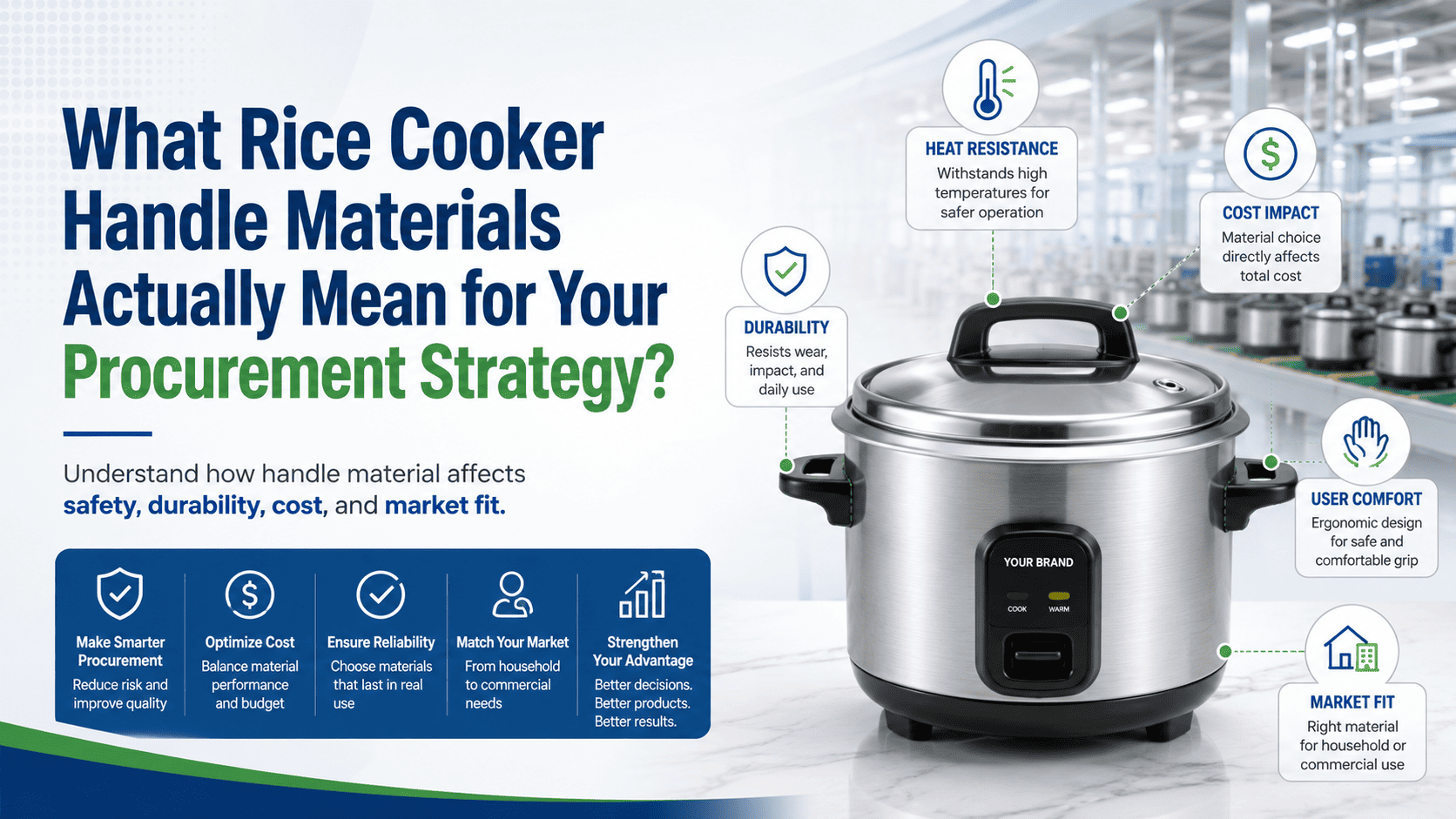
The real issue isn't which handle material performs best in laboratory conditions—it's matching your material specification to what your price point actually buys in production reality. Most handle material problems trace back to procurement managers specifying premium materials at budget pricing, creating gaps that suppliers fill with substitutions you discover too late. Understanding the cost thresholds where material switches happen, and building inspection protocols that catch these switches before shipment, protects you better than any material science degree.
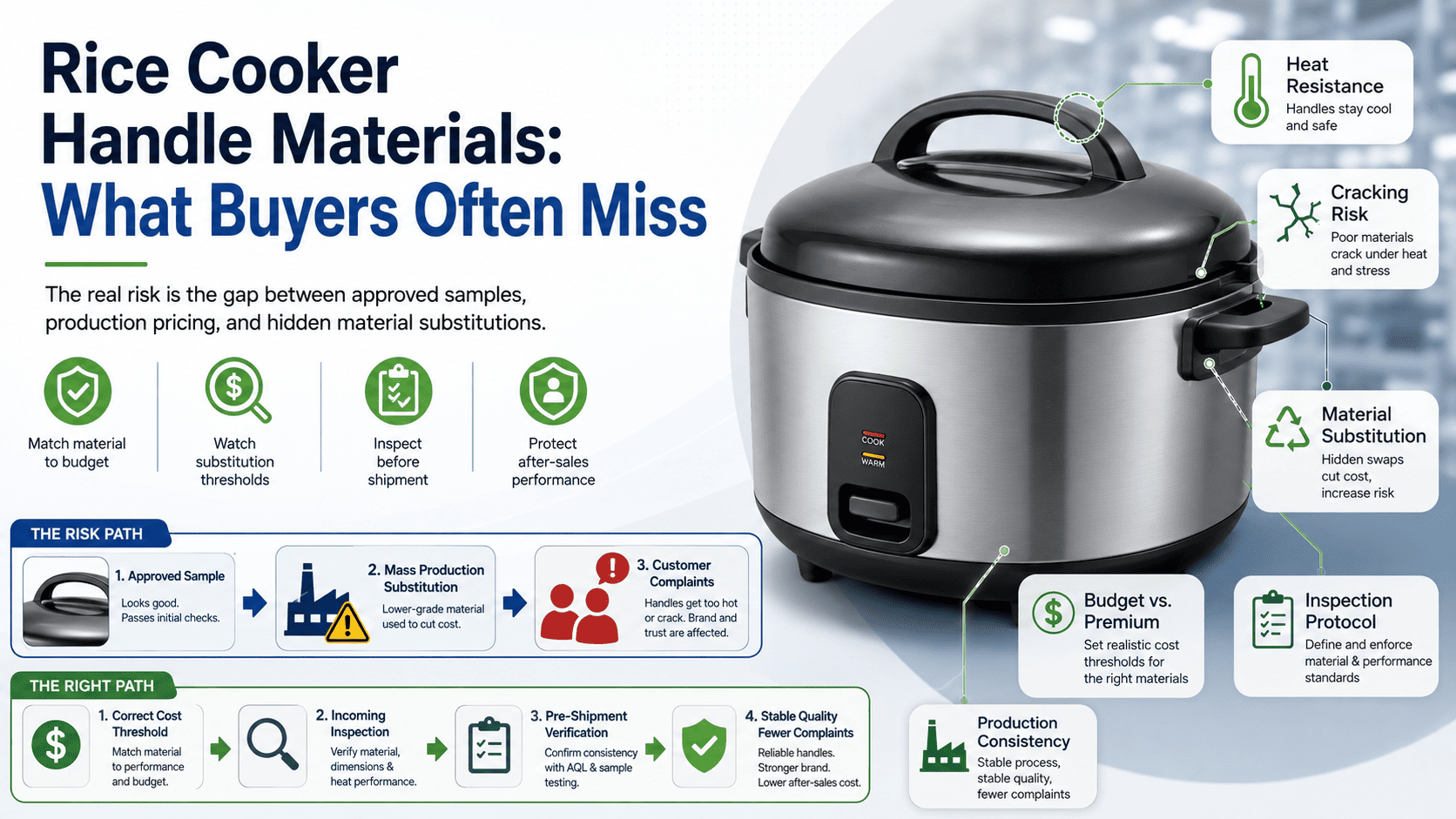
Here's what makes this conversation different from the spec sheets your suppliers send: I'm not explaining materials as a neutral researcher. I'm showing you the procurement decision tree from the supplier side—where material switches happen, why they happen, and how buyers like Moo actually verify what arrives matches what they ordered.
My factory produces rice cookers at multiple price points, and I've seen which material decisions succeed at each tier.
Why Do Rice Cooker Manufacturers Use Different Handle Materials?
The question seems straightforward until you realize "different materials" often means "the same general material family with different grades, fillers, additives, or surface treatments."
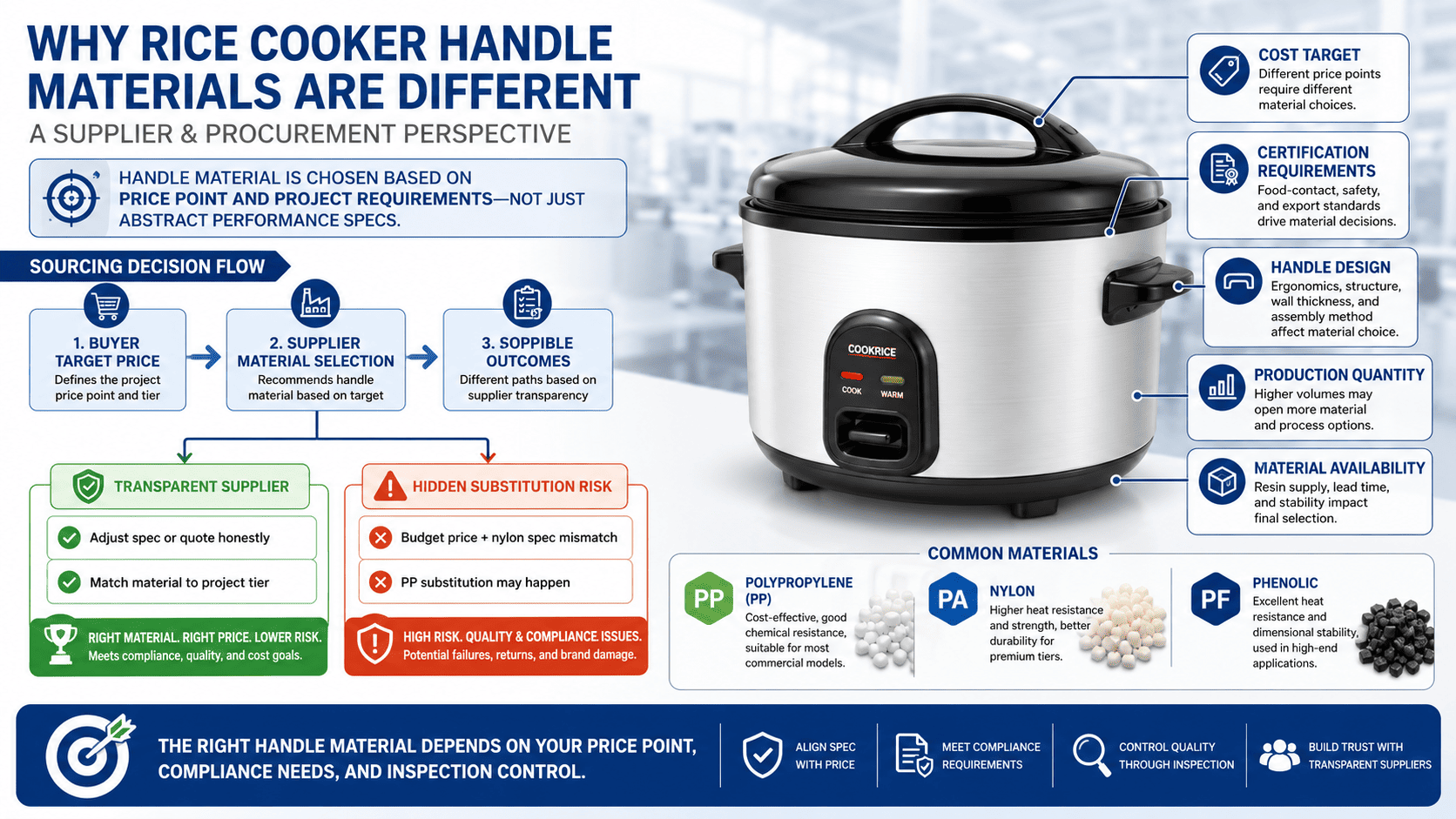
Manufacturers do not choose handle materials based solely on performance specifications. They choose based on the cost target you set, the certification requirements your market demands, the handle design, the production quantity, and material availability during your production window.
When a procurement manager requests quotations for 10,000 units at $12 FOB, suppliers reverse-engineer material choices from that price point. If your target price only supports polypropylene handles but your specification mentions nylon, experienced suppliers either reject the project or propose modified PP that bridges the gap.
Less transparent suppliers may simply produce PP handles and hope your inspection process does not catch the substitution.
The Real Cost Architecture Behind Handle Materials
Material selection follows predictable economics. At Kenly, our material costs break down roughly like this:
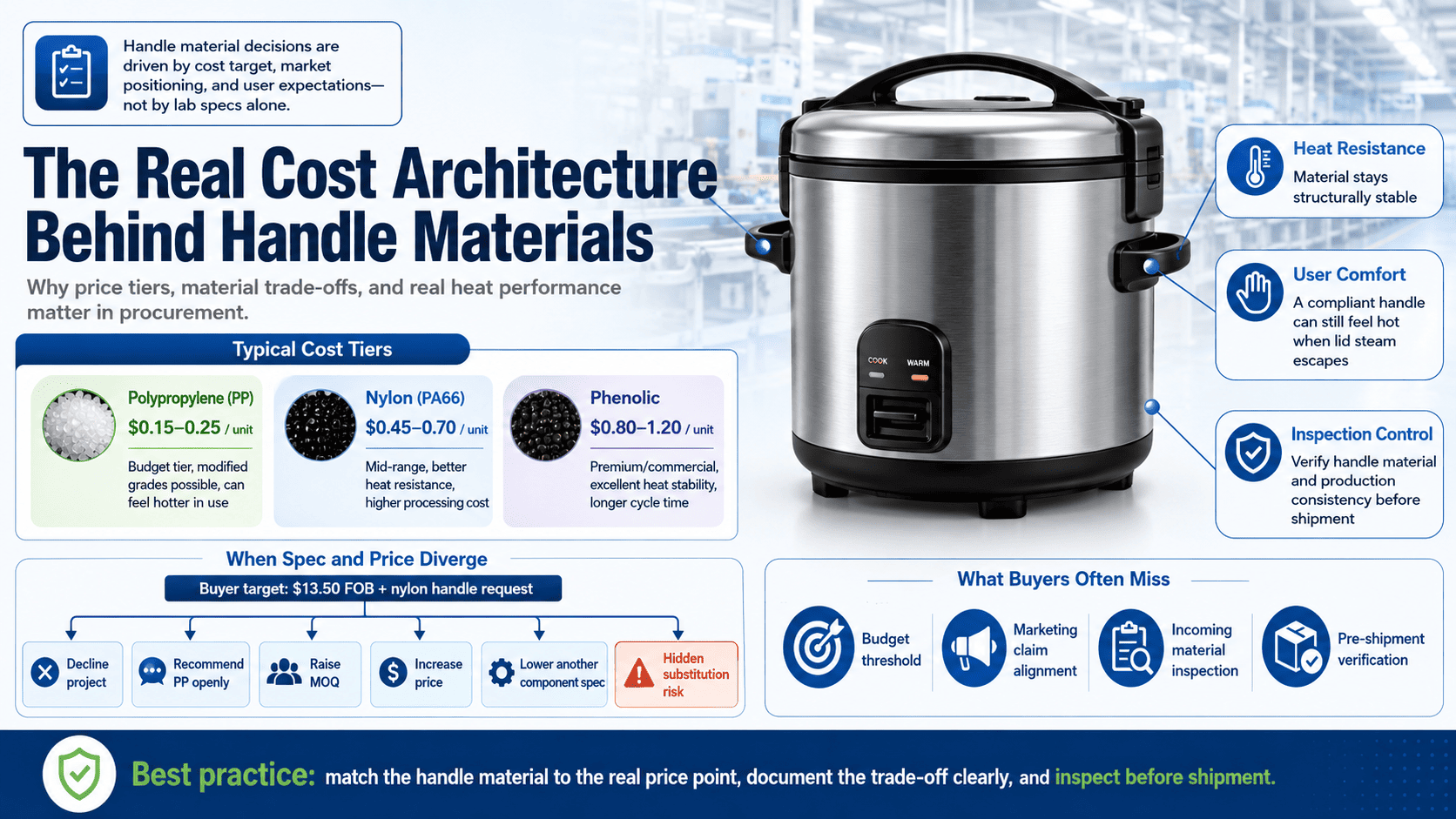
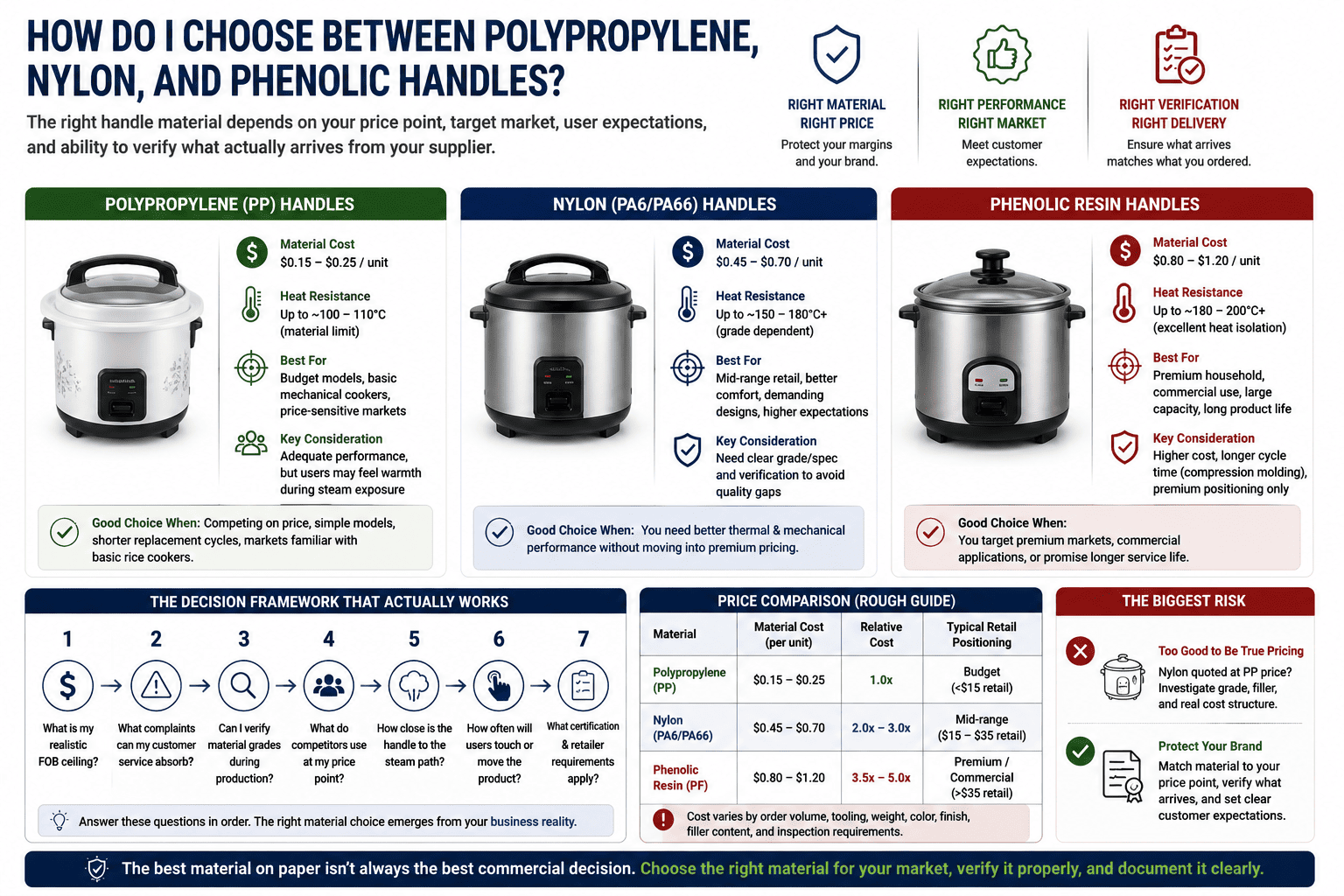
Polypropylene handles: $0.15–0.25 per unit depending on additives and surface finish. This material works for rice cookers priced under $15 retail in many markets. The material itself tolerates temperatures up to approximately 100–110°C1, but user comfort during steam exposure matters more than the laboratory material limit.
Nylon handles: $0.45–0.70 per unit for injection-molded PA66 with appropriate heat stabilization2. The price increase is not only caused by raw material. It can also involve higher processing temperatures, material drying, longer cooling cycles, and slower production speed. This material commonly makes sense for mid-range rice cookers.
Phenolic resin handles: $0.80–1.20 per unit because production may involve compression molding rather than normal thermoplastic injection molding3, requiring different equipment and longer cycle times. These handles usually appear in premium or specialized commercial models.
The gaps between these tiers create predictable problems. A procurement manager who needs to hit $13.50 FOB but specifies nylon handles creates a cost gap that must close somewhere.
Suppliers may:
- Decline the project
- Recommend polypropylene openly
- Reduce another component specification
- Increase the MOQ
- Charge a higher price
- Use a lower nylon grade
- Substitute another material without clear approval
The buyer should know which of these decisions is being made before mass production.
When Specification and Production Reality Diverge
I review customer complaints quarterly with our quality team. The most common handle-related issues follow clear patterns.
One Thai distributor ordered 5,000 drum rice cookers with “heat-resistant nylon handles” at $11.80 FOB. Their original specification mentioned PA66, but their price point supported modified polypropylene more realistically.
Our quotation clearly listed “modified polypropylene with heat stabilizers,” which they approved. Six months later, customer service reported handles feeling hot during normal use—not defective according to the approved specification, but disappointing compared with customer expectations created by competing products using actual nylon.
The distributor did not make a traditional quality-control mistake. They made a commercial trade-off: accept PP limitations at their price point or increase pricing to afford nylon.
The problem was that this trade-off was not communicated internally. Their marketing team continued promoting “premium heat-resistant handles” without qualifying the claim.
This pattern repeats across markets. Buyers face genuine constraints:
- Market pricing
- Competitor positioning
- Retail margin requirements
- Certification costs
- Packaging costs
- Warranty reserves
- Order quantity
- Delivery deadlines
The goal is not always to choose the most expensive material. The goal is to make the trade-off consciously and document it clearly.
What Temperature Can Rice Cooker Handles Actually Withstand?
The disconnect between laboratory test results and customer complaints about hot handles has confused procurement managers for years.
Your supplier provides test reports showing handle temperatures stayed below the applicable limit during operation. Your testing laboratory confirms compliance with IEC 60335-related appliance safety requirements4. Yet customers post reviews saying the handle feels too hot during normal use.
Everyone may have followed the written specification. What failed was the connection between compliance testing and real user behavior.
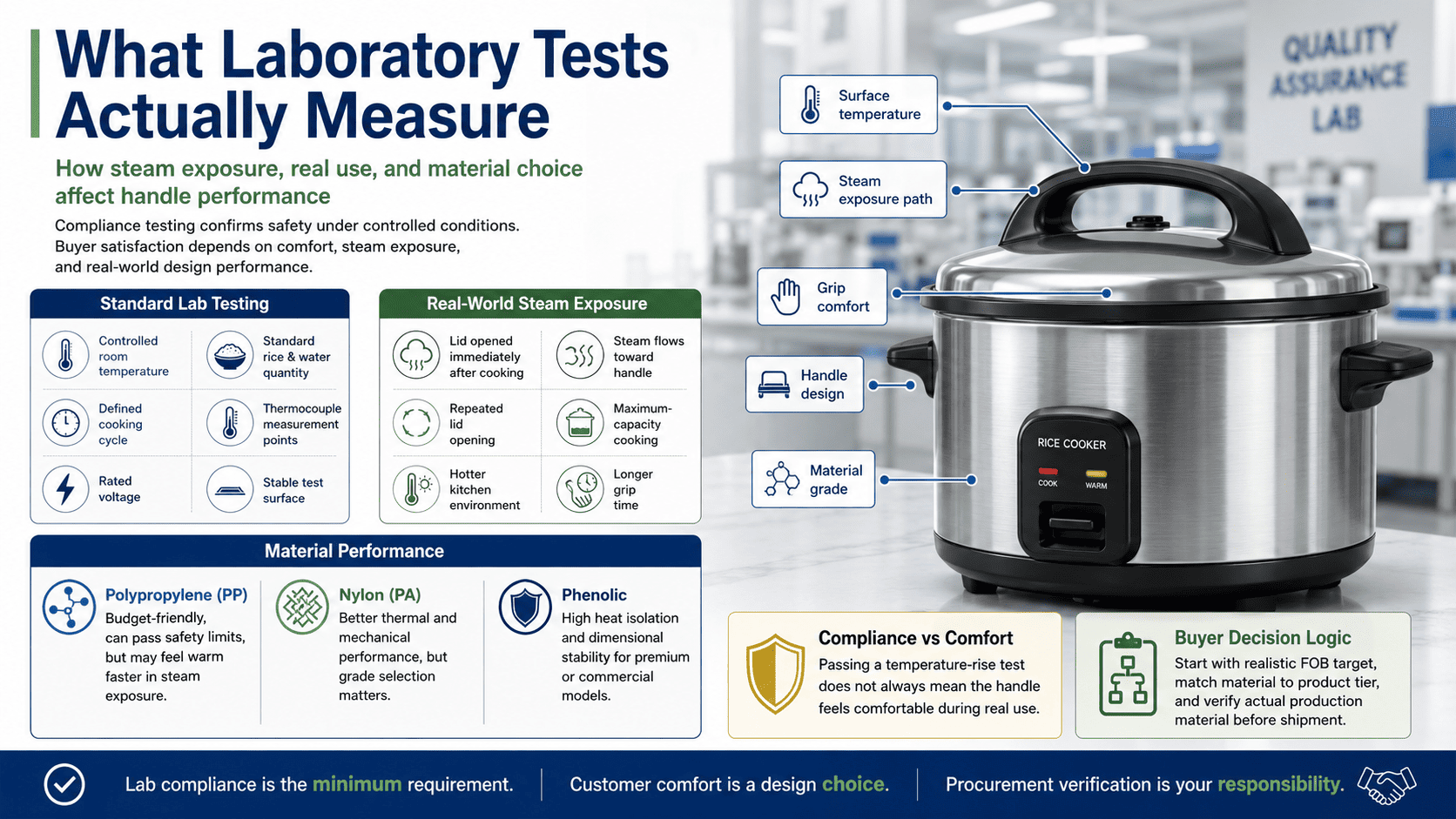
Heat resistance and user comfort are not the same measurement. A handle may remain structurally stable and pass an accessible-surface temperature test while still becoming uncomfortable during short steam-exposure events when the user opens the lid.
What Laboratory Tests Actually Measure
Standard temperature-rise testing usually places thermocouples on accessible handle surfaces while the rice cooker operates under controlled conditions.
Testing may use:
- Controlled room temperature
- A defined rice and water quantity
- A standard cooking cycle
- Specific measurement positions
- Defined operating voltage
- A stable test surface
- A specified measurement time
Controlled laboratory conditions are important because they make test results repeatable. Thermal comfort and temperature studies also rely on controlled ambient conditions5.
The test confirms whether the product meets the applicable safety requirements under the defined procedure.
However, many customer complaints occur in situations that may not be fully represented by one standard test condition:
- The lid is opened immediately after cooking
- Steam flows directly toward the handle
- Users repeatedly open the lid during cooking
- The kitchen temperature is higher than the laboratory condition
- The cooker is filled to maximum capacity
- A different rice variety generates more steam
- The user grips a different part of the handle
- The user holds the handle longer than expected
Burn discomfort depends on temperature, exposure time, and heat-transfer method6. A short steam event can feel different from touching a warm surface at a stable temperature.
Material Performance in Steam Exposure Scenarios
Here is what may happen when users lift the lid immediately after cooking:
Polypropylene handles
PP can perform adequately in budget rice cookers, but users may feel warmth relatively quickly when steam reaches the handle surface. The material may remain within safety limits while still creating a comfort complaint.
Nylon handles
Properly selected nylon grades usually provide better thermal and mechanical performance. They may reduce how quickly the user perceives heat during short handling events.
However, “nylon” is not one universal specification. PA6, PA66, glass-filled nylon, mineral-filled nylon, and heat-stabilized grades can perform differently.
Phenolic resin handles
Phenolic handles are commonly selected when higher heat isolation and long-term dimensional stability are required. They may suit premium household products or commercial models where users handle the appliance frequently.
The material alone does not determine the final result. Handle performance also depends on:
- Wall thickness
- Internal ribs
- Distance from the steam vent
- Metal fasteners
- Handle-to-lid connection
- Air gaps
- Surface texture
- Handle size
- Grip position
- Product capacity
- Steam direction
A well-designed PP handle may provide a better user experience than a poorly designed nylon handle.
The Gap Between Specification and Comfort
A procurement manager once asked why their rice cookers passed all certification tests but still generated reviews mentioning hot handles.
Their specification required the handle to meet the applicable temperature-rise limits, which the product did. But the specification did not include:
- Steam exposure during lid opening
- Handle temperature immediately after cooking
- Maximum-capacity cooking
- Repeated lid-opening tests
- User comfort evaluation
- Local cooking-habit simulation
The product complied with the written requirement but did not fully match customer expectations.
This gap appears frequently when procurement teams focus only on certification.
Compliance is the minimum market-entry requirement. Customer comfort is a separate product-positioning decision.
How Do I Choose Between Polypropylene, Nylon, and Phenolic Handles?
The question assumes you are choosing purely based on material properties. In reality, the decision depends on the intersection of your price point, target market expectations, handle design, certification needs, and ability to verify what actually arrives from your supplier.
The decision tree should start with your realistic FOB price target, not with ideal material properties. Material selection must work backward from economics and forward to a verification process you will actually implement.
Polypropylene Handles: When Cost Control Drives Selection
Choose PP handles when your project competes mainly on price and your target FOB cannot support premium engineering materials.
PP can make sense for:
Budget retail positioning
If you supply discount retailers or compete in markets where customers prioritize capacity and price, PP handles may align with expectations.
Simple mechanical rice cookers
Basic cook-and-keep-warm models often do not need the same handle specification as premium digital or high-temperature commercial models.
Shorter product replacement cycles
In markets where customers replace rice cookers every two or three years, a properly designed PP handle may perform adequately throughout the expected warranty period.
Markets familiar with basic rice cookers
Customers who commonly use entry-level mechanical rice cookers may accept more heat sensation than customers accustomed to premium insulated appliances.
PP selection requires honest product positioning. Marketing should not describe a standard PP handle as “premium nylon” or imply performance the product was not designed to deliver.
Nylon Handles: The Middle Ground Most Buyers Actually Need
Nylon handles make sense for a broad range of mid-tier rice cooker projects where buyers need better thermal and mechanical performance without moving into phenolic pricing.
Nylon may be appropriate for:
Mid-range retail
The material upgrade can support a stronger product presentation and better user comfort while keeping the model commercially competitive.
Brand reputation protection
If negative reviews affect your full product range, the incremental cost of a suitable nylon grade may reduce complaint risk.
More demanding handle designs
Thin handles, folding handles, lid handles near steam vents, and larger-capacity cookers may benefit from stronger material performance.
Markets with higher customer expectations
Customers in established appliance markets may compare handle comfort, weight, finish, and durability closely.
But nylon creates verification requirements. PA6, PA66, glass-filled grades, and mineral-filled grades have different thermal and mechanical characteristics7.
A specification that says only “nylon handle” is incomplete.
Buyers should define:
- Nylon type
- Grade or equivalent performance
- Filler percentage if applicable
- Heat stabilizer requirement
- Color
- Recycled-material policy
- Approved supplier or resin source
- Mechanical-strength requirement
- Temperature-rise requirement
- Change-approval process
Phenolic Resin Handles: Premium Positioning Only
Phenolic handles are most suitable when the economics support premium positioning or when the product will be used frequently in demanding environments.
Typical applications include:
Premium household appliances
Customers paying a higher retail price expect a noticeable improvement in grip comfort, material feel, heat isolation, and durability.
Commercial and hospitality products
Restaurants, hotels, catering operators, and institutional kitchens may handle rice cookers more frequently than household users.
Large-capacity rice cookers
Higher-capacity cookers may generate more heat and steam and require stronger handles.
Long product-life positioning
If the buyer promises a longer expected service life, handle durability becomes more important.
The main mistake is choosing phenolic resin because it is “the best” without checking whether the market will pay for it.
The best technical material is not automatically the best commercial decision.
The Decision Framework That Actually Works
Rather than starting with material properties, ask these questions in order:
-
What is my realistic FOB ceiling?
Use the maximum sustainable cost, not only the desired negotiation target. -
What handle complaints can my customer service absorb?
A budget brand and a premium brand may have very different complaint tolerances. -
Can I verify material grades during production?
If material verification is weak, a premium written specification may not protect you. -
What do competitors use at my price point?
Customer expectations are influenced by the products already sold in that channel. -
How close is the handle to the steam path?
Handle position and design may matter as much as the material itself. -
How often will users touch or move the product?
A commercial cooker and a household cooker create different durability demands. -
What certification and retailer requirements apply?
Safety limits, material declarations, and retailer specifications should be confirmed before sampling.
After answering these questions, material selection usually narrows to one or two realistic options.
What's the Price Difference Between Handle Materials?
Procurement managers often ask for a simple comparison: “How much more does nylon cost than PP?”
The answer depends on order volume, tooling status, material grade, handle weight, production timing, color, surface finishing, filler content, and inspection requirements.
However, rough price frameworks help you identify quotations that do not align with production reality. When one supplier quotes PA66 handles at the same price another supplier quotes standard PP, the buyer should investigate the material grade and cost structure carefully.
Understanding price architecture protects you from two opposite problems:
- Paying for premium materials you are not actually receiving
- Expecting premium materials at prices that force hidden substitutions
Raw Material Cost Differentials
At indicative market pricing, which should always be reconfirmed for each order, material costs may follow ranges similar to these at production volumes above 5,000 units:
| Material | Indicative Cost Range per Handle | Typical Use Case |
|---|---|---|
| Polypropylene, standard | $0.15–0.20 | Basic rice cooker models |
| Modified polypropylene with additives | $0.20–0.28 | Budget models needing improved heat performance |
| Nylon PA6 | $0.35–0.50 | Mid-range models |
| Nylon PA66 | $0.45–0.65 | Higher mid-range models |
| Phenolic resin | $0.80–1.20 | Premium or commercial models |
These ranges assume injection-molded handles for PP and nylon and a different molding process where applicable for phenolic materials.
Raw material represents only part of the total cost. Tooling conditions, cycle time, drying requirements, scrap rate, quality control, and production-line availability also affect the final quotation.
Production Cost Impact Beyond Materials
When you upgrade from PP to nylon handles, several production factors change.
Tooling temperature requirements increase
Nylon generally requires higher processing temperatures than polypropylene8. The supplier must use equipment and molds suitable for the selected resin.
Material drying becomes more important
Nylon can absorb moisture. Improper drying may lead to:
- Surface defects
- Reduced strength
- Bubbles
- Brittleness
- Dimensional inconsistency
- Poor appearance
A factory needs controlled storage and drying procedures, not merely the correct resin name on the purchase order.
Cycle times may extend
Higher processing temperatures and different cooling behavior may reduce daily output compared with a simple PP handle.
This may affect:
- MOQ
- Production lead time
- Mold allocation
- Peak-season scheduling
- Unit price
Quality-control frequency increases
Higher-performance materials require stronger process control. Inspection costs may appear directly in the quotation or indirectly through longer production time and higher MOQ.
Scrap and rework costs may increase
If nylon is not dried or molded correctly, the rejection rate can increase. The supplier must include realistic scrap assumptions in the quotation.
Tooling and mold wear may differ
The use of glass-fiber reinforcement or other fillers can affect mold wear and surface finish. Buyers should confirm whether the existing mold is suitable for the requested grade.
Why Extremely Low Material Upgrade Prices Need Investigation
Suppose Supplier A quotes a $0.35 upgrade from PP to PA66, while Supplier B quotes only $0.05.
The lower price may be legitimate if Supplier B:
- Already purchases PA66 in high volume
- Has suitable molds and production lines
- Uses a lighter handle design
- Has lower overhead
- Is offering an introductory price
However, it may also mean:
- PA6 is being used instead of PA66
- Recycled resin is included
- Filler content is unusually high
- The material is modified PP rather than nylon
- The handle weight is reduced
- Another component is being downgraded
- Testing has been reduced
- The quotation does not include the full requirement
The buyer should ask the supplier to explain the cost difference rather than assuming that the lowest upgrade price is automatically the best value.
Buyer Checklist: How to Confirm Rice Cooker Handle Materials Before Ordering
Use this checklist before approving samples, confirming the purchase order, or authorizing mass production.
1. Product and Market Positioning
- What is the target retail price?
- Is the model budget, mid-range, premium, or commercial?
- How do customers use and handle rice cookers in the target market?
- What material do major competitors use?
- What level of customer complaint is acceptable?
- Does the marketing claim match the actual material?
2. Handle Material Specification
- Is the material PP, modified PP, PA6, PA66, phenolic resin, or another grade?
- Is the exact resin grade identified?
- Are fillers or reinforcing fibers used?
- What is the filler percentage?
- Are heat stabilizers required?
- Is recycled resin allowed?
- Is there a maximum recycled-content percentage?
- Is an approved raw-material supplier required?
- Are alternative materials allowed?
- Must substitutions receive written buyer approval?
3. Handle Design
- How far is the handle from the steam vent?
- What is the handle wall thickness?
- Are there internal reinforcement ribs?
- Does the handle contain metal fasteners that transfer heat?
- Is there an air gap between the hot lid and the handle?
- Is the grip area large enough?
- Are there sharp edges or uncomfortable seams?
- Is the handle fixed, folding, or removable?
- Can the handle support the fully loaded cooker weight?
4. Sample Testing
- Has the handle been tested during a complete cooking cycle?
- Was the cooker filled to maximum rated capacity?
- Was the local rice type used?
- Was the handle checked immediately after cooking?
- Was steam exposure during lid opening evaluated?
- Was repeated lid opening tested?
- Was the handle tested after repeated cooking cycles?
- Was mechanical pull or load testing performed?
- Was the sample tested at the correct voltage and wattage?
5. Certification and Documentation
- Does the certification report cover the exact model?
- Is the handle included in accessible-surface temperature testing?
- Does the material meet applicable chemical restrictions?
- Can the supplier provide a material declaration or resin information?
- Does the rating label match the tested product?
- Do packaging and marketing claims match the approved material?
- Does a material change require additional testing?
6. Mass-Production Control
- Is the approved golden sample available on the production line?
- Is the material specification included in the purchase order?
- Is the handle material listed in the BOM?
- Are incoming resin batches inspected?
- Are resin lot numbers recorded?
- Are drying conditions documented?
- Are molding temperatures controlled?
- Are first-piece samples approved?
- Are handle defects recorded during production?
- Can the factory trace each production batch to the resin lot?
7. Pre-Shipment Inspection
- Does the production handle match the approved sample?
- Is the color consistent?
- Is the surface texture consistent?
- Are there cracks, bubbles, sink marks, or deformation?
- Is the handle secure?
- Does the handle move or loosen under load?
- Has temperature-rise testing been repeated?
- Has a steam-exposure check been performed?
- Have random units been opened to verify the handle structure?
- Are material declarations available for the shipment?
The checklist should become part of your purchase specification and inspection standard, not remain only in an internal sourcing document.
Certification Requirements for Rice Cooker Handle Materials
The handle normally does not contact food, but it is an accessible appliance part that users grip during normal operation. Therefore, the main compliance concerns are usually accessible-surface temperature, mechanical strength, material restrictions, electrical-appliance safety, and consistency with the certified design.
Requirements vary by market, product structure, and current standard edition. Buyers should confirm the exact rules with an accredited laboratory or local compliance specialist.
| Compliance Area | What Buyers Should Confirm | Procurement Risk |
|---|---|---|
| Electrical appliance safety | Applicable IEC, EN, UL, KC, SAA, or local household-appliance standard | Customs rejection or failed safety testing |
| Accessible-surface temperature | Maximum handle temperature under the required test condition | Handle may pass material tests but fail product-level testing |
| Mechanical strength | Handle pull, load, impact, and repeated-use requirements | Handle may crack or detach during lifting |
| Material identification | PP, PA6, PA66, phenolic, filler content, or approved equivalent | Hidden substitutions and inconsistent batches |
| Restricted substances | RoHS, REACH, or other market-specific chemical restrictions | Compliance failure or retailer rejection |
| Flammability where applicable | Resin or component flammability requirements | Safety and certification risk |
| Material declaration | Resin supplier data, declaration, or supporting records | Inability to prove material consistency |
| Test-report scope | Exact model, handle design, voltage, wattage, and production factory | Existing report may not cover the customized product |
| Change control | Whether material or handle-structure changes require retesting | Unapproved change may invalidate compliance evidence |
| Packaging claims | “Nylon,” “heat-resistant,” or other material claims | Misleading claims may create legal or customer-service risk |
What Handle Changes May Affect Certification?
Buyers should consult the laboratory before changing:
- Material family
- Nylon grade
- Filler percentage
- Recycled content
- Handle thickness
- Handle shape
- Steam-vent position
- Handle mounting structure
- Metal fasteners
- Lid material
- Product wattage
- Heating system
- Product capacity
- Handle distance from hot surfaces
Even when the material name stays the same, a structural change can affect the surface temperature and mechanical-strength result.
Documents Buyers May Request
Depending on the market and buyer requirements, useful documents may include:
- Material declaration
- Resin grade information
- Supplier certificate of analysis
- RoHS report
- REACH declaration
- Mechanical test result
- Temperature-rise test result
- Product safety test report
- Critical-component list
- Bill of materials
- Approved sample record
- Change-notification procedure
A generic material data sheet does not prove that the same material was used in your production order. Documentation must be combined with factory traceability and inspection.
Factory Capability: What a Reliable Rice Cooker Supplier Should Support
A reliable factory should control more than the material name written on a quotation. It should manage resin purchasing, storage, drying, molding, assembly, testing, traceability, and change approval.
| Factory Capability | What Buyers Should Verify | Why It Matters |
|---|---|---|
| Material sourcing control | Approved resin suppliers and recorded purchase batches | Reduces hidden substitutions |
| Incoming material inspection | Resin identification, appearance, documentation, and lot recording | Prevents wrong materials from entering production |
| Controlled material storage | Moisture protection and separated material areas | Important for nylon performance |
| Resin drying capability | Defined drying temperature, time, and equipment | Reduces bubbles, brittleness, and molding defects |
| Injection-molding capability | Suitable machines, molds, and temperature control | Supports stable PP and nylon production |
| Phenolic molding support | Appropriate equipment if phenolic handles are required | Prevents unsupported subcontracting |
| Regrind control | Written limits for recycled or reprocessed material | Protects strength and heat performance |
| Mold maintenance | Maintenance records and first-piece approval | Reduces deformation and inconsistent dimensions |
| In-line inspection | Surface, dimension, color, fitting, and assembly checks | Finds problems before final assembly |
| Mechanical testing | Handle pull, load, hinge, and repeated-use checks | Reduces cracking and detachment risk |
| Temperature testing | Cooking-cycle and accessible-handle temperature checks | Confirms product-level performance |
| Steam-exposure evaluation | Supplemental testing during lid opening | Helps predict customer comfort complaints |
| Batch traceability | Resin lot, molding date, line, operator, and inspection record | Supports root-cause analysis |
| Change control | Written buyer approval before material substitution | Protects the approved specification |
| Certification support | Test reports and coordination with accredited laboratories | Reduces market-entry risk |
| After-sales analysis | Complaint classification and corrective action | Prevents repeated handle failures |
Questions to Ask During a Factory Audit
- Where are PP, nylon, and other resins stored?
- Are materials clearly separated and labeled?
- How does the factory prevent mixing different grades?
- Is nylon dried before molding?
- Are drying time and temperature recorded?
- Is recycled resin used?
- What percentage of regrind is allowed?
- Can the factory show recent resin purchase records?
- Can it trace a finished handle to a material batch?
- How are molding temperatures recorded?
- How often is the mold inspected?
- What tests are performed on the first piece?
- How is handle strength tested?
- How is temperature rise checked?
- Can material changes happen without buyer approval?
- Is production subcontracted to another molding factory?
A factory that cannot answer these questions may still produce acceptable samples, but the buyer has less protection against batch inconsistency.
What a Good Change-Control Process Looks Like
If the original resin becomes unavailable or its price changes significantly, the supplier should not silently switch materials.
A good process includes:
- Supplier identifies the proposed change
- Supplier provides the reason for the change
- New material information is shared
- Cost and delivery impact are explained
- New samples are produced
- Required tests are repeated
- Buyer provides written approval
- BOM and specification are updated
- Production records identify the change date
This process protects both parties. It prevents the supplier from being accused of unauthorized substitution and prevents the buyer from receiving an unverified material.
Common Mistakes When Sourcing Rice Cooker Handle Materials
Mistake 1: Writing Only “Heat-Resistant Handle”
“Heat-resistant” is not a measurable material specification.
It does not define:
- Material
- Grade
- Filler
- Temperature limit
- Test method
- Test duration
- Product configuration
- Acceptance standard
Replace vague language with specific requirements.
Mistake 2: Specifying “Nylon” Without a Grade
PA6, PA66, reinforced nylon, and modified nylon can perform differently.
The purchase order should identify the required grade or define an approved-equivalent process based on measurable performance.
Mistake 3: Expecting Nylon at a Polypropylene Price
When the target price does not support the specified material, something must change.
The supplier may reduce another component, lower the material grade, increase recycled content, reduce handle weight, or substitute PP.
Buyers should reconcile the specification with the realistic cost before confirming the order.
Mistake 4: Approving Only the Appearance Sample
PP, nylon, and modified materials can look similar after molding and surface finishing.
Visual inspection alone may not identify the material.
The sample should also be evaluated for:
- Heat performance
- Steam exposure
- Strength
- Repeated use
- Material documentation
- Product-level certification
Mistake 5: Ignoring Handle Design
Material is only one part of performance.
A handle located directly above a steam path can become uncomfortable even when a better resin is used. Wall thickness, metal fasteners, ribs, and air gaps also matter.
Mistake 6: Testing Only During Normal Cooking
Many hot-handle complaints occur immediately after cooking when users open the lid.
Supplement standard testing with a controlled lid-opening and steam-exposure evaluation.
Mistake 7: Allowing Uncontrolled Recycled Material
Recycled resin may reduce cost, but uncontrolled content can affect:
- Strength
- Brittleness
- Color
- Odor
- Heat resistance
- Batch consistency
If recycled material is allowed, define the maximum percentage and acceptance requirements.
Mistake 8: Not Keeping an Approved Golden Sample
Without an approved production reference, the buyer and supplier may disagree about:
- Color
- Texture
- Handle weight
- Flexibility
- Surface finish
- Assembly
- Grip comfort
Keep a signed or sealed sample for mass-production comparison.
Mistake 9: Relying Only on a Material Data Sheet
A data sheet describes a resin grade. It does not prove that the resin was used in your shipment.
Combine documentation with:
- Purchase records
- Batch traceability
- Incoming inspection
- Production controls
- Independent testing when necessary
Mistake 10: Ignoring Marketing Claims
If the packaging says “PA66 premium heat-resistant handle” but production uses modified PP, the problem is not only technical. It can become a retailer, legal, or customer-trust issue.
Marketing claims must match the approved BOM.
Mistake 11: Allowing Material Changes Without Written Approval
The purchase agreement should state that any change to handle resin, filler, recycled content, supplier, structure, or production location requires written buyer approval.
Mistake 12: Checking the Handle Only at Final Inspection
Material control starts before production.
By final inspection, the handles may already be molded, assembled, and packed. If the material is wrong, correcting the problem can require complete rework.
FAQ About Rice Cooker Handle Materials
1. What is the best material for a rice cooker handle?
There is no universal best material.
PP is suitable for many budget models, nylon fits a broad range of mid-tier products, and phenolic resin may suit premium or commercial applications. The best choice depends on product design, price point, target market, and user expectations.
2. Is nylon always better than polypropylene?
Not always.
A properly designed PP handle may perform well in a basic rice cooker. A poorly designed nylon handle located close to the steam vent may still become uncomfortable. Material and structural design must be evaluated together.
3. What is the difference between PA6 and PA66 handles?
Both are nylon materials, but their thermal, moisture, mechanical, and processing characteristics differ. Performance also changes when glass fiber, mineral filler, heat stabilizer, or recycled material is added.
Buyers should not treat all nylon grades as identical.
4. Are phenolic handles worth the extra cost?
They can be worthwhile for premium household models, large-capacity cookers, commercial kitchens, hotels, and other applications where heat isolation and frequent handling matter.
For a budget rice cooker, the added cost may not create enough retail value.
5. Can I identify PP and nylon by appearance?
Usually not reliably.
Surface texture, color, coating, and mold finish can make different materials look similar. Material verification may require documentation, density checks, controlled testing, or laboratory analysis.
6. Why does the handle feel hot even though the rice cooker passed certification?
Certification testing follows defined laboratory conditions. Customer discomfort may occur during steam exposure, maximum-capacity cooking, repeated lid opening, or hotter kitchen conditions.
Passing a safety test does not automatically guarantee premium user comfort.
7. Should rice cooker handles contain glass fiber?
Glass-fiber reinforcement can improve strength and dimensional stability, but it may also affect surface finish, molding conditions, brittleness, and mold wear.
The correct percentage depends on the design and performance requirement.
8. Can recycled material be used in handles?
It may be possible in some products and markets, but recycled content must be controlled.
Buyers should define whether recycled resin is allowed, the maximum percentage, and the required mechanical, chemical, and appearance standards.
9. How can I prevent material substitution?
Use:
- A written material specification
- Approved resin grade
- BOM
- Golden sample
- Supplier declarations
- Batch traceability
- Incoming-material records
- Change-approval requirements
- Independent testing when justified
No single control is enough by itself.
10. What tests should be performed on rice cooker handles?
Depending on the product and market, useful tests may include:
- Accessible-surface temperature
- Steam exposure
- Handle pull strength
- Static load
- Repeated opening and closing
- Impact resistance
- Cooking-cycle durability
- Appearance inspection
- Dimensional checks
- Material verification
- Chemical compliance testing
11. Does changing the handle material affect certification?
It may.
A change in material, filler, structure, mounting method, or location can affect temperature-rise, mechanical-strength, chemical-compliance, or flammability results. Confirm with the relevant laboratory before production.
12. What should be written in the purchase order?
The purchase order or attached specification should include:
- Material family
- Grade
- Filler content
- Recycled-content limit
- Color
- Handle structure
- Approved sample
- Temperature requirement
- Mechanical requirement
- Certification requirement
- Change-control clause
- Inspection standard
13. How should I compare quotations from different suppliers?
Make sure each supplier is quoting the same:
- Material grade
- Handle weight
- Filler content
- Recycled-content policy
- Handle design
- Testing requirement
- Certification scope
- Packaging
- Order quantity
Otherwise, the prices are not directly comparable.
14. Can a cheaper PP handle be improved without switching to nylon?
Sometimes.
Possible improvements include:
- Better PP grade
- Heat stabilizers
- Structural ribs
- Increased distance from the steam vent
- Air gaps
- Thicker grip area
- Improved handle geometry
- Better lid and steam-path design
The supplier should test the complete product rather than relying only on the resin specification.
15. What is the biggest warning sign from a supplier?
A major warning sign is a supplier that promises PA66, premium heat resistance, low MOQ, very low pricing, immediate delivery, and no certification impact without explaining any trade-offs.
Reliable suppliers should be able to explain how the material, price, production process, and test requirements fit together.
Conclusion
Rice cooker handle material selection is not simply a comparison of polypropylene, nylon, and phenolic resin.
It is a procurement decision involving:
- Target retail price
- FOB cost
- User behavior
- Steam exposure
- Handle design
- Material grade
- Manufacturing control
- Certification
- Marketing claims
- Warranty risk
- Supplier transparency
A premium material name written on a specification sheet does not protect the buyer if the price does not support that material or the factory cannot control it consistently.
At the same time, choosing a lower-cost material does not automatically mean poor quality. A well-designed PP handle with honest product positioning and controlled production may be the right solution for a budget market.
The strongest sourcing approach is to align four things:
- The material your market actually needs
- The price your project can realistically support
- The testing that reflects real customer use
- The factory controls that prevent unapproved substitutions
Define the material grade, control recycled content, verify the handle design, test steam exposure, maintain an approved sample, and require written approval before any change.
That process protects your brand more effectively than simply writing “premium heat-resistant nylon handle” on the purchase order.
"Improving electric thermal stability of polypropylene by chemically linking ...", https://pmc.ncbi.nlm.nih.gov/articles/PMC7857108/. Polymer-property references report polypropylene heat-deflection and service-temperature ranges broadly consistent with an approximate 100–110°C material limit, though such data are measured on standardized specimens rather than finished rice-cooker handles under steam exposure. Evidence role: statistic; source type: research. Supports: A neutral polymer-properties source should support the approximate upper service-temperature or heat-deflection range for polypropylene. Scope note: Contextual materials data do not directly prove handle comfort or durability in the finished appliance. ↩
"Processing Degradation of Polyamide 6/Montmorillonite ...", https://tsapps.nist.gov/publication/get_pdf.cfm?pub_id=853846. Studies of polyamide processing describe polyamide as an injection-moldable engineering thermoplastic and explain that thermal stabilizers can improve resistance to heat-induced degradation. Evidence role: mechanism; source type: paper. Supports: A polymer engineering source should explain polyamide injection molding and the role of heat stabilizers in maintaining thermal performance. Scope note: The source supports the material mechanism, not rice-cooker-specific procurement pricing. ↩
"A study of thermoset polyester bulk molding compound in the ...", https://scholars.csus.edu/esploro/outputs/graduate/A-study-of-thermoset-polyester-bulk/99258076163701671?institution=01CALS_USL. Educational materials on thermoset processing describe thermosetting molding compounds as commonly formed by compression molding, supporting the distinction between phenolic-type processing and thermoplastic injection molding. Evidence role: definition; source type: education. Supports: An educational or technical source should define thermosetting materials as commonly processed by compression molding. Scope note: The support is process-level context rather than direct evidence about a specific factory. ↩
"IEC 60335-2-65:2023", https://www.iecee.org/certification/iec-standards/iec-60335-2-652023. IEC 60335 standards for household and similar electrical appliances include safety requirements and accessible-surface considerations. Buyers should confirm the exact part and edition applicable to rice cookers with their testing laboratory. Evidence role: expert consensus; source type: institution. Scope note: Public summaries may confirm general scope but may not reproduce all test methods or numerical limits. ↩
"Thermal Comfort Studies | NIST", https://www.nist.gov/el/net-zero-energy-residential-test-facility/thermal-comfort-studies. Temperature and thermal-comfort studies use controlled environmental conditions to produce repeatable measurements. Evidence role: general support; source type: institution. Supports: The use of controlled ambient conditions in thermal testing. Scope note: The source supports the controlled-test concept without defining a rice-cooker-specific test cycle. ↩
"Modeling Burns for Pre-Cooled Skin Flame Exposure - PMC", https://pmc.ncbi.nlm.nih.gov/articles/PMC5615561/. Thermal-injury research shows that skin pain and burn risk depend on contact temperature, exposure duration, and heat-transfer mode. Evidence role: mechanism; source type: paper. Supports: Perceived pain and injury risk vary with temperature, exposure duration, and heat-transfer method. Scope note: The evidence is physiological and mechanistic, not rice-cooker-specific. ↩
"Thermal Degradation of Glass Fibre-Reinforced Polyamide 6 ...", https://pmc.ncbi.nlm.nih.gov/articles/PMC11859150/. Polymer engineering studies distinguish different polyamide systems and document that glass-fiber or mineral fillers change thermal and mechanical properties. Evidence role: definition; source type: paper. Supports: Fillers and reinforcement can alter polyamide performance. Scope note: The evidence supports material differences generally, not the frequency of substitution in rice-cooker supply chains. ↩
"Nylon", https://en.wikipedia.org/wiki/Nylon. Materials references list polypropylene melting at a lower temperature than nylon 66, supporting the comparison of processing-temperature requirements. Exact values vary with grade, crystallinity, and additives. Evidence role: statistic; source type: encyclopedia. Scope note: The citation supports the material comparison, not a specific production-delay estimate. ↩