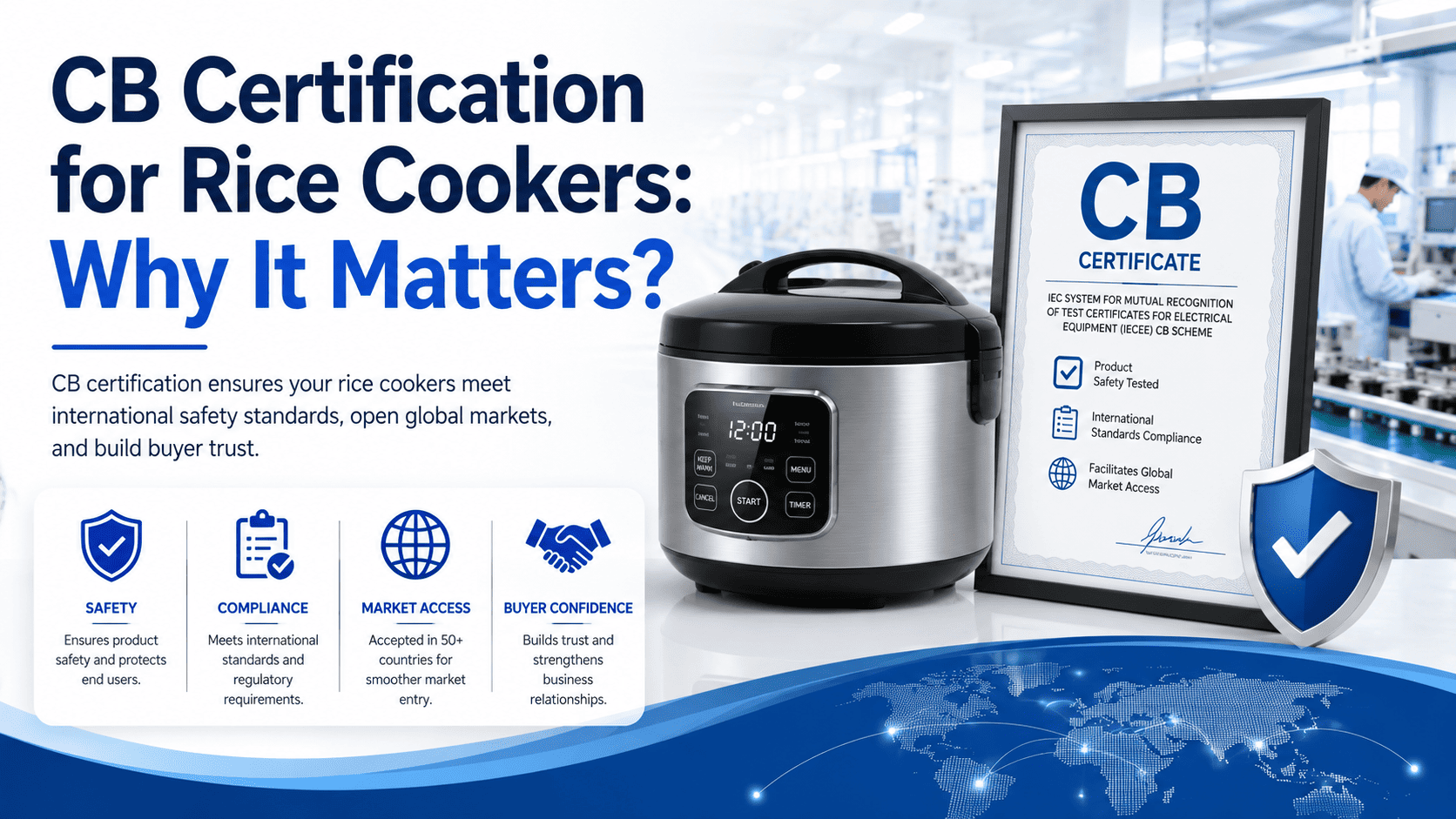
Worried about sourcing compliant rice cookers from overseas? Choosing a supplier with the wrong certification can lead to blocked shipments, costing you time and money. Understanding CB certification is your first step.
CB certification is a crucial tool for buyers to reduce sourcing risk.1 It shows a supplier’s rice cooker has passed international safety tests based on IEC standards2. This allows you to quickly verify a manufacturer's basic compliance capabilities before committing to a partnership, making your procurement process safer.
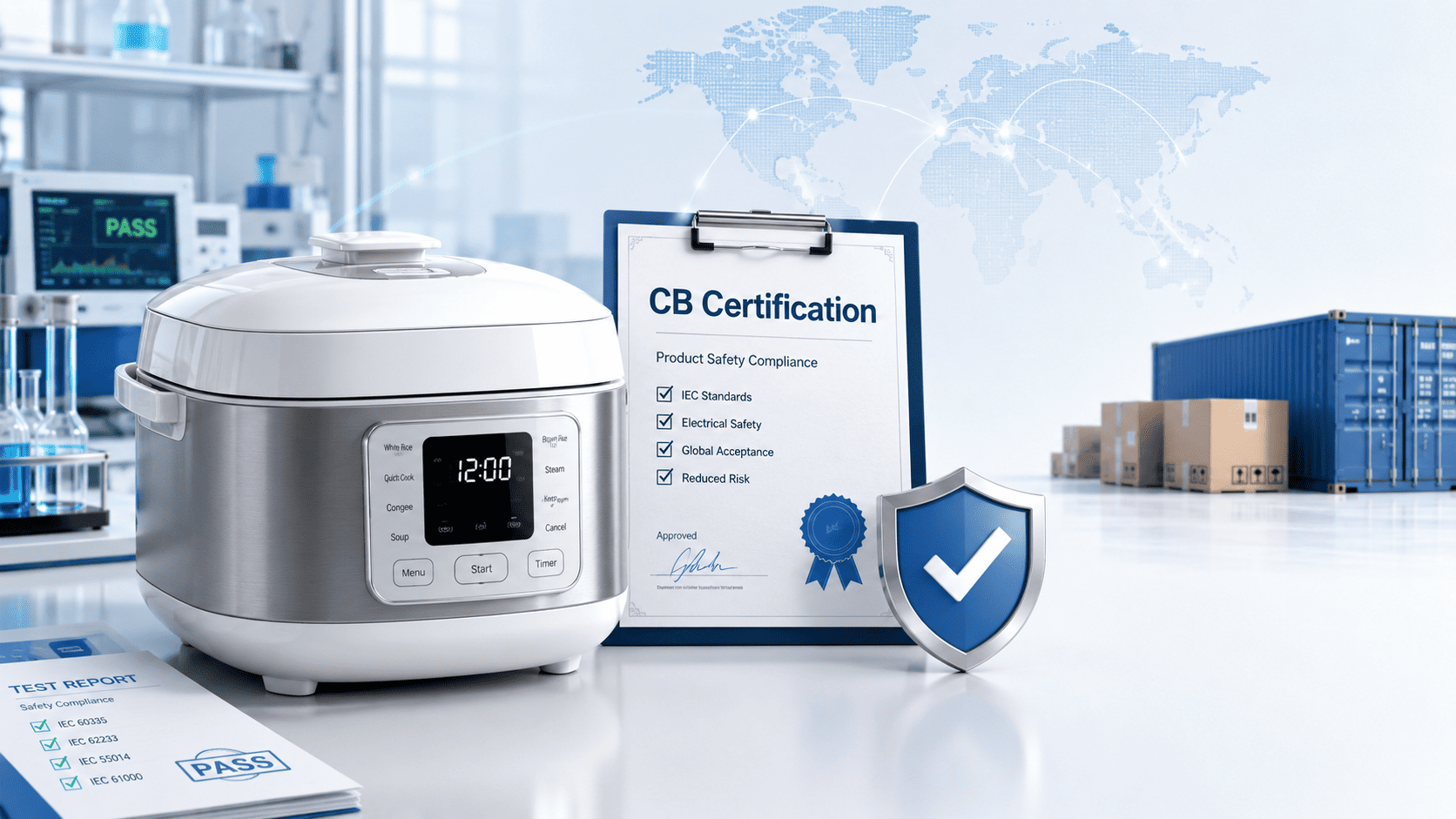
So, you've found a supplier who says they have CB certification. That means you're good to go, right? It’s a great start, but it’s not the end of the story. In my experience, the real value of a CB certificate is in the details, and this is where many buyers miss the most important checks. This certification is more than just a piece of paper; it’s a powerful tool to assess a supplier, but only if you know how to use it correctly. Let’s dive into how it can really help you and what to look out for.
How Does CB Certification Really Help You Choose a Supplier?
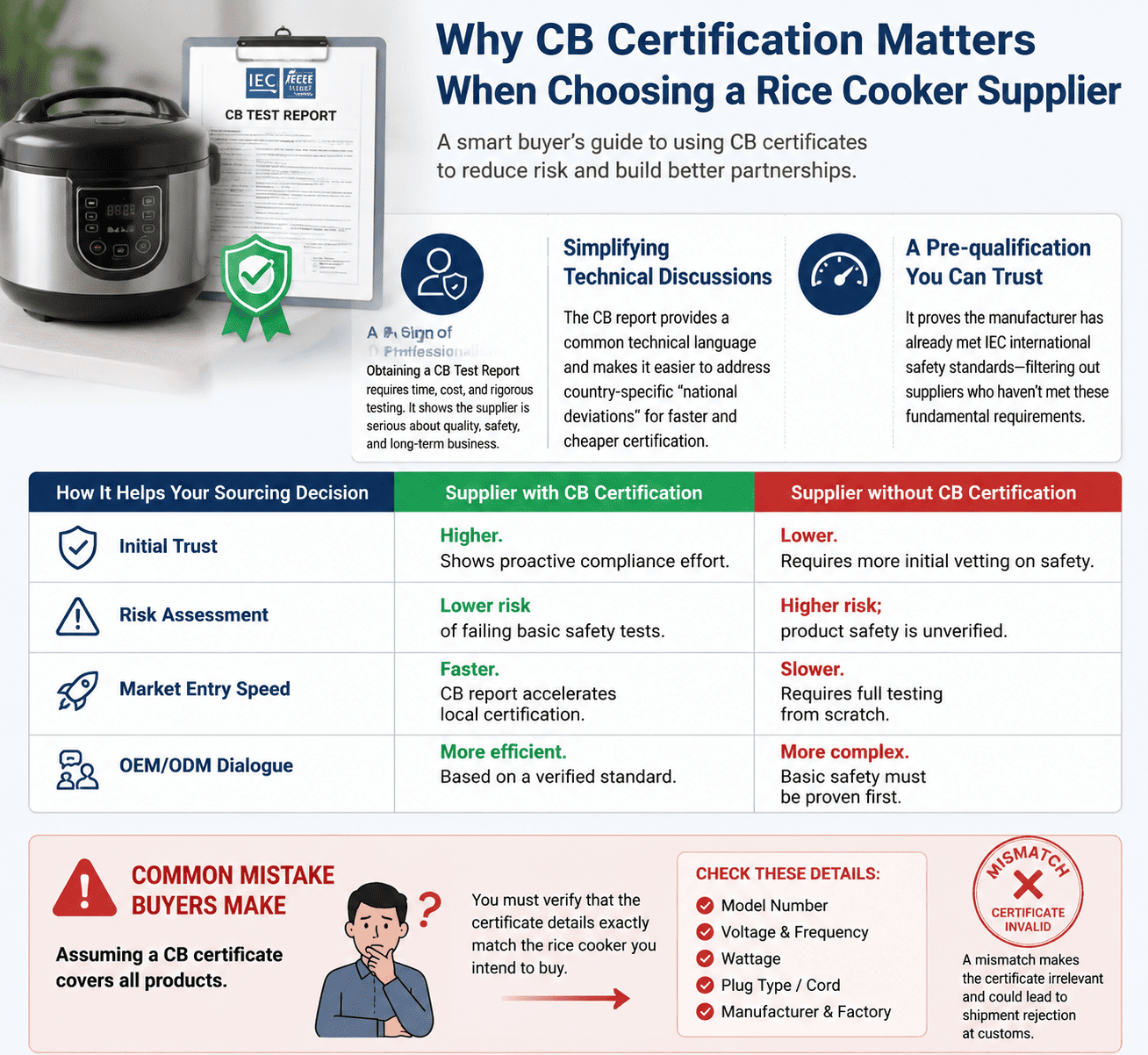
You're comparing multiple rice cooker suppliers, and they all claim to be reliable and professional. How do you separate the serious manufacturers from the ones who might cut corners on safety? A valid CB certificate is your first and most effective filter, proving a supplier has invested in meeting global standards.
CB certification helps you choose a supplier by acting as a baseline safety check. It proves the manufacturer’s product has been tested against IEC standards, which signals their capability and seriousness. This saves you time by filtering out suppliers who haven't met these fundamental international requirements.
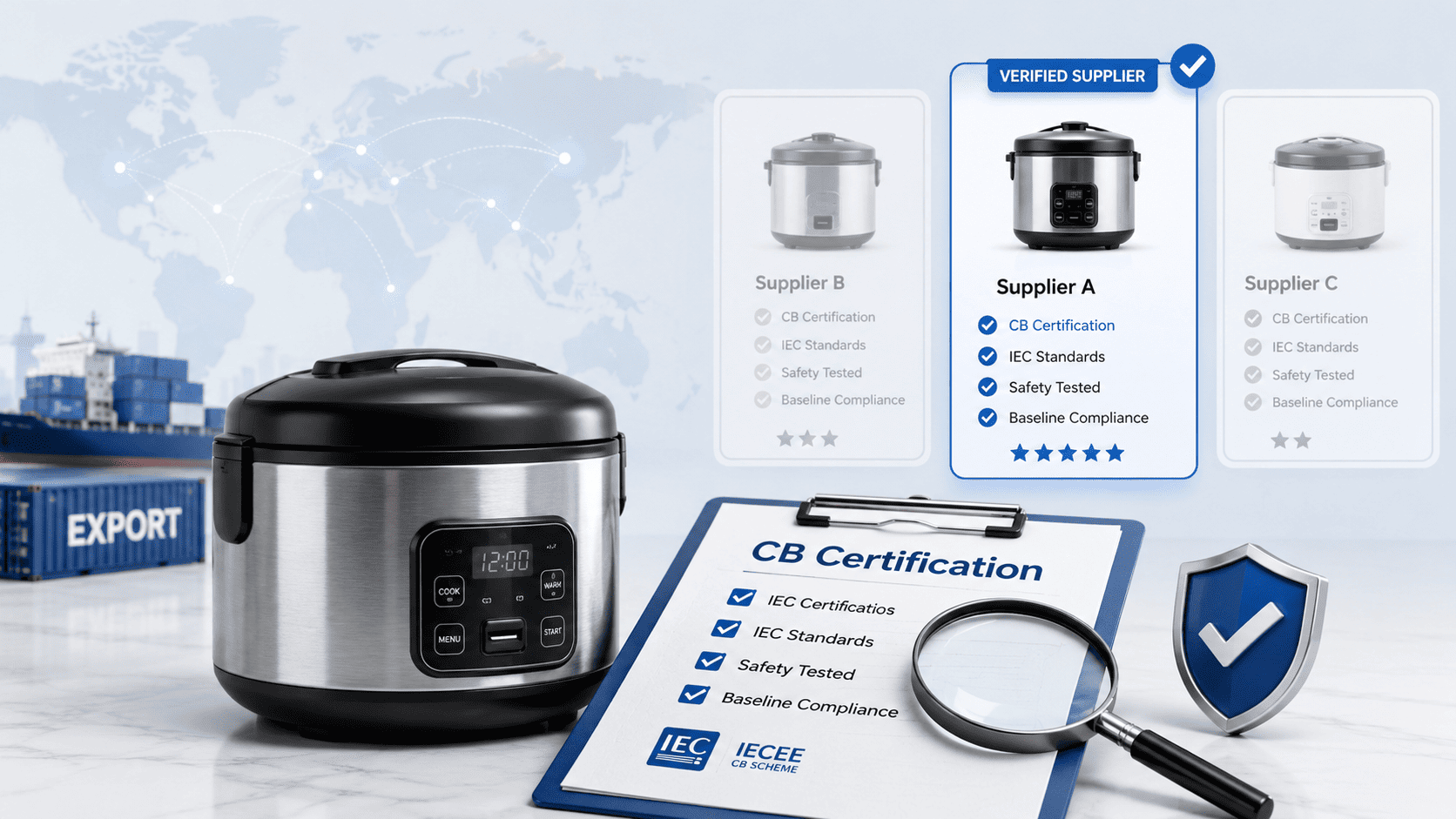
When I talk to procurement managers, they are often juggling dozens of potential suppliers. A CB certificate immediately tells them that a manufacturer isn't a beginner in the export market. It shows they've already invested time and money into a complex process, which is a strong indicator of their commitment to quality and safety. Think of it as a pre-qualification step that the supplier has already completed for you.
A Sign of Professionalism
Getting a CB Test Report isn't a simple or cheap process3. It requires submitting product samples to an accredited laboratory for rigorous testing against electrical safety standards. A supplier who voluntarily goes through this process is demonstrating that they are serious about long-term business and international compliance. In my 15+ years in this industry, I've seen that suppliers with valid CB reports are generally more organized, have better internal quality control, and communicate more effectively4 about technical requirements.
Simplifying Technical Discussions
Once you start talking about country-specific certifications, like KC for Korea or GS for Germany, having a CB report streamlines the entire conversation. The CB report provides a common technical language. Instead of starting from zero, the discussion becomes about "national deviations5"—the few extra requirements specific to your country. This makes the path to local certification much faster and cheaper6.
| Feature | Supplier with CB Certification | Supplier without CB Certification |
|---|---|---|
| Initial Trust | Higher. Shows proactive compliance effort. | Lower. Requires more initial vetting on safety. |
| Risk Assessment | Lower risk of failing basic safety tests. | Higher risk; product safety is unverified. |
| Market Entry Speed | Faster. CB report accelerates local certification. | Slower. Requires full testing from scratch. |
| OEM/ODM Dialogue | More efficient. Based on a verified standard. | More complex. Basic safety must be proven first. |
Are You Making This Common Mistake with CB Certificates?
You've found a supplier with a CB certificate for their rice cookers, which feels like a win. But if that certificate doesn't match the specific model you want to order, it's useless. This oversight could mean your shipment gets rejected at customs, a costly and entirely avoidable mistake.
The biggest mistake buyers make is assuming a supplier's CB certificate covers all their products.7 You must verify that the certificate details—like the model number, voltage, wattage, and plug type—exactly match the rice cooker you intend to buy. A mismatch makes the certificate irrelevant for your order.
I once had a conversation with a procurement manager from Thailand, let's call him Moo. He was about to sign a large OEM deal based on a CB certificate he had seen. He asked us to match the price. During our initial checks, I asked for the full test report. We quickly discovered the certificate was for a 120V model intended for the Americas, while Moo's market in Thailand requires 220V8. That single detail made the certificate completely invalid for his needs. Checking this saved him from a huge headache and a container of non-compliant products.
The Devil is in the Details
A CB Test Certificate is a highly detailed document. Simply seeing the "IECEE" logo isn't enough. You, or a trusted partner, need to read the fine print. Key information is often found on the first few pages and in the technical appendices.
Who is the Applicant?
Pay close attention to the "Applicant" and "Manufacturer" fields. Sometimes, a trading company will show you a certificate that actually belongs to the factory they source from. This isn't necessarily a red flag, but it's crucial for transparency. You need to know who is ultimately responsible for the product's compliance. As an OEM/ODM partner, we ensure our company name, Kenly, is clearly listed, so there is no confusion about who stands behind the product.
| Checklist Item | Why It's Important | What to Ask Your Supplier |
|---|---|---|
| Model Number | Ensures the certificate applies to the exact product you are buying. | "Can you confirm this CB report covers model DR-180?" |
| Rated Voltage/Wattage | Must match your target market's electrical system (e.g., 220V vs. 120V). | "Is the tested voltage on this report 220-240V for my market?" |
| Plug and Cordset | The tested components must be the ones used in your final product. | "Does the report cover the BS plug we need for our market?" |
| Applicant/Manufacturer | Verifies the certificate belongs to your supplier, not a third party. | "Is your company name listed as the manufacturer on this report?" |
Does CB Certification Guarantee Your Rice Cooker Can Enter Any Market?
You might think a CB certificate is a golden ticket for global sales. This assumption can lead to unexpected delays and costs when you discover your target market has additional, mandatory local rules. The truth is, CB is a powerful foundation, but it is not the final approval for market entry.
No, CB certification does not guarantee entry into any market. It is a valuable stepping stone. Most countries and regions have their own mandatory marks (like CE, UKCA, KC, GS). A CB report can simplify and speed up the process of getting these local certifications, but it doesn't replace them.
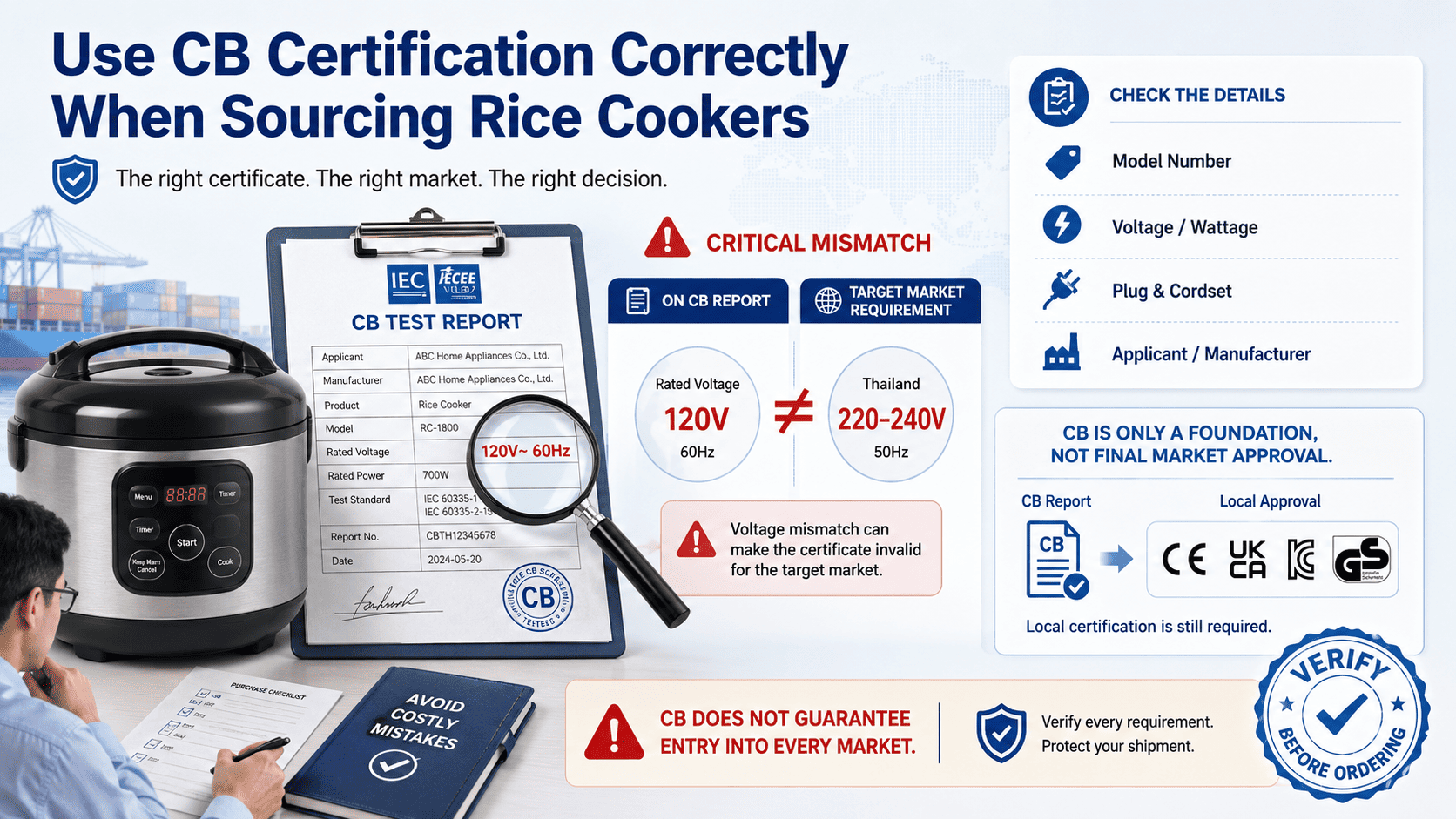
The IECEE CB Scheme is an international agreement among member countries to recognize each other's safety test results.9 It's designed to reduce the need for duplicate testing. So, instead of conducting a full set of safety tests for Europe, then another full set for Korea, you can use one CB test report as the technical basis for both applications. This saves a tremendous amount of time and money, but it doesn't mean you can skip the local application process.
From CB Report to National Mark
The typical process works like this: you take your supplier's valid CB test report and submit it to a National Certification Body (NCB) in your target country. They will review the report. If the international IEC standard used for the CB test is fully harmonized with their national standard, the process may be very quick. If there are "national deviations" (special rules for that country), the NCB may require a few additional tests. Once satisfied, they will issue the local mark you need to legally sell the product.
OEM/ODM and Specification Changes
This is a critical point in OEM/ODM discussions. Let's say a buyer wants to customize a rice cooker that already has a CB certificate. If they ask to change a critical component, like the heating element or thermostat, to a different model to reduce costs, the existing CB certificate may no longer be valid. Any change to a critical safety component requires a re-evaluation and possibly a new or updated test report.10 As a manufacturer, it is my responsibility to have this conversation transparently with my clients. We have to balance customization with compliance to avoid any issues down the road.
| Target Market | National Mark | How CB Helps |
|---|---|---|
| European Union | CE Mark (LVD) | The CB report serves as strong technical evidence for the LVD Declaration of Conformity.11 |
| United Kingdom | UKCA Mark | Similar to CE, a CB report helps demonstrate safety compliance for the UK market. |
| South Korea | KC Mark | The CB report can be used to waive some tests, significantly reducing time and cost for KC certification. |
| Germany | GS Mark | A CB report is often a prerequisite for getting the voluntary but highly respected GS mark.12 |
Conclusion
CB certification is a vital starting point for sourcing rice cookers, but smart buyers must check the details and understand it's a tool for risk management, not a final guarantee.
"CB Scheme - IECEE", https://www.iecee.org/who-we-are/cb-scheme. The International Electrotechnical Commission for Electrical Equipment (IECEE) describes its CB Scheme as a multilateral agreement to allow international acceptance of product safety test reports and certificates, aiming to reduce trade barriers caused by different national certification criteria. Evidence role: definition; source type: institution. Supports: The source should explain that the IECEE CB Scheme's goal is to facilitate trade by providing a framework for mutual recognition of safety test results, thereby reducing risks and costs for manufacturers and importers.. ↩
"International Electrotechnical Commission - Wikipedia", https://en.wikipedia.org/wiki/International_Electrotechnical_Commission. The International Electrotechnical Commission (IEC) is a global, not-for-profit organization that prepares and publishes international standards for all electrical, electronic, and related technologies, which form the basis for testing within the CB Scheme. Evidence role: definition; source type: institution. Supports: The source should define the International Electrotechnical Commission (IEC) and its function in developing and publishing international standards for electrical and electronic technologies.. ↩
"IECEE CB Scheme Certification for Global Market Access - Intertek", https://www.intertek.com/product-certification-marks/cb-scheme/. Certification bodies describe the process for obtaining a CB Test Report as a multi-step procedure involving technical documentation review, product sample testing against relevant IEC standards, and potentially factory audits, which entails significant investment in time and resources. Evidence role: general_support; source type: other. Supports: The source should outline the typical process for obtaining a CB Test Report, including application, sample submission, laboratory testing, and factory inspection, which illustrates the complexity and associated costs.. Scope note: Specific costs vary widely by product, laboratory, and country, so sources typically provide a process overview rather than exact figures. ↩
"Pros and Cons of Working in Manufacturing | Goodwin University", https://www.goodwin.edu/enews/pros-and-cons-of-working-manufacturing/. Industry analysis suggests that the rigorous requirements for obtaining international product certifications often compel manufacturers to develop more sophisticated internal quality control systems and technical communication protocols, which can be an indicator of overall supplier reliability. Evidence role: general_support; source type: other. Supports: The source should discuss how the process of achieving international certifications like CB often requires manufacturers to implement robust quality management systems and technical documentation practices.. Scope note: The source would support a correlation between certification and supplier organization, not a direct causal link. ↩
"About us - IECEE", https://www.iecee.org/who-we-are/about-us. The IECEE defines 'national deviations' as specific local requirements, regulations, or standards in a member country that differ from the corresponding IEC standard, which must be addressed with additional testing or evaluation before a national mark can be granted. Evidence role: definition; source type: institution. Supports: The source should define 'national deviations' in the context of the IECEE CB Scheme and explain that they are country-specific requirements not covered by the harmonized IEC standard.. ↩
"IECEE CB Scheme Certification for Global Market Access - Intertek", https://www.intertek.com/product-certification-marks/cb-scheme/. Certification bodies note that leveraging a CB Test Report can reduce the time and expense of obtaining national certifications by up to 70-80% by eliminating the need for duplicative testing, requiring only an evaluation for national deviations. Evidence role: general_support; source type: other. Supports: The source should explain that using an existing CB Test Report can eliminate the need for redundant product safety testing when applying for national marks, leading to significant reductions in both certification costs and time-to-market.. Scope note: The exact savings are dependent on the target country's harmonization with IEC standards and the specific product. ↩
"[PDF] FAA and Industry Guide to Product Certification", https://www.faa.gov/sites/faa.gov/files/aircraft/air_cert/design_approvals/transport/CPI_guide.pdf. Compliance and sourcing experts frequently caution buyers to verify that a CB certificate's details, particularly the product model number and technical specifications, precisely match the goods being purchased, as a mismatch invalidates the certificate for that order. Evidence role: expert_consensus; source type: other. Supports: The source should warn importers that a CB certificate is specific to the exact model, manufacturer, and critical components listed, and that it should not be assumed to cover a supplier's entire product line.. ↩
"Mains electricity - Wikipedia", https://en.wikipedia.org/wiki/Mains_electricity. The International Electrotechnical Commission (IEC) World Plugs guide lists the standard voltage in Thailand as 220V with a frequency of 50 Hz. Evidence role: statistic; source type: encyclopedia. Supports: The source should list the standard residential voltage and frequency for Thailand.. ↩
"IECEE - Wikipedia", https://en.wikipedia.org/wiki/IECEE. The IECEE officially defines its CB Scheme as a system for the mutual recognition of test certificates for electrical and electronic components, equipment, and products, based on a multilateral agreement among participating countries and certification organizations. Evidence role: definition; source type: institution. Supports: The source should be an official page from the IECEE that defines the CB Scheme and its function as a system for mutual recognition of test certificates.. ↩
"Electrical Safety for Research", https://ehs.virginia.edu/Electrical-Safety/Research. Certification bodies state that any modification to a certified product involving a 'critical component'—such as a power supply, switch, or safety interlock—requires a conformity assessment to determine if the existing certification remains valid or if additional testing is needed. Evidence role: mechanism; source type: other. Supports: The source should explain the rules for modifying a product that has already received CB certification, noting that changes to critical components necessitate a formal review or re-testing.. ↩
"A complete guide to CE marking and CB certification of electrical ...", https://certification-experts.com/a-complete-guide-to-ce-marking-and-cb-certification-of-electrical-equipment/. European Commission guidance on the Low Voltage Directive (LVD) clarifies that while a CB report is not a substitute for a Declaration of Conformity, it can serve as key technical documentation within the required technical file to support the manufacturer's claim of compliance with the directive's safety objectives. Evidence role: mechanism; source type: government. Supports: The source should explain that for CE marking, manufacturers must compile a technical file to prove compliance with directives like the LVD, and a CB report based on harmonized EN/IEC standards is considered strong evidence of this.. ↩
"GS Mark | US | TÜV Rheinland", https://www.tuv.com/usa/en/gs-mark.html. German certification bodies, such as TÜV SÜD, explain that while the GS Mark has its own requirements under the German Product Safety Act (ProdSG), a valid CB Test Report and Certificate can be used to demonstrate compliance with many of the core safety standards, thus serving as a foundation for the GS Mark application. Evidence role: mechanism; source type: government. Supports: The source should describe the process for obtaining the GS Mark and explain how a valid CB Test Report can be used as the basis for the application, streamlining the process.. ↩