When I first joined Kenly 12 years ago as a post-sales handler, I thought thermal fuses were the simplest component in our rice cookers. They're small, cheap—usually less than 20 cents per unit—and tucked away where users never see them.
Then a distributor in Southeast Asia called about a shipment where three units caught fire during normal cooking. The root cause? A thermal fuse that did not open when the heating element overheated. That single batch nearly cost them their market position and taught me that the smallest component often carries the largest liability.
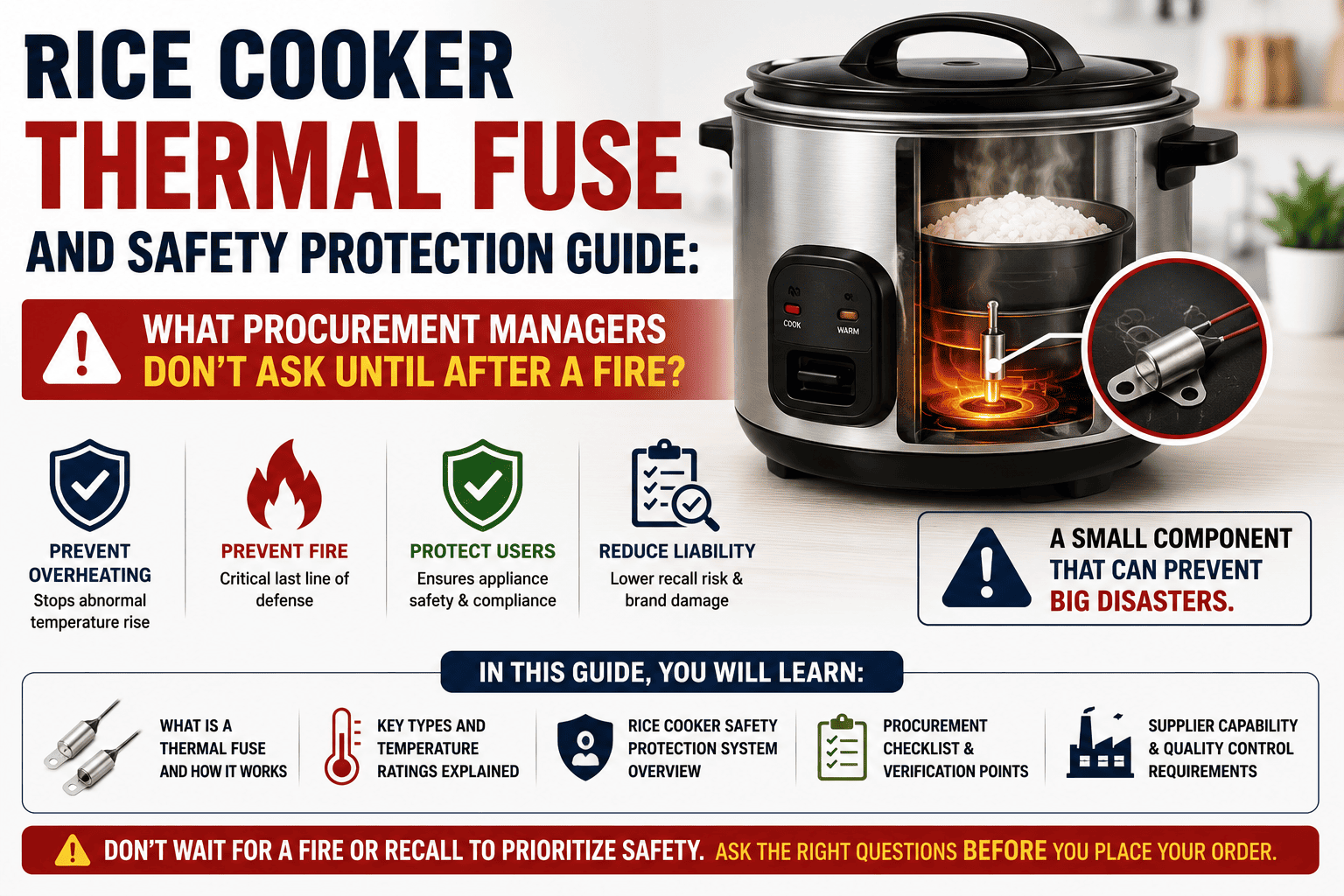
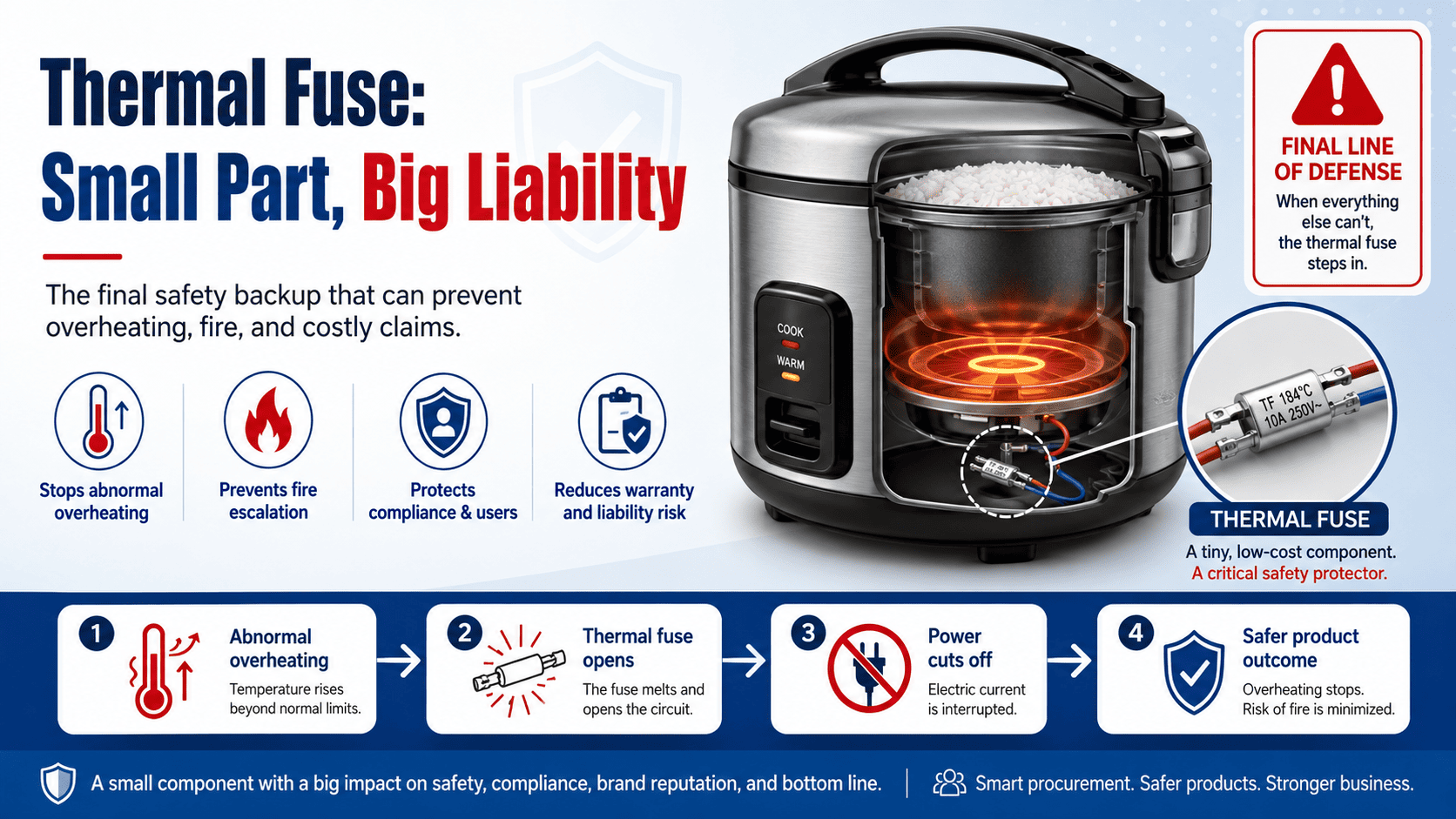
The thermal fuse in your rice cooker serves a safety and compliance function, not just an operational one. It is the final line of defense that can determine whether an abnormal overheating event becomes a routine repair, a warranty claim, or a product-liability case. Buyers who treat it as a simple cost-reduction component may unknowingly assume responsibility for validating the substituted part.
Most procurement managers ask about thermal fuse specifications only when reviewing cost-reduction proposals from suppliers. The conversation usually starts with:
“Can we use a cheaper fuse to lower the unit price?”
What buyers often do not realize is that changing a safety-critical component can trigger a chain reaction involving component approval, product testing, certification documentation, production traceability, and legal responsibility.
The key procurement decision is not simply which temperature rating to choose. It is whether to use the component covered by the approved product design or accept responsibility for validating an alternative.
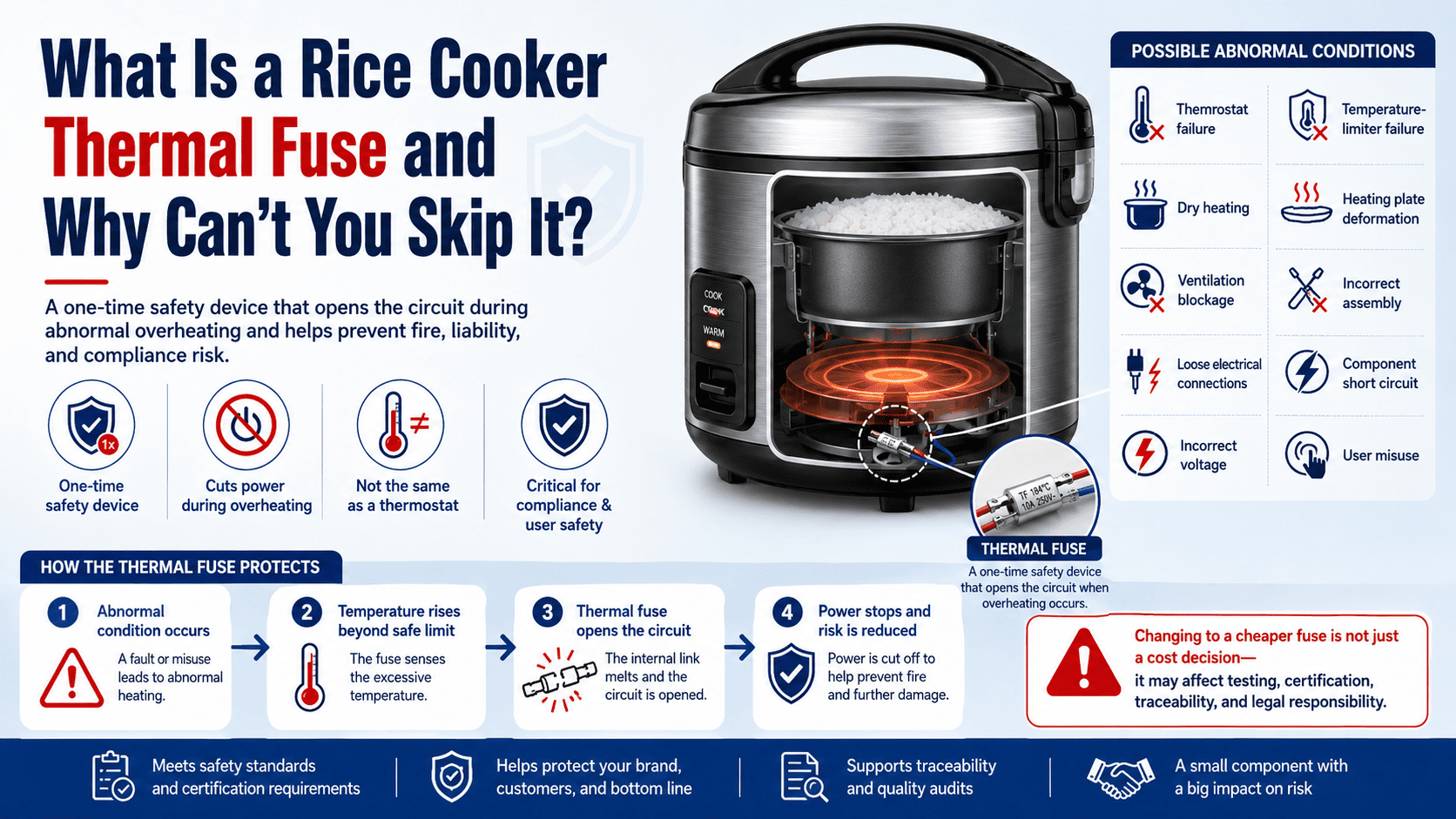
What Is a Rice Cooker Thermal Fuse and Why Can't You Skip It?
Buyers sometimes confuse thermal fuses with standard electrical fuses or resettable thermostats. I have reviewed email discussions where procurement teams asked to:
- Replace the thermal fuse with a resettable control
- Use a higher-temperature fuse to avoid premature failures
- Remove one safety device because another thermostat was already installed
- Use a cheaper fuse with the same temperature printed on its body
These requests reveal a misunderstanding of how thermal protection works in heat-generating appliances.
A thermal fuse is a one-time, temperature-sensitive safety device. It permanently opens the electrical circuit when the temperature at its installation point exceeds its specified operating threshold.
Unlike a thermostat that repeatedly switches during normal cooking, a thermal fuse should activate only during an abnormal overheating condition.
Possible abnormal conditions include:
- Thermostat failure
- Temperature-limiter failure
- Dry heating
- Heating plate deformation
- Ventilation blockage
- Incorrect assembly
- Loose electrical connections
- Component short circuit
- Incorrect voltage
- User misuse
- Insulation damage
In a typical rice cooker safety design, thermal protection may include several layers:
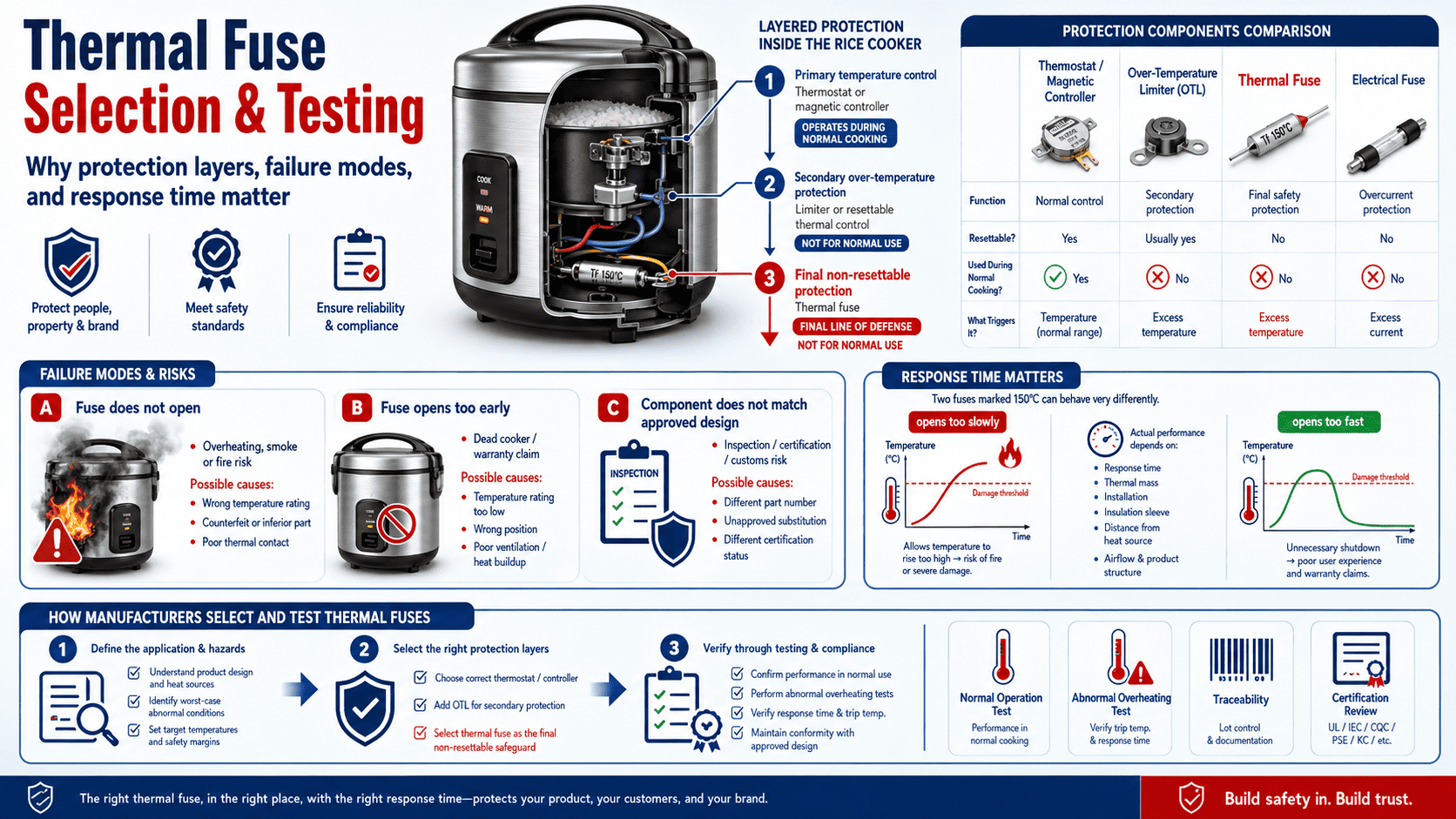
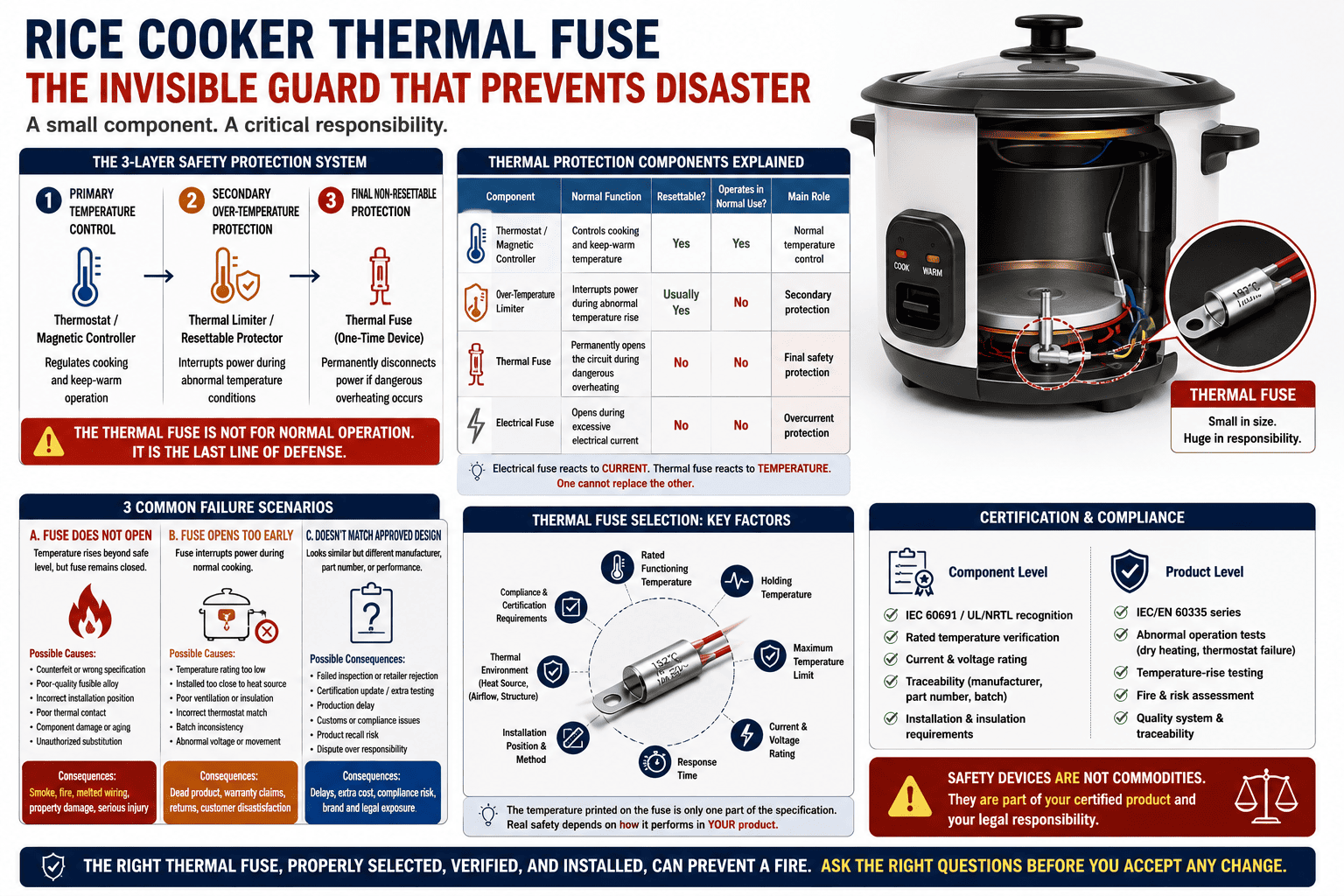
- Primary temperature control: The thermostat or magnetic temperature controller regulates cooking and keep-warm operation.
- Secondary over-temperature protection: A temperature limiter or resettable thermal control interrupts power under abnormal temperature conditions.
- Final non-resettable protection: The thermal fuse permanently disconnects power if the previous controls fail and the temperature continues rising.
The exact protection structure depends on the rice cooker design and applicable safety standard. The important point is that the thermal fuse is not intended to regulate normal cooking. It exists to stop an abnormal event from escalating.
The Difference Between a Thermostat, Thermal Limiter, and Thermal Fuse
| Component | Normal Function | Resettable? | Expected to Operate During Normal Use? | Main Role |
|---|---|---|---|---|
| Thermostat or magnetic controller | Controls cooking and keep-warm temperature | Yes | Yes | Normal temperature control |
| Over-temperature limiter | Interrupts power during abnormal temperature rise | Usually yes | No | Secondary protection |
| Thermal fuse | Permanently opens the circuit during dangerous overheating | No | No | Final safety protection |
| Electrical fuse | Opens during excessive electrical current | No | No | Overcurrent protection |
An electrical fuse responds mainly to excessive current. A thermal fuse responds mainly to temperature. One cannot automatically replace the other.
The Legal Function vs. Operational Function Gap
Here is where buyers often make their first procurement mistake.
They ask:
“What temperature rating should we use?”
A better question is:
“Which thermal fuse and installation method were evaluated as part of the approved product design?”
Thermal fuse failures generally fall into three categories.
Failure Type A: The Fuse Does Not Open
The temperature rises beyond the safe condition, but the fuse remains electrically closed.
Possible causes include:
- Counterfeit component
- Wrong temperature rating
- Poor-quality fusible alloy
- Excessive thermal lag
- Incorrect installation position
- Poor thermal contact
- Damaged fuse from assembly
- Component degradation during storage
- Unauthorized material substitution
The result may include melted wiring, deformed plastic, smoke, or fire.
Failure Type B: The Fuse Opens Too Early
The fuse interrupts power during normal cooking or keep-warm operation.
Possible causes include:
- Temperature rating too low
- Fuse installed too close to the heating source
- Incorrect insulation sleeve
- Excessive wattage
- Poor ventilation
- Incorrect thermostat matching
- Batch inconsistency
- Abnormal voltage
- Mechanical movement after assembly
The result is usually a dead rice cooker, warranty claim, retailer return, or customer complaint.
Failure Type C: The Component Does Not Match the Approved Design
The fuse may appear technically similar, but the manufacturer, part number, performance data, dimensions, or certification status differ from the approved component.
Possible consequences include:
- Failed buyer inspection
- Retailer rejection
- Additional laboratory review
- Certification update
- Production delay
- Customs questions
- Product recall risk
- Dispute over responsibility
Each failure type comes from treating the thermal fuse as an isolated commodity rather than as part of a complete thermal-protection system.
Why Response Time Matters Alongside Temperature Rating
A common misconception is that every thermal fuse marked 150°C performs identically.
It does not.
Thermal fuse performance depends on:
- Rated functioning temperature
- Holding temperature
- Maximum temperature limit
- Current rating
- Voltage rating
- Thermal mass
- Fuse-body dimensions
- Fusible-alloy design
- Installation pressure
- Insulation sleeve
- Distance from the heat source
- Rate of temperature increase
- Airflow around the fuse
IEC 60730-related standards establish requirements for automatic electrical controls1, while IEC 60691 specifically addresses thermal-links2.
The temperature printed on the fuse is only one part of the specification. Buyers should also evaluate how the component behaves in the actual rice cooker structure.
A fuse that opens too slowly may allow nearby wiring or plastic parts to reach damaging temperatures. A fuse that heats too quickly may open during an acceptable short-term temperature rise.
For this reason, the complete product—not only the fuse—must be evaluated under normal and abnormal operating conditions.
How Do Manufacturers Select and Test Thermal Fuses?
Buyers sometimes assume thermal fuse selection is a lookup exercise:
- Measure the normal operating temperature
- Add a safety margin
- Choose a fuse
- Start production
Real product development is more complicated.
Thermal fuse selection requires balancing three objectives:
- Prevent premature opening
- Interrupt dangerous overheating quickly enough
- Maintain conformity with the approved product design
A supplier evaluating a thermal fuse should consider:
- Normal cooking temperature
- Keep-warm temperature
- Maximum abnormal temperature
- Heating element wattage
- Product capacity
- Voltage and frequency
- Thermostat type
- Thermal limiter setting
- Fuse position
- Fuse mounting method
- Insulation material
- Ambient temperature
- Plastic-body temperature limit
- Wiring temperature rating
- Abnormal-operation test results
A supplier offering a cheaper fuse with the same printed temperature should be able to explain whether the replacement has the same:
- Physical dimensions
- Current and voltage rating
- Holding temperature
- Functioning temperature
- Maximum temperature limit
- Certification status
- Manufacturer traceability
- Installation requirements
- Response characteristics
The Hidden Validation Responsibilities Buyers May Inherit
When buyers designate their own thermal fuse supplier, they may assume responsibilities they did not intend to accept.
1. Batch Consistency Verification
A rice cooker factory can inspect:
- Markings
- Dimensions
- Appearance
- Electrical continuity
- Terminal condition
- Packaging
- Supplier documents
However, routine incoming inspection may not fully verify:
- Exact fusible-alloy composition
- Thermal response profile
- Long-term aging
- Humidity resistance
- Vibration resistance
- Performance after repeated temperature cycling
If the buyer selects the component supplier, the buyer should confirm who is responsible for validating these characteristics.
2. Regulatory Traceability
CE technical documentation must support conformity of the product placed on the market3. For CB and national certification schemes, safety-critical component information may also appear in the test report or critical-component list.
The buyer should be able to connect the production component with:
- Component manufacturer
- Part number
- Specification sheet
- Certification file
- Test report
- Purchase record
- Incoming inspection record
- Production batch
- Finished product model
A generic data sheet without manufacturer identification is weak evidence.
3. Compatibility Validation
The same thermal fuse may not be suitable for every model variation.
Changing any of the following may affect the thermal environment:
- Capacity
- Wattage
- Heating plate
- Thermostat
- Insulation
- Bottom-cover structure
- Ventilation holes
- Internal wiring
- Fuse location
- Mounting clip
- Product voltage
- Body material
A fuse approved in a 500W 1.8L rice cooker should not automatically be assumed suitable for a 900W 5L model.
What Can Factory Incoming Inspection Actually Verify?
Buyers sometimes see “100% testing” in a factory presentation and assume every thermal characteristic is verified on every fuse.
That is rarely practical.
A responsible factory should clearly explain what it tests directly and what it verifies through supplier documentation.
What Can Be Checked During Routine Incoming Inspection?
Possible incoming checks include:
- Component marking
- Manufacturer identification
- Part number
- Rated functioning temperature
- Voltage and current rating
- Body dimensions
- Lead length
- Lead condition
- Insulation sleeve
- Packaging damage
- Electrical continuity
- Supplier batch number
- Certificate or declaration
- Quantity
- Appearance defects
For example:
- Visual inspection: Component markings, physical damage, terminal condition
- Electrical continuity: Confirms that the fuse is electrically closed at room temperature
- Dimensional inspection: Confirms that the fuse fits the approved mounting structure
- Document verification: Confirms that the supplier, part number, and certification match the approved list
What Usually Requires Specialized Testing?
The following checks may require specialized equipment or third-party laboratory support:
- Functioning-temperature verification
- Holding-temperature verification
- Thermal response-time testing
- Long-term temperature cycling
- Humidity aging
- Vibration testing
- Metallurgical analysis
- Fusible-alloy composition
- Destructive abnormal-operation testing
- Product-level fire-risk evaluation
Routine factory inspection cannot replace product certification and component qualification.
The correct approach is to combine:
- Qualified component supplier
- Valid component documentation
- Incoming inspection
- Controlled installation
- Product-level safety testing
- Batch traceability
- Change control
Certification Requirements for Rice Cooker Thermal Fuses
Thermal fuses are safety-critical components. Their certification requirements should be reviewed at both component level and complete-product level.
The exact requirement depends on the target market, conformity route, product standard, certification body, and final rice cooker design.
Component-Level Requirements
A thermal fuse may need supporting evidence based on standards such as IEC 606912 or an applicable UL/NRTL component-recognition standard.
Buyers should confirm:
| Component Information | What to Verify |
|---|---|
| Manufacturer | Full legal manufacturer name |
| Part number | Exact production part number |
| Rated functioning temperature | Temperature specified by component manufacturer |
| Holding temperature | Maximum temperature at which it should remain closed under defined conditions |
| Maximum temperature limit | Upper permitted component exposure |
| Current rating | Must support the product's operating current |
| Voltage rating | Must match or exceed product voltage requirements |
| Certification file | IEC, UL/NRTL, or other applicable evidence |
| Dimensions | Must match the approved mounting structure |
| Lead material and length | Must match assembly and temperature requirements |
| Insulation sleeve | Material and temperature rating |
| Production location | Where required for traceability |
Product-Level Requirements
The complete rice cooker may be assessed under household-appliance safety standards such as IEC/EN 60335 and applicable national requirements.
At product level, the test laboratory may evaluate:
- Normal temperature rise
- Abnormal operation
- Thermostat failure
- Dry heating
- Ventilation blockage
- Component fault conditions
- Wiring temperature
- Plastic-part temperature
- Accessibility of live parts
- Insulation strength
- Fire risk
- Protection-device operation
The thermal fuse must work together with the:
- Thermostat
- Over-temperature limiter
- Heating element
- Internal wiring
- Thermal insulation
- Housing
- Mounting system
A component certificate alone does not prove that the final rice cooker is safe.
CE and European Market Documentation
The Low Voltage Directive 2014/35/EU4 applies to relevant household electrical appliances placed on the EU market.
The LVD allows manufacturer conformity assessment through internal production control when applicable. It does not universally require notified-body certification for every rice cooker. However, manufacturers must maintain technical evidence supporting conformity.
Useful documentation may include:
- EU Declaration of Conformity
- Product safety test report
- CB report where used
- Critical-component list
- Circuit diagram
- Bill of materials
- Thermal fuse data sheet
- Component certification
- Risk assessment
- Rating label
- Product photos
- User manual
- Production-control records
CB Scheme Considerations
The IECEE CB Scheme5 facilitates international acceptance of electrical-product test reports.
Buyers should verify that the CB report matches the final product in:
- Model number
- Voltage
- Frequency
- Wattage
- Capacity
- Heating element
- Thermostat
- Thermal fuse
- Power cord
- Plug
- Internal wiring
- Production factory
A CB report may support applications for national approvals, but additional national requirements can still apply.
UK Market Considerations
Requirements for products placed on the Great Britain market may involve CE or UKCA arrangements depending on current rules and product category. Buyers should verify the current applicable route before shipment.
Useful records may include:
- Declaration of conformity
- Safety test report
- Critical-component list
- Thermal fuse documentation
- UK importer information
- English manual
- Rating label
- Technical file
Current UK guidance should be checked before market entry6.
Other Market Requirements
Depending on destination, buyers may also need to review:
- KC certification for South Korea
- SAA/RCM requirements for Australia
- UL or ETL requirements for North America
- PSE requirements for Japan
- INMETRO requirements for Brazil
- G-Mark or local conformity programs in Middle Eastern markets
- Country-specific registration or energy-efficiency requirements
Do not assume one certificate automatically covers every country.
Changes That May Require Certification Review
Ask the laboratory or certification body before changing:
- Thermal fuse manufacturer
- Thermal fuse part number
- Rated functioning temperature
- Current rating
- Voltage rating
- Fuse dimensions
- Installation position
- Mounting clip
- Insulation sleeve
- Heating element
- Thermostat
- Temperature limiter
- Wiring
- Plastic material
- Product wattage
- Voltage
- Capacity
- Ventilation design
Even if two fuses have the same printed temperature, the substitution may still require technical review.
Factory Capability: What a Reliable Rice Cooker Supplier Should Support
A reliable supplier should manage the thermal fuse as part of a controlled safety system, not as a low-cost purchasing item.
| Factory Capability | What Buyers Should Verify | Why It Matters |
|---|---|---|
| Approved supplier control | Defined list of approved thermal fuse manufacturers and part numbers | Prevents unauthorized sourcing |
| Incoming inspection | Marking, continuity, dimensions, appearance, documents, and batch number | Reduces wrong-component risk |
| Component traceability | Supplier lot linked to production batch | Supports recalls and root-cause analysis |
| Controlled storage | Dry, clean, separated storage with proper identification | Prevents damage and mixing |
| Installation work instruction | Defined position, crimping, sleeve, spacing, and mounting method | Fuse performance depends on installation |
| First-piece approval | Initial units checked before mass production | Finds assembly errors early |
| 100% electrical testing | High-voltage, grounding, continuity, wattage, and function tests where applicable | Controls production safety |
| Abnormal-operation testing | Product tested under defined fault conditions during development or validation | Confirms protection-system behavior |
| Test-equipment calibration | Current calibration records and defined testing limits | Improves measurement reliability |
| Critical-component change control | Written approval before thermal fuse substitution | Protects certification and buyer specification |
| Certification support | CB, CE, KC, UKCA, SAA, or other documentation where applicable | Reduces market-entry delays |
| Retention samples | Samples retained from production batches | Supports complaint investigation |
| Corrective action system | Root-cause analysis and preventive action after failures | Prevents repeated problems |
| After-sales traceability | Ability to identify affected batch and component lot | Limits recall scope and claim cost |
What Buyers Should Observe During a Factory Audit
During a factory audit or video inspection, check:
- Are thermal fuses stored separately by manufacturer and part number?
- Are boxes clearly marked with batch information?
- Can the factory show purchase records?
- Can it show incoming inspection records?
- Is the approved component listed in the BOM?
- Is the fuse installation position shown in a work instruction?
- Are workers using the correct insulation sleeve?
- Is the lead crimped rather than improperly soldered near the fuse body?
- Is the fuse protected from excessive mechanical stress?
- Are safety tests performed on actual production units?
- Are testing machines calibrated?
- Are failed units separated and recorded?
- Can the factory trace a finished product to a component batch?
- Is subcontracting involved in thermal fuse installation or wiring?
Thermal Fuse Installation Capability
Even a high-quality fuse can fail if installed incorrectly.
Important installation controls include:
- Correct distance from heating plate
- Correct thermal contact
- Correct insulation sleeve
- Correct lead bending
- Correct crimping
- No excessive soldering heat near the fuse body
- No mechanical pressure on the fuse
- Secure mounting
- Sufficient clearance from sharp metal parts
- Protection from vibration
- Correct wire temperature rating
- Correct terminal connection
The buyer should not evaluate only the component brand. The installation method is equally important.
Change-Control Capability
A good factory should have a written process for component changes.
The process should include:
- Supplier identifies the proposed change
- Reason for change is documented
- New component documents are provided
- Engineering comparison is completed
- Certification impact is reviewed
- Samples are produced
- Required tests are completed
- Buyer approval is received in writing
- BOM and work instructions are updated
- Production records identify the effective change date
A supplier that changes a safety-critical component without notification creates unnecessary risk for both parties.
What Questions Should You Ask Your Rice Cooker Supplier About Thermal Fuses?
Most RFQ templates ask:
“What safety certificates do you have?”
That question is not enough.
A certificate may confirm that a product was tested, but it does not prove that your production order will use the same safety-critical components.
Questions About Component Traceability
“Which thermal fuse manufacturer and part number do you use?”
The supplier should be able to provide:
- Manufacturer name
- Part number
- Temperature rating
- Voltage rating
- Current rating
- Technical data sheet
- Applicable component certification
- Critical-component listing where available
If the supplier provides only a generic data sheet without manufacturer identification, ask for stronger evidence.
“Can you provide the component certification documents?”
Useful documents may include:
- IEC 60691 certificate or report
- UL/NRTL component-recognition information
- Manufacturer declaration
- Technical specification sheet
- Batch certificate where available
- Test report
- Critical-component-list reference
“How do you trace the fuse to my production batch?”
The supplier should explain how it connects:
- Incoming batch
- Warehouse record
- Production line
- Production date
- Finished product batch
- Shipment
- Retention sample
Questions About Incoming Quality Control
“Which parameters do you inspect directly?”
A clear answer may include:
- Marking
- Appearance
- Dimensions
- Lead length
- Continuity
- Packaging
- Supplier batch
- Documentation
“Which parameters are verified through supplier or laboratory reports?”
A realistic answer may include:
- Functioning temperature
- Holding temperature
- Response behavior
- Long-term aging
- Alloy composition
Be cautious if the supplier claims to perform complete thermal-performance testing on every incoming fuse but cannot show the equipment and records.
Questions About Component Substitution
“Under what circumstances would you change the thermal fuse?”
Possible reasons include:
- Component discontinuation
- Long delivery time
- Supplier quality problem
- Price increase
- Certification update
- Material shortage
The key issue is not whether change is ever allowed. It is whether the buyer is informed and the change is validated.
“Do you require written buyer approval before changing a safety-critical component?”
The purchase agreement should clearly state that thermal fuse substitutions require written approval.
“If I nominate my own fuse supplier, what documents and testing do you require?”
Possible requirements include:
- Component certification
- Technical specification
- Manufacturer identification
- Samples
- Dimensional drawing
- Performance report
- Certification review
- Product-level validation
- Written responsibility agreement
Questions About Production and Testing
- Is the fuse installed on your own production line?
- Is any wiring work subcontracted?
- How is the fuse mounted?
- How do you prevent excessive soldering heat?
- Do you use crimping?
- Is the fuse position checked?
- Is continuity tested after assembly?
- Is high-voltage testing performed?
- Is grounding tested?
- Is wattage tested?
- Are abnormal-operation tests available from product development?
- Do you retain production samples?
- How are failed units investigated?
Questions About Long-Term Support
“What happens if the original fuse is discontinued?”
The supplier should have a process for:
- Remaining-stock review
- Replacement evaluation
- Certification review
- Sample approval
- Buyer notification
- Test-report update
- BOM revision
“What documents will you provide for customs and market compliance?”
Requirements vary, but the supplier may need to provide:
- Declaration of conformity
- CB certificate and report
- Product safety report
- Component information
- Rating label
- Manual
- Technical file documents
- Local certification documents
- Factory information
- Importer information
Buyer Checklist: Thermal Fuse and Safety Protection
Use this checklist before confirming the sample, purchase order, or mass production.
1. Product Configuration
- What is the rice cooker capacity?
- What is the rated wattage?
- What is the voltage and frequency?
- What type of thermostat is used?
- Is there a secondary temperature limiter?
- Where is the thermal fuse installed?
- What plastic and wire materials are near the fuse?
- Does the final configuration match the test report?
2. Thermal Fuse Specification
- Who is the manufacturer?
- What is the exact part number?
- What is the rated functioning temperature?
- What is the holding temperature?
- What is the maximum temperature limit?
- What is the voltage rating?
- What is the current rating?
- What are the fuse dimensions?
- What lead material and length are used?
- What insulation sleeve is used?
- Is the component listed in the approved BOM?
3. Certification Documentation
- Is there IEC 60691 or applicable component evidence?
- Is there UL/NRTL recognition where required?
- Is the fuse included in the product's critical-component list?
- Does the product test report cover the exact model?
- Does the report match voltage, wattage, capacity, and factory?
- Does the target market require additional approval?
- Does a proposed substitution require laboratory review?
4. Supplier and Factory Control
- Is the component supplier approved?
- Are incoming batches inspected?
- Are batch numbers recorded?
- Is the fuse stored separately?
- Is the material traceable to production?
- Is the installation process documented?
- Is first-piece approval performed?
- Are workers trained?
- Is testing equipment calibrated?
- Are failed components quarantined?
5. Product Testing
- Has the product completed normal temperature-rise testing?
- Has it completed abnormal-operation testing?
- Has thermostat failure been evaluated?
- Has dry-heating behavior been evaluated?
- Has ventilation blockage been evaluated?
- Does the fuse open before nearby materials reach dangerous temperatures?
- Are internal wires protected?
- Is the thermal fuse still correctly positioned after vibration or transport?
6. Change Control
- Does the contract prohibit unauthorized substitutions?
- Must the supplier provide advance written notice?
- Must new samples be approved?
- Is certification review required?
- Who pays for retesting?
- Who owns the updated test report?
- Is the effective change date recorded?
- Can affected batches be identified?
7. Pre-Shipment Inspection
- Does the fuse manufacturer match the approved specification?
- Does the part number match?
- Are markings readable?
- Is the fuse installed in the correct position?
- Is the insulation sleeve correct?
- Are leads damaged?
- Is the mounting secure?
- Are wiring connections correct?
- Do random units pass electrical testing?
- Are traceability records available?
8. Commercial and Liability Terms
- Who selected the thermal fuse?
- Who approved any substitution?
- Who is responsible for certification costs?
- What is the warranty period?
- How are safety complaints handled?
- Who pays for laboratory analysis?
- Who pays for recall or rework if the component is wrong?
- Is product-liability insurance required?
- Are incident-reporting procedures defined?
How Do Thermal Fuse Failures Impact Product Warranty and Liability?
The real cost of a thermal fuse decision appears after production—when warranty claims, retailer complaints, customs questions, or safety incidents occur.
Buyers often calculate the decision only in component-cost terms:
“Fuse A saves $0.15 per unit compared with Fuse B.”
For an order of 10,000 units, that saving equals $1,500.
That number looks attractive until the buyer considers the possible cost of:
- Product replacements
- Reverse logistics
- Retailer deductions
- Laboratory investigation
- Legal review
- Product recall
- Warehouse inspection
- Rework
- Lost sales
- Marketplace suspension
- Brand damage
- Property-damage claims
An Illustrative Cost Comparison
| Cost Item | Possible Impact |
|---|---|
| Component saving on 10,000 units | $1,500 |
| 100 additional warranty replacements at $30 each | $3,000 |
| Independent failure analysis | $1,000–$5,000 |
| Warehouse inspection or rework | Depends on location and quantity |
| Retailer penalty | Contract-specific |
| Product recall | Potentially much higher |
| Property-damage or injury claim | Potentially severe |
One safety incident can exceed the savings created across many orders.
Warranty Cost
A thermal fuse that opens prematurely usually creates a non-functioning product rather than a fire.
The buyer may face:
- Customer refund
- Replacement unit
- Service-center labor
- Spare parts
- Shipping
- Retailer deduction
- Negative review
- Loss of repeat purchase
If premature-opening failures occur in the first few months, the buyer should investigate:
- Fuse temperature rating
- Installation position
- Product wattage
- Thermostat behavior
- Local voltage
- Maximum-capacity cooking
- User habits
- Ventilation
- Component batch
- Assembly consistency
Replacing the fuse without identifying the root cause may allow the problem to recur.
Product-Liability Exposure
A fuse that fails to open during dangerous overheating creates a more serious situation.
Potential consequences include:
- Melted product
- Smoke
- Fire
- Property damage
- Personal injury
- Insurance claim
- Regulatory investigation
- Recall
- Civil lawsuit
- Marketplace removal
The allocation of responsibility may depend on:
- Who designed the product
- Who selected the fuse
- Who approved the substitution
- Whether the production component matched the certified design
- Whether the manufacturer followed the approved BOM
- Whether the buyer requested a cost-reduction change
- Whether the importer fulfilled local obligations
- Whether warnings and instructions were adequate
- Whether the incident resulted from misuse
- Whether traceability records are complete
This is why safety-critical changes should always be documented.
Responsibility Matrix
| Situation | Main Questions to Investigate |
|---|---|
| Factory used an unapproved fuse | Did the factory violate the approved BOM or purchase specification? |
| Buyer nominated the fuse supplier | Did the buyer provide valid documentation and accept validation responsibility? |
| Fuse matched the approved specification but failed | Was it a component batch defect, installation problem, or design issue? |
| Buyer changed wattage after testing | Was the thermal-protection system revalidated? |
| Supplier changed component due to shortage | Was the buyer informed and was the change approved? |
| Customs rejects component documentation | Who was contractually responsible for compliance documents? |
| Product fire occurs | Did the fuse fail, was it installed correctly, and did the complete protection system function? |
What Should Happen After a Serious Safety Complaint?
A structured response should include:
- Record the incident details
- Obtain photos, videos, serial numbers, and purchase information
- Stop shipment of related batches if necessary
- Identify the production batch
- Identify the thermal fuse batch
- Secure retention samples
- Inspect warehouse stock
- Conduct independent analysis where appropriate
- Review certification documents
- Determine whether the incident is isolated or systematic
- Implement containment action
- Develop corrective and preventive action
- Inform regulators or retailers where legally required
- Document all decisions
Do not immediately blame the user, the fuse supplier, or the factory before completing the investigation.
Common Mistakes When Sourcing Thermal Fuses for Rice Cookers
Mistake 1: Comparing Only the Printed Temperature
Two fuses marked 150°C may differ in:
- Manufacturer
- Holding temperature
- Maximum temperature limit
- Response characteristics
- Dimensions
- Current rating
- Certification
- Quality consistency
The printed temperature alone is not enough.
Mistake 2: Choosing a Higher Temperature to Prevent Premature Opening
A higher-temperature fuse may reduce nuisance failures, but it may also allow the product to become dangerously hot before power is interrupted.
Do not raise the temperature rating without product-level safety validation.
Mistake 3: Replacing a Thermal Fuse With a Resettable Thermostat
The two components have different functions.
A resettable control may fail in a closed state. The non-resettable thermal fuse exists as final protection when other controls fail.
Mistake 4: Treating the Fuse as a Standalone Component
The fuse works as part of a system involving:
- Heating element
- Thermostat
- Temperature limiter
- Internal wiring
- Insulation
- Housing
- Ventilation
- Mounting position
Changing one element can affect the others.
Mistake 5: Accepting a Generic Data Sheet
A generic data sheet may not identify:
- Actual manufacturer
- Production location
- Certification file
- Exact part number
- Batch
- Test report
Require traceable documentation.
Mistake 6: Allowing Unauthorized Substitution
The contract should state that safety-critical components cannot be changed without written buyer approval and certification review.
Mistake 7: Relying Only on Continuity Testing
A fuse can pass room-temperature continuity testing and still fail under thermal stress.
Continuity testing confirms only that the fuse is currently closed.
Mistake 8: Ignoring Installation Position
A good fuse installed too far from the heat source may open too late. Installed too close, it may open during normal use.
Position and mounting must match the validated design.
Mistake 9: Applying Excessive Soldering Heat
Thermal fuses can be damaged during assembly if excessive heat travels through their leads.
The factory should follow the component manufacturer's installation instructions and use controlled connection methods.
Mistake 10: Changing Wattage Without Reviewing Protection
Increasing wattage changes the thermal environment. The thermostat, limiter, fuse, wiring, and insulation may all require review.
Mistake 11: Assuming CE or CB Covers Every Custom Version
A certificate or report for one model may not automatically cover changes to:
- Capacity
- Wattage
- Voltage
- Plug
- Heating element
- Thermostat
- Fuse
- Wiring
- Body structure
Review the exact report scope.
Mistake 12: Waiting Until Pre-Shipment Inspection
By pre-shipment inspection, thousands of units may already be assembled.
Thermal fuse control must begin during:
- Supplier qualification
- RFQ
- Sample development
- Certification
- BOM approval
- Incoming inspection
- Production
Mistake 13: Selecting a Buyer-Nominated Fuse Without Defining Responsibility
If the buyer nominates the component supplier, the agreement should define:
- Documentation requirements
- Incoming inspection
- Validation testing
- Certification costs
- Failure responsibility
- Claim handling
- Replacement cost
Mistake 14: Ignoring Traceability
Without batch traceability, one defective fuse lot may force a much larger inspection or recall than necessary.
FAQ About Rice Cooker Thermal Fuses
1. What does a thermal fuse do in a rice cooker?
A thermal fuse permanently disconnects electrical power when the temperature at its installation point reaches an abnormal level. It acts as final protection if normal temperature controls fail.
2. Is a thermal fuse the same as a thermostat?
No.
A thermostat controls normal cooking and keep-warm temperatures and usually resets automatically. A thermal fuse is non-resettable and should operate only during an abnormal overheating condition.
3. Can a rice cooker work without a thermal fuse?
A product may technically power on without one, but removing a safety device from a validated design can create serious safety and compliance risk.
The complete thermal-protection system must meet the applicable product standard.
4. What temperature rating should a rice cooker thermal fuse use?
There is no universal rating.
The correct selection depends on:
- Normal operating temperature
- Abnormal temperature
- Fuse location
- Wattage
- Capacity
- Thermostat
- Housing material
- Wiring
- Applicable safety tests
Use the rating validated for the specific product design.
5. Is a higher-temperature fuse better?
Not automatically.
A higher rating may prevent premature opening but may also delay protection during overheating. Any change should be evaluated through product-level testing.
6. Can I use a cheaper fuse with the same temperature rating?
Possibly, but only after confirming:
- Manufacturer
- Part number
- Certification
- Holding temperature
- Maximum temperature limit
- Current and voltage rating
- Dimensions
- Installation compatibility
- Product-test impact
The same printed temperature does not prove equivalence.
7. Does CE certification require a thermal fuse?
European appliance safety rules require the product to control thermal hazards. The exact protection method depends on the product design and applicable standard.
Many rice cooker designs use a thermal fuse as final protection, but buyers should review the actual test report rather than relying on a general assumption.
8. Does CB certification cover the thermal fuse?
The CB report may identify safety-critical components, including the thermal fuse manufacturer and part number. Check the critical-component list and report details.
9. What certification should the thermal fuse itself have?
Depending on market and conformity route, useful evidence may include IEC 60691 certification or applicable UL/NRTL component recognition.
Confirm the exact requirement with the product testing laboratory.
10. How can a factory test thermal fuses during incoming inspection?
Routine factory inspection may include:
- Marking
- Appearance
- Dimensions
- Electrical continuity
- Lead condition
- Packaging
- Batch number
- Document verification
Full thermal-performance testing usually requires specialized equipment.
11. Can the factory test every fuse at its functioning temperature?
Testing every fuse until it opens would destroy every component because thermal fuses are non-resettable.
Factories therefore rely on qualified suppliers, certification, batch testing, documentation, and sample-based verification.
12. Why does a thermal fuse open during normal cooking?
Possible causes include:
- Rating too low
- Wrong installation position
- Excessive wattage
- Thermostat malfunction
- Poor ventilation
- Incorrect voltage
- Component inconsistency
- Assembly error
The product should be investigated rather than simply replacing the fuse.
13. Can a thermal fuse be replaced after it opens?
Technically, a qualified service technician may replace it after identifying and correcting the cause of overheating.
It should not be replaced without investigating why it opened.
14. Should the thermal fuse be soldered?
Installation should follow the component manufacturer's instructions.
Excessive soldering heat can damage a thermal fuse. Controlled crimping or other approved connection methods are commonly used.
15. Does changing the thermal fuse invalidate certification?
It may affect the approved product design.
The new component should be reviewed against the test report, critical-component list, certification-body rules, and complete product performance.
16. What should be included in the purchase order?
The purchase order or attached specification should include:
- Manufacturer
- Part number
- Rated functioning temperature
- Voltage rating
- Current rating
- Certification
- Dimensions
- Insulation sleeve
- Approved installation method
- Change-control requirement
- Traceability requirement
- Inspection standard
17. How can buyers prevent counterfeit thermal fuses?
Use:
- Approved manufacturers
- Authorized distributors
- Purchase records
- Component certification
- Batch traceability
- Incoming inspection
- Supplier audits
- Independent testing when justified
18. What is the biggest warning sign from a supplier?
A major warning sign is a supplier that agrees to change the thermal fuse immediately based only on price and printed temperature, without reviewing certification, installation, abnormal-operation testing, or liability.
Conclusion
The thermal fuse may cost only a few cents, but it protects one of the highest-risk failure points in a rice cooker.
Procurement managers should not evaluate it only by:
- Unit price
- Printed temperature
- Visual appearance
- Generic data sheet
- Supplier promise
A safer sourcing decision evaluates the complete system:
- Qualified thermal fuse manufacturer
- Exact part number
- Component certification
- Product-level safety testing
- Correct installation position
- Controlled assembly
- Incoming inspection
- Batch traceability
- Written change approval
- Clear allocation of responsibility
The right question is not:
“How much can we save by changing the fuse?”
The better questions are:
“Does the replacement match the validated safety design?”
“Who will verify its performance?”
“Will the certification documentation remain valid?”
“Who accepts responsibility if the substitution fails?”
A small component saving cannot justify an uncontrolled fire risk, certification problem, or product-liability dispute.
Use the certified design as your default. Require evidence before accepting alternatives. Put safety-critical component controls into the purchase order, BOM, inspection standard, and change-approval process.
That is how procurement managers prevent a thermal fuse discussion from becoming a product recall discussion.
"EN IEC 60730-1:2024 - Automatic Electrical Controls General", https://standards.iteh.ai/catalog/standards/clc/9c45c54e-54b1-4fc9-9ea4-2aa0c3f016c4/en-iec-60730-1-2024?srsltid=AfmBOopEypy7oIb_EpAQksAs8lU2C_qM-4F_2e7B_T48CF96ttk0oYGf. IEC 60730 series standards specify performance requirements for automatic electrical controls used in household appliances, including temperature-dependent switching characteristics. Evidence role: definition; source type: institution. Scope note: Precise terminology and test methods are defined across different parts of the standard. ↩
"EN IEC 60691:2023/A1:2024 - Thermal-links Guide", https://standards.iteh.ai/catalog/standards/sist/f8720fb9-732e-43cd-9015-34fd0ad5c3e0/sist-en-iec-60691-2024-a1-2025?srsltid=AfmBOoqHVJEVYjNNOSvNaqlH_2sEOpwEs0LRSahE5850M_8hWwDIjdfP. IEC 60691 specifies requirements and test methods for thermal-links used for safety purposes in electrical appliances. Evidence role: definition; source type: institution. ↩
"CE Marking", https://www.trade.gov/ce-marking. CE marking requires manufacturers to maintain technical documentation supporting conformity of the product placed on the market. Component specifications may form part of that evidence depending on the applicable legislation and conformity route. Evidence role: general support; source type: government. ↩
"Low Voltage Directive (LVD)", https://single-market-economy.ec.europa.eu/sectors/electrical-and-electronic-engineering-industries-eei/low-voltage-directive-lvd_en. The CE Low Voltage Directive and IEC 60335 household appliance standards require manufacturers to control thermal hazards as part of product safety design, though the specific protection method varies by appliance type and risk assessment. Evidence role: general support; source type: government. Scope note: Standards establish thermal-protection requirements generally rather than mandating the same thermal-fuse arrangement for every appliance. ↩
"IECEE CB Scheme Certification for Global Market Access", https://www.intertek.com/product-certification-marks/cb-scheme/. The CB Scheme facilitates international acceptance of test reports and certificates for electrical products. Additional national certification and production-surveillance requirements may apply. Evidence role: mechanism; source type: institution. ↩
"Placing UKCA or CE marked products on the market in Great Britain", https://www.gov.uk/guidance/placing-ukca-or-ce-marked-products-on-the-market-in-great-britain. UK guidance explains current arrangements for placing CE- or UKCA-marked products on the Great Britain market. Requirements vary by product category and conformity route, so current guidance should be checked before shipment. Evidence role: general support; source type: government. ↩