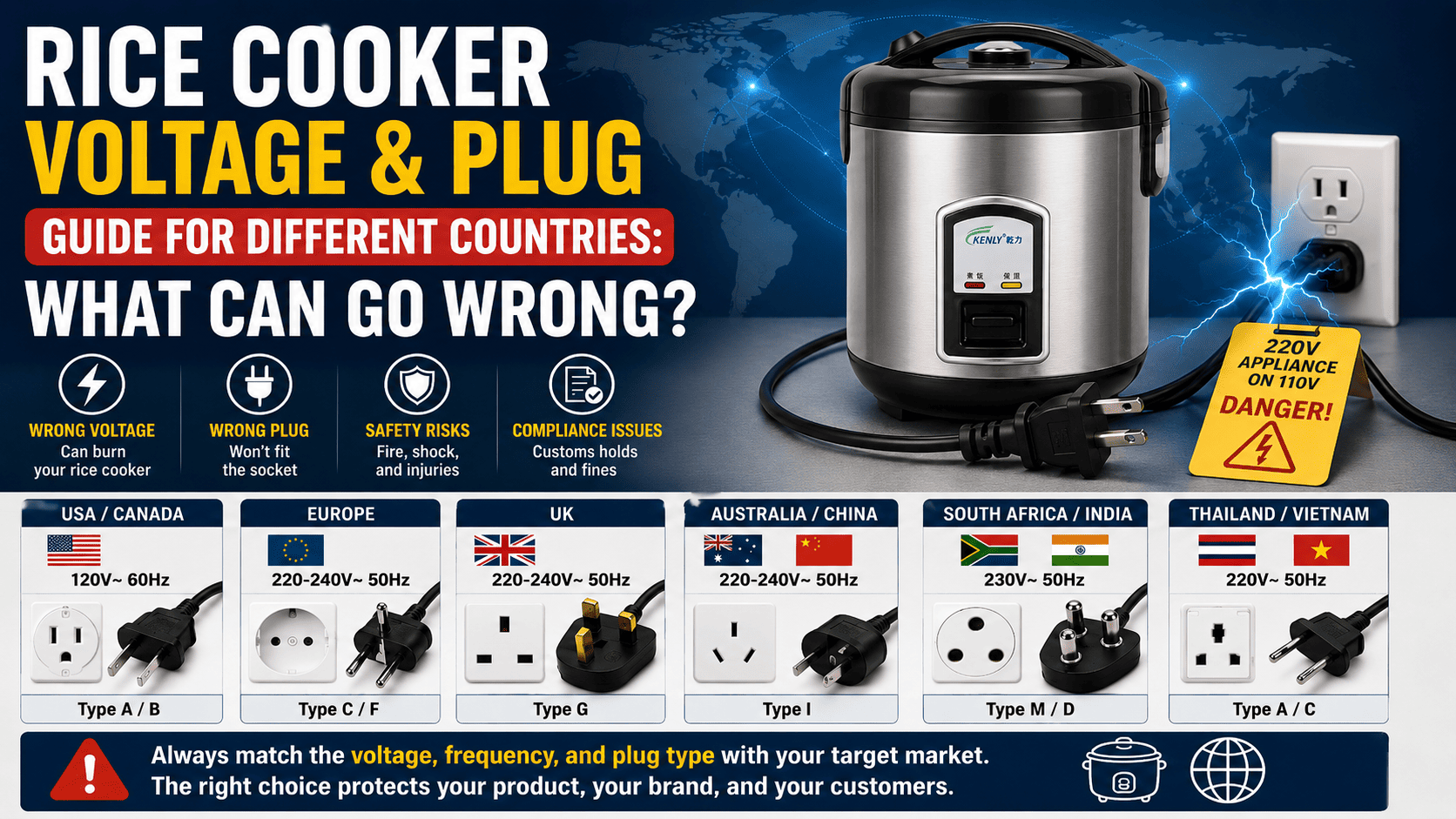
Three times in the past quarter, I've received urgent emails from procurement managers who ordered bulk rice cooker shipments only to discover—at the port or during sample testing—that their units won't power on in the target market. The issue isn't quality. It's voltage and plug mismatch. Most buyers assume that if the plug fits the wall socket, the rice cooker will work. This assumption costs thousands of dollars in rejected shipments, rushed reorders, and missed selling seasons.
Rice cooker voltage and plug compatibility depends on two separate specifications: your target market's electrical voltage (110V or 220V1) and the physical plug type (Type A, C, G2, etc.). A rice cooker with the correct plug for your country can still fail if its voltage doesn't match your mains supply. Before placing a sample or bulk order, verify both specifications independently—checking only plug type leads to three common sourcing failures: product won't power on during testing, bulk shipment rejected at port, or customer complaints after distribution.
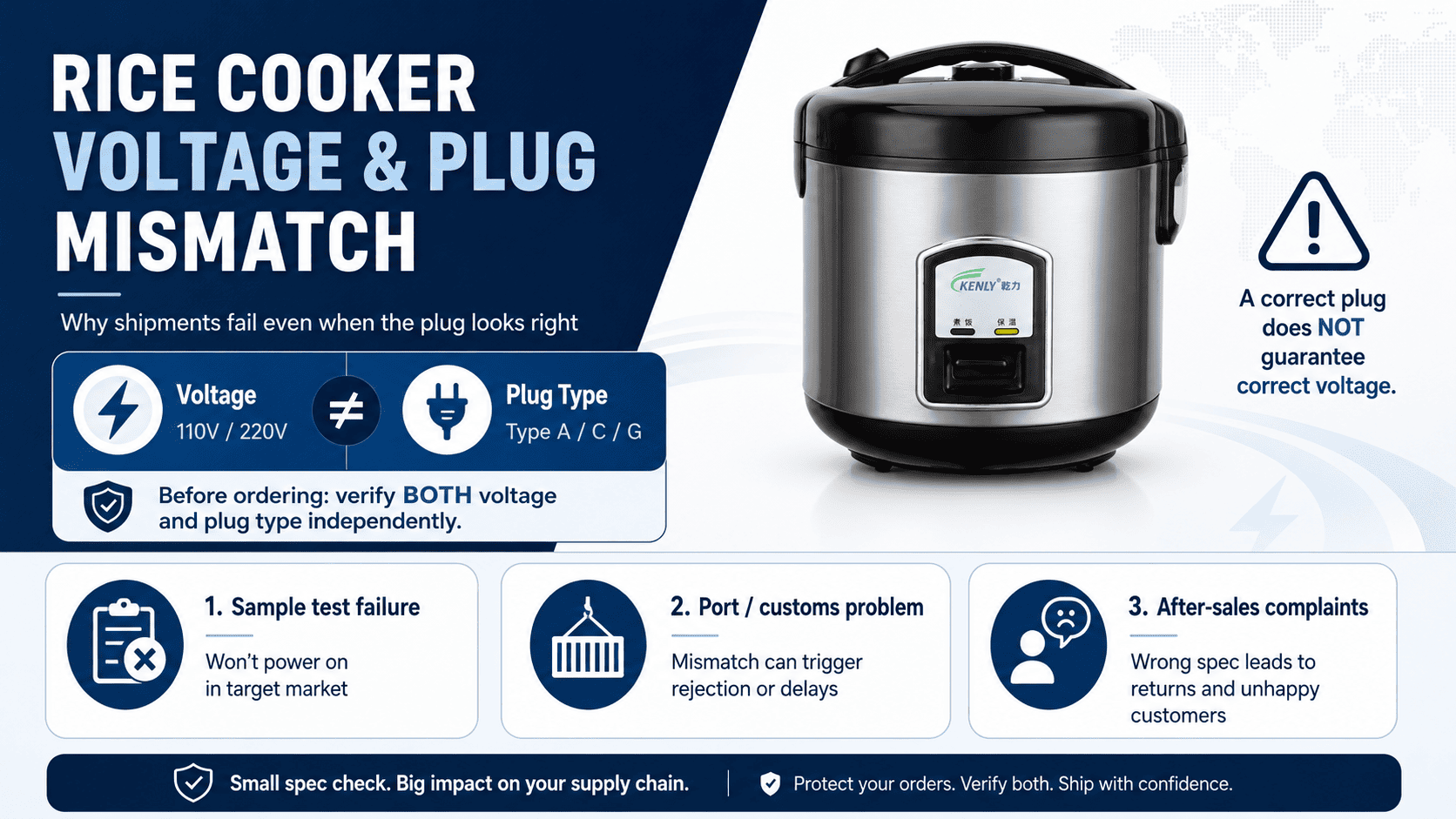
Understanding voltage and plug compatibility isn't about electrical engineering theory. It's about preventing costly mistakes that surface when your customer plugs in their first unit. I'll walk you through the verification steps that catch these errors before you commit to production.
Why Does Rice Cooker Voltage Matter More Than Plug Type?
I see this error most often: a buyer requests "European plugs" for a 220V market, receives samples, and everything works. Then they place a bulk order for the US market, request "American plugs," and the units arrive dead on arrival. The plug fits perfectly. The voltage kills the product.
Rice cooker voltage determines whether the heating element can safely convert electrical current into heat. A 220V rice cooker plugged into a 110V outlet (even with the correct plug adapter) will underheat and fail to cook rice. A 110V rice cooker plugged into a 220V outlet will overheat, potentially causing fire hazard or immediate component failure.
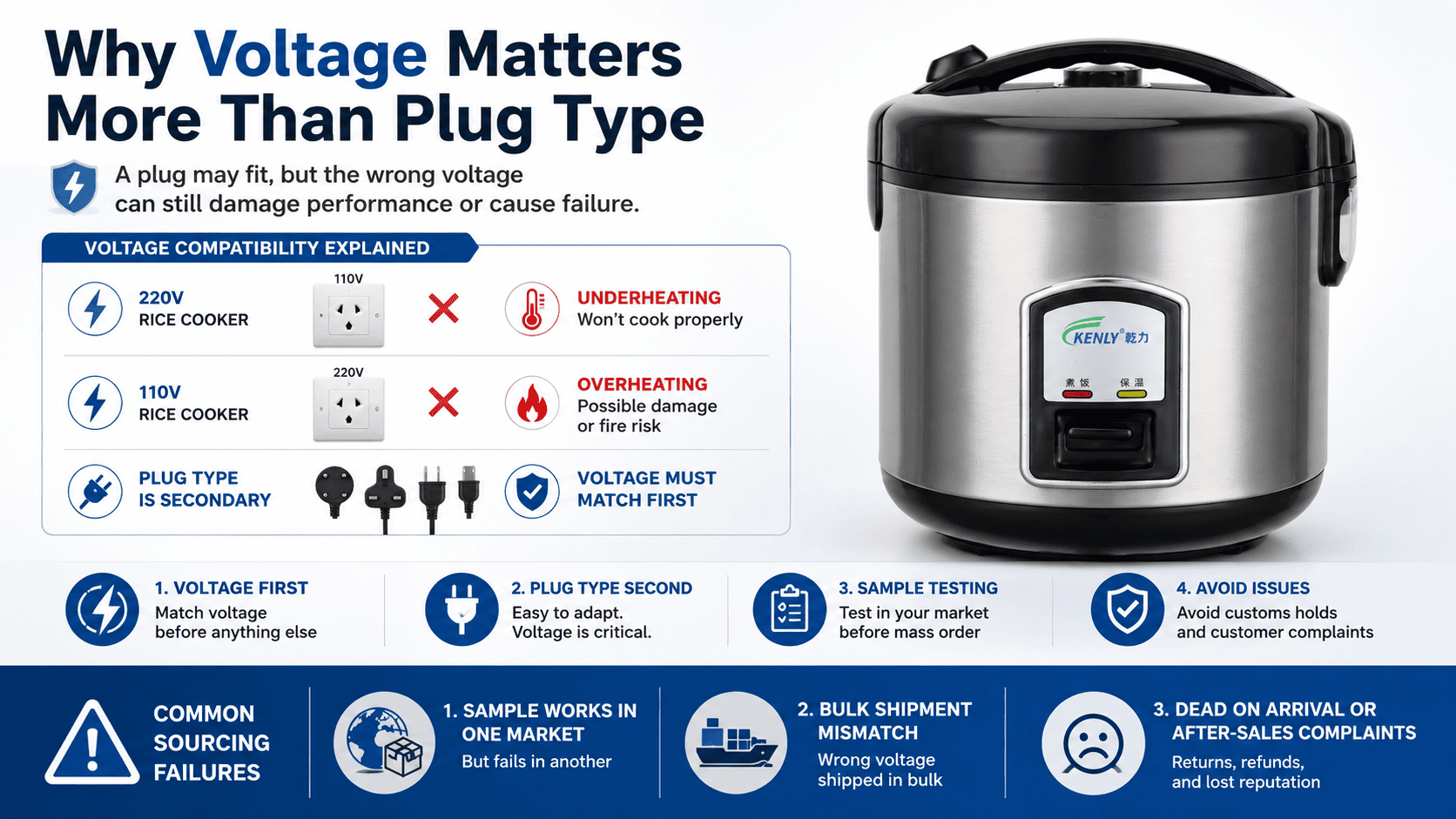
How Voltage Mismatch Destroys Rice Cookers
When I investigate customer complaints about "rice cooker won't cook" or "burned smell after 5 minutes," the root cause is almost always voltage mismatch. Here's what happens:
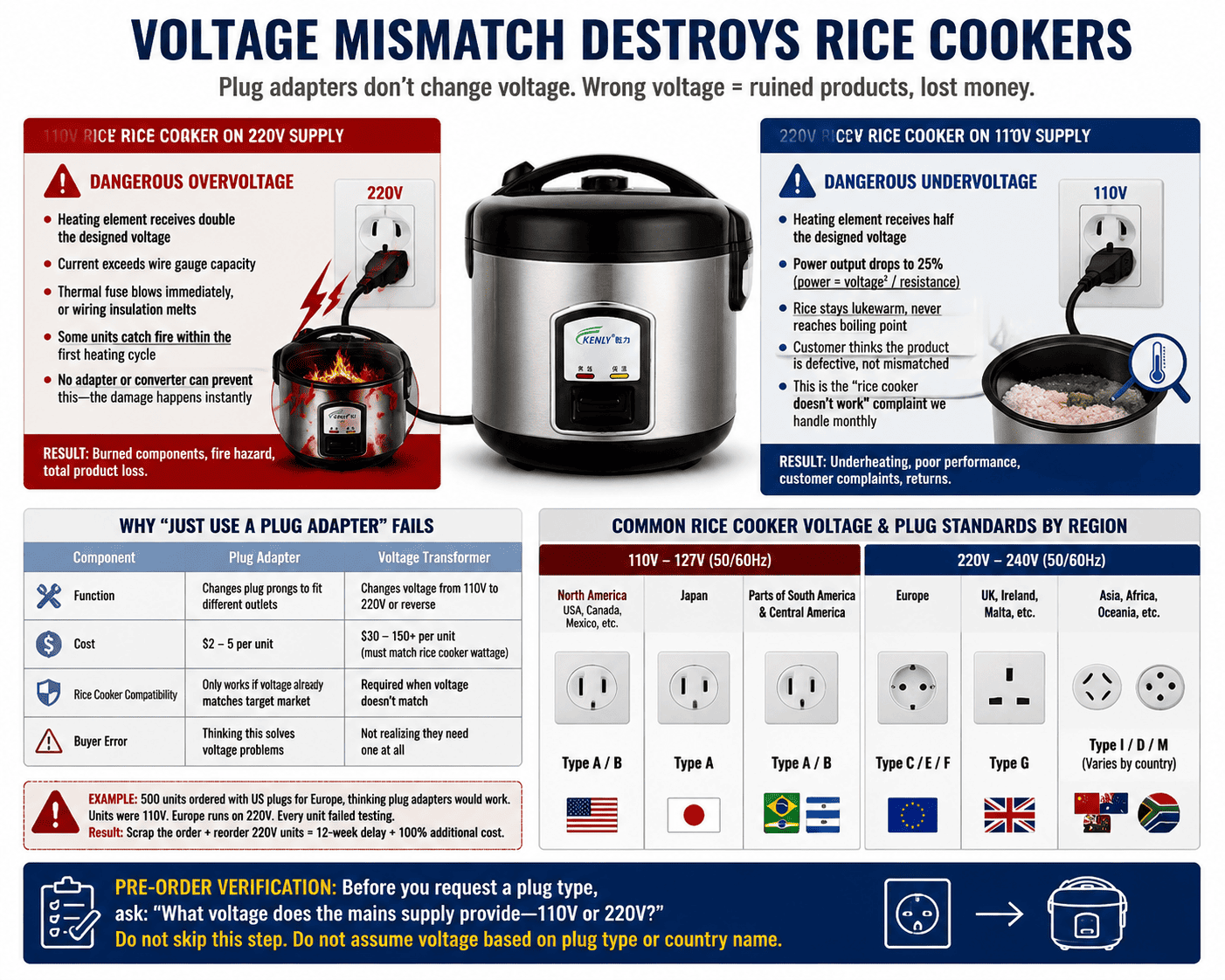
110V rice cooker on 220V supply:
- Heating element receives double the designed voltage
- Current exceeds wire gauge capacity
- Thermal fuse blows immediately3, or worse, wiring insulation melts
- Some units catch fire within the first heating cycle
- No adapter or converter can prevent this—the damage happens instantly
220V rice cooker on 110V supply:
- Heating element receives half the designed voltage
- Power output drops to 25% (power = voltage squared / resistance4)
- Rice stays lukewarm, never reaches boiling point
- Customer assumes the product is defective, not mismatched
- This is the "rice cooker doesn't work" complaint we handle monthly
I've processed warranty claims for entire shipments ruined this way. The buyer thought they were saving money by using plug adapters instead of ordering units built for the correct voltage. The cost: 100% product loss, zero salvage value.
Why "Just Use a Plug Adapter" Fails
A plug adapter changes the physical plug shape. It does not change voltage. This distinction prevents the most expensive sourcing error I see:
| Component | Plug Adapter | Voltage Transformer |
|---|---|---|
| Function | Changes plug prongs to fit different outlets | Changes voltage from 110V to 220V or reverse |
| Cost | $2–5 per unit | $30–150+ per unit (must match rice cooker wattage) |
| Rice Cooker Compatibility | Only works if voltage already matches target market | Required when voltage doesn't match |
| Buyer Error | Thinking this solves voltage problems | Not realizing they need one at all |
Three months ago, a buyer ordered 500 units with US plugs for the European market, assuming plug adapters would solve the problem. The units were 110V. Europe runs on 220V. Every single rice cooker failed sample testing. The buyer had to scrap the order and reorder 220V units with European plugs—a 12-week delay and 100% additional cost.
Pre-order verification: Before you request a plug type, ask your customer or market research team: "What voltage does the mains supply provide—110V or 220V?" Do not skip this step. Do not assume voltage based on plug type or country name.
What Are the Most Common Rice Cooker Voltage Standards by Region?
The world divides into two voltage camps: roughly 110–127V (primarily North America, parts of Central/South America, Japan) and 220–240V (most of Europe, Asia, Africa, Oceania). But plug types don't follow voltage lines, which is where procurement errors concentrate.
Most rice cooker markets use either 110–127V or 220–240V mains supply. However, countries within the same voltage range use different plug types, and some countries use multiple plug types simultaneously. Before specifying plug type in your purchase order, verify both the target market's voltage and the specific plug standard your customer requires.
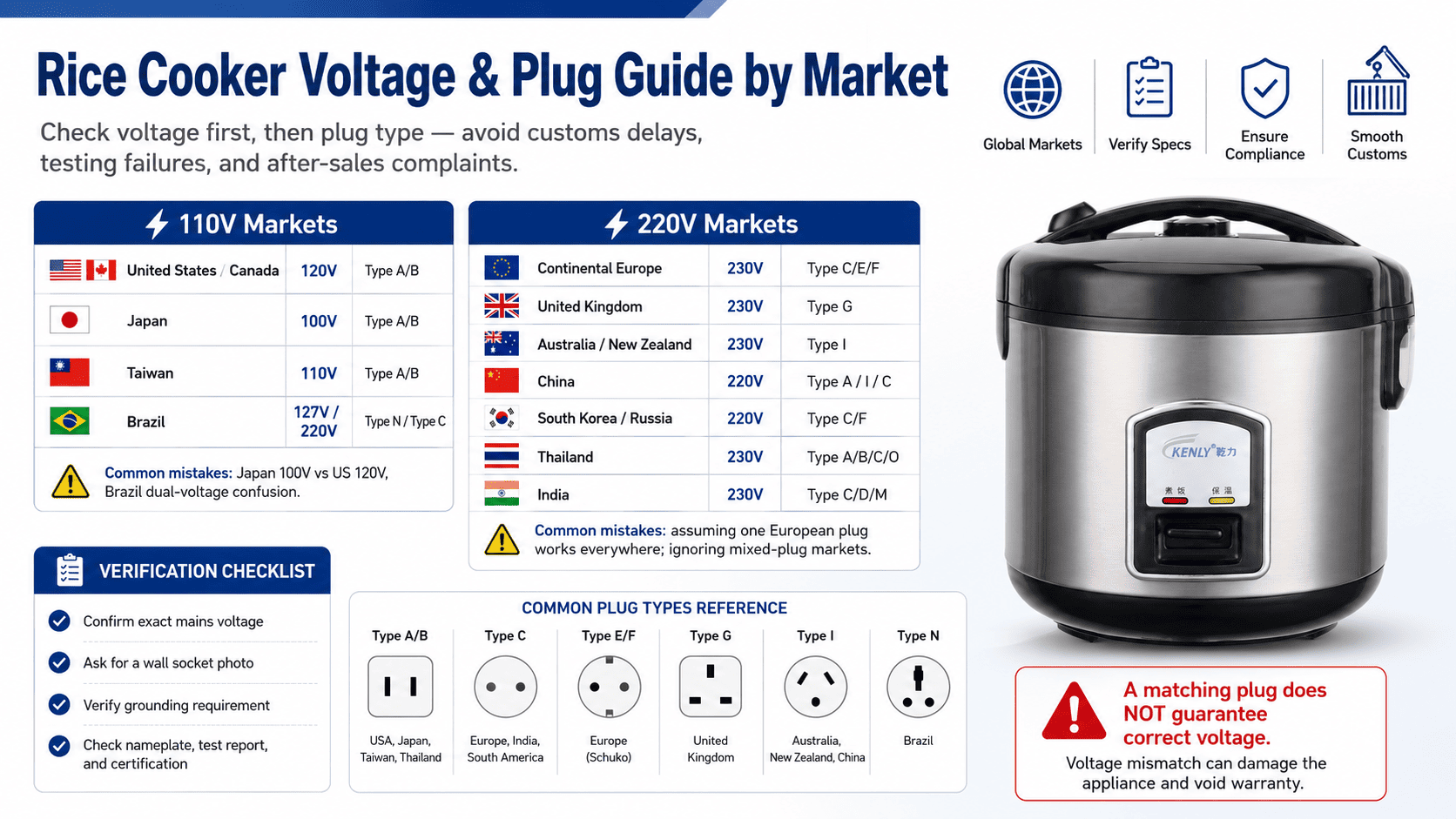
110V Markets and Their Plug Types
| Region/Country | Voltage | Plug Type | Common Error |
|---|---|---|---|
| United States | 120V | Type A/B (flat prongs) | Ordering Type C (European) plugs for US market |
| Canada | 120V | Type A/B | Same as US error |
| Japan | 100V | Type A/B | Assuming Japanese voltage matches US—100V vs 120V affects performance |
| Taiwan | 110V | Type A/B | Confusing with mainland China (220V, Type A/I) |
| Brazil | 127V/220V | Type N (some Type C) | Mixing the two voltage zones within Brazil |
Japan voltage trap: I've seen buyers order 120V rice cookers for Japan because "they both use Type A plugs." Japan runs on 100V5. A 120V rice cooker will work, but performs 20% hotter than designed, shortening lifespan. If your customer is quality-sensitive, confirm whether they need true 100V models or accept 120V with shortened service life.
Brazil dual-voltage trap: Brazil uses both 127V and 220V depending on the region6. If your customer distributes nationally, ask which voltage zone they prioritize or whether they need dual-voltage models (which require different internal components, not just plugs).
220V Markets and Their Plug Types
This is where most "wrong plug for right voltage" errors happen. Buyers know they need 220V, but assume one European plug works everywhere:
| Region/Country | Voltage | Plug Type | Common Error |
|---|---|---|---|
| Continental Europe | 230V | Type C/E/F (round prongs) | Assuming Type C works in UK (needs Type G) |
| United Kingdom | 230V | Type G (3 rectangular prongs) | Ordering European Type C plugs for UK market |
| Australia/New Zealand | 230V | Type I (angled flat prongs) | Confusing with China Type I (China is 220V but some areas use different plug angles) |
| China (mainland) | 220V | Type A/I/C (mixed) | Not asking customer which plug they stock—many use Type I exclusively |
| South Korea | 220V | Type C/F | Assuming Korean Type C matches European Type C (grounding pin differs) |
| Russia | 220V | Type C/F | Same assumption as Korea—grounding specs differ |
| Thailand | 230V | Type A/B/C/O (mixed) | Ordering only Type C when customer warehouses stock Type A |
| India | 230V | Type C/D/M | Not confirming which of three plug types customer uses |
The "European plug" trap: A buyer orders Type C plugs because their target market is 230V Europe. The shipment arrives in the UK. Type C plugs don't fit UK sockets—the UK uses Type G exclusively. The buyer now needs to reorder with Type G plugs, or buy 2,000 plug adapters, adding $4,000+ to landed cost.
I've processed this exact error four times in the past year. Each time, the buyer says, "I thought Europe all used the same plug." They don't.
Verification Checklist Before You Order
I send this checklist to every customer who inquires about voltage and plugs:
-
Ask your customer: "What voltage is your mains supply—110V, 120V, 220V, or 230V?" Not "what country," but the specific voltage number.
-
Ask your customer: "Show me a photo of the wall socket where the rice cooker will plug in." This catches mixed-plug markets (Thailand, India, Brazil) where multiple plug types coexist.
-
Cross-check the IEC 60906 standard7: This is the international plug type reference. Match your customer's photo to the standard chart. Do not rely on country names alone.
-
Confirm grounding requirements: Some markets require grounded plugs (3-prong), others accept 2-prong. If your rice cooker has a metal outer shell, grounding is usually mandatory for certification.
-
Ask if they need certification labels for the plug type: For example, UK Type G plugs must display BS 1363 certification8. If your OEM manufacturer doesn't include the marking, the product can be rejected at customs.
How Do I Verify My Rice Cooker Order Matches Target Market Voltage?
The product specification sheet from your supplier should list voltage range clearly. But I've seen plenty of spec sheets that say "220V" when the actual unit is 220–240V, or list "110V" without clarifying it won't work in Japan's 100V. Your job is to eliminate ambiguity before production starts.
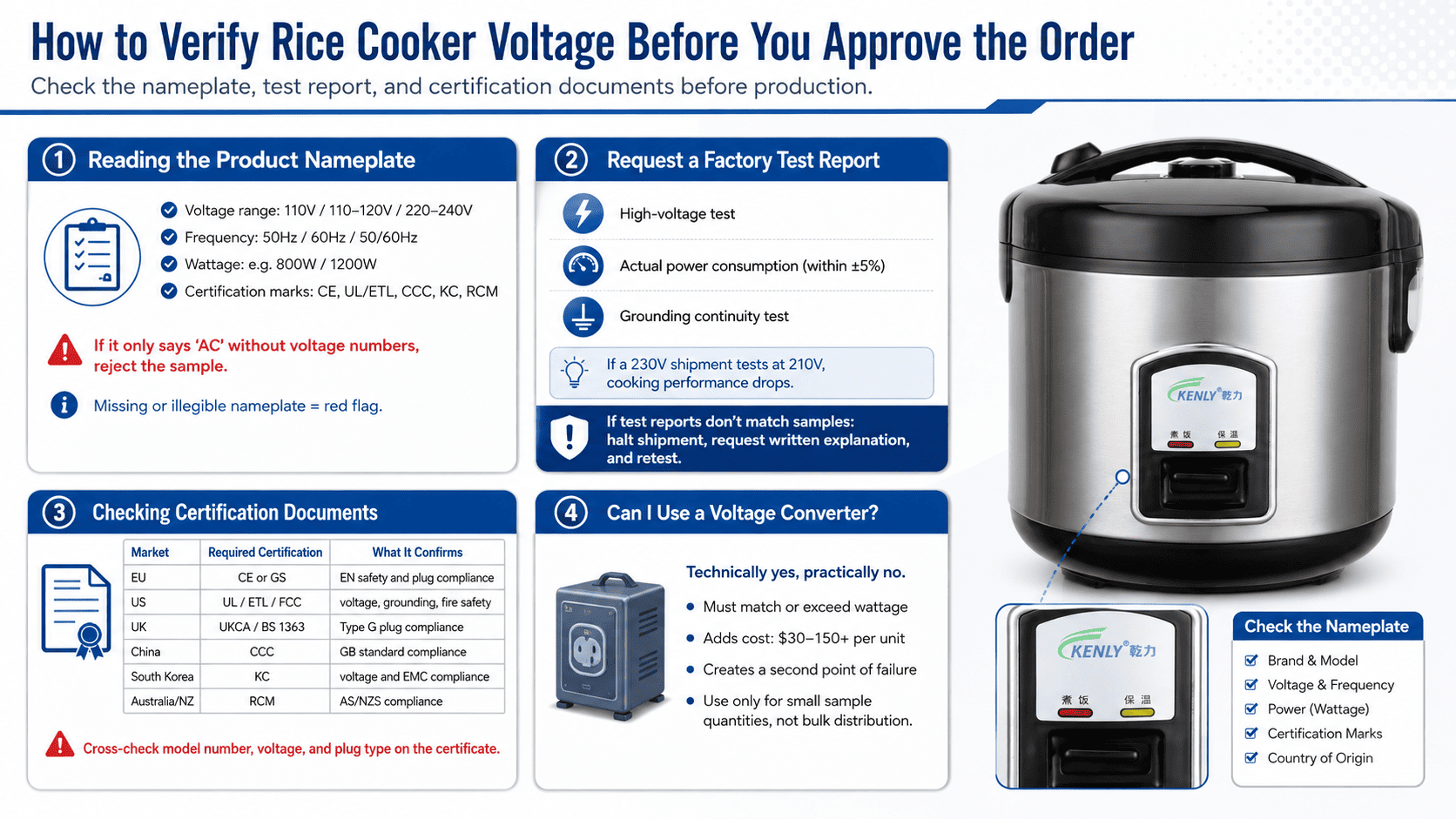
Verify your rice cooker order matches target market voltage by checking three documents: the product nameplate (molded or printed on the unit), the factory test report (showing actual voltage testing), and the certification document (CE, UL, etc.) that confirms voltage rating. Do not rely on sales quotations or verbal confirmations—request written specification confirmation from the factory before approving samples.
Reading the Product Nameplate
Every rice cooker must have a nameplate—usually molded into the bottom plastic or printed on a metal tag. During sample inspection, photograph this nameplate and check:
- Voltage range: Should state "110V" or "110-120V" or "220-240V"—not just "AC." If it says "AC" without voltage numbers, reject the sample.
- Frequency: Should state "50Hz," "60Hz," or "50/60Hz." Most markets tolerate 50/60Hz dual-frequency units, but confirm your target market doesn't have frequency-specific regulations.
- Wattage: For example, "800W" or "1200W." This number must match the heating element capacity and determines transformer size if your customer uses voltage converters.
- Certification marks: Should show CE (Europe), UL/ETL (US), CCC (China), KC (Korea), or other marks matching your target market. If the mark is missing, the product might clear customs but fail retailer audits.
Nameplate missing or illegible: I've rejected samples where the nameplate ink fades after one cleaning cycle, or where the factory "forgets" to mold the voltage number. This is a red flag—it suggests the factory runs multiple voltage versions on the same line and might mix them up during bulk production.
Requesting a Factory Test Report
After you approve the sample, request a pre-shipment test report that includes:
- High voltage test results: Shows the unit was tested at maximum rated voltage (e.g., 240V for a 220–240V model) to ensure insulation doesn't break down.
- Actual power consumption: Should match the nameplate wattage within ±5%. If a 1000W nameplate shows 850W actual power, the heating element is mismatched.
- Grounding continuity test: Confirms the ground pin connects to the metal chassis (if applicable). Grounding failures cause certification rejections.
Two years ago, a buyer received a bulk shipment of "230V" rice cookers that tested at 210V during their incoming inspection. The units technically worked but underperformed—rice took 50% longer to cook. The factory had substituted a different heating element to cut costs. The buyer caught it because they requested test reports and verified actual voltage before distribution.
What to do if test reports don't match samples: Halt shipment immediately. Request the factory to explain the discrepancy in writing. Do not accept verbal explanations like "all units are the same"—demand retesting or sample replacement. If the factory resists, escalate to a third-party inspection service before you pay the balance.
Checking Certification Documents
Certification documents confirm that a testing lab verified voltage and plug safety. For rice cookers, key certifications include:
| Market | Required Certification | What It Confirms |
|---|---|---|
| European Union | CE (self-declared)9 or GS (TÜV tested) | Voltage, plug type, insulation meet EN standards |
| United States | UL, ETL, or FCC | Voltage, grounding, fire safety meet US standards |
| United Kingdom | UKCA (post-Brexit) or BS 1363 | Type G plug meets UK-specific standards |
| China | CCC (3C mark) | Voltage and plug meet Chinese GB standards |
| South Korea | KC mark | Voltage and EMC meet Korean standards |
| Australia/NZ | RCM mark | Voltage and plug meet AS/NZS standards |
Certification trap—mismatched voltage: I've seen CE certificates that list "220–240V" but the actual product nameplate says "220V" only. This happens when the factory reuses old certification documents for new models. Cross-check the model number on the certificate against the model number on your sample. If they don't match exactly, the certification is invalid.
Pre-order request: Ask the factory to email you copies of all relevant certifications before you place the order. Verify the model number, voltage, and plug type listed on the certificate match your specifications. If the factory says "we'll get certification after production," that's a sourcing risk—you might end up with uncertified units that can't clear customs.
Can I Use a Voltage Converter or Transformer with My Rice Cooker?
Buyers ask this question when they've already ordered the wrong voltage and want to avoid reordering. The short answer: technically yes, practically no. Voltage converters add cost, bulk, and failure risk that eliminate any savings from ordering the wrong voltage in the first place.
Voltage converters can physically allow a 110V rice cooker to run on 220V supply (or reverse), but they must match or exceed the rice cooker's wattage rating, add significant cost per unit ($30–150+), introduce a second point of failure, and create safety liability if the converter fails under load. For procurement purposes, voltage converters are a last-resort solution for small sample quantities, not a viable strategy for bulk distribution.
Why Converters Aren't a Procurement Solution
Here's what happens when a buyer tries to distribute rice cookers with voltage converters:
Cost explosion:
- A 1000W rice cooker needs a converter rated for at least 1200W (20% safety margin)
- A 1200W step-down transformer (220V to 110V) costs $40–80 wholesale
- If your rice cooker costs $25 FOB, the converter doubles landed cost
- Your customer can't compete with suppliers who ordered the correct voltage from the start
Customer confusion:
- You must explain to end users how to connect the converter—most won't read instructions
- If the converter fails, customers blame the rice cooker, not the converter
- Warranty claims skyrocket because "product doesn't work" (actually converter failed or customer plugged it in wrong)
Safety liability:
- If the converter overheats or fails, the rice cooker might receive incorrect voltage and cause fire
- Your certification (CE, UL) doesn't cover third-party converters—you lose liability protection
- Insurance companies may deny claims if the product was used with non-certified converters
When Converters Make Sense
I recommend converters only in two scenarios:
-
Sample testing: You ordered 110V samples but your office runs on 220V. Buy a converter for testing purposes only—never distribute this setup to customers.
-
Small expat markets: Your customer serves a niche market (e.g., American expats in Europe) who specifically request 110V appliances because they'll
"Mains electricity by country", https://en.wikipedia.org/wiki/Mains_electricity_by_country. The International Electrotechnical Commission recognizes two main voltage ranges for residential mains supply: approximately 100-127V (common in North and Central America, Japan) and 220-240V (prevalent in Europe, Asia, Africa, and Oceania), though specific voltages vary by country. Evidence role: general_support; source type: institution. Supports: international standards organizations document the two primary voltage ranges used in residential electrical systems worldwide. Scope note: Standards documentation confirms voltage ranges but does not address rice cooker compatibility specifically ↩
"AC power plugs and sockets", https://en.wikipedia.org/wiki/AC_power_plugs_and_sockets. The letter designation system for plug types (Type A, B, C, etc.) is commonly used in trade and documented in references such as IEC Technical Report 60083, which catalogs plug and socket systems by country; this classification helps distinguish the 15+ distinct plug configurations used globally. Evidence role: definition; source type: institution. Supports: international documentation of plug type classifications. ↩
"Thermal cutoff", https://en.wikipedia.org/wiki/Thermal_cutoff. Thermal fuses (thermal cutoffs) are one-time safety devices widely used in heating appliances to permanently open a circuit when temperature exceeds a rated threshold, typically due to overheating from component failure or misuse; electrical engineering resources note that excessive voltage increases current and heat generation, potentially triggering thermal fuses as designed, though catastrophic failure may occur before the fuse activates. Evidence role: mechanism; source type: education. Supports: appliance safety engineering references explain thermal fuse operation as overheat protection. Scope note: References describe thermal fuse design principles but do not specifically address rice cooker voltage mismatch scenarios ↩
"Joule heating", https://en.wikipedia.org/wiki/Joule_heating. For resistive heating elements, electrical power is calculated as P = V²/R, where P is power in watts, V is voltage, and R is resistance; this relationship explains why halving voltage reduces power output to one-quarter, as demonstrated in undergraduate electrical engineering curricula. Evidence role: mechanism; source type: education. Supports: university physics resources and electrical engineering references confirm the relationship between voltage, resistance, and power in resistive loads. ↩
"Mains electricity by country", https://en.wikipedia.org/wiki/Mains_electricity_by_country. Japan maintains a nominal mains voltage of 100V (with tolerance typically 95-107V) according to Japanese Industrial Standards, making it one of the lowest voltage residential systems globally, though it shares plug types with higher-voltage North American markets. Evidence role: general_support; source type: government. Supports: Japanese industrial standards confirm the country's unique lower voltage specification. ↩
"Electricity sector in Brazil", https://en.wikipedia.org/wiki/Electricity_sector_in_Brazil. Brazil's electrical system historically developed with regional variation, resulting in some areas using 127V and others 220V for residential supply, a situation that persists despite standardization efforts; Brazilian standard ABNT NBR 5410 addresses installations for both voltage levels, though regional consolidation continues. Evidence role: historical_context; source type: government. Supports: Brazilian standards organizations document the country's dual-voltage infrastructure. ↩
"AC power plugs and sockets", https://en.wikipedia.org/wiki/AC_power_plugs_and_sockets. The IEC publishes plug and socket standards including IEC 60906 (which specifies a single international standard plug) and IEC 60884 (covering national plug types); however, IEC 60906 has seen limited adoption globally, while existing national standards documented in IEC TR 60083 remain dominant in most markets. Evidence role: general_support; source type: institution. Supports: the International Electrotechnical Commission publishes standards for plug and socket systems. Scope note: IEC 60906 was intended as a universal standard but is not the primary reference for existing plug types in most countries ↩
"BS 1363", https://en.wikipedia.org/wiki/BS_1363. BS 1363 is the British Standard specification for 13-amp plugs, socket-outlets, and adaptors, mandated for use in the United Kingdom; compliant plugs must meet safety requirements including fused design, and manufacturers typically display BS 1363 marking to indicate conformity, though specific marking requirements are detailed in related certification schemes. Evidence role: general_support; source type: government. Supports: British Standards Institution documents requirements for UK plug certification and marking. Scope note: BS 1363 is the technical standard, but certification marking requirements may also involve separate conformity assessment schemes ↩
"EU - EU Legislation and CE Marking", https://www.trade.gov/country-commercial-guides/eu-eu-legislation-and-ce-marking. Under EU regulations, CE marking indicates manufacturer's declaration of conformity with applicable EU directives; for many low-voltage electrical products covered by the Low Voltage Directive (2014/35/EU), manufacturers may self-assess and self-declare conformity, though certain product categories require third-party Notified Body involvement as specified in the relevant directive's conformity assessment procedures. Evidence role: mechanism; source type: government. Supports: European Union regulations specify when manufacturers may self-declare CE conformity versus requiring third-party certification. ↩